
South Africa Silicone Fluids Market (2024-2029)

The South Africa Silicone Fluids Market was valued at $56.4 Million in 2024 and projected to reach to $73.4 Million by 2029, representing a compound annual growth rate of 3.3%. South Africa's silicone fluids market demonstrates steady growth potential driven by expanding automotive production, increasing personal care product formulations, and rising industrial applications.


| Market Size in | USD 26.32 MN |
| Market Forecast in | |
| CAGR | |
| Forecast Period | |
| Units Considered | Value (USD MN) |
South Africa Silicone Fluids Market Trends and Insights
- South Africa's demand for silicone fluids is driven by applications across automotive, personal care, industrial, and electronics sectors, where these versatile materials serve as lubricants, release agents, and performance additives.
- The market in South Africa reflects steady regional growth, supported by manufacturing expansion and increased adoption of high-performance chemical solutions in key industries. During the forecast period from 2024 to 2029, South Africa is expected to experience moderate but consistent market expansion.
- South Africa's silicone fluids sector benefits from rising industrial activity, growing consumer goods production, and investment in advanced manufacturing technologies.
- The country's position within the Middle East Africa region positions South Africa as a significant market for specialty chemicals, with local demand reinforced by both domestic consumption and regional supply chain integration..
Key Market Statistics
- CAGR (2024-2029) 3.3% CAGR
- Market Size, 2024 ~USD 56.4 Million
- Forecast, 2029 ~USD 73.4 Million
- Country South Africa
South Africa Silicone Fluids Market Overview
Market Size & Growth :
South Africa's silicone fluids market is valued at USD 56.4 million in 2024, with projected growth to USD 73.4 million by 2029, representing a steady CAGR of 3.3% over the forecast period.
Key Application Sectors :
Automotive, personal care, industrial manufacturing, and electronics sectors drive demand for silicone fluids in South Africa, utilizing them as lubricants, release agents, and performance enhancers.
Regional Growth Dynamics :
South Africa's 3.3% CAGR reflects moderate but consistent market expansion, outpaced by the global average of 4.4%, indicating localized demand patterns and market maturity considerations.
Industrial Applications :
South Africa's manufacturing and automotive sectors leverage silicone fluids for thermal stability, water resistance, and lubrication properties, supporting industrial competitiveness and product innovation.
South Africa Silicone Fluids Market Dynamics
- The market's 3.3% CAGR reflects growing adoption across manufacturing sectors, though growth remains moderate compared to global expansion rates.
- Key opportunities emerge from electronics manufacturing growth and automotive aftermarket demand. Looking ahead to 2029, South Africa's market will benefit from infrastructure development, rising consumer spending on personal care products, and industrial modernization initiatives.
- However, market growth may be tempered by economic constraints, import competition, and raw material cost volatility.
- Strategic investments in local production capacity and innovation in specialty silicone formulations will be critical for market participants seeking competitive advantage in this evolving landscape..
Market Ecosystem
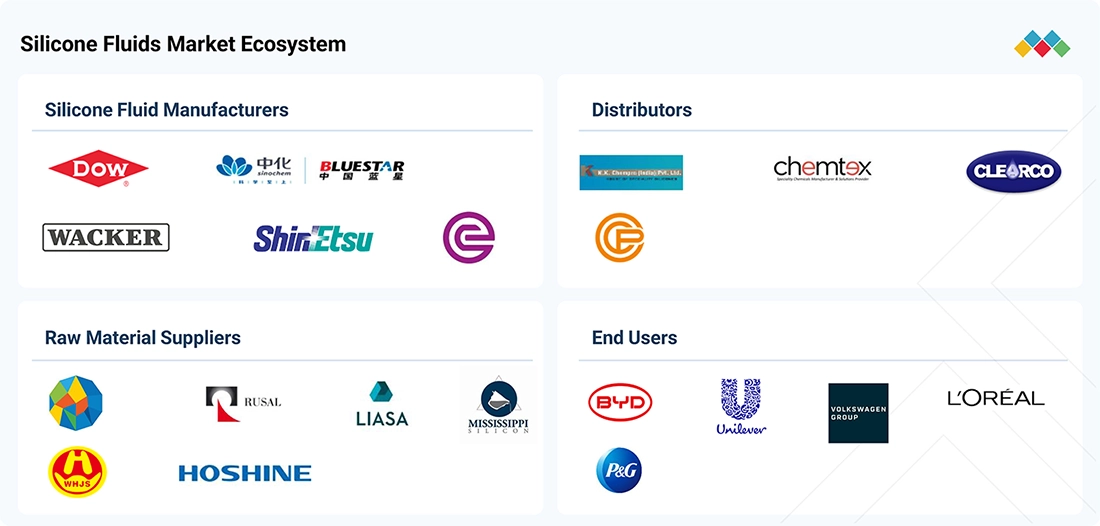
SILICONE FLUIDS MARKET: COMMERCIAL USE CASES ACROSS INDUSTRIES
| COMPANY | USE CASE DESCRIPTION | BENEFITS |
|---|---|---|
 |
Silicone release coatings are crucial for ensuring that adhesive products such as stickers, labels, and tapes can be easily peeled off. Traditionally, these coatings rely on platinum-based curing catalysts. However, platinum's high cost and limited availability pose significant challenges. This situation has led to a growing need to reduce the use of platinum in the curing process | Shin-Etsu Chemical Co., Ltd. developed the “Reduced-Platinum Reaction Curing System Technology,” incorporating a highly reactive silicone composition. This innovation enables effective curing using about half the platinum required by conventional methods. The company has initiated productization by integrating this technology into its silicone release coatings, with sample shipments already receiving positive customer feedback. |
|
|
In response to the European Union's REACH regulations, which proposed reducing the concentration of specific siloxanes in certain silicone products to less than 0.1%, Shin-Etsu Chemical Co., Ltd. recognized the need to adapt its silicone emulsions. Although these siloxanes were not identified as harmful to human health or the environment, compliance with evolving regulations and addressing customer concerns became imperative. | Leveraging advanced purification technologies, Shin-Etsu developed new silicone emulsion products with significantly reduced concentrations of the specified siloxanes, aligning with REACH regulatory trends. These emulsions meet stringent regulatory requirements and offer greater stability than previous formulations. Silicone emulsions, which use emulsifying agents to mix silicone with water and other materials, are widely used in applications such as release agents, lubricants, and gloss enhancers. |
Logos and trademarks shown above are the property of their respective owners. Their use here is for informational and illustrative purposes only.
Related Ecosystem
Speciality Chemicals
- Corrosion Inhibitors
- Polyetheretherketone (PEEK)
- Acrylonitrile Butadiene Styrene (ABS)
- Epoxy Resin
- Polycarbonate
- Basf se
- DOW CHEMICAL COMPANY
- Evonik industries ag
- Clariant ag.
- Solvay sa
Key Takeaways
- South Africa's silicone fluids market is valued at USD 56.4 million in 2024 and will reach USD 73.4 million by 2029.
- South Africa is experiencing a 3.3% CAGR, reflecting steady growth driven by automotive, personal care, and industrial applications.
- South Africa's market expansion is supported by increased manufacturing activity and adoption of specialty chemical solutions.
- South Africa's strategic position in the Middle East Africa region enhances its role as a key market for silicone fluid products.
Silicone Fluids Market Report Scope
| Report Metric | Details |
|---|---|
| Base Year | 2024 |
| Fastest Growing Segment | AUTOMOTIVE & TRANSPORTATION (End-Use Industry) |
| Forecast Period | 2024–2029 |
| Growth Rate | CAGR of 4.4% from 2024 to 2029 |
| Largest Segment | MODIFIED (Type) |
| Market Size Base Year (Billions) | ~USD 7.3 (2024) |
| Revenue Forecast (Billions) | ~USD 10.3 (2029) |
| Segments Covered | Type, End-Use Industry |
South Africa Silicone Fluids Market Report Segmentation
2 segment dimensions are covered across the global market.
By Type
- Modified
- Straight
By End-Use Industry
- Automotive & Transportation
- Building & Construction
- Industrial
- Other End-Use Industries
- Personal Care & Beauty
- Textiles
Target Audience
- Chemical Manufacturers & Suppliers : South Africa-based and international silicone fluid producers need localized market data to optimize production capacity, pricing strategies, and distribution networks for the South African market.
- Automotive Industry Players : OEMs and automotive suppliers in South Africa require insights into silicone fluid demand trends, application specifications, and competitive offerings to enhance product performance and sourcing strategies.
- Personal Care & Cosmetics Companies : South African beauty and personal care manufacturers need market intelligence on silicone fluid formulation trends, regulatory requirements, and consumer preferences for product development.
- Industrial & Electronics Manufacturers : South African industrial and electronics producers require data on silicone fluid applications, performance specifications, and supplier landscape to optimize manufacturing processes and product quality.
- Investment & Business Development Teams : Private equity firms, venture capitalists, and corporate development teams evaluating opportunities in South Africa's chemical sector need validated market sizing and growth forecasts for investment decisions.
Key Companies in the South Africa Silicone Fluids Market
| Company | HQ | Ownership | Strongest segments |
|---|---|---|---|
| KCC CORPORATION | Norway | Public Company | Caustic soda and industrial liquid cargoes,Clean petroleum products,Dry bulk commodities (alumina, ores, grains), |
| DOW | United States | Public Company | Packaging & Specialty Plastics,Industrial Intermediates & Infrastructure,Performance Materials & Coatings, |
| SHIN-ETSU CHEMICAL CO., LTD. | Japan | Public Company | Electronic materials (semiconductor silicon, photoresists, photomask blanks, synthetic quartz, LED packaging, encapsulants, pellicles),Living environment basic materials (PVC, caustic soda, methanol, chloromethanes, PVA),Functional materials (silicones, cellulose derivatives, silicon metal, synthetic pheromones, specialty polymers, fluoroelastomers, silicon anode material), |
| WACKER CHEMIE AG | Germany | Public Company | Silicones,Polymers,Polysilicon, |
| ELKEM ASA | Norway | Public Company | Silicones,Silicon Products,Carbon Solutions, |
| EVONIK INDUSTRIES AG | Germany | Public Company | Advanced Technologies,Custom Solutions,Infrastructure, |
| INNOSPEC INC. | United States | Public Company | Performance Chemicals,Fuel Specialties,Oilfield Services, |
KCC CORPORATION
KCC Corporation is a Norwegian public company founded in 2018 with 19 employees.
DOW
Dow is a United States-based public company founded in 1897 with 34,600 employees.
SHIN-ETSU CHEMICAL CO., LTD.
Shin-Etsu Chemical Co., Ltd. is a Japanese public company founded in 1926 with 27,342 employees.
WACKER CHEMIE AG
Wacker Chemie AG is a German public company founded in 1914 with 16,196 employees.
ELKEM ASA
Elkem ASA is a Norwegian public company founded in 1904 with 7,000 employees.
EVONIK INDUSTRIES AG
Evonik Industries AG is a German public company founded in 1847 with 30,643 employees.
INNOSPEC INC.
Innospec Inc. is a United States-based public company founded in 1938 with 2,450 employees.
Reasons to Buy this Report
- Localized Market Intelligence : Gain country-specific insights into South Africa's silicone fluids market dynamics, competitive landscape, and sector-specific demand patterns unavailable in global reports.
- Accurate Sizing & Forecasting : Access precise market valuations (USD 56.4M in 2024) and 5-year projections with South Africa-specific CAGR of 3.3%, enabling confident business planning and investment decisions.
- Sector-Specific Application Data : Understand how automotive, personal care, industrial, and electronics sectors utilize silicone fluids in South Africa, identifying high-potential customer segments and market opportunities.
- Strategic Market Entry Planning : Develop targeted go-to-market strategies for South Africa with comprehensive understanding of regional growth drivers, regulatory environment, and competitive positioning requirements.
- Investment & Partnership Decisions : Make informed decisions on manufacturing partnerships, distribution channels, and market expansion in South Africa backed by validated market data and growth trajectory analysis.
Frequently asked questions
What is the current market size of silicone fluids in South Africa?
South Africa's silicone fluids market is estimated at USD 56.4 million in 2024, based on verified market data.
What is the projected market size for silicone fluids in South Africa by 2029?
South Africa's silicone fluids market is forecast to reach USD 73.4 million by 2029, representing growth from the 2024 baseline.
What is the CAGR for South Africa's silicone fluids market?
South Africa's silicone fluids market is projected to grow at a compound annual growth rate of 3.3% from 2024 to 2029.
Which industries drive demand for silicone fluids in South Africa?
South Africa's silicone fluids demand is driven by automotive, personal care, industrial manufacturing, and electronics sectors.
Why is South Africa an important market for silicone fluids?
South Africa serves as a key market within the Middle East Africa region, with growing manufacturing activity and increasing adoption of specialty chemical solutions.
RESEARCH METHODOLOGY
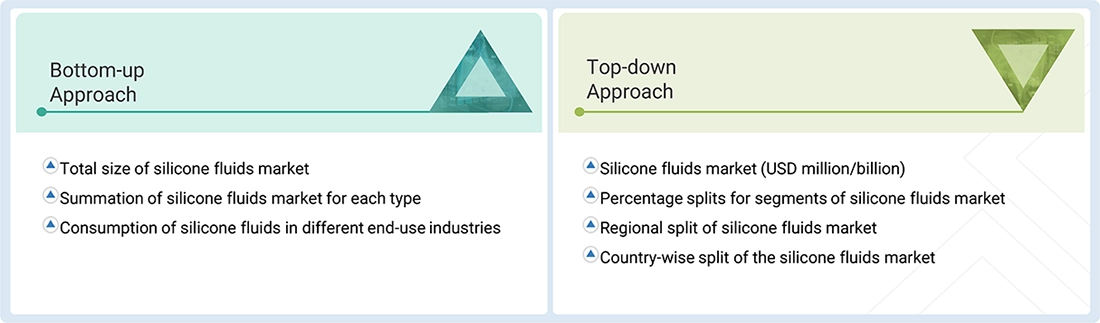
The study involved major activities to estimate the current size of the global silicone fluids market. Exhaustive secondary research was carried out to collect information on the market, the peer product market, and the parent product group market. The next step was to validate these findings, assumptions, and sizes with industry experts across the value chain of silicone fluids through primary research. Both the top-down and bottom-up approaches were employed to estimate the overall size of the silicone fluids market. After that, market breakdown and data triangulation procedures were used to determine the size of different segments and sub-segments of the market.
Secondary Research
The market for the companies offering silicone fluids is obtained from secondary data available through paid and unpaid sources, analyzing the product portfolios of the major companies in the ecosystem, and rating the companies by their performance and quality. Various secondary sources such as Business Standard, Bloomberg, World Bank, and Factiva were referred to identify and collect information for this study on the silicone fluids market. The secondary sources include annual reports, press releases, investor presentations of companies, white papers, journals, certified publications, and articles from recognized authors, directories, and databases. The secondary research was used to obtain critical information on the industry’s value chain, the total pool of key players, market classification, and segmentation from the market and technology-oriented perspectives.
Primary Research
In the primary research process, various primary sources from both the supply and demand sides were interviewed to obtain qualitative and quantitative information for this report. The primary sources from the supply side included industry experts, such as C-Level Executives, Directors, and related key executives from various key companies and organizations operating in the silicone fluids market. After the market engineering (calculations for market statistics, market breakdown, market size estimations, market forecasting, and data triangulation), extensive primary research was conducted to gather information and verify and validate the critical numbers arrived at. Primary research was also conducted to identify the segmentation types, industry trends, competitive landscape of silicone fluids offered by various market players, and key market dynamics, such as drivers, restraints, opportunities, challenges, industry trends, and key player strategies. In the complete market engineering process, the top-down and bottom-up approaches were extensively used, along with several data triangulation methods, to perform the market estimation and market forecasting for the overall market segments and subsegments listed in this report. Extensive qualitative and quantitative analysis was performed on the complete market engineering process to list the key information/insights throughout the report.
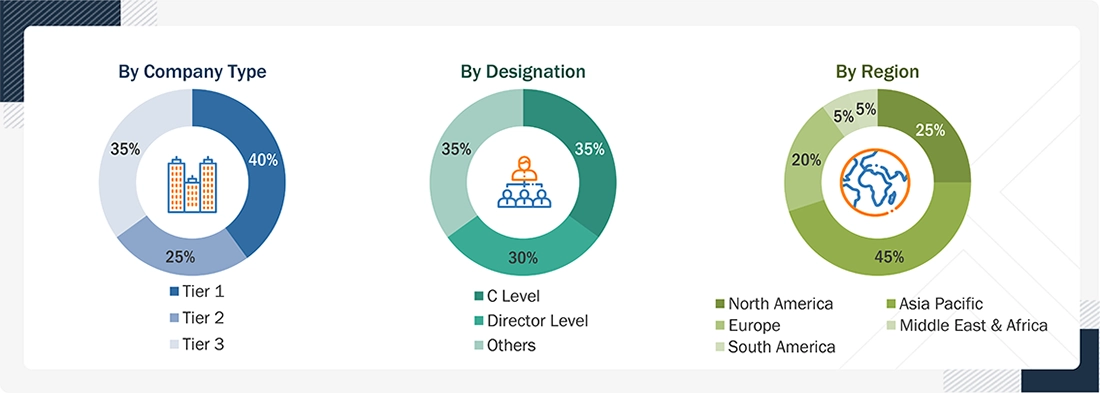
Notes: Others include sales, marketing, and product managers.
Tier 1: >USD 1 Billion; Tier 2: USD 500 million–1 Billion; and Tier 3: <USD 500 million.
To know about the assumptions considered for the study, download the pdf brochure
Market Size Estimation
Both the top-down and bottom-up approaches were used to estimate and validate the global size of the silicone fluids market. These approaches were also used extensively to estimate the size of various dependent segments of the market. The research methodology used to estimate the market size included the following:
Data Triangulation
After arriving at the overall market size using the market size estimation processes explained above, the market was split into several segments and subsegments. The data triangulation and market breakup procedures were employed, wherever applicable, to complete the overall market engineering process and arrive at the exact statistics of each market segment and subsegment. The data were triangulated by studying various factors and trends from both the demand and supply sides.
Market Definition
Silicone fluids are a class of synthetic high-performance polymers made from siloxane chains that manifest excellent thermal stability, lubricity, and water repellence characteristics. These fluids exist in a range of viscosities and find applications in multiple industries owing to their uniquely beneficial chemical and physical properties. The primary classes of silicone fluids include dimethyl silicone fluids, phenyl modified silicone fluids, methyl hydrogen silicone fluids, and fluorosilicone fluids. Major silicone fluid properties include high-temperature stability, low surface tension, water and moisture resistance, electrical insulation properties, oxidation resistance, and UV resistance. Such properties render them highly useful in personal, skin care, and hair care applications, where their presence improves the spreadability and endurance of formulated creams. In automotive lubricants and coatings, they reduce friction and provide sustained protection. Construction products like sealants and adhesives use silicone fluids to enhance waterproofing and durability. In the electronics and semiconductors sector, silicone fluids are used for dielectric and heat dissipation. The Asia Pacific region leads the silicone fluids market, followed by North America and Europe.
Key Stakeholders
- Silicone Fluid Manufacturers
- Raw Material Suppliers
- Service Providers
- Distributors and Retailers
- Research & Development Entities
- Industry Associations and Regulatory Bodies
- End Users
Report Objectives
- To estimate and forecast the silicone fluids market, in terms of value and volume
- To provide detailed information about the major factors (drivers, restraints, opportunities, and challenges) influencing the market growth
- To define, describe, and forecast the market by type, end-use industry, and region
- To forecast the market size along with segments and submarkets in key regions: North America, Europe, Asia Pacific, Middle East & Africa, and South America, along with their key countries
- To strategically analyze micromarkets for individual growth trends, prospects, and their contribution to the total market
- To analyze growth opportunities in the market for stakeholders and provide details on the competitive landscape for market leaders
- To strategically profile key players and comprehensively analyze their market shares and core competencies
- To analyze competitive developments, such as acquisitions, agreements, and expansions in the silicone fluids market
Available customizations:
With the given market data, MarketsandMarkets offers customizations according to client-specific needs.
The following customization options are available for the silicone fluids report:
Product Analysis
- Product matrix, which provides a detailed comparison of the market for different types of silicone fluids
Regional Analysis
- A further breakdown of the silicone fluids market for additional countries
Company Information
- Detailed analysis and profiling of additional market players (up to five)
Get the Full Silicone Fluids Market Report
Full forecast, segment splits, and company analysis for all Silicone Fluids Market.
- China Silicone Fluids Market
- India Silicone Fluids Market
- Japan Silicone Fluids Market
- South Korea Silicone Fluids Market
- Germany Silicone Fluids Market
- UK Silicone Fluids Market
- Italy Silicone Fluids Market
- France Silicone Fluids Market
- Canada Silicone Fluids Market
- Mexico Silicone Fluids Market
- US Silicone Fluids Market
- Brazil Silicone Fluids Market
- Argentina Silicone Fluids Market
- Rest Of Europe Silicone Fluids Market
- Rest Of Asia Pacific Silicone Fluids Market
Need a Tailored Report?
Customize this report to your needs
Get 10% FREE Customization
Customize This Report
