
US Silicone Market (2025-2030)

The US Silicone Market was valued at $485.4 Million in 2025 and projected to reach to $587.9 Million by 2030, representing a compound annual growth rate of 3.9%. The US silicone market is positioned for steady expansion through 2030, driven by increasing adoption in automotive lightweighting, advanced construction materials, and high-performance electronics.


| Market Size in | USD 26.32 MN |
| Market Forecast in | |
| CAGR | |
| Forecast Period | |
| Units Considered | Value (USD MN) |
US Silicone Market Trends and Insights
- The US market benefits from strong demand across automotive, construction, electronics, and personal care sectors, where silicone's versatility and performance characteristics drive adoption.
- In 2025, the US represents a mature yet dynamic market segment within the broader North American region, with established manufacturing capabilities and robust supply chains supporting continued expansion. Growth in the US silicone market through 2030 is underpinned by increasing applications in advanced manufacturing, sustainable product formulations, and high-performance industrial coatings.
- The US market's 3.9% CAGR reflects steady demand from end-use industries seeking improved durability, thermal stability, and environmental compliance.
- By 2030, the US silicone market is expected to capture significant value from innovation in specialty silicones and growing consumer preference for premium, long-lasting materials across residential and commercial applications..
Key Market Statistics
- CAGR (2025-2030) 3.9% CAGR
- Market Size, 2025 ~USD 485.4 Million
- Forecast, 2030 ~USD 587.9 Million
- Country US
US Silicone Market Overview
Market Valuation :
The US silicone market is valued at $485.4 million in 2025 and is projected to reach $587.9 million by 2030, representing steady growth in a mature market.
Growth Rate :
The US market expands at a CAGR of 3.9% through 2030, outpacing global growth expectations and demonstrating resilience in domestic demand across key industries.
Key End-Use Sectors :
Automotive, construction, electronics, and personal care sectors drive US silicone adoption, leveraging the material's superior performance, durability, and versatility in demanding applications.
Market Maturity :
The US represents a mature yet dynamic silicone market with established supply chains, strong regulatory frameworks, and continuous innovation in product formulations and applications.
US Silicone Market Dynamics
- Regulatory support for sustainable manufacturing and growing consumer demand for durable, long-lasting products will sustain market momentum.
- The automotive sector's shift toward electric vehicles and the construction industry's focus on energy-efficient building materials present significant growth opportunities for silicone-based solutions. Innovation in specialty silicones and bio-based alternatives will further enhance market competitiveness.
- Strong domestic manufacturing capabilities and established distribution networks provide US companies with competitive advantages.
- However, raw material cost volatility and competition from alternative materials may moderate growth rates.
- Overall, the US market is expected to maintain healthy expansion as industries continue to recognize silicone's unique performance benefits..
Market Ecosystem
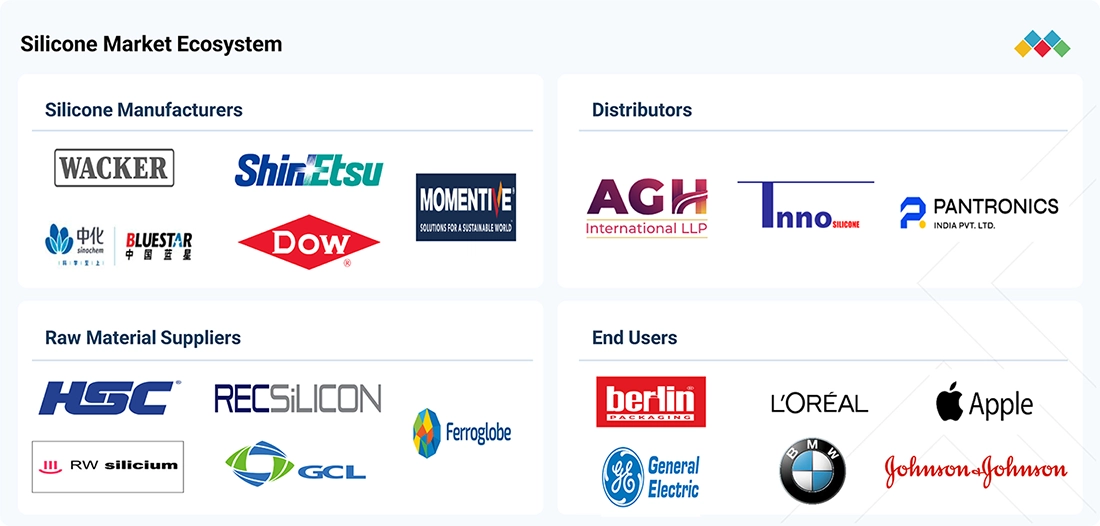
SILICONE MARKET: COMMERCIAL USE CASES ACROSS INDUSTRIES
| COMPANY | USE CASE DESCRIPTION | BENEFITS |
|---|---|---|
 |
First carbon-neutral silicone façade project using DOWSIL™ sealants (PAS 2060 verified) to address embodied carbon in curtain wall systems while ensuring structural glazing performance. | Reduced embodied carbon footprint, verified climate-neutrality, maintained structural integrity and sealing efficiency in high-performance façades. |
 |
Long-term “living object” study on SILRES® silicone resin emulsion paint tested over 20 years for durability, water repellence, and breathability in façade applications. | Long-term “living object” study on SILRES® silicone resin emulsion paint tested over 20 years for durability, water repellence, and breathability in façade applications. |
Logos and trademarks shown above are the property of their respective owners. Their use here is for informational and illustrative purposes only.
Related Ecosystem
Automotive Advance Technologies
- Battery Electric Vehicle (BEV)
- Light Commercial Vehicles (LCVs)
- Fuel Cell Electric Vehicle (FCEV)
- Hybrid Electric Vehicle (HEV)
- Internal Combustion Engine (ICE)
- BOSCH LIMITED
- Continental ag
- Visteon Corporation
- DENSO Corporation
- ZF FRIEDRICHSHAFEN AG
Adhesives And Sealants
- Alkyd Resins
- Polyurethane Resin
- Epoxy Resin
- Polyester Resin
- Polyolefin
- 3M COMPANY
- Henkel ag and co. kgaa
- H.B. Fuller Company
- Sika ag
- DOW CHEMICAL COMPANY
Paints And Coatings
- Polyurethane Resin
- Alkyd Resins
- Epoxy Resin
- Polyester Resin
- Acrylics
- Basf se
- JOTUN
- PPG Industries, Inc.
- DOW CHEMICAL COMPANY
- Akzonobel n.v.
Key Takeaways
- The US silicone market is valued at $485.4 million in 2025 and will reach $587.9 million by 2030 at a 3.9% CAGR.
- The US market is driven by strong demand from automotive, construction, electronics, and personal care industries requiring high-performance materials.
- The US silicone market benefits from established manufacturing infrastructure and mature supply chains supporting steady growth through 2030.
- Innovation in specialty silicones and sustainability initiatives are key growth catalysts for the US market over the forecast period.
Silicone Market Report Scope
| Report Metric | Details |
|---|---|
| Base Year | 2025 |
| Fastest Growing Segment | COMPRESSION MOLDING (Process) |
| Forecast Period | 2025-2030 |
| Growth Rate | CAGR of 5.2% from 2025 to 2030 |
| Largest Segment | ELASTOMER (Type) |
| Market Size Base Year (Billions) | ~USD 25.8 (2025) |
| Revenue Forecast (Billions) | ~USD 33.25 (2030) |
| Segments Covered | Type, End-Use Industry, Process |
US Silicone Market Report Segmentation
3 segment dimensions are covered across the global market.
By Type
- Elastomer
- Elastomers
- Fluids
- Gels & Other Products
- High-Temperature Vulcanized/High Consistency Rubber
- Liquid Silicone Rubber
- Resins
- Room-Temperature Vulcanized
- -Food Grade
- -Industrial Grade
- -Medical Grade
By End-Use Industry
- Automotive & Transportation
- Building & Construction
- Consumer Goods
- Electrical & Electronics
- Electronics
- Energy
- Foam
- Healthcare
- Industrial Process
- Medical & Healthcare
- Other End-Use Industries
- Personal Care & Consumer Products
- Transportation
By Process
- Compression Molding
- Extrusion
- Injection Molding
- Liquid Injection Molding
- Other Processes
US: SILICONE MARKET, BY END-USE INDUSTRY, 2024–2030
| Segment | 2024 | 2025 | 2026 | 2027 | 2028 | 2029 | 2030 | CAGR (%) |
|---|---|---|---|---|---|---|---|---|
| BUILDING & CONSTRUCTION | 1494.8 | 1574.2 | 1657.7 | 1745.5 | 1837.7 | 1934.5 | 2036.2 | 5.3 |
| ELECTRONICS | 341.7 | 364.1 | 388 | 413.5 | 440.7 | 469.7 | 500.5 | 6.6 |
| ENERGY | 128.1 | 134.2 | 140.6 | 147.4 | 154.4 | 161.7 | 169.5 | 4.8 |
| INDUSTRIAL PROCESS | 939.6 | 987.2 | 1037.3 | 1089.9 | 1145.1 | 1203.2 | 1264.2 | 5.1 |
| MEDICAL & HEALTHCARE | 213.5 | 228.2 | 243.9 | 260.6 | 278.6 | 297.7 | 318.2 | 6.9 |
| OTHER END-USE INDUSTRIES | 341.7 | 357.3 | 373.6 | 390.7 | 408.5 | 427.2 | 446.8 | 4.6 |
| PERSONAL CARE & CONSUMER PRODUCTS | 512.5 | 541.6 | 572.3 | 604.7 | 639 | 675.3 | 713.6 | 5.7 |
| TRANSPORTATION | 299 | 318 | 338.3 | 359.8 | 382.7 | 407.1 | 433.1 | 6.4 |
| TOTAL | 4270.8 | 4504.8 | 4751.7 | 5012.1 | 5286.8 | 5576.4 | 5881.9 | 5.5 |
Target Audience
- Chemical Manufacturers : Silicone producers and chemical companies need US-specific market data to optimize production capacity, identify growth sectors, and develop targeted product portfolios for domestic customers.
- Automotive OEMs & Suppliers : Automotive manufacturers require detailed US silicone market insights to source materials, forecast costs, and evaluate silicone adoption trends in vehicle design and manufacturing.
- Construction & Building Materials Companies : Construction material suppliers need US market analysis to understand silicone sealant and adhesive demand, building code compliance, and opportunities in energy-efficient construction.
- Electronics & Consumer Goods Manufacturers : Electronics and personal care companies require US market intelligence to assess silicone component availability, pricing trends, and application opportunities in their product lines.
- Investment & Strategy Consultants : Private equity firms, management consultants, and strategic advisors need comprehensive US silicone market data to evaluate acquisition targets, market entry strategies, and growth potential.
Reasons to Buy this Report
- Accurate US Market Sizing : Obtain precise valuation data for the US silicone market ($485.4M in 2025) with detailed forecasts through 2030, enabling confident investment and expansion planning decisions.
- Sector-Specific Insights : Understand demand drivers across automotive, construction, electronics, and personal care sectors specific to the US market, identifying high-growth opportunities and emerging applications.
- Competitive Positioning : Benchmark your US operations against market growth rates (3.9% CAGR) and identify competitive gaps, market share opportunities, and strategic positioning within the domestic landscape.
- Regulatory & Supply Chain Intelligence : Access insights on US regulatory frameworks, manufacturing capabilities, and distribution networks that impact silicone market dynamics and operational efficiency.
- Strategic Growth Planning : Leverage comprehensive US market analysis to develop targeted go-to-market strategies, product development roadmaps, and investment priorities aligned with domestic demand trends.
Frequently asked questions
What is the current size of the US silicone market in 2025?
The US silicone market is valued at $485.4 million in 2025, representing a mature and established segment within the broader chemicals and materials industry.
What is the projected size of the US silicone market by 2030?
The US silicone market is projected to reach $587.9 million by 2030, reflecting a compound annual growth rate of 3.9% over the forecast period.
Which industries drive demand in the US silicone market?
The US silicone market is primarily driven by automotive, construction, electronics, and personal care sectors, all of which rely on silicone's superior performance and durability characteristics.
What is the CAGR for the US silicone market from 2025 to 2030?
The US silicone market is expected to grow at a compound annual growth rate of 3.9% between 2025 and 2030, indicating steady and sustainable expansion.
What factors support growth in the US silicone market?
Growth in the US silicone market is supported by innovation in specialty silicones, increasing demand for sustainable formulations, advanced manufacturing applications, and consumer preference for premium, long-lasting materials.
RESEARCH METHODOLOGY
The study involved four major activities to estimate the current size of the global silicone market. Exhaustive secondary research was carried out to collect information on the market, the peer product market, and the parent product group market. The next step was to validate these findings, assumptions, and sizes with industry experts across the silicone value chain through primary research. The top-down and bottom-up approaches were employed to estimate the overall size of the silicone market. After that, market breakdown and data triangulation procedures were used to determine the size of different market segments.
Secondary Research
The market for companies offering silicone was derived from secondary data available through paid and unpaid sources, by analyzing the product portfolios of major companies in the ecosystem, and by rating companies by performance and quality. For this study, information on the silicone market was gathered from a range of credible secondary sources, including Business Standard, Bloomberg, the World Bank, and Factiva. Additional industry-related insights were obtained from vendor annual reports, press releases, investor presentations, industry forums, certified publications, and whitepapers. Secondary research was used to obtain critical information on the industry’s value chain, the total pool of key players, market classification, and segmentation from market- and technology-oriented perspectives.
Primary Research
In the primary research process, various primary sources from the supply and demand sides were interviewed to obtain qualitative and quantitative information for this report. Primary sources on the supply side included industry experts such as chief executive officers (CEOs), vice presidents (VPs), marketing directors, technology and innovation directors, and other key executives from several companies and organizations operating in the silicone market. After the complete market engineering (calculations for market statistics, market breakdown, market size estimations, market forecasting, and data triangulation), extensive primary research was conducted to gather information and verify and validate the critical numbers arrived at.
Primary research was also conducted to identify segmentation types, industry trends, the competitive landscape of silicone offered by various market players, and key market dynamics such as drivers, restraints, opportunities, challenges, trends, and key player strategies. In the complete market engineering process, the top-down and bottom-up approaches and several data triangulation methods were extensively used to perform the market estimation and market forecasting for the overall market segments and subsegments listed in this report. Extensive qualitative and quantitative analysis was performed on the complete market engineering process to list the key information/insights throughout the report.
The following is the breakdown of primary respondents:
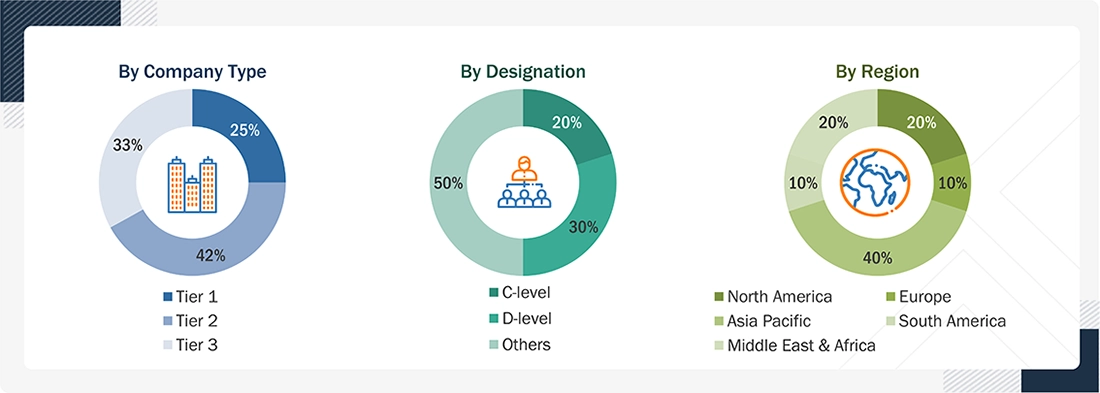
To know about the assumptions considered for the study, download the pdf brochure
Market Size Estimation
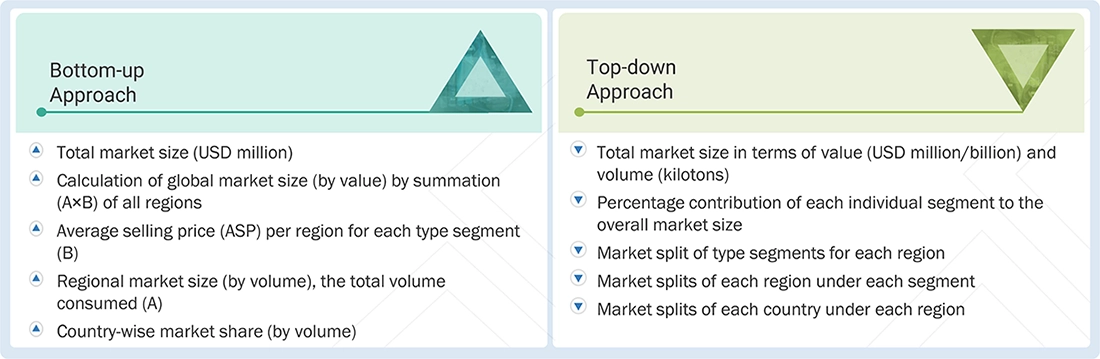
The top-down and bottom-up approaches were used to estimate and validate the size of the global silicone market. These approaches were also used extensively to estimate the size of various dependent market segments. The research methodology used to estimate the market size included the following:
Silicone Market : Top-Down and Bottom-Up Approach
Data Triangulation
After arriving at the overall market size using the market size estimation processes, the market was split into several segments and subsegments. The data triangulation and market breakdown procedures were employed, wherever applicable, to complete the overall market engineering process and arrive at the exact statistics of each market segment and subsegment. The data was triangulated by studying various factors and trends from the demand and supply sides.
Market Definition
Silicones are high-performance specialty polymers comprising siloxane. They are produced by reacting silicon and methyl chloride and treating the reaction product with water. They have unique properties among polymers because they contain organic groups with a chain of inorganic atoms. They have high heat and oxidative stability, outstanding low-temperature flexibility, and resistance to various chemicals, weathering, ozone, and ultraviolet (UV) sunlight.
Silicones are used in various end-use industries because of their high heat resistance and eco-friendly nature. They exist in various forms, ranging from fluids, resins, and gels to tough, stiff, and strong elastomers. These stable, inert compounds are widely used in almost all modern end-use industries, including building & construction, transportation, personal care & consumer products, electronics, medical & healthcare, industrial processes, and energy.
Key Stakeholders
- Silicone manufacturers
- Silicone traders, distributors, contractors, and suppliers
- End-use industry participants of different segments of the silicone market
- Government and research organizations
- Associations and industrial bodies
- Research and consulting firms
- R&D institutions
- Environmental support agencies
- Investment banks and private equity firms
Report Objectives
- To define, describe, and forecast the size of the global silicone market by type and end-use industry, in terms of value and volume
- To forecast the market size of segments for North America, Europe, Asia Pacific, South America, and the Middle East & Africa, along with their respective countries, in terms of value and volume
- To provide detailed information on the significant drivers, restraints, opportunities, and challenges influencing the market
- To strategically analyze micromarkets concerning individual growth trends, prospects, and their contribution to the market
- To assess the growth opportunities in the market for stakeholders and provide details on the competitive landscape for market leaders
- To strategically profile key players and comprehensively analyze their market shares and core competencies
- To analyze competitive developments, such as partnerships, expansions, acquisitions, agreements, and product launches in the silicone market
- To provide the impact of AI/Gen AI on the market
- To provide the macroeconomic outlook for each region covered under the study, and the impact of the 2025 US tariffs on the market
Available customizations:
With the given market data, MarketsandMarkets offers customizations according to client-specific needs.
The following customization options are available for the silicone report:
Product Analysis
-
A product matrix that gives a detailed comparison of the product portfolio of each company
Regional Analysis
-
A further breakdown of the silicone market for additional countries
Company Information
-
Detailed analysis and profiling of additional market players (up to five)
Get the Full Silicone Market Report
Full forecast, segment splits, and company analysis for all Silicone Market.
- Argentina Silicone Market
- South Africa Silicone Market
- Rest Of Europe Silicone Market
- Rest Of Asia Pacific Silicone Market
- GCC Countries Silicone Market
- Rest Of Mea Silicone Market
- -Rest Of GCC Silicone Market
- Rest Of South America Silicone Market
- Canada Silicone Market
- Mexico Silicone Market
- Germany Silicone Market
- UK Silicone Market
- France Silicone Market
- Italy Silicone Market
- Russia Silicone Market
- Turkey Silicone Market
- China Silicone Market
- Japan Silicone Market
- India Silicone Market
- South Korea Silicone Market
- Australia Silicone Market
- Brazil Silicone Market
Need a Tailored Report?
Customize this report to your needs
Get 10% FREE Customization
Customize This Report
