
Portugal Small-Scale LNG Market (2025-2030)

The Portugal Small-Scale LNG Market was valued at $1.05 Million in 2025 and projected to reach to $1.39 Million by 2030, representing a compound annual growth rate of 5.69%. Portugal's small-scale LNG market is positioned to experience steady growth as the country advances its energy transition strategy and diversifies away from traditional fossil fuels.


| Market Size in | USD 26.32 MN |
| Market Forecast in | |
| CAGR | |
| Forecast Period | |
| Units Considered | Value (USD MN) |
Portugal Small-Scale LNG Market Trends and Insights
- Valued at USD 1.05 million in 2025, Portugal's market is expected to expand to USD 1.39 million by 2030, reflecting a compound annual growth rate (CAGR) of 5.69%.
- This growth trajectory underscores Portugal's increasing adoption of small-scale LNG solutions as the country pursues decarbonization and energy security objectives. The Portuguese small-scale LNG sector benefits from the nation's strategic location on the Atlantic coast and its existing LNG infrastructure, including regasification terminals.
- Portugal's commitment to renewable energy integration and industrial decarbonization is driving demand for flexible, cleaner fuel alternatives in maritime, industrial, and distributed energy applications.
- Between 2025 and 2030, Portugal is anticipated to see gradual market maturation as regulatory frameworks evolve and investment in small-scale LNG distribution networks accelerates. Portugal's market dynamics reflect broader European trends toward energy independence and climate neutrality, though the country's smaller market size compared to regional peers indicates opportunities for targeted growth in specialized applications and regional supply chains..
Key Market Statistics
- CAGR (2025-2030) 5.69% CAGR
- Market Size, 2025 ~USD 1.05 Million
- Forecast, 2030 ~USD 1.39 Million
- Country Portugal
Portugal Small-Scale LNG Market Overview
Market Valuation Growth :
Portugal's small-scale LNG market is valued at USD 1.05 million in 2025 and is projected to reach USD 1.39 million by 2030, demonstrating steady expansion within the country's energy infrastructure.
CAGR Performance :
Portugal's market grows at 5.69% CAGR through 2030, slightly below the global average of 7.5%, reflecting a measured but consistent adoption rate aligned with national energy transition policies.
Energy Transition Driver :
Small-scale LNG adoption in Portugal is accelerating as the country pursues decarbonization goals and seeks flexible, distributed energy solutions to complement renewable energy infrastructure.
Niche Market Positioning :
Portugal's small-scale LNG segment remains a specialized market within Europe, with growth opportunities in maritime fuel applications, industrial heating, and remote area energy supply.
Portugal Small-Scale LNG Market Dynamics
- The market's 5.69% CAGR reflects increasing investment in distributed LNG infrastructure to support industrial facilities, maritime operations, and regions with limited pipeline connectivity.
- Government initiatives promoting clean energy adoption and EU regulatory frameworks are expected to drive demand for flexible, scalable LNG solutions. Looking ahead to 2030, Portugal's small-scale LNG market will benefit from technological advancements in liquefaction and storage, coupled with growing interest in LNG as a bridge fuel for hard-to-decarbonize sectors.
- Strategic partnerships between energy providers and industrial consumers, combined with port infrastructure development, will unlock new applications and geographic expansion opportunities across the country..
Market Ecosystem
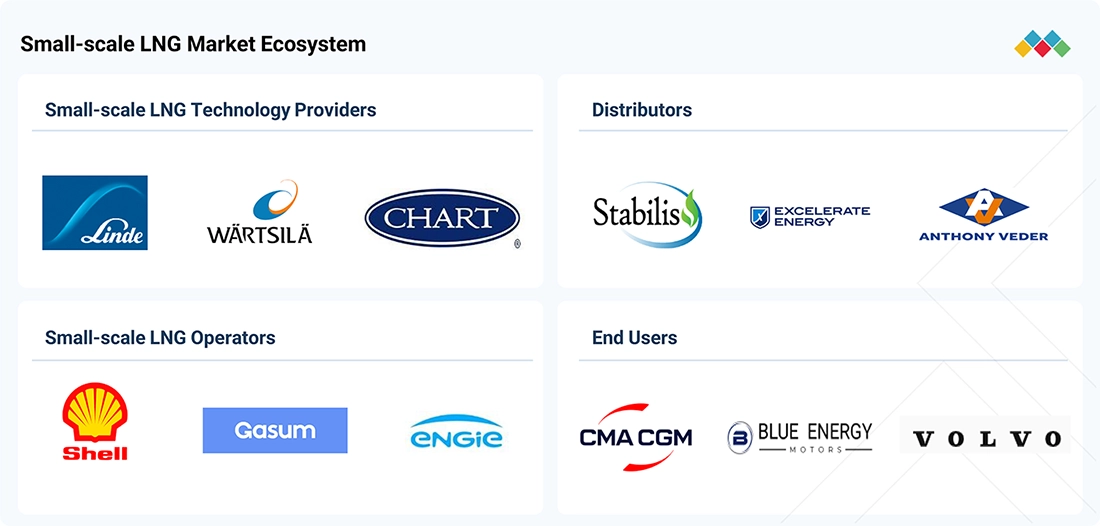
SMALL-SCALE LNG MARKET: COMMERCIAL USE CASES ACROSS INDUSTRIES
| COMPANY | USE CASE DESCRIPTION | BENEFITS |
|---|---|---|
 |
Chart developed a compact small-scale LNG liquefaction facility in rural Pennsylvania to utilize locally available shale natural gas and supply LNG to industrial, transportation, and marine customers. The plant was designed to produce approximately 50,000 gallons/day, with the plot size optimized to 300 × 300 feet (92 × 92 meters). Chart used its Nitrogen Cycle technology as an alternative to the mixed-refrigerant process. | Enabled local natural gas to be supplied as LNG to industrial, transportation, and marine customers | Supported truck-to-ship LNG bunkering operations on the Great Lakes, providing an alternative marine fuel aligned with stricter environmental requirements |
 |
Wärtsilä supplied a boil-off gas (BOG) reliquefaction package for the Dragon LNG terminal in Milford Haven, Wales, which operates two 163,000-m³ LNG storage tanks. The system reliquefied BOG during periods of zero gas send-out and included a refrigerant handling system, coldbox, and LNG pumps. | Enabled Dragon LNG to maintain a zero-gas-flaring policy while improving BOG handling flexibility and energy efficiency | Reduced standby power consumption and supported higher yield factors during gas send-out to the National Gas Transmission System (NGTS) |
 |
Galileo deployed modular Cryobox technology at the La Mora field in Argentina to liquefy previously flared gas and supply LNG to a 40-MW thermal power plant. The facility produces approximately 120 tons of LNG/day. | Converted previously flared gas into usable LNG for power generation, supporting reduced gas flaring, improved resource utilization, and reliable power supply |
Logos and trademarks shown above are the property of their respective owners. Their use here is for informational and illustrative purposes only.
Related Ecosystem
Locomotives And Rolling Stock
- Sensors
- Passenger Information System (PIS)
- Cartesian Robots
- Flow Sensors
- Gas Sensors
- Siemens ag
- Alstom s.a.
- Hitachi, Ltd.
- Knorr-bremse ag
- RAILPROS
Bulk Chemicals And Inorganics
- Corrosion Inhibitors
- Glycol Ethers
- Acetic Acid
- Acetone
- Ammonium Nitrate
- Basf se
- DOW CHEMICAL COMPANY
- Exxon Mobil Corporation
- AZELIS HOLDINGS SA
- Sinopec limited
Equipment Machine And Tooling
- Wastewater Treatment
- Air Cooled Heat Exchangers
- Diaphragm Pumps
- Fiberglass
- HVAC System
- Alfa Laval Corporate AB
- Veolia
- Johnson Controls International plc
- Daikin Industries,Ltd.
- Parker-Hannifin Corporation
Key Takeaways
- Portugal's small-scale LNG market is valued at USD 1.05 million in 2025 and is projected to grow to USD 1.39 million by 2030 at a CAGR of 5.69%.
- Portugal's strategic Atlantic location and existing LNG terminal infrastructure position the country as a potential regional hub for small-scale LNG distribution.
- Portugal's energy transition policies and industrial decarbonization targets are driving adoption of small-scale LNG in maritime, industrial, and distributed energy sectors.
- Portugal's smaller market size relative to larger European economies presents opportunities for specialized applications and niche supply chain development through 2030.
Small-Scale LNG Market Report Scope
| Report Metric | Details |
|---|---|
| Base Year | 2025 |
| Fastest Growing Segment | MARINE TRANSPORT (Application) |
| Forecast Period | 2025-2030 |
| Growth Rate | CAGR of 7.5% from 2025 to 2030 |
| Largest Segment | LIQUEFACTION (Type) |
| Market Size Base Year (Billions) | ~USD 22.14 (2025) |
| Revenue Forecast (Billions) | ~USD 31.78 (2030) |
| Segments Covered | Type, Mode Of Supply, Application, Material, End-Use Industry |
Portugal Small-Scale LNG Market Report Segmentation
5 segment dimensions are covered across the global market.
By Type
- Liquefaction
- Non-Self-Supporting Tanks
- Regasification
- Self-Supporting Tanks
By Mode Of Supply
- Other Modes Of Supply
- Trans-Shipment & Bunkering
- Trucks
By Application
- Heavy-Duty Vehicles
- Industrial & Powe
- Industrial & Power
- Marine Transport
- Other Applications
- Others Applications
By Material
- 9% Nickel Steel
- Aluminum Alloy
- Other Materials
- Steel
By End-Use Industry
- Energy & Power
- Industrial
- Transportation & Logistics
PORTUGAL: SMALL-SCALE LNG MARKET, BY APPLICATION, 2024–2030
| Segment | 2024 | 2025 | 2026 | 2027 | 2028 | 2029 | 2030 | CAGR (%) |
|---|---|---|---|---|---|---|---|---|
| HEAVY-DUTY VEHICLES | 263.3 | 282 | 302.1 | 323.7 | 346.7 | 371.5 | 397.9 | 7.13 |
| INDUSTRIAL & POWER | 240 | 253 | 266.7 | 281.2 | 296.5 | 312.6 | 329.6 | 5.43 |
| MARINE TRANSPORT | 109.5 | 119 | 129.3 | 140.5 | 152.6 | 165.8 | 180.2 | 8.65 |
| OTHERS APPLICATIONS | 49.3 | 51.3 | 53.4 | 55.5 | 57.7 | 60.1 | 62.5 | 4.03 |
| TOTAL | 662 | 705.3 | 751.5 | 800.9 | 853.6 | 910 | 970.2 | 6.59 |
Target Audience
- Energy & Utilities Companies : Portuguese and international energy providers need localized market data to assess small-scale LNG investment opportunities, infrastructure development, and customer acquisition strategies in Portugal.
- Industrial & Manufacturing Sectors : Industrial facilities and manufacturers in Portugal require insights into LNG availability, pricing trends, and supply chain logistics to evaluate small-scale LNG as a viable energy alternative.
- Maritime & Shipping Operators : Port authorities and shipping companies operating in Portuguese waters need market intelligence on LNG fuel availability and infrastructure to support maritime decarbonization initiatives.
- Government & Policy Makers : Portuguese government agencies and policymakers use market data to inform energy transition strategies, infrastructure investment decisions, and regulatory frameworks for small-scale LNG.
- Investment & Financial Institutions : Private equity firms, venture capital investors, and financial institutions evaluating energy sector opportunities in Portugal require detailed market forecasts and growth potential analysis.
Reasons to Buy this Report
- Localized Market Intelligence : Gain Portugal-specific insights into market valuation, growth trajectories, and competitive dynamics that generic global reports cannot provide, enabling targeted business strategy development.
- Investment Decision Support : Access detailed forecasts and CAGR analysis for Portugal's small-scale LNG sector to evaluate market entry opportunities, expansion plans, and capital allocation decisions with confidence.
- Regulatory & Policy Context : Understand Portugal's unique energy transition policies, EU compliance requirements, and national decarbonization targets that directly influence small-scale LNG adoption and market dynamics.
- Competitive Positioning : Identify market gaps, emerging applications, and growth segments specific to Portugal's industrial, maritime, and distributed energy sectors to establish competitive advantages.
- Stakeholder Alignment : Leverage Portugal-focused data to align with government initiatives, secure partnerships with local energy providers, and demonstrate market viability to investors and stakeholders.
Frequently asked questions
What is the current market size of small-scale LNG in Portugal?
Portugal's small-scale LNG market was valued at USD 1.05 million in 2025 and is expected to reach USD 1.39 million by 2030.
What is the projected growth rate for Portugal's small-scale LNG market?
Portugal's small-scale LNG market is projected to grow at a compound annual growth rate (CAGR) of 5.69% between 2025 and 2030.
What factors are driving growth in Portugal's small-scale LNG sector?
Portugal's growth is driven by energy transition policies, industrial decarbonization targets, existing LNG infrastructure, and demand for cleaner fuel alternatives in maritime and industrial applications.
How does Portugal's small-scale LNG market compare to other European markets?
Portugal's market is smaller than major European economies but benefits from strategic coastal positioning and existing LNG terminals, creating opportunities for regional specialization and niche applications.
What applications are driving small-scale LNG demand in Portugal?
Key applications in Portugal include maritime fuel, industrial heating, distributed energy generation, and support for renewable energy integration as part of the country's decarbonization strategy.
RESEARCH METHODOLOGY
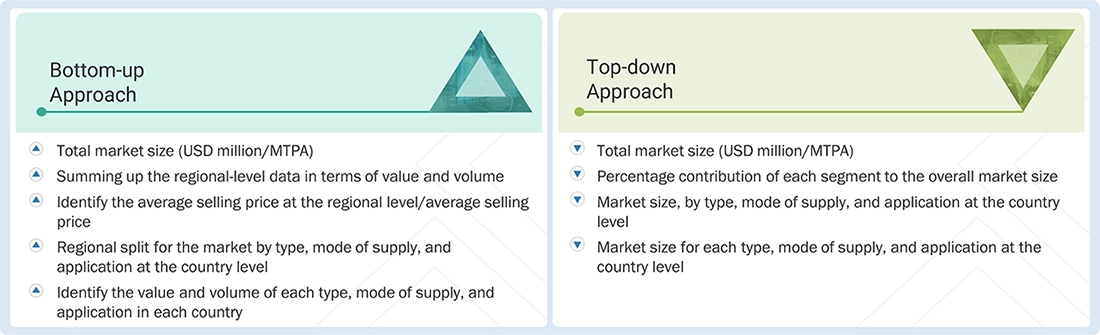
The study involved four major activities to estimate the current size of the global small-scale LNG market. Exhaustive secondary research was carried out to collect information on the market, the peer product market, and the parent product group market. The next step was to validate these findings, assumptions, and sizes with industry experts across the value chain of small-scale LNG through primary research. The top-down and bottom-up approaches were employed to estimate the overall size of the small-scale LNG market. After that, market breakdown and data triangulation procedures were used to determine the size of different segments and sub-segments of the market.
Secondary Research
The market for companies offering small-scale LNG was determined using secondary data available through paid and unpaid sources, analyzing the product portfolios of the major companies in the ecosystem, and rating the companies by their performance and quality. Various secondary sources, such as Business Standard, Bloomberg, World Bank, and Factiva, were referred to identify and collect information for this study on the small-scale LNG market. In the secondary research process, various secondary sources were referred to identify and collect information related to the study. Secondary sources included annual reports, press releases, and investor presentations of door vendors, forums, certified publications, and whitepapers. Secondary research was used to obtain critical information on the industry’s value chain, the total pool of key players, market classification, and segmentation from the market and technology-oriented perspectives.
Primary Research
In the primary research process, various primary sources from both the supply and demand sides were interviewed to obtain qualitative and quantitative information for this report. The primary sources from the supply side included industry experts, such as Chief Executive Officers (CEOs), Vice Presidents (VPs), marketing directors, technology and innovation directors, and related key executives from several key companies and organizations operating in the small-scale LNG market. After the complete market engineering process (calculations for market statistics, market breakdown, market size estimations, market forecasting, and data triangulation), extensive primary research was conducted to gather information and verify and validate the critical numbers arrived at. Primary research was also conducted to identify the segmentation types, industry trends, competitive landscape of small-scale LNG offered by various market players, and key market dynamics, such as drivers, restraints, opportunities, challenges, industry trends, and key player strategies. In the complete market engineering process, the top-down and bottom-up approaches and several data triangulation methods were extensively used to perform the market estimation and market forecasting for the overall market segments and subsegments listed in this report. Extensive qualitative and quantitative analysis was performed on the complete market engineering process to list the key information/insights throughout the report.
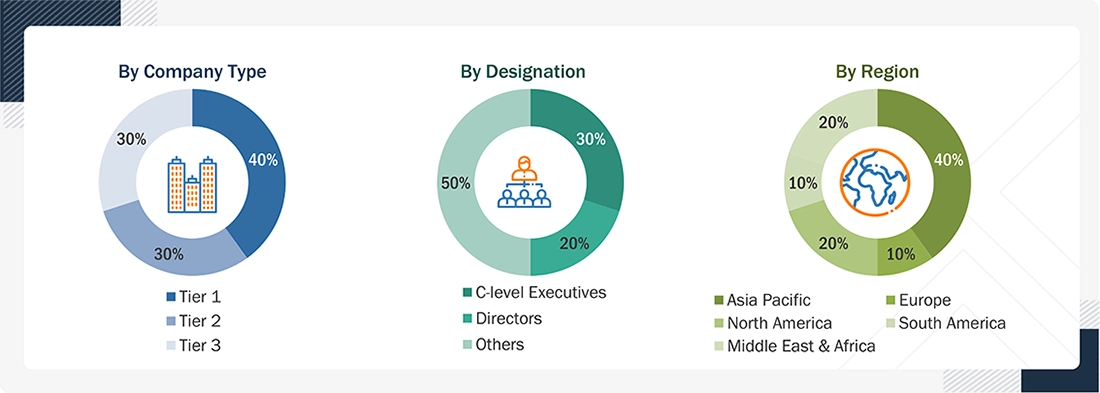
Notes: Other designations include sales, marketing, and product managers.
Tier 1: >USD 1 Billion; Tier 2: USD 500 million–1 Billion; and Tier 3: USD 500 million
To know about the assumptions considered for the study, download the pdf brochure
Market Size Estimation
The top-down and bottom-up approaches were used to estimate and validate the size of the global small-scale LNG market. These approaches were also used extensively to estimate the size of various dependent market segments. The research methodology used to estimate the market size included the following:
Small-Scale LNG Market : Top-Down and Bottom-Up Approach
Data Triangulation
After arriving at the overall market size using the market size estimation processes, the market was split into several segments and subsegments. The data triangulation and market breakup procedures were employed, wherever applicable, to complete the overall market engineering process and arrive at the exact statistics of each market segment and subsegment. The data were triangulated by studying various factors and trends from both the demand and supply sides.
Market Definition
Small-scale LNG refers to the liquefaction, storage, transportation, and regasification of natural gas at a smaller scale than conventional LNG facilities. It provides flexible and reliable energy solutions for areas with limited or no pipeline infrastructure and is used across marine bunkering, industrial applications, transportation, power generation, and remote energy supply. Small-scale LNG facilities generally have capacities below 1 million metric tons per annum (MTPA). According to the International Gas Union (IGU), small-scale LNG facilities typically have liquefaction and regasification capacities of 0.05–1.0 MTPA, while small LNG vessels have capacities of up to 30,000 m³. Small-scale LNG offers several advantages over conventional large-scale LNG projects. It requires lower initial investment and generally has shorter project development timelines, enabling faster deployment. These facilities also provide greater operational flexibility and can be developed according to local energy requirements. Small-scale LNG is particularly suitable for remote and off-grid locations where pipeline infrastructure is unavailable or costly to develop. In addition, it supports the replacement of diesel and other higher-emission fuels in transportation and industrial applications, while providing a flexible option for improving access to natural gas.
Key Stakeholders
- Small-scale LNG manufacturers
- Raw material suppliers
- Converters & processors
- Distributors and traders
- Industry associations and regulatory bodies
- End users
Report Objectives
- To define, describe, and forecast the size of the global small-scale LNG market, based on type, mode of supply, application, and region in terms of value
- To provide detailed information on the significant drivers, restraints, opportunities, and challenges influencing the market
- To strategically analyze micromarkets concerning individual growth trends, prospects, and their contribution to the market
- To assess the growth opportunities in the market for stakeholders and provide details on the competitive landscape for market leaders
- To forecast the market size of segments and subsegments for North America, Europe, Asia Pacific, South America, and the Middle East & Africa
- To strategically profile key players and comprehensively analyze their market shares and core competencies
- To analyze competitive developments such as product launches, acquisitions, expansions, partnerships, and agreements in the small-scale LNG market
- To assess the impact of AI/Gen AI on the market
Available customizations:
With the given market data, MarketsandMarkets offers customizations according to client-specific needs. The following customization options are available for the small-scale LNG market report:
Product Analysis
- A product matrix that gives a detailed comparison of the product portfolio of each company
Regional Analysis
- A further breakdown of the small-scale LNG market for additional countries
Company Information
- Detailed analysis and profiling of additional market players (up to five)
Get the Full Small-Scale LNG Market Report
Full forecast, segment splits, and company analysis for all Small-Scale LNG Market.
- China Small-Scale LNG Market
- Japan Small-Scale LNG Market
- India Small-Scale LNG Market
- South Korea Small-Scale LNG Market
- Australia Small-Scale LNG Market
- Taiwan Small-Scale LNG Market
- Singapore Small-Scale LNG Market
- Indonesia Small-Scale LNG Market
- Canada Small-Scale LNG Market
- Mexico Small-Scale LNG Market
- US Small-Scale LNG Market
- Germany Small-Scale LNG Market
- France Small-Scale LNG Market
- Italy Small-Scale LNG Market
- UK Small-Scale LNG Market
- Russia Small-Scale LNG Market
- Spain Small-Scale LNG Market
- Netherlands Small-Scale LNG Market
- Turkey Small-Scale LNG Market
- Brazil Small-Scale LNG Market
- Argentina Small-Scale LNG Market
- Chile Small-Scale LNG Market
- South Africa Small-Scale LNG Market
- Rest Of Europe Small-Scale LNG Market
- Rest Of Asia Pacific Small-Scale LNG Market
- GCC Countries Small-Scale LNG Market
- -Rest Of GCC Countries Small-Scale LNG Market
- Rest Of South America Small-Scale LNG Market
Need a Tailored Report?
Customize this report to your needs
Get 10% FREE Customization
Customize This Report
