
Australia Small Drones Market (2025-2030)

The Australia Small Drones Market was valued at $78.6 Million in 2025 and projected to reach to $152.4 Million by 2030, representing a compound annual growth rate of 14.2%. Australia's small drones market is positioned for substantial expansion through 2030, driven by increasing defence investments, commercial sector adoption, and technological advancement.


| Market Size in | USD 26.32 MN |
| Market Forecast in | |
| CAGR | |
| Forecast Period | |
| Units Considered | Value (USD MN) |
Australia Small Drones Market Trends and Insights
- This expansion reflects Australia's increasing adoption of drone technology across commercial, defence, and infrastructure sectors.
- Australia's strategic location in the Asia Pacific region and strong regulatory framework position it as a key market for unmanned aerial systems development and deployment. The 14.2% compound annual growth rate in Australia significantly outpaces the global average of 11.9%, driven by rising demand from agriculture, mining, and government applications.
- Australia's investment in autonomous systems and defence modernisation further accelerates market penetration.
- Between 2025 and 2030, Australia is expected to nearly double its small drones market value, reflecting the country's commitment to advanced aerospace technologies and digital transformation initiatives..
Key Market Statistics
- CAGR (2025-2030) 14.2% CAGR
- Market Size, 2025 ~USD 78.6 Million
- Forecast, 2030 ~USD 152.4 Million
- Country Australia
Australia Small Drones Market Overview
Market Valuation Growth :
Australia's small drones market is valued at USD 78.6 million in 2025, with a projected CAGR of 14.2%, significantly outpacing the global growth rate of 11.9%, demonstrating strong regional momentum.
Regulatory Leadership :
Australia maintains one of the most mature and progressive regulatory frameworks for drone operations in the Asia-Pacific region, enabling faster commercialization and market adoption across multiple sectors.
Defence & Security Focus :
Australia's defence sector is increasingly investing in small drone technology for surveillance, reconnaissance, and border security applications, driven by regional geopolitical considerations and strategic partnerships.
Commercial Expansion :
Growing adoption across agriculture, mining, infrastructure inspection, and emergency services sectors is driving commercial demand, with Australian enterprises leveraging drones for operational efficiency and cost reduction.
Australia Small Drones Market Dynamics
- The country's strategic location in the Asia-Pacific region, combined with its robust regulatory environment, creates a competitive advantage for market participants.
- Government initiatives supporting autonomous systems and digital infrastructure modernization are expected to accelerate market penetration across agriculture, mining, and critical infrastructure sectors. The forecast growth to USD 152.4 million by 2030 reflects strong demand from both public and private sectors.
- Key growth catalysts include expanding use cases in precision agriculture, enhanced border security operations, and infrastructure asset management.
- Australia's skilled workforce and innovation ecosystem position the nation as a regional hub for drone technology development and deployment, attracting international investment and fostering local entrepreneurship..
Market Ecosystem
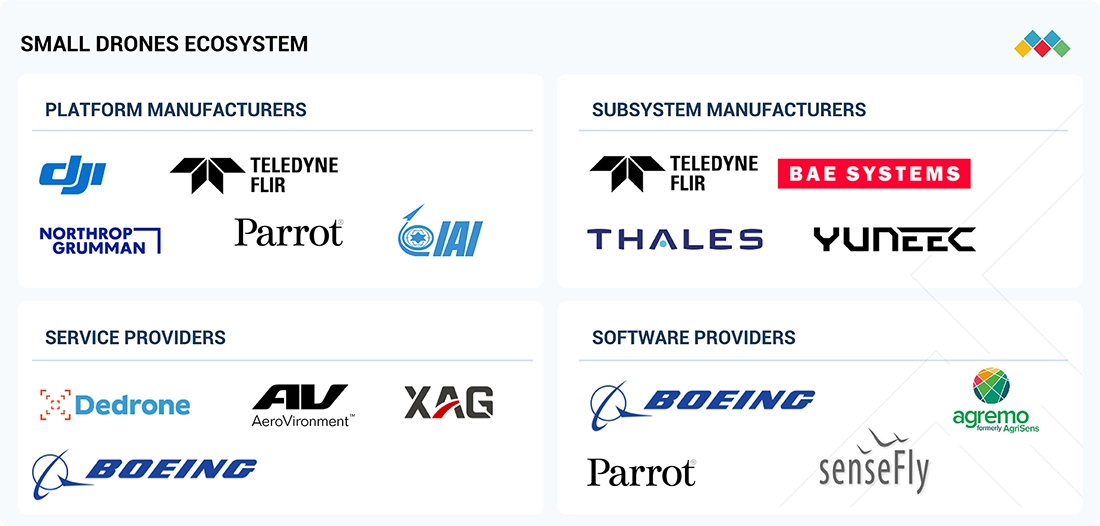
Small Drones (UAV) Market: COMMERCIAL USE CASES ACROSS INDUSTRIES
| COMPANY | USE CASE DESCRIPTION | BENEFITS |
|---|---|---|
 |
DJI has developed advanced small drones such as the Mavic 3 Enterprise and Phantom series, extensively used in commercial sectors including surveying, precision agriculture, public safety, and inspection operations. These systems integrate AI-driven obstacle avoidance and multispectral imaging for high-precision missions. | Offers superior reliability and imaging accuracy with user-friendly operation and cost-efficient scalability, enabling large-scale adoption across civil, industrial, and infrastructure applications. |
 |
Parrot produces the ANAFI USA and ANAFI Ai, small drones designed for government, defense, and enterprise operations. These platforms focus on secure data processing, encryption, and 4G connectivity for real-time mission execution. | Ensures secure and compliant data handling with real-time cloud connectivity, lightweight construction, and high mobility, ideal for inspection, mapping, and tactical applications. |
 |
IAI manufactures BirdEye and Mini Panther UAVs for ISR (Intelligence, Surveillance, and Reconnaissance) and tactical defense missions. These drones deliver long-endurance performance with integrated battlefield intelligence. | Provides extended flight duration up to 24 hours, reliable ISR capabilities, and seamless defense network integration, enhancing situational awareness and operational command. |
 |
Lockheed Martin develops the Indago 4 small UAS, deployed in defense, law enforcement, and industrial inspection roles, emphasizing rugged design, portability, and secure communication systems. | Offers up to 50 minutes of endurance, low acoustic signature for stealth operations, encrypted communications, and adaptability for both defense and commercial applications. |
 |
AeroVironment manufactures small drones such as Raven, Puma, and Wasp AE, proven platforms used extensively by U.S. defense forces for tactical reconnaissance and surveillance missions. | Delivers battle-tested endurance and reliability with hand-launch portability, real-time intelligence capability, and rapid deployment efficiency in contested or high-risk environments. |
Logos and trademarks shown above are the property of their respective owners. Their use here is for informational and illustrative purposes only.
Related Ecosystem
Unmanned Systems
- Rotary Wing Aircraft
- Fixed-Wing Drones
- Sensors
- Fuel Cell
- Fixed Wing Aircraft
- LOCKHEED MARTIN CORPORATION
- Northrop Grumman Corporation
- ISRAEL AEROSPACE INDUSTRIES LTD
- Elbit Systems Ltd.
- Thales group
Semi Autonomous And Autonomous Vehicle
- Light Commercial Vehicles (LCVs)
- Battery Electric Vehicle (BEV)
- Fuel Cell Electric Vehicle (FCEV)
- Internal Combustion Engine (ICE)
- Fuel Cell
- BOSCH LIMITED
- Visteon Corporation
- Continental ag
- DENSO Corporation
- Infineon technologies ag
Key Takeaways
- Australia's small drones market will grow from $78.6M (2025) to $152.4M (2030) at a 14.2% CAGR, outpacing global growth.
- Australia's regulatory maturity and defence investments create a favourable ecosystem for drone technology adoption and innovation.
- Key growth drivers in Australia include agricultural automation, mining operations, infrastructure inspection, and government modernisation programmes.
- Australia's position in Asia Pacific and advanced manufacturing capabilities position it as a regional hub for small drone development and deployment.
Small Drones Market Report Scope
| Report Metric | Details |
|---|---|
| Base Year | 2025 |
| Fastest Growing Segment | FULLY AUTONOMOUS (Mode Of Operation) |
| Forecast Period | 2025–2030 |
| Growth Rate | CAGR of 11.9% from 2025 to 2030 |
| Largest Segment | BATTERY OPERATED/ELECTRIC (Power Source) |
| Market Size Base Year (Billions) | ~USD 6.41 (2025) |
| Revenue Forecast (Billions) | ~USD 11.25 (2030) |
| Segments Covered | Platform, Type, Mode Of Operation, Power Source, Battery Type, Application, Civil & Commercial, Defense & Government |
Australia Small Drones Market Report Segmentation
8 segment dimensions are covered across the global market.
By Platform
- Civil & Commercial
- Defense & Government
By Type
- Bicopters
- Ctol
- Fixed Wing
- Hexacopters
- Hybrid
- Micro (25 G–5 Kg)
- Micro (250 G–2 Kg)
- Mini (5 Kg–150 Kg)
- Mini (5 Kg–50 Kg)
- Multirotor
- Nano (<25 G)
- Octocopters
- Quadcopters
- Rotary Wing
- Single Rotor
- Small (2 Kg–25 Kg)
- Tricopters
- Vtol
By Mode Of Operation
- Fully Autonomous
- Optionally Piloted
- Remotely Piloted
By Power Source
- Battery Operated/Electric
- Fuel Powered
By Battery Type
- Fuel Cell
- Lithium-Ion
- Nickel
By Application
- Aerial Imaging
- Border Management
- Commercial
- Consumer
- Delivery
- Firefighting & Disaster Management
- Government & Law Enforcement
- Industrial Warehousing
- Inspection & Maintenance
- Isr
- Maritime Security
- Military
- Police Operations & Investigations
- Precision Agriculture
- Product Delivery
- Search & Rescue
- Surveillance & Monitoring
- Surveying & Mapping
- Traffic Monitoring
- Ucav
By Civil & Commercial
- Micro
- Small
By Defense & Government
- Micro
- Mini
- Nano
Target Audience
- Defence & Government Agencies : Australian defence departments and government bodies require market intelligence on drone capabilities, procurement trends, and technology roadmaps to inform strategic defence investments and border security operations.
- Commercial Drone Manufacturers : Drone manufacturers and technology providers need Australia-specific market data to assess market potential, identify customer segments, and develop localized product offerings for commercial and defence applications.
- Enterprise End-Users : Australian enterprises in agriculture, mining, infrastructure, and logistics sectors need market insights to evaluate drone technology ROI, identify solution providers, and plan digital transformation initiatives.
- Investment & Private Equity Firms : Investors targeting the Australian aerospace and defence sector require detailed market forecasts, growth drivers, and competitive dynamics to identify high-potential investment opportunities and portfolio companies.
- Regulatory & Policy Bodies : Australian regulatory authorities and policy makers need market research to inform drone regulation frameworks, safety standards, and strategic initiatives supporting the growth of the domestic drone industry.
Key Companies in the Australia Small Drones Market
| Company | HQ | Ownership | Strongest segments |
|---|---|---|---|
| ADLINK TECHNOLOGY INC. | Taiwan | Public Company | Computer-on-Modules and Embedded Boards,Industrial PCs, Edge Computing Platforms, and Motherboards,Rugged Computing and Railway Systems, |
| JABIL | United States | Public Company | Intelligent Infrastructure (5G, wireless, cloud, networking, storage, industrial and semi-cap),Regulated Industries (healthcare, medical devices, packaging, automotive and transportation),Connected Living and Digital Commerce (consumer devices, mobility, digital commerce ecosystem, smart building controls), |
| LATTICE SEMICONDUCTOR | United States | Public Company | Small FPGA platforms (Nexus, Nexus 2, MachXO, iCE, CrossLink families),Mid-range FPGA platform (Lattice Avant family including Avant-G/E/X),Domain software solutions (Radiant, Propel, Automate, mVision, ORAN, sensAI, Sentry, Drive, Glance), |
| XILINX, INC. | United States | Private Company | High-end FPGAs and adaptive SoCs (incl. data center and 5G),Mid/low-range PLDs and configuration devices,Design tools, IP cores, and embedded platforms, |
| EXYN TECHNOLOGIES INC | United States | Public Company | ExynAI autonomy software licenses and subscriptions,ExynView mission planning and 3D data software,Exyn Nexys modular 3D mapping hardware and systems, |
| CYIENT | India | Public Company | Digital, Engineering & Technology,Design Led Manufacturing,Others (Platforms, Niche Solutions, Advisory), |
| ISRAEL AEROSPACE INDUSTRIES LTD. | Israel | Private Company | Aerial defense, UAS & special mission aircraft,Naval systems and sensors,Land defense, missiles & C4I, |
| LOCKHEED MARTIN CORPORATION | United States | Public Company | Aeronautics,Missiles and Fire Control,Rotary and Mission Systems, |
ADLINK TECHNOLOGY INC.
ADLINK Technology Inc. is a public company headquartered in Taiwan, founded in 1995 with 342 employees. The company provides industrial computing and edge AI solutions.
JABIL
Jabil is a U.S.-based public company founded in 1966 with 135,000 employees. The company is a leading provider of manufacturing services and supply chain solutions.
LATTICE SEMICONDUCTOR
Lattice Semiconductor is a U.S. public company founded in 1983 with 1,174 employees. The company designs and manufactures programmable logic devices and related semiconductors.
XILINX, INC.
Xilinx, Inc. is a private U.S. company founded in 1984 with 4,890 employees. The company designs and manufactures field-programmable gate arrays (FPGAs) and adaptive computing platforms.
EXYN TECHNOLOGIES INC
Exyn Technologies Inc. is a U.S. public company founded in 2014 with 42 employees. The company develops autonomous drone technology and aerial intelligence solutions.
CYIENT
Cyient is an India-based public company founded in 1991 with 12,049 employees. The company provides engineering, design, and digital services across multiple industries.
ISRAEL AEROSPACE INDUSTRIES LTD.
Israel Aerospace Industries Ltd. is a private Israeli company founded in 1953 with 15,151 employees. The company is a leading aerospace and defense manufacturer.
LOCKHEED MARTIN CORPORATION
Lockheed Martin Corporation is a U.S. public company founded in 1912 with 123,000 employees. The company is a major defense, aerospace, and security contractor.
Reasons to Buy this Report
- Regional Market Intelligence : Gain comprehensive insights specific to Australia's small drones market dynamics, including local regulatory environment, competitive landscape, and sector-specific growth drivers that differ from global trends.
- Investment Decision Support : Access detailed market sizing and forecasts (2025-2030) to inform capital allocation decisions, market entry strategies, and partnership opportunities within Australia's high-growth drone sector.
- Sector-Specific Opportunities : Identify targeted growth opportunities across defence, commercial, agriculture, mining, and infrastructure sectors with Australia-specific demand patterns and adoption timelines.
- Competitive Positioning : Understand Australia's regulatory advantages, skilled workforce capabilities, and innovation ecosystem to benchmark competitive positioning and identify differentiation strategies in the regional market.
- Strategic Planning : Leverage Australia-focused market data to develop localized go-to-market strategies, product development roadmaps, and partnership frameworks aligned with regional growth trajectories and stakeholder requirements.
Frequently asked questions
What is the current size of Australia's small drones market?
Australia's small drones market was valued at USD 78.6 million in 2025 and is projected to reach USD 152.4 million by 2030.
What is the growth rate of Australia's small drones market?
Australia's small drones market is growing at a compound annual growth rate (CAGR) of 14.2% from 2025 to 2030, exceeding the global average of 11.9%.
Which sectors are driving growth in Australia's small drones market?
Key sectors driving Australia's small drones market include agriculture, mining, infrastructure inspection, defence, and government applications requiring autonomous aerial systems.
How does Australia's market compare to global small drones market trends?
Australia's 14.2% CAGR outpaces the global 11.9% CAGR, reflecting stronger regional demand and strategic investments in autonomous technologies and defence modernisation.
What factors support Australia's small drones market expansion through 2030?
Australia's market expansion is supported by regulatory frameworks, defence spending, agricultural modernisation, mining automation, and positioning as an Asia Pacific technology hub.
RESEARCH METHODOLOGY
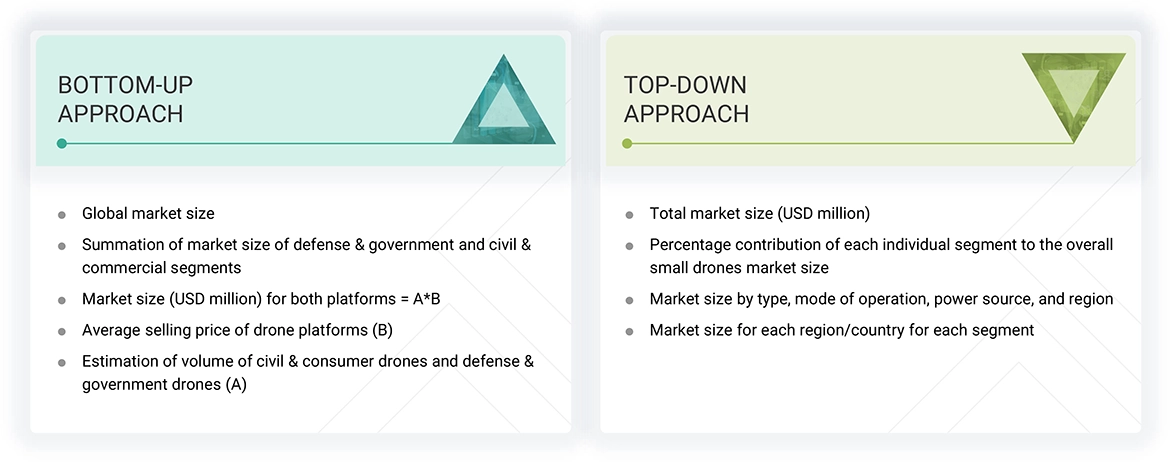
The research study on the small drones market involved the extensive use of secondary sources, directories, and databases, such as D&B Hoovers, Bloomberg, and Factiva, to identify and collect relevant information. Primary sources included industry experts from the market, as well as suppliers, manufacturers, solution providers, technology developers, alliances, and organizations related to all segments of the industry’s value chain. In-depth interviews of primary respondents, including industry participants, subject matter experts, industry consultants, and C-level executives, were conducted to obtain and verify critical qualitative and quantitative information about the market and assess the market’s growth prospects. A deductive approach, also known as the bottom-up approach, combined with the top-down approach, was used to forecast the market size of different segments.
Secondary Research
The share of companies in the small drones market was determined based on secondary data made available through paid and unpaid sources and an analysis of the product portfolios of major companies. These companies were rated based on their performance and quality. These data points were further validated by primary sources. Secondary sources for this research study included corporate filings, such as annual reports, investor presentations, and financial statements from trade, business, and professional associations. The secondary data was collected and analyzed to determine the overall market size, which was further validated by primary respondents.
Primary Research
Extensive primary research was conducted after obtaining information about the current scenario of the small drones market through secondary research. Several primary interviews were conducted with market experts from both the demand and supply sides across different regions. This primary data was collected through questionnaires, emails, and telephonic interviews.
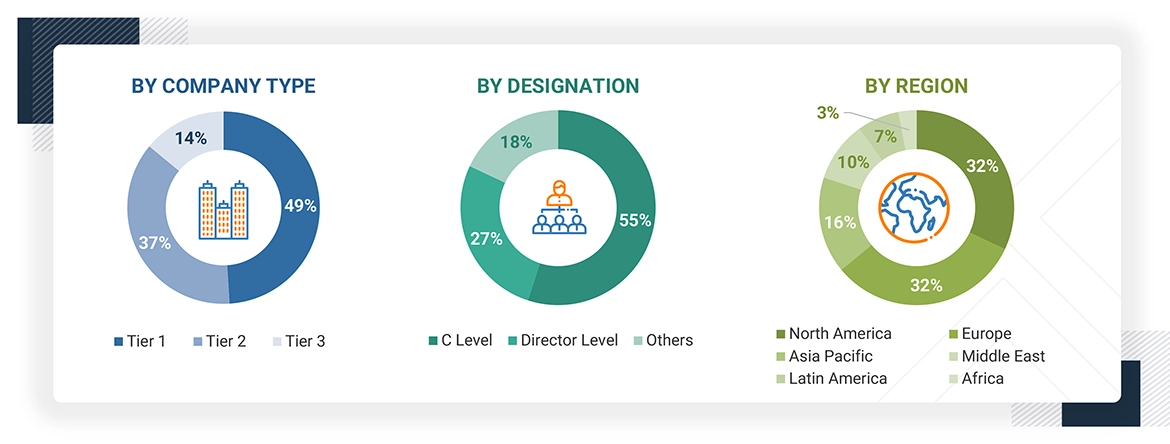
Note: Others include sales, marketing, and product managers.
The tiers of companies have been defined based on their total revenue as of 2024. Tier 1 = >USD 1 billion; tier 2 = between USD 100 million and USD 1 billion; and tier 3 = USD 100 million.
To know about the assumptions considered for the study, download the pdf brochure
Market Size Estimation
The top-down and bottom-up approaches were used to estimate and validate the size of the small drones market. The research methodology used to estimate the market size includes the following details.
Key market players were identified through secondary research, and their market share was determined through primary and secondary research. This included a study of the annual and financial reports of top players and extensive interviews with industry stakeholders such as CEOs, technical advisors, military experts, and subject matter experts of leading companies operating in the small drones market.
All percentage shares, splits, and breakdowns were determined using secondary sources and verified through primary sources. All possible parameters that affect the markets covered in this research study were accounted for, viewed in extensive detail, verified through primary research, and analyzed to obtain the final quantitative and qualitative data on the small drones market. This data was consolidated, enhanced with detailed inputs, analyzed by MarketsandMarkets, and presented in this report.
Small Drones Market : Top-Down and Bottom-Up Approach
Data Triangulation
After arriving at the overall size of the small drones market from the estimation process explained above, the total market was split into several segments and subsegments. The data triangulation and market breakdown procedures explained below were implemented, wherever applicable, to complete the overall market engineering process and arrive at the exact statistics for various market segments and subsegments. The data was triangulated by studying different factors and trends from the demand and supply sides. The small drones market size was also validated using top-down and bottom-up approaches.
Market Definition
Small drones, or small unmanned aerial vehicles (SUAVs), are remotely piloted aerial vehicles that play significant roles in the defense and commercial sectors. These drones are used in various missions, such as military attacks and border surveillance. They are also used for mapping, surveying, determining weather conditions, and enforcing regional laws.
Key Stakeholders
- Drone manufacturers
- Component suppliers
- Government and regulatory bodies
- Military and defense organizations
- Commercial sector companies
- Drone service providers
- Technology developers
- End users
Report Objectives
- To define, describe, segment, and forecast the size of the small drones market based on platform, application, type, mode of operation, and power source
- To forecast the size of various market segments within six regions: North America, Europe, Asia Pacific, Middle East, Africa, and Latin America
- To identify and analyze key drivers, restraints, opportunities, and challenges influencing market growth
- To provide an overview of the regulatory landscape with respect to drone detection regulations
- To analyze micro markets with respect to individual growth trends, prospects, and their contribution to the overall market
- To analyze opportunities in the market for stakeholders by identifying key market trends
- To profile key market players and comprehensively analyze their market share and core competencies
- To analyze the degree of competition in the market by identifying growth strategies adopted by leading players, such as acquisitions, contracts, partnerships, and product launches
- To identify detailed financial positions, key products, and unique selling points of leading players
- To provide a detailed competitive landscape of the market, along with market ranking analysis, market share analysis, and revenue analysis of key players
Available Customizations
Along with the market data, MarketsandMarkets offers customizations to meet the specific needs of companies. The following customization options are available for the report:
Product Analysis
- Product matrix, which gives a detailed comparison of the product portfolio of each company
Regional Analysis
- Further breakdown of market segments at the country level
Company Information
- Detailed analysis and profiling of five additional market players
Get the Full Small Drones Market Report
Full forecast, segment splits, and company analysis for all Small Drones Market.
- UAE Small Drones Market
- Saudi Arabia Small Drones Market
- Israel Small Drones Market
- Turkey Small Drones Market
- Brazil Small Drones Market
- Mexico Small Drones Market
- Argentina Small Drones Market
- South Africa Small Drones Market
- Nigeria Small Drones Market
- Rest Of Europe Small Drones Market
- Rest Of Asia Pacific Small Drones Market
- Canada Small Drones Market
- US Small Drones Market
- UK Small Drones Market
- Germany Small Drones Market
- France Small Drones Market
- Italy Small Drones Market
- Russia Small Drones Market
- Sweden Small Drones Market
- China Small Drones Market
- India Small Drones Market
- Japan Small Drones Market
- South Korea Small Drones Market
Need a Tailored Report?
Customize this report to your needs
Get 10% FREE Customization
Customize This Report
