
UK Smart Lighting Market (2025-2030)

The UK Smart Lighting Market was valued at $431.1 Million in 2025 and projected to reach to $737.2 Million by 2030, representing a compound annual growth rate of 11.3%. The UK smart lighting market is positioned for sustained growth through 2030, supported by stringent energy efficiency mandates and the government's net-zero carbon commitments.


| Market Size in | USD 26.32 MN |
| Market Forecast in | |
| CAGR | |
| Forecast Period | |
| Units Considered | Value (USD MN) |
UK Smart Lighting Market Trends and Insights
- The UK market is driven by increasing adoption of IoT-enabled lighting solutions across residential, commercial, and industrial sectors.
- In the UK, energy efficiency regulations and government sustainability initiatives are accelerating the transition from traditional to smart lighting systems. The UK smart lighting market benefits from strong consumer awareness and early technology adoption rates.
- UK businesses are investing in connected lighting infrastructure to reduce operational costs and enhance building automation capabilities.
- The UK's mature retail and hospitality sectors are particularly active in deploying smart lighting solutions to improve customer experience and energy management. By 2030, the UK smart lighting market is expected to capture significant value as smart home penetration increases and commercial real estate modernization continues.
- The UK market's growth trajectory reflects both consumer demand for intelligent lighting control and regulatory pressure to meet carbon reduction targets across the nation..
Key Market Statistics
- CAGR (2025-2030) 11.3% CAGR
- Market Size, 2025 ~USD 431.1 Million
- Forecast, 2030 ~USD 737.2 Million
- Country UK
UK Smart Lighting Market Overview
Market Valuation Growth :
The UK smart lighting market is valued at $431.1 million in 2025 and is projected to reach $737.2 million by 2030, representing a robust 11.3% CAGR over the forecast period.
Regulatory Drivers :
UK energy efficiency regulations and government sustainability initiatives are accelerating the transition from traditional lighting to smart, IoT-enabled solutions across all sectors.
Sector Expansion :
Smart lighting adoption is accelerating across residential, commercial, and industrial sectors in the UK, driven by cost savings, automation capabilities, and environmental compliance requirements.
IoT Integration :
Increasing adoption of IoT-enabled lighting solutions is transforming the UK market, enabling remote control, energy monitoring, and integration with smart building ecosystems.
UK Smart Lighting Market Dynamics
- Commercial and industrial sectors are leading adoption, driven by operational cost reductions and sustainability goals.
- Residential adoption is accelerating as consumer awareness of smart home benefits increases and product prices become more competitive.
- The integration of AI and advanced analytics into lighting systems is expected to unlock new value propositions, particularly in predictive maintenance and occupancy-based optimization..
Market Ecosystem
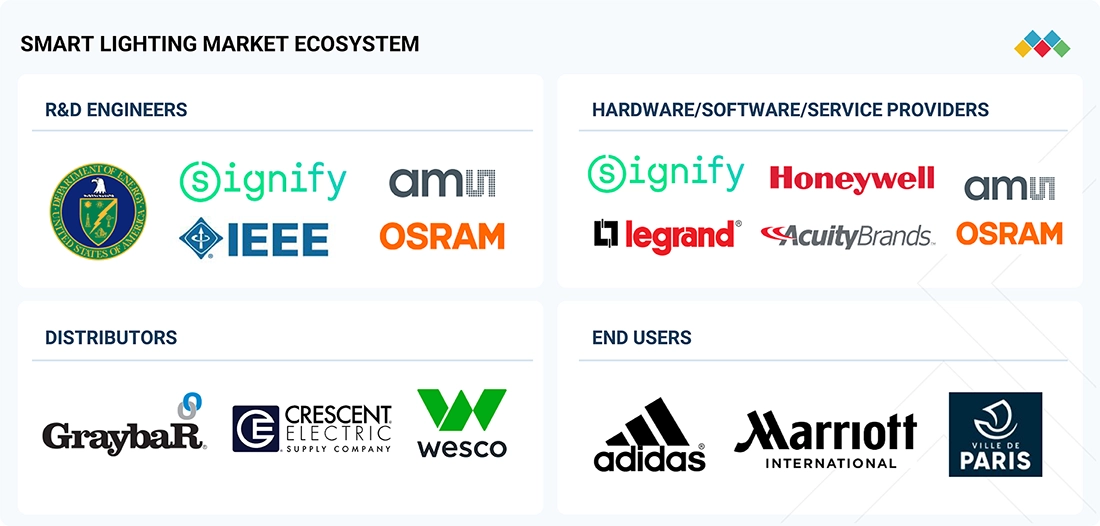
Smart Lighting Market: COMMERCIAL USE CASES ACROSS INDUSTRIES
| COMPANY | USE CASE DESCRIPTION | BENEFITS |
|---|---|---|
 |
Comprehensive smart lighting systems for residential, commercial, and outdoor environments, integrating sensors, wireless control, and cloud-based management. | Industry leadership, high energy efficiency, advanced IoT connectivity, and strong interoperability with smart home ecosystems. |
 |
Intelligent lighting solutions featuring wireless controls, occupancy sensing, and daylight harvesting for smart buildings and industrial spaces. | Enhanced energy savings, automation-driven lighting optimization, and improved operational efficiency in connected environments. |
 |
Smart switches, lighting control systems, and integrated building management solutions for commercial and residential infrastructure. | Seamless integration with building automation systems, user-friendly interfaces, and improved lighting flexibility and comfort. |
 |
Networked lighting systems integrated with building management platforms for industrial, commercial, and institutional facilities. | Real-time lighting control, improved energy management, enhanced occupant comfort, and reduced operational costs. |
 |
IoT-enabled smart lighting solutions for homes, offices, and public infrastructure, incorporating motion sensors and wireless connectivity. | Improved energy efficiency, flexible installation, enhanced user experience, and alignment with sustainable smart city initiatives. |
Logos and trademarks shown above are the property of their respective owners. Their use here is for informational and illustrative purposes only.
Related Ecosystem
Smart Home
- Sensors
- Pressure Sensors
- Temperature Sensors
- Actuators
- Face Recognition
- HONEYWELL INTERNATIONAL INC.
- SCHNEIDER ELECTRIC SE
- Siemens ag
- Samsung
- ABB India Limited
Smart Lighting
- Fiber Laser
- Fluorescent Lighting
- Gas Lasers
- Sensors
- 3D Sensors
- Zumtobel group ag
- Nedap n.v.
- Acuity Brands, Inc.
- OSRAM Licht AG
- Philips
Key Takeaways
- The UK smart lighting market will grow from $431.1M (2025) to $737.2M (2030), representing 71% total growth over the forecast period.
- The UK market is expanding at an 11.3% CAGR, driven by energy efficiency mandates and smart home adoption across residential and commercial segments.
- UK businesses prioritize smart lighting for operational cost reduction and building automation, with retail and hospitality sectors leading adoption.
- Regulatory pressure and sustainability targets in the UK are accelerating the transition from traditional to connected lighting infrastructure.
Smart Lighting Market Report Scope
| Report Metric | Details |
|---|---|
| Base Year | 2025 |
| Fastest Growing Segment | RETROFIT INSTALLATIONS (Installation Type) |
| Forecast Period | 2025–2030 |
| Growth Rate | CAGR of 12% from 2025 to 2030 |
| Largest Segment | INDOOR (End-Use Application) |
| Market Size Base Year (Billions) | ~USD 9.86 (2025) |
| Revenue Forecast (Billions) | ~USD 17.38 (2030) |
| Segments Covered | Communication Technology, Type, End-Use Application, Application, Distribution Channel, Offering, Hardware, Component, Installation Type |
UK Smart Lighting Market Report Segmentation
9 segment dimensions are covered across the global market.
By Communication Technology
- Wired
- Wireless
By Type
- 6Lowpan
- Ble
- Dali
- Enocean
- Post-Installation
- Power Line Communications (Plc)
- Power Over Ethernet (Poe)
- Pre-Installation
- Wi-Fi
- Wired Hybrid Protocols
- Wireless Hybrid Protocols
- Zigbee
By End-Use Application
- Indoor
- Outdoor
By Application
- Architectural Lighting
- Commercial
- Highways And Roadways Lighting
- Industrial
- Lighting For Public Places
- Residential
By Distribution Channel
- Offline Sales
- Online Sales
By Offering
- Hardware
- Services
- Software
By Hardware
- Lighting Controls
- Lights & Luminaires
By Component
- Dimmers
- Gateways
- Led Driver & Ballasts
- Led Drivers & Ballasts
- Relay Units
- Sensors
- Switches
By Installation Type
- New Installations
- Retrofit Installations
Target Audience
- UK Lighting Manufacturers : Manufacturers need UK-specific market data to understand local demand patterns, competitive positioning, and growth opportunities in residential, commercial, and industrial segments.
- Smart Home Technology Providers : Smart home companies require detailed UK market insights to identify integration opportunities, assess market penetration rates, and develop localized product strategies.
- Commercial Real Estate & Facilities Managers : Facilities managers need market analysis to justify smart lighting investments, understand ROI timelines, and align upgrades with UK sustainability and energy efficiency mandates.
- UK Government & Policy Bodies : Government agencies and policymakers need market intelligence to evaluate the effectiveness of energy efficiency regulations and sustainability initiatives on smart lighting adoption.
- Investment & Venture Capital Firms : Investors targeting the UK smart lighting sector require comprehensive market forecasts, growth drivers, and competitive landscape analysis to identify promising investment opportunities.
Key Companies in the UK Smart Lighting Market
| Company | HQ | Ownership | Strongest segments |
|---|---|---|---|
| AT&S | Austria | ||
| SAMSUNG | Korea, South | ||
| BOREALIS AG | United States | ||
| FOXCONN INDUSTRIAL INTERNET CO LTD | United States | ||
| PLDT ENTERPRISE | Philippines | ||
| DIODES INCORPORATED | United States |
AT&S
AT&S Austria is a printed circuit board manufacturer producing high-tech interconnect solutions for various industrial and electronic applications.
SAMSUNG
Samsung is a South Korean multinational conglomerate operating across electronics, semiconductors, telecommunications, and consumer appliances.
BOREALIS AG
Borealis AG is a polyolefins and base chemicals company based in the United States, producing materials for packaging, automotive, and industrial applications.
FOXCONN INDUSTRIAL INTERNET CO LTD
Foxconn Industrial Internet Co Ltd is a United States-based electronics manufacturing and industrial internet services provider.
PLDT ENTERPRISE
PLDT Enterprise is a Philippines-based telecommunications and ICT solutions provider serving business customers with connectivity and digital services.
DIODES INCORPORATED
Diodes Incorporated is a United States semiconductor manufacturer producing analog and mixed-signal integrated circuits for various applications.
Reasons to Buy this Report
- UK-Specific Market Sizing : Access precise valuation data for the UK smart lighting market with detailed forecasts through 2030, enabling accurate budget allocation and investment planning for UK operations.
- Regulatory Landscape Intelligence : Understand UK-specific energy efficiency regulations and government sustainability initiatives shaping market dynamics, ensuring compliance and competitive positioning in the British market.
- Sector-Level Insights : Gain detailed analysis of smart lighting adoption across UK residential, commercial, and industrial sectors, identifying high-growth opportunities and sector-specific growth drivers.
- Competitive Strategy Development : Leverage UK market trends and growth projections to develop targeted go-to-market strategies, product positioning, and partnership opportunities specific to the British market.
- Investment Decision Support : Make informed investment and expansion decisions with comprehensive UK market data, CAGR analysis, and forecast scenarios for smart lighting technology and solutions.
Frequently asked questions
What is the current size of the UK smart lighting market?
The UK smart lighting market is valued at $431.1 million in 2025 and is projected to reach $737.2 million by 2030.
What is the growth rate of the UK smart lighting market?
The UK smart lighting market is growing at a compound annual growth rate (CAGR) of 11.3% from 2025 to 2030.
Which sectors are driving growth in the UK smart lighting market?
Residential smart homes, commercial office buildings, retail environments, and hospitality venues are the primary growth drivers in the UK market.
What regulatory factors influence the UK smart lighting market?
UK energy efficiency regulations, building codes, and government carbon reduction targets are key regulatory drivers accelerating smart lighting adoption.
How much will the UK smart lighting market grow by 2030?
The UK smart lighting market is expected to grow by $306.1 million from 2025 to 2030, representing approximately 71% total growth.
RESEARCH METHODOLOGY
The research study involved 4 major activities in estimating the size of the smart lighting market. Exhaustive secondary research has been done to collect important information about the market and peer markets. The validation of these findings, assumptions, and sizing with the help of primary research with industry experts across the supply chain has been the next step. Both top-down and bottom-up approaches have been used to estimate the market size. Post which the market breakdown and data triangulation have been adopted to estimate the market sizes of segments and sub-segments.
Secondary Research
In the secondary research process, various secondary sources have been referred to for identifying and collecting information required for this study. The secondary sources include annual reports, press releases, investor presentations of companies, white papers, and articles from recognized authors. Secondary research has been mainly done to obtain key information about the market’s value chain, the pool of key market players, market segmentation according to industry trends, regional outlook, and developments from both market and technology perspectives.
Primary Research
In primary research, various primary sources from both supply and demand sides have been interviewed to obtain qualitative and quantitative insights required for this report. Primary sources from the supply side include experts such as CEOs, vice presidents, marketing directors, manufacturers, technology and innovation directors, end users, and related executives from multiple key companies and organizations operating in the smart lighting market ecosystem. After interacting with industry experts, brief sessions were conducted with highly experienced independent consultants to reinforce the findings from our primary. This, along with the in-house subject matter experts’ opinions, has led us to the findings as described in the remainder of this report. The breakdown of primary respondents is as follows:
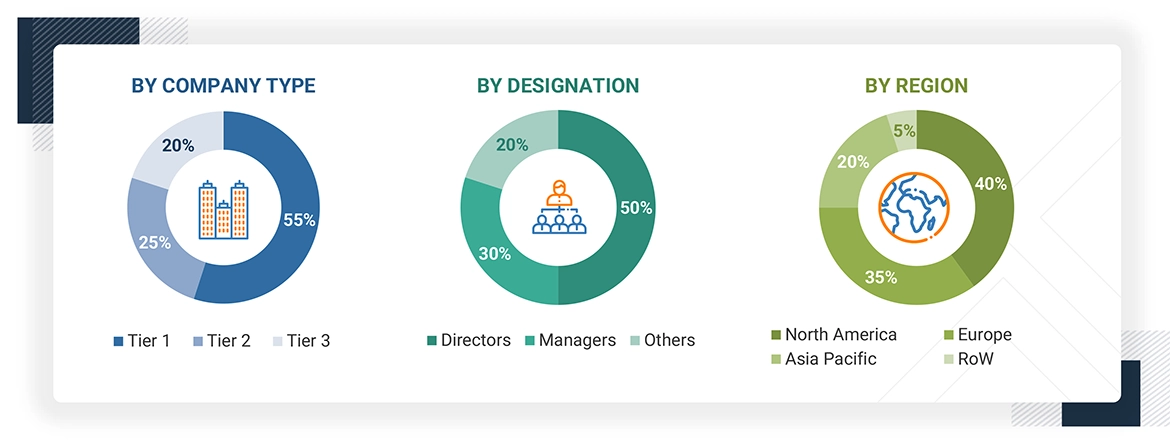
Note: “Others” includes sales, marketing, and product managers
To know about the assumptions considered for the study, download the pdf brochure
Market Size Estimation
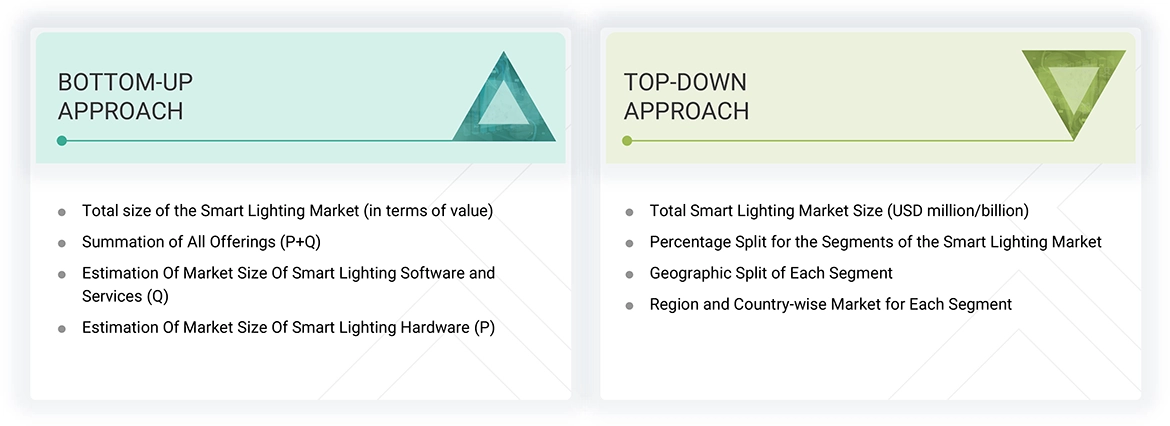
The bottom-up procedure has been employed to arrive at the overall size of the smart lighting market.
- Identification of major companies providing smart lighting hardware, software, and services
- Identification of key segments within the smart lighting market across different geographical regions
- Estimation of the market size in various regions by analyzing the adoption of smart lighting solutions across different industries
- Determination of market share estimates for deployments in different end-use application segments by assessing the demand for smart lighting products and solutions
- Tracking ongoing and upcoming developments in smart lighting products
- Compilation of regional market size data for each segment to derive regional market estimates
- Conducting interviews with multiple key leaders to comprehend the smart lighting market scope, product demand, future market growth, and potential impact of economic downturns
- Verification and validation of estimates through cross-checking with primary sources, discussions with leaders, and consultation with domain experts at MarketsandMarkets
- Analysis of various paid and unpaid information sources, including annual reports, press releases, white papers, and databases
The top-down approach has been used to estimate and validate the total size of the smart lighting market.
- Focusing, initially, on the top-line investments and spending in the ecosystems of various industries. Tracking further splits based on product launches, advancements in smart lighting technologies, smart lighting solutions and software used for various industrial applications, and developments in the key market areas
- Representing and developing the information related to market revenue offered by key hardware, software, and service providers
- Carrying out multiple on-field discussions with key opinion leaders across each major company involved in the development of hardware and software components and services pertaining to smart lighting
- Estimating the geographic split using secondary sources based on factors such as the number of players in a specific country and region, types of products, levels of services offered, and types of software implemented.
Smart Lighting Market : Top-Down and Bottom-Up Approach
Data Triangulation
After arriving at the overall market size—using the market size estimation processes as explained above—the market has been split into several segments and subsegments. To complete the entire market engineering process and arrive at the exact statistics of each market segment and subsegment, data triangulation and market breakdown procedures have been employed, wherever applicable. The data has been triangulated by studying various factors and trends from the demand and supply sides of the smart lighting market.
Market Definition
Smart lighting systems combine automation technologies with connectivity features and intelligent control aspects to deliver enhanced efficiency and improved experience paired with convenience. The system contains LED luminaires, sensors, and wire-based or wireless communication systems to allow remote monitoring and scheduling adjustments based on occupancy status, daylight exposure, and user settings. Users can operate smart lighting systems through mobile applications, voice commands, and centralized automation networks which enable full control of brightness adjustments, color temperature settings, and hue transformation features. These devices play an essential role in residential, commercial, and industrial sectors, helping to reduce energy consumption while aiding sustainability efforts.
Key Stakeholders
- Raw material and component suppliers
- Communication network providers
- Smart lighting device manufacturers
- Original equipment manufacturers
- Semiconductor component suppliers
- Analysts and strategic business planners
- Venture capitalists and start-ups
- Research laboratories and intellectual property (IP) companies
- Technology standards organizations, forums, alliances, and associations
- Hardware vendors
- Software integrators
- Smart lighting solutions-related service providers
- End users
- Government bodies such as regulatory authorities and policymakers
Report Objectives
- To define, estimate, and forecast the smart lighting market based on hardware, software, and services offerings, wired and wireless communication technologies, indoor and outdoor applications, online and offline sales distribution channels, and new and retrofit installation types
- To estimate and project the market size, in terms of value, for various segments with respect to four regions: Americas, Europe, Asia Pacific, and the Rest of the World (ROW)
- To describe and forecast the smart lighting market size, in terms of volume, by hardware offering
- To provide detailed insights regarding drivers, restraints, opportunities, and challenges influencing the growth of the market
- To analyse emerging applications and standards in the smart lighting market
- To examine manufacturers of smart lighting products, their strategies, production plans, and the overall supply chain, including material and component suppliers
- To strategically analyse the micromarkets1 with respect to individual growth trends, prospects, and contributions to the overall market
- To analyse the market opportunities for stakeholders, and provide a comprehensive competitive landscape analysis
- To provide a detailed overview of the smart lighting value chain and ecosystem
- To provide a detailed overview of impact of AI/Gen AI on smart lighting market
- To provide information about the key technology trends, trade analysis, and patents related to the smart lighting market
- To benchmark the market players using the proprietary company evaluation matrix framework, which analyses them on various parameters within the broad categories of market ranking/share and product portfolio
- To analyse competitive developments, such as partnership, acquisitions, agreements, collaborations, and product launches
- To strategically profile key players and analyse their market share, ranking, and core competencies
This research report categorizes the smart lighting market based on offering, communication technology, installation type, distribution channel, end-use application, and region.
Available Customizations
With the given market data, MarketsandMarkets offers customizations according to the specific requirements of companies. The following customization options are available for the report:
- Detailed analysis and profiling of additional market players based on various blocks of the supply chain
Get the Full Smart Lighting Market Report
Full forecast, segment splits, and company analysis for all Smart Lighting Market.
- US Smart Lighting Market
- Canada Smart Lighting Market
- Mexico Smart Lighting Market
- Germany Smart Lighting Market
- France Smart Lighting Market
- Italy Smart Lighting Market
- Spain Smart Lighting Market
- Netherlands Smart Lighting Market
- China Smart Lighting Market
- Japan Smart Lighting Market
- India Smart Lighting Market
- South Korea Smart Lighting Market
- Brazil Smart Lighting Market
- Argentina Smart Lighting Market
Need a Tailored Report?
Customize this report to your needs
Get 10% FREE Customization
Customize This Report
