



Smart Lighting Market Size, Share & Growth Trends Forecast to 2030
Report Code
SE 2506
Published in
Feb, 2025, By MarketsandMarkets™
Smart Lighting Market Size, Share, Growth & Trends by Lights and Luminaire, Lighting Controls, LED Drivers and Ballasts, Sensors, Switches, Gateways, Dimmers, Relay Units, DALI, Power over Ethernet (PoE), Power Line Communications (PLC) and Zigbee - Global Forecast to 2030

USD 17.38 BN
MARKET SIZE, 2030

CAGR 12%
(2025-2030)

305
REPORT PAGES

233
MARKET TABLES
SMART LIGHTING MARKET OVERVIEW
According to Marketsandmarkets, the global smart lighting market size was valued at USD 9.86 billion in 2025 and is projected to reach USD 17.38 billion by 2030, growing at a CAGR of 12.0% from 2025 to 2030. There are multiple factors driving the growth of the smart lighting market. Establishment of digital and standard protocols by regulatory bodies, increasing smart city initiatives globally, advancements in AI and edge computing, growing adoption of LEDs and luminaires in outdoor applications, rising demand for IoT- integrated smart lighting solutions, and increasing penetration of data analytics in smart lighting are some of the major factors influencing the market growth.
REPORT SCOPE
| REPORT METRIC | DETAILS |
|---|---|
| Market Size in 2025 (Value) | USD 9.86 Billion |
| Market Forecast in 2030 (Value) | USD 17.38 Billion |
| Growth Rate | CAGR of 12.0% from 2025-2030 |
| Years Considered | 2021-2030 |
| Base Year | 2024 |
| Forecast Period | 2025-2030 |
| Units Considered | Value (USD Million/Billion), Volume (Thousand Units) |
| Report Coverage | Revenue forecast, company ranking, competitive landscape, growth factors, and trends |
| Segments Covered |
|
| Regions Covered | Americas, Europe, Asia Pacific, and RoW |
| Top Companies |
|
| Drive Growth |
|
The smart lighting industry has emerged as one of the most dynamic segments within the broader smart home and commercial automation industry, driven by rapid adoption of energy-efficient and connected lighting solutions. According to recent industry reports, the global smart lighting market size is projected to grow significantly over the next decade, propelled by increasing investments in IoT infrastructure, rising consumer demand for automated lighting controls, and strong regulatory support for energy savings. Market analysis shows that devices such as smart bulbs, adaptive luminaires, and networked control systems collectively account for the largest industry share, as both residential and commercial sectors seek solutions that offer real-time control, mesh connectivity, and integration with AI assistants. Key statistics indicate a forecasted annual growth rate that outpaces traditional lighting, underscoring the transition toward intelligent lighting ecosystems.
Smart lighting market growth trends in the smart led lighting market reveal that technological advancements and consumer preferences are reshaping industry dynamics. Smart lighting devices now incorporate features such as occupancy sensing, adaptive brightness, daylight harvesting, and remote programming boosting demand across end-use verticals. Detailed market forecasts highlight that the Asia-Pacific region is expected to register robust growth, while North America and Europe continue to hold substantial market share due to higher penetration of connected devices. Industry analysis further points to the expanding role of wireless protocols and standardized interoperability frameworks, enabling seamless integration with broader building management systems. With sustainability goals driving investments and a growing array of product innovations, smart lighting is set to experience sustained growth in both consumer and enterprise applications worldwide.
Market Size & Forecast
• 2025 Market Size: USD 9.86 billion
• 2030 Projected Market Size: USD 17.38 billion
• CAGR (2025-2030): 12.0%
• Outdoor lighting: Expected to exhibit the highest CAGR
• Asia Pacific: Expected to exhibit the highest CAGR
SMART LIGHTING MARKET KEY TAKEAWAYS
-
BY OFFERINGOffering includes Hardware, Software, and Services. Services in the smart lighting market growth are expected to exhibit the highest CAGR due to growing demand for installation, maintenance, and managed lighting solutions that ensure optimal performance and energy efficiency.
-
BY INSTALLATION TYPEInstallation type segment includes New Installations and Retrofit Installations. Retrofit installations are expected to exhibit the highest CAGR due to increasing demand for upgrading existing lighting infrastructure to energy-efficient, IoT-enabled systems without major capital expenditure.
-
BY COMMUNICATION TECHNOLOGYThe communication technology segment includes Wired and Wireless. Wired communication technology is expected to lead the smart lighting market in 2024 due to its reliable data transmission, low latency, and secure connectivity, which are critical for large-scale urban and industrial lighting networks.
-
BY DISTRIBUTION CHANNELDistribution channel includes online sales and offline sales. Offline sales are expected to lead in 2024 because traditional retail channels and direct distributor networks remain the primary choice for commercial and municipal lighting purchases, where buyers prefer in-person evaluation and installation support.
-
BY END-USE APPLICATIONThe end-use application segment includes indoor and outdoor applications. Outdoor lighting is expected to exhibit the highest CAGR due to increasing smart city projects, rising demand for energy-efficient streetlights, and the need for adaptive, IoT-enabled public and roadway illumination.
-
BY REGIONAsia Pacific is expected to exhibit the highest CAGR due to rapid urbanization, strong smart city initiatives, and increasing adoption of energy-efficient, IoT-enabled lighting solutions across commercial and public infrastructure.
-
COMPETITIVE LANDSCAPEThe major market players have adopted both organic and inorganic strategies, including partnerships, expansions, and product launches. For instance, in November 2024, the lighting brands Thorn and Zumtobel of Zumtobel Group joined forces with Sunderland Association Football Club (Sunderland AFC) to execute an extensive Stadium of Light illumination upgrade.
The smart lighting market share is being driven by rapid urbanization and the global push for smart city initiatives, which are fueling demand for connected and energy-efficient lighting solutions. Rising adoption of IoT-enabled and human-centric lighting systems in commercial, residential, and public spaces is further accelerating market growth. Technological advancements such as AI-based adaptive lighting, Li-Fi integration, and sensor-driven automation are enabling smarter, more responsive lighting networks. Additionally, supportive government policies promoting energy efficiency, sustainability, and reduced carbon emissions are creating new opportunities, while increasing investments and partnerships between lighting vendors and IoT platform providers are shaping the competitive landscape.
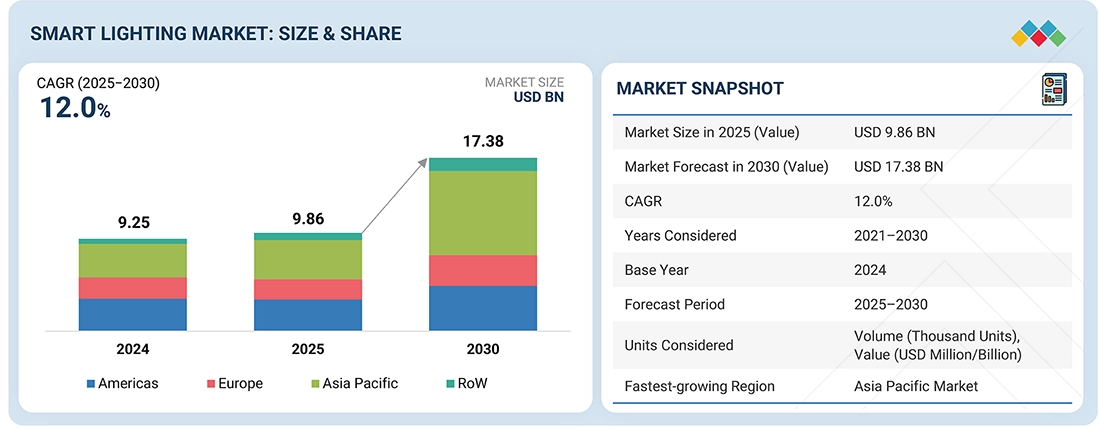
Source: Secondary Research, Interviews with Experts, MarketsandMarkets Analysis
SMART LIGHTING MARKET TRENDS & DISRUPTIONS IMPACTING CUSTOMERS' CUSTOMERS
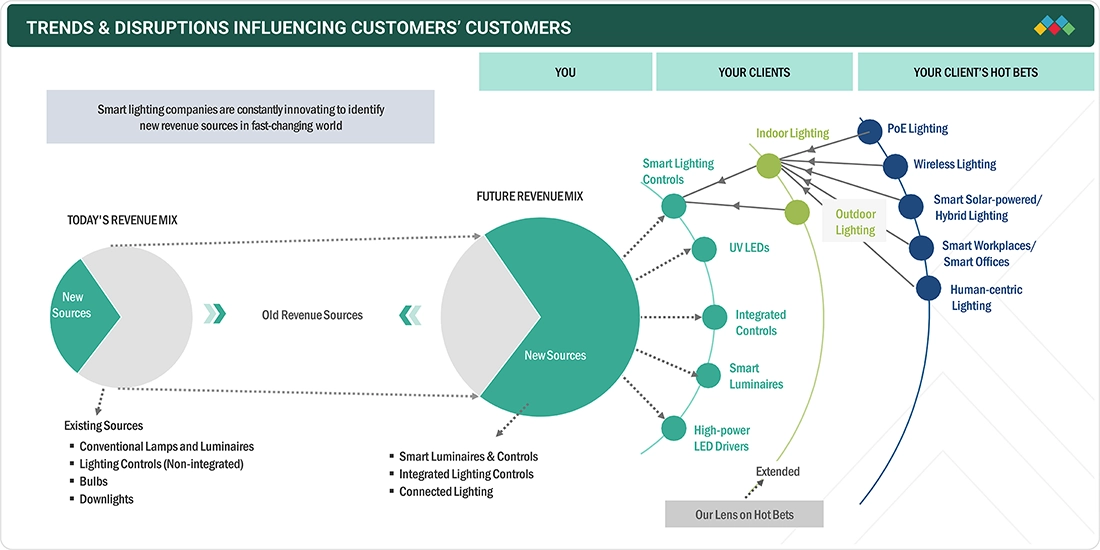
Smart lighting companies are increasingly shifting from traditional lamps, bulbs, and non-integrated controls toward connected, integrated, and human-centric lighting solutions to capture new revenue streams. Innovations such as PoE lighting, wireless systems, smart solar-powered lighting, and IoT-enabled smart workplaces are redefining the market, enabling enhanced energy efficiency, automation, and user-centric experiences. This transition reflects a broader disruption as companies pivot from conventional revenue sources to smart, technology-driven lighting offerings.
Source: Secondary Research, Interviews with Experts, MarketsandMarkets Analysis
SMART LIGHTING MARKET DYNAMICS

Drivers
Impact
Level
Level
-
Increasing smart city initiatives

-
Rising demand for IoT-integrated smart lighting solutions


RESTRAINTS
Impact
Level
Level
-
Difficulties associated with retrofitting of traditional lighting infrastructure

-
Cybersecurity concerns associated with internet-connected lighting systems


OPPORTUNITIES
Impact
Level
Level
-
Emerging smart office and smart retail trends

-
Rising adoption of human-centric lighting solutions


CHALLENGES
Impact
Level
Level
-
Interoperability and compatibility issues

-
High upfront costs of equipment & accessories

Source: Secondary Research, Interviews with Experts, MarketsandMarkets Analysis
Driver: Increasing Smart City Initiatives
The growing implementation of smart city projects is driving the deployment of connected and energy-efficient lighting systems. Governments and municipalities are increasingly adopting smart lighting to enhance urban infrastructure, reduce energy consumption, and enable adaptive illumination for public safety and sustainability.
Restraint: Cybersecurity Concerns Associated with Internet-Connected Lighting Systems
As lighting systems become part of larger IoT networks, they are exposed to cybersecurity vulnerabilities. Unauthorized access or hacking can compromise data privacy or disrupt operations, making robust encryption, secure communication protocols, and continuous monitoring essential for system integrity.
Opportunity: Emerging Smart Office and Smart Retail Trends
The increasing adoption of intelligent lighting in offices and retail spaces presents significant growth opportunities. Smart lighting enhances employee productivity, improves customer experience, and supports energy optimization through automation and personalized control, aligning with modern workplace and retail transformation trends.
Challenge: High Upfront Costs of Equipment & Accessories
The adoption of smart lighting systems is often limited by the high initial investment required for sensors, controllers, communication modules, and installation. These costs can be challenging for small-scale projects or developing regions, despite long-term savings through reduced energy and maintenance expenses.
Smart Lighting Market: COMMERCIAL USE CASES ACROSS INDUSTRIES
| COMPANY | USE CASE DESCRIPTION | BENEFITS |
|---|---|---|
 |
Comprehensive smart lighting systems for residential, commercial, and outdoor environments, integrating sensors, wireless control, and cloud-based management. | Industry leadership, high energy efficiency, advanced IoT connectivity, and strong interoperability with smart home ecosystems. |
 |
Intelligent lighting solutions featuring wireless controls, occupancy sensing, and daylight harvesting for smart buildings and industrial spaces. | Enhanced energy savings, automation-driven lighting optimization, and improved operational efficiency in connected environments. |
 |
Smart switches, lighting control systems, and integrated building management solutions for commercial and residential infrastructure. | Seamless integration with building automation systems, user-friendly interfaces, and improved lighting flexibility and comfort. |
 |
Networked lighting systems integrated with building management platforms for industrial, commercial, and institutional facilities. | Real-time lighting control, improved energy management, enhanced occupant comfort, and reduced operational costs. |
 |
IoT-enabled smart lighting solutions for homes, offices, and public infrastructure, incorporating motion sensors and wireless connectivity. | Improved energy efficiency, flexible installation, enhanced user experience, and alignment with sustainable smart city initiatives. |
Logos and trademarks shown above are the property of their respective owners. Their use here is for informational and illustrative purposes only.
SMART LIGHTING MARKET ECOSYSTEM
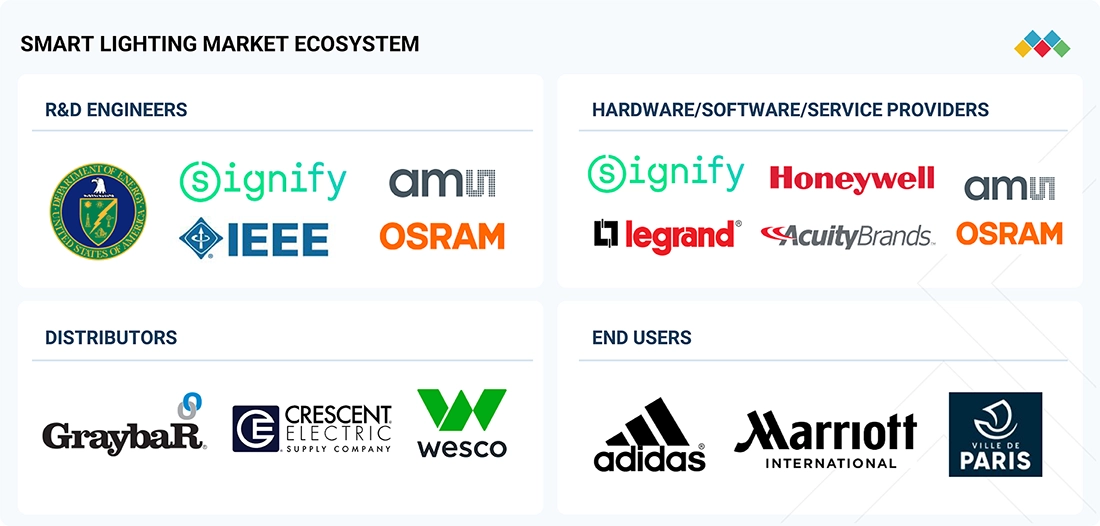
The smart lighting ecosystem comprises R&D engineers driving innovation, hardware, software, and services providers developing integrated solutions, distributors facilitating market reach, and end users adopting connected lighting for energy efficiency, automation, and enhanced user experience. This interconnected network ensures continuous product improvement, seamless deployment, and scalable adoption across residential, commercial, and industrial segments.
Logos and trademarks shown above are the property of their respective owners. Their use here is for informational and illustrative purposes only.
SMART LIGHTING MARKET SEGMENTS
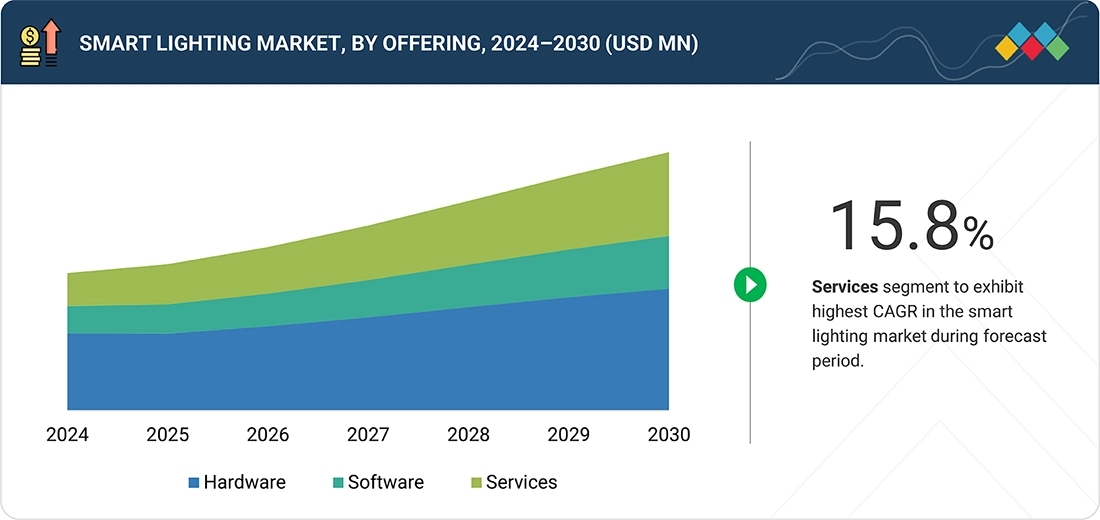
Source: Secondary Research, Interviews with Experts, MarketsandMarkets Analysis
Smart Lighting Market Growth, Offering
Hardware is expected to lead in 2024 as it forms the foundation of smart lighting systems. The growing adoption of connected lighting across residential, commercial, and industrial segments drives strong demand for physical components that enable automation, energy management, and integration with smart networks.
Smart Lighting Market, Installation Type
Retrofit installation is projected to show the highest CAGR due to the preference for upgrading existing lighting systems rather than installing entirely new setups. This approach offers cost efficiency, convenience, and faster deployment, allowing buildings to modernize and achieve energy savings without major structural changes.
Smart Lighting Market, Communication Technology
Wireless communication technology is expected to grow fastest due to its flexibility, scalability, and ease of deployment. It simplifies installation, support integration with smart systems, and enable seamless connectivity in both new and existing environments, aligning with the increasing demand for automated and connected lighting.
Smart Lighting Market, By Distribution Channel
Offline sales are anticipated to lead as customers rely on hands-on evaluation, personalized guidance, and immediate access to solutions. Distributors, retail outlets, and installers remain key in educating end users, ensuring proper setup, and fostering trust, which is critical for widespread adoption.
Smart Lighting Market, By End-use Application
Indoor commercial applications are expected to dominate due to growing adoption in offices, retail, and institutional facilities. The focus on improving productivity, user comfort, operational efficiency, and sustainability drives strong demand for smart lighting solutions in these environments.
SMART LIGHTING MARKET GROWTH REGION
Asia Pacific to exhibit the fastest CAGR in the global smart lighting market during the forecast period
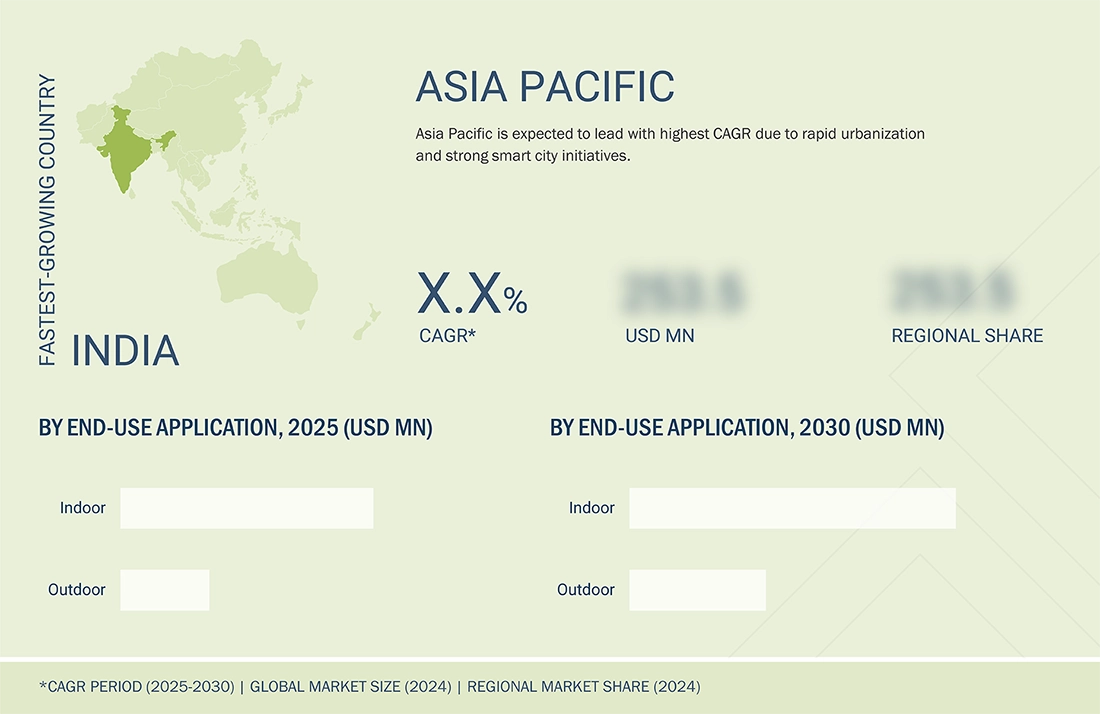
Asia Pacific is expected to register the highest CAGR due to rapid urbanization, increasing smart city initiatives, and strong government support for energy-efficient infrastructure. Growing awareness of sustainability, rising commercial and residential construction, and increasing adoption of connected technologies in countries like China, India, and South Korea further drive the demand for smart lighting solutions in the region.
The European smart lighting market is projected to reach USD 3.06 billion by 2030 from USD 2.02 billion in 2025, at a CAGR of 8.6% from 2025 to 2030. The regional market is driven by stringent energy-efficiency regulations and sustainability mandates set by European regulatory bodies, promoting the widespread adoption of smart lighting solutions across commercial, industrial, and municipal sectors.
The Asia Pacific smart lighting market is projected to reach USD 8.45 billion by 2030, up from USD 3.94 billion in 2025, at a CAGR of 16.5% from 2025 to 2030. This growth is driven by large-scale urban development, expanding smart-city programs, and the acceleration of LED-to-IoT lighting transitions across the region. The rising adoption of intelligent lighting solutions in commercial buildings, industrial facilities, residential complexes, and municipal infrastructure is strengthening overall market demand. Government-backed energy-efficiency policies, carbon-reduction targets, and nationwide LED modernization initiatives are further supporting expansion.
The North American smart lighting market is projected to reach USD 3.67 billion by 2030, up from USD 2.63 billion in 2025, at a CAGR of 6.9% from 2025 to 2030. This growth is driven by the increasing adoption of intelligent lighting solutions across commercial, industrial, and municipal sectors. Market expansion is supported by stringent energy-efficiency regulations, carbon-reduction targets, and rebate programs introduced by US and Canadian authorities. Rising smart-building investments and the modernization of public infrastructure, including street lighting, campuses, and transportation hubs, are accelerating the transition from conventional lighting to IoT-enabled connected systems across the region.
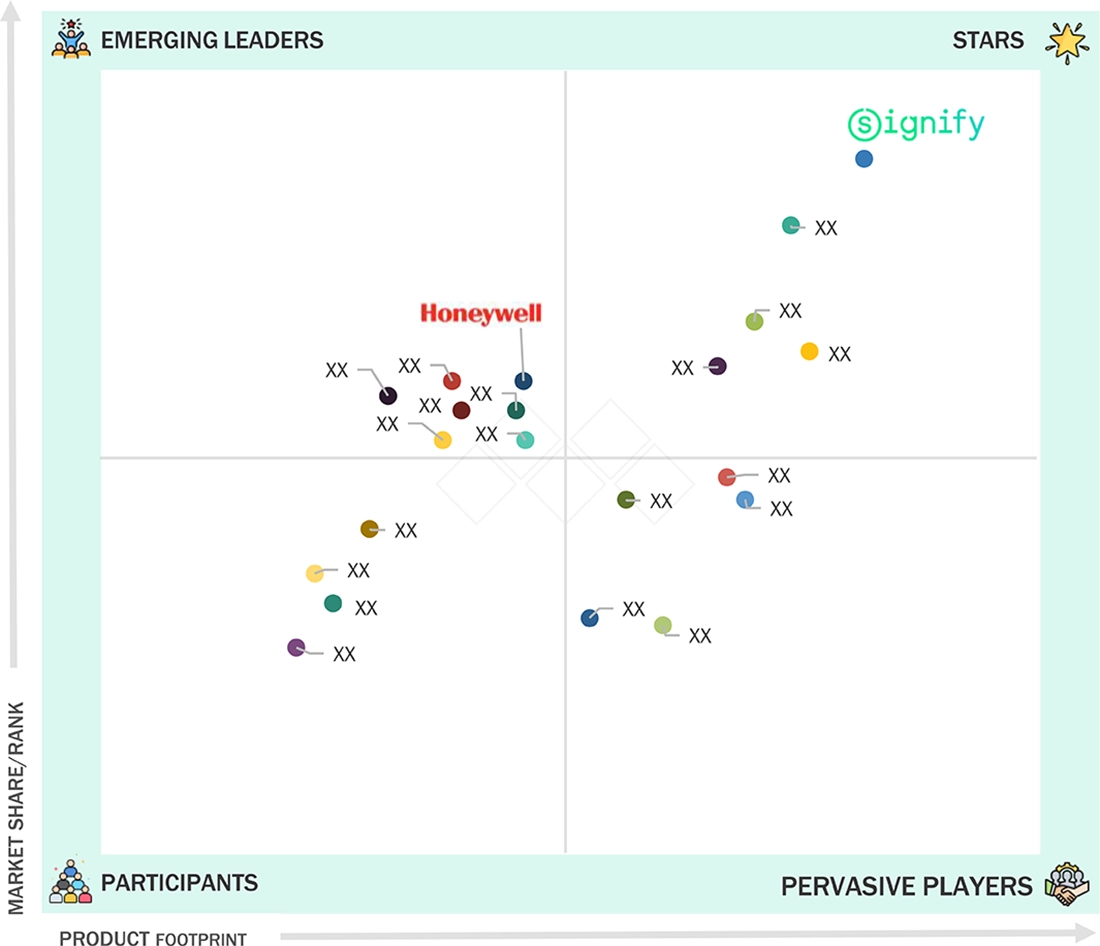
Smart Lighting Market: COMPANY EVALUATION MATRIX
Signify is a star player with high market share and a broad product portfolio, maintaining a strong global presence. Honeywell is an emerging leader with growth opportunities, leveraging its building management expertise to expand in commercial and industrial smart lighting.
Source: Secondary Research, Interviews with Experts, MarketsandMarkets Analysis
KEY MARKET PLAYERS- Smart Lighting Companies
- Signify Holding (Netherlands)
- Acuity Brands, Inc. (US)
- Legrand (France)
- Honeywell International Inc. (US)
- Panasonic Holdings Corporation (Japan)
- Elbit System Limited (Israel)
- Boeing (US)
- Aselsan A.S. (Turkey)
- Kongsberg (Norway)
- Northrop Grumman (US)
- GMV Innovating Solutions S.L. (Spain)
- Kratos Defense & Security Solutions (US)
- Mitsubishi Electric Corporation (Japan)
- Thales (France)
- SpaceX (US)
- Terma Group (Denmark)
- BAE Systems plc (UK)
- Leonardo S.p.A. (Italy)
- Indra Sistemas, S.A. (Spain)
- Amazon (US)
- Honeywell International Inc. (US)
- Exail (France)
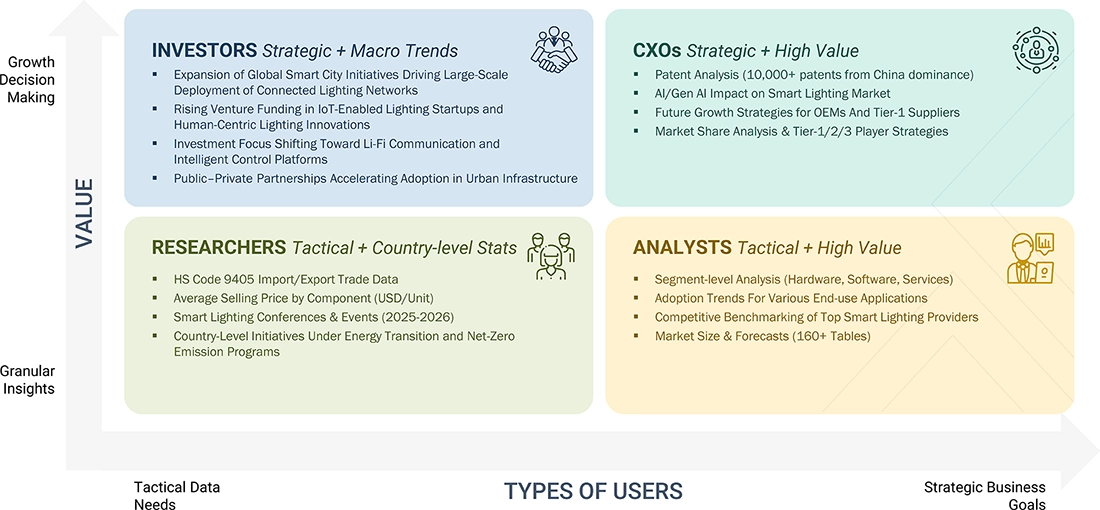
WHAT IS IN IT FOR YOU: Smart Lighting Market REPORT CONTENT GUIDE
DELIVERED CUSTOMIZATIONS
We have successfully delivered the following deep-dive customizations:
| CLIENT REQUEST | CUSTOMIZATION DELIVERED | VALUE ADDS |
|---|---|---|
| European Smart City Authority | Evaluation of connected lighting infrastructure across public areas, transportation corridors, and residential clusters with focus on interoperability and adaptive illumination. |
|
| North American Building Automation Company | Assessment of IoT-integrated lighting controls aligned with Building Management Systems (BMS) for commercial complexes. |
|
| Asia Pacific Real Estate Developer | Comparative evaluation of human-centric and circadian lighting technologies for smart homes and commercial properties. |
|
| Middle East Infrastructure Operator | Cost–performance analysis of adaptive street lighting systems incorporating motion sensors and dynamic dimming capabilities. |
|
| South American Utility Provider | Feasibility study for deployment of solar-powered and IoT-connected smart streetlights within urban grids. |
|
RECENT DEVELOPMENTS
- January 2025 : Signify Holding added new innovative features along with Philips Hue accessories that enhanced home illumination functions and entertainment features as well as home security solutions. The first generative Al assistant from Philips Hue became commercially available to customers. Through the Hue app users can access an assistant that creates customized lighting scenes based on their preferences for moods along with celebrations and various design styles. Users can generate perfect ambient settings through input commands either by verbal or written instructions using this assistance tool. Users can also utilize type or voice commands while receiving feedback to achieve ongoing system upgrades.
- November 2024 : The lighting brands Thorn and Zumtobel of Zumtobel Group joined forces with Sunderland Association Football Club (Sunderland AFC) to execute an extensive Stadium of Light illumination upgrade. The initiative belongs to Sunderland AFC's biggest stadium investment program of the past two decades while advancing the club's long-term sustainability framework to achieve complete energy independence by 2028.
- October 2024 : Acuity Brands established Nightingale as its patient-focused brand which combines lighting solutions to provide a splendid experience for patients while supporting both caregiver performance needs. Nightingale utilizes its extensive lighting experience to combine design elements with advanced illumination technology which establishes a healing environment that cares for patients.
- February 2024 : Panasonic Life Solutions India (PEWIN) established a new manufacturing plant in Daman, Gujrat, India. The dedicated manufacturing unit will extend the existing product capabilities and boost the overall production capability for lighting at their Indian facilities. PEWIN allocated INR 15 million (approximately USD 0.18 million) to build the facility which will enable the manufacturing of lighting products under its own roof as part of the company's strategic growth plan.
- January 2024 : Legrand introduced its newest advanced LED dimmer in the radiant Collection. This dimmer controls lighting precisely through its advanced circuitry which delivers wide-ranging dimmer functions to eliminate standard dimming difficulties.
Table of Contents
 Exclusive indicates content/data unique to MarketsandMarkets and not available with any competitors.
TITLE
PAGE NO
1
INTRODUCTION
27
2
RESEARCH METHODOLOGY
33
3
EXECUTIVE SUMMARY
45
4
PREMIUM INSIGHTS
51
5
MARKET OVERVIEW
Smart lighting market thrives on AI, IoT integration, despite cybersecurity and retrofitting challenges.
55
5.1
INTRODUCTION
5.2
MARKET DYNAMICS
5.2.1
DRIVERS
5.2.1.1
RISING SMART CITY INITIATIVES GLOBALLY
5.2.1.2
ADVANCEMENTS IN ARTIFICIAL INTELLIGENCE (AI) AND EDGE COMPUTING TECHNOLOGIES
5.2.1.3
ESTABLISHMENT OF STANDARD AND DIGITAL PROTOCOLS BY AUTHORIZED BODIES
5.2.1.4
GROWING DEMAND FOR INTERNET OF THINGS (IOT)-INTEGRATED SMART LIGHTING SOLUTIONS
5.2.1.5
RISING ADOPTION OF LED LIGHTS AND LUMINAIRES IN OUTDOOR APPLICATIONS
5.2.1.6
INCREASING INCORPORATION OF DATA ANALYTICS INTO SMART LIGHTING
5.2.2
RESTRAINTS
5.2.2.1
CYBERSECURITY CONCERNS ASSOCIATED WITH INTERNET-CONNECTED LIGHTING SYSTEMS
5.2.2.2
DIFFICULTIES ASSOCIATED WITH RETROFITTING OF TRADITIONAL LIGHTING INFRASTRUCTURE
5.2.3
OPPORTUNITIES
5.2.3.1
DEVELOPMENT OF SOLAR-POWERED AND HYBRID SMART LIGHTING SOLUTIONS
5.2.3.2
EMERGING SMART OFFICE AND SMART RETAIL TRENDS
5.2.3.3
RISING ADOPTION OF HUMAN-CENTRIC LIGHTING SOLUTIONS
5.2.3.4
GROWING ADOPTION OF POWER OVER ETHERNET (POE)-BASED LIGHTING SOLUTIONS IN COMMERCIAL AND HEALTHCARE APPLICATIONS
5.2.3.5
INCREASING DEMAND FOR PERSONALIZED LIGHTING CONTROL SOLUTIONS
5.2.4
CHALLENGES
5.2.4.1
HIGH UPFRONT COSTS OF EQUIPMENT AND ACCESSORIES
5.2.4.2
INTEROPERABILITY AND COMPATIBILITY ISSUES
5.3
TRENDS/DISRUPTIONS IMPACTING CUSTOMER BUSINESS
5.4
PRICING ANALYSIS
5.4.1
AVERAGE SELLING PRICE TREND OF KEY PLAYERS, BY OFFERING, 2024
5.4.2
AVERAGE SELLING PRICE TREND, BY REGION, 2020–2024
5.5
VALUE CHAIN ANALYSIS
5.6
ECOSYSTEM ANALYSIS
5.7
INVESTMENT AND FUNDING SCENARIO
5.8
TECHNOLOGY ANALYSIS
5.8.1
KEY TECHNOLOGIES
5.8.1.1
INTERNET OF THINGS (IOT)
5.8.1.2
COMMUNICATION PROTOCOLS
5.8.1.3
SMART SENSORS
5.8.2
COMPLEMENTARY TECHNOLOGIES
5.8.2.1
ARTIFICIAL INTELLIGENCE (AI) AND MACHINE LEARNING (ML)
5.8.2.2
LIGHT FIDELITY (LI-FI)
5.8.2.3
GEOFENCING TECHNOLOGY
5.8.3
ADJACENT TECHNOLOGIES
5.8.3.1
BUILDING MANAGEMENT SYSTEM (BMS)
5.8.3.2
5G INFRASTRUCTURE
5.9
PATENT ANALYSIS
5.10
TRADE ANALYSIS
5.10.1
IMPORT SCENARIO (HS CODE 9405)
5.10.2
EXPORT SCENARIO (HS CODE 9405)
5.11
KEY CONFERENCES AND EVENTS, 2025–2026
5.12
CASE STUDY ANALYSIS
5.12.1
ULINE USES CREE LIGHTING LUMINAIRES INTEGRATED WITH SYNAPSE SIMPLYSNAP CONTROLS TO HELP ACHIEVE OPERATIONAL EXCELLENCE AND RELIABILITY
5.12.2
GERMAN MUNICIPALITY IMPLEMENTS SIGNIFY HOLDING’S BRIGHTSITES SOLUTION TO ADVANCE SMART CITY GOALS
5.12.3
HONEYWELL INTERNATIONAL INC. ESTABLISHES NEW AIRFIELD GROUND LIGHT MANUFACTURING FACILITY IN INDIA
5.13
TARIFF AND REGULATORY LANDSCAPE
5.13.1
TARIFF ANALYSIS
5.13.2
REGULATORY BODIES, GOVERNMENT AGENCIES, AND OTHER ORGANIZATIONS
5.13.3
REGULATIONS
5.13.3.1
RESTRICTION OF HAZARDOUS SUBSTANCES (ROHS) AND WASTE ELECTRICAL AND ELECTRONIC EQUIPMENT (WEEE)
5.13.3.2
REGISTRATION, EVALUATION, AUTHORISATION AND RESTRICTION OF CHEMICALS (REACH)
5.13.3.3
UNITED NATIONS FRAMEWORK CONVENTION ON CLIMATE CHANGE (UNFCCC)
5.13.3.4
GENERAL DATA PROTECTION REGULATION (GDPR)
5.14
PORTER’S FIVE FORCES ANALYSIS
5.14.1
INTENSITY OF COMPETITIVE RIVALRY
5.14.2
THREAT OF NEW ENTRANTS
5.14.3
THREAT OF SUBSTITUTES
5.14.4
BARGAINING POWER OF BUYERS
5.14.5
BARGAINING POWER OF SUPPLIERS
5.15
KEY STAKEHOLDERS AND BUYING CRITERIA
5.15.1
KEY STAKEHOLDERS IN BUYING PROCESS
5.15.2
BUYING CRITERIA
5.16
IMPACT OF AI/GEN AI ON SMART LIGHTING MARKET
6
SMART LIGHTING MARKET, BY COMMUNICATION TECHNOLOGY
Market Size & Growth Rate Forecast Analysis to 2030 in USD Million | 10 Data Tables
98
6.1
INTRODUCTION
6.2
WIRED
6.2.1
DALI
6.2.1.1
OFFERS VERSATILITY AND GREATER ENERGY SAVINGS
6.2.2
POWER OVER ETHERNET (POE)
6.2.2.1
USED TO POWER DEVICES THROUGH ETHERNET CABLES
6.2.3
POWER LINE COMMUNICATIONS (PLCS)
6.2.3.1
HELP IMPROVE CONNECTIVITY BETWEEN LIGHTING SOLUTIONS
6.2.4
WIRED HYBRID PROTOCOLS
6.2.4.1
ENSURE SECURITY AND ISOLATION OF CONTROL SYSTEMS
6.3
WIRELESS
6.3.1
ZIGBEE
6.3.1.1
SERVES LOW-POWER WIRELESS IOT NETWORKS
6.3.2
WI-FI
6.3.2.1
FACILITATES DIRECT DEVICE-TO-DEVICE CONNECTIONS
6.3.3
BLE
6.3.3.1
ENHANCES USER MOBILITY BY ELIMINATING CABLES
6.3.4
ENOCEAN
6.3.4.1
ENABLES PROLONGED COMMUNICATION WITHOUT NEED FOR RECHARGING
6.3.5
6LOWPAN
6.3.5.1
FACILITATES COMMUNICATION FOR DEVICES WITH LIMITED PROCESSING CAPABILITIES
6.3.6
WIRELESS HYBRID PROTOCOLS
6.3.6.1
IMPROVE DATA TRANSMISSION THROUGH PROACTIVE AND REACTIVE ROUTING
7
SMART LIGHTING MARKET, BY END-USE APPLICATION
Market Size & Growth Rate Forecast Analysis to 2030 in USD Million | 10 Data Tables
109
7.1
INTRODUCTION
7.2
INDOOR
7.2.1
COMMERCIAL
7.2.1.1
INCREASING DEMAND FROM CORPORATE OFFICES TO DRIVE GROWTH
7.2.2
INDUSTRIAL
7.2.2.1
RISING DEMAND FOR ENHANCED SAFETY AND PRODUCTIVITY TO DRIVE MARKET
7.2.3
RESIDENTIAL
7.2.3.1
GROWING DEMAND FOR SMART HOME SOLUTIONS TO BOOST MARKET
7.2.4
OTHERS
7.3
OUTDOOR
7.3.1
HIGHWAYS AND ROADWAYS LIGHTING
7.3.1.1
GROWING NEED FOR CONNECTED STREET LIGHTING SYSTEMS TO FUEL GROWTH
7.3.2
ARCHITECTURAL LIGHTING
7.3.2.1
INCREASING PROLIFERATION OF HUMAN-CENTRIC LIGHTING TO DRIVE DEMAND
7.3.3
LIGHTING FOR PUBLIC PLACES
7.3.3.1
GROWING NEED TO ENHANCE SAFETY AND SECURITY TO DRIVE GROWTH
8
SMART LIGHTING MARKET, BY DISTRIBUTION CHANNEL
Market Size & Growth Rate Forecast Analysis to 2030 in USD Million | 6 Data Tables
119
8.1
INTRODUCTION
8.2
OFFLINE SALES
8.2.1
EXPANSION OF SMART CITY PROJECTS AND COMMERCIAL RETROFITTING TO FUEL DEMAND
8.3
ONLINE SALES
8.3.1
WIDER PRODUCT AVAILABILITY, COMPETITIVE PRICING, CONVENIENCE, AND DETAILED PRODUCT COMPARISONS TO DRIVE MARKET
9
SMART LIGHTING MARKET, BY OFFERING
Market Size & Growth Rate Forecast Analysis to 2030 in USD Million and Units | 16 Data Tables
124
9.1
INTRODUCTION
9.2
HARDWARE
9.2.1
LIGHTS AND LUMINAIRES
9.2.1.1
INCREASING ADOPTION OF ENERGY-EFFICIENT LED LUMINAIRES, RISING SMART HOME PENETRATION, AND LARGE-SCALE INFRASTRUCTURE PROJECTS TO BOOST DEMAND
9.2.2
LIGHTING CONTROLS
9.2.2.1
LED DRIVERS AND BALLASTS
9.2.2.2
SENSORS
9.2.2.3
SWITCHES
9.2.2.4
DIMMERS
9.2.2.5
RELAY UNITS
9.2.2.6
GATEWAYS
9.3
SOFTWARE
9.3.1
ABILITY TO OPTIMIZE ENERGY CONSUMPTION WHILE ENHANCING USER CONVENIENCE TO DRIVE MARKET
9.4
SERVICES
9.4.1
PRE-INSTALLATION SERVICES
9.4.1.1
HELP TAILOR LIGHTING SOLUTIONS TO SUIT CUSTOMER REQUIREMENTS
9.4.2
POST-INSTALLATION SERVICES
9.4.2.1
PROLONGED LIFESPAN OF LUMINAIRES AND LAMPS WHILE OPTIMIZING ENERGY CONSUMPTION AND EFFICIENCY TO DRIVE DEMAND
10
SMART LIGHTING MARKET, BY INSTALLATION TYPE
Market Size & Growth Rate Forecast Analysis to 2030 in USD Million | 2 Data Tables
140
10.1
INTRODUCTION
10.2
NEW INSTALLATIONS
10.2.1
INCREASING ADOPTION OF SMART CITY INITIATIVES AND STRINGENT ENERGY EFFICIENCY REGULATIONS TO DRIVE GROWTH
10.3
RETROFIT INSTALLATIONS
10.3.1
REDUCED DOWNTIME AND INSTALLATION COSTS DUE TO COMPATIBILITY WITH EXISTING LIGHTING TO DRIVE ADOPTION
11
SMART LIGHTING MARKET, BY REGION
Comprehensive coverage of 9 Regions with country-level deep-dive of 16 Countries | 122 Data Tables.
143
11.1
INTRODUCTION
11.2
AMERICAS
11.2.1
AMERICAS: MACROECONOMIC OUTLOOK
11.2.2
NORTH AMERICA
11.2.2.1
US
11.2.2.2
CANADA
11.2.2.3
MEXICO
11.2.3
SOUTH AMERICA
11.2.3.1
BRAZIL
11.2.3.2
ARGENTINA
11.2.3.3
REST OF SOUTH AMERICA
11.3
EUROPE
11.3.1
EUROPE: MACROECONOMIC OUTLOOK
11.3.2
GERMANY
11.3.2.1
INCREASING DEMAND FROM COMMERCIAL SECTOR TO DRIVE MARKET
11.3.3
FRANCE
11.3.3.1
NEED FOR SUSTAINABLE LIGHTING IN PUBLIC SPACES TO FUEL MARKET
11.3.4
UK
11.3.4.1
GROWING DEMAND FROM PUBLIC AND PRIVATE SPACES TO PROPEL MARKET
11.3.5
ITALY
11.3.5.1
RESURGENCE OF CONSTRUCTION INDUSTRY TO BOOST DEMAND
11.3.6
SPAIN
11.3.6.1
EMISSION REDUCTION GOALS TO DRIVE MARKET
11.3.7
NETHERLANDS
11.3.7.1
GOVERNMENT INITIATIVES PROMOTING ENERGY-EFFICIENT LIGHTING TO DRIVE GROWTH
11.3.8
REST OF EUROPE
11.4
ASIA PACIFIC
11.4.1
ASIA PACIFIC: MACROECONOMIC OUTLOOK
11.4.2
CHINA
11.4.2.1
RISING CONSTRUCTION ACTIVITIES TO ACCELERATE DEMAND
11.4.3
JAPAN
11.4.3.1
GROWING FOCUS ON SMART CITY DEVELOPMENT TO PROPEL MARKET
11.4.4
INDIA
11.4.4.1
INCREASING DEMAND FROM CONSTRUCTION SECTOR TO DRIVE GROWTH
11.4.5
AUSTRALIA & NEW ZEALAND
11.4.5.1
GROWING FOCUS ON SUSTAINABILITY INITIATIVES TO BOOST MARKET
11.4.6
SOUTH KOREA
11.4.6.1
GROWING DEMAND FROM COMMERCIAL BUILDINGS AND RESIDENTIAL DEVELOPMENTS TO FUEL GROWTH
11.4.7
REST OF ASIA PACIFIC
11.5
ROW
11.5.1
ROW: MACROECONOMIC OUTLOOK
11.5.2
MIDDLE EAST
11.5.2.1
DEMAND FOR CONNECTED URBAN ENVIRONMENTS TO DRIVE MARKET
11.5.2.2
GCC COUNTRIES
11.5.2.3
REST OF THE MIDDLE EAST
11.5.3
AFRICA
11.5.3.1
INCREASING INVESTMENTS IN INFRASTRUCTURE AND RENEWABLE ENERGY TO DRIVE MARKET
12
COMPETITIVE LANDSCAPE
Uncover key player strategies and valuations shaping market dominance through 2024.
194
12.1
OVERVIEW
12.2
KEY PLAYER STRATEGIES/RIGHT TO WIN, JANUARY 2021– JANUARY 2025
12.3
REVENUE ANALYSIS, 2020–2024
12.4
MARKET SHARE ANALYSIS, 2024
12.5
COMPANY VALUATION AND FINANCIAL METRICS
12.5.1
COMPANY VALUATION
12.5.2
FINANCIAL METRICS
12.6
BRAND/PRODUCT COMPARISON
12.7
COMPANY EVALUATION MATRIX: KEY PLAYERS, 2024
12.7.1
STARS
12.7.2
EMERGING LEADERS
12.7.3
PERVASIVE PLAYERS
12.7.4
PARTICIPANTS
12.7.5
COMPANY FOOTPRINT: KEY PLAYERS, 2024
12.7.5.1
COMPANY FOOTPRINT
12.7.5.2
REGION FOOTPRINT
12.7.5.3
INSTALLATION TYPE FOOTPRINT
12.7.5.4
OFFERING FOOTPRINT
12.7.5.5
END-USE APPLICATION FOOTPRINT
12.7.5.6
COMMUNICATION TECHNOLOGY FOOTPRINT
12.8
COMPANY EVALUATION MATRIX: STARTUPS/SMES, 2024
12.8.1
PROGRESSIVE COMPANIES
12.8.2
RESPONSIVE COMPANIES
12.8.3
DYNAMIC COMPANIES
12.8.4
STARTING BLOCKS
12.8.5
COMPETITIVE BENCHMARKING: STARTUPS/SMES, 2024
12.8.5.1
DETAILED LIST OF STARTUPS/SMES
12.8.5.2
COMPETITIVE BENCHMARKING OF KEY STARTUPS/SMES
12.9
COMPETITIVE SCENARIO
12.9.1
PRODUCT LAUNCHES/DEVELOPMENTS
12.9.2
DEALS
12.9.3
EXPANSIONS
13
COMPANY PROFILES
In-depth Company Profiles of Leading Market Players with detailed Business Overview, Product and Service Portfolio, Recent Developments, and Unique Analyst Perspective (MnM View)
226
13.1
INTRODUCTION
13.2
KEY PLAYERS
13.2.1
SIGNIFY HOLDING
13.2.1.1
BUSINESS OVERVIEW
13.2.1.2
PRODUCTS/SOLUTIONS/SERVICES OFFERED
13.2.1.3
RECENT DEVELOPMENTS
13.2.1.4
MNM VIEW
13.2.2
LEGRAND
13.2.3
ACUITY BRANDS, INC.
13.2.4
ZUMTOBEL GROUP
13.2.5
PANASONIC HOLDINGS CORPORATION
13.2.6
AMS-OSRAM AG
13.2.7
HONEYWELL INTERNATIONAL INC.
13.2.8
WIPRO LIGHTING
13.2.9
LUTRON ELECTRONICS CO., INC
13.2.10
CREE LIGHTING USA LLC
13.2.11
LEDVANCE GMBH
13.3
OTHER PLAYERS
13.3.1
HLI SOLUTIONS, INC.
13.3.2
SAVANT SYSTEMS, INC.
13.3.3
DIALIGHT
13.3.4
SCHNEIDER ELECTRIC
13.3.5
ABB
13.3.6
LIGHTWAVE
13.3.7
RAB LIGHTING INC.
13.3.8
SYNAPSE WIRELESS INC.
13.3.9
LEVITON MANUFACTURING CO., INC.
13.3.10
SYSKA
13.3.11
BUILDING ROBOTICS INC. (SIEMENS COMPANY)
13.3.12
HELVAR
13.3.13
LIFX
13.3.14
SENGLED GMBH
13.3.15
TVILIGHT PROJECTS B.V.
13.3.16
NANOLEAF
13.3.17
UBICQUIA, INC.
13.3.18
JAQUAR INDIA
13.3.19
INTER IKEA SYSTEMS B.V.
14
APPENDIX
297
14.1
INSIGHTS FROM INDUSTRY EXPERTS
14.2
DISCUSSION GUIDE
14.3
KNOWLEDGESTORE: MARKETSANDMARKETS’ SUBSCRIPTION PORTAL
14.4
CUSTOMIZATION OPTIONS
14.5
RELATED REPORTS
14.6
AUTHOR DETAILS
LIST OF TABLES
TABLE 1
RISK FACTOR ANALYSIS
TABLE 2
AVERAGE SELLING PRICE OF HARDWARE TYPE OFFERED KEY PLAYERS, BY OFFERING
TABLE 3
AVERAGE SELLING PRICE TREND OF SMART LIGHTS AND LUMINAIRES, BY REGION, 2020–2024 (USD)
TABLE 4
ROLES OF COMPANIES IN SMART LIGHTING ECOSYSTEM
TABLE 5
SMART LIGHTING MARKET: LIST OF MAJOR PATENTS, 2022–2024
TABLE 6
IMPORT DATA RELATED TO HS CODE 9405-COMPLIANT PRODUCTS, BY COUNTRY, 2019–2023 (USD MILLION)
TABLE 7
EXPORT DATA FOR HS CODE 9405-COMPLIANT PRODUCTS, BY COUNTRY, 2019–2023 (USD MILLION)
TABLE 8
SMART LIGHTING MARKET: LIST OF KEY CONFERENCES AND EVENTS, 2025–2026
TABLE 9
MFN TARIFF FOR HS CODE 9405-COMPLIANT PRODUCTS, 2023
TABLE 10
NORTH AMERICA: REGULATORY BODIES, GOVERNMENT AGENCIES, AND OTHER ORGANIZATIONS
TABLE 11
EUROPE: REGULATORY BODIES, GOVERNMENT AGENCIES, AND OTHER ORGANIZATIONS
TABLE 12
ASIA PACIFIC: REGULATORY BODIES, GOVERNMENT AGENCIES, AND OTHER ORGANIZATIONS
TABLE 13
ROW: REGULATORY BODIES, GOVERNMENT AGENCIES, AND OTHER ORGANIZATIONS
TABLE 14
SMART LIGHTING MARKET: IMPACT ANALYSIS OF PORTER’S FIVE FORCES
TABLE 15
INFLUENCE OF STAKEHOLDERS ON BUYING PROCESS, BY END-USE APPLICATION (%)
TABLE 16
KEY BUYING CRITERIA, BY END-USE APPLICATION
TABLE 17
SMART LIGHTING MARKET, BY COMMUNICATION TECHNOLOGY, 2021–2024 (USD MILLION)
TABLE 18
SMART LIGHTING MARKET, BY COMMUNICATION TECHNOLOGY, 2025–2030 (USD MILLION)
TABLE 19
SMART LIGHTING MARKET FOR WIRED COMMUNICATION TECHNOLOGY, BY TYPE, 2021–2024 (USD MILLION)
TABLE 20
SMART LIGHTING MARKET FOR WIRED COMMUNICATION TECHNOLOGY, BY TYPE, 2025–2030 (USD MILLION)
TABLE 21
WIRED: SMART LIGHTING MARKET, BY REGION, 2021–2024 (USD MILLION)
TABLE 22
WIRED: SMART LIGHTING MARKET, BY REGION, 2025–2030 (USD MILLION)
TABLE 23
WIRELESS: SMART LIGHTING MARKET, BY TYPE, 2021–2024 (USD MILLION)
TABLE 24
WIRELESS: SMART LIGHTING MARKET, BY TYPE, 2025–2030 (USD MILLION)
TABLE 25
WIRELESS: SMART LIGHTING MARKET, BY REGION, 2021–2024 (USD MILLION)
TABLE 26
WIRELESS: SMART LIGHTING MARKET, BY REGION, 2025–2030 (USD MILLION)
TABLE 27
SMART LIGHTING MARKET, BY END-USE APPLICATION, 2021–2024 (USD MILLION)
TABLE 28
SMART LIGHTING MARKET, BY END-USE APPLICATION, 2025–2030 (USD MILLION)
TABLE 29
INDOOR SMART LIGHTING MARKET, BY APPLICATION, 2021–2024 (USD MILLION)
TABLE 30
INDOOR SMART LIGHTING MARKET, BY APPLICATION, 2025–2030 (USD MILLION)
TABLE 31
INDOOR SMART LIGHTING MARKET, BY REGION, 2021–2024 (USD MILLION)
TABLE 32
INDOOR SMART LIGHTING MARKET, BY REGION, 2025–2030 (USD MILLION)
TABLE 33
OUTDOOR SMART LIGHTING MARKET, BY APPLICATION, 2021–2024 (USD MILLION)
TABLE 34
OUTDOOR SMART LIGHTING MARKET, BY APPLICATION, 2025–2030 (USD MILLION)
TABLE 35
OUTDOOR SMART LIGHTING MARKET, BY REGION, 2021–2024 (USD MILLION)
TABLE 36
OUTDOOR SMART LIGHTING MARKET, BY REGION, 2025–2030 (USD MILLION)
TABLE 37
SMART LIGHTING MARKET, BY DISTRIBUTION CHANNEL, 2021–2024 (USD MILLION)
TABLE 38
SMART LIGHTING MARKET, BY DISTRIBUTION CHANNEL, 2025–2030 (USD MILLION)
TABLE 39
OFFLINE SALES: SMART LIGHTING MARKET, BY REGION, 2021–2024 (USD MILLION)
TABLE 40
OFFLINE SALES: SMART LIGHTING MARKET, BY REGION, 2025–2030 (USD MILLION)
TABLE 41
ONLINE SALES: SMART LIGHTING MARKET, BY REGION, 2021–2024 (USD MILLION)
TABLE 42
ONLINE SALES: SMART LIGHTING MARKET, BY REGION, 2025–2030 (USD MILLION)
TABLE 43
SMART LIGHTING MARKET, BY OFFERING, 2021–2024 (USD MILLION)
TABLE 44
SMART LIGHTING MARKET, BY OFFERING, 2025–2030 (USD MILLION)
TABLE 45
HARDWARE: SMART LIGHTING MARKET, BY REGION, 2021–2024 (USD MILLION)
TABLE 46
HARDWARE: SMART LIGHTING MARKET, BY REGION, 2025–2030 (USD MILLION)
TABLE 47
SMART LIGHTING MARKET, BY HARDWARE, 2021–2024 (USD MILLION)
TABLE 48
SMART LIGHTING MARKET, BY HARDWARE, 2025–2030 (USD MILLION)
TABLE 49
LIGHTING CONTROLS: SMART LIGHTING MARKET, BY COMPONENT, 2021–2024 (USD MILLION)
TABLE 50
LIGHTING CONTROLS: SMART LIGHTING MARKET, BY COMPONENT, 2025–2030 (USD MILLION)
TABLE 51
LIGHTING CONTROLS: SMART LIGHTING MARKET, BY COMPONENT, 2021–2024 (THOUSAND UNITS)
TABLE 52
LIGHTING CONTROLS: SMART LIGHTING MARKET, BY COMPONENT, 2025–2030 (THOUSAND UNITS)
TABLE 53
SOFTWARE: SMART LIGHTING MARKET, BY REGION, 2021–2024 (USD MILLION)
TABLE 54
SOFTWARE: SMART LIGHTING MARKET, BY REGION, 2025–2030 (USD MILLION)
TABLE 55
SERVICES: SMART LIGHTING MARKET, BY REGION, 2021–2024 (USD MILLION)
TABLE 56
SERVICES: SMART LIGHTING MARKET, BY REGION, 2025–2030 (USD MILLION)
TABLE 57
SMART LIGHTING MARKET FOR SERVICES, BY TYPE, 2021–2024 (USD MILLION)
TABLE 58
SMART LIGHTING MARKET FOR SERVICES, BY TYPE, 2025–2030 (USD MILLION)
TABLE 59
SMART LIGHTING MARKET, BY INSTALLATION TYPE, 2021–2024 (USD MILLION)
TABLE 60
SMART LIGHTING MARKET, BY INSTALLATION TYPE, 2025–2030 (USD MILLION)
TABLE 61
SMART LIGHTING MARKET, BY REGION, 2021–2024 (USD MILLION)
TABLE 62
SMART LIGHTING MARKET, BY REGION, 2025–2030 (USD MILLION)
TABLE 63
AMERICAS: SMART LIGHTING MARKET, BY SUB-REGION, 2021–2024 (USD MILLION)
TABLE 64
AMERICAS: SMART LIGHTING MARKET, BY SUB-REGION, 2025–2030 (USD MILLION)
TABLE 65
AMERICAS: SMART LIGHTING MARKET, BY INSTALLATION TYPE, 2021–2024 (USD MILLION)
TABLE 66
AMERICAS: SMART LIGHTING MARKET, BY INSTALLATION TYPE, 2025–2030 (USD MILLION)
TABLE 67
AMERICAS: SMART LIGHTING MARKET, BY OFFERING, 2021–2024 (USD MILLION)
TABLE 68
AMERICAS: SMART LIGHTING MARKET, BY OFFERING, 2025–2030 (USD MILLION)
TABLE 69
AMERICAS: SMART LIGHTING MARKET, BY COMMUNICATION TECHNOLOGY, 2021–2024 (USD MILLION)
TABLE 70
AMERICAS: SMART LIGHTING MARKET, BY COMMUNICATION TECHNOLOGY, 2025–2030 (USD MILLION)
TABLE 71
AMERICAS: SMART LIGHTING MARKET, BY DISTRIBUTION CHANNEL, 2021–2024 (USD MILLION)
TABLE 72
AMERICAS: SMART LIGHTING MARKET, BY DISTRIBUTION CHANNEL, 2025–2030 (USD MILLION)
TABLE 73
AMERICAS: SMART LIGHTING MARKET, BY END-USE APPLICATION, 2021–2024 (USD MILLION)
TABLE 74
AMERICAS: SMART LIGHTING MARKET, BY END-USE APPLICATION, 2025–2030 (USD MILLION)
TABLE 75
AMERICAS: INDOOR SMART LIGHTING MARKET, BY APPLICATION, 2021–2024 (USD MILLION)
TABLE 76
AMERICAS: INDOOR SMART LIGHTING MARKET, BY APPLICATION, 2025–2030 (USD MILLION)
TABLE 77
AMERICAS: OUTDOOR SMART LIGHTING MARKET, BY APPLICATION, 2021–2024 (USD MILLION)
TABLE 78
AMERICAS: OUTDOOR SMART LIGHTING MARKET, BY APPLICATION, 2025–2030 (USD MILLION)
TABLE 79
NORTH AMERICA: SMART LIGHTING MARKET, BY COUNTRY, 2021–2024 (USD MILLION)
TABLE 80
NORTH AMERICA: SMART LIGHTING MARKET, BY COUNTRY, 2025–2030 (USD MILLION)
TABLE 81
NORTH AMERICA: SMART LIGHTING MARKET, BY INSTALLATION TYPE, 2021–2024 (USD MILLION)
TABLE 82
NORTH AMERICA: SMART LIGHTING MARKET, BY INSTALLATION TYPE, 2025–2030 (USD MILLION)
TABLE 83
US: SMART LIGHTING MARKET, BY INSTALLATION TYPE, 2021–2024 (USD MILLION)
TABLE 84
US: SMART LIGHTING MARKET, BY INSTALLATION TYPE, 2025–2030 (USD MILLION)
TABLE 85
CANADA: SMART LIGHTING MARKET, BY INSTALLATION TYPE, 2021–2024 (USD MILLION)
TABLE 86
CANADA: SMART LIGHTING MARKET, BY INSTALLATION TYPE, 2025–2030 (USD MILLION)
TABLE 87
MEXICO: SMART LIGHTING MARKET, BY INSTALLATION TYPE, 2021–2024 (USD MILLION)
TABLE 88
MEXICO: SMART LIGHTING MARKET, BY INSTALLATION TYPE, 2025–2030 (USD MILLION)
TABLE 89
SOUTH AMERICA: SMART LIGHTING MARKET, BY COUNTRY, 2021–2024 (USD MILLION)
TABLE 90
SOUTH AMERICA: SMART LIGHTING MARKET, BY COUNTRY, 2025–2030 (USD MILLION)
TABLE 91
SOUTH AMERICA: SMART LIGHTING MARKET, BY INSTALLATION TYPE, 2021–2024 (USD MILLION)
TABLE 92
SOUTH AMERICA: SMART LIGHTING MARKET, BY INSTALLATION TYPE, 2025–2030 (USD MILLION)
TABLE 93
BRAZIL: SMART LIGHTING MARKET, BY INSTALLATION TYPE, 2021–2024 (USD MILLION)
TABLE 94
BRAZIL: SMART LIGHTING MARKET, BY INSTALLATION TYPE, 2025–2030 (USD MILLION)
TABLE 95
ARGENTINA: SMART LIGHTING MARKET, BY INSTALLATION TYPE, 2021–2024 (USD MILLION)
TABLE 96
ARGENTINA: SMART LIGHTING MARKET, BY INSTALLATION TYPE, 2025–2030 (USD MILLION)
TABLE 97
REST OF SOUTH AMERICA: SMART LIGHTING MARKET, BY INSTALLATION TYPE, 2021–2024 (USD MILLION)
TABLE 98
REST OF SOUTH AMERICA: SMART LIGHTING MARKET, BY INSTALLATION TYPE, 2025–2030 (USD MILLION)
TABLE 99
EUROPE: SMART LIGHTING MARKET, BY COUNTRY, 2021–2024 (USD MILLION)
TABLE 100
EUROPE: SMART LIGHTING MARKET, BY COUNTRY, 2025–2030 (USD MILLION)
TABLE 101
EUROPE: SMART LIGHTING MARKET, BY INSTALLATION TYPE, 2021–2024 (USD MILLION)
TABLE 102
EUROPE: SMART LIGHTING MARKET, BY INSTALLATION TYPE, 2025–2030 (USD MILLION)
TABLE 103
EUROPE: SMART LIGHTING MARKET, BY OFFERING, 2021–2024 (USD MILLION)
TABLE 104
EUROPE: SMART LIGHTING MARKET, BY OFFERING, 2025–2030 (USD MILLION)
TABLE 105
EUROPE: SMART LIGHTING MARKET, BY COMMUNICATION TECHNOLOGY, 2021–2024 (USD MILLION)
TABLE 106
EUROPE: SMART LIGHTING MARKET, BY COMMUNICATION TECHNOLOGY, 2025–2030 (USD MILLION)
TABLE 107
EUROPE: SMART LIGHTING MARKET, BY DISTRIBUTION CHANNEL, 2021–2024 (USD MILLION)
TABLE 108
EUROPE: SMART LIGHTING MARKET, BY DISTRIBUTION CHANNEL, 2025–2030 (USD MILLION)
TABLE 109
EUROPE: SMART LIGHTING MARKET, BY END-USE APPLICATION, 2021–2024 (USD MILLION)
TABLE 110
EUROPE: SMART LIGHTING MARKET, BY END-USE APPLICATION, 2025–2030 (USD MILLION)
TABLE 111
EUROPE: INDOOR SMART LIGHTING MARKET, BY APPLICATION, 2021–2024 (USD MILLION)
TABLE 112
EUROPE: INDOOR SMART LIGHTING MARKET, BY APPLICATION, 2025–2030 (USD MILLION)
TABLE 113
EUROPE: OUTDOOR SMART LIGHTING MARKET, BY APPLICATION, 2021–2024 (USD MILLION)
TABLE 114
EUROPE: OUTDOOR SMART LIGHTING MARKET, BY APPLICATION, 2025–2030 (USD MILLION)
TABLE 115
GERMANY: SMART LIGHTING MARKET, BY INSTALLATION TYPE, 2021–2024 (USD MILLION)
TABLE 116
GERMANY: SMART LIGHTING MARKET, BY INSTALLATION TYPE, 2025–2030 (USD MILLION)
TABLE 117
FRANCE: SMART LIGHTING MARKET, BY INSTALLATION TYPE, 2021–2024 (USD MILLION)
TABLE 118
FRANCE: SMART LIGHTING MARKET, BY INSTALLATION TYPE, 2025–2030 (USD MILLION)
TABLE 119
UK: SMART LIGHTING MARKET, BY INSTALLATION TYPE, 2021–2024 (USD MILLION)
TABLE 120
UK: SMART LIGHTING MARKET, BY INSTALLATION TYPE, 2025–2030 (USD MILLION)
TABLE 121
ITALY: SMART LIGHTING MARKET, BY INSTALLATION TYPE, 2021–2024 (USD MILLION)
TABLE 122
ITALY: SMART LIGHTING MARKET, BY INSTALLATION TYPE, 2025–2030 (USD MILLION)
TABLE 123
SPAIN: SMART LIGHTING MARKET, BY INSTALLATION TYPE, 2021–2024 (USD MILLION)
TABLE 124
SPAIN: SMART LIGHTING MARKET, BY INSTALLATION TYPE, 2025–2030 (USD MILLION)
TABLE 125
NETHERLANDS: SMART LIGHTING MARKET, BY INSTALLATION TYPE, 2021–2024 (USD MILLION)
TABLE 126
NETHERLANDS: SMART LIGHTING MARKET, BY INSTALLATION TYPE, 2025–2030 (USD MILLION)
TABLE 127
REST OF EUROPE: SMART LIGHTING MARKET, BY INSTALLATION TYPE, 2021–2024 (USD MILLION)
TABLE 128
REST OF EUROPE: SMART LIGHTING MARKET, BY INSTALLATION TYPE, 2025–2030 (USD MILLION)
TABLE 129
ASIA PACIFIC: SMART LIGHTING MARKET, BY COUNTRY, 2021–2024 (USD MILLION)
TABLE 130
ASIA PACIFIC: SMART LIGHTING MARKET, BY COUNTRY, 2025–2030 (USD MILLION)
TABLE 131
ASIA PACIFIC: SMART LIGHTING MARKET, BY INSTALLATION TYPE, 2021–2024 (USD MILLION)
TABLE 132
ASIA PACIFIC: SMART LIGHTING MARKET, BY INSTALLATION TYPE, 2025–2030 (USD MILLION)
TABLE 133
ASIA PACIFIC: SMART LIGHTING MARKET, BY OFFERING, 2021–2024 (USD MILLION)
TABLE 134
ASIA PACIFIC: SMART LIGHTING MARKET, BY OFFERING, 2025–2030 (USD MILLION)
TABLE 135
ASIA PACIFIC: SMART LIGHTING MARKET, BY COMMUNICATION TECHNOLOGY, 2021–2024 (USD MILLION)
TABLE 136
ASIA PACIFIC: SMART LIGHTING MARKET, BY COMMUNICATION TECHNOLOGY, 2025–2030 (USD MILLION)
TABLE 137
ASIA PACIFIC: SMART LIGHTING MARKET, BY DISTRIBUTION CHANNEL, 2021–2024 (USD MILLION)
TABLE 138
ASIA PACIFIC: SMART LIGHTING MARKET, BY DISTRIBUTION CHANNEL, 2025–2030 (USD MILLION)
TABLE 139
ASIA PACIFIC: SMART LIGHTING MARKET, BY END-USE APPLICATION, 2021–2024 (USD MILLION)
TABLE 140
ASIA PACIFIC: SMART LIGHTING MARKET, BY END-USE APPLICATION, 2025–2030 (USD MILLION)
TABLE 141
ASIA PACIFIC: INDOOR SMART LIGHTING MARKET, BY APPLICATION, 2021–2024 (USD MILLION)
TABLE 142
ASIA PACIFIC: INDOOR SMART LIGHTING MARKET, BY APPLICATION, 2025–2030 (USD MILLION)
TABLE 143
ASIA PACIFIC: OUTDOOR SMART LIGHTING MARKET, BY APPLICATION, 2021–2024 (USD MILLION)
TABLE 144
ASIA PACIFIC: OUTDOOR SMART LIGHTING MARKET, BY APPLICATION, 2025–2030 (USD MILLION)
TABLE 145
CHINA: SMART LIGHTING MARKET, BY INSTALLATION TYPE, 2021–2024 (USD MILLION)
TABLE 146
CHINA: SMART LIGHTING MARKET, BY INSTALLATION TYPE, 2025–2030 (USD MILLION)
TABLE 147
JAPAN: SMART LIGHTING MARKET, BY INSTALLATION TYPE, 2021–2024 (USD MILLION)
TABLE 148
JAPAN: SMART LIGHTING MARKET, BY INSTALLATION TYPE, 2025–2030 (USD MILLION)
TABLE 149
INDIA: SMART LIGHTING MARKET, BY INSTALLATION TYPE, 2021–2024 (USD MILLION)
TABLE 150
INDIA: SMART LIGHTING MARKET, BY INSTALLATION TYPE, 2025–2030 (USD MILLION)
TABLE 151
AUSTRALIA & NEW ZEALAND: SMART LIGHTING MARKET, BY INSTALLATION TYPE, 2021–2024 (USD MILLION)
TABLE 152
AUSTRALIA & NEW ZEALAND: SMART LIGHTING MARKET, BY INSTALLATION TYPE, 2025–2030 (USD MILLION)
TABLE 153
SOUTH KOREA: SMART LIGHTING MARKET, BY INSTALLATION TYPE, 2021–2024 (USD MILLION)
TABLE 154
SOUTH KOREA: SMART LIGHTING MARKET, BY INSTALLATION TYPE, 2025–2030 (USD MILLION)
TABLE 155
REST OF ASIA PACIFIC: SMART LIGHTING MARKET, BY INSTALLATION TYPE, 2021–2024 (USD MILLION)
TABLE 156
REST OF ASIA PACIFIC: SMART LIGHTING MARKET, BY INSTALLATION TYPE, 2025–2030 (USD MILLION)
TABLE 157
ROW: SMART LIGHTING MARKET, BY REGION, 2021–2024 (USD MILLION)
TABLE 158
ROW: SMART LIGHTING MARKET, BY REGION, 2025–2030 (USD MILLION)
TABLE 159
ROW: SMART LIGHTING MARKET, BY INSTALLATION TYPE, 2021–2024 (USD MILLION)
TABLE 160
ROW: SMART LIGHTING MARKET, BY INSTALLATION TYPE, 2025–2030 (USD MILLION)
TABLE 161
ROW: SMART LIGHTING MARKET, BY OFFERING, 2021–2024 (USD MILLION)
TABLE 162
ROW: SMART LIGHTING MARKET, BY OFFERING, 2025–2030 (USD MILLION)
TABLE 163
ROW: SMART LIGHTING MARKET, BY COMMUNICATION TECHNOLOGY, 2021–2024 (USD MILLION)
TABLE 164
ROW: SMART LIGHTING MARKET, BY COMMUNICATION TECHNOLOGY, 2025–2030 (USD MILLION)
TABLE 165
ROW: SMART LIGHTING MARKET, BY DISTRIBUTION CHANNEL, 2021–2024 (USD MILLION)
TABLE 166
ROW: SMART LIGHTING MARKET, BY DISTRIBUTION CHANNEL, 2025–2030 (USD MILLION)
TABLE 167
ROW: SMART LIGHTING MARKET, BY END-USE APPLICATION, 2021–2024 (USD MILLION)
TABLE 168
ROW: SMART LIGHTING MARKET, BY END-USE APPLICATION, 2025–2030 (USD MILLION)
TABLE 169
ROW: INDOOR SMART LIGHTING MARKET, BY APPLICATION, 2021–2024 (USD MILLION)
TABLE 170
ROW: INDOOR SMART LIGHTING MARKET, BY APPLICATION, 2025–2030 (USD MILLION)
TABLE 171
ROW: OUTDOOR SMART LIGHTING MARKET, BY APPLICATION, 2021–2024 (USD MILLION)
TABLE 172
ROW: OUTDOOR SMART LIGHTING MARKET, BY APPLICATION, 2025–2030 (USD MILLION)
TABLE 173
MIDDLE EAST: SMART LIGHTING MARKET, BY REGION, 2021–2024 (USD MILLION)
TABLE 174
MIDDLE EAST: SMART LIGHTING MARKET, BY REGION, 2025–2030 (USD MILLION)
TABLE 175
MIDDLE EAST: SMART LIGHTING MARKET, BY INSTALLATION TYPE, 2021–2024 (USD MILLION)
TABLE 176
MIDDLE EAST: SMART LIGHTING MARKET, BY INSTALLATION TYPE, 2025–2030 (USD MILLION)
TABLE 177
GCC COUNTRIES: SMART LIGHTING MARKET, BY INSTALLATION TYPE, 2021–2024 (USD MILLION)
TABLE 178
GCC COUNTRIES: SMART LIGHTING MARKET, BY INSTALLATION TYPE, 2025–2030 (USD MILLION)
TABLE 179
REST OF MIDDLE EAST: SMART LIGHTING MARKET, BY INSTALLATION TYPE, 2021–2024 (USD MILLION)
TABLE 180
REST OF MIDDLE EAST: SMART LIGHTING MARKET, BY INSTALLATION TYPE, 2025–2030 (USD MILLION)
TABLE 181
AFRICA: SMART LIGHTING MARKET, BY INSTALLATION TYPE, 2021–2024 (USD MILLION)
TABLE 182
AFRICA: SMART LIGHTING MARKET, BY INSTALLATION TYPE, 2025–2030 (USD MILLION)
TABLE 183
SMART LIGHTING MARKET: KEY STRATEGIES ADOPTED BY LEADING PLAYERS, JANUARY 2021–JANUARY 2025
TABLE 184
SMART LIGHTING MARKET: DEGREE OF COMPETITION
TABLE 185
SMART LIGHTING MARKET: REGION FOOTPRINT
TABLE 186
SMART LIGHTING MARKET: INSTALLATION TYPE FOOTPRINT
TABLE 187
SMART LIGHTING MARKET: OFFERING FOOTPRINT
TABLE 188
SMART LIGHTING MARKET: END-USE APPLICATION FOOTPRINT
TABLE 189
SMART LIGHTING MARKET: COMMUNICATION TECHNOLOGY FOOTPRINT
TABLE 190
SMART LIGHTING MARKET: DETAILED LIST OF KEY STARTUPS/SMES
TABLE 191
SMART LIGHTING MARKET: COMPETITIVE BENCHMARKING OF KEY STARTUPS/SMES
TABLE 192
SMART LIGHTING MARKET: PRODUCT LAUNCHES/DEVELOPMENTS, APRIL 2020–JANUARY 2025
TABLE 193
SMART LIGHTING MARKET: DEALS, APRIL 2020–JANUARY 2025
TABLE 194
SMART LIGHTING MARKET: EXPANSIONS, APRIL 2020–JANUARY 2025
TABLE 195
SIGNIFY HOLDING: COMPANY OVERVIEW
TABLE 196
SIGNIFY HOLDING: PRODUCTS/SOLUTIONS/SERVICES OFFERED
TABLE 197
SIGNIFY HOLDING: PRODUCT LAUNCHES/DEVELOPMENTS
TABLE 198
SIGNIFY HOLDING: DEALS
TABLE 199
LEGRAND: COMPANY OVERVIEW
TABLE 200
LEGRAND: PRODUCTS/SOLUTIONS/SERVICES OFFERED
TABLE 201
LEGRAND: PRODUCT LAUNCHES /DEVELOPMENTS
TABLE 202
LEGRAND: DEALS
TABLE 203
ACUITY BRANDS, INC.: COMPANY OVERVIEW
TABLE 204
ACUITY BRANDS, INC.: PRODUCTS/SOLUTIONS/SERVICES OFFERED
TABLE 205
ACUITY BRANDS, INC.: PRODUCT LAUNCHES/DEVELOPMENTS
TABLE 206
ACUITY BRANDS, INC.: DEALS
TABLE 207
ZUMTOBEL GROUP: COMPANY OVERVIEW
TABLE 208
ZUMTOBEL GROUP: PRODUCTS/SOLUTIONS/SERVICES OFFERED
TABLE 209
ZUMTOBEL GROUP: DEALS
TABLE 210
PANASONIC HOLDINGS CORPORATION: COMPANY OVERVIEW
TABLE 211
PANASONIC HOLDINGS CORPORATION: PRODUCTS/SOLUTIONS/ SERVICES OFFERED
TABLE 212
PANASONIC HOLDINGS CORPORATION: EXPANSIONS
TABLE 213
AMS-OSRAM AG: COMPANY OVERVIEW
TABLE 214
AMS-OSRAM AG: PRODUCTS/SOLUTIONS/SERVICES OFFERED
TABLE 215
AMS-OSRAM AG: PRODUCT LAUNCHES/DEVELOPMENTS
TABLE 216
AMS-OSRAM AG: DEALS
TABLE 217
HONEYWELL INTERNATIONAL INC.: COMPANY OVERVIEW
TABLE 218
HONEYWELL INTERNATIONAL INC.: PRODUCTS/SOLUTIONS/SERVICES OFFERED
TABLE 219
HONEYWELL INTERNATIONAL INC.: DEALS
TABLE 220
WIPRO LIGHTING: COMPANY OVERVIEW
TABLE 221
WIPRO LIGHTING: PRODUCTS/SOLUTIONS/SERVICES OFFERED
TABLE 222
WIPRO LIGHTING: DEALS
TABLE 223
WIPRO LIGHTING: EXPANSIONS
TABLE 224
LUTRON ELECTRONICS CO., INC: COMPANY OVERVIEW
TABLE 225
LUTRON ELECTRONICS CO., INC: PRODUCTS/SOLUTIONS/SERVICES OFFERED
TABLE 226
LUTRON ELECTRONICS CO., INC: PRODUCT LAUNCHES/DEVELOPMENTS
TABLE 227
CREE LIGHTING USA LLC: COMPANY OVERVIEW
TABLE 228
CREE LIGHTING USA LLC: PRODUCTS/SOLUTIONS/SERVICES OFFERED
TABLE 229
CREE LIGHTING USA LLC: PRODUCT LAUNCHES/DEVELOPMENTS
TABLE 230
LEDVANCE GMBH: COMPANY OVERVIEW
TABLE 231
LEDVANCE GMBH: PRODUCTS/SOLUTIONS/SERVICES OFFERED
TABLE 232
LEDVANCE GMBH: PRODUCT LAUNCHES/DEVELOPMENTS
TABLE 233
LEDVANCE GMBH: DEALS
LIST OF FIGURES
FIGURE 1
SMART LIGHTING MARKET SEGMENTATION
FIGURE 2
SMART LIGHTING MARKET: RESEARCH DESIGN
FIGURE 3
MARKET SIZE ESTIMATION METHODOLOGY: APPROACH 1 (SUPPLY SIDE) – REVENUE GENERATED BY KEY PLAYERS
FIGURE 4
MARKET SIZE ESTIMATION METHODOLOGY: APPROACH 2 (DEMAND SIDE) —BOTTOM-UP ESTIMATION BASED ON REGION
FIGURE 5
MARKET SIZE ESTIMATION METHODOLOGY: BOTTOM-UP APPROACH
FIGURE 6
MARKET SIZE ESTIMATION METHODOLOGY: TOP-DOWN APPROACH
FIGURE 7
DATA TRIANGULATION
FIGURE 8
GLOBAL SMART LIGHTING MARKET, 2021–2030 (USD MILLION)
FIGURE 9
HARDWARE SEGMENT TO LEAD MARKET DURING FORECAST PERIOD
FIGURE 10
WIRELESS COMMUNICATION TECHNOLOGY TO RECORD HIGHER CAGR DURING FORECAST PERIOD
FIGURE 11
RETROFIT INSTALLATIONS TO GROW AT HIGHER CAGR DURING FORECAST PERIOD
FIGURE 12
INDOOR APPLICATION TO DOMINATE MARKET DURING FORECAST PERIOD
FIGURE 13
ONLINE SALES TO GROW AT HIGHER CAGR DURING FORECAST PERIOD
FIGURE 14
ASIA PACIFIC HELD LARGEST SHARE OF SMART LIGHTING MARKET IN 2024
FIGURE 15
RISING DEMAND FOR ENERGY-EFFICIENT AND CONNECTED LIGHTING TO FUEL MARKET GROWTH
FIGURE 16
RETROFIT INSTALLATIONS SEGMENT TO LEAD MARKET IN 2030
FIGURE 17
INDOOR SEGMENT TO DOMINATE MARKET DURING FORECAST PERIOD
FIGURE 18
HARDWARE SEGMENT TO LEAD MARKET DURING FORECAST PERIOD
FIGURE 19
WIRED COMMUNICATION TECHNOLOGY SEGMENT TO DOMINATE MARKET DURING FORECAST PERIOD
FIGURE 20
OFFLINE SALES SEGMENT TO DOMINATE MARKET DURING FORECAST PERIOD
FIGURE 21
ASIA PACIFIC TO DOMINATE MARKET DURING FORECAST PERIOD
FIGURE 22
SMART LIGHTING MARKET: DRIVERS, RESTRAINTS, OPPORTUNITIES, AND CHALLENGES
FIGURE 23
SMART LIGHTING MARKET DRIVERS: IMPACT ANALYSIS
FIGURE 24
SMART LIGHTING MARKET RESTRAINTS: IMPACT ANALYSIS
FIGURE 25
SMART LIGHTING MARKET OPPORTUNITIES: IMPACT ANALYSIS
FIGURE 26
SMART LIGHTING MARKET CHALLENGES: IMPACT ANALYSIS
FIGURE 27
TRENDS/DISRUPTIONS INFLUENCING CUSTOMER BUSINESS
FIGURE 28
AVERAGE SELLING PRICE OF HARDWARE TYPE OFFERED KEY PLAYERS, BY OFFERING
FIGURE 29
AVERAGE SELLING PRICE TREND OF LIGHTS AND LUMINAIRES, BY REGION, 2020–2024 (USD)
FIGURE 30
SMART LIGHTING MARKET: VALUE CHAIN ANALYSIS
FIGURE 31
SMART LIGHTING ECOSYSTEM ANALYSIS
FIGURE 32
SMART LIGHTING MARKET: INVESTMENT AND FUNDING SCENARIO FOR STARTUPS, 2020–2024 (USD MILLION)
FIGURE 33
SMART LIGHTING MARKET: PATENT ANALYSIS, 2015–2024
FIGURE 34
IMPORT DATA FOR HS CODE 9405-COMPLIANT PRODUCTS, BY KEY COUNTRY, 2019–2023 (USD MILLION)
FIGURE 35
EXPORT DATA RELATED TO HS CODE 9405-COMPLIANT PRODUCTS, BY KEY COUNTRY, 2019–2023 (USD MILLION)
FIGURE 36
SMART LIGHTING MARKET: PORTER’S FIVE FORCES ANALYSIS
FIGURE 37
INFLUENCE OF STAKEHOLDERS ON BUYING PROCESS, BY END-USE APPLICATION
FIGURE 38
KEY BUYING CRITERIA, BY END-USE APPLICATION
FIGURE 39
SMART LIGHTING MARKET: IMPACT OF AI/GEN AI
FIGURE 40
WIRELESS COMMUNICATION TECHNOLOGY TO REGISTER HIGH GROWTH DURING FORECAST PERIOD
FIGURE 41
INDOOR APPLICATION TO DOMINATE MARKET IN 2030
FIGURE 42
OFFLINE SALES SEGMENT TO HOLD LARGER MARKET SHARE IN 2025
FIGURE 43
HARDWARE SEGMENT TO DOMINATE MARKET DURING FORECAST PERIOD
FIGURE 44
LIGHTS AND LUMINAIRES SEGMENT TO ACCOUNT FOR LARGER MARKET SHARE DURING FORECAST PERIOD
FIGURE 45
RETROFIT INSTALLATIONS TO REGISTER HIGHER CAGR DURING FORECAST PERIOD
FIGURE 46
ASIA PACIFIC TO LEAD SMART LIGHTING MARKET FROM 2025 TO 2030
FIGURE 47
SMART LIGHTING MARKET IN INDIA TO REGISTER HIGHEST CAGR DURING FORECAST PERIOD
FIGURE 48
AMERICAS: SMART LIGHTING MARKET SNAPSHOT
FIGURE 49
EUROPE: SMART LIGHTING MARKET SNAPSHOT
FIGURE 50
ASIA PACIFIC: SMART LIGHTING MARKET SNAPSHOT
FIGURE 51
ROW: SMART LIGHTING MARKET SNAPSHOT
FIGURE 52
SMART LIGHTING MARKET: REVENUE ANALYSIS OF KEY PLAYERS, 2020–2024 (USD BILLION)
FIGURE 53
SMART LIGHTING MARKET SHARE ANALYSIS, 2024
FIGURE 54
SMART LIGHTING MARKET: COMPANY VALUATION, 2024
FIGURE 55
SMART LIGHTING MARKET: FINANCIAL METRICS, 2024
FIGURE 56
SMART LIGHTING MARKET: BRAND/PRODUCT COMPARISON
FIGURE 57
SMART LIGHTING MARKET: COMPANY EVALUATION MATRIX (KEY PLAYERS), 2024
FIGURE 58
SMART LIGHTING MARKET: COMPANY FOOTPRINT
FIGURE 59
SMART LIGHTING MARKET: COMPANY EVALUATION MATRIX (STARTUPS/SMES), 2024
FIGURE 60
SIGNIFY HOLDING: COMPANY SNAPSHOT
FIGURE 61
LEGRAND: COMPANY SNAPSHOT
FIGURE 62
ACUITY BRANDS, INC.: COMPANY SNAPSHOT
FIGURE 63
ZUMTOBEL GROUP: COMPANY SNAPSHOT
FIGURE 64
PANASONIC HOLDINGS CORPORATION: COMPANY SNAPSHOT
FIGURE 65
AMS-OSRAM AG: COMPANY SNAPSHOT
FIGURE 66
HONEYWELL INTERNATIONAL INC.: COMPANY SNAPSHOT
Methodology
The research study involved 4 major activities in estimating the size of the smart lighting market. Exhaustive secondary research has been done to collect important information about the market and peer markets. The validation of these findings, assumptions, and sizing with the help of primary research with industry experts across the supply chain has been the next step. Both top-down and bottom-up approaches have been used to estimate the market size. Post which the market breakdown and data triangulation have been adopted to estimate the market sizes of segments and sub-segments.
Secondary Research
In the secondary research process, various secondary sources have been referred to for identifying and collecting information required for this study. The secondary sources include annual reports, press releases, investor presentations of companies, white papers, and articles from recognized authors. Secondary research has been mainly done to obtain key information about the market’s value chain, the pool of key market players, market segmentation according to industry trends, regional outlook, and developments from both market and technology perspectives.
Primary Research
In primary research, various primary sources from both supply and demand sides have been interviewed to obtain qualitative and quantitative insights required for this report. Primary sources from the supply side include experts such as CEOs, vice presidents, marketing directors, manufacturers, technology and innovation directors, end users, and related executives from multiple key companies and organizations operating in the smart lighting market ecosystem. After interacting with industry experts, brief sessions were conducted with highly experienced independent consultants to reinforce the findings from our primary. This, along with the in-house subject matter experts’ opinions, has led us to the findings as described in the remainder of this report. The breakdown of primary respondents is as follows:
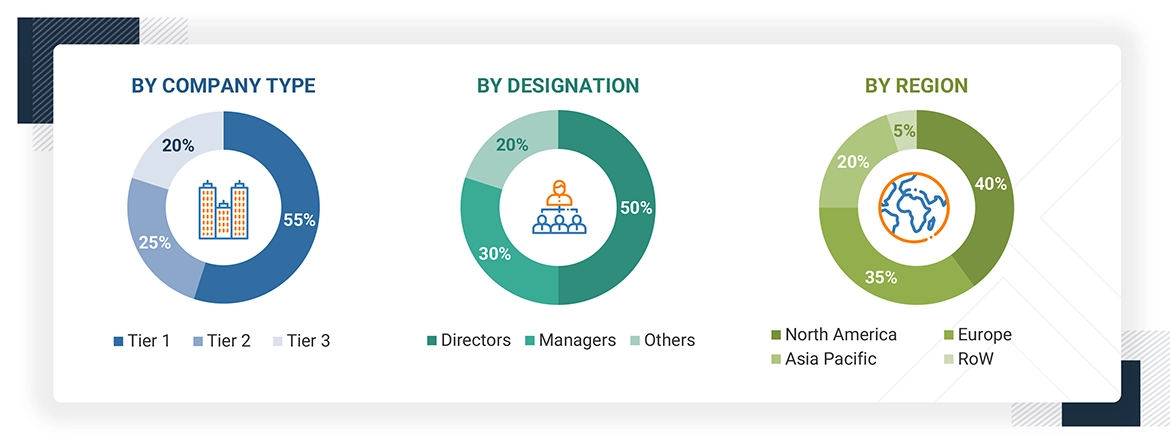
Note: “Others” includes sales, marketing, and product managers
To know about the assumptions considered for the study, download the pdf brochure
Market Size Estimation
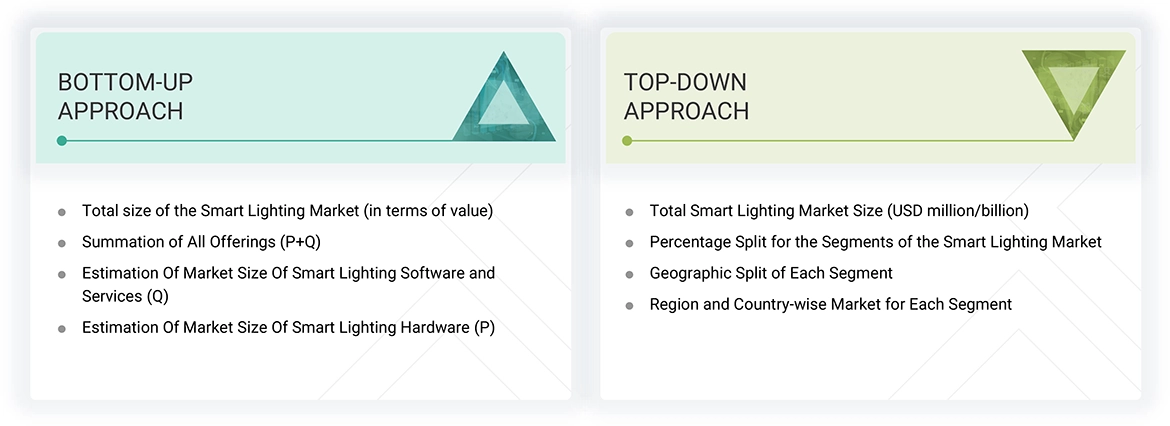
The bottom-up procedure has been employed to arrive at the overall size of the smart lighting market.
- Identification of major companies providing smart lighting hardware, software, and services
- Identification of key segments within the smart lighting market across different geographical regions
- Estimation of the market size in various regions by analyzing the adoption of smart lighting solutions across different industries
- Determination of market share estimates for deployments in different end-use application segments by assessing the demand for smart lighting products and solutions
- Tracking ongoing and upcoming developments in smart lighting products
- Compilation of regional market size data for each segment to derive regional market estimates
- Conducting interviews with multiple key leaders to comprehend the smart lighting market scope, product demand, future market growth, and potential impact of economic downturns
- Verification and validation of estimates through cross-checking with primary sources, discussions with leaders, and consultation with domain experts at MarketsandMarkets
- Analysis of various paid and unpaid information sources, including annual reports, press releases, white papers, and databases
The top-down approach has been used to estimate and validate the total size of the smart lighting market.
- Focusing, initially, on the top-line investments and spending in the ecosystems of various industries. Tracking further splits based on product launches, advancements in smart lighting technologies, smart lighting solutions and software used for various industrial applications, and developments in the key market areas
- Representing and developing the information related to market revenue offered by key hardware, software, and service providers
- Carrying out multiple on-field discussions with key opinion leaders across each major company involved in the development of hardware and software components and services pertaining to smart lighting
- Estimating the geographic split using secondary sources based on factors such as the number of players in a specific country and region, types of products, levels of services offered, and types of software implemented.
Smart Lighting Market : Top-Down and Bottom-Up Approach
Data Triangulation
After arriving at the overall market size—using the market size estimation processes as explained above—the market has been split into several segments and subsegments. To complete the entire market engineering process and arrive at the exact statistics of each market segment and subsegment, data triangulation and market breakdown procedures have been employed, wherever applicable. The data has been triangulated by studying various factors and trends from the demand and supply sides of the smart lighting market.
Market Definition
Smart lighting systems combine automation technologies with connectivity features and intelligent control aspects to deliver enhanced efficiency and improved experience paired with convenience. The system contains LED luminaires, sensors, and wire-based or wireless communication systems to allow remote monitoring and scheduling adjustments based on occupancy status, daylight exposure, and user settings. Users can operate smart lighting systems through mobile applications, voice commands, and centralized automation networks which enable full control of brightness adjustments, color temperature settings, and hue transformation features. These devices play an essential role in residential, commercial, and industrial sectors, helping to reduce energy consumption while aiding sustainability efforts.
Key Stakeholders
- Raw material and component suppliers
- Communication network providers
- Smart lighting device manufacturers
- Original equipment manufacturers
- Semiconductor component suppliers
- Analysts and strategic business planners
- Venture capitalists and start-ups
- Research laboratories and intellectual property (IP) companies
- Technology standards organizations, forums, alliances, and associations
- Hardware vendors
- Software integrators
- Smart lighting solutions-related service providers
- End users
- Government bodies such as regulatory authorities and policymakers
Report Objectives
- To define, estimate, and forecast the smart lighting market based on hardware, software, and services offerings, wired and wireless communication technologies, indoor and outdoor applications, online and offline sales distribution channels, and new and retrofit installation types
- To estimate and project the market size, in terms of value, for various segments with respect to four regions: Americas, Europe, Asia Pacific, and the Rest of the World (ROW)
- To describe and forecast the smart lighting market size, in terms of volume, by hardware offering
- To provide detailed insights regarding drivers, restraints, opportunities, and challenges influencing the growth of the market
- To analyse emerging applications and standards in the smart lighting market
- To examine manufacturers of smart lighting products, their strategies, production plans, and the overall supply chain, including material and component suppliers
- To strategically analyse the micromarkets1 with respect to individual growth trends, prospects, and contributions to the overall market
- To analyse the market opportunities for stakeholders, and provide a comprehensive competitive landscape analysis
- To provide a detailed overview of the smart lighting value chain and ecosystem
- To provide a detailed overview of impact of AI/Gen AI on smart lighting market
- To provide information about the key technology trends, trade analysis, and patents related to the smart lighting market
- To benchmark the market players using the proprietary company evaluation matrix framework, which analyses them on various parameters within the broad categories of market ranking/share and product portfolio
- To analyse competitive developments, such as partnership, acquisitions, agreements, collaborations, and product launches
- To strategically profile key players and analyse their market share, ranking, and core competencies
This research report categorizes the smart lighting market based on offering, communication technology, installation type, distribution channel, end-use application, and region.
Available Customizations
With the given market data, MarketsandMarkets offers customizations according to the specific requirements of companies. The following customization options are available for the report:
- Detailed analysis and profiling of additional market players based on various blocks of the supply chain
Key Questions Addressed by the Report
What is the current size of the Smart Lighting Market?
The global Smart Lighting Market is valued at USD 9.86 billion in 2025 and is projected to reach USD 17.38 billion by 2030, growing at a CAGR of 12.0%.
What are the major trends shaping the Smart Lighting industry?
Key trends include AI-based adaptive lighting, IoT-enabled connected lighting, human-centric lighting, Li-Fi technology, and increasing adoption of data analytics in lighting systems.
What are the key growth drivers of the Smart Lighting Market?
Rising smart city initiatives, increasing demand for energy-efficient solutions, LED adoption, advancements in AI and edge computing, and growing IoT integration are major growth drivers.
Which region is expected to witness the highest growth in the Smart Lighting Market?
Asia Pacific is expected to register the highest CAGR due to rapid urbanization, government support for energy efficiency, and expanding smart city projects across China, India, and South Korea.
Which companies are leading the Smart Lighting Market?
Major players include Signify Holding, Acuity Brands, Legrand, ams-OSRAM AG, Panasonic Holdings Corporation, Zumtobel Group, and LEDVANCE GmbH.
Which application segment is expected to grow the fastest?
Outdoor lighting is projected to record the highest growth owing to increasing investments in smart streetlights and public infrastructure modernization.
What technologies are commonly used in smart lighting systems?
Smart lighting solutions use technologies such as Zigbee, DALI, Power over Ethernet (PoE), Bluetooth Low Energy (BLE), Power Line Communication (PLC), and wireless IoT connectivity.
Which installation type is witnessing the highest demand?
Retrofit installations are expected to grow the fastest as organizations upgrade existing lighting infrastructure with connected and energy-efficient systems without major construction costs.
How does the Smart Lighting Market report analyze the industry?
The report evaluates market size, growth forecasts, competitive landscape, key trends, segmentation, regional analysis, company profiles, and recent developments using top-down and bottom-up methodologies.
What opportunities are emerging in the Smart Lighting industry?
Opportunities include smart building automation, AI-powered lighting systems, sustainability initiatives, smart city projects, and increasing demand for connected lighting in commercial and residential sectors.
Fact checked
Personalize This Research
- Triangulate with your Own Data
- Get Data as per your Format and Definition
- Gain a Deeper Dive on a Specific Application, Geography, Customer or Competitor
- Any level of Personalization
Let Us Help You
- What are the Known and Unknown Adjacencies Impacting the Smart Lighting Market
- What will your New Revenue Sources be?
- Who will be your Top Customer; what will make them switch?
- Defend your Market Share or Win Competitors
- Get a Scorecard for Target Partners

Custom Market Research Services
We Will Customise The Research For You, In Case The Report Listed Above Does Not Meet With Your Requirements
Get 10% Free CustomisationTESTIMONIALS

Tetsuya Ohhira
Business Development Manager-Technology Business
Nikon Corporation,
Leading Japanese MNC specializing in optics and imaging productswww.nikon.com
MarketsandMarkets™ response
is quick. Their attitude is flexible and positive. Analyst Insights are globally considered and
significant. Client Services quickly respond to our inquiry and demand. Their wide range of global
surveys help us make our strategic plan.
We hope Knowledge Store will be easier to search
for a report.
VP - Marketing & Business Development
Leading Provider of Process Control Solutions
We engaged with MarketsandMarkets on a study to perform an analysis and recommend a Go-To-Market strategy for metrology and process control in the semiconductor market. The study was tailored to our targets and needs with well-defined milestones. Our overall experience with the MarketsandMarkets team was very good throughout the project in all aspects including the analysis methodologies used, the quality and depth of primary and secondary data sets, the professionalism and flexibility of the team and the ability to meet the target schedule and milestones. We want to thank MarketsandMarkets team for a job well done.
- US Smart Lighting Market
- Canada Smart Lighting Market
- Mexico Smart Lighting Market
- Germany Smart Lighting Market
- France Smart Lighting Market
- UK Smart Lighting Market
- Italy Smart Lighting Market
- Spain Smart Lighting Market
- Netherlands Smart Lighting Market
- China Smart Lighting Market
- Japan Smart Lighting Market
- India Smart Lighting Market
- South Korea Smart Lighting Market
- Brazil Smart Lighting Market
- Argentina Smart Lighting Market
Growth opportunities and latent adjacency in Smart Lighting Market






Adam
Apr, 2026
What are the differences between wired and wireless communication technologies in smart lighting?.
John
Apr, 2026
Which end-use applications (residential, commercial, industrial) dominate the smart lighting market?.
Porter
Apr, 2026
What are the major challenges (cost, cybersecurity, interoperability) facing smart lighting adoption?.
User
Sep, 2019
I am very much interested in understanding market revenue and forecast in terms of $ and #units for smart lighting broken down by segments (commercial, industrial, outdoor, residential), and by lighting technology (LED, CFL, HID, etc). Is this information available as a part of this report? .
Zhang
Jul, 2022
I am developing a wireless smart lighting switch for home usage and want to sell it around the world out of china. I would like to know where in the world could that kind of products be best sold to, the market size right now, and the possible prospect, especially for Europe. It’s not in a hurry, no strict timeline, It’s a new tech of controlling any light anywhere using any device connected to the lighting device wirelessly. It’s not decided for the exact market budget including information taking. Only after the product had been developed successfully..
User
Sep, 2019
I'm wireless controller manufacturersand hence, looking specifically into wirelessly connected light bulbs. Do you have any information about this? Also, is the report contain market share analysis of varoius lighting controls manufacturers by region? .
User
Sep, 2019
I am currently a student at the University of Texas. I am researching the smart lighting industry. My group and I have to do a presentation on the market and how it will be affected with in the near future. I feel this article would be very helpful and would like to read it for some more specific details. I am specifically looking forward the market projections for US by region/states for smart lighitng space. Could you share such infomration? If yes, at what cost?.
User
Nov, 2019
My company is the distributors of smart lighting product lines. I am researching about smart lighting market. I am specifically looking for market information about Southeast Asia and Africa Markets. Is your study include detailed information for these 2 regions? If it is not readily available how much time will you need for this?.
Denis
Jun, 2025
Let’s keep the conversation going—I’m really interested in hearing your ideas..
User
Mar, 2019
I’m a researcher and analysing smart lightning market in Sweden, Russia and Denmark, compare the demands in them. I am also looking for the market drivers and barrieers within these countries. I feel that your report will be the greatest source of information for me to prepare! Does your report has information about these countries? at what price? .