
Canada Smart Lighting Market (2025-2030)

The Canada Smart Lighting Market was valued at $607.6 Million in 2025 and projected to reach to $955.5 Million by 2030, representing a compound annual growth rate of 9.5%. Canada's smart lighting market is positioned for steady expansion through 2030, supported by increasing consumer awareness of energy savings and smart home integration.


| Market Size in | USD 26.32 MN |
| Market Forecast in | |
| CAGR | |
| Forecast Period | |
| Units Considered | Value (USD MN) |
Canada Smart Lighting Market Trends and Insights
- This 9.5% compound annual growth rate reflects Canada's increasing adoption of connected lighting solutions across residential, commercial, and industrial sectors.
- Canada's strong digital infrastructure and rising consumer demand for energy-efficient technologies are driving market expansion throughout the forecast period. The Canadian smart lighting landscape is characterized by growing integration of IoT and AI-enabled systems in urban centers and commercial facilities.
- Canada's commitment to sustainability and net-zero emissions targets is accelerating the transition from traditional to smart lighting solutions.
- By 2030, Canada is expected to see widespread deployment of advanced lighting controls, occupancy sensors, and daylight harvesting systems across both new construction and retrofit applications. Canada's market growth is supported by favorable government incentives, increasing awareness of operational cost savings, and the proliferation of smart home platforms.
- Canada's competitive advantage in technology adoption positions the country as a key market within North America's broader smart lighting ecosystem..
Key Market Statistics
- CAGR (2025-2030) 9.5% CAGR
- Market Size, 2025 ~USD 607.6 Million
- Forecast, 2030 ~USD 955.5 Million
- Country Canada
Canada Smart Lighting Market Overview
Market Valuation :
Canada's smart lighting market is valued at $607.6 million in 2025, with projections reaching $955.5 million by 2030, representing a robust 9.5% CAGR over the forecast period.
Digital Infrastructure Advantage :
Canada's advanced digital infrastructure and high broadband penetration enable rapid adoption of IoT-enabled lighting solutions across urban and suburban markets.
Multi-Sector Growth :
Smart lighting adoption is accelerating across residential, commercial, and industrial sectors, driven by energy efficiency mandates and sustainability initiatives at federal and provincial levels.
Energy Efficiency Focus :
Rising consumer and corporate demand for energy-efficient technologies, combined with government incentives for green building certifications, is propelling market expansion in Canada.
Canada Smart Lighting Market Dynamics
- Provincial governments and municipalities are implementing building codes that favor connected lighting systems, creating favorable regulatory conditions.
- The commercial real estate sector is particularly active in upgrading to smart lighting for operational efficiency and tenant experience improvements.
- Residential adoption is accelerating as smart home ecosystems become more affordable and user-friendly, with major retailers expanding product availability across the country..
Market Ecosystem
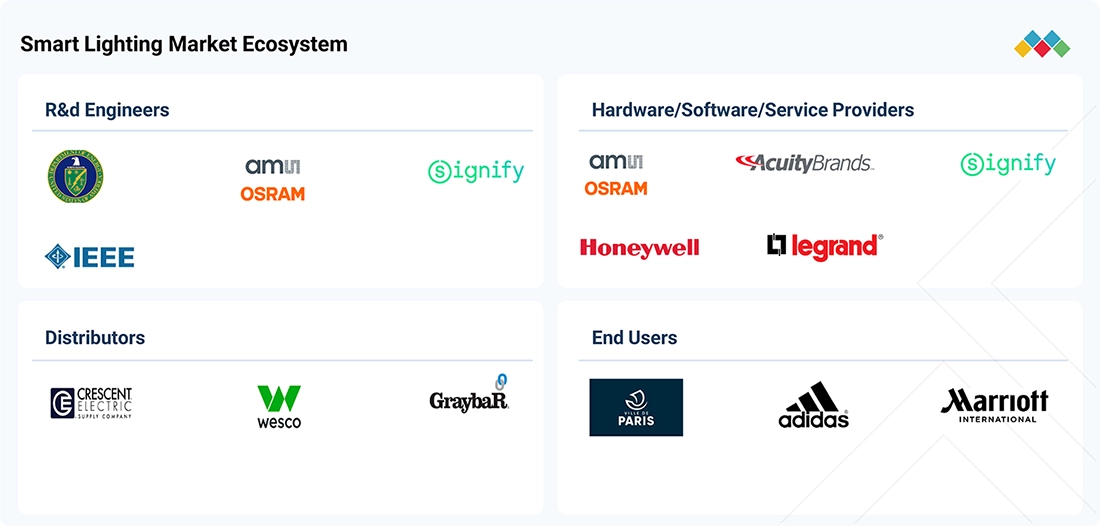
SMART LIGHTING MARKET SIZE, SHARE & GROWTH TRENDS FORECAST TO 2032: COMMERCIAL USE CASES ACROSS INDUSTRIES
| COMPANY | USE CASE DESCRIPTION | BENEFITS |
|---|---|---|
 |
Signify offers smart and connected lighting solutions through its Interact platform, combining LED luminaires, occupancy sensors, daylight sensors, and connected controls for offices, industrial facilities, healthcare, retail, and outdoor applications. Its solutions enable automated lighting adjustment, zoning, scheduling, and remote monitoring based on occupancy and environmental conditions. | Enables intelligent and energy-efficient lighting control | Reduces energy consumption and operational costs | Supports remote monitoring and automated lighting management | Improves occupant comfort and safety |
 |
Legrand provides connected lighting control solutions incorporating sensors, switches, dimmers, and building-control technologies. These solutions are used across commercial buildings, residential spaces, healthcare, education, and industrial facilities to automate lighting based on occupancy, daylight, and user requirements. | Provides automated and flexible lighting control | Supports energy-efficiency and sustainability objectives | Enhances occupant comfort and convenience | Enables integration with building management systems |
 |
Acuity Brands offers intelligent lighting and control solutions through platforms such as nLight, incorporating occupancy sensors, photocells, controllers, switches, dimmers, and connected luminaires. The solutions support indoor and outdoor applications and can scale from individual rooms to entire buildings and campuses. | Enables smart and adaptive lighting control | Reduces energy consumption and installation requirements | Supports real-time monitoring and building optimization | Improves operational efficiency and occupant experience |
 |
Zumtobel provides connected architectural lighting solutions combining LED luminaires with lighting controls, sensors, and digital management technologies. Its solutions are designed for offices, healthcare, education, retail, industrial facilities, and public spaces, supporting adaptive and human-centric lighting environments. | Provides flexible and high-quality lighting environments | Supports energy-efficient and sustainable buildings | Enhances occupant well-being and productivity | Enables connected and automated lighting management |
 |
Panasonic provides LED lighting and connected lighting solutions incorporating smart luminaires, sensors, and control technologies for offices, factories, warehouses, retail facilities, and public spaces. These solutions support automated lighting control, energy management, and efficient operation across different environments. | Enables efficient and reliable lighting control | Reduces energy consumption and operating costs | Supports safer and more comfortable environments | Facilitates smart-building and energy-management applications |
Logos and trademarks shown above are the property of their respective owners. Their use here is for informational and illustrative purposes only.
Related Ecosystem
Smart Home
- Sensors
- Pressure Sensors
- Temperature Sensors
- Actuators
- Face Recognition
- HONEYWELL INTERNATIONAL INC.
- SCHNEIDER ELECTRIC SE
- Siemens ag
- Samsung
- ABB India Limited
Smart Lighting
- Fiber Laser
- Fluorescent Lighting
- Gas Lasers
- Sensors
- 3D Sensors
- Zumtobel group ag
- Nedap n.v.
- Acuity Brands, Inc.
- OSRAM Licht AG
- Philips
Key Takeaways
- Canada's smart lighting market will grow from $607.6M (2025) to $955.5M (2030) at a 9.5% CAGR.
- Canada's sustainability initiatives and net-zero targets are primary drivers of smart lighting adoption.
- Commercial and industrial sectors in Canada represent the largest growth opportunity for connected lighting solutions.
- Canada's advanced digital infrastructure supports rapid deployment of IoT-enabled smart lighting systems.
Smart Lighting Market Report Scope
| Report Metric | Details |
|---|---|
| Base Year | 2025 |
| Fastest Growing Segment | RETROFIT INSTALLATIONS (Installation Type) |
| Forecast Period | 2025–2030 |
| Growth Rate | CAGR of 12% from 2025 to 2030 |
| Largest Segment | INDOOR (End-Use Application) |
| Market Size Base Year (Billions) | ~USD 9.86 (2025) |
| Revenue Forecast (Billions) | ~USD 17.38 (2030) |
| Segments Covered | Communication Technology, Type, End-Use Application, Application, Distribution Channel, Offering, Hardware, Component, Installation Type |
Canada Smart Lighting Market Report Segmentation
9 segment dimensions are covered across the global market.
By Communication Technology
- Wired
- Wireless
By Type
- 6Lowpan
- Ble
- Dali
- Enocean
- Post-Installation
- Power Line Communications (Plc)
- Power Over Ethernet (Poe)
- Pre-Installation
- Wi-Fi
- Wired Hybrid Protocols
- Wireless Hybrid Protocols
- Zigbee
By End-Use Application
- Indoor
- Outdoor
By Application
- Architectural Lighting
- Commercial
- Highways And Roadways Lighting
- Industrial
- Lighting For Public Places
- Residential
By Distribution Channel
- Offline Sales
- Online Sales
By Offering
- Hardware
- Services
- Software
By Hardware
- Lighting Controls
- Lights & Luminaires
By Component
- Dimmers
- Gateways
- Led Driver & Ballasts
- Led Drivers & Ballasts
- Relay Units
- Sensors
- Switches
By Installation Type
- New Installations
- Retrofit Installations
Target Audience
- Smart Lighting Manufacturers : Manufacturers need Canada-specific market data to assess market entry opportunities, competitive positioning, and demand forecasts for product launches and capacity planning.
- Distributors & Retailers : Distribution partners require detailed market insights to optimize inventory, identify high-demand product categories, and develop targeted sales strategies for Canadian regions.
- Commercial Real Estate Developers : Real estate professionals need market intelligence on smart lighting adoption trends, ROI metrics, and regulatory requirements to incorporate connected lighting in new and retrofit projects.
- Energy & Sustainability Consultants : Consultants advising on energy efficiency require Canada-specific data on smart lighting benefits, cost savings, and alignment with provincial sustainability goals and incentive programs.
- Technology Investors & Private Equity : Investment firms evaluating opportunities in Canada's smart lighting ecosystem need market sizing, growth projections, and competitive dynamics to inform investment decisions and valuations.
Key Companies in the Canada Smart Lighting Market
| Company | HQ | Ownership | Strongest segments |
|---|---|---|---|
| AT&S | Austria | ||
| SAMSUNG | Korea, South | ||
| BOREALIS AG | United States | ||
| FOXCONN INDUSTRIAL INTERNET CO LTD | United States | ||
| PLDT ENTERPRISE | Philippines | ||
| DIODES INCORPORATED | United States |
AT&S
AT&S Austria is a printed circuit board manufacturer producing high-tech interconnect solutions for various industrial and electronic applications.
SAMSUNG
Samsung is a South Korean multinational conglomerate operating across electronics, semiconductors, telecommunications, and consumer appliances.
BOREALIS AG
Borealis AG is a polyolefins and base chemicals company based in the United States, producing materials for packaging, automotive, and industrial applications.
FOXCONN INDUSTRIAL INTERNET CO LTD
Foxconn Industrial Internet Co Ltd is a United States-based electronics manufacturing and industrial internet services provider.
PLDT ENTERPRISE
PLDT Enterprise is a Philippines-based telecommunications and ICT solutions provider serving business customers with connectivity and digital services.
DIODES INCORPORATED
Diodes Incorporated is a United States semiconductor manufacturer producing analog and mixed-signal integrated circuits for various applications.
Reasons to Buy this Report
- Market-Specific Sizing & Forecasts : Access precise valuation data for Canada's smart lighting market with detailed projections through 2030, enabling accurate budget allocation and revenue forecasting for Canadian operations.
- Regulatory & Policy Insights : Understand federal and provincial regulations, building codes, and government incentives driving smart lighting adoption across Canada's residential, commercial, and industrial sectors.
- Competitive Landscape Analysis : Identify key players, market share distribution, and competitive strategies specific to Canada, helping you position products and services effectively in this growing market.
- Sector-Specific Opportunities : Discover high-growth segments within Canada's market, including smart homes, commercial real estate, industrial facilities, and municipal infrastructure projects with expansion potential.
- Consumer & Business Trends : Gain insights into Canadian consumer preferences, adoption barriers, and business decision-making factors to refine go-to-market strategies and product development for the Canadian market.
Frequently asked questions
What is the current size of Canada's smart lighting market?
Canada's smart lighting market is valued at $607.6 million in 2025 and is projected to reach $955.5 million by 2030.
What is the expected growth rate for smart lighting in Canada?
Canada's smart lighting market is expected to grow at a compound annual growth rate (CAGR) of 9.5% from 2025 to 2030.
Which sectors are driving smart lighting adoption in Canada?
Commercial, industrial, and residential sectors are driving smart lighting adoption in Canada, with commercial facilities leading due to energy efficiency and operational cost benefits.
How are Canada's sustainability goals impacting the smart lighting market?
Canada's net-zero emissions targets and sustainability commitments are accelerating the transition from traditional to smart lighting solutions, creating significant market growth opportunities.
What technologies are most prevalent in Canada's smart lighting market?
IoT-enabled controls, occupancy sensors, daylight harvesting systems, and AI-powered lighting management platforms are the most prevalent technologies in Canada's smart lighting market.
RESEARCH METHODOLOGY
This study involved four major activities in estimating the current size of the smart lighting market. Extensive secondary research was conducted to gather information on the smart lighting ecosystem, including lighting manufacturers, LED technology providers, sensor suppliers, lighting-control companies, system integrators, distributors, building automation providers, and end users. This was followed by primary research with industry stakeholders across the value chain, including smart lighting manufacturers, technology providers, component suppliers, distributors, system integrators, building owners, and facility managers, to validate assumptions and market sizing. Both top-down and bottom-up approaches were used to estimate the overall market size. Market breakdowns and data triangulation techniques were then applied to determine the size of individual segments and subsegments by offering, communication technology, distribution channel, end-use application, and region. Secondary and primary sources were jointly used to support a comprehensive, technical, commercial, and competitive analysis of the global smart lighting market.
Secondary Research
Various secondary sources were referred to during the secondary research process to identify and collect information relevant to the smart lighting market. These sources included annual reports, company presentations, press releases, product catalogs, technical datasheets, patents, technical publications, company websites, trade directories, and government databases. Secondary research was conducted to obtain key insights into the market’s supply chain, value chain, competitive landscape, and segmentation by offering, communication technology, distribution channel, end-use application, and region. It also helped assess industry trends, adoption of smart lighting across commercial, residential, industrial, healthcare, retail, hospitality, and outdoor applications, and developments in LED lighting, connected luminaires, occupancy and daylight sensors, wired and wireless controls, IoT platforms, and lighting-management systems. The collected information was further analyzed to estimate the overall market size and validate market assumptions, which were subsequently refined through primary research with industry experts and key stakeholders.
Primary Research
Extensive primary research was conducted after gaining knowledge about the current scenario of the smart lighting market through secondary research. Several primary interviews were conducted with experts from the demand and supply sides across four major regions: North America, Europe, Asia Pacific, and RoW. This primary data was collected through questionnaires, emails, and telephonic interviews.
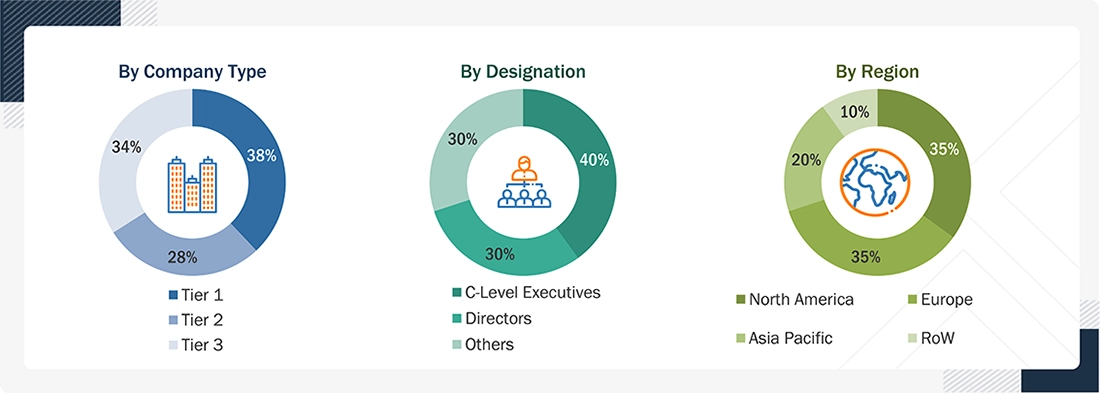
Note: The three tiers of the companies are defined based on their total revenue in 2025: Tier 1 - revenue greater than or equal to USD 1 billion; Tier 2 - revenue between USD 100 million and USD 1 billion; and Tier 3 revenue less than or equal to USD 100 million. Other designations include sales managers, marketing managers, and product managers.
To know about the assumptions considered for the study, download the pdf brochure
Market Size Estimation
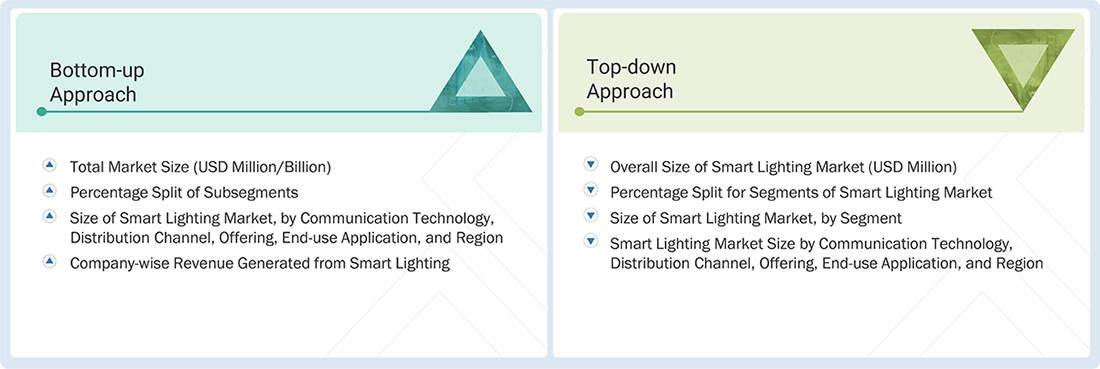
Both top-down and bottom-up approaches were used to estimate and validate the total size of the smart lighting market. These methods were also used extensively to estimate the size of various subsegments in the market. The following research methodology was used to estimate the market size:
- Major players in the smart lighting market and related markets were identified through extensive secondary research.
- The industry’s value chain and market size in terms of value and volume were determined through primary and secondary research processes.
- All percentage shares, splits, and segment-level breakdowns were determined using secondary sources and verified through primary research and data triangulation.
Data Triangulation
After arriving at the overall size of the smart lighting market through the market size estimation process, the total market was divided into relevant segments and subsegments. Data triangulation and market breakdown procedures were applied, wherever applicable, to complete the market engineering process and derive statistics for each segment and subsegment. The data were triangulated by evaluating factors and trends from the demand and supply sides, including technology adoption, product offerings, communication technologies, application requirements, smart-building investments, energy-efficiency initiatives, and regional trends. The analysis considered key smart lighting technologies such as LED lighting, connected luminaires, occupancy and daylight sensors, wired and wireless controls, IoT platforms, and lighting-management systems, along with hardware and services, distribution channels, and indoor and outdoor applications. Along with this, the market size was validated using top-down and bottom-up approaches to ensure consistency across the overall market and individual segments.
Market Definition
Smart lighting refers to lighting systems that combine LED luminaires, sensors, controllers, communication technologies, and software to enable automated, connected, and intelligent control of illumination. Smart lighting systems can detect occupancy, daylight, environmental conditions, and user preferences and adjust lighting levels, color, scheduling, and operation accordingly. These solutions can incorporate wireless or wired connectivity, occupancy and daylight sensing, dimming, and centralized or cloud-based lighting management across indoor and outdoor environments.
Smart lighting plays an important role across commercial and residential buildings, industrial facilities, healthcare, retail, hospitality, and outdoor infrastructure. These solutions enable energy management, automated lighting control, remote monitoring, occupant comfort, safety, and operational efficiency. Smart lighting systems are commonly integrated into offices, homes, factories, warehouses, hospitals, hotels, retail spaces, streets, and smart-city infrastructure. A typical smart lighting system may consist of LED luminaires, drivers, sensors, switches or controllers, communication interfaces, gateways, and lighting-management software, with its configuration varying according to the application, connectivity technology, control requirements, and operating environment.
Key Stakeholders
- Raw material and component suppliers
- Communication network providers
- Smart lighting device manufacturers
- Original equipment manufacturers
- Semiconductor component suppliers
- Analysts and strategic business planners
- Venture capitalists and start-ups
- Research laboratories and intellectual property (IP) companies
- Technology standards organizations, forums, alliances, and associations
- Hardware vendors
- Software integrators
- Smart lighting solutions-related service providers
- End users
- Government bodies such as regulatory authorities and policymakers
Report Objectives
- To define, estimate, and forecast the smart lighting market based on offering (hardware, software, and services), communication technology (wired and wireless), end-use application (indoor and outdoor), distribution channel (online retail and offline retail), and installation type (new installations and retrofit installations)
- To estimate and project the market size, in terms of value, for various segments with respect to four regions: North America, Europe, Asia Pacific, and the Rest of the World (ROW)
- To describe and forecast the market size, in terms of volume, by offering
- To provide detailed insights regarding drivers, restraints, opportunities, and challenges influencing the growth of the market
- To analyze emerging applications and standards in the market
- To examine manufacturers of smart lighting products, their strategies, production plans, and the overall supply chain, including material and component suppliers
- To strategically analyze the micromarkets with respect to individual growth trends, prospects, and contributions to the overall market
- To analyze the market opportunities for stakeholders and provide a comprehensive competitive landscape analysis
- To provide a detailed overview of the smart lighting value chain and ecosystem
- To provide a detailed overview of the impact of AI/Gen AI on the market
- To provide information about the key technology trends, trade analysis, and patents related to the market
- To benchmark the market players using the proprietary company evaluation matrix framework, which analyzes them on various parameters within the broad categories of market ranking/share and product portfolio
- To analyze competitive developments, such as partnerships, acquisitions, agreements, collaborations, and product launches
- To strategically profile key players and analyze their market share, ranking, and core competencies
Available customizations:
With the given market data, MarketsandMarkets offers customizations according to the company’s specific needs. The following customization options are available for the report:
Company Information:
- Detailed analysis and profiling of additional market players (up to 5)
Get the Full Smart Lighting Market Report
Full forecast, segment splits, and company analysis for all Smart Lighting Market.
- US Smart Lighting Market
- Mexico Smart Lighting Market
- Germany Smart Lighting Market
- France Smart Lighting Market
- UK Smart Lighting Market
- Italy Smart Lighting Market
- Spain Smart Lighting Market
- Netherlands Smart Lighting Market
- China Smart Lighting Market
- Japan Smart Lighting Market
- India Smart Lighting Market
- South Korea Smart Lighting Market
- Brazil Smart Lighting Market
- Argentina Smart Lighting Market
Need a Tailored Report?
Customize this report to your needs
Get 10% FREE Customization
Customize This Report
