
Japan Smart Robots Market (2025-2030)

The Japan Smart Robots Market was valued at $40.1 Million in 2025 and projected to reach to $97.8 Million by 2030, representing a compound annual growth rate of 19.5%. Japan's smart robots market is poised for sustained growth driven by structural labor shortages and technological advancement.


| Market Size in | USD 26.32 MN |
| Market Forecast in | |
| CAGR | |
| Forecast Period | |
| Units Considered | Value (USD MN) |
Japan Smart Robots Market Trends and Insights
- Japan's advanced manufacturing ecosystem and aging workforce have positioned the nation as a critical hub for robotics adoption across industrial and service sectors.
- The 19.5% compound annual growth rate reflects Japan's commitment to automation and AI-driven solutions to address labor shortages and enhance productivity. Driving Japan's market growth are investments in collaborative robots, autonomous systems, and AI-enabled automation technologies.
- Japan's strong semiconductor and electronics infrastructure supports rapid innovation in smart robotics, while government initiatives and corporate R&D spending accelerate deployment across automotive, electronics, and healthcare industries.
- By 2030, Japan is expected to solidify its position as a leading smart robots market within Asia Pacific, with expanding applications in manufacturing, logistics, and elderly care. Japan's competitive advantages include technological expertise, established supply chains, and early adoption of Industry 4.0 standards.
- The market's trajectory through 2030 underscores Japan's strategic focus on maintaining industrial competitiveness while addressing demographic challenges through intelligent automation..
Key Market Statistics
- CAGR (2025-2030) 19.5% CAGR
- Market Size, 2025 ~USD 40.1 Million
- Forecast, 2030 ~USD 97.8 Million
- Country Japan
Japan Smart Robots Market Overview
Market Valuation Growth :
Japan's smart robots market is valued at $40.1 million in 2025 and is projected to reach $97.8 million by 2030, representing a 143.6% increase over the five-year forecast period.
Aging Workforce Catalyst :
Japan's demographic challenges, with an aging population and declining workforce, are driving accelerated adoption of smart robots across manufacturing, healthcare, and service sectors to maintain productivity.
Advanced Manufacturing Hub :
Japan's world-class manufacturing infrastructure and expertise in precision engineering position it as a global leader in smart robotics innovation and deployment across automotive and electronics industries.
AI Integration Leadership :
Japanese companies are pioneering AI-driven robotics solutions, combining traditional robotics excellence with cutting-edge artificial intelligence to create next-generation autonomous systems for industrial and consumer applications.
Japan Smart Robots Market Dynamics
- The nation's 19.5% CAGR significantly outpaces global economic growth, reflecting strategic investments in automation across manufacturing, logistics, and service sectors.
- Government initiatives supporting Industry 4.0 and robotics R&D further accelerate market expansion. By 2030, Japan's smart robots market will establish the country as a critical innovation center for global robotics adoption.
- Increasing integration of AI, IoT, and cloud technologies will enable more sophisticated autonomous systems.
- The convergence of aging demographics with technological capability creates a unique market dynamic where robotics adoption becomes essential for economic competitiveness and social sustainability..
Market Ecosystem
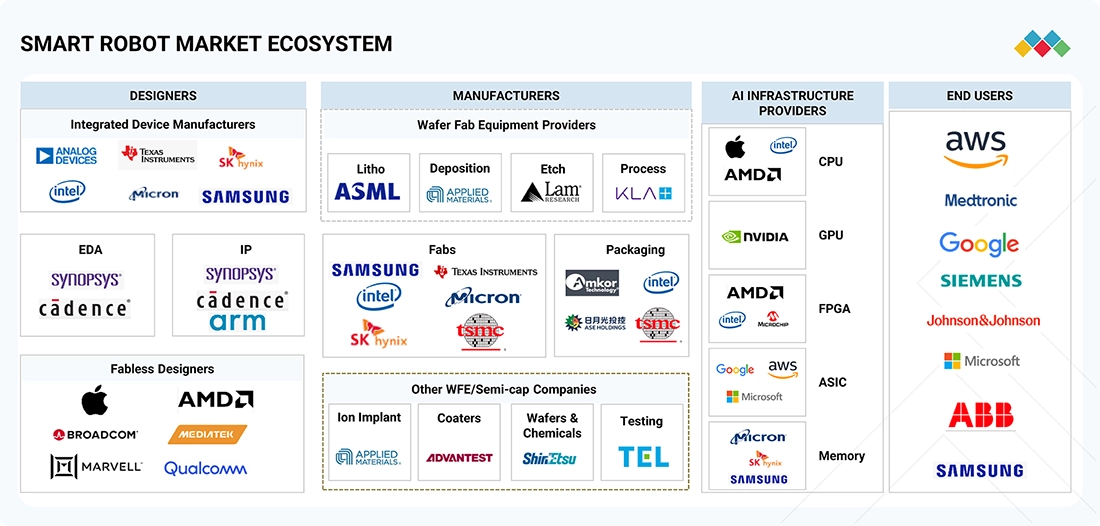
Smart Robots Market: COMMERCIAL USE CASES ACROSS INDUSTRIES
| COMPANY | USE CASE DESCRIPTION | BENEFITS |
|---|---|---|
 |
Used for personal & domestic applications such as cleaning, bin emptying, pad washing, and self-cleaning cycles. | Compatible with all operating systems, such as Android, Chrome OS, Windows, iOS, and macOS, it also learns cleaning rules, asks for and responds to feedback, and remembers how to react |
 |
Used for personal & domestic, and professional applications, such as vacuuming, sweeping, scrubbing, and mopping. Also offers various smart delivery robots for high-end hospitality in hotels, restaurants, and other applications, as well as humanoids for educational institutions, research facilities, and new communication and entertainment applications | Act as an intelligent commercial robot that consolidates sweeping, mopping, vacuuming, and drying into one unit. Humanoids are equipped with voice interaction through a tablet on its chest, facial recognition, and emotion recognition |
 |
Articulated, Collaborative, Delta, Scara, and Paint Robot used for various professional applications such as material handling, machine tending, cutting, assembling, testing, inspecting, dispensing, grinding, and polishing | Automate high-volume and repetitive tasks with consistent speed and reliability, resulting in substantial gains in output for industries like automotive, electronics, and logistics. |
 |
Articulated and collaborative technologies are used in various professional applications, including material handling, assembly, welding, and polishing. They cater to a wide array of industries, from automotive manufacturing to logistics | Flexible in installation for small parts assembly, material handling, or testing and handle more demanding tasks while still maintaining flexibility and safety in a collaborative setting |
 |
Industrial, automotive, manufacturing, and others enhancing automation, productivity, and precision | These robots excel in high-volume production by operating 24/7 with minimal downtime, increasing throughput and speeding up production cycles |
Logos and trademarks shown above are the property of their respective owners. Their use here is for informational and illustrative purposes only.
Related Ecosystem
Drones And Robotics
- Sensors
- Articulated Robots
- Cartesian Robots
- Scara Robots
- Actuators
- ABB India Limited
- KUKA AG
- MOMENTIVE PERFORMANCE MATERIALS INC.
- Fanuc Corporation
- STAUBLI INTERNATIONAL AG
Key Takeaways
- Japan's smart robots market will nearly double from $40.1M (2025) to $97.8M (2030), driven by a 19.5% CAGR.
- Japan's aging population and labor shortage create strong demand for automation in manufacturing, logistics, and healthcare sectors.
- Japan's semiconductor and electronics expertise positions the nation as a technology leader in smart robotics innovation.
- Government support and corporate R&D investments accelerate Japan's adoption of collaborative and AI-enabled robotic systems.
Smart Robots Market Report Scope
| Report Metric | Details |
|---|---|
| Base Year | 2025 |
| Fastest Growing Segment | SOFTWARE (Component) |
| Forecast Period | 2025–2030 |
| Growth Rate | CAGR of 21.5% from 2025 to 2030 |
| Largest Segment | GROUND (Operating Environment) |
| Market Size Base Year (Billions) | ~USD 16.16 (2025) |
| Revenue Forecast (Billions) | ~USD 42.8 (2030) |
| Segments Covered | Component, Hardware Component, Type, Sensor Type, Actuator Type, Control System Type, Processor Type, Mobility, Operating Environment, Application, Personal & Domestic Application, Professional Application, Education & Entertainment Application, Domestic Application, Other Personal & Domestic Application, Military & Defense Application, Law Enforcement Application, Logistics Management Application, Industrial Application |
Japan Smart Robots Market Report Segmentation
19 segment dimensions are covered across the global market.
By Component
- Hardware
- Software
By Hardware Component
- Actuators
- Control Systems
- Other Hardware Components
- Power Sources
- Sensors
By Type
- Industrial Robots
- Service Robots
By Sensor Type
- Accelerometers
- Force/Torque Sensors
- Gyroscopes
- Microphones
- Other Sensor Types
- Position Sensors
- Tilt Sensors
- Vision/Image Sensors
By Actuator Type
- Electrical
- Hydraulic
- Piezoelectric
- Pneumatic
- Ultrasonic
By Control System Type
- Controllers
- Processors
By Processor Type
- Asics
- Fpgas
- Gpus
- Mpus
By Mobility
- Mobile
- Stationary
By Operating Environment
- Ground
- Underwater
By Application
- Personal & Domestic
- Professional
By Personal & Domestic Application
- Companionship
- Domestic
- Education & Entertainment
- Other Personal & Domestic Application
- Other Personal & Domestic Applications
By Professional Application
- Field/Agriculture
- Healthcare Assistance
- Industrial
- Inspection & Maintenance
- Law Enforcement
- Logistics Management
- Military & Defense
- Other Professional Applications
- Otherprofessional Applications
- Public Relations
By Education & Entertainment Application
- Robotic Pets
- Smart Toys
By Domestic Application
- Lawn Mowing
- Pool Cleaning
- Vacuum & Floor Cleaning
By Other Personal & Domestic Application
- Elderly & Disability Assistance
- Home Security & Surveillance
By Military & Defense Application
- Border Security
- Combat Operations
- Search & Rescue Operations
- Spying
By Law Enforcement Application
- Patrolling
- Riot Control
By Logistics Management Application
- Pick & Place
- Sorting
By Industrial Application
- Manufacturing
- Material Handling
Target Audience
- Robotics Manufacturers : Japanese and international robotics companies need Japan-specific market data to benchmark performance, identify growth opportunities, and develop localized product strategies for the world's most advanced robotics market.
- Industrial Automation Integrators : System integrators and automation solution providers require detailed Japan market insights to identify customer segments, understand adoption barriers, and position solutions addressing labor shortages and manufacturing efficiency.
- Technology Investors & VCs : Investment firms targeting Japan's robotics and AI sectors need comprehensive market analysis to evaluate startup opportunities, assess market timing, and identify high-growth segments within the $97.8M 2030 market.
- Manufacturing & Logistics Companies : Japanese manufacturers and logistics operators need market intelligence on smart robotics solutions to evaluate automation investments, understand competitive offerings, and plan digital transformation initiatives.
- Government & Policy Makers : Japanese government agencies and policy organizations require market data to assess Industry 4.0 progress, evaluate robotics adoption rates, and inform strategic initiatives supporting automation and economic competitiveness.
Key Companies in the Japan Smart Robots Market
| Company | HQ | Ownership | Strongest segments |
|---|---|---|---|
| ADEPT TECHNOLOGY INC | United Kingdom | Private Company | Managed Services (network, cloud, cybersecurity supporting robots),Fixed Line and Data Connectivity for Automated Sites,Education and Public-Sector IT Solutions, |
| APPLE INC | United States | Public Company | Sensors & On-device AI Enablers,Control Systems & Software Platforms,Cloud & Services for Robotics Use Cases, |
| GOOGLE INC | United States | Public Company | Software (AI, perception, navigation, conversational interfaces),Control Systems (cloud and edge orchestration),Sensors and Data Services, |
| HCL TECHNOLOGIES LIMITED | India | Public Company | Software and Control Systems (AI, data, integration, lifecycle management),Engineering and R&D for Smart Robot Hardware (sensors, actuators, platforms),Automation and Digital Process Operations (RPA, hyper intelligent automation), |
| IBM CORPORATION | United States | Public Company | Software (AI, data, orchestration for smart robots),Control Systems & Infrastructure,Consulting & Managed Services for Robotics, |
| MICROSOFT CORPORATION | United States | Public Company | Software (AI, orchestration, analytics, cloud services),Control Systems (edge, IoT, integration middleware),Services and Support, |
| NORTHROP GRUMMAN CORPORATION | United States | Public Company | Sensors,Actuators,Power Sources, |
| KORE WIRELESS GROUP | United States | Public Company | Connectivity-as-a-service for smart robots,Device and fleet management software,Security and data services for robotic systems, |
| FUJISOFT INCORPORATED | Japan | Private Company | Software (robot OS, middleware, cloud integration, security),Control Systems and Building/Area Management (FSGate and related),Embedded Technologies and Mobile/Information Appliance Development, |
| VOITH | Germany | Private Company | Actuators, drives, and power transmission for industrial smart robots,Control systems, electrics, and electronics,Software and digital services linked to smart robotics, |
| IROBOT CORPORATION | United States | Private Company | Roomba robot vacuums,Roomba vacuum and mop combos,Robot mop products, |
| ABB | Switzerland | Public Company | Industrial smart robots (hardware, cells, and integration),Control systems and industrial software for smart robots,Sensors, actuators, and power-related components, |
| KUKA AG | Germany | Private Company | Industrial smart robots (stationary and mobile, incl. controllers),Collaborative and mobile robots,Software, control systems, and digital services, |
| FANUC CORPORATION | Japan | Public Company | Industrial smart robots (hardware: manipulators, actuators, power, control),CNC and factory automation components for smart cells,Software, FIELD system, AI-based monitoring, |
| YASKAWA ELECTRIC CORPORATION | Japan | Public Company | Industrial smart robots (welding, handling, assembly, palletizing),Motion components (servo motors, drives, encoders) for smart robots,Control systems and software, |
| AMAZON.COM, INC. | United States | Public Company | Control Systems & Software (including AWS robotics/AI services),Service Robots (warehouse, logistics, consumer endpoints),Sensors, Actuators & Power/Embedded Hardware, |
| KONGSBERG MARITIME | Norway | Public Company | Sensors and positioning systems,Actuators, propulsion and manoeuvring,Control systems and marine automation, |
| ECA GROUP | France | Private Company | Underwater service robots (ROVs, AUVs) and payloads,Ground and maritime unmanned systems for defense and security,Training and tactical simulators (flying, driving, maritime, land), |
| INTUITIVE SURGICAL | United States | Public Company | da Vinci Surgical Systems (capital platforms),Instruments, accessories, and disposables,Ion endoluminal system and related disposables, |
ADEPT TECHNOLOGY INC
Adept Technology Inc is a private company founded in 2003 in the United Kingdom with 346 employees.
APPLE INC
Apple Inc is a public company founded in 1976 in the United States with 166,000 employees.
GOOGLE INC
Google Inc is a public company founded in 1998 in the United States with 194,668 employees.
HCL TECHNOLOGIES LIMITED
HCL Technologies Limited is a public company founded in 1976 in India.
IBM CORPORATION
IBM Corporation is a public company founded in 1911 in the United States with 264,300 employees.
MICROSOFT CORPORATION
Microsoft Corporation is a public company founded in 1975 in the United States with 228,000 employees.
NORTHROP GRUMMAN CORPORATION
Northrop Grumman Corporation is a public company founded in 1939 in the United States with 95,000 employees.
KORE WIRELESS GROUP
Kore Wireless Group is a public company founded in 2002 in the United States with 403 employees.
FUJISOFT INCORPORATED
Fujisoft Incorporated is a private company founded in 1970 in Japan with 19,689 employees.
VOITH
Voith is a private company founded in 1867 in Germany with 23,224 employees.
IROBOT CORPORATION
iRobot Corporation is a private company founded in 1990 in the United States with 541 employees.
ABB
ABB is a public company founded in 1883 in Switzerland with 111,900 employees.
KUKA AG
KUKA AG is a private company founded in 1898 in Germany with 14,985 employees.
FANUC CORPORATION
Fanuc Corporation is a public company founded in 1950 in Japan with 10,040 employees.
YASKAWA ELECTRIC CORPORATION
Yaskawa Electric Corporation is a public company founded in 1915 in Japan with 12,483 employees.
AMAZON.COM, INC.
Amazon.com, Inc. is a public company founded in 1994 in the United States with 1,576,000 employees.
KONGSBERG MARITIME
Kongsberg Maritime is a public company founded in 2025 in Norway with 8,411 employees.
ECA GROUP
ECA Group is a private company founded in 1936 in France with 660 employees.
INTUITIVE SURGICAL
Intuitive Surgical is a public company founded in 1995 in the United States with 17,021 employees.
Reasons to Buy this Report
- Japan-Specific Market Sizing : Access precise valuation data for Japan's smart robots market with verified 2025 baseline ($40.1M) and 2030 forecast ($97.8M), enabling accurate financial planning and investment decisions specific to the Japanese market.
- Competitive Landscape Intelligence : Understand Japan's unique competitive dynamics, including local manufacturers, international players, and emerging startups operating in the Japanese smart robots ecosystem with country-specific market positioning.
- Demographic-Driven Growth Drivers : Leverage insights into how Japan's aging workforce and labor shortage challenges are creating unprecedented demand for smart robotics solutions, identifying high-potential market segments and customer pain points.
- Technology Adoption Trends : Gain detailed analysis of AI integration, IoT connectivity, and automation adoption rates specific to Japan's manufacturing, healthcare, and service sectors to inform product development and go-to-market strategies.
- Strategic Investment Guidance : Make informed investment and partnership decisions in Japan's robotics market with comprehensive data on growth trajectories, regulatory environment, and emerging opportunities across industrial and service robotics segments.
Frequently asked questions
What is the current size of Japan's smart robots market?
Japan's smart robots market is valued at $40.1 million in 2025 and is projected to grow to $97.8 million by 2030.
What is the growth rate of Japan's smart robots market?
Japan's smart robots market is growing at a compound annual growth rate (CAGR) of 19.5% from 2025 to 2030.
What factors are driving growth in Japan's smart robots market?
Japan's market growth is driven by an aging workforce, labor shortages, strong semiconductor infrastructure, government initiatives, and increased corporate R&D investments in automation and AI technologies.
Which industries in Japan are adopting smart robots most rapidly?
Japan's automotive, electronics, manufacturing, logistics, and healthcare sectors are leading adopters of smart robotics solutions.
How does Japan's smart robots market compare to the global market?
Japan's 19.5% CAGR slightly trails the global 21.5% CAGR, but Japan's market size and technological leadership position it as a key regional player within Asia Pacific.
RESEARCH METHODOLOGY
The study involved major activities in estimating the current market size for the blockchain market. Exhaustive secondary research was done to collect information on the blockchain industry. The next step was to validate these findings, assumptions, and sizing with industry experts across the value chain using primary research. Different approaches, such as top-down and bottom-up, were employed to estimate the total market size. After that, the market breakup and data triangulation procedures were used to estimate the market size of the segments and subsegments of the blockchain market.
Secondary Research
The secondary research for this study involved gathering information from a wide range of credible sources. These included company annual reports, investor presentations, press releases, whitepapers, certified publications, and articles from reputable associations and government publications. Additional data was obtained from corporate filings, professional and trade associations, journals, and industry-recognized authors. Research from consortiums, councils, and gold- and silver-standard websites, directories, and databases also contributed to the qualitative framework. Key global sources such as the International Trade Centre (ITC) and the International Monetary Fund (IMF) were consulted to support and validate the market analysis.
Primary Research
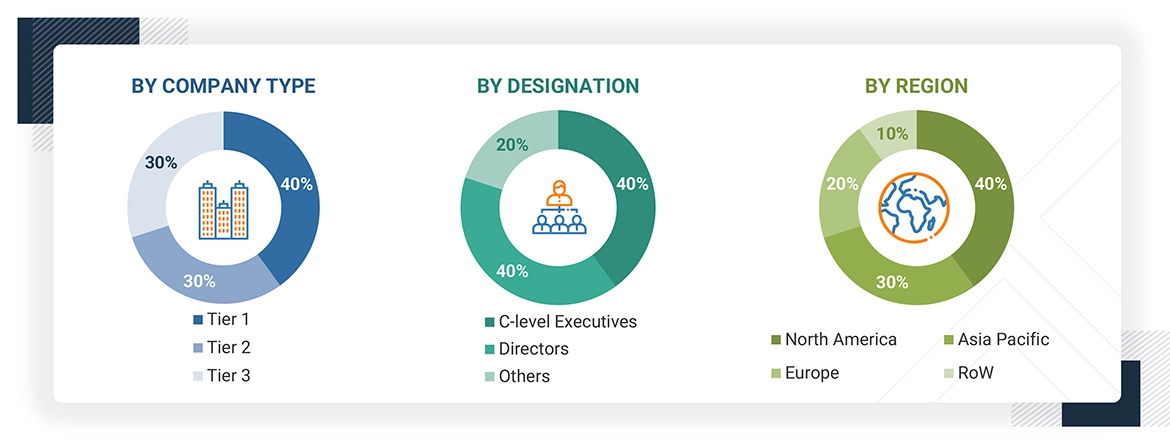
Extensive primary research was accomplished after understanding and analyzing the smart robots market scenario through secondary research. Several primary interviews were conducted with key opinion leaders from demand- and supply-side vendors across four major regions—North America, Europe, Asia Pacific, and RoW. Approximately 20% of the primary interviews were conducted with the demand side and 80% with the supply side. Primary data was collected through questionnaires, e-mails, and telephonic interviews. Various departments within organizations, such as sales, operations, and administration, were contacted to provide a holistic viewpoint in the report.
To know about the assumptions considered for the study, download the pdf brochure
Market Size Estimation
The smart robots market size and submarkets have been estimated and validated using top-down and bottom-up approaches. Secondary research identified key market players and their regional market shares, which were confirmed via primary and secondary sources. The methodology involved analyzing annual reports and conducting expert interviews (with CEOs, VPs, and directors) for quantitative and qualitative insights. All market shares, splits, and influencing factors were thoroughly examined, verified, and analyzed. The final data was consolidated and enriched with expert insights and analysis from MarketsandMarkets, ensuring a comprehensive and accurate representation of the report.
Bottom-Up Approach
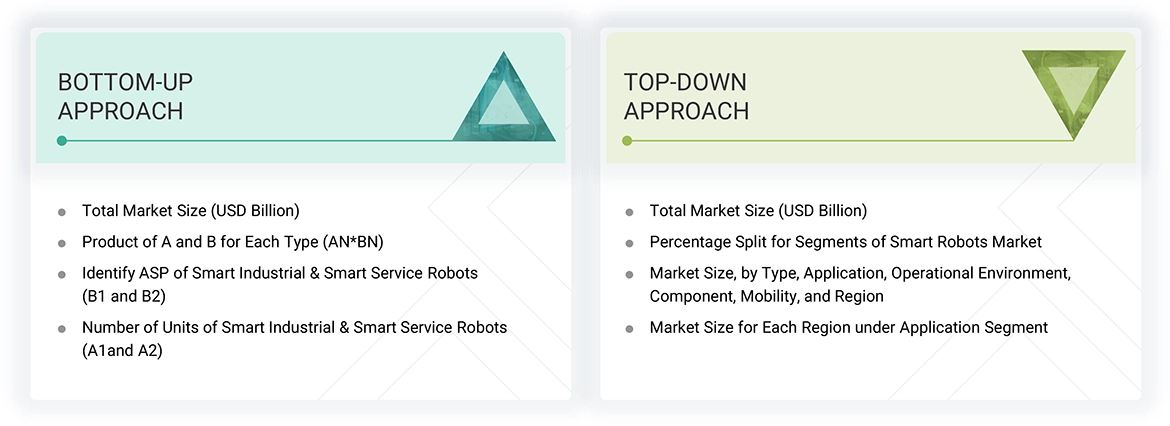
The bottom-up approach has been employed to arrive at the overall size of the smart robots market from the calculations based on the revenues of key players and their shares in the market. For instance, key players, such as iRobot Corporation (US), SoftBank Robotics Group (Japan), ABB (Switzerland), and KUKA AG (Germany), have been studied, and market estimations have been done considering the shipment and average selling prices (ASPs) of smart robots.
Top-Down Approach
In the top-down approach, the overall market size is segmented using percentage splits derived from primary and secondary research. Conversely, the bottom-up approach aggregates data from individual segments to validate the total market size. Primary respondents across different regions further confirmed these findings. Additionally, the bottom-up approach was used to cross-check data obtained from secondary sources and verify company market shares by estimating their revenue contributions. To ensure accuracy and consistency, data triangulation was used—integrating findings from the industrial and markets with segment-specific data. The triangulation and validation methods applied in this study help strengthen the reliability of the overall market estimation.
Smart Robots Market : Top-Down and Bottom-Up Approach
Data Triangulation
After arriving at the overall size of the smart robots market through the process explained above, the overall market has been split into several segments. Data triangulation procedures have been employed to complete the overall market engineering process and arrive at the exact statistics for all the segments, wherever applicable. The data has been triangulated by studying various factors and trends from the demand and supply sides. The market has also been validated using top-down and bottom-up approaches.
Market Definition
Smart robots are automated devices that can think, sense, move, and manipulate materials, parts, tools, or specialized devices through a variable programmed motion to perform various tasks. The functioning of a smart robot is executed by the control system in AI, whereas sensing and manipulation are body functions based on physics, mechanical and electrical engineering, and software.
Key Stakeholders
- Original equipment manufacturers (OEMs)
- Technology solution providers
- Research institutes
- Market research and consulting firms
- Technology investors
- Governments and financial institutions
- Analysts and strategic business planners
- End users and prospective end users
Report Objectives
- To describe, segment, and forecast the smart robots market based on operating environment, mobility, type, component, application, and geography, in terms of value
- To forecast the global smart robots market, by operating environment and type, in terms of volume
- To describe, segment, and forecast the market for four key regions: North America, Europe, Asia Pacific, and RoW, in terms of value
- To provide detailed information regarding the market dynamics (drivers, restraints, opportunities, and challenges) influencing the growth of the smart robots market
- To strategically analyze micromarkets1 with regard to individual growth trends, prospects, and contributions to the overall market
- To analyze competitive developments, such as product launches & developments, expansions, partnerships, and acquisitions, in the smart robots market
- To strategically profile the key players in the smart robots market and comprehensively analyze their market ranking and core competencies2
Available Customizations
With the market data given, MarketsandMarkets offers customizations according to the company’s specific needs. The following customization options are available for the report:
Company Information
- Detailed analysis and profiling of additional market players (up to 7)
Get the Full Smart Robots Market Report
Full forecast, segment splits, and company analysis for all Smart Robots Market.
Need a Tailored Report?
Customize this report to your needs
Get 10% FREE Customization
Customize This Report
