
China Social and Emotional Learning Market (2023-2028)

The China Social and Emotional Learning Market was valued at $183 Million in 2023 and projected to reach to $600 Million by 2028, representing a compound annual growth rate of 26.9%. China's Social and Emotional Learning market is positioned for exceptional growth through 2028, driven by systemic educational reforms emphasizing student mental wellness and character development.


| Market Size in | USD 26.32 MN |
| Market Forecast in | |
| CAGR | |
| Forecast Period | |
| Units Considered | Value (USD MN) |
China Social and Emotional Learning Market Trends and Insights
- This represents a compound annual growth rate of 26.9%, significantly outpacing global trends as China prioritizes mental health and holistic student development in educational institutions.
- The market growth in China is driven by increasing government initiatives, rising awareness of emotional intelligence in schools, and growing adoption of digital learning platforms that integrate SEL curricula. China's SEL market expansion reflects broader educational reforms emphasizing student well-being alongside academic achievement.
- Between 2023 and 2028, China is expected to see substantial investment in SEL software, training programs, and assessment tools across primary, secondary, and higher education sectors.
- The integration of artificial intelligence and data analytics into SEL platforms is accelerating adoption rates in China, particularly in tier-1 and tier-2 cities where digital infrastructure is most advanced. The competitive landscape in China features both domestic edtech companies and international players adapting solutions to meet local regulatory requirements and cultural contexts.
- China's SEL market opportunity is further strengthened by partnerships between educational institutions, technology providers, and government bodies committed to fostering emotional resilience and social competencies among students..
Key Market Statistics
- CAGR (2023-2028) 26.9% CAGR
- Market Size, 2023 ~USD 183 Million
- Forecast, 2028 ~USD 600 Million
- Country China
China Social and Emotional Learning Market Overview
Rapid Market Expansion :
China's SEL market is growing at 26.9% CAGR, significantly exceeding the global rate of 23.6%, driven by government emphasis on mental health and holistic education reform in schools nationwide.
Substantial Market Growth :
Market valuation is projected to grow from $183 million in 2023 to $600 million by 2028, representing a 228% increase over five years as educational institutions prioritize emotional intelligence development.
Government Policy Support :
China's education ministry initiatives promoting mental health awareness and emotional competency in curricula are accelerating SEL adoption across primary, secondary, and higher education institutions.
Digital Learning Integration :
Increasing adoption of EdTech platforms and AI-powered SEL solutions in Chinese schools is creating new market opportunities for digital emotional learning tools and assessment technologies.
China Social and Emotional Learning Market Dynamics
- Government policies increasingly mandate SEL integration into school curricula, while rising awareness of mental health challenges among students fuels institutional investment in emotional intelligence programs.
- The market benefits from China's robust EdTech ecosystem and growing digitalization of education. Key growth catalysts include expanding middle-class demand for comprehensive student development, increased school budgets for mental health initiatives, and partnerships between educational institutions and SEL solution providers.
- As China continues prioritizing holistic education over purely academic metrics, the SEL market will attract significant venture capital and corporate investment, establishing the country as a major regional hub for emotional learning innovation and implementation..
Market Ecosystem
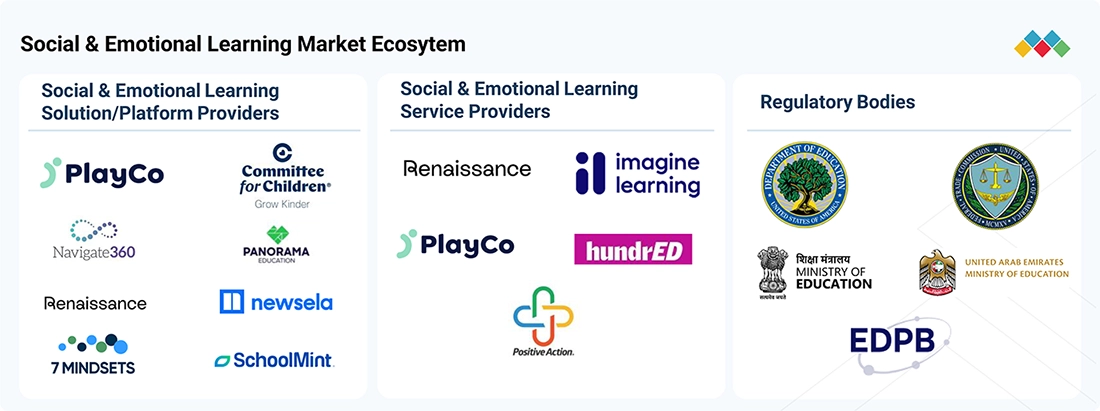
SOCIAL AND EMOTIONAL LEARNING (SEL) MARKET: COMMERCIAL USE CASES ACROSS INDUSTRIES
| COMPANY | USE CASE DESCRIPTION | BENEFITS |
|---|---|---|
 |
Panorama Education deployed its SEL and survey platform for the Utah State Board of Education across public schools to support an Early Warning System. The platform integrated academic, behavioral, and SEL data to identify at-risk students and enable timely interventions by educators. | Improved early identification of at-risk students, enhanced data-driven interventions, better tracking of student progress, and improved coordination among educators and administrators. |
 |
EVERFI collaborated with school districts across the US to deliver digital SEL curriculum focused on emotional intelligence, resilience, and responsible decision-making. Schools integrated EVERFI’s modules into classroom instruction to standardize SEL delivery. | Scalable SEL implementation, consistent curriculum delivery, improved student behavioral outcomes, and reduced burden on educators through ready-to-use digital content. |
 |
Nearpod partnered with K–12 schools to deliver interactive SEL lessons through its platform, enabling real-time participation, feedback, and activity-based learning in both in-person and virtual classrooms. | Higher student participation, improved retention of SEL concepts, enhanced classroom engagement, and effective delivery of SEL in hybrid learning environments. |
Logos and trademarks shown above are the property of their respective owners. Their use here is for informational and illustrative purposes only.
Related Ecosystem
Software And Services
- Natural Language Processing (NLP)
- Machine Learning
- Supply Chain Management
- Predictive Analytics
- Image Sensors
- International Business Machines Corporation
- MICROSOFT CORPORATION
- Oracle Corporation
- SAP SE
- Amazon.com, Inc.
Key Takeaways
- China's SEL market is projected to grow from $183.0 million in 2023 to $600.0 million by 2028, representing a 26.9% CAGR.
- Government educational reforms and increased focus on student mental health are primary drivers of market expansion in China.
- Digital platforms integrating AI and analytics are accelerating SEL adoption across China's educational institutions.
- China's SEL market presents significant opportunities for both domestic and international edtech providers meeting localized regulatory requirements.
Social and Emotional Learning Market Report Scope
| Report Metric | Details |
|---|---|
| Base Year | 2023 |
| Fastest Growing Segment | TRAINING AND SUPPORT (Service) |
| Forecast Period | 2023–2028 |
| Growth Rate | CAGR of 23.6% from 2023 to 2028 |
| Largest Segment | WEB-BASED (Type) |
| Market Size Base Year (Billions) | ~USD 3.57 (2023) |
| Revenue Forecast (Billions) | ~USD 10.3 (2028) |
| Segments Covered | Offering, Solution, Service, End User, Type |
China Social and Emotional Learning Market Report Segmentation
5 segment dimensions are covered across the global market.
By Offering
- Services
- Solutions
By Solution
- Sel Assessment Tools
- Sel Platform
By Service
- Consulting
- Deployment And Integration
- Integration And Deployment
- Training And Support
By End User
- Elementary
- Elementary Schools (K-5)
- Middle And High Schools
- Middle And High Schools (6-12)
- Other End Users
- Pre-K
- Therapists And Psychologists
By Type
- Application
- Web-Based
CHINA: SOCIAL AND EMOTIONAL LEARNING MARKET, BY END USER, 2023–2028
| Segment | 2023 | 2024 | 2025 | 2026 | 2027 | 2028 | CAGR (%) |
|---|---|---|---|---|---|---|---|
| ELEMENTARY SCHOOLS (K-5) | 59 | 77 | 99 | 124 | 155 | 188 | 26 |
| MIDDLE AND HIGH SCHOOLS (6-12) | 81 | 108 | 141 | 180 | 228 | 282 | 28.2 |
| OTHER END USERS | 27 | 35 | 44 | 55 | 68 | 83 | 25.3 |
| PRE-K | 9 | 12 | 15 | 19 | 23 | 28 | 24.8 |
| THERAPISTS AND PSYCHOLOGISTS | 6 | 8 | 10 | 12 | 15 | 19 | 25.3 |
| TOTAL | 183 | 239 | 309 | 391 | 489 | 600 | 26.9 |
Target Audience
- EdTech Companies & Solution Providers : Need China-specific market data to develop localized SEL platforms, assess market entry feasibility, and identify partnership opportunities with Chinese schools and educational institutions.
- Investment & Private Equity Firms : Require detailed market sizing and growth projections for China to evaluate investment opportunities in SEL startups, EdTech companies, and education service providers operating in this high-growth market.
- Educational Institutions & School Districts : Seek market intelligence on SEL solution providers, pricing benchmarks, and implementation best practices to make informed procurement decisions and budget allocations for emotional learning programs.
- Government & Policy Makers : Need market analysis to inform education policy development, curriculum standards, and funding decisions related to mental health and emotional intelligence initiatives in Chinese schools.
- Consulting & Research Firms : Require granular China market data and forecasts to support client advisory services, competitive analysis, and strategic planning for education sector stakeholders and corporate clients.
Reasons to Buy this Report
- Market Size & Growth Data : Access precise valuation figures for China's SEL market ($183M in 2023, $600M by 2028) with detailed CAGR analysis to benchmark competitive positioning and investment opportunities in this high-growth segment.
- China-Specific Growth Drivers : Understand unique factors accelerating SEL adoption in China including government policy mandates, curriculum reforms, and institutional priorities that differ from global market dynamics.
- Regional Market Differentiation : Gain insights into how China's SEL market outpaces global trends at 26.9% vs. 23.6% CAGR, identifying competitive advantages and market gaps specific to Chinese educational institutions and EdTech providers.
- Strategic Investment Planning : Make informed decisions on market entry, product localization, and partnership strategies tailored to China's unique regulatory environment, school system structure, and digital learning infrastructure.
- Competitive Intelligence : Identify emerging players, technology trends, and customer segments within China's SEL ecosystem to develop targeted go-to-market strategies and differentiated value propositions for Chinese stakeholders.
Frequently asked questions
What is the current market size of Social and Emotional Learning in China?
China's Social and Emotional Learning market was valued at $183.0 million in 2023 and is expected to grow to $600.0 million by 2028.
What is the projected growth rate for China's SEL market?
China's SEL market is projected to grow at a compound annual growth rate (CAGR) of 26.9% from 2023 to 2028.
What factors are driving growth in China's Social and Emotional Learning market?
Key drivers include government educational reforms prioritizing student well-being, increased awareness of emotional intelligence, digital platform adoption, and AI integration in learning solutions across China.
Which regions in China are leading SEL market adoption?
Tier-1 and tier-2 cities in China are leading SEL adoption due to advanced digital infrastructure and higher investment in educational technology.
Who are the main competitors in China's SEL market?
China's SEL market includes both domestic edtech companies and international players who adapt their solutions to comply with local regulations and cultural contexts.
RESEARCH METHODOLOGY
The research study involved four major activities in estimating the social & emotional learning market size. Exhaustive secondary research has been done to collect important information about the market and peer markets. The next step has been to validate these findings and assumptions and size them with the help of primary research with industry experts across the value chain. Both top-down and bottom-up approaches have been used to estimate the market size. Post which the market breakdown and data triangulation have been adopted to estimate the market sizes of segments and sub-segments.
Secondary Research
The market size of the companies offering Social & emotional learning solutions to various end users was arrived at based on the secondary data available through paid and unpaid sources and by analyzing the product portfolios of major companies in the ecosystem and rating the companies based on their performance and quality. In the secondary research process, various sources were referred to identify and collect information for the study. The secondary sources included annual reports, press releases, investor presentations of companies, white papers, journals, certified publications, and articles from recognized authors, directories, and databases. Secondary research was mainly used to obtain critical information about industry insights, the market’s monetary chain, the overall pool of key players, market classification, and segmentation according to industry trends to the bottom-most level, regional markets, and key developments from both market- and technology-oriented perspectives.
Primary Research
In the primary research process, various sources from the supply and demand sides were interviewed to obtain qualitative and quantitative information for the report, Such as Chief Experience Officers (CXOs), Vice Presidents (VPs), directors from business development, marketing, and product development/innovation teams, and related key executives from Social & emotional learning solution vendors, system integrators, professional and managed service providers, industry associations, independent consultants, and key opinion leaders.
Primary interviews were conducted to gather insights, such as market statistics, data on revenue collected from software and services, market breakups, market size estimations, market forecasts, and data triangulation. Stakeholders from the demand side, such as Chief Information Officers (CIOs), Chief Finance Officers (CFOs), Chief Strategy Officers (CSOs), and the installation team of end users who use social & emotional learning, were interviewed to understand buyers’ perspectives on suppliers, products, service providers, and their current usage of Social & emotional learning solutions which is expected to affect the overall Social & emotional learning market growth.
BREAKDOWN OF PRIMARIES
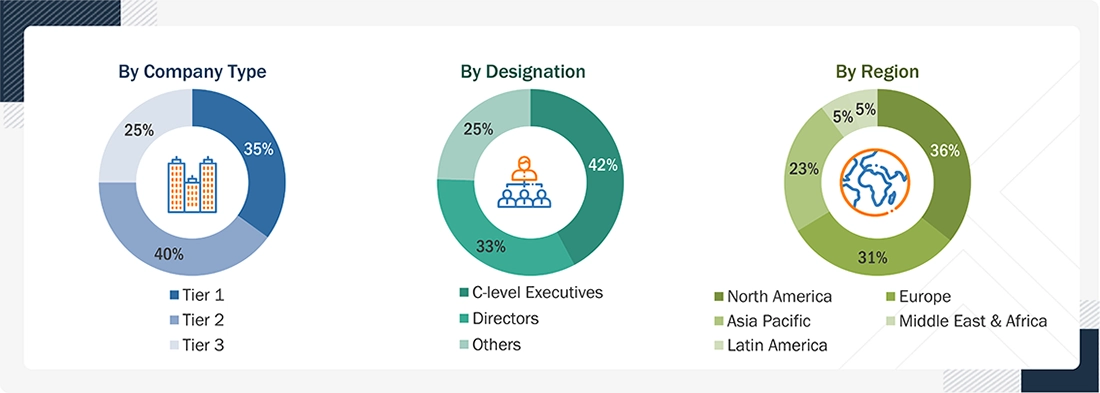
Note 1: Tier 1 companies have revenues of more than USD 10 billion; tier 2 companies’ revenue ranges from USD 1 billion to USD 10 billion; and tier 3 companies’ revenue ranges from USD 500 million to USD 1 billion
To know about the assumptions considered for the study, download the pdf brochure
Market Size Estimation
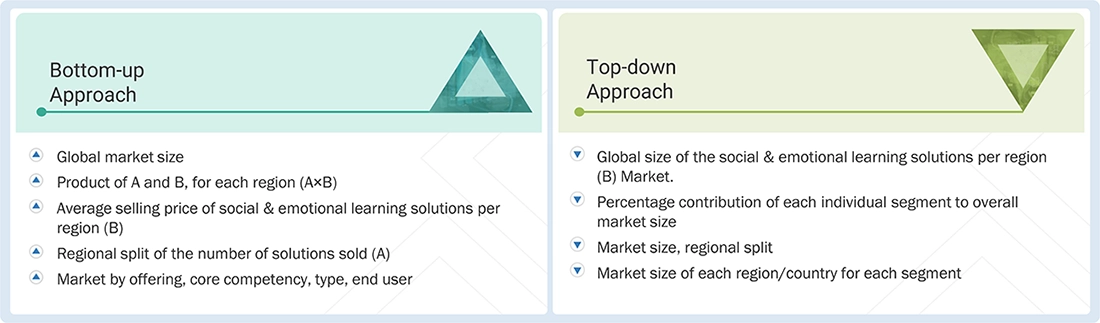
In the market engineering process, the top-down and bottom-up approaches were used along with multiple data triangulation methods to estimate and validate the size of the Social & emotional learning market and other dependent submarkets. The research methodology used to estimate the market sizes includes the following:
- Initially, MarketsandMarkets focuses on top-line investments and spending in the ecosystems. Further, significant developments in the critical market area have been considered.
- Tracking the recent and upcoming developments in the Social & emotional learning market that include investments, R&D activities, product launches, collaborations, mergers and acquisitions, and partnerships, as well as forecasting the market size based on these developments and other critical parameters.
- Conduct multiple discussions with key opinion leaders to learn about the diverse types of authentications and brand protection offerings used and the applications for which they are used to analyze the breakdown of the scope of work carried out by major companies.
- Segmenting the market based on technology types concerning applications wherein the types are to be used and deriving the size of the global application market.
- Segmenting the overall market into various market segments
- Validating the estimates at every level through discussions with key opinion leaders, such as chief executives (CXOs), directors, and operation managers, and finally with the domain experts at MarketsandMarkets
Social and Emotional Learning Market : Top-Down and Bottom-Up Approach
Data Triangulation
The Social & emotional learning market has been split into segments and sub-segments after the overall market size was estimated using the above estimation process. To complete the overall market engineering process and arrive at the exact statistics for all segments and sub-segments, data triangulation and market breakdown procedures have been used, wherever applicable. The data has been triangulated by studying various factors and trends from both the demand and supply sides.
The Social & emotional learning market size has been validated using top-down and bottom-up approaches.
Market Definition
Social and Emotional Learning (SEL) refers to a structured approach that enables individuals to develop essential competencies such as emotional regulation, self-awareness, social awareness, relationship management, and responsible decision-making. It focuses on building behavioral and interpersonal skills that support personal development, academic success, and overall well-being. Social and Emotional Learning is increasingly integrated into educational systems, training programs, and organizational frameworks through curriculum-based content, digital platforms, assessment tools, and support services. It plays a critical role in fostering inclusive learning environments, improving student engagement, and promoting positive social behaviors. By strengthening both cognitive and emotional capabilities, SEL supports long-term outcomes such as improved academic performance, workforce readiness, and healthier communities.
Key Stakeholders
- SEL Providers
- Independent Software Vendors (ISVs)
- SEL Content Developers
- Education Consultants
- System Integrators
- Educationists
- Corporate Trainers
- Compliance Regulatory Authorities
- Government Authorities
- University Bodies
- Professors and Teachers
- Investment Firms
Report Objectives
- To determine and forecast the global Social & emotional learning market by offering, core competency, type, end user, and region from 2026 to 2032 and analyze the various macroeconomic and microeconomic factors affecting the market growth.
- To forecast the size of the market segments concerning five central regions: North America, Europe, Asia Pacific (APAC), Middle East & Africa (MEA), and Latin America.
- To provide detailed information about the major factors (drivers, restraints, opportunities, and challenges) influencing the growth of the Social & emotional learning market.
- Analyze each submarket concerning individual growth trends, prospects, and contributions to the overall Social & emotional learning market.
- To analyze the opportunities in the market for stakeholders by identifying the high-growth segments of the Social & emotional learning market.
- To profile the key market players; provide a comparative analysis based on business overviews, regional presence, product offerings, business strategies, and key financials; and illustrate the market’s competitive landscape.
- Track and analyze competitive developments in the market, such as mergers and acquisitions, product developments, partnerships and collaborations, and Research and Development (R&D) activities.
Available customizations:
With the given market data, MarketsandMarkets offers customizations per the company’s specific needs. The following customization options are available for the report:
Geographic Analysis
-
Further break-up of the Asia Pacific market into countries contributing 75% to the regional market size
-
Further break-up of the North American market into countries contributing 75% to the regional market size
-
Further break-up of the Latin American market into countries contributing 75% to the regional market size
-
Further break-up of the Middle East African market into countries contributing 75% to the regional market size
-
Further break-up of the European market into countries contributing 75% to the regional market size
Company Information
-
Detailed analysis and profiling of additional market players (up to 5)
Get the Full Social and Emotional Learning Market Report
Full forecast, segment splits, and company analysis for all Social and Emotional Learning Market.
- Canada Social and Emotional Learning Market
- US Social and Emotional Learning Market
- UK Social and Emotional Learning Market
- Germany Social and Emotional Learning Market
- Japan Social and Emotional Learning Market
- India Social and Emotional Learning Market
- France Social and Emotional Learning Market
- Italy Social and Emotional Learning Market
- Nordic Countries Social and Emotional Learning Market
- Rest Of Europe Social and Emotional Learning Market
- Spain Social and Emotional Learning Market
- Anz Social and Emotional Learning Market
- Rest Of Asia Pacific Social and Emotional Learning Market
- South Korea Social and Emotional Learning Market
- Southeast Asia Social and Emotional Learning Market
- GCC Countries Social and Emotional Learning Market
Need a Tailored Report?
Customize this report to your needs
Get 10% FREE Customization
Customize This Report
