South America Sodium Silicate Market (2024-2029)

The South America Sodium Silicate Market was valued at $376.6 Million in 2024 and projected to reach to $450.2 Million by 2029, representing a compound annual growth rate of 3.6%. South America's sodium silicate market is positioned for moderate but consistent growth through 2029, supported by expanding industrial infrastructure and increasing environmental regulations driving water treatment adoption.


| Market Size in | USD 26.32 MN |
| Market Forecast in | |
| CAGR | |
| Forecast Period | |
| Units Considered | Value (USD MN) |
South America Sodium Silicate Market Trends and Insights
- South America's sodium silicate demand is driven by applications in detergents, water treatment, and construction materials, with Brazil and Argentina serving as key demand centers.
- The region's growth trajectory reflects steady industrialization and increased adoption of sodium silicate in manufacturing processes across multiple end-use sectors. South America's market expansion is supported by rising investments in infrastructure and chemical processing industries.
- Between 2024 and 2029, South America is expected to experience moderate but consistent growth, outpaced by global trends yet maintaining resilience through regional economic recovery and sectoral diversification.
- South America's sodium silicate market remains competitive, with both multinational and regional players establishing production and distribution networks to serve local demand..
Key Market Statistics
- CAGR (2024-2029) 3.6% CAGR
- Market Size, 2024 ~USD 376.6 Million
- Forecast, 2029 ~USD 450.2 Million
- Geography South America
South America Sodium Silicate Market Overview
Brazil Dominance :
Brazil accounts for the largest share of South America's sodium silicate market at USD 265.7 million in 2024, driven by robust demand from detergent manufacturing, water treatment facilities, and construction sectors.
Steady Regional Growth :
South America's sodium silicate market is projected to expand from USD 376.6 million in 2024 to USD 450.2 million by 2029, representing a CAGR of 3.6%, outpacing some mature markets but trailing the global average of 4.4%.
Argentina's Emerging Potential :
Argentina represents a secondary but growing market opportunity at USD 64.8 million in 2024, with increasing applications in water treatment and industrial cleaning products supporting gradual market expansion.
Diversified Application Base :
South America's sodium silicate demand spans detergents, water treatment, construction materials, and specialty chemicals, providing market resilience across multiple end-use industries and reducing dependency on single sectors.
South America Sodium Silicate Market Dynamics
- Brazil's industrial base and Argentina's growing manufacturing sector will remain primary growth engines, though the region's 3.6% CAGR reflects slower expansion compared to Asia-Pacific markets.
- Rising demand for sustainable detergent formulations and stringent water quality standards across major urban centers will sustain market momentum. The forecast period will see consolidation among regional suppliers and increased competition from global manufacturers establishing local operations.
- Investment in production capacity and distribution networks will be critical for capturing market share.
- Economic stability in Brazil and Argentina, coupled with infrastructure development initiatives, will create favorable conditions for sodium silicate applications in construction and industrial segments, though macroeconomic volatility remains a potential headwind for sustained growth..
Market Ecosystem
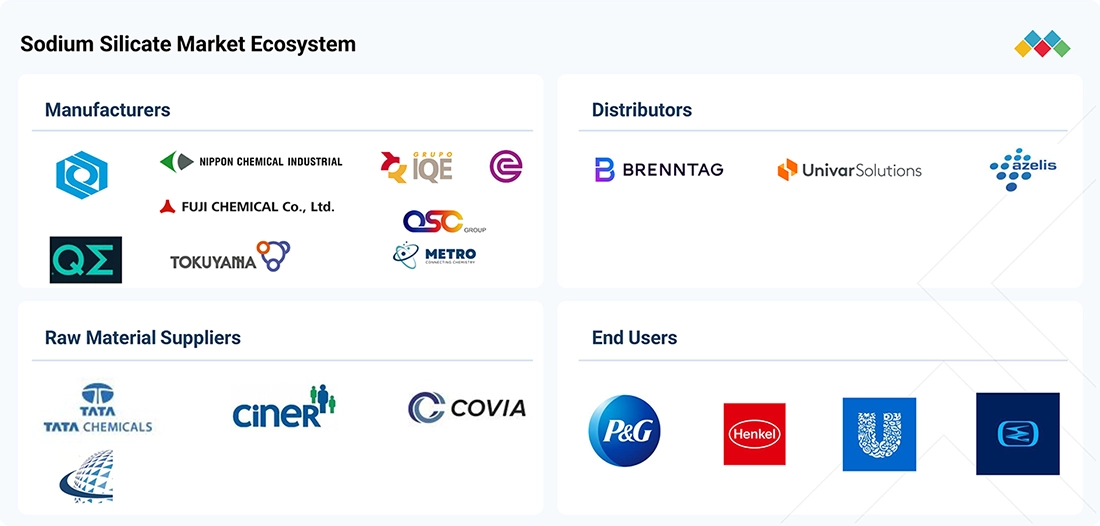
SODIUM SILICATE MARKET: COMMERCIAL USE CASES ACROSS INDUSTRIES
| COMPANY | USE CASE DESCRIPTION | BENEFITS |
|---|---|---|
 |
The company Solvay developed highly dispersible silica for tires using bio-based sodium silicate made from rice husk ash. This method turns agricultural waste into a raw material used to produce silica for tires, meeting the demand for more environmentally friendly and sustainable tire materials. | The bio-circular technique minimizes environmental damage from the silica manufacturing process and provides tire manufacturers with silica that enables low rolling resistance and high abrasion resistance. Solvay stated that CO2 emissions were reduced by 35 % for every ton of silica produced in Livorno factories compared to traditional manufacturing. |
 |
PQ Silicas required a constant supply of softened water for its sodium silicate manufacturing process in the UK. PQ Silicas' existing water-softening technique is outdated and unsatisfactory, which could undermine production continuity and product quality. Veolia developed the Ionsoft Duplex water softener to meet the additional volume required for the plant expansion. | The upgraded method provided a continuous supply of suitably softened process water and 100% standby capacity. The company completed the entire project within the planned installation period, and the enhanced regeneration regime saved USD 2,487.60 per year in salt consumption while ensuring stable sodium silicate production. |
 |
CSIR-CSMCRI developed and transferred a process to Kadvani Chemicals for producing fine precipitated silica from sodium silicate. A demonstration was successfully conducted at Kadvani Chemicals' plant in Jamnagar, and silica with particle sizes of less than ten microns was produced for use in further processing of polymers. | This technology enabled the production of application-oriented precipitated silica from sodium silicate and was later commercialized. CSIR-CSMCRI informed that a license was granted for the use of this technology to Kadvani Chemicals and other firms, which helped establish a viable application of sodium silicate for implementing silica production. |
Logos and trademarks shown above are the property of their respective owners. Their use here is for informational and illustrative purposes only.
Related Ecosystem
Adhesives And Sealants
- Alkyd Resins
- Polyurethane Resin
- Epoxy Resin
- Polyester Resin
- Polyolefin
- 3M COMPANY
- Henkel ag and co. kgaa
- H.B. Fuller Company
- Sika ag
- DOW CHEMICAL COMPANY
Bulk Chemicals And Inorganics
- Corrosion Inhibitors
- Glycol Ethers
- Acetic Acid
- Acetone
- Ammonium Nitrate
- Basf se
- DOW CHEMICAL COMPANY
- Exxon Mobil Corporation
- AZELIS HOLDINGS SA
- Sinopec limited
Ceramics And Glass
- Zirconia
- Alumina Ceramics
- Silicon Carbide
- Silicon Nitride
- Titanate Ceramics
- Saint-gobain
- 3M COMPANY
- Kyocera Corporation
- COORSTEK INCORPORATED
- CERAMTEC GMBH
Key Takeaways
- South America's sodium silicate market is valued at USD 376.6 million in 2024 and will reach USD 450.2 million by 2029.
- South America is growing at a 3.6% CAGR, reflecting moderate expansion driven by detergent and water treatment applications.
- South America's market is supported by infrastructure investments and industrial diversification across Brazil and Argentina.
- South America's competitive landscape includes both multinational corporations and regional manufacturers establishing local supply chains.
Sodium Silicate Market Report Scope
| Report Metric | Details |
|---|---|
| Base Year | 2024 |
| Fastest Growing Segment | BIO-BASED (Source) |
| Forecast Period | 2024–2029 |
| Growth Rate | CAGR of 4.4% from 2024 to 2029 |
| Largest Segment | SYNTHETIC (Source) |
| Market Size Base Year (Billions) | ~USD 5.51 (2024) |
| Revenue Forecast (Billions) | ~USD 6.83 (2029) |
| Segments Covered | Form, Application, Type, Source, End User |
South America Sodium Silicate Market Report Segmentation
5 segment dimensions are covered across the global market.
By Form
- Liquid
- Solid
By Application
- Adhesive & Sealants
- Adhesives
- Boiler Water Treatment
- Cooling Water Treatment
- Detergents & Cleaning Agents
- Other Applications
- Paints, Coatings, & Inks
- Precipitated Silica
- Pulp & Paper
- Raw Water Treatment
- Silicone Elastomers
- Upr & Composite
- Water Desalination
- Water Treatment
By Type
- Anti-Foaming Agents
- Biocides & Disinfectants
- Chelating Agents
- Coagulants & Flocculants
- Corrosion Inhibitors
- Hydrophilic
- Hydrophobic
- Other Types
- Ph Adjusters & Stabilizers
- Scale Inhibitors
By Source
- Bio-Based
- Synthetic
By End User
- Commercial
- Industrial
- Residential
- –Chemical Fertilizers
- –Food & Beverage
- –Mining & Mineral Processing
- –Municipal
- –Oil & Gas
- –Others
- –Power
- –Pulp & Paper
Target Audience
- Chemical Manufacturers : Sodium silicate producers and chemical companies need South America market data to optimize production capacity, identify distribution partnerships, and develop region-specific product formulations for detergent and water treatment applications.
- Water Treatment Operators : Municipal and industrial water treatment facilities require market insights to forecast sodium silicate procurement needs, evaluate supplier options, and plan budget allocations for treatment chemical purchases across South America.
- Detergent & Cleaning Product Manufacturers : Consumer goods companies formulating detergents and industrial cleaners need South America sodium silicate market intelligence to secure raw material supply, manage costs, and align product development with regional demand trends.
- Construction & Building Materials Companies : Construction material suppliers and concrete manufacturers require market data to assess sodium silicate demand in South America's construction sector and plan strategic investments in production and distribution infrastructure.
- Investment & Strategy Consultants : Private equity firms, management consultants, and business strategists need comprehensive South America market analysis to evaluate investment opportunities, assess market attractiveness, and guide client expansion strategies in the region.
Key Companies in the South America Sodium Silicate Market
| Company | HQ | Ownership | Strongest segments |
|---|---|---|---|
| SINCHEM INDUSTRY | Liquid,Solid,Detergent & Cleaning Agents, | ||
| BASF SE | Germany | Public Company | Liquid Sodium Silicate,Solid Sodium Silicate,Detergent & Cleaning Agents, |
| PQ CORPORATION | Italy | Public Company | Liquid,Solid,Detergent & Cleaning Agents, |
| QEMETICA | Poland | Private Company | Liquid Sodium Silicate,Solid Sodium Silicate,Detergent & Cleaning Agents, |
| NIPPON CHEMICAL INDUSTRIAL CO., LTD. | Japan | Public Company | Liquid Sodium Silicate,Solid Sodium Silicate,Detergent & Cleaning Agents, |
| OCCIDENTAL PETROLEUM CORPORATION | United States | Public Company | Liquid Sodium Silicate,Solid Sodium Silicate,Detergent & Cleaning Agents, |
| TOKUYAMA CORPORATION | Japan | Public Company | Liquid Sodium Silicate,Solid Sodium Silicate,Detergent & Cleaning Agents, |
| EVONIK INDUSTRIES AG | Germany | Public Company | Liquid Sodium Silicate,Solid Sodium Silicate,Detergent & Cleaning Agents, |
| METRO CHEM INDUSTRIES | India | Private Company | Liquid Sodium Silicate,Solid Sodium Silicate,Detergent & Cleaning Agents, |
| STPP GROUP | United Arab Emirates | Private Company | Liquid Sodium Silicate,Solid Sodium Silicate,Detergent & Cleaning Agents, |
| SINCHEM SILICA GEL CO., LTD. | China | Liquid Sodium Silicate,Solid Sodium Silicate,Detergent & Cleaning Agents, |
SINCHEM INDUSTRY
Insufficient data available to provide a factual business description for Sinchem Industry.
BASF SE
BASF SE is a German public chemical company founded in 1865 with 94,910 employees.
PQ CORPORATION
PQ Corporation is an Italian public chemical company founded in 1987 with 923 employees.
QEMETICA
Qemetica is a Polish private chemical company founded in 1945 with 3,343 employees.
NIPPON CHEMICAL INDUSTRIAL CO., LTD.
Nippon Chemical Industrial Co., Ltd. is a Japanese public chemical company founded in 1893 with 735 employees.
OCCIDENTAL PETROLEUM CORPORATION
Occidental Petroleum Corporation is a United States public energy company founded in 1920 with 10,412 employees.
TOKUYAMA CORPORATION
Tokuyama Corporation is a Japanese public chemical company founded in 1918 with 6,390 employees.
EVONIK INDUSTRIES AG
Evonik Industries AG is a German public chemical company founded in 1847 with 30,643 employees.
METRO CHEM INDUSTRIES
Metro Chem Industries is an Indian private chemical company founded in 1976.
STPP GROUP
STPP Group is a United Arab Emirates private company founded in 2009.
SINCHEM SILICA GEL CO., LTD.
Insufficient data available to provide a factual business description for Sinchem Silica Gel Co., Ltd.
Countries within South America - compare and drill down
| Country | 2025 size (native) |
|---|---|
| Brazil | USD 265.7 Million |
| Argentina | USD 64.8 Million |
Country market size visualization
Reasons to Buy this Report
- Country-Level Market Sizing : Access detailed market valuations for Brazil (USD 265.7M) and Argentina (USD 64.8M), enabling precise investment decisions and competitive positioning strategies specific to each South American market.
- Growth Trajectory Insights : Understand South America's 3.6% CAGR trajectory through 2029, identifying expansion opportunities and timing for market entry or capacity investments in the region's fastest-growing segments.
- Application-Specific Demand Analysis : Gain clarity on sodium silicate consumption patterns across detergents, water treatment, and construction sectors in South America, enabling targeted product development and marketing strategies.
- Competitive Landscape Assessment : Benchmark your position against regional and global competitors operating in South America's sodium silicate market, identifying gaps and opportunities for differentiation and market share capture.
- Strategic Planning & Forecasting : Leverage 5-year forecasts and regional insights to develop informed business strategies, supply chain optimization, and resource allocation plans tailored to South America's unique market dynamics.
Frequently asked questions
What is the current market size of sodium silicate in South America?
South America's sodium silicate market is estimated at USD 376.6 million in 2024.
What is the projected market size for South America by 2029?
South America's sodium silicate market is forecast to reach USD 450.2 million by 2029.
What is the CAGR for South America's sodium silicate market?
South America's sodium silicate market is expected to grow at a CAGR of 3.6% from 2024 to 2029.
Which countries drive sodium silicate demand in South America?
Brazil and Argentina are the primary demand centers for sodium silicate in South America, driven by industrial and construction applications.
What are the main applications of sodium silicate in South America?
South America's sodium silicate is primarily used in detergents, water treatment, construction materials, and various chemical manufacturing processes.
RESEARCH METHODOLOGY
The study involved four major activities to estimate the current size of the global sodium silicate market. Exhaustive secondary research was carried out to collect information on the market, the peer product market, and the parent product group market. The next step was to validate these findings, assumptions, and sizes with industry experts across the value chain of sodium silicate through primary research. The top-down and bottom-up approaches were employed to estimate the overall size of the sodium silicate market. After that, market breakdown and data triangulation procedures were used to determine the size of different segments and sub-segments of the market.
Secondary Research
The market for sodium silicate was determined using secondary data available through paid and unpaid sources, analyzing the product portfolios of the major companies in the ecosystem, and rating the companies by their performance and quality. Various secondary sources, such as Business Standard, Bloomberg, World Bank, and Factiva, were referred to identify and collect information for this study on the sodium silicate market. In the secondary research process, various secondary sources were referred to identify and collect information related to the study. Secondary sources included annual reports, press releases, and investor presentations of door vendors, forums, certified publications, and whitepapers. Secondary research was used to obtain critical information on the industry’s value chain, the total pool of key players, market classification, and segmentation from the market and technology-oriented perspectives.
Primary Research
In the primary research process, various primary sources from both the supply and demand sides were interviewed to obtain qualitative and quantitative information for this report. Supply-side primary sources included industry experts such as Chief Executive Officers (CEOs), Vice Presidents (VPs), marketing directors, technology and innovation directors, and other key executives from several companies and organizations operating in the sodium silicate market. After the complete market engineering (calculations for market statistics, market breakdown, market size estimations, market forecasting, and data triangulation), extensive primary research was conducted to gather information and verify and validate the critical numbers arrived at. Primary research was also conducted to identify the segmentation types, industry trends, competitive landscape of sodium silicate offered by various market players, and key market dynamics, such as drivers, restraints, opportunities, challenges, industry trends, and key players’ strategies. In the complete market engineering process, the top-down and bottom-up approaches and several data triangulation methods were extensively used to perform the market estimation and market forecasting for the overall market segments and subsegments listed in this report. Extensive qualitative and quantitative analysis was performed on the complete market engineering process to list key information/insights throughout the report.
Following is the breakdown of primary respondents:
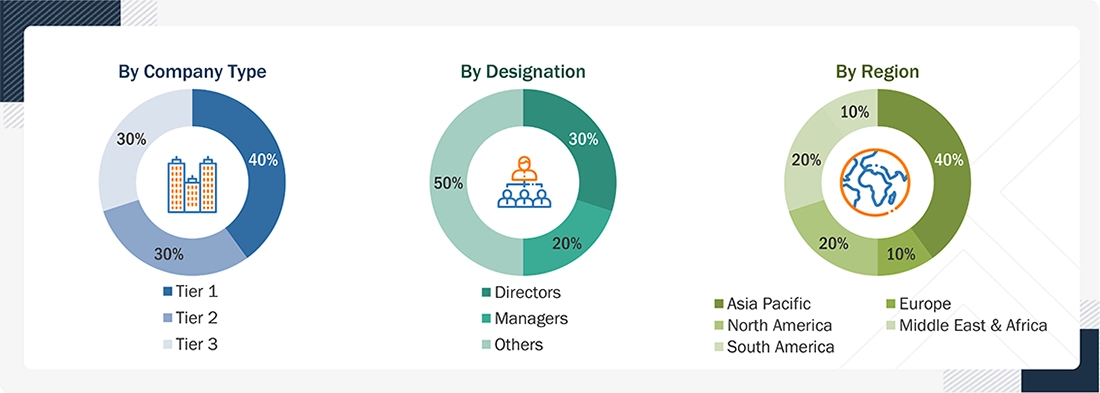
Notes: Other designations include sales, marketing, and product managers.
Tier 1: >USD 1 Billion; Tier 2: USD 500 million–1 Billion; and Tier 3: <USD 500 million.
To know about the assumptions considered for the study, download the pdf brochure
Market Size Estimation
The top-down and bottom-up approaches were used to estimate and validate the size of the global sodium silicate market. These approaches were also used extensively to estimate the size of various dependent market segments. The research methodology used to estimate the market size included the following:
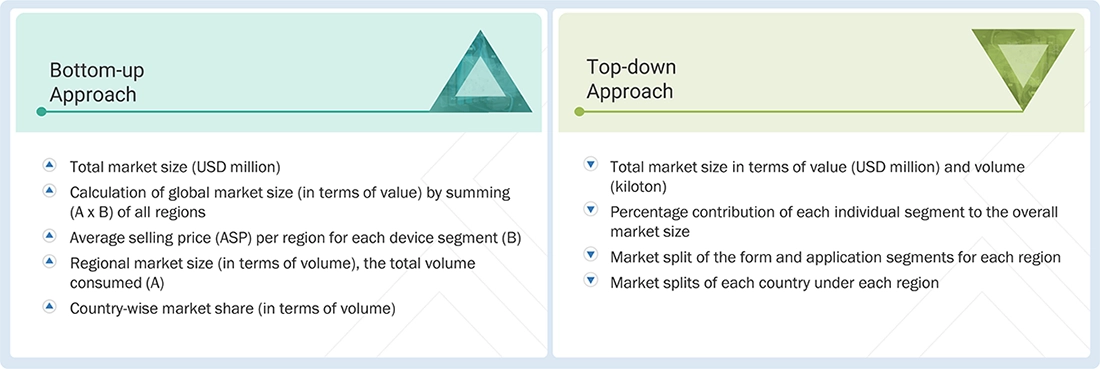
Data Triangulation
After arriving at the overall market size using the market size estimation processes, the market was split into several segments and subsegments. Data triangulation and market breakup procedures were employed, wherever applicable, to complete the overall market engineering process and arrive at the exact statistics of each market segment and subsegment. The data were triangulated by studying various factors and trends from both the demand and supply sides.
Market Definition
Sodium silicate is a compound formed from sodium oxide and silica, with certain formulations dependent on the ratio of the components. Sodium silicate is manufactured by fusing sodium carbonate with silica sand. The process yields sodium silicate glass, which can be dissolved in water to acquire sodium silicate solutions. Sodium silicate can be obtained in solid and liquid forms, with its alkaline properties, binding properties and ability to seal and stabilize. Depending on the sodium oxide-to-silica ratio, sodium silicate can vary in its chemical and physical properties.
Sodium silicate is a commonly used ingredient in detergents and cleaning products, where it serves as a detergent builder and processing aid. In addition, sodium silicate is used in glues & adhesives, pulp & paper, water & wastewater treatment, and other industries.
Key Stakeholders
- Sodium silicate manufacturers
- Raw material suppliers
- Distributors and traders
- Industry associations and regulatory bodies
- End users
Report Objectives
- To define, describe, and forecast the size of the global sodium silicate market, based on form, application, and region in terms of value and volume
- To provide detailed information on the significant drivers, restraints, opportunities, and challenges influencing the market
- To strategically analyze micromarkets concerning individual growth trends, prospects, and their contribution to the market
- To assess the growth opportunities in the market for stakeholders and provide details on the competitive landscape for market leaders
- To forecast the market size of segments and subsegments for North America, Europe, Asia Pacific, South America, and the Middle East & Africa
- To strategically profile key players and comprehensively analyze their market shares and core competencies
- To analyze competitive developments such as acquisitions, product launches, expansions, partnerships, and agreements in the sodium silicate market
- To assess the impact of AI/Gen AI on the market
Available customizations:
With the given market data, MarketsandMarkets offers customizations according to client-specific needs.
The following customization options are available for the sodium silicate market report:
Product Analysis
- A product matrix that gives a detailed comparison of the product portfolio of each company
Regional Analysis
- A further breakdown of the sodium silicate market for additional countries
Company Information
- Detailed analysis and profiling of additional market players (up to five)
Get the Full Sodium Silicate Market Report
Full forecast, segment splits, and company analysis for all Sodium Silicate Market.
- China Sodium Silicate Market
- India Sodium Silicate Market
- Japan Sodium Silicate Market
- South Korea Sodium Silicate Market
- Indonesia Sodium Silicate Market
- Germany Sodium Silicate Market
- UK Sodium Silicate Market
- France Sodium Silicate Market
- Poland Sodium Silicate Market
- Italy Sodium Silicate Market
- Spain Sodium Silicate Market
- Netherlands Sodium Silicate Market
- Brazil Sodium Silicate Market
- Argentina Sodium Silicate Market
- South Africa Sodium Silicate Market
- Rest Of Europe Sodium Silicate Market
- Rest Of Asia Pacific Sodium Silicate Market
- GCC Countries Sodium Silicate Market
- –Rest Of GCC Countries Sodium Silicate Market
- Rest Of South America Sodium Silicate Market
Need a Tailored Report?
Customize this report to your needs
Get 10% FREE Customization
Customize This Report
