
Europe Software Defined Vehicle Market (2026-2031)

The Europe Software Defined Vehicle Market was valued at $45110 Million in 2026 and projected to reach to $287240 Million by 2031, representing a compound annual growth rate of 54.4%. Europe's Software Defined Vehicle market is poised for transformative growth, driven by regulatory mandates, consumer demand for connected mobility, and substantial OEM investments in digital transformation.


| Market Size in | USD 26.32 MN |
| Market Forecast in | |
| CAGR | |
| Forecast Period | |
| Units Considered | Value (USD MN) |
Europe Software Defined Vehicle Market Trends and Insights
- This remarkable 54.4% compound annual growth rate reflects Europe's leadership in automotive digitalization and regulatory compliance with stringent emissions standards.
- Europe's automotive manufacturers are rapidly adopting software-defined architectures to enhance vehicle functionality, enable over-the-air updates, and support autonomous driving capabilities. The European market's acceleration is driven by strong regulatory frameworks, including the EU's Digital Services Act and automotive cybersecurity mandates, which incentivize software-centric vehicle design.
- Europe's established OEM ecosystem and technology partnerships position the region as a critical hub for software-defined vehicle innovation.
- Between 2026 and 2031, Europe is expected to capture significant market share as legacy automakers and emerging EV manufacturers invest heavily in software platforms and in-vehicle computing infrastructure..
Key Market Statistics
- CAGR (2026-2031) 54.4% CAGR
- Market Size, 2026 ~USD 45110 Million
- Forecast, 2031 ~USD 287240 Million
- Geography Europe
Europe Software Defined Vehicle Market Overview
Exceptional Growth Trajectory :
Europe's Software Defined Vehicle market is projected to grow from $45,110 million in 2026 to $287,240 million by 2031, representing a 54.4% CAGR—significantly outpacing the global average of 16%.
Regulatory Compliance Driver :
Stringent EU emissions standards and digital mobility regulations are accelerating software-defined vehicle adoption across European manufacturers, positioning the region as a global innovation leader.
Automotive Digitalization Leadership :
European OEMs are rapidly investing in software-centric architectures, over-the-air updates, and autonomous capabilities to maintain competitive advantage in the evolving mobility landscape.
Market Consolidation Opportunity :
The region's mature automotive ecosystem combined with advanced tech infrastructure creates significant M&A and partnership opportunities for software and semiconductor providers targeting European manufacturers.
Europe Software Defined Vehicle Market Dynamics
- The region's automotive heritage combined with cutting-edge technology adoption positions European manufacturers as frontrunners in software-defined architecture implementation.
- By 2031, the market will be dominated by integrated software platforms, advanced cybersecurity solutions, and autonomous driving capabilities.
- Strategic partnerships between traditional automakers and software companies will intensify, reshaping the competitive landscape and creating new revenue streams across the value chain..
Market Ecosystem
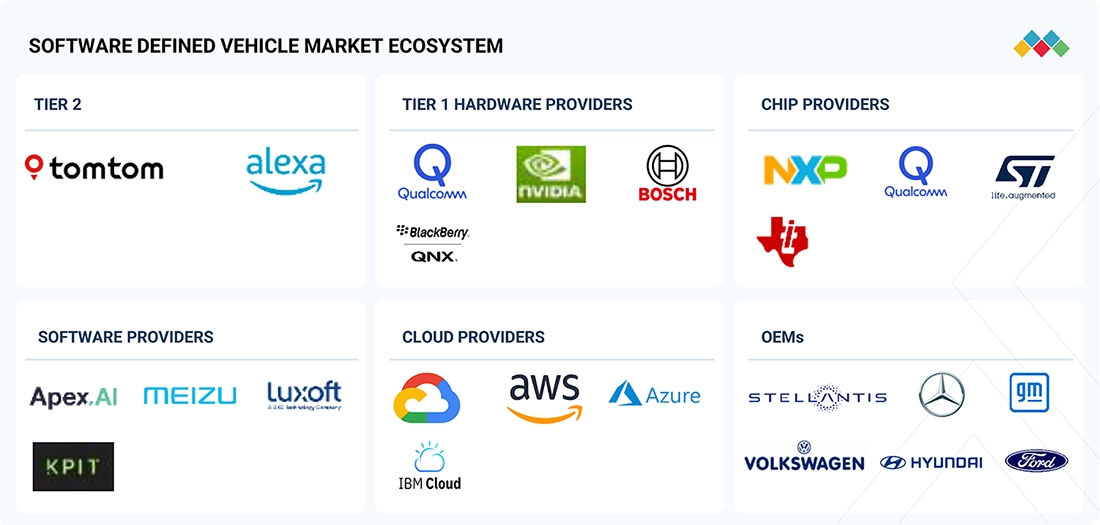
SOFTWARE DEFINED VEHICLE MARKET: COMMERCIAL USE CASES ACROSS INDUSTRIES
| COMPANY | USE CASE DESCRIPTION | BENEFITS |
|---|---|---|
 |
Deployment of vehicle-wide OTA software architecture enabling continuous rollout of battery optimization algorithms, full self driving updates, and performance enhancements without dealership intervention | Tesla remotely improves vehicle acceleration, energy efficiency, and ADAS capabilities across millions of vehicles, reducing recall costs and accelerating feature deployment. |
 |
Integration of software-defined feature activation through the Mercedes me platform, allowing customers to unlock rear wheel steering, acceleration upgrades, and digital services on demand | Mercedes generates recurring software revenue while extending vehicle functionality throughout the ownership lifecycle. |
 |
Utilization of centralized vehicle computing architecture to coordinate battery management, autonomous driving, cockpit systems, and cloud connected services through a unified software stack | NIO delivers synchronized vehicle updates and reduces software integration complexity across multiple electronic control domains. |
 |
Development of smartphone vehicle ecosystem integration enabling seamless transfer of navigation, smart home controls, AI assistants, and digital services between devices and vehicles | Xiaomi creates a unified consumer ecosystem experience, increasing customer retention and software service engagement. |
 |
Deployment of zonal architecture and cloud-based diagnostics to continuously monitor vehicle subsystems and predict component failures before breakdown events occur | Rivian reduces service center visits, improves vehicle uptime, and enhances customer satisfaction through predictive maintenance capabilities. |
Logos and trademarks shown above are the property of their respective owners. Their use here is for informational and illustrative purposes only.
Related Ecosystem
Automotive Advance Technologies
- Battery Electric Vehicle (BEV)
- Light Commercial Vehicles (LCVs)
- Fuel Cell Electric Vehicle (FCEV)
- Hybrid Electric Vehicle (HEV)
- Internal Combustion Engine (ICE)
- BOSCH LIMITED
- Continental ag
- Visteon Corporation
- DENSO Corporation
- ZF FRIEDRICHSHAFEN AG
On Highway Off Highway Vehicles
- Internal Combustion Engine (ICE)
- Agricultural Tractors
- Crawler Excavator
- Battery Electric Vehicle (BEV)
- Excavators
- Visteon Corporation
- Deere & Company
- Honda Motor Co., Ltd.
- AB VOLVO PENTA
- Komatsu Ltd.
Electrical System And Components
- Natural Language Processing (NLP)
- Sensors
- Machine Learning
- Temperature Sensors
- Actuators
- ABB India Limited
- Siemens ag
- SCHNEIDER ELECTRIC SE
- Eaton Corporation plc
- General Electric Company
Key Takeaways
- Europe's Software Defined Vehicle market will grow from $45.1B (2026) to $287.2B (2031), representing a 54.4% CAGR—significantly outpacing global growth.
- Europe's regulatory environment, including EU cybersecurity and digital service mandates, is a primary catalyst accelerating software-defined vehicle adoption across the region.
- Europe's legacy OEMs and EV startups are competing to establish software platforms and in-vehicle computing dominance, driving substantial R&D investment.
- Europe's market leadership in autonomous driving and connected vehicle technologies positions the region as a global innovation center for software-defined architectures.
Software Defined Vehicle Market Report Scope
| Report Metric | Details |
|---|---|
| Base Year | 2026 |
| Fastest Growing Segment | LIGHT COMMERCIAL VEHICLE (Vehicle Type) |
| Forecast Period | 2026–2031 |
| Growth Rate | CAGR of 16% from 2026 to 2031 |
| Largest Segment | SEMI-SDV (Sdv Type) |
| Market Size Base Year (Billions) | ~USD 448.96 (2026) |
| Revenue Forecast (Billions) | ~USD 942.96 (2031) |
| Segments Covered | Sdv Type, Vehicle Type |
Europe Software Defined Vehicle Market Report Segmentation
2 segment dimensions are covered across the global market.
By Sdv Type
- Sdv
- Semi-Sdv
By Vehicle Type
- Light Commercial Vehicle
- Passenger Car
Target Audience
- Automotive OEMs & Tier-1 Suppliers : European manufacturers need detailed market intelligence to benchmark SDV investments, identify technology gaps, and optimize software architecture strategies against regional competitors.
- Software & Technology Companies : Tech providers targeting European automotive require market sizing, customer segmentation, and regulatory compliance data to develop localized solutions and go-to-market strategies.
- Investment & Private Equity Firms : Investors evaluating European automotive tech opportunities need comprehensive market forecasts, growth drivers, and competitive dynamics to identify acquisition and funding targets.
- Automotive Consultants & Analysts : Strategy consultants advising European clients require regional market data, trend analysis, and competitive benchmarking to support transformation roadmaps and business case development.
- Government & Policy Organizations : EU regulatory bodies and national governments need market intelligence on SDV adoption rates and technology readiness to inform digital mobility policies and infrastructure investments.
Key Companies in the Europe Software Defined Vehicle Market
| Company | HQ | Ownership | Strongest segments |
|---|---|---|---|
| LEAR CORPORATION | United States | Public Company | Hardware – Electrical Distribution & Power (Harnesses, Junction Boxes, HV Power Control),Hardware – Electronic Control Units (Body Domain Control Modules and Related ECUs),Software & Connected Services (including Cybersecurity), |
| KIA CORPORATION | South Korea | Public Company | SDV (full software-defined platforms),Semi-SDV (partially software-defined),Hardware, |
| ROBERT BOSCH GMBH | India | Private Company | Hardware – ADAS and domain/zonal controllers,Hardware – Telematics and connectivity,Software – ADAS and vehicle motion control, |
| CONTINENTAL AG | Germany | Public Company | Hardware – E/E and controllers,Software – embedded and middleware,Applications – ADAS, |
| VALEO S.A. | France | Public Company | ADAS (sensors, domain controllers, parking automation),Telematics and connectivity solutions,Feature-on-demand enablement (software, HMI, access), |
| APTIV PLC | Ireland | Public Company | Hardware – ADAS & Smart Vehicle Compute,Hardware – E/E Architecture & Electrical Distribution,Software – ADAS & Safety, |
| TESLA MOTORS | United States | Public Company | Hardware (central compute, E/E, connectivity),Software (ADAS, telematics, feature-on-demand),SDV (full software-defined stack), |
| NVIDIA CORPORATION | United States | Public Company | Hardware – Centralized and Zonal Compute Platforms,Software – ADAS and Autonomous Driving Stack,Software – Telematics, Connectivity, and Cloud-Orchestrated SDV Services, |
| VOLKSWAGEN AG | Germany | Public Company | SDV (full SDV platforms),Semi-SDV,Domain Centralized E/E, |
| HARMAN INTERNATIONAL INDUSTRIES, INC | United States | Private Company | Hardware,Software,SDV (full SDV platforms), |
| BLACKBERRY LIMITED | Canada | Public Company | QNX-based SDV and semi-SDV software (OS, middleware, safety runtimes),Automotive security, connectivity, and telematics (Certicom, Radar, secure comms),Enterprise mobility, UEM, and adjacent software leveraged into SDV ecosystem, |
| ZF FRIEDRICHSHAFEN AG | Germany | Private Company | Hardware – E/E controllers and sensors,Software – embedded and middleware,Software – cloud, telematics, and feature-on-demand enablement, |
| SIEMENS AG | Germany | Public Company | Software (PLM, simulation, SDV engineering platforms),Hardware (automation, test, and E/E development infrastructure),Services and consulting for SDV programs, |
LEAR CORPORATION
Lear Corporation is a publicly traded American automotive supplier founded in 1917, employing 164,300 people worldwide. The company specializes in seating systems and electrical distribution products for the automotive industry.
KIA CORPORATION
Kia Corporation is a South Korean automotive manufacturer founded in 1944 and publicly traded, with 32,366 employees producing vehicles for global markets.
ROBERT BOSCH GMBH
Robert Bosch GmbH is a private German multinational technology and engineering company founded in 1886, operating in India with 412,774 employees across automotive, industrial, and consumer goods sectors.
CONTINENTAL AG
Continental AG is a German public company founded in 1871 with 22,076 employees, specializing in automotive components, tires, and safety systems.
VALEO S.A.
Valeo S.A. is a French publicly traded automotive supplier founded in 1923, employing 87,115 people in the design and manufacture of components and systems for vehicles.
APTIV PLC
Aptiv PLC is a publicly traded Irish company founded in 2011 with 140,000 employees, providing advanced electrical and software solutions for the automotive industry.
TESLA MOTORS
Tesla Motors is a publicly traded American electric vehicle and clean energy company founded in 2003, employing 134,785 people in the design, manufacture, and sale of electric vehicles and energy storage systems.
NVIDIA CORPORATION
NVIDIA Corporation is a publicly traded American technology company founded in 1993 with 42,000 employees, specializing in graphics processing units and artificial intelligence computing platforms.
VOLKSWAGEN AG
Volkswagen AG is a German public automotive manufacturer founded in 1937 with 598,592 employees, producing a wide range of vehicles under multiple brands globally.
HARMAN INTERNATIONAL INDUSTRIES, INC
Harman International Industries, Inc. is a private American company founded in 1980 with 26,000 employees, specializing in audio, visual, and connected car technologies.
BLACKBERRY LIMITED
BlackBerry Limited is a Canadian publicly traded company founded in 1984 with 1,749 employees, providing cybersecurity and software solutions for enterprise and IoT applications.
ZF FRIEDRICHSHAFEN AG
ZF Friedrichshafen AG is a private German automotive supplier founded in 1915 with 145,909 employees, manufacturing driveline and chassis technology components.
SIEMENS AG
Siemens AG is a German public conglomerate founded in 1847 with 310,312 employees, operating across electrification, automation, and digitalization sectors globally.
Countries within Europe - compare and drill down
| Country | 2025 size (native) |
|---|
Country market size visualization
Reasons to Buy this Report
- Regional Market Sizing & Forecasts : Obtain precise market valuations for Europe ($45.1B in 2026, $287.2B in 2031) with detailed segment breakdowns by vehicle type, software category, and country-level analysis.
- Competitive Landscape Intelligence : Identify leading European OEMs, software providers, and technology partners driving SDV adoption, including market share analysis and strategic positioning of key players.
- Regulatory & Compliance Insights : Understand EU-specific regulations, emissions standards, and digital mobility mandates shaping software-defined vehicle requirements and investment priorities across the region.
- Investment & Partnership Opportunities : Discover high-growth segments, emerging technologies, and strategic collaboration opportunities with European manufacturers accelerating their digital transformation initiatives.
- Country-Level Deep Dives : Access granular analysis of major European markets (Germany, France, UK, Scandinavia) with localized growth drivers, OEM strategies, and market entry recommendations.
Frequently asked questions
What is the projected market size for Software Defined Vehicles in Europe by 2031?
Europe's Software Defined Vehicle market is projected to reach $287,240 million by 2031, growing from $45,110 million in 2026 at a 54.4% CAGR.
Why is Europe's Software Defined Vehicle market growing faster than the global average?
Europe's market growth is accelerated by stringent EU regulations on cybersecurity, emissions, and digital services, combined with strong OEM investment in software-centric architectures and autonomous driving capabilities.
Which European countries are leading the Software Defined Vehicle market adoption?
Germany, France, and Sweden are leading Europe's software-defined vehicle adoption, driven by established automotive manufacturing bases, technology innovation hubs, and supportive regulatory frameworks.
What technologies are driving Europe's Software Defined Vehicle market expansion?
Over-the-air update capabilities, in-vehicle computing platforms, autonomous driving systems, and cloud-connected vehicle architectures are primary technologies driving Europe's market growth.
How are European OEMs responding to the Software Defined Vehicle market opportunity?
Europe's legacy OEMs are establishing dedicated software divisions, partnering with technology companies, and acquiring software startups to build competitive software-defined vehicle platforms and services.
RESEARCH METHODOLOGY
The study involved four major activities in estimating the current size of the software defined vehicle (SDV) market. Exhaustive secondary research was done to collect information on the market, the peer market, and the parent market. The next step was to validate these findings, assumptions, and sizing with the industry experts across value chains through primary research. The top-down approach was employed to estimate the complete market size. Thereafter, market breakdown and data triangulation processes were used to estimate the market size of segments and subsegments.
Secondary Research
Secondary sources referred to for this research study included software defined vehicle industry organizations; corporate filings such as annual reports, investor presentations, and financial statements; trade and business whitepapers and databases; and articles from recognized associations and government publishing sources. The secondary data was collected and analyzed to arrive at the overall market size, which was further validated by primary research.
Primary Research
Extensive primary research was conducted after acquiring an understanding of this market scenario through secondary research. Several primary interviews were conducted with market experts from the demand- and supply-side OEMs (in terms of component supply, country-level government associations, and trade associations) and component manufacturers across four major regions, namely, Asia Pacific, Europe, North America, and the Rest of the World. Approximately 60% and 40% of primary interviews were conducted from the demand and supply side, respectively. Primary data was collected through questionnaires, emails, LinkedIn, and telephonic interviews. In the canvassing of primaries, various departments within organizations, such as sales, operations, and administration, were covered to provide a holistic viewpoint in the report.
Brief sessions with highly experienced independent consultants were conducted to reinforce findings from primaries after interacting with industry experts. This, along with the in-house subject matter experts’ opinions, led to the findings, as described in the remainder of this report.
In the primary research process, various primary sources from the supply and demand sides were interviewed to obtain qualitative and quantitative information for the report. The primary sources from the supply side included industry experts, such as Vice Presidents (VPs), marketing directors, technology and innovation directors, and related key executives from various key companies and organizations. The primary sources from the demand side included end users, such as Chief Information Officers (CIOs), consultants, service professionals, technicians and technologists, and managers at public and investor-owned utilities.
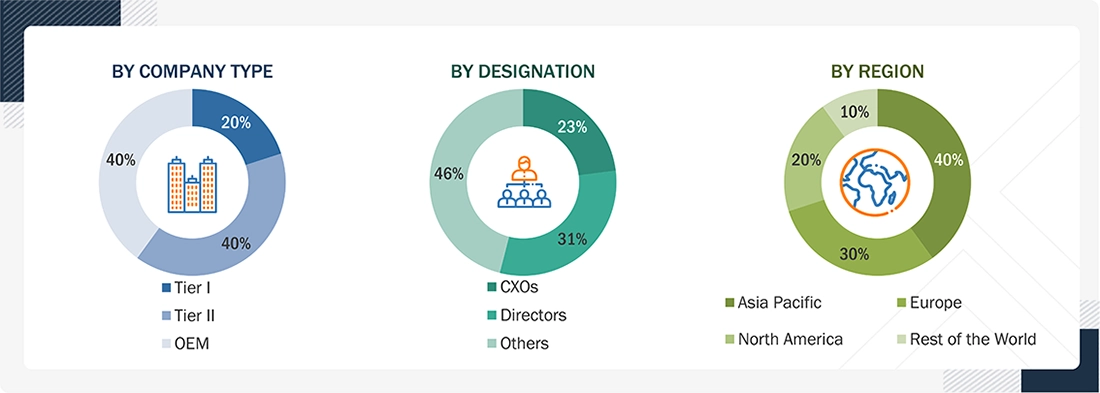
Note: Tier 1 companies’ revenue is more than USD 10 billion; Tier 2 companies’ revenue ranges between USD 1 and 10 billion; and Tier 3 companies’ revenue ranges between USD 500 million and USD 1 billion
To know about the assumptions considered for the study, download the pdf brochure
Market Size Estimation
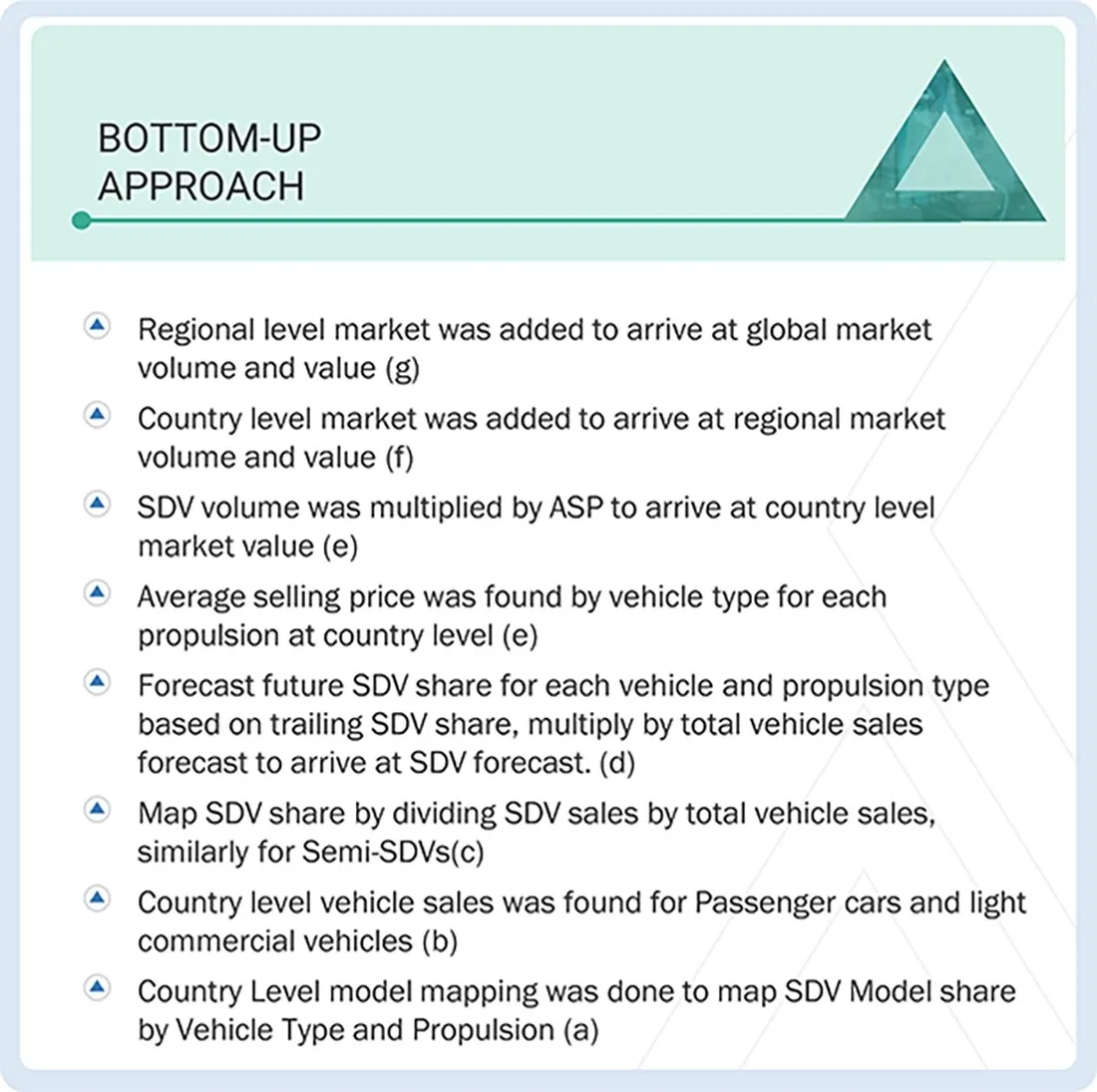
The software defined vehicle market estimation follows a bottom-up methodology, where country-level SDV volumes are first derived by mapping SDV penetration across vehicle types and propulsion categories. Total vehicle sales data for passenger cars and light commercial vehicles are analyzed at the country level, and SDV adoption rates are applied to calculate SDV unit sales. Future SDV penetration trends are assessed to estimate forecast volumes. Average selling prices (ASP) for SDV systems are then applied to derive market value at the country level. These country-level estimates are aggregated to regional totals, which are further consolidated to determine the global SDV market size and forecast.
Data Triangulation
After arriving at the overall market size using the market size estimation processes as explained above, the market was split into several segments and subsegments. To complete the overall market engineering process and arrive at the exact statistics of each market segment and subsegment, data triangulation and market breakdown procedures were employed, wherever applicable. The data was triangulated by studying various factors and trends from both the demand and supply sides.
Market Definition
A software defined vehicle (SDV) is an automobile where its core features, safety functions, and user experience are primarily controlled, updated, and enhanced by software rather than fixed, physical hardware. Much like a smartphone, an SDV can continuously evolve, add new features, and improve long after it leaves the factory.
Report Objectives
- To segment and forecast the software defined vehicle market in terms of volume (thousand units) and value (USD billion) from 2026 to 2035
- SDV Type (SDV, Semi-SDV)
- Vehicle Type (Passenger Car, Light Commercial Vehicle)
- Offering (Hardware, Software)
- Region (Asia Pacific, Europe, North America, and Rest of the World)
- To analyze E/E architecture (domain-centralized architecture, zonal architecture) and application (ADAS, telematics, feature-on-demand) qualitatively
- To analyze regional markets for growth trends, prospects, and their contribution to the overall market
- To define, describe, and forecast the size of the software defined vehicle market with respect to growth trends and prospects, and determine the contribution of the segments to the total market
- To provide detailed information regarding the major factors (drivers, challenges, restraints, and opportunities) influencing market growth
- To strategically analyze markets with respect to individual growth trends, prospects, and contribution to the total market
- To analyze opportunities for stakeholders and the competitive landscape for market leaders
- To study the following with respect to the market -
- Software Defined Vehicle Architecture & OEM Competitive Analysis
- OEM Ecosystem For E/E Architecture Development
- Supply chain analysis
- Ecosystem analysis
- Pricing Analysis
- Technology analysis
- HS Code
- Case Study Analysis
- Patent Analysis
- Impact of 2025 India-EU Trade Deal
- Regulatory Landscape
- Key Stakeholders and Buying Criteria
- Funding, By Application
- Key Conferences & Events
- To strategically profile key players and comprehensively analyze their market share and core competencies
- To analyze the impact of AI on the market
- To track and analyze competitive developments, such as deals (mergers & acquisitions, partnerships, collaborations), product developments, and other activities, carried out by key industry participants
Available customizations:
With the given market data, MarketsandMarkets offers customizations in line with company-specific needs.
- Software defined vehicle market, by application, at the regional level (for regions covered in the report)
- Software defined vehicle market, by E/E architecture, at the country level (for 5 countries not covered in the report)
Company Information
- Profiling of additional market players (up to 5)
Get the Full Software Defined Vehicle Market Report
Full forecast, segment splits, and company analysis for all Software Defined Vehicle Market.
Need a Tailored Report?
Customize this report to your needs
Get 10% FREE Customization
Customize This Report
