Germany Solar Encapsulation Market (2023-2028)

The Germany Solar Encapsulation Market was valued at $174.3 Million in 2023 and projected to reach to $305.1 Million by 2028, representing a compound annual growth rate of 11.9%. Germany's solar encapsulation market is poised for sustained expansion through 2028, supported by the country's commitment to renewable energy and its position as Europe's leading solar technology manufacturer.


| Market Size in | USD 26.32 MN |
| Market Forecast in | |
| CAGR | |
| Forecast Period | |
| Units Considered | Value (USD MN) |
Germany Solar Encapsulation Market Trends and Insights
- Germany is positioned as a key hub for solar technology innovation in Europe, with encapsulation materials playing a critical role in enhancing module durability and efficiency.
- The market in Germany is projected to expand significantly, reaching USD 305.1 million by 2028, reflecting a compound annual growth rate of 11.9%-substantially outpacing global growth trends. The acceleration in Germany's solar encapsulation market is underpinned by increasing domestic solar installations, stringent quality standards, and rising demand for high-performance photovoltaic modules.
- Germany's commitment to renewable energy targets and the expansion of both utility-scale and residential solar projects are driving encapsulation material consumption.
- By 2028, Germany is expected to solidify its position as a leading market for advanced encapsulation solutions, supported by technological advancements and favorable regulatory frameworks that prioritize sustainable energy infrastructure..
Key Market Statistics
- CAGR (2023-2028) 11.9% CAGR
- Market Size, 2023 ~USD 174.3 Million
- Forecast, 2028 ~USD 305.1 Million
- Country Germany
Germany Solar Encapsulation Market Overview
Market Valuation & Growth :
Germany's solar encapsulation market reached USD 174.3 million in 2023 with a robust CAGR of 11.9%, significantly outpacing the global growth rate of 8%, reflecting strong domestic demand and manufacturing expansion.
European Innovation Hub :
Germany serves as a critical innovation center for solar encapsulation technology in Europe, leveraging its advanced manufacturing capabilities and R&D infrastructure to develop high-performance materials for photovoltaic modules.
Renewable Energy Transition :
The country's aggressive Energiewende (energy transition) policy and ambitious targets for renewable energy adoption are driving substantial investments in solar infrastructure, directly boosting demand for quality encapsulation materials.
Forecast Growth Trajectory :
The market is projected to expand to USD 305.1 million by 2028, representing a 75% increase from 2023 levels, driven by rising PV installations, manufacturing localization, and enhanced module durability requirements.
Germany Solar Encapsulation Market Dynamics
- The market's 11.9% CAGR reflects strong domestic PV deployment, increasing module efficiency standards, and growing demand for durable encapsulation solutions.
- Government incentives and manufacturing investments continue to strengthen the competitive landscape. Key growth drivers include rising residential and commercial solar installations, stringent EU durability regulations, and Germany's role as a technology export hub.
- The forecast to USD 305.1 million by 2028 underscores robust market fundamentals.
- However, competition from Asian manufacturers and raw material cost volatility present challenges.
- Strategic focus on advanced materials, sustainability, and localized production will be critical for market participants seeking to capitalize on Germany's renewable energy momentum..
Market Ecosystem
Related Ecosystem
Decarbonization
- Battery Electric Vehicle (BEV)
- Energy Management Systems
- Fuel Cell
- Fuel Cell Electric Vehicle (FCEV)
- Geographical Information System (GIS)
- TotalEnergies SE
- Siemens ag
- Mitsui & Co., Ltd.
- General Electric Company
- Thyssenkrupp ag
Key Takeaways
- Germany's solar encapsulation market is valued at USD 174.3 million in 2023 and is forecast to reach USD 305.1 million by 2028.
- Germany's market is growing at a 11.9% CAGR, significantly faster than the global average of 8%, reflecting strong regional demand.
- Germany's renewable energy policies and expanding solar installations are primary drivers of encapsulation material demand.
- Germany is emerging as a leading European hub for advanced solar encapsulation technologies and manufacturing innovation.
Solar Encapsulation Market Report Scope
| Report Metric | Details |
|---|---|
| Base Year | 2023 |
| Fastest Growing Segment | THERMOPLASTIC POLYURETHANE (TPU) (Material) |
| Forecast Period | 2023-2028 |
| Growth Rate | CAGR of 8% from 2023 to 2028 |
| Largest Segment | CRYSTALLINE SILICON SOLAR (Technology) |
| Market Size Base Year (Billions) | ~USD 4.9 (2023) |
| Revenue Forecast (Billions) | ~USD 7.2 (2028) |
| Segments Covered | Technology, Material, Application |
Germany Solar Encapsulation Market Report Segmentation
3 segment dimensions are covered across the global market.
By Technology
- Crystalline Silicon Solar
- Thin-Film Solar
By Material
- Ethylene-Vinyl Acetate (Eva)
- Ionomer
- Polydimethylsiloxane (Pdms)
- Polyolefin
- Polyvinyl Butyral (Pvb)
- Thermoplastic Polyurethane (Tpu)
By Application
- Building-Integrated Pv
- Floating Pv
- Ground-Mounted Pv
Target Audience
- Solar Module Manufacturers : German and European PV manufacturers need detailed market data to optimize encapsulation material sourcing, assess supplier capabilities, and align production strategies with growing domestic demand.
- Encapsulation Material Suppliers : Chemical and material companies require Germany-specific market intelligence to identify growth opportunities, benchmark competitive positioning, and develop localized product strategies for this key European hub.
- Investment & Private Equity Firms : Investors evaluating opportunities in German solar manufacturing and materials sectors need comprehensive market data to assess valuations, growth potential, and strategic acquisition targets.
- Government & Policy Makers : German energy and industrial policy officials require market insights to evaluate renewable energy transition progress, manufacturing competitiveness, and effectiveness of Energiewende incentive programs.
- Technology & R&D Organizations : Research institutions and innovation centers need market-specific data to align R&D priorities with commercial demand, identify collaboration opportunities, and guide technology development roadmaps.
Reasons to Buy this Report
- Market-Specific Growth Intelligence : Gain detailed insights into Germany's 11.9% CAGR trajectory and USD 174.3M-to-USD 305.1M forecast, enabling precise investment and expansion planning tailored to Europe's largest solar market.
- Competitive Landscape Analysis : Understand Germany's unique manufacturing ecosystem, key local players, and competitive positioning within the European encapsulation market to identify partnership and acquisition opportunities.
- Regulatory & Policy Framework : Access comprehensive analysis of Germany's Energiewende policies, EU durability standards, and government incentives directly impacting encapsulation material demand and market dynamics.
- Technology & Innovation Trends : Identify emerging encapsulation technologies, material innovations, and R&D priorities specific to German manufacturers and their role in advancing European solar module performance standards.
- Strategic Market Entry Guidance : Leverage Germany-specific market data, supply chain insights, and customer segmentation to develop targeted go-to-market strategies and optimize resource allocation in this high-growth region.
Frequently asked questions
What is the current size of Germany's solar encapsulation market?
Germany's solar encapsulation market was valued at USD 174.3 million in 2023 and is expected to grow to USD 305.1 million by 2028.
What is the growth rate of Germany's solar encapsulation market?
Germany's solar encapsulation market is growing at a compound annual growth rate (CAGR) of 11.9% from 2023 to 2028.
What factors are driving growth in Germany's solar encapsulation market?
Key drivers include Germany's renewable energy transition, increasing solar installations, stringent quality standards, and rising demand for high-performance photovoltaic modules.
How does Germany's market growth compare to global trends?
Germany's 11.9% CAGR significantly outpaces the global solar encapsulation market CAGR of 8%, indicating stronger regional demand and market dynamics.
What is the forecast market size for Germany's solar encapsulation market by 2028?
Germany's solar encapsulation market is projected to reach USD 305.1 million by 2028, representing a 75% increase from 2023 levels.
RESEARCH METHODOLOGY
The study involved major activities in estimating the current size of the solar encapsulation market. Exhaustive secondary research was done to collect information on the peer and parent markets. The next step was to validate these findings, assumptions, and sizing with industry experts across the value chain through primary research. Both top-down and bottom-up approaches were employed to estimate the total market size. Thereafter, market breakdown and data triangulation were used to estimate the market size of the segments and subsegments.
Secondary Research
This research study on the solar encapsulation market involved the use of extensive secondary sources, directories, and databases, such as Hoover’s, Bloomberg, Factiva, IRENA, International Energy Agency, and Statista Industry Journal, to collect and identify information useful for a technical, market-oriented, and commercial study of the solar encapsulation market. The other secondary sources included annual reports, press releases & investor presentations of companies, white papers, certified publications, articles by recognized authors, manufacturer associations, trade directories, and databases.
Primary Research
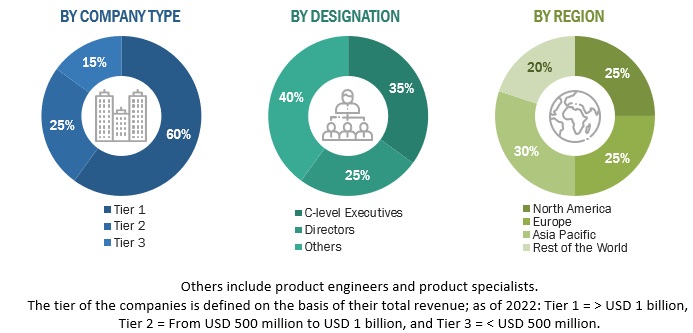
The solar encapsulation market comprises several stakeholders, such as solar encapsulation manufacturers, technology providers, and technical support providers in the supply chain. The demand side of this market is characterized by the rising demand for solar encapsulation in various applications such as ground-mounted, building-integrated photovoltaic, floating photovoltaic and other applications. The supply side is characterized by rising demand for contracts from the industrial sector and mergers & acquisitions among big players. Various primary sources from both the supply and demand sides of the market were interviewed to obtain qualitative and quantitative information. Following is the breakdown of primary respondents:
To know about the assumptions considered for the study, download the pdf brochure
Market Size Estimation
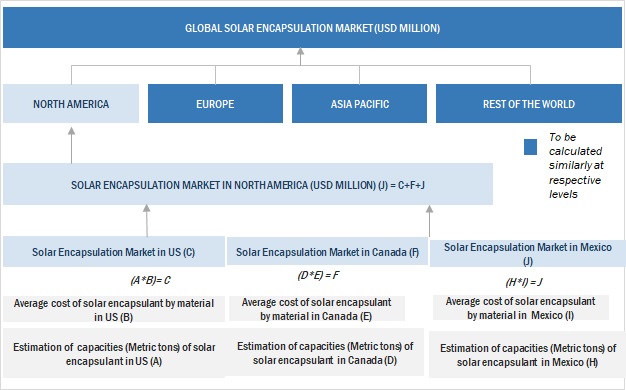
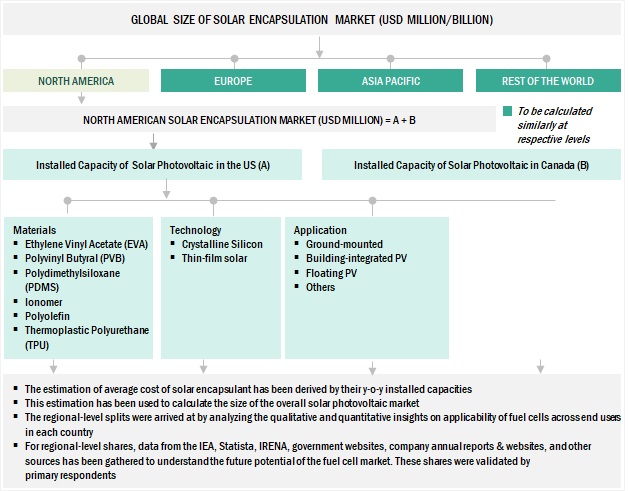
Both top-down and bottom-up approaches were used to estimate and validate the total size of the solar encapsulation market. These methods were also used extensively to estimate the size of various subsegments in the market. The research methodology used to estimate the market size includes the following:
- The key players in the industry and market have been identified through extensive secondary research, and their market share has been determined through primary and secondary research.
- The industry’s value chain and market size, in terms of value, have been determined through both primary and secondary research processes.
- All percentage shares, splits, and breakdowns have been determined using secondary sources and verified through primary sources.
Solar encapsulation Market Size: Top-Down Approach
To know about the assumptions considered for the study, Request for Free Sample Report
Solar encapsulation Market Size: Bottom-Up Approach
Data Triangulation
After arriving at the overall market size from the above estimation process, the total market has been split into several segments and subsegments. Data triangulation and market breakdown processes have been employed to complete the overall market engineering process and arrive at the exact statistics for all the segments and sub-segments, wherever applicable. The data has been triangulated by studying various factors and trends from both the demand- and supply sides. Along with this, the market has been validated using both the top-down and bottom-up approaches.
Market Definition
Solar encapsulation is the technique of applying specific polymeric materials for sealing photovoltaic (PV) cells and other components within a solar panel. This protective layer plays an essential role in preserving the panel's long-term durability and performance. Ethylene Vinyl Acetate (EVA), Thermoplastic Polyurethane (TPU), Polyvinyl Butyral (PVB), Polydimethylsiloxane (PDMS), Ionomer, and Polyolefin are the main types of materials used in the solar encapsulation process.
The solar encapsulation market size can be estimated by adding the revenues generated by the global companies manufacturing solar encapsulants.
Key Stakeholders
- PV Cell Manufacturer
- PV Module Manufacturer
- PV Market Technical Consultants
- Energy & power consulting companies
- Environmental research institutes
- Government and research organizations
- Institutional investors/shareholders
- Power and energy associations
- Repair and maintenance service providers
- Organizations, forums, alliances, and associations
- Clean energy generation research & consulting companies
- State and national regulatory authorities
Objectives of the Study
- To describe, segment, and forecast the solar encapsulation market by materials, technology, and application in terms of value
- To forecast the market across four key regions, namely, North America, Europe, Asia Pacific, and the Rest of the World (RoW), along with country-level analysis in terms of value and volume
- To provide detailed information about key drivers, restraints, opportunities, and challenges influencing the solar encapsulation market growth
- To strategically analyze the solar encapsulation market with respect to individual growth trends, prospects, and contributions of each segment to the market
- To analyze the supply chain, trends/disruptions impacting customer business, market/ecosystem map, pricing analysis, and regulatory landscape pertaining to solar encapsulations
- To strategically analyze micromarkets1 with respect to individual growth trends, expansions, and their contribution to the overall market
- To analyze opportunities for stakeholders in the solar encapsulation market and draw a competitive landscape for market players
- To benchmark players within the market using the company evaluation matrix, which analyzes market players based on several parameters within the broad categories of business and product strategies
- To analyze the key market players with respect to their market share, product specifications, and applications
- To strategically profile the key players and comprehensively analyze their market ranking and core competencies
- To analyze competitive developments in the solar encapsulation market, such as product launches, sales contracts, agreements, investments, expansions, and partnerships
Available Customizations:
With the given market data, MarketsandMarkets offers customizations according to the specific requirements of companies. The following customization options are available for the report:
Product Analysis
- Product Matrix, which provides a detailed comparison of the product portfolio of each company
Company Information
- Detailed analyses and profiling of additional market players
Get the Full Solar Encapsulation Market Report
Full forecast, segment splits, and company analysis for all Solar Encapsulation Market.
- Rest Of Europe Solar Encapsulation Market
- Rest Of Asia Pacific Solar Encapsulation Market
- Japan Solar Encapsulation Market
- China Solar Encapsulation Market
- India Solar Encapsulation Market
- Australia Solar Encapsulation Market
- South Korea Solar Encapsulation Market
- Canada Solar Encapsulation Market
- Mexico Solar Encapsulation Market
- US Solar Encapsulation Market
- Italy Solar Encapsulation Market
- France Solar Encapsulation Market
- UK Solar Encapsulation Market
- Netherlands Solar Encapsulation Market
- Spain Solar Encapsulation Market
Need a Tailored Report?
Customize this report to your needs
Get 10% FREE Customization
Customize This Report
