
Other GCC Countries Solar Photovoltaic Glass Market (2023-2028)

The Other GCC Countries Solar Photovoltaic Glass Market was valued at $1 Million in 2023 and projected to reach to $2.5 Million by 2028, representing a compound annual growth rate of 21.2%. Other GCC Countries' solar photovoltaic glass market is positioned for significant growth as regional governments prioritize renewable energy diversification.


| Market Size in | USD 26.32 MN |
| Market Forecast in | |
| CAGR | |
| Forecast Period | |
| Units Considered | Value (USD MN) |
Other GCC Countries Solar Photovoltaic Glass Market Trends and Insights
- Other GCC Countries is capitalizing on regional renewable energy initiatives and increasing solar capacity installations across the Gulf region.
- The 21.2% compound annual growth rate reflects Other GCC Countries' commitment to diversifying energy portfolios and reducing carbon emissions through solar infrastructure development. Other GCC Countries' solar PV glass market is driven by government incentives, declining solar equipment costs, and rising electricity demand.
- Other GCC Countries is witnessing accelerated adoption of photovoltaic technologies as part of broader Vision 2030-aligned sustainability goals.
- The forecast period through 2028 indicates sustained momentum in Other GCC Countries, supported by favorable regulatory frameworks and private sector investments in renewable energy projects..
Key Market Statistics
- CAGR (2023-2028) 21.2% CAGR
- Market Size, 2023 ~USD 1 Million
- Forecast, 2028 ~USD 2.5 Million
- Country Other GCC Countries
Other GCC Countries Solar Photovoltaic Glass Market Overview
Rapid Market Expansion :
Other GCC Countries' solar photovoltaic glass market is growing at 21.2% CAGR, expanding from $1.0 million in 2023 to $2.5 million by 2028, driven by regional renewable energy commitments and Vision 2030 initiatives.
Regional Solar Capacity Growth :
Increasing solar installations across Oman, Bahrain, and Qatar are fueling demand for high-quality PV glass, as these nations diversify energy portfolios away from oil dependency.
Government Support & Incentives :
Other GCC Countries benefit from favorable government policies, subsidies, and renewable energy targets that accelerate solar project development and PV glass consumption.
Strategic Market Position :
Despite smaller market size compared to Saudi Arabia and UAE, Other GCC Countries represent an emerging opportunity with untapped potential for solar infrastructure expansion.
Other GCC Countries Solar Photovoltaic Glass Market Dynamics
- The 21.2% CAGR reflects increasing solar capacity installations and infrastructure investments across Oman, Bahrain, Qatar, and Kuwait, supported by national sustainability agendas and international climate commitments. The market's expansion is underpinned by rising electricity demand, declining solar technology costs, and government incentives promoting clean energy adoption.
- As these nations advance their renewable energy roadmaps and attract foreign investment in solar projects, demand for specialized PV glass will accelerate, creating opportunities for manufacturers and suppliers targeting the emerging GCC solar sector..
Market Ecosystem
Related Ecosystem
Ceramics And Glass
- Zirconia
- Alumina Ceramics
- Silicon Carbide
- Silicon Nitride
- Titanate Ceramics
- Saint-gobain
- 3M COMPANY
- Kyocera Corporation
- CERAMTEC GMBH
- COORSTEK INCORPORATED
Power Infrastructure
- Geographical Information System (GIS)
- Cogeneration
- Battery Electric Vehicle (BEV)
- Cellular Network
- Fuel Cell
- ABB India Limited
- Siemens ag
- SCHNEIDER ELECTRIC SE
- General Electric Company
- Eaton Corporation plc
Key Takeaways
- Other GCC Countries' solar PV glass market is projected to grow from $1.0 million (2023) to $2.5 million (2028) at a 21.2% CAGR.
- Other GCC Countries is benefiting from regional renewable energy mandates and government-backed solar deployment programs.
- Other GCC Countries' market growth is supported by declining solar technology costs and increasing private sector participation.
- Other GCC Countries is positioned as an emerging hub for solar infrastructure development in the Middle East and Africa region.
Solar Photovoltaic Glass Market Report Scope
| Report Metric | Details |
|---|---|
| Base Year | 2023 |
| Fastest Growing Segment | PEROVSKITE MODULE (End User) |
| Forecast Period | 2023-2028 |
| Growth Rate | CAGR of 28.4% from 2023 to 2028 |
| Largest Segment | ACTIVE (Mechanism) |
| Market Size Base Year (Billions) | ~USD 7.82 (2023) |
| Revenue Forecast (Billions) | ~USD 27.3 (2028) |
| Segments Covered | Type, Installation, End User, Application, Mechanism |
Other GCC Countries Solar Photovoltaic Glass Market Report Segmentation
5 segment dimensions are covered across the global market.
By Type
- Ar Coated
- Ar-Coated Solar Pv Glass
- Tco Coated
- Tco-Coated Solar Pv Glass
- Tempered
- Tempered Solar Pv Glass
By Installation
- Float Glass
- Float Glass Technology
- Pattern Glass
- Pattern Glass Technology
By End User
- Crystalline Silicon Pv Module
- Perovskite Module
- Thin Film Module
By Application
- Non-Residential
- Residential
- Utility
By Mechanism
- Active
- Passive
Target Audience
- Solar Equipment Manufacturers : Manufacturers of photovoltaic glass and solar components need market intelligence on Other GCC Countries to identify expansion opportunities and localize production strategies.
- Renewable Energy Developers : Solar project developers and EPC contractors require detailed market data on Other GCC Countries to assess project feasibility, supply chain requirements, and revenue potential.
- Investment & Private Equity Firms : Investors evaluating renewable energy opportunities in the GCC region need specific market metrics for Other GCC Countries to support due diligence and portfolio decisions.
- Glass & Material Suppliers : Raw material and specialty glass suppliers need insights into Other GCC Countries' demand patterns to optimize inventory, pricing, and distribution strategies.
- Government & Policy Makers : Regional policymakers and energy planners use market data on Other GCC Countries to inform renewable energy targets, incentive programs, and infrastructure development initiatives.
Reasons to Buy this Report
- Market-Specific Growth Data : Access precise market sizing and forecasts exclusive to Other GCC Countries, enabling accurate investment decisions and resource allocation in this emerging solar segment.
- Regional Opportunity Identification : Identify high-potential sub-markets within Oman, Bahrain, Qatar, and Kuwait with detailed insights into local solar project pipelines and government renewable energy targets.
- Competitive Positioning Strategy : Benchmark your business against regional competitors and understand market dynamics specific to Other GCC Countries to develop targeted market entry or expansion strategies.
- Investment & Risk Assessment : Evaluate market viability and growth trajectory in Other GCC Countries with comprehensive data supporting capital allocation decisions and partnership opportunities.
- Regulatory & Policy Insights : Understand government incentives, renewable energy mandates, and policy frameworks driving solar adoption across Other GCC Countries to align business operations accordingly.
Frequently asked questions
What is the current market size of solar PV glass in Other GCC Countries?
Other GCC Countries' solar photovoltaic glass market was valued at $1.0 million in 2023 and is expected to grow to $2.5 million by 2028.
What is the projected growth rate for Other GCC Countries' solar PV glass market?
Other GCC Countries' solar PV glass market is expected to grow at a compound annual growth rate (CAGR) of 21.2% from 2023 to 2028.
What factors are driving growth in Other GCC Countries' solar PV glass market?
Other GCC Countries' market growth is driven by government renewable energy initiatives, declining solar equipment costs, rising electricity demand, and private sector investments in solar infrastructure.
How does Other GCC Countries' market compare to the global solar PV glass market?
While the global solar PV glass market grows at 28.4% CAGR, Other GCC Countries maintains a strong 21.2% CAGR, reflecting regional market maturity and localized growth dynamics.
What opportunities exist for investors in Other GCC Countries' solar PV glass market?
Other GCC Countries offers investment opportunities through government-backed solar projects, manufacturing partnerships, and supply chain development aligned with regional renewable energy targets.
RESEARCH METHODOLOGY
The study involved four major activities in estimating the current size of the solar photovoltaic glass market—extensive secondary research collected information on the market, peer, and parent markets. The next step was to validate these findings, assumptions, and measures with industry experts across the value chain of solar PV glass through primary research. Both top-down and bottom-up approaches were employed to estimate the total market size. After that, market breakdown and data triangulation were used to estimate the size of the segments and sub-segments of the market.
Secondary Research
The research methodology used to estimate and forecast the access control market begins with capturing data on the revenues of key vendors in the market through secondary research. In the secondary research process, various secondary sources, such as Hoovers, Bloomberg BusinessWeek, Factiva, World Bank, and Industry Journals, were referred to to identify and collect information for this study. These secondary sources included annual reports, press releases, investor presentations of companies, white papers, certified publications, articles by recognized authors, notifications by regulatory bodies, trade directories, and databases. Vendor offerings have also been taken into consideration to determine market segmentation.
Primary Research
The solar photovoltaic glass market comprises several stakeholders in the supply chain, such as manufacturers, equipment manufacturers, traders, associations, and regulatory organizations. The development of various end-use industries characterizes the demand side of this market. Various primary sources from the supply and demand sides of the market were interviewed to obtain qualitative and quantitative information. Following is the breakdown of the primary respondents:
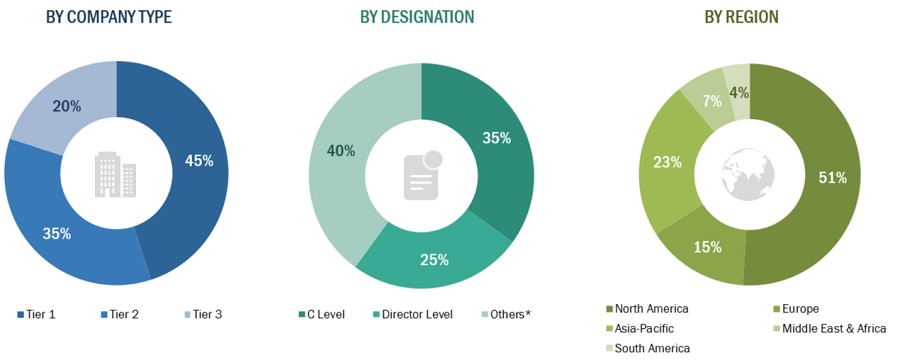
Note: “Others” includes sales, marketing, and product managers
To know about the assumptions considered for the study, download the pdf brochure
Market Size Estimation
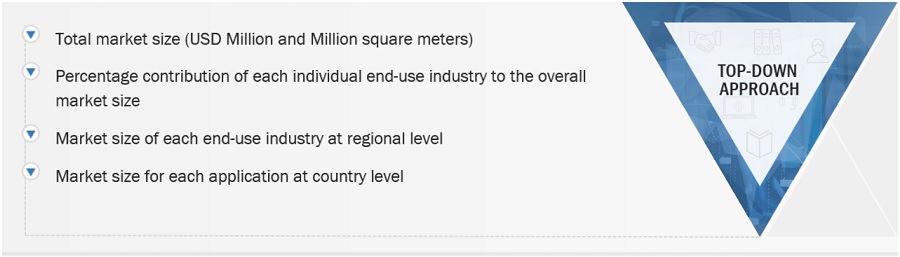
The top-down and bottom-up approaches were used to estimate and validate the total size of the solar photovoltaic glass market. These methods were also used extensively to determine the market size of various segments. The research methodology used to estimate the market size included the following:
- The key players were identified through extensive primary and secondary research.
- The value chain and market size of the reticulated foam market, in terms of value and volume, were determined through primary and secondary research.
- All percentage shares, splits, and breakdowns were determined using secondary sources and verified through primary sources.
- All possible parameters that affect the market covered in this research study were accounted for, viewed in extensive detail, verified through primary research, and analyzed to obtain the final quantitative and qualitative data.
- The research included the study of reports, reviews, and newsletters of top market players, along with extensive interviews for opinions from key leaders, such as CEOs, directors, and marketing executives.
Global Solar Photovoltaic Glass Market Size: Bottom-Up Approach
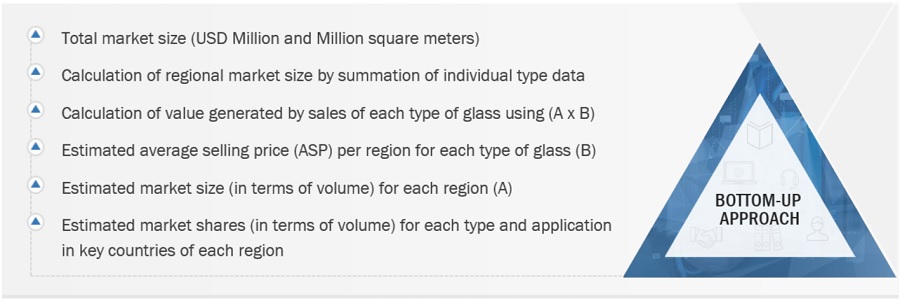
To know about the assumptions considered for the study, Request for Free Sample Report
Global Solar Photovoltaic Glass Market Size: Top-Down Approach
Data Triangulation
After arriving at the overall market size using the market size estimation processes as explained above, the market was split into several segments and sub-segments. Data triangulation and market breakdown procedures were employed to complete the overall market engineering process and determine each market segment’s and subsegment’s exact statistics. The market size was calculated globally by summing up the country-level and regional-level data.
Market Definition
The solar PV (photovoltaic) glass market refers to the global industry involved in producing, distributing, and selling specialized glass materials used in manufacturing solar panels or photovoltaic modules. This market encompasses the various types of glass designed to enhance the performance, efficiency, and durability of solar cells within solar modules, facilitating the conversion of sunlight into electricity.
Key Stakeholder
- Manufacturers of solar photovoltaic glass
- Traders, distributors, and suppliers of solar photovoltaic glass
- Government and research organizations
- Associations and industrial bodies
- Research and consulting firms
- R&D institutions
- Environment support agencies
- Investment banks and private equity firms
Report Objectives:
- To define, describe, and forecast the size of the global solar photovoltaic glass market in terms of value and volume
- To provide detailed information regarding the key factors, such as drivers, restraints, opportunities, and industry-specific challenges, influencing the growth of the solar photovoltaic glass market.
- To analyze and forecast the size of various segments (type, installation, end-use, application) of the solar photovoltaic glass market based on five major regions—North America, Europe, Asia Pacific, South America, Middle East & Africa—along with key countries in each of these regions
- To analyze recent developments and competitive strategies, such as expansions, new product developments, partnerships, and acquisitions, product launches to draw the competitive landscape of the market
- To strategically profile the key players in the market and comprehensively analyze their core competencies
Available Customizations:
With the given market data, MarketsandMarkets offers customizations according to client-specific needs. The following customization options are available for the report:
- Additional country-level analysis of the solar photovoltaic glass market
- Profiling of additional market players (up to 5)
- Product matrix, which gives a detailed comparison of the product portfolio of each company.
Get the Full Solar Photovoltaic Glass Market Report
Full forecast, segment splits, and company analysis for all Solar Photovoltaic Glass Market.
- China Solar Photovoltaic Glass Market
- Japan Solar Photovoltaic Glass Market
- India Solar Photovoltaic Glass Market
- South Korea Solar Photovoltaic Glass Market
- Taiwan Solar Photovoltaic Glass Market
- Vietnam Solar Photovoltaic Glass Market
- Canada Solar Photovoltaic Glass Market
- Mexico Solar Photovoltaic Glass Market
- US Solar Photovoltaic Glass Market
- Germany Solar Photovoltaic Glass Market
- France Solar Photovoltaic Glass Market
- UK Solar Photovoltaic Glass Market
- Italy Solar Photovoltaic Glass Market
- Spain Solar Photovoltaic Glass Market
- Netherlands Solar Photovoltaic Glass Market
- Brazil Solar Photovoltaic Glass Market
- Chile Solar Photovoltaic Glass Market
- UAE Solar Photovoltaic Glass Market
- Turkey Solar Photovoltaic Glass Market
- South Africa Solar Photovoltaic Glass Market
- Israel Solar Photovoltaic Glass Market
- Rest Of Europe Solar Photovoltaic Glass Market
- Rest Of Asia Pacific Solar Photovoltaic Glass Market
- Rest Of South America Solar Photovoltaic Glass Market
Need a Tailored Report?
Customize this report to your needs
Get 10% FREE Customization
Customize This Report
