
Europe Solid Biomass Feedstock Market (2024-2029)

The Europe Solid Biomass Feedstock Market was valued at $7970.5 Million in 2024 and projected to reach to $11331.1 Million by 2029, representing a compound annual growth rate of 7.3%. Europe's solid biomass feedstock market is poised for sustained expansion through 2029, driven by the European Green Deal, renewable energy targets, and the transition away from fossil fuels.


| Market Size in | USD 26.32 MN |
| Market Forecast in | |
| CAGR | |
| Forecast Period | |
| Units Considered | Value (USD MN) |
Europe Solid Biomass Feedstock Market Trends and Insights
- This represents a compound annual growth rate of 7.3%, outpacing the global average of 6.3%, reflecting Europe's strong commitment to renewable energy and carbon neutrality targets.
- Europe's leadership in biomass adoption is driven by stringent EU renewable energy directives and the continent's abundant forestry resources. The European market benefits from established supply chains, advanced conversion technologies, and supportive regulatory frameworks that incentivize biomass utilization across heating, power generation, and industrial applications.
- Europe's transition away from fossil fuels has positioned solid biomass feedstock as a critical component of the energy mix, particularly in Nordic and Central European countries with significant forestry sectors.
- Between 2024 and 2029, Europe is expected to consolidate its position as a global leader in sustainable biomass utilization. Key drivers include the EU's Green Deal objectives, increasing energy security concerns, and growing demand for carbon-neutral heating solutions across residential and commercial sectors throughout Europe..
Key Market Statistics
- CAGR (2024-2029) 7.3% CAGR
- Market Size, 2024 ~USD 7970.5 Million
- Forecast, 2029 ~USD 11331.1 Million
- Geography Europe
Europe Solid Biomass Feedstock Market Overview
Market Leadership Position :
Europe commands a significant share of the global solid biomass feedstock market, valued at $7,970.5 million in 2024, with a regional CAGR of 7.3% exceeding the global average of 6.3%, demonstrating Europe's dominance in renewable biomass adoption.
Strong Regulatory Framework :
Europe's stringent carbon neutrality targets and renewable energy directives (RED IV) drive sustained demand for solid biomass feedstock, positioning the region as a leader in sustainable energy transition and biomass utilization policies.
Robust Growth Trajectory :
The European market is projected to reach $11,331.1 million by 2029, representing a growth of $3,360.6 million over five years, reflecting increasing investments in biomass heating, power generation, and industrial applications across member states.
Diverse Country Participation :
Germany ($2,386.3M), UK ($1,825.8M), and Sweden ($1,219.5M) lead European biomass markets, supported by established forestry sectors, advanced conversion technologies, and government incentives for renewable energy adoption.
Europe Solid Biomass Feedstock Market Dynamics
- The region's mature forestry infrastructure, combined with technological advancements in biomass conversion and increasing industrial heat demand, creates favorable conditions for market growth.
- Key European economies are investing heavily in biomass supply chains and district heating networks. The market will benefit from circular economy initiatives, waste-to-energy programs, and agricultural residue utilization across EU member states.
- However, sustainability concerns and competition from alternative renewables may moderate growth rates.
- Strategic investments in biomass logistics, certification standards, and carbon accounting will be critical for maintaining Europe's competitive advantage in the global solid biomass feedstock market..
Market Ecosystem
Related Ecosystem
Decarbonization
- Battery Electric Vehicle (BEV)
- Energy Management Systems
- Fuel Cell
- Fuel Cell Electric Vehicle (FCEV)
- Geographical Information System (GIS)
- TotalEnergies SE
- Siemens ag
- Mitsui & Co., Ltd.
- General Electric Company
- Thyssenkrupp ag
Key Takeaways
- Europe's solid biomass feedstock market will grow from $7,970.5M (2024) to $11,331.1M (2029) at a 7.3% CAGR, exceeding global growth rates.
- Europe leads globally in biomass adoption due to EU renewable energy directives, abundant forestry resources, and carbon neutrality commitments.
- Established supply chains and advanced conversion technologies across Europe enable efficient biomass utilization in heating, power, and industrial sectors.
- EU Green Deal objectives and energy security concerns are primary growth catalysts driving European solid biomass feedstock demand through 2029.
Solid Biomass Feedstock Market Report Scope
| Report Metric | Details |
|---|---|
| Base Year | 2024 |
| Fastest Growing Segment | BIOMETHANE (Application) |
| Forecast Period | 2024-2029 |
| Growth Rate | CAGR of 6.3% from 2024 to 2029 |
| Largest Segment | UTILITIES (End User) |
| Market Size Base Year (Billions) | ~USD 26.67 (2024) |
| Revenue Forecast (Billions) | ~USD 36.2 (2029) |
| Segments Covered | Source, Type, Application, End User |
Europe Solid Biomass Feedstock Market Report Segmentation
4 segment dimensions are covered across the global market.
By Source
- Agriculture Waste
- Animal Waste
- Forest Waste
- Municipal Waste
By Type
- Briquettes
- Chips
- Pellets
By Application
- Biofuel
- Biofuels
- Biomethane
- Electricity
- Heat
By End User
- Industrial
- Residential & Commercial
- Utilities
EUROPE: SOLID BIOMASS FEEDSTOCK MARKET, BY END USER, 2024–2029
| Segment | 2024 | 2025 | 2026 | 2027 | 2028 | 2029 | CAGR (%) |
|---|---|---|---|---|---|---|---|
| INDUSTRIAL | 1773.5 | 2113.5 | 2506.5 | 2888.6 | 3124.7 | 3331.3 | 13.4 |
| RESIDENTIAL & COMMERCIAL | 665.2 | 696.4 | 728 | 760 | 792.4 | 825.8 | 4.4 |
| UTILITIES | 5531.8 | 5904.4 | 6325 | 6734.9 | 6998.8 | 7174 | 5.3 |
| TOTAL | 7970.5 | 8714.3 | 9559.5 | 10383.5 | 10915.9 | 11331.1 | 7.3 |
Target Audience
- Energy & Utility Companies : European energy providers require detailed market data to assess biomass feedstock availability, pricing trends, and supply chain reliability for power generation and district heating projects across the region.
- Biomass Producers & Suppliers : Feedstock producers and aggregators need country-specific market sizing and growth forecasts to optimize production capacity, identify expansion opportunities, and develop distribution strategies across European markets.
- Investment & Private Equity Firms : Investors evaluating biomass sector opportunities require comprehensive regional analysis, competitive positioning data, and growth projections to identify acquisition targets and portfolio companies in Europe's renewable energy landscape.
- Policy Makers & Government Agencies : European regulatory bodies and government officials utilize market intelligence to develop renewable energy policies, set biomass sustainability standards, and allocate resources for carbon neutrality initiatives.
- Industrial & Manufacturing Sectors : Industrial facilities seeking biomass for heating, steam generation, and bioenergy applications require market data on feedstock availability, pricing, and supply chain logistics specific to their European operating regions.
Countries within Europe - compare and drill down
| Country | 2025 size (native) |
|---|---|
| Germany | USD 2386.3 Million |
| UK | USD 1825.8 Million |
| France | USD 1136.2 Million |
| Italy | USD 1135 Million |
| Sweden | USD 1219.5 Million |
| Russia | USD 940.4 Million |
| Rest Of Europe | USD 2687.9 Million |
Country market size visualization
Reasons to Buy this Report
- Regional Market Quantification : Access precise market sizing for Europe's solid biomass feedstock sector with country-level breakdowns for Germany, UK, France, Italy, Sweden, and Russia, enabling targeted investment and expansion strategies.
- Competitive Landscape Intelligence : Understand market dynamics across Europe's leading biomass markets, identify regional growth drivers, and benchmark performance against country-specific trends to optimize market entry and positioning strategies.
- Regulatory & Policy Insights : Gain comprehensive understanding of Europe's renewable energy directives, carbon neutrality mandates, and biomass sustainability standards that shape market opportunities and compliance requirements across jurisdictions.
- Growth Forecasting & Planning : Leverage detailed 5-year projections (2024-2029) with 7.3% regional CAGR to inform capital allocation, supply chain development, and long-term strategic planning for biomass feedstock operations in Europe.
- Investment Decision Support : Make data-driven investment decisions with comprehensive European market analysis, identifying high-growth segments, emerging opportunities, and risk factors specific to regional biomass feedstock markets.
Frequently asked questions
What is the current size of Europe's solid biomass feedstock market?
Europe's solid biomass feedstock market was valued at $7,970.5 million in 2024 and is projected to reach $11,331.1 million by 2029.
What is the growth rate for Europe's solid biomass feedstock market?
Europe's solid biomass feedstock market is growing at a compound annual growth rate (CAGR) of 7.3% from 2024 to 2029, which exceeds the global CAGR of 6.3%.
Why is Europe's biomass market growing faster than the global average?
Europe's faster growth is driven by stringent EU renewable energy directives, abundant forestry resources, strong carbon neutrality commitments, and established biomass supply chains across the continent.
What are the primary applications of solid biomass feedstock in Europe?
In Europe, solid biomass feedstock is primarily used for heating in residential and commercial sectors, power generation, and industrial applications, supported by advanced conversion technologies.
Which European regions are leading in solid biomass feedstock adoption?
Nordic and Central European countries with significant forestry sectors, such as Sweden, Finland, and Poland, are leading in solid biomass feedstock adoption and utilization.
RESEARCH METHODOLOGY
The study involved major activities in estimating the current size of the solid biomass feedstock market. Exhaustive secondary research was done to collect information on the peer and parent markets. The next step was to validate these findings, assumptions, and sizing with industry experts across the value chain through primary research. Both top-down and bottom-up approaches were employed to estimate the total market size. Thereafter, market breakdown and data triangulation were used to estimate the market size of the segments and subsegments.
Secondary Research
This research study on the solid biomass feedstocks market involved the use of extensive secondary sources, directories, and databases, such as Hoover’s, Bloomberg, Factiva, IRENA, International Energy Agency, and Statista Industry Journal, to collect and identify information useful for a technical, market-oriented, and commercial study of the solid biomass feedstocks market. The other secondary sources included annual reports, press releases & investor presentations of companies, white papers, certified publications, articles by recognized authors, manufacturer associations, trade directories, and databases.
Primary Research
The solid biomass feedstocks market comprises several stakeholders, such as solid biomass feedstock providers, technology providers, and technical support providers in the supply chain. The demand side of this market is characterized by the rising demand for solid biomass feedstock in various applications such as electricity, heat, biofuels, and biomethane. The supply side is characterized by rising demand for contracts from the industrial sector and mergers & acquisitions among big players. Various primary sources from both the supply and demand sides of the market were interviewed to obtain qualitative and quantitative information. Following is the breakdown of primary respondents:
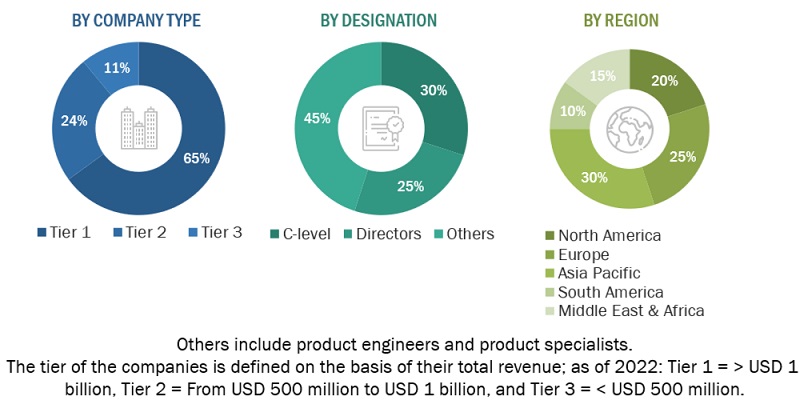
To know about the assumptions considered for the study, download the pdf brochure
Market Size Estimation
Both top-down and bottom-up approaches were used to estimate and validate the total size of the market. These methods were also used extensively to estimate the size of various subsegments in the market. The research methodology used to estimate the market size includes the following:
- The key players in the industry and market have been identified through extensive secondary research, and their market share has been determined through primary and secondary research.
- The industry’s value chain and market size, in terms of value, have been determined through both primary and secondary research processes.
- All percentage shares, splits, and breakdowns have been determined using secondary sources and verified through primary sources.
Solid Biomass Feedstock Market Size: Top-Down Approach
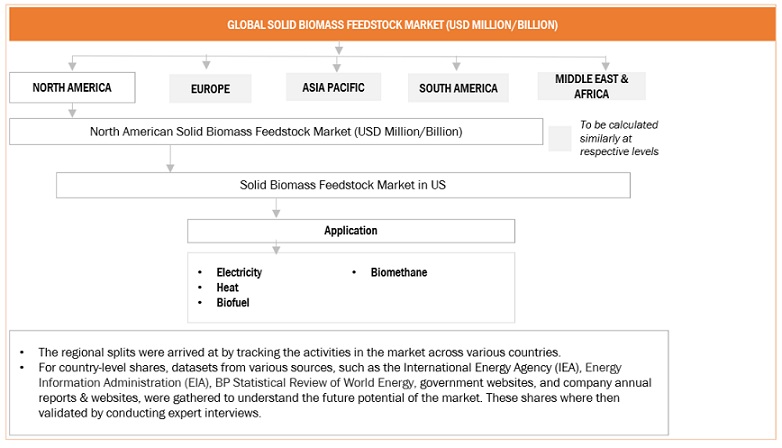
To know about the assumptions considered for the study, Request for Free Sample Report
Solid Biomass Feedstock Market Size: Bottom-Up Approach
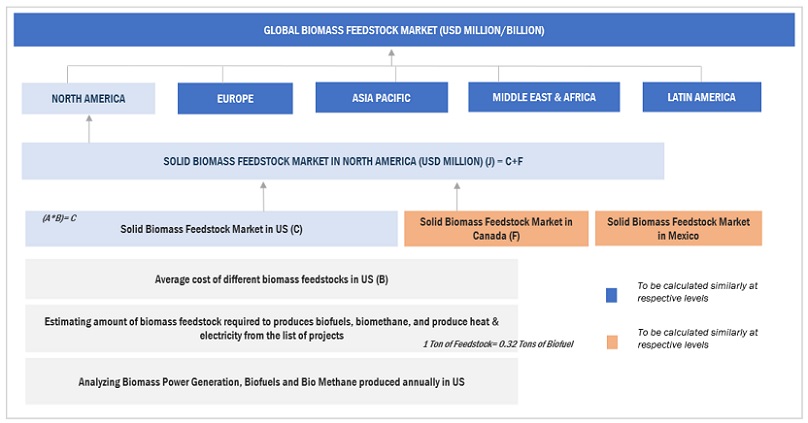
Data Triangulation
After arriving at the overall market size from the above estimation process, the total market has been split into several segments and subsegments. Data triangulation and market breakdown processes have been employed to complete the overall market engineering process and arrive at the exact statistics for all the segments and sub-segments, wherever applicable. The data has been triangulated by studying various factors and trends from both the demand- and supply sides. Along with this, the market has been validated using both the top-down and bottom-up approaches.
Market Definition
Solid biomass feedstock comprises organic materials in solid form, including wood, forestry residues, agricultural byproducts, and organic waste. These materials serve as a crucial feedstock for diverse energy production processes. Harnessing solid biomass feedstock as a renewable energy source holds great promise in mitigating climate change by curbing greenhouse gas emissions.
The market is defined as the sum of the revenue generated by global companies offering solid biomass feedstock for applications such as electricity, heat, and biofuel.
Key Stakeholders
- Biofuel suppliers
- Consulting companies in energy & power sector
- Energy regulators
- Government and research organizations
- Power and energy associations
- State and national regulatory authorities
- Research companies in clean energy generation sector
- Organizations, forums, alliances, and associations
- Industrial authorities and associations
- State and national regulatory authorities
- Research Institutes
Objectives of the Study
- To describe, segment, and forecast the market, by source, type, application, and end user in terms of value
- To forecast the market across five key regions, namely, North America, Europe, Asia Pacific, Middle East & Africa, and South America in terms of value and volume
- To provide detailed information about key drivers, restraints, opportunities, and challenges influencing the market
- To strategically analyze the solid biomass feedstocks market with respect to individual growth trends, prospects, and contributions of each segment to the market
- To analyze the supply chain, trends/disruptions impacting customer business, market/ecosystem, pricing trends, and regulatory landscape pertaining to solid biomass feedstock
- To strategically analyze micromarkets1 with respect to individual growth trends, expansions, and their contribution to the overall market
- To analyze opportunities for stakeholders in the market and draw a competitive landscape for market players
- To benchmark players within the market using the company evaluation matrix, which analyzes market players based on several parameters within the broad categories of business and product strategies
- To analyze the key market players with respect to their market share, product specifications, and applications
- To strategically profile the key players and comprehensively analyze their market ranking and core competencies2
- To analyze competitive developments in the market, such as product launches, sales contracts, agreements, investments, expansions, partnerships, and collaborations
Available Customizations:
With the given market data, MarketsandMarkets offers customizations according to the specific requirements of companies. The following customization options are available for the report:
Product Analysis
- Product Matrix, which provides a detailed comparison of the product portfolio of each company
Company Information
- Detailed analyses and profiling of additional market players
Get the Full Solid Biomass Feedstock Market Report
Full forecast, segment splits, and company analysis for all Solid Biomass Feedstock Market.
- Rest Of Asia Pacific Solid Biomass Feedstock Market
- GCC Countries Solid Biomass Feedstock Market
- Rest Of South America Solid Biomass Feedstock Market
- China Solid Biomass Feedstock Market
- India Solid Biomass Feedstock Market
- Japan Solid Biomass Feedstock Market
- Australia Solid Biomass Feedstock Market
- Thailand Solid Biomass Feedstock Market
- Germany Solid Biomass Feedstock Market
- UK Solid Biomass Feedstock Market
- France Solid Biomass Feedstock Market
- Italy Solid Biomass Feedstock Market
- Sweden Solid Biomass Feedstock Market
- Russia Solid Biomass Feedstock Market
- Canada Solid Biomass Feedstock Market
- Mexico Solid Biomass Feedstock Market
- US Solid Biomass Feedstock Market
- Brazil Solid Biomass Feedstock Market
- Argentina Solid Biomass Feedstock Market
- Chile Solid Biomass Feedstock Market
- Rest Of Europe Solid Biomass Feedstock Market
Need a Tailored Report?
Customize this report to your needs
Get 10% FREE Customization
Customize This Report
