
Europe Space-Based Solar Power Market (2030-2035)

The Europe Space-Based Solar Power Market was valued at $1389.3 Million in 2030 and projected to reach to $1820.1 Million by 2035, representing a compound annual growth rate of 2.7%. Europe's space-based solar power market is poised for measured but meaningful growth through 2035, driven by regulatory support, climate commitments, and technological maturation.


| Market Size in | USD 26.32 MN |
| Market Forecast in | |
| CAGR | |
| Forecast Period | |
| Units Considered | Value (USD MN) |
Europe Space-Based Solar Power Market Trends and Insights
- Valued at $1,389.3 million in 2030, Europe's market is expected to expand to $1,820.1 million by 2035, reflecting a compound annual growth rate of 2.7%.
- This growth trajectory underscores Europe's commitment to advancing clean energy technologies and reducing carbon emissions through innovative aerospace and defence sector initiatives. The European market benefits from strong regulatory frameworks, substantial government investment in space infrastructure, and collaborative international partnerships.
- Europe's strategic focus on energy independence and technological sovereignty drives adoption of space-based solar solutions across member states.
- Between 2030 and 2035, Europe's market expansion will be supported by advances in satellite technology, declining launch costs, and increasing private sector participation in the space economy. Europe's space-based solar power sector represents a convergence of aerospace innovation and energy security priorities.
- The region's established space agencies, skilled workforce, and industrial base position Europe as a key player in commercializing orbital solar technology, with sustained investment expected throughout the forecast period..
Key Market Statistics
- CAGR (2030-2035) 2.7% CAGR
- Market Size, 2030 ~USD 1389.3 Million
- Forecast, 2035 ~USD 1820.1 Million
- Geography Europe
Europe Space-Based Solar Power Market Overview
Market Valuation Growth :
Europe's space-based solar power market is valued at $1,389.3 million in 2030 and is projected to reach $1,820.1 million by 2035, demonstrating steady expansion in the renewable energy sector.
Consistent CAGR Performance :
The European market exhibits a compound annual growth rate of 2.7% from 2030 to 2035, reflecting sustained investment in clean energy infrastructure and technological advancement across the continent.
EU Green Energy Commitment :
Europe's focus on the European Green Deal and carbon neutrality targets by 2050 positions space-based solar power as a strategic technology for achieving ambitious renewable energy goals.
Strategic Technology Integration :
European aerospace and defence companies are increasingly integrating space-based solar capabilities into their portfolios, supporting the continent's energy independence and sustainability objectives.
Europe Space-Based Solar Power Market Dynamics
- The continent's investment in renewable energy infrastructure and space technology creates a favorable environment for market expansion.
- European governments and private sector stakeholders are prioritizing clean energy solutions to meet stringent carbon reduction targets and enhance energy security. The 2.7% CAGR reflects Europe's strategic approach to integrating space-based solar technology within its broader renewable energy portfolio.
- Continued R&D investments, public-private partnerships, and supportive EU policies will sustain market momentum.
- By 2035, Europe is expected to establish itself as a key player in space-based solar innovation, contributing significantly to global decarbonization efforts while strengthening regional energy independence..
Market Ecosystem
Related Ecosystem
Key Takeaways
- Europe's space-based solar power market will grow from $1,389.3 million in 2030 to $1,820.1 million in 2035 at a 2.7% CAGR.
- Europe's regulatory environment and government support for space infrastructure create favorable conditions for market expansion.
- Europe's energy security objectives and climate commitments drive investment in alternative renewable energy technologies.
- Europe's aerospace and defence industrial base provides competitive advantages in developing and deploying space-based solar systems.
Space-Based Solar Power Market Report Scope
| Report Metric | Details |
|---|---|
| Base Year | 2030 |
| Fastest Growing Segment | COMMERCIAL (End User) |
| Forecast Period | 2030-2035 |
| Largest Segment | GOVERNMENT AND DEFENSE (End User) |
| Segments Covered | Beam Type, End User |
Europe Space-Based Solar Power Market Report Segmentation
2 segment dimensions are covered across the global market.
By Beam Type
- Laser Beam Power Transmission
- Microwave Power Transmission
By End User
- Commercial
- Government And Defense
EUROPE: SPACE-BASED SOLAR POWER MARKET, BY END USER, 2030–2040
| Segment | 2030 | 2031 | 2032 | 2033 | 2034 | 2035 | 2036 | 2037 | 2038 | 2039 | 2040 | CAGR (%) |
|---|---|---|---|---|---|---|---|---|---|---|---|---|
| COMMERCIAL | 69.5 | 78.1 | 87 | 96.4 | 106.2 | 116.4 | 127 | 138 | 149.5 | 161.5 | 173.9 | 9.6 |
| GOVERNMENT AND DEFENSE | 1319.9 | 1350 | 1380.7 | 1412.2 | 1444.4 | 1477.3 | 1509.6 | 1542.7 | 1576.4 | 1610.9 | 1646.1 | 2.2 |
| TOTAL | 1389.3 | 1428 | 1467.8 | 1508.6 | 1550.6 | 1593.8 | 1636.6 | 1680.7 | 1725.9 | 1772.4 | 1820.1 | 2.7 |
Target Audience
- Aerospace & Defence Companies : European manufacturers and contractors need detailed market intelligence to develop space-based solar solutions, identify partnership opportunities, and align product strategies with regional demand.
- Energy & Utility Providers : European energy companies require market data to evaluate space-based solar integration into their renewable portfolios and assess long-term investment viability.
- Government & Policy Makers : EU and national government officials need comprehensive market analysis to inform energy policy, allocate R&D funding, and support strategic technology initiatives.
- Investment & Financial Institutions : Investors and financial analysts require detailed European market forecasts and growth metrics to evaluate funding opportunities and portfolio allocation in clean energy technology.
- Technology & Research Organizations : European research institutions and tech innovators need market insights to guide R&D priorities, secure funding, and commercialize space-based solar power advancements.
Countries within Europe - compare and drill down
| Country | 2025 size (native) |
|---|
Country market size visualization
Reasons to Buy this Report
- Regional Market Sizing & Forecasts : Access precise valuation data for Europe's space-based solar power market with detailed projections through 2035, enabling accurate budget allocation and investment planning.
- Competitive Landscape Analysis : Understand key European players, market consolidation trends, and competitive positioning within the aerospace & defence sector's renewable energy segment.
- Regulatory & Policy Insights : Gain comprehensive understanding of EU regulations, green energy mandates, and government incentives driving market adoption across European nations.
- Technology Adoption Trends : Identify emerging technologies, R&D initiatives, and innovation pipelines specific to European space-based solar power development and deployment strategies.
- Strategic Growth Opportunities : Discover untapped market segments, partnership opportunities, and expansion pathways tailored to Europe's energy transition and space industry ecosystem.
Frequently asked questions
What is the projected market size for space-based solar power in Europe by 2035?
Europe's space-based solar power market is forecast to reach $1,820.1 million by 2035, up from $1,389.3 million in 2030.
What is the CAGR for Europe's space-based solar power market?
Europe's space-based solar power market is expected to grow at a compound annual growth rate of 2.7% between 2030 and 2035.
What factors are driving growth in Europe's space-based solar power market?
Europe's market growth is driven by energy security priorities, climate commitments, regulatory support, government investment in space infrastructure, and declining satellite launch costs.
How does Europe's space-based solar power market compare to other regions?
Europe maintains a significant position in the global space-based solar power market, supported by established aerospace capabilities, strong regulatory frameworks, and substantial public and private investment.
What role do European space agencies play in the market?
European space agencies provide funding, technical expertise, and regulatory oversight that facilitate research, development, and commercialization of space-based solar power technologies across the continent.
RESEARCH METHODOLOGY
The research study conducted on the Space-Based Solar Power market involved extensive use of secondary sources, directories, and databases, such as D&B Hoovers, Bloomberg Businessweek, and Factiva, to identify and collect information relevant to the market. Publications of the International Energy Agency, American Oil & Gas Reporter, and Global Firepower, DNV GL are also considered in these secondary sources. Primary sources included industry experts from the market as well as suppliers, manufacturers, solution providers, technology developers, alliances, and organizations related to all segments of the industry’s value chain. In-dep.th interviews of various primary respondents, including key industry participants, subject matter experts (SMEs), industry consultants, and C-level executives, were conducted to obtain and verify critical qualitative and quantitative information about the market as well as to assess the growth prospects of the market.
Secondary Research
The market share for companies was determined based on secondary data made available through paid and unpaid sources and analysis of product portfolios of major companies and then rating them based on performance and quality. These data points were further validated by primary sources.
Secondary sources that were referred to for this research study included financial statements of companies with on-site hydrogen production, storage and conversion facilities and information from various trade, business, and professional associations, among others. The secondary data was collected and analyzed to arrive at the overall size of the Space-Based Solar Power market, which was validated by primary respondents.
Primary Research
Extensive primary research was conducted after obtaining information about the current scenario of the Space-Based Solar Power market through secondary research. Several primary interviews were conducted with market experts from the demand and supply sides across North America, Europe, and Asia Pacific, to obtain qualitative and quantitative information on the market. This primary data was collected through questionnaires, emails, and telephonic interviews. Primary sources from the supply side included various industry experts, such as vice presidents, directors, regional managers, technology providers, product development teams, distributors, and end users.
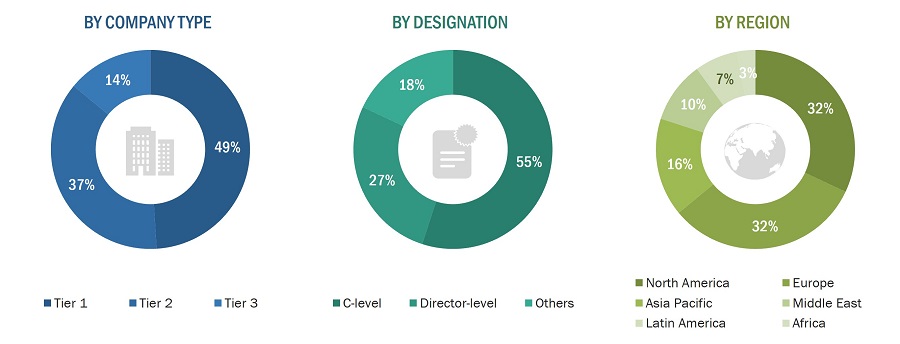
To know about the assumptions considered for the study, download the pdf brochure
Market Size Estimation
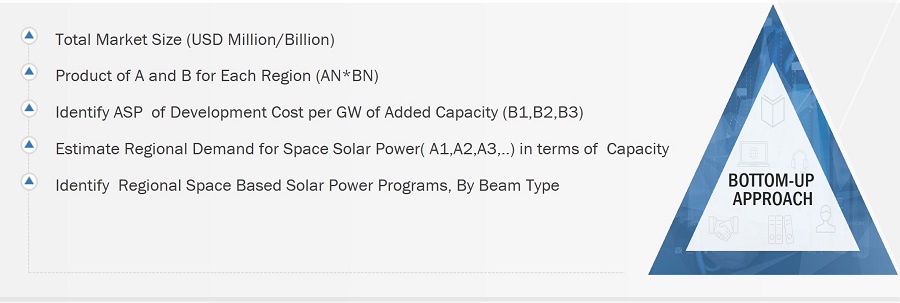
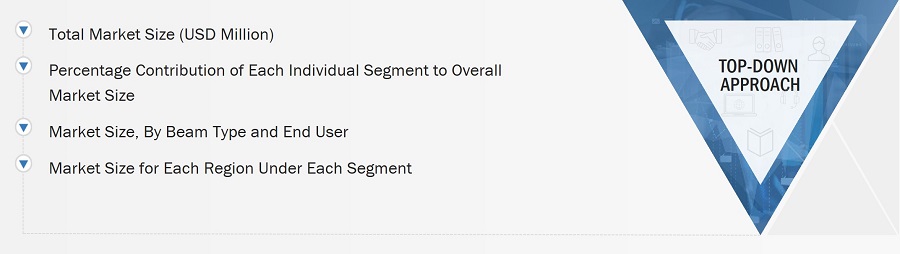
- Both top-down and bottom-up approaches were used to estimate and validate the size of the Space-Based Solar Power market.
- Key players were identified through secondary research, and their market ranking was determined through primary and secondary research. This included a study of annual and financial reports of the top market players and extensive interviews of leaders, including CEOs, directors, and marketing executives.
- All percentage shares, splits, and breakdowns were determined using secondary sources and verified through primary sources. All possible parameters that affect the markets covered in this research study were accounted for, viewed in extensive detail, verified through primary research, and analyzed to obtain the final quantitative and qualitative data. This data was consolidated, enhanced with detailed inputs, analyzed by MarketsandMarkets, and presented in this report.
Market size estimation methodology: Bottom-up Approach
Market size estimation methodology: Top-down Approach
Data triangulation
After arriving at the overall size from the market size estimation process explained above, the total market was split into several segments and subsegments. The data triangulation and market breakdown procedures explained below were implemented, wherever applicable, to complete the overall market engineering process and arrive at the exact statistics for various market segments and subsegments. The data was triangulated by studying various factors and trends from both the demand and supply sides. Along with this, the market size was validated using both top-down and bottom-up approaches.
Market Definition
A Space-based solar power system is an energy collection, transmission and distribution hardware that uses satellites as well as ground infrastructure to focus solar radiation energy from the sun using special mirrors and direct the energy to terrestrial rectifying antennas (rectennas) via microwave and laser beams. The received energy can then be used for electricity and power generation for terrestrial uses. The key end users include government, defense and commercial entities that will utilize the novel technique as an alternative to traditional solar energy-based power generation. The technique offers specific advantages over traditional solar panel technologies including day and night operations and higher conversion efficiencies.
Stakeholders
Various stakeholders of the market are listed below:
- Government Authorities
- Regulatory Bodies
- R&D Companies
- Defense Organizations
- Subsystem Manufacturers
- Energy Providers and Utilities
- Environmental Groups and Policymakers
- Investors and Financial Institutions
- Commercial Space Companies
Report Objectives
- To define, describe, and forecast the size of the Space-Based Solar Power market based on beam type, application, end-user, and region from 2030 to 2040.
- To forecast the size of market segments with respect to major regions, namely North America, Europe, and Asia Pacific
- To identify and analyze key drivers, restraints, opportunities, and challenges influencing market growth.
- To analyze opportunities for stakeholders in the market by identifying key market trends
- To strategically analyze micromarkets1 with respect to individual growth trends, prospects, and their contribution to the global market
- To analyze competitive developments such as contracts, acquisitions, agreements, and partnerships, product launches, and research and development (R&D) activities in the Space-Based Solar Power market.
- To provide a detailed competitive landscape of the market, as well as an analysis of business and corporate strategies adopted by leading market players.
- To strategically profile key market players and comprehensively analyze their core competencies2.
1. Micromarkets are defined as further segments and subsegments of the space-based solar power market included in the report.
2.Core competencies of the companies have been captured in terms of their key developments, SWOT analysis, and key strategies adopted by them to sustain their position in the market.
Available customizations
Along with the market data, MarketsandMarkets offers customizations as per the specific needs of companies. The following customization options are available for the report:
Product Analysis
- Product matrix, which gives a detailed comparison of the product portfolio of each company.
Regional Analysis
- Further breakdown of the market segments at the regional level
Company Information
- Detailed analysis and profiling of additional market players (up to 5)
Get the Full Space-Based Solar Power Market Report
Full forecast, segment splits, and company analysis for all Space-Based Solar Power Market.
Need a Tailored Report?
Customize this report to your needs
Get 10% FREE Customization
Customize This Report
