
Middle East Space Propulsion Market (2026-2031)

The Middle East Space Propulsion Market was valued at $37.8 Million in 2026 and projected to reach to $189.3 Million by 2031, representing a compound annual growth rate of 38.0%. The Middle East space propulsion market is poised for transformative growth, driven by ambitious regional space programs and substantial government investments in satellite infrastructure.


| Market Size in | USD 26.32 MN |
| Market Forecast in | |
| CAGR | |
| Forecast Period | |
| Units Considered | Value (USD MN) |
Middle East Space Propulsion Market Trends and Insights
- This remarkable 38.0% compound annual growth rate significantly outpaces global trends, reflecting the Middle East's strategic investments in space capabilities and satellite infrastructure.
- The Middle East's accelerating adoption of advanced propulsion technologies is driven by regional space agencies, commercial ventures, and defense modernization initiatives seeking indigenous space launch and orbital capabilities. The Middle East's market expansion is underpinned by increased government funding for space programs, partnerships with international aerospace firms, and growing demand for satellite-based communications and Earth observation.
- The Middle East is positioning itself as a critical player in the global space economy, with investments in launch vehicle development and in-space propulsion systems.
- Between 2026 and 2031, the Middle East will capture substantial market share through both domestic space initiatives and regional collaboration frameworks that emphasize technological sovereignty and economic diversification beyond traditional sectors..
Key Market Statistics
- CAGR (2026-2031) 38.0% CAGR
- Market Size, 2026 ~USD 37.8 Million
- Forecast, 2031 ~USD 189.3 Million
- Geography Middle East
Middle East Space Propulsion Market Overview
Exceptional Growth Trajectory :
The Middle East space propulsion market is expanding at 38% CAGR, nearly 3x faster than the global rate of 12.5%, driven by regional governments' strategic space ambitions and satellite deployment initiatives.
Rapid Market Expansion :
Market valuation is projected to surge from $37.8 million in 2026 to $189.3 million by 2031, representing a 401% increase over five years and positioning the region as a high-growth emerging market.
UAE & Saudi Arabia Leadership :
The UAE ($38.9M) and Saudi Arabia ($19.5M) are spearheading regional investments in space infrastructure, satellite programs, and advanced propulsion technologies aligned with Vision 2030 initiatives.
Strategic Space Infrastructure Development :
Increased government funding for indigenous space capabilities, satellite communications, and Earth observation systems is accelerating demand for advanced propulsion solutions across the Middle East.
Middle East Space Propulsion Market Dynamics
- Countries like the UAE and Saudi Arabia are prioritizing space technology development as part of broader economic diversification strategies, creating robust demand for advanced propulsion systems.
- The region's strategic geographic location and growing partnerships with international space agencies further enhance market opportunities. Looking ahead to 2031, the Middle East will emerge as a critical hub for space propulsion innovation and deployment.
- Continued government support, increasing private sector participation, and regional collaborations on space missions will sustain the 38% CAGR.
- The market's expansion reflects not only technological advancement but also the region's commitment to establishing sovereign space capabilities and reducing dependency on external providers..
Market Ecosystem
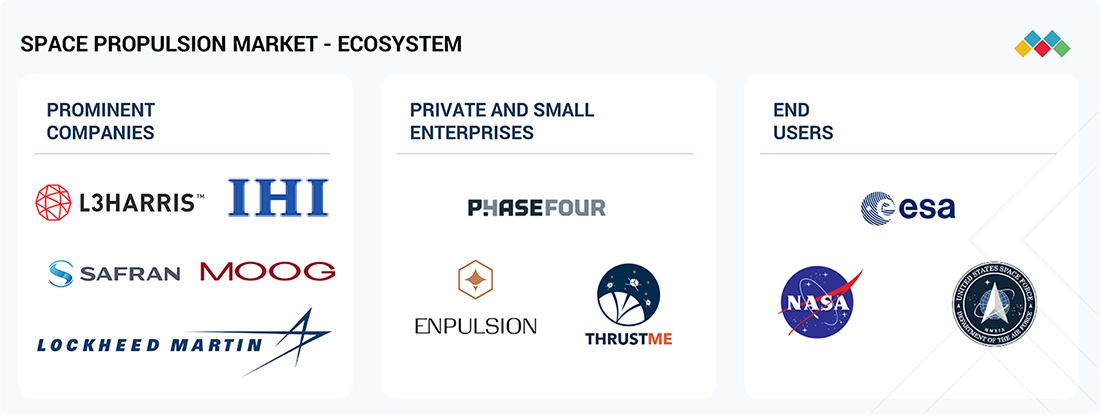
SPACE PROPULSION MARKET SIZE, SHARE, AND TRENDS, 2025 TO 2031: COMMERCIAL USE CASES ACROSS INDUSTRIES
| COMPANY | USE CASE DESCRIPTION | BENEFITS |
|---|---|---|
 |
Positioned Helios as a high-energy orbital transfer vehicle for delivering satellites from LEO to GEO, MEO, and other distant orbits after launch | Reduces orbit-raising time, improves rideshare flexibility, lowers onboard propellant use, and supports commercial orbital transfer services |
 |
Developing in-orbit refueling services with Airbus Defence and Space for satellites that require additional propellant for station keeping, maneuvering, and mission-life extension | Extends satellite operating life, reduces replacement cost, improves asset utilization, and creates demand for refuelable propulsion systems |
 |
Blue Moon Mark 1 planned to support commercial lunar cargo delivery, including lunar transfer, descent, landing, and surface payload delivery | Supports supports NASA CLPS payloads and commercial lunar logistics, increases demand for lander propulsion systems, and enables future lunar cargo and infrastructure missions. |
Logos and trademarks shown above are the property of their respective owners. Their use here is for informational and illustrative purposes only.
Related Ecosystem
Space
- C-Band
- Small Satellite
- Antennas
- Ka-Band
- Microsatellite
- AIRBUS
- L3Harris Technologies, Inc.
- Thales group
- Northrop Grumman Corporation
- LOCKHEED MARTIN CORPORATION
Key Takeaways
- The Middle East space propulsion market will grow from $37.8M (2026) to $189.3M (2031), representing a 38.0% CAGR.
- The Middle East's growth rate is three times faster than the global average, driven by regional space ambitions and defense investments.
- The Middle East is leveraging space propulsion technology to establish indigenous satellite and launch capabilities.
- The Middle East's market expansion reflects broader economic diversification and technological sovereignty initiatives across the region.
Space Propulsion Market Report Scope
| Report Metric | Details |
|---|---|
| Base Year | 2026 |
| Fastest Growing Segment | SATELLITES (Platform) |
| Forecast Period | 2026–2031 |
| Growth Rate | CAGR of 12.5% from 2026 to 2031 |
| Largest Segment | CHEMICAL (Propulsion Type) |
| Market Size Base Year (Billions) | ~USD 8 (2026) |
| Revenue Forecast (Billions) | ~USD 14.41 (2031) |
| Segments Covered | Component, Type, End User, Platform, Propulsion Type |
Middle East Space Propulsion Market Report Segmentation
5 segment dimensions are covered across the global market.
By Component
- Nozzles
- Other Components
- Power Processing Units
- Propellant Feed Systems
- Propulsion Thermal Control Systems
- Rocket Motors
- Thrusters
By Type
- Argon
- Biopropellant Thrusters
- Chemical Thrusters
- Cold & Warm Gas Thrusters
- Cold/Warm Gas
- Crewed Spacecraft
- Electric
- Electric Thrusters
- Hall-Effect Thrusters
- Hybrid
- Hydrogen
- Ion Thrusters
- Krypton
- Large Satellites
- Liquid
- Magnetoplasmadynamic Thrusters
- Medium Satellites
- Medium-To-Heavy Launch Vehicles
- Monopropellant Thrusters
- Nuclear
- Pulsed Plasma Thrusters
- Reusable Launch Vehicles
- Small Launch Vehicles
- Small Satellites
- Solar
- Solar Electric
- Solar Sail
- Solar Thermal
- Solid
- Tether
- Uncrewed Spacecraft
- Xenon
By End User
- Commercial
- Government & Defense
- Scommercial
By Platform
- Capsule & Cargo Spacecraft
- Interplanetary Spacecraft & Probes
- Landers & Rovers
- Launch Vehicles
- Satellites
By Propulsion Type
- Chemical
- Non-Chemical
Target Audience
- Aerospace & Defence Manufacturers : Propulsion system developers and spacecraft manufacturers need market intelligence to identify partnership opportunities with regional space agencies and position advanced propulsion solutions for Middle Eastern satellite programs.
- Government & Space Agencies : Regional space authorities and government bodies require competitive benchmarking and technology trend analysis to inform procurement strategies, budget allocation, and indigenous capability development programs.
- Investment & Private Equity Firms : Investors targeting aerospace and space technology sectors need comprehensive market sizing and growth forecasts to evaluate acquisition targets, fund allocation, and portfolio companies operating in the Middle East.
- Satellite Operators & Telecom Companies : Regional and international satellite operators planning constellation deployments and communications infrastructure require propulsion market insights to optimize launch strategies and supply chain planning.
- Technology & Consulting Firms : Strategic consultants and technology advisors serving Middle Eastern clients need detailed market analysis to support business development, feasibility studies, and technology roadmap recommendations.
Key Companies in the Middle East Space Propulsion Market
| Company | HQ | Ownership | Strongest segments |
|---|---|---|---|
| RAM COMPANY | United States | Public Company | DDR5 memory interface chips (RCD, DB, PMIC, SPD hubs, sensors, client clock drivers),DDR4 memory interface chips,Interface IP (high-speed memory and chip-to-chip controller IP), |
| COBHAM PLC | United Kingdom | Private Company | Airborne communications and connectivity systems,Mission systems for defense and government platforms,Satellite communications solutions, |
| BODYCOTE PLC | United Kingdom | Public Company | Precision Heat Treatment (conventional and value-added),Specialist Technologies – HIP and Powdermet,Surface Technologies and Coatings, |
| SPACEX | United States | Public Company | Launch & Space Systems (Falcon 9, Falcon Heavy, Dragon, Starship development),Starlink Connectivity (consumer, enterprise, government),AI Platform & X (Grok, enterprise AI, real-time information platform, compute infrastructure), |
| NORTHROP GRUMMAN | United States | Public Company | Aeronautics Systems,Defense Systems,Mission Systems, |
| L3HARRIS TECHNOLOGIES, INC. | United States | Public Company | Space & Mission Systems (SMS),Communications & Spectrum Dominance (CSD),Missile Solutions (MSL), |
| SAFRAN | France | Public Company | Aerospace Propulsion,Aircraft Equipment, Defense and Aerosystems,Aircraft Interiors, |
| LOCKHEED MARTIN CORPORATION | United States | Public Company | Aeronautics,Missiles and Fire Control,Rotary and Mission Systems, |
| MOOG INC. | United States | Public Company | Military Aircraft,Commercial Aircraft,Space and Defense, |
| OHB SE | Germany | Public Company | Space Systems (satellites and payloads),Access to Space (assembly and space products),Digital (mechatronics, antennas, IT, launch brokerage), |
RAM COMPANY
RAM COMPANY is a publicly traded United States company established in 1990 with 791 employees operating in the industrial or defense sector.
COBHAM PLC
COBHAM PLC is a United Kingdom-based private company founded in 1889 with 10,037 employees, providing aerospace and defense solutions.
BODYCOTE PLC
BODYCOTE PLC is a publicly listed United Kingdom company established in 1923 with 3,921 employees, specializing in thermal processing and materials services.
SPACEX
SPACEX is a publicly traded United States aerospace company founded in 2002 with 22,000 employees, focused on space launch and satellite services.
NORTHROP GRUMMAN
NORTHROP GRUMMAN is a major publicly traded United States defense contractor founded in 1939 with 95,000 employees, providing aerospace and defense systems.
L3HARRIS TECHNOLOGIES, INC.
L3HARRIS TECHNOLOGIES, INC. is a publicly traded United States defense and aerospace company founded in 1895 with 45,000 employees.
SAFRAN
SAFRAN is a major publicly traded French aerospace and defense company founded in 1896 with 103,710 employees, providing propulsion and equipment solutions.
LOCKHEED MARTIN CORPORATION
LOCKHEED MARTIN CORPORATION is a major publicly traded United States defense contractor founded in 1912 with 123,000 employees, specializing in aerospace and security systems.
MOOG INC.
MOOG INC. is a publicly traded United States company founded in 1951 with 13,500 employees, manufacturing motion control and aerospace components.
OHB SE
OHB SE is a publicly traded German aerospace and technology company founded in 1993 with 3,974 employees, providing satellite and space solutions.
Countries within Middle East - compare and drill down
| Country | 2025 size (native) |
|---|---|
| Saudi Arabia | USD 19.5 Million |
| UAE | USD 38.9 Million |
| Rest Of Middle East | USD 130.9 Million |
Country market size visualization
Reasons to Buy this Report
- Capture High-Growth Market Opportunity : With 38% CAGR significantly outpacing global trends, the Middle East represents an exceptional investment opportunity for propulsion technology providers seeking exposure to emerging, high-velocity markets.
- Strategic Government Initiatives Insight : Understand how UAE Vision 2030 and Saudi Arabia's space programs are reshaping regional demand, enabling vendors to align product development and market entry strategies with government priorities.
- Competitive Landscape Intelligence : Gain detailed analysis of regional competitors, market consolidation trends, and partnership opportunities among Middle Eastern space agencies and international aerospace players.
- Country-Level Market Segmentation : Access granular market data for UAE ($38.9M) and Saudi Arabia ($19.5M) plus emerging opportunities in Rest of Middle East ($130.9M), enabling targeted go-to-market strategies.
- Technology & Application Forecasting : Identify emerging propulsion technologies, satellite applications, and infrastructure projects driving regional demand through 2031, supporting long-term business planning and R&D investment decisions.
Frequently asked questions
What is the current size of the Middle East space propulsion market?
The Middle East space propulsion market is valued at $37.8 million in 2026 and is projected to reach $189.3 million by 2031.
What is the CAGR for the Middle East space propulsion market?
The Middle East space propulsion market is expected to grow at a compound annual growth rate of 38.0% from 2026 to 2031.
What factors are driving growth in the Middle East space propulsion market?
Growth in the Middle East is driven by government space program investments, satellite infrastructure development, defense modernization, and regional partnerships with international aerospace companies.
How does the Middle East market compare to global space propulsion growth?
The Middle East's 38.0% CAGR significantly exceeds the global average of 12.5%, making it one of the fastest-growing regional markets for space propulsion technology.
What applications are driving space propulsion demand in the Middle East?
Key applications include satellite launch systems, orbital maneuvering, communications satellite deployment, Earth observation capabilities, and indigenous space launch vehicle development.
RESEARCH METHODOLOGY
The study involved four major activities in estimating the current size of the space propulsion market. Exhaustive secondary research was done to collect information on the market, its adjacent markets, and its parent market. The next step was to validate these findings, assumptions, and sizing with industry experts across the value chain through primary research. Demand-side analysis was conducted to estimate the overall market size. After that, market breakdown and data triangulation procedures were employed to estimate the sizes of various segments and subsegments within the market.
Secondary Research
During the secondary research process, various sources were consulted to identify and collect information for this study. The secondary sources included government sources, such as SIPRI; corporate filings, including annual reports, press releases, and investor presentations from companies; white papers, journals, and certified publications; and articles from recognized authors, directories, and databases.
Primary Research
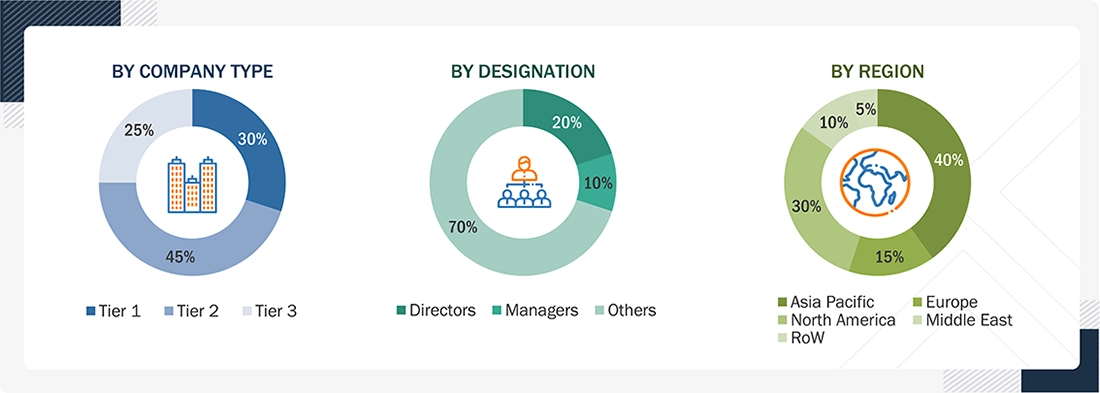
Extensive primary research was conducted after acquiring information regarding the space propulsion market scenario through secondary research. Several primary interviews were conducted with market experts from the demand and supply sides across major countries of North America, Europe, the Asia Pacific, the Middle East, and the Rest of the World (RoW). Primary data was collected through questionnaires, emails, and telephonic interviews.
To know about the assumptions considered for the study, download the pdf brochure
Market Size Estimation
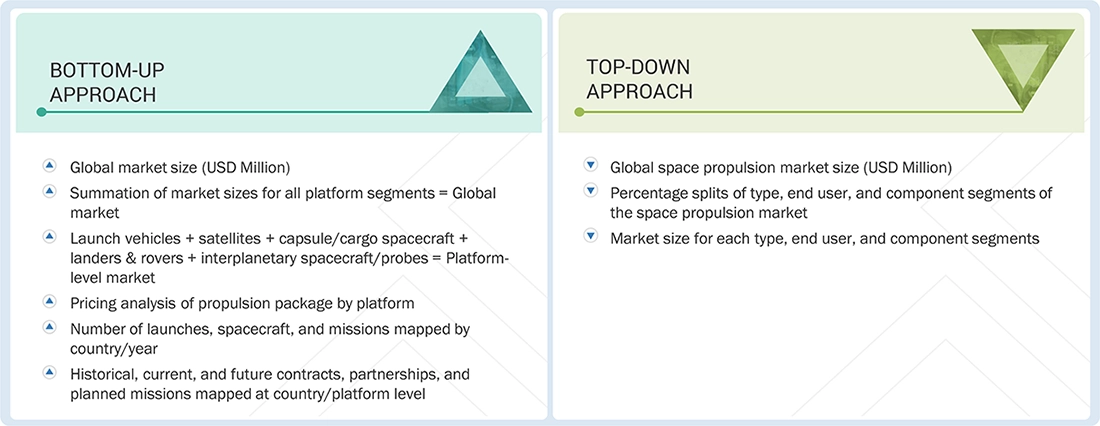
The top-down and bottom-up approaches were used to estimate and validate the size of the space propulsion market. The research methodology used to estimate the size of the market included the following details:
- Key players in the space propulsion market were identified through secondary research, and their market shares were determined through a combination of primary and secondary research. This included a study of the annual and financial reports of the top market players, as well as extensive interviews with leaders, including directors, engineers, marketing executives, and other key stakeholders of leading companies operating in the market.
- All percentage shares, splits, and breakdowns were determined using secondary sources and verified through primary sources.
- All possible parameters that affect the markets covered in this research study were accounted for, viewed in extensive detail, verified through primary research, and analyzed to obtain the final quantitative and qualitative data on the space propulsion market. This data was consolidated, enhanced with detailed inputs, analyzed by MarketsandMarkets, and presented in this report.
Space Propulsion Market : Top-Down and Bottom-Up Approach
Data Triangulation
After determining the overall market size, the total market was divided into several segments and subsegments. The data triangulation and market breakdown procedures explained below were implemented, wherever applicable, to complete the overall market engineering process and arrive at the estimated market numbers for the market segments and subsegments. The data was triangulated by studying various factors and trends from the demand and supply sides. Additionally, the market size was validated using top-down and bottom-up approaches.
Market Definition
Space propulsion refers to the technology used to generate thrust, enabling spacecraft to navigate and maneuver in outer space. It encompasses a range of systems, including chemical propulsion, which relies on chemical reactions to produce high-velocity exhaust; electric propulsion, which uses electric fields to accelerate ions; and emerging technologies, such as solar sails and nuclear propulsion. These systems are critical for achieving orbital insertion, station-keeping, interplanetary travel, and deorbiting, with efficiency, scalability, and sustainability being key considerations in their development.
Key Stakeholders
- Propulsion System Manufacturers
- Satellite Operators
- Raw Material Providers
- Component Providers
- National Space Agencies
- Launch Service Providers
- Original Equipment Manufacturers
- Regulatory Bodies
- Department of Defense
- Space Propulsion Service Providers
Report Objectives
- To define, describe, segment, and forecast the size of the space propulsion market based on platform, type, end user, component, and region
- To forecast the size of market segments based on five regions: North America, Europe, the Asia Pacific, the Middle East, and the Rest of the World
- To identify and analyze key drivers, restraints, opportunities, and challenges influencing the growth of the market
- To identify industry trends, market trends, and technology trends prevailing in the market
- To analyze micro markets with respect to individual technological trends, prospects, and their contribution to the overall market
- To strategically profile key market players and comprehensively analyze their market ranking and core competencies
- To provide a detailed competitive landscape of the market and analyze competitive growth strategies, such as product launches and developments, contracts, and deals, adopted by key players in the market
- To identify the detailed financial position of key players, as well as their key products, unique selling points, and key developments
Customization Options
MarketsandMarkets offers the following customizations for this market report:
- Additional country-level analysis of the space propulsion market
- Profiling of other market players (up to 5)
Product Analysis
- Product matrix, which provides a detailed comparison of the product portfolio of each company in the space propulsion market
Get the Full Space Propulsion Market Report
Full forecast, segment splits, and company analysis for all Space Propulsion Market.
- US Space Propulsion Market
- Canada Space Propulsion Market
- France Space Propulsion Market
- Germany Space Propulsion Market
- Italy Space Propulsion Market
- Russia Space Propulsion Market
- UK Space Propulsion Market
- Australia Space Propulsion Market
- China Space Propulsion Market
- India Space Propulsion Market
- Japan Space Propulsion Market
- South Korea Space Propulsion Market
- Saudi Arabia Space Propulsion Market
- UAE Space Propulsion Market
- Rest Of Middle East Space Propulsion Market
- Africa Space Propulsion Market
- Latin America Space Propulsion Market
Need a Tailored Report?
Customize this report to your needs
Get 10% FREE Customization
Customize This Report
