
Germany Spare Parts Management (SPM) Market (2025-2030)

The Germany Spare Parts Management (SPM) Market was valued at $83.6 Million in 2025 and projected to reach to $127.5 Million by 2030, representing a compound annual growth rate of 8.8%. Germany's Spare Parts Management market is positioned for sustained growth, driven by the country's commitment to Industry 4.0 and digital manufacturing excellence.


| Market Size in | USD 26.32 MN |
| Market Forecast in | |
| CAGR | |
| Forecast Period | |
| Units Considered | Value (USD MN) |
Germany Spare Parts Management (SPM) Market Trends and Insights
- Germany's SPM sector is driven by the country's strong manufacturing base and digital transformation initiatives across industrial enterprises.
- The market in Germany reflects robust demand for inventory optimization and supply chain efficiency solutions among automotive, machinery, and electronics manufacturers..
Key Market Statistics
- CAGR (2025-2030) 8.8% CAGR
- Market Size, 2025 ~USD 83.6 Million
- Forecast, 2030 ~USD 127.5 Million
- Country Germany
Germany Spare Parts Management (SPM) Market Overview
Market Valuation :
Germany's Spare Parts Management market is valued at USD 83.6 million in 2025, with projections reaching USD 127.5 million by 2030, demonstrating strong growth potential in Europe's largest economy.
Manufacturing Excellence :
Germany's robust manufacturing base, including automotive, machinery, and industrial sectors, drives significant demand for advanced spare parts management solutions and inventory optimization technologies.
Digital Transformation :
German industrial enterprises are actively investing in digital transformation initiatives, creating substantial opportunities for SPM solutions that enhance operational efficiency and reduce downtime.
Inventory Optimization Focus :
The German market reflects robust demand for inventory optimization capabilities, as manufacturers seek to minimize carrying costs while maintaining supply chain resilience and equipment availability.
Germany Spare Parts Management (SPM) Market Dynamics
- The 8.8% CAGR reflects increasing adoption of SPM solutions among German manufacturers seeking to optimize inventory levels and reduce operational costs.
- Key growth drivers include the expansion of predictive maintenance technologies, integration with IoT systems, and the need for supply chain visibility across complex manufacturing networks. The forecast period through 2030 will see accelerated adoption as German enterprises prioritize efficiency gains and cost reduction in competitive global markets.
- Investment in automation, AI-driven inventory management, and cloud-based SPM platforms will intensify, particularly among mid-sized manufacturers and Mittelstand companies.
- The market will benefit from regulatory compliance requirements and sustainability initiatives driving demand for optimized spare parts logistics..
Market Ecosystem
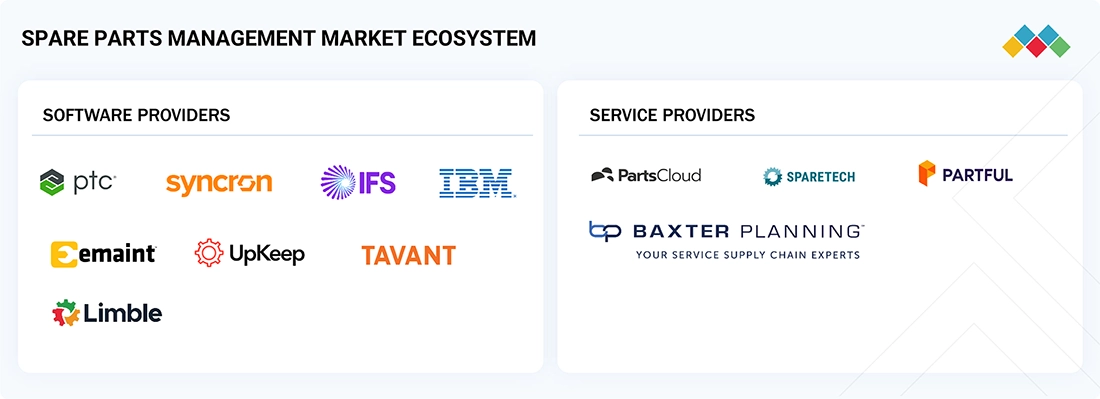
spare-part-management-market: COMMERCIAL USE CASES ACROSS INDUSTRIES
| COMPANY | USE CASE DESCRIPTION | BENEFITS |
|---|---|---|
 |
Embraer successfully optimizes spare parts planning with Servigistics, saving more than USD 50 million | 12.5% reduction in inventory, cutting carrying costs by USD 25.5 million | Total cost savings exceeding USD 50 million | 35% improvement in inventory turns and enhanced service levels | 2.5% increase in profit (USD 26 million) | Greater planning agility and cross-team efficiency through a unified parts ecosystem |
 |
Syncron enables Al Masaood Automobiles to enhance inventory efficiency and service performance | 15% reduction in national inventory and 20% in branch inventory | Increase in parts turnover from 1.89 to 2.50 turns | Reduction in stock order cycle from 61 days to 46 days | Decrease in manual order review from full intervention to 20–30% | First-pick availability improvement from 93% to 96% | 35% reduction in storage space and 15% decrease in manpower load | Enhanced supplier collaboration and sustained profitability with unchanged staff headcount |
 |
eMaint streamlines spare parts management for Cerapedics through CMMS integration | Hundreds of labor hours saved through automated parts tracking and access | Rapid search capability enabling faster response during maintenance emergencies | Seamless synchronization between maintenance and procurement systems | Reduction in downtime and improved spare parts availability | Simplified purchase order generation and inventory forecasting | Enhanced operational visibility and decision-making through analytics |
 |
ToolsGroup enables Lennox to optimize service parts planning and reduce stock-outs | Stock-outs reduced by more than half, from 9% to 4% | Improved forecast precision through advanced seasonality clustering and ML insights | Enhanced service levels while expanding distribution capacity by 30% | Balanced inventory allocation and reduced working capital requirements | Streamlined operational control with dynamic, automated inventory mix optimization |
 |
Triangle Tube enhances after-sales experience through 3D digital transformation with Partful | Improved order accuracy and reduced downtime across service operations | Enhanced customer experience through faster response times and more transparent communication | Increased operational efficiency and reduced dependency on manual parts lookup | Strengthened customer relationships through transparency and reliable support | Achieved better alignment between technology innovation and customer-centric service goals |
Logos and trademarks shown above are the property of their respective owners. Their use here is for informational and illustrative purposes only.
Related Ecosystem
Analytics
- Natural Language Processing (NLP)
- Machine Learning
- Supply Chain Management
- Predictive Analytics
- Image Sensors
- International Business Machines Corporation
- MICROSOFT CORPORATION
- Oracle Corporation
- SAP SE
Digitalization And Iot
- Sensors
- Remote Monitoring
- Supply Chain Management
- Passenger Information System (PIS)
- Platform as A Service (PaaS)
- International Business Machines Corporation
- Cisco Systems, Inc.
- MICROSOFT CORPORATION
- Oracle Corporation
- HUAWEI TECHNOLOGIES CO LTD
Software And Services
- Natural Language Processing (NLP)
- Machine Learning
- Supply Chain Management
- Predictive Analytics
- Image Sensors
- International Business Machines Corporation
- MICROSOFT CORPORATION
- Oracle Corporation
- SAP SE
- Amazon.com, Inc.
Key Takeaways
- Germany's SPM market will expand from $83.6M (2025) to $127.5M (2030) at 8.8% CAGR
- Germany's manufacturing sector drives adoption of advanced spare parts management solutions
- Germany leads European digital transformation in supply chain and inventory management
- Germany's market growth is supported by Industry 4.0 initiatives and automation trends
Spare Parts Management (SPM) Market Report Scope
| Report Metric | Details |
|---|---|
| Base Year | 2025 |
| Fastest Growing Segment | SUPPORT & MAINTENANCE (Professional Service) |
| Forecast Period | 2025–2030 |
| Growth Rate | CAGR of 12.3% from 2025 to 2030 |
| Largest Segment | LARGE ENTERPRISES (Organization Size) |
| Market Size Base Year (Billions) | ~USD 1.02 (2025) |
| Revenue Forecast (Billions) | ~USD 1.82 (2030) |
| Segments Covered | Offering, Solution, Professional Service, Type, Deployment Mode, Deployment Type, Organization Size, Vertical |
Germany Spare Parts Management (SPM) Market Report Segmentation
8 segment dimensions are covered across the global market.
By Offering
- Professional Services
- Solutions
By Solution
- Inventory Management
- Other Solutions
- Planning & Forecasting
- Procurement & Order Management
- Reporting & Analytics
- Spare Parts Tracking & Automation
By Professional Service
- Integration & Implementation
- Support & Maintenance
- Training & Consultation
- Training & Consulting
By Type
- Integrated Spm Software
- Standalone Spm Software
By Deployment Mode
- Cloud
- On-Premises
By Deployment Type
- Cloud
- On-Premises
By Organization Size
- Large Enterprises
- Smes
By Vertical
- Construction & Real Estate
- Energy & Utilities
- Healthcare & Life Sciences
- It & Telecom
- Manufacturing
- Oil & Gas
- Other Verticals
- Transportation & Logistics
Target Audience
- SPM Solution Providers : Software vendors and technology providers need Germany-specific market data to develop localized offerings, understand competitive positioning, and identify growth opportunities in Europe's largest industrial market.
- Manufacturing Enterprises : German manufacturers and industrial companies require market insights to benchmark their SPM investments, evaluate solution providers, and optimize spare parts management strategies for competitive advantage.
- System Integrators & Consultants : Implementation partners and management consultants need detailed Germany market intelligence to advise clients on SPM adoption, identify best practices, and develop implementation roadmaps aligned with local market trends.
- Investment & Private Equity Firms : Investors evaluating opportunities in Germany's industrial technology sector require comprehensive market data to assess growth potential, competitive dynamics, and valuation benchmarks for SPM-related investments.
- Supply Chain & Operations Leaders : C-suite executives and operations managers in German enterprises need market research to justify SPM investments, understand industry benchmarks, and align procurement strategies with market developments.
Key Companies in the Germany Spare Parts Management (SPM) Market
| Company | HQ | Ownership | Strongest segments |
|---|---|---|---|
| IFS | Peru | Public Company | Retail and commercial banking (loans, deposits, current accounts),Insurance (life annuities, life, and retail insurance),Wealth and asset management (brokerage, mutual and investment funds), |
| PTC | United States | Public Company | PLM Suite (Windchill, Arena, FlexPLM),CAD and Product Development (Creo, Onshape, Mathcad),Industrial IoT and Connectivity (ThingWorx, Kepware, Kepware Edge, KEPServerEX), |
| SAP | Germany | Public Company | SAP S/4HANA and core ERP,Human Experience Management (SAP SuccessFactors),Spend Management and Business Network, |
| IBM | United States | Public Company | Software (Hybrid Cloud and AI Platforms),Consulting (Strategy, Technology, Managed Services),Infrastructure (Servers, Storage, Hybrid Cloud Infrastructure Services), |
| ORACLE | United States | Public Company | Cloud applications (Fusion ERP/EPM/SCM/HCM, NetSuite, Oracle Health, CX),Database and middleware (Oracle Database, MySQL, Java, middleware tools),Cloud infrastructure (compute, storage, networking, Autonomous Database PaaS), |
| DASSAULT SYSTEMES | France | Public Company | 3D Modeling (CATIA, SOLIDWORKS, GEOVIA, BIOVIA),Social & Collaborative (ENOVIA, CENTRIC PLM, 3DEXCITE),Simulation & Manufacturing (SIMULIA, DELMIA, 3DVIA), |
| UPKEEP | United States | Private Company | Core CMMS subscriptions (work orders, assets, PM),Advanced analytics, reporting, and dashboards,Integrations, APIs, and ecosystem add-ons, |
IFS
IFS is a Peruvian public company founded in 1897 with 9,229 employees.
PTC
PTC is a United States-based public company founded in 1985 with 7,000 employees.
SAP
SAP is a German public company founded in 1972 with 111,038 employees.
IBM
IBM is a United States-based public company founded in 1911 with 264,300 employees.
ORACLE
Oracle is a United States-based public company founded in 1977 with 141,000 employees.
DASSAULT SYSTEMES
Dassault Systèmes is a French public company founded in 1981 with 25,724 employees.
UPKEEP
UKG (formerly UpKeep) is a United States-based private company founded in 2014.
Reasons to Buy this Report
- Market-Specific Insights : Gain detailed understanding of Germany's unique SPM market dynamics, including sector-specific drivers, competitive landscape, and growth opportunities tailored to German industrial enterprises.
- Strategic Investment Planning : Leverage accurate market sizing and forecasts (2025-2030) to inform investment decisions, product development strategies, and market entry plans specific to Germany's manufacturing ecosystem.
- Competitive Positioning : Understand Germany's manufacturing strengths, digital transformation initiatives, and inventory optimization priorities to position solutions effectively against local and international competitors.
- Customer Segmentation Data : Access insights into German buyer personas, including automotive, machinery, and industrial sectors, enabling targeted marketing and sales strategies for maximum market penetration.
- Growth Opportunity Identification : Identify high-potential segments within Germany's SPM market, including emerging technologies, regional hotspots, and underserved customer groups for expansion and innovation initiatives.
Frequently asked questions
What is the current size of Germany's Spare Parts Management market?
Germany's SPM market is valued at USD 83.6 million in 2025.
What is the projected market size for Germany's SPM sector by 2030?
Germany's SPM market is forecast to reach USD 127.5 million by 2030.
What is the growth rate of Germany's Spare Parts Management market?
Germany's SPM market is expected to grow at a compound annual growth rate of 8.8% from 2025 to 2030.
Which industries drive demand for SPM solutions in Germany?
Germany's automotive, machinery, electronics, and manufacturing sectors are primary drivers of SPM solution adoption.
Why is Germany's SPM market growing faster than global average?
Germany's strong industrial base, Industry 4.0 initiatives, and focus on supply chain digitalization support above-average market growth.
RESEARCH METHODOLOGY
This research study on the spare parts management market involved extensive secondary sources, including directories, IEEE Communication-Efficient: Algorithms and Systems, and the International Journal of Innovation and Technology Management, as well as paid databases. Primary sources were mainly industry experts from core and related industries, preferred spare parts management providers, third-party service providers, consulting service providers, end users, and other commercial enterprises. In-depth interviews with primary respondents, including key industry participants and subject matter experts, were conducted to gather and verify critical qualitative and quantitative information, as well as assess the market’s prospects.
Secondary Research
In the secondary research process, various sources were referred to to identify and collect information for this study. Secondary sources included annual reports, press releases, and investor presentations of companies; white papers, journals, and certified publications; and articles from recognized authors, directories, and databases. The data was also collected from other secondary sources, such as journals, government websites, blogs, and vendors’ websites. Additionally, the spare parts management spending of various countries was extracted from the respective sources.
Primary Research
In the primary research process, various sources from the supply and demand sides were interviewed to obtain qualitative and quantitative information on the market. The primary sources from the supply side included various industry experts, such as chief experience officers (CXOs), vice presidents (VPs), and directors specializing in business development, marketing, and spare parts management services. It also included key executives from spare parts management vendors, system integrators (SIs), professional service providers, industry associations, and other key opinion leaders.
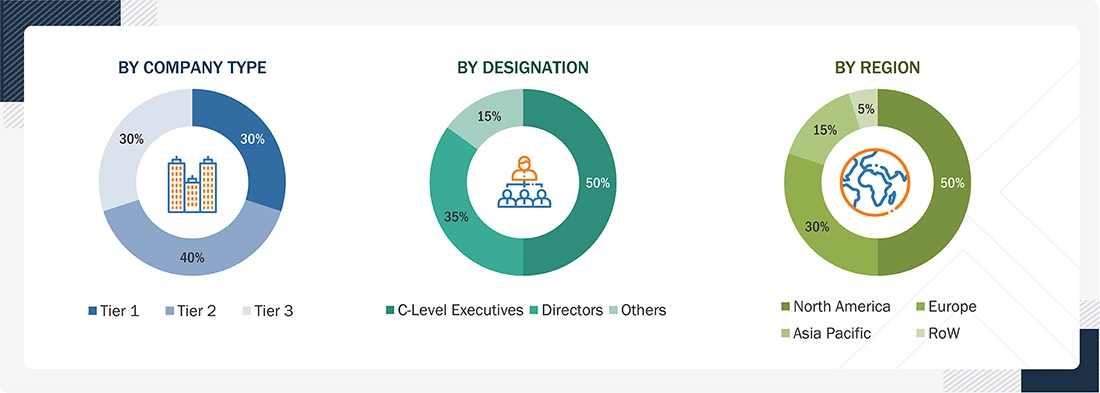
Note: Tier 1 companies’ revenues are more than USD 10 billion; tier 2 companies’ revenues range between USD 1 and 10 billion; and tier 3 companies’ revenues range between USD 500 million and USD 1 billion. Other designations include sales, marketing, and product managers.
Source: Industry Experts
To know about the assumptions considered for the study, download the pdf brochure
Market Size Estimation
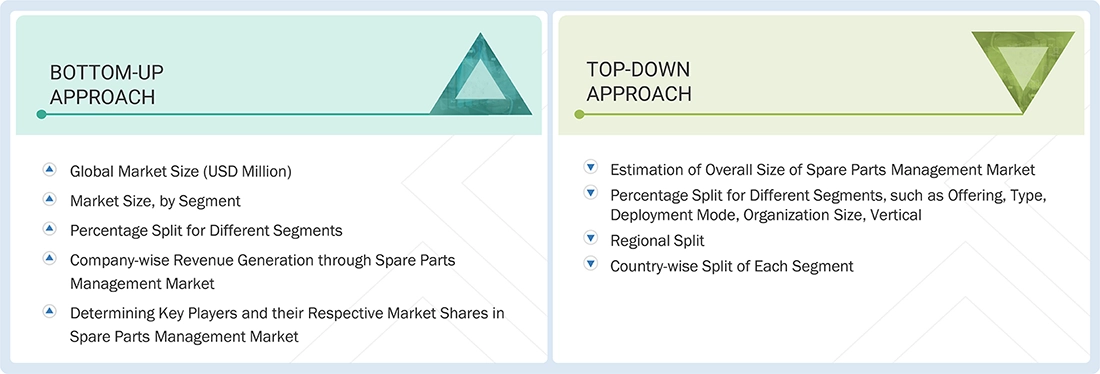
Multiple approaches were adopted to estimate and forecast the spare parts management market. The first approach involved estimating the market size by companies’ revenue generated through the sale of spare parts management products.
Market Size Estimation Methodology: Top-down Approach
The top-down approach prepared an exhaustive list of all the vendors offering products in the spare parts management market. The revenue contribution of the market vendors was estimated through annual reports, press releases, funding, investor presentations, paid databases, and primary interviews. Each vendor’s offerings were evaluated based on offering, type, deployment mode, organization size, vertical, and region. The markets were triangulated through primary and secondary research. The primary procedure included extensive interviews for key insights from industry leaders, such as CIOs, CEOs, VPs, directors, and marketing executives. The market numbers were further triangulated with the existing MarketsandMarkets’ repository for validation.
Market Size Estimation Methodology: Bottom-up Approach
The bottom-up approach identified the adoption rate of spare parts management products across different verticals in key countries, considering the regions that contribute the most to the market share. For cross-validation, the adoption of spare parts management products among enterprises and other use cases for their regions was identified and extrapolated. Use cases identified in different areas were weighed for the market size calculation.
Based on the market numbers, the regional split was determined by primary and secondary sources. The procedure included an analysis of the spare parts management market’s regional penetration. Based on secondary research, the regional spending on Information and Communications Technology (ICT), socioeconomic analysis of each country, strategic vendor analysis of major spare parts management service providers, and organic and inorganic business development activities of regional and global players were estimated.
Spare Parts Management (SPM) Market : Top-Down and Bottom-Up Approach
Data Triangulation
After determining the overall market size using the market size estimation processes as explained above, the market was split into several segments and subsegments. Data triangulation and market breakup procedures were employed, wherever applicable, to complete the overall market engineering process and arrive at the exact statistics of each market segment and subsegment. The overall market size was then used in the top-down approach to estimate the size of other individual markets by applying percentage splits to the market segmentation.
Market Definition
MarketsandMarkets defines the spare parts management (SPM) market as the set of software platforms, digital tools, and services that enable organizations to plan, forecast, procure, store, track, and optimize spare parts across asset-intensive operations. These solutions support key functions such as demand forecasting, procurement and order management, inventory planning, multi-echelon optimization, warehouse automation, real-time tracking, and analytics.
The market covers standalone SPM software and integrated SPM solutions, deployed through cloud-based and on-premises models. SPM tools are used by large enterprises and SMEs across industries, including manufacturing, transportation and logistics, construction, healthcare, energy and utilities, IT & telecom, and oil & gas.
SPM solutions help organizations minimize equipment downtime, reduce excess inventory, improve service levels, and align spare parts availability with maintenance strategies. With growing asset complexity, global supply-chain volatility, and the rise of predictive maintenance, SPM has become essential for ensuring operational continuity and cost-efficient service operations.
Key Stakeholders
- SPM Software Providers
- OEM Aftermarket Divisions (Automotive, Industrial, Machinery, etc.)
- Spare Parts Distributors and Authorized Dealers
- System Integrators and Digital Supply Chain Solution Providers
- Maintenance, Repair, and Operations (MRO) Service Providers
- Logistics & Warehousing Providers
- Government Organizations, Regulatory Bodies, and Standards Organizations
- Industry Associations (Manufacturing, Logistics, Asset Management)
- End Users
Report Objectives
- To define, describe, and forecast the spare parts management market based on offering (solutions [planning & forecasting, procurement & order management, inventory management, spare parts tracking & automation, reporting & analytics, others], professional services [training & consultation, integration & implementation, support & maintenance]), type (standalone SPM software, integrated SPM software), deployment mode (on-premises, cloud), organization size (large enterprises, SMEs), and vertical (manufacturing, transportation & logistics, construction & real estate, healthcare & life sciences, energy & utilities, IT & telecom, oil & gas, other verticals [BFSI, retail & consumer goods])
- To forecast the market size of five major regional segments: North America, Europe, Asia Pacific, the Middle East & Africa, and Latin America
- To strategically analyze the market subsegments with respect to individual growth trends, prospects, and contributions to the total market
- To provide detailed information related to the major factors influencing the growth of the market (drivers, restraints, opportunities, and challenges)
- To strategically analyze macro and micro markets with respect to growth trends, prospects, and their contributions to the overall market
- To analyze industry trends, patents, innovations, and pricing data related to the market
- To analyze the opportunities in the market for stakeholders and provide details of the competitive landscape for major players
- To analyze the impact of AI/generative AI on the market
- To profile key players in the market and comprehensively analyze their market share/ranking and core competencies
- To track and analyze competitive developments, such as mergers & acquisitions, product launches, and partnerships & collaborations, in the market
Customizations Options
With the given market data, MarketsandMarkets offers customizations as per the company’s specific needs. The following customization options are available for the report:
Product Analysis
- The product matrix provides a detailed comparison of the product portfolio of each company.
Geographic Analysis based on feasibility
- Further breakup of the North American spare parts management market
- Further breakup of the European spare parts management market
- Further breakup of the Asia Pacific spare parts management market
- Further breakup of the Middle East & Africa spare parts management market
- Further breakup of the Latin American spare parts management market
Company Information
- Detailed analysis and profiling of additional market players (up to five)
Get the Full Spare Parts Management (SPM) Market Report
Full forecast, segment splits, and company analysis for all Spare Parts Management (SPM) Market.
- US Spare Parts Management (SPM) Market
- Canada Spare Parts Management (SPM) Market
- UK Spare Parts Management (SPM) Market
- France Spare Parts Management (SPM) Market
- Italy Spare Parts Management (SPM) Market
- China Spare Parts Management (SPM) Market
- India Spare Parts Management (SPM) Market
- Japan Spare Parts Management (SPM) Market
- Saudi Arabia Spare Parts Management (SPM) Market
- UAE Spare Parts Management (SPM) Market
- South Africa Spare Parts Management (SPM) Market
- Brazil Spare Parts Management (SPM) Market
- Mexico Spare Parts Management (SPM) Market
- Rest Of Europe Spare Parts Management (SPM) Market
- Rest Of Asia Pacific Spare Parts Management (SPM) Market
- Rest Of Latin America Spare Parts Management (SPM) Market
- GCC Countries Spare Parts Management (SPM) Market
- Other GCC Countries Spare Parts Management (SPM) Market
Need a Tailored Report?
Customize this report to your needs
Get 10% FREE Customization
Customize This Report
