
Germany Steam Trap Market (2024-2029)

The Germany Steam Trap Market was valued at $368.2 Million in 2024 and projected to reach to $435.1 Million by 2029, representing a compound annual growth rate of 3.4%. Germany's steam trap market is positioned for moderate but consistent growth through 2029, driven by the country's strong industrial base and commitment to energy efficiency.


| Market Size in | USD 26.32 MN |
| Market Forecast in | |
| CAGR | |
| Forecast Period | |
| Units Considered | Value (USD MN) |
Germany Steam Trap Market Trends and Insights
- Germany's industrial base, particularly in manufacturing and energy sectors, drives steady demand for efficient steam management solutions.
- The market in Germany reflects the country's commitment to industrial optimization and energy efficiency standards across semiconductor and electronics applications. The growth trajectory in Germany is supported by increasing adoption of advanced steam trap technologies in process industries and heating systems.
- Germany's focus on sustainability and operational cost reduction encourages investment in steam trap systems that minimize energy loss and improve system reliability.
- Between 2024 and 2029, Germany's market expansion will be shaped by regulatory compliance, industrial modernization initiatives, and the integration of smart monitoring technologies in steam management infrastructure..
Key Market Statistics
- CAGR (2024-2029) 3.4% CAGR
- Market Size, 2024 ~USD 368.2 Million
- Forecast, 2029 ~USD 435.1 Million
- Country Germany
Germany Steam Trap Market Overview
Market Size & Growth :
Germany's steam trap market is valued at USD 368.2 million in 2024, with projected growth to USD 435.1 million by 2029, representing a steady CAGR of 3.4%.
Industrial Manufacturing Strength :
Germany's robust manufacturing sector, including automotive, chemicals, and food processing industries, drives consistent demand for reliable steam management and energy efficiency solutions.
Energy Efficiency Focus :
German industrial facilities prioritize steam trap optimization to reduce energy consumption and operational costs, aligning with the country's sustainability and Industry 4.0 initiatives.
Regional Market Maturity :
As a mature industrial economy, Germany demonstrates stable demand patterns with emphasis on high-quality, technologically advanced steam trap solutions from established manufacturers.
Germany Steam Trap Market Dynamics
- The manufacturing sector's ongoing modernization efforts and stringent environmental regulations create sustained demand for advanced steam management solutions.
- Key growth drivers include the expansion of pharmaceutical and food processing industries, coupled with increasing investments in plant optimization and predictive maintenance technologies.
- Germany's focus on reducing industrial energy consumption aligns with EU sustainability directives, further supporting market expansion.
- The market is expected to benefit from technological innovations in IoT-enabled steam traps and digital monitoring systems that appeal to German manufacturers' preference for precision engineering and operational excellence..
Market Ecosystem
Related Ecosystem
Industrial Automation
- Sensors
- Image Sensors
- Manufacturing Execution System (MES)
- Actuators
- Flow Sensors
- Siemens ag
- ABB India Limited
- Emerson Electric Co.
- HONEYWELL INTERNATIONAL INC.
- SCHNEIDER ELECTRIC SE
Industrial Equipment
- HVAC System
- Fiberglass
- Actuators
- Cartridge Filters
- Electrostatic Precipitators
- Siemens ag
- GRUNDFOS GROUP
- ABB India Limited
- SCHNEIDER ELECTRIC SE
- Eaton Corporation plc
Smart Home
- Sensors
- Pressure Sensors
- Temperature Sensors
- Actuators
- Face Recognition
- HONEYWELL INTERNATIONAL INC.
- SCHNEIDER ELECTRIC SE
- Siemens ag
- Samsung
- Godrej Industries Limited
Key Takeaways
- Germany's steam trap market is valued at USD 368.2 million in 2024 and projected to reach USD 435.1 million by 2029.
- Germany maintains a 3.4% CAGR, reflecting steady industrial demand and energy efficiency investments.
- Germany's manufacturing and energy sectors are primary drivers of steam trap adoption and market growth.
- Germany's regulatory environment and sustainability focus support long-term market expansion through 2029.
Steam Trap Market Report Scope
| Report Metric | Details |
|---|---|
| Base Year | 2024 |
| Fastest Growing Segment | LIQUID EXPANSION STEAM TRAPS (Thermostatic) |
| Forecast Period | 2024-2029 |
| Growth Rate | CAGR of 4.1% from 2024 to 2029 |
| Largest Segment | STEEL (Body Material) |
| Market Size Base Year (Billions) | ~USD 4.56 (2024) |
| Revenue Forecast (Billions) | ~USD 5.57 (2029) |
| Segments Covered | Product Type, Mechanical, Body Material, End-Use Industry, Thermodynamic, Thermostatic, Connection, Pressure, Size, Application |
Germany Steam Trap Market Report Segmentation
10 segment dimensions are covered across the global market.
By Product Type
- Mechanical
- Thermodynamic
- Thermostatic
By Mechanical
- Ball Float Steam Traps
- Inverted Bucket Steam Traps
By Body Material
- Iron
- Other Body Materials
- Steel
By End-Use Industry
- Chemicals
- Energy & Power
- Food & Beverages
- Oil & Gas
- Other End-Use Industries
- Pharmaceuticals
- Textiles
By Thermodynamic
- Disc Steam Traps
- Piston Type Steam Traps
By Thermostatic
- Balanced Pressure Steam Traps
- Bellows Steam Traps
- Bimetallic Steam Traps
- Liquid Expansion Steam Traps
By Connection
- Flanged
- Other Connections
- Screwed
- Socket Welded
By Pressure
- >10 Bars-<= 25 Bars
- >25 Bars
- <= 10 Bars
By Size
- >Dn 25-<=Dn 65
- >Dn 65
- <=Dn 25
By Application
- Drip
- Process
- Tracing
GERMANY: STEAM TRAP MARKET, BY END-USE INDUSTRY, 2024–2029
| Segment | 2024 | 2025 | 2026 | 2027 | 2028 | 2029 | CAGR (%) |
|---|---|---|---|---|---|---|---|
| CHEMICALS | 83 | 86.1 | 89.4 | 92.9 | 96.6 | 100.6 | 3.9 |
| ENERGY & POWER | 46.9 | 47.8 | 48.7 | 49.6 | 50.6 | 51.6 | 1.9 |
| FOOD & BEVERAGES | 76.5 | 80 | 83.7 | 87.5 | 91.5 | 95.8 | 4.6 |
| OIL & GAS | 80.9 | 83.3 | 85.9 | 88.7 | 91.6 | 94.7 | 3.2 |
| OTHER END-USE INDUSTRIES | 30.4 | 30.7 | 31 | 31.3 | 31.6 | 31.8 | 1 |
| PHARMACEUTICALS | 35 | 36.7 | 38.5 | 40.5 | 42.5 | 44.7 | 5 |
| TEXTILES | 15.5 | 15.5 | 15.5 | 15.6 | 15.7 | 15.9 | 0.6 |
| TOTAL | 368.2 | 380.1 | 392.7 | 406 | 420.1 | 435.1 | 3.4 |
GERMANY: STEAM TRAP MARKET, BY END-USE INDUSTRY, 2020–2023,
| Segment | 2020 | 2021 | 2022 | 2023 | CAGR (%) |
|---|---|---|---|---|---|
| CHEMICALS | 72.5 | 74.7 | 77.3 | 80.1 | 3.4 |
| ENERGY & POWER | 43.8 | 44.4 | 45.2 | 46 | 1.7 |
| FOOD & BEVERAGES | 64.1 | 66.9 | 69.9 | 73.1 | 4.5 |
| OIL & GAS | 72.6 | 74.4 | 76.4 | 78.6 | 2.7 |
| OTHER END-USE INDUSTRIES | 29.2 | 29.5 | 29.7 | 30.1 | 0.9 |
| PHARMACEUTICALS | 29.4 | 30.6 | 32 | 33.5 | 4.4 |
| TEXTILES | 15.4 | 15.4 | 15.4 | 15.5 | 0.2 |
| TOTAL | 327 | 335.8 | 345.9 | 356.9 | 3 |
Target Audience
- Industrial Equipment Manufacturers : German and international manufacturers need market data to develop region-specific steam trap products, optimize supply chains, and align offerings with German industrial standards and efficiency requirements.
- Energy & Facility Managers : Facility managers and energy directors in German manufacturing plants require market insights to justify capital investments in steam trap upgrades and demonstrate ROI through efficiency improvements.
- Business Development & Sales Teams : Sales and BD professionals targeting German industrial clients need localized market intelligence to identify growth opportunities, support pitch strategies, and understand customer pain points specific to the region.
- Consulting & Engineering Firms : Engineering consultants and industrial advisors serving German manufacturers require detailed market data to provide credible recommendations on steam system optimization and technology adoption.
- Investors & Private Equity : Investment firms evaluating opportunities in German industrial technology and energy efficiency sectors need comprehensive market analysis to assess growth potential and competitive dynamics.
Reasons to Buy this Report
- Localized Market Intelligence : Gain Germany-specific insights into market size, growth trajectories, and regional dynamics that differ from global trends, enabling targeted business strategies for the German industrial sector.
- Competitive Positioning : Understand the competitive landscape specific to Germany's manufacturing hubs, identify key players, and benchmark your offerings against regional competitors in automotive, chemical, and food processing industries.
- Regulatory & Compliance Guidance : Access detailed information on German and EU energy efficiency regulations, sustainability requirements, and industrial standards that impact steam trap adoption and product specifications.
- Investment & Expansion Planning : Make informed decisions on market entry, facility expansion, or product localization in Germany with data-driven forecasts and growth opportunity analysis through 2029.
- Customer Segmentation Insights : Identify and prioritize high-value customer segments within Germany's industrial base, including manufacturing subsectors with the highest steam trap demand and adoption rates.
Frequently asked questions
What is the current size of Germany's steam trap market?
Germany's steam trap market is valued at USD 368.2 million in 2024.
What is the projected market size for Germany by 2029?
Germany's steam trap market is forecast to reach USD 435.1 million by 2029.
What is the CAGR for Germany's steam trap market?
Germany's steam trap market is expected to grow at a CAGR of 3.4% from 2024 to 2029.
Which industries drive demand for steam traps in Germany?
Germany's manufacturing, energy, and semiconductor & electronics sectors are primary drivers of steam trap demand.
What factors support growth in Germany's steam trap market?
Germany's focus on energy efficiency, industrial modernization, regulatory compliance, and smart monitoring technologies support market growth.
RESEARCH METHODOLOGY
The study involved major activities in estimating the current market size for the steam trap market. Exhaustive secondary research was done to collect information on the steam trap industry. The next step was to validate these findings, assumptions, and sizing with industry experts across the value chain using primary research. Different approaches, such as top-down and bottom-up, were employed to estimate the total market size. After that, the market breakup and data triangulation procedures were used to estimate the market size of the segments and subsegments of the steam trap market.
Secondary Research
The market for the companies offering steam trap is arrived at by secondary data available through paid and unpaid sources, analyzing the product portfolios of the major companies in the ecosystem, and rating the companies by their performance and quality. Various sources were referred to in the secondary research process to identify and collect information for this study. The secondary sources include annual reports, press releases, investor presentations of companies, white papers, journals, certified publications, and articles from recognized authors, directories, and databases. In the secondary research process, various secondary sources were referred to for identifying and collecting information related to the study. Secondary sources included annual reports, press releases, and investor presentations of vendors, forums, certified publications, and whitepapers. The secondary research was used to obtain critical information on the industry's value chain, the total pool of key players, market classification, and segmentation from the market and technology-oriented perspectives.
Primary Research
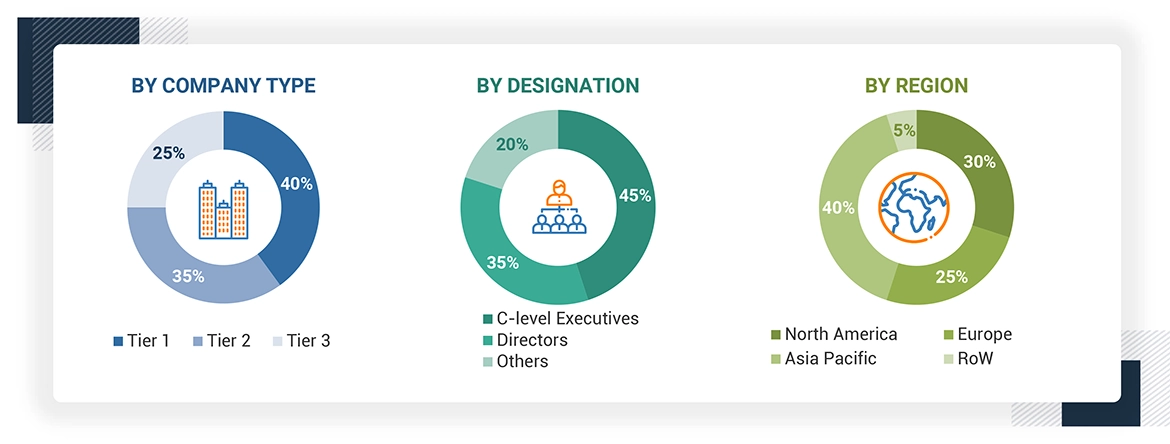
Extensive primary research has been conducted after understanding and analyzing the current scenario of the steam trap market through secondary research. Several primary interviews have been conducted with the key opinion leaders from the demand and supply sides across four main regions—North America, Europe, Asia Pacific, and the Rest of Europe. Approximately 30% of the primary interviews were conducted with the demand-side respondents, while approximately 70% were conducted with the supply-side respondents. The primary data has been collected through questionnaires, emails, and telephone interviews.
After interacting with industry experts, brief sessions were conducted with highly experienced independent consultants to reinforce the findings from our primary. This, along with the in-house subject matter experts’ opinions, has led us to the findings as described in the remainder of this report. The breakdown of primary respondents is as follows:
About the assumptions considered for the study, To know download the pdf brochure
Market Size Estimation
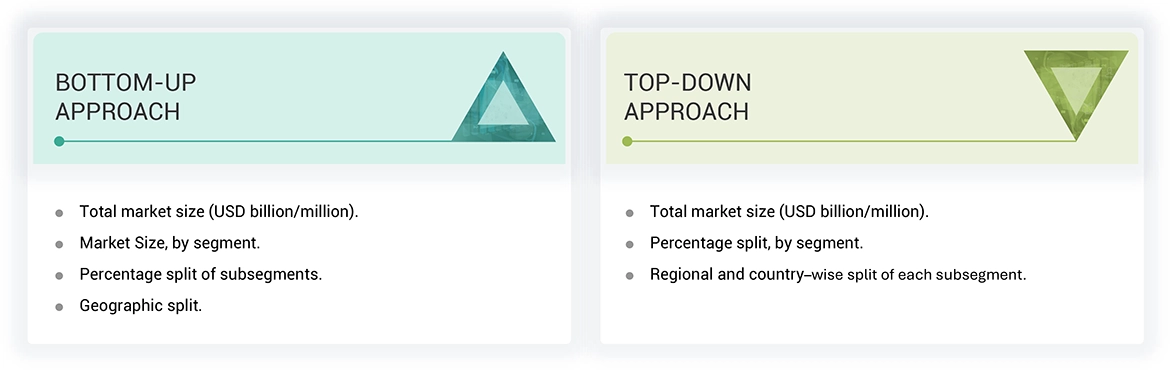
Both top-down and bottom-up approaches wete used to estimate and validate the total size of the steam trap market. These methods were also used extensively to estimate the size of various subsegments in the market. The research methodology used to estimate the market size includes the following:
Steam Trap Market : Top-Down and Bottom-Up Approach
Data Triangulation
After arriving at the overall market size using the market size estimation processes as explained above, the market was split into several segments and subsegments. The data triangulation and market breakdown procedures were employed, wherever applicable, to complete the overall market engineering process and arrive at the exact statistics of each market segment and subsegment. The data was triangulated by studying various factors and trends from the demand and supply sides.
Market Definition
A steam trap is an automatic device designed to eliminate condensate and non-condensable gases from a steam system while ensuring that live steam is not released. Functioning as an automatic valve, it opens to permit condensate discharge and closes to safeguard against live steam leakage. The presence of steam traps is crucial for the efficient functioning of steam systems.
Key Stakeholders
- End users
- Government bodies, venture capitalists, and private equity firms
- Steam trap manufacturers
- Steam trap distributors
- Steam trap industry associations
- Professional service/solution providers
- Research institutions and organizations
- Standards organizations and regulatory authorities
- System integrators
- Technology consultants
Report Objectives
- To describe and forecast the steam trap market, in terms of value, based on product type, connection, body material, pressure, size, application and end use industry
- To forecast the size of the steam trap market in terms of volume
- To forecast the market size, in terms of value, for four main regions—North America, Europe, Asia Pacific, and the RoW (Rest of the World)
- To provide detailed information regarding drivers, restraints, opportunities, and challenges influencing the market growth
- To provide a detailed overview of the value chain of the steam trap ecosystem
- To strategically analyze micromarkets1 with respect to individual growth trends, prospects, and contributions to the total market
- To analyze the opportunities for stakeholders and details of the competitive landscape of the market
- To strategically profile the key players and comprehensively analyze their market positions in terms of ranking and core competencies2
- To analyze the major growth strategies implemented by key market players, such as agreements, acquisitions, product launches, expansions, and partnerships
- To study the impact of AI on the market under study, along with macroeconomic outlook for each region
Available Customizations
With the given market data, MarketsandMarkets offers customizations according to the specific requirements of companies. The following customization options are available for the report:
- Detailed analysis and profiling of additional market players based on various blocks of the supply chain
Get the Full Steam Trap Market Report
Full forecast, segment splits, and company analysis for all Steam Trap Market.
Need a Tailored Report?
Customize this report to your needs
Get 10% FREE Customization
Customize This Report
