
Europe Steel Rebar Market (2025-2030)

The Europe Steel Rebar Market was valued at $16909.6 Million in 2025 and projected to reach to $19989.9 Million by 2030, representing a compound annual growth rate of 3.4%. Europe's steel rebar market demonstrates resilient growth momentum, supported by substantial infrastructure investment and modernization efforts across the continent.


| Market Size in | USD 26.32 MN |
| Market Forecast in | |
| CAGR | |
| Forecast Period | |
| Units Considered | Value (USD MN) |
Europe Steel Rebar Market Trends and Insights
- This steady growth in Europe reflects the region's ongoing infrastructure modernization, urban development projects, and renewed investment in sustainable construction practices.
- Europe's rebar demand is driven by both new construction activity and the replacement of aging infrastructure across member states. The European steel rebar market benefits from stringent building codes, green construction initiatives, and the European Union's focus on climate-neutral infrastructure by 2050.
- Europe's construction sector, particularly in Central and Eastern Europe, continues to present significant opportunities for rebar consumption.
- Between 2025 and 2030, Europe is expected to see increased adoption of high-strength rebar variants and recycled steel products, aligning with the region's circular economy objectives and decarbonization targets..
Key Market Statistics
- CAGR (2025-2030) 3.4% CAGR
- Market Size, 2025 ~USD 16909.6 Million
- Forecast, 2030 ~USD 19989.9 Million
- Geography Europe
Europe Steel Rebar Market Overview
Market Valuation & Growth :
Europe's steel rebar market is valued at USD 16,909.6 million in 2025 and is projected to reach USD 19,989.9 million by 2030, representing a steady CAGR of 3.4% over the forecast period.
Infrastructure Modernization :
Europe's rebar demand is driven by ongoing infrastructure modernization initiatives, including bridge rehabilitation, railway expansion, and urban renewal projects across major economies like Germany, France, and Italy.
Sustainable Construction Focus :
The region is increasingly adopting sustainable construction practices and green building standards, driving demand for high-quality rebar that meets stringent European environmental and safety regulations.
Urban Development Investment :
Renewed investment in urban development, smart city projects, and residential construction across Europe is fueling consistent rebar consumption and market expansion through 2030.
Europe Steel Rebar Market Dynamics
- The region's focus on sustainable urban development and compliance with EU construction standards continues to drive steady demand for high-quality rebar products.
- Key markets including Germany, France, Italy, and Spain are experiencing renewed construction activity, particularly in residential and commercial sectors. Looking ahead to 2030, Europe's rebar market is expected to benefit from continued EU funding for infrastructure projects, green building initiatives, and digital transformation in construction.
- However, growth remains moderate at 3.4% CAGR compared to global rates, reflecting market maturity and regulatory constraints.
- Strategic opportunities exist in recycled rebar production and advanced reinforcement solutions aligned with circular economy principles..
Market Ecosystem
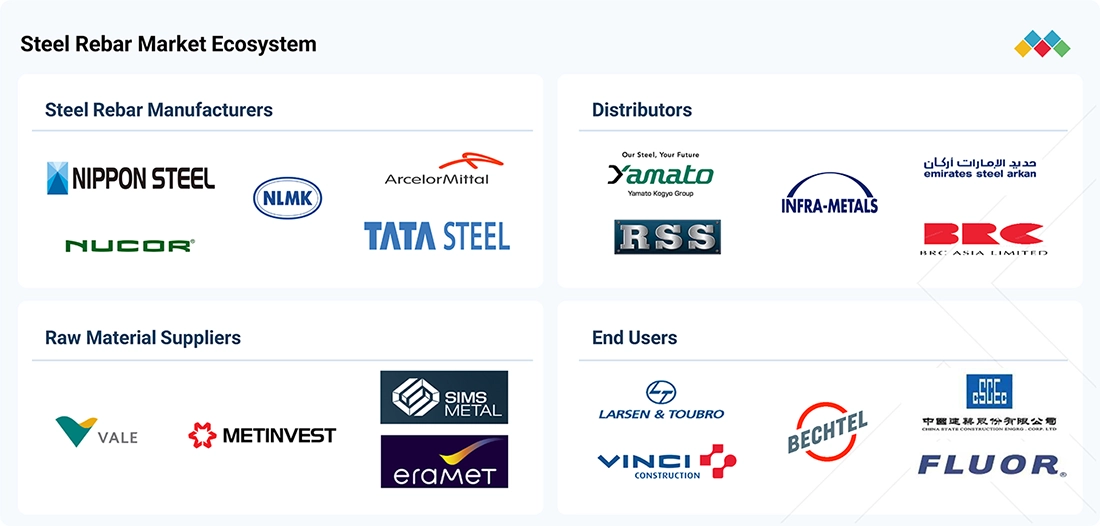
STEEL REBAR MARKET: COMMERCIAL USE CASES ACROSS INDUSTRIES
| COMPANY | USE CASE DESCRIPTION | BENEFITS |
|---|---|---|
 |
Helix Steel implemented its patented Twisted Steel Micro Rebar (TSMR) technology as an alternative to conventional rebar and welded wire mesh (WWM) in concrete applications. The solution was used in commercial and industrial flooring, including warehouse floors, to address challenges such as labor-intensive reinforcement placement, construction delays, and crack propagation. TSMR was integrated directly into concrete mixes to provide uniform reinforcement distribution without manual mesh installation. | The TSMR solution reduced labor requirements by up to 50% and eliminated manual wire mesh placement, shortening construction time. It improved concrete load capacity, crack control, ductility, and structural integrity while reducing material handling and simplifying installation. The solution also supported smoother concrete pours and was particularly beneficial for joint-free flooring and tank foundations, making it suitable for lean and efficient construction practices. |
Logos and trademarks shown above are the property of their respective owners. Their use here is for informational and illustrative purposes only.
Related Ecosystem
Infrastructure Material
- Alumina Ceramics
- Ceramic Coatings
- Monolithic Ceramics
- Polyphenylene Sulfide (PPS)
- Titanate Ceramics
- Saint-gobain
- Simpson Manufacturing Co., Inc.
- DOW CHEMICAL COMPANY
- Basf se
- Sika ag
Building And Construction
- HVAC System
- Acoustic Insulation
- Alkyd Resins
- Fiberglass
- Thermal Insulation
- Snc-lavalin group inc.
- Saint-gobain
- LHOIST S.A
- USG CORPORATION
- Basf se
Key Takeaways
- Europe's steel rebar market will grow from USD 16,909.6 million (2025) to USD 19,989.9 million (2030) at a 3.4% CAGR.
- Europe's construction sector drives rebar demand through infrastructure renewal and compliance with EU sustainability standards.
- High-strength and recycled steel rebar products are gaining traction in Europe due to circular economy and decarbonization initiatives.
- Central and Eastern European markets present significant growth opportunities for rebar consumption through 2030.
Steel Rebar Market Report Scope
| Report Metric | Details |
|---|---|
| Base Year | 2025 |
| Fastest Growing Segment | #3 BAR SIZE (Bar Size) |
| Forecast Period | 2025–2030 |
| Growth Rate | CAGR of 4% from 2025 to 2030 |
| Largest Segment | INFRASTRUCTURE (End-Use Industry) |
| Market Size Base Year (Billions) | ~USD 220.61 (2025) |
| Revenue Forecast (Billions) | ~USD 268.4 (2030) |
| Segments Covered | Type, Process, Coating Type, Bar Size, End-Use Sector, Product Type, End-Use Industry |
Europe Steel Rebar Market Report Segmentation
7 segment dimensions are covered across the global market.
By Type
- Deformed
- Mild
By Process
- Basic Oxygen Furnace
- Basic Oxygen Steelmaking
- Electric Arc Furnace
By Coating Type
- Epoxy Coated Steel Rabar
- Galvanized Steel Rabar
- Plain Carbon Steel Rabar
By Bar Size
- #3 Bar Size
- #4 Bar Size
- #5 Bar Size
- #8 Bar Size
- Other Bar Sizes
By End-Use Sector
- Housing
- Industrial
- Infrastructure
By Product Type
- Merchant Bar
- Rail
- Rebar
- Wire Rod
By End-Use Industry
- Construction
- Infrastructure
Target Audience
- Construction & Infrastructure Companies : European builders, contractors, and infrastructure developers need market intelligence to forecast rebar procurement costs, identify supply chain partners, and plan project budgets aligned with regional demand trends.
- Steel Manufacturers & Suppliers : Rebar producers and steel distributors require detailed market data to optimize production capacity, assess competitive positioning, and identify growth opportunities in key European markets and segments.
- Investment & Private Equity Firms : Investors evaluating European construction and materials sectors need comprehensive market analysis to assess acquisition targets, growth potential, and return forecasts in the regional rebar industry.
- Government & Policy Makers : European government agencies and urban planners utilize market research to inform infrastructure investment decisions, construction standards, and sustainable building policies affecting rebar demand.
- Logistics & Supply Chain Operators : Distributors, warehousing companies, and logistics providers need market forecasts to optimize inventory management, distribution networks, and capacity planning for rebar supply across European regions.
Key Companies in the Europe Steel Rebar Market
| Company | HQ | Ownership | Strongest segments |
|---|---|---|---|
| THYSSENKRUPP AG | Germany | ||
| HYUNDAI MOTOR GROUP | South Korea | ||
| SAMSUNG | Korea, South | Public Company | Deformed rebar,Mild rebar,Plain (uncoated), |
| SSAB | Sweden | ||
| EMIRATES STEEL | United Arab Emirates | Public Company | Deformed rebar – Plain, BOS/EAF, infrastructure-focused,Deformed rebar – Coated (galvanized, epoxy), infrastructure and industrial,Mild rebar – Housing and light industrial, |
| ARCELORMITTAL | Luxembourg | ||
| GERDAU S/A | Brazil | Public Company | Deformed rebar,Mild rebar,Plain (uncoated) rebar, |
| NUCOR CORPORATION | United States | Public Company | Deformed Rebar,Mild Rebar,Plain (Uncoated), |
| COMMERCIAL METALS COMPANY | United States | Public Company | Deformed rebar – plain, EAF-based,Fabricated rebar, cages, and meshes,Merchant bar, light structural, and wire rod for construction, |
| TATA STEEL | India | Public Company | Deformed rebar (plain & coated),Mild rebar and wire rods,Cut-and-bend, pre-cages, welded mesh, |
| STEEL AUTHORITY OF INDIA LIMITED | India | Public Company | Deformed Rebar – Plain (uncoated),Deformed Rebar – Galvanized,Deformed Rebar – Epoxy Coated, |
| MECHEL PAO | Russia | Public Company | Deformed Rebar,Mild (Plain) Rebar,BOS-route Rebar, |
| STEEL DYNAMICS, INC. | United States | Public Company | Deformed Rebar – EAF, Plain & Coated, #4–#8,Mild Rebar & Merchant Bar – EAF,Engineered Special Bar Quality (SBQ) for Construction-related Uses, |
| JSW | India | Public Company | Deformed TMT rebar – plain (uncoated),Deformed TMT rebar – galvanized and epoxy coated,Mild steel rebar and wire rods for construction, |
| BAOSTEEL GROUP CO., LTD. | China | Private Company | Deformed Rebar,Mild Rebar,Plain (Uncoated) Rebar, |
| METINVEST | Netherlands | Private Company | Deformed Rebar – Plain, BOS route,Deformed Rebar – Plain, EAF route,Mild Rebar / Rounds, |
| PAO SEVERSTAL | Russia | Public Company | Deformed, Plain, BOS-route rebar for infrastructure,Deformed, Plain, BOS-route rebar for housing & industrial,EAF-route rebar and specialty sizes (#3–#5), |
THYSSENKRUPP AG
ThyssenKrupp AG is a German industrial conglomerate with operations across multiple sectors including steel, materials, and engineering.
HYUNDAI MOTOR GROUP
Hyundai Motor Group is a South Korean multinational conglomerate primarily engaged in automotive manufacturing and related industries.
SAMSUNG
Samsung is a South Korean public company founded in 1969 with 128,735 employees, operating as a diversified multinational conglomerate across electronics, semiconductors, and other industries.
SSAB
SSAB is a Swedish steel company specializing in high-strength steel products and solutions for various industrial applications.
EMIRATES STEEL
Emirates Steel is a United Arab Emirates-based public company founded in 2005, engaged in steel manufacturing and production.
ARCELORMITTAL
ArcelorMittal is a Luxembourg-based multinational steel manufacturing company and one of the world's largest steel producers.
GERDAU S/A
Gerdau S/A is a Brazilian public company founded in 1901 with 30,000 employees, specializing in steel production and distribution.
NUCOR CORPORATION
Nucor Corporation is a United States-based public company founded in 1905 with 33,000 employees, operating as a leading steel and steel products manufacturer.
COMMERCIAL METALS COMPANY
Commercial Metals Company is a United States-based public company founded in 1915 with 12,690 employees, engaged in steel manufacturing and recycling.
TATA STEEL
Tata Steel is an Indian public company founded in 1907 with 112,262 employees, operating as a major integrated steel producer.
STEEL AUTHORITY OF INDIA LIMITED
Steel Authority of India Limited is an Indian public company founded in 1954 with 53,159 employees, serving as a major state-owned steel manufacturer.
MECHEL PAO
Mechel PAO is a Russian public company founded in 2003, engaged in mining, steel production, and power generation.
STEEL DYNAMICS, INC.
Steel Dynamics, Inc. is a United States-based public company founded in 1993 with 14,400 employees, operating as a steel manufacturer and recycler.
JSW
JSW is an Indian public company founded in 1982 with 16,083 employees, operating in the steel and infrastructure sectors.
BAOSTEEL GROUP CO., LTD.
Baosteel Group Co., Ltd. is a Chinese private company founded in 1993 with 118,500 employees, operating as a major integrated steel producer.
METINVEST
Metinvest is a Netherlands-based private company founded in 2001 with 38,000 employees, engaged in mining and steel production.
PAO SEVERSTAL
PAO Severstal is a Russian public company founded in 1955 with 100,000 employees, operating as a major integrated steel and mining producer.
Countries within Europe - compare and drill down
| Country | 2025 size (native) |
|---|---|
| Germany | USD 2.3 Million |
| UK | USD 0.8 Million |
| France | USD 0.9 Million |
| Italy | USD 1.6 Million |
| Spain | USD 0.9 Million |
| Russia | USD 9.7 Million |
| Turkey | USD 11.7 Million |
| Ukraine | USD 0.7 Million |
| Rest Of Europe | USD 2 Million |
Country market size visualization
Reasons to Buy this Report
- Regional Market Sizing : Obtain precise market valuation data for Europe's steel rebar sector with country-level breakdowns for Germany, France, Italy, Spain, and other key European markets to inform localized business strategies.
- Growth Trajectory Analysis : Understand Europe's 3.4% CAGR growth dynamics through 2030, identifying which segments and geographies offer the strongest expansion opportunities within the mature European construction market.
- Infrastructure Investment Insights : Access detailed analysis of EU-funded infrastructure projects, urban modernization initiatives, and construction pipeline data driving rebar demand across European regions and sectors.
- Competitive Landscape Intelligence : Benchmark your position against regional competitors and understand market consolidation trends, pricing dynamics, and supply chain strategies specific to European rebar manufacturers and distributors.
- Regulatory & Sustainability Trends : Stay informed on European environmental standards, green building certifications, and circular economy regulations shaping rebar product development and market opportunities through 2030.
Frequently asked questions
What is the current size of Europe's steel rebar market in 2025?
Europe's steel rebar market is valued at USD 16,909.6 million in 2025, representing a significant segment of the global construction materials industry.
What is the projected market size for Europe's steel rebar by 2030?
Europe's steel rebar market is forecast to reach USD 19,989.9 million by 2030, reflecting a 3.4% compound annual growth rate over the five-year period.
What factors are driving growth in Europe's steel rebar market?
Europe's rebar market growth is driven by infrastructure modernization, EU sustainability mandates, increased adoption of high-strength variants, and demand for recycled steel products aligned with circular economy goals.
Which European regions show the strongest rebar demand potential?
Central and Eastern European markets demonstrate significant growth potential for rebar consumption due to ongoing infrastructure development and construction activity through 2030.
How are sustainability trends affecting Europe's steel rebar market?
Europe's commitment to climate neutrality by 2050 and circular economy principles is accelerating demand for recycled and high-strength rebar products that reduce carbon footprint and material waste.
RESEARCH METHODOLOGY
This study involved four major activities to estimate the current size of the steel rebar market. Exhaustive secondary research was carried out to collect information on the market, the peer product market, and the parent product group market. The next step was to validate these findings, assumptions, and sizes with industry experts across the value chain of steel rebar through primary research. The top-down and bottom-up approaches were employed to estimate the overall size of the steel rebar market. After that, market breakdown and data triangulation procedures were used to determine the size of different segments of the market.
Secondary Research
The market for steel rebar companies was identified using secondary data from both paid and unpaid sources. This involved analyzing the product portfolios of major companies in the ecosystem and rating them based on performance and quality. For this study, various secondary sources, such as Business Standard, Bloomberg, the World Bank, and Factiva, were referred to to identify and collect information on the steel rebar market. In the secondary research process, various secondary sources were referred to to identify and collect information related to the study. Secondary sources included annual reports, press releases, and investor presentations of steel rebar manufacturers, forums, certified publications, and whitepapers. The secondary research was used to obtain critical information on the industry’s value chain, the total pool of key players, market classification, and segmentation from the market and technology-oriented perspectives.
Primary Research
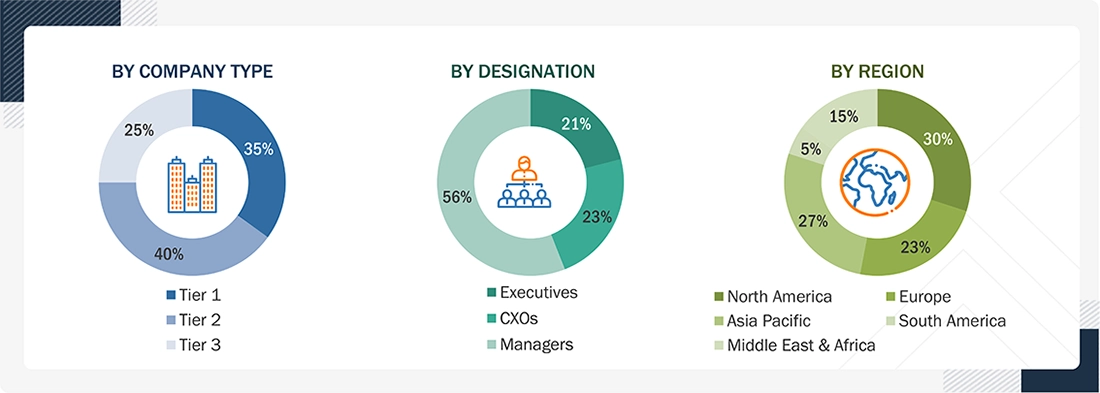
In the primary research process, various primary sources from the supply and demand sides were interviewed to obtain qualitative and quantitative information for this report. The primary sources from the supply side included industry experts, such as chief executive officers (CEOs), vice presidents (VPs), marketing directors, technology and innovation directors, and related key executives from several key companies and organizations operating in the steel rebar market. After the complete market engineering (calculations for market statistics, market breakdown, market size estimations, market forecasting, and data triangulation), extensive primary research was conducted to gather information and verify and validate the critical numbers arrived at.
Primary research was also conducted to identify the segmentation types, industry trends, competitive landscape of steel rebar offered by various market players, and key market dynamics, such as drivers, restraints, opportunities, challenges, trends, and key player strategies. In the complete market engineering process, the top-down and bottom-up approaches and several data triangulation methods were extensively used to perform the market estimation and market forecasting for the overall market segments and subsegments listed in this report. Extensive qualitative and quantitative analysis was performed on the complete market engineering process to list the key information/insights throughout the report.
To know about the assumptions considered for the study, download the pdf brochure
Market Size Estimation
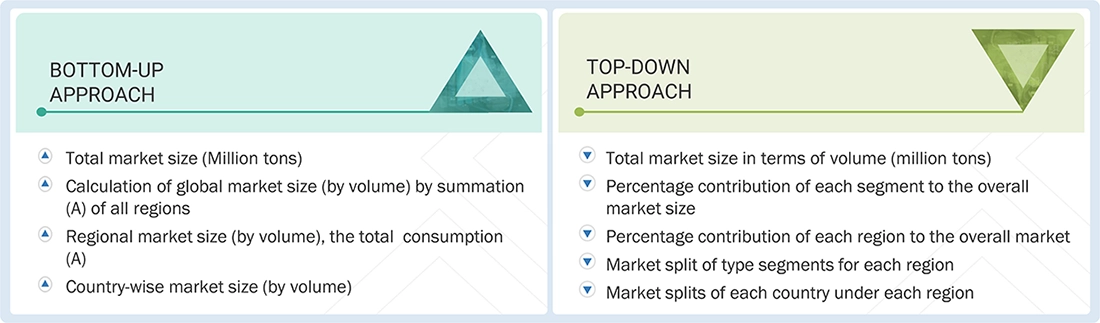
The top-down and bottom-up approaches were used to estimate and validate the size of the steel rebar market. These approaches were also used extensively to estimate the size of various dependent market segments. The research methodology used to estimate the market size included the following:
Steel Rebar Market : Top-Down and Bottom-Up Approach
Data Triangulation
After arriving at the overall market size using the market size estimation processes, the market was split into several segments and subsegments. The data triangulation and market breakup procedures were employed, wherever applicable, to complete the overall market engineering process and arrive at the exact statistics of each market segment and subsegment. The data was triangulated by studying various factors and trends from the demand and supply sides.
Market Definition
Steel rebar is a term used for long rods, bars, or nets of wire made from steel to reinforce concrete to give it better tensile strength. Concrete is strong in compression but weak in tensile strength, which means it cannot bear loads well. The use of rebar, made of iron, allows much stronger and more durable concrete to be ready for use in construction; such rebar may improve the strength of concrete to prevent any cracking and weakening under loads. The process of making steel rebar involves the production of different grades, sizes, shapes, and coatings suitable for a specific type of construction. Most often, rebar is made of carbon steel and is used in the construction of buildings, bridges, highways, etc.
Key Stakeholders
- Raw Material Suppliers
- Steel Rebar Manufacturers
- Retailers and Distributors
- Research & Development Entities
- Industry Associations and Regulatory Bodies
- End Users
Report Objectives
- To define, describe, and forecast the size of the steel rebar market, by type, process, coating type, bar size, and end-use sector, in terms of value and volume
- To forecast the market size of segments for North America, Europe, Asia Pacific, South America, and the Middle East & Africa, along with their respective countries, in terms of value and volume
- To provide detailed information on the significant drivers, restraints, opportunities, and challenges influencing the market
- To strategically analyze micromarkets concerning individual growth trends, prospects, and their contribution to the market
- To assess the growth opportunities in the market for stakeholders and provide details on the competitive landscape for market leaders
- To strategically profile key players and comprehensively analyze their market shares and core competencies
- To analyze competitive developments, such as partnerships, acquisitions, and expansions in the steel rebar market
- To provide the impact of AI/Gen AI on the market
- To provide the macroeconomic outlook for each region covered under the study, and the impact of the 2025 US tariff on the market
Available customizations:
With the given market data, MarketsandMarkets offers customizations according to client-specific needs.
The following customization options are available for the steel rebar report:
Product Analysis
-
A product matrix that gives a detailed comparison of the product portfolio of each company.
Regional Analysis
-
A further breakdown of the steel rebar market for additional countries
Company Information
-
Detailed analysis and profiling of additional market players (up to five)
Get the Full Steel Rebar Market Report
Full forecast, segment splits, and company analysis for all Steel Rebar Market.
- US Steel Rebar Market
- Canada Steel Rebar Market
- Mexico Steel Rebar Market
- Germany Steel Rebar Market
- UK Steel Rebar Market
- France Steel Rebar Market
- Italy Steel Rebar Market
- Spain Steel Rebar Market
- Russia Steel Rebar Market
- Turkey Steel Rebar Market
- Ukraine Steel Rebar Market
- China Steel Rebar Market
- India Steel Rebar Market
- Japan Steel Rebar Market
- South Korea Steel Rebar Market
- Australia Steel Rebar Market
- South Africa Steel Rebar Market
- Brazil Steel Rebar Market
- Argentina Steel Rebar Market
- Rest Of Europe Steel Rebar Market
- Rest Of Asia Pacific Steel Rebar Market
- GCC Countries Steel Rebar Market
- –Rest Of GCC Countries Steel Rebar Market
- Rest Of South America Steel Rebar Market
Need a Tailored Report?
Customize this report to your needs
Get 10% FREE Customization
Customize This Report
