
Latin America Supply Chain Management (SCM) Market (2025-2030)

The Latin America Supply Chain Management (SCM) Market was valued at $275.3 Million in 2025 and projected to reach to $449 Million by 2030, representing a compound annual growth rate of 10.3%. Latin America's Supply Chain Management market is positioned for sustained expansion, with the region's 10.3% CAGR reflecting strong momentum in digital transformation and operational modernization.


| Market Size in | USD 26.32 MN |
| Market Forecast in | |
| CAGR | |
| Forecast Period | |
| Units Considered | Value (USD MN) |
Latin America Supply Chain Management (SCM) Market Trends and Insights
- This represents a compound annual growth rate (CAGR) of 10.3%, significantly outpacing global trends.
- Latin America's SCM adoption is being driven by increasing digitalization, regulatory pressures, and the need for operational efficiency across manufacturing, retail, and logistics sectors. The Latin America SCM market is benefiting from rising e-commerce penetration, supply chain resilience initiatives, and investment in cloud-based solutions.
- Latin America's enterprises are modernizing legacy systems to enhance visibility and reduce costs across their supply networks.
- Between 2025 and 2030, Latin America is expected to see accelerated adoption of AI-driven analytics, real-time tracking, and integrated planning platforms as organizations prioritize supply chain optimization. Latin America's competitive landscape includes both regional players and global vendors establishing local operations.
- The region's growth trajectory reflects broader Latin America economic recovery, infrastructure improvements, and heightened focus on sustainable and agile supply chain practices..
Key Market Statistics
- CAGR (2025-2030) 10.3% CAGR
- Market Size, 2025 ~USD 275.3 Million
- Forecast, 2030 ~USD 449 Million
- Geography Latin America
Latin America Supply Chain Management (SCM) Market Overview
Outpacing Global Growth :
Latin America's SCM market is growing at 10.3% CAGR, significantly exceeding the global rate of 8.7%, driven by accelerating digital transformation initiatives across the region.
Brazil & Mexico Lead Adoption :
Brazil and Mexico represent the largest SCM markets in Latin America, with combined market size exceeding USD 2 billion, serving as innovation hubs for supply chain modernization.
Regulatory & Compliance Drivers :
Increasing regulatory pressures and compliance requirements across Latin American countries are compelling organizations to adopt advanced SCM solutions for transparency and operational efficiency.
Rapid Digitalization Wave :
Latin American enterprises are accelerating digital adoption to enhance visibility, reduce costs, and improve resilience in supply chains, creating substantial opportunities for SCM vendors.
Latin America Supply Chain Management (SCM) Market Dynamics
- The market's growth trajectory is underpinned by increasing investments in cloud-based solutions, IoT integration, and real-time visibility platforms that address regional supply chain complexities. By 2030, the Latin American SCM market is expected to reach USD 449 million, driven by rising e-commerce activity, manufacturing sector growth, and heightened focus on supply chain resilience.
- Key growth catalysts include regulatory compliance mandates, labor cost optimization, and the need for enhanced supplier collaboration across multinational operations in the region..
Market Ecosystem
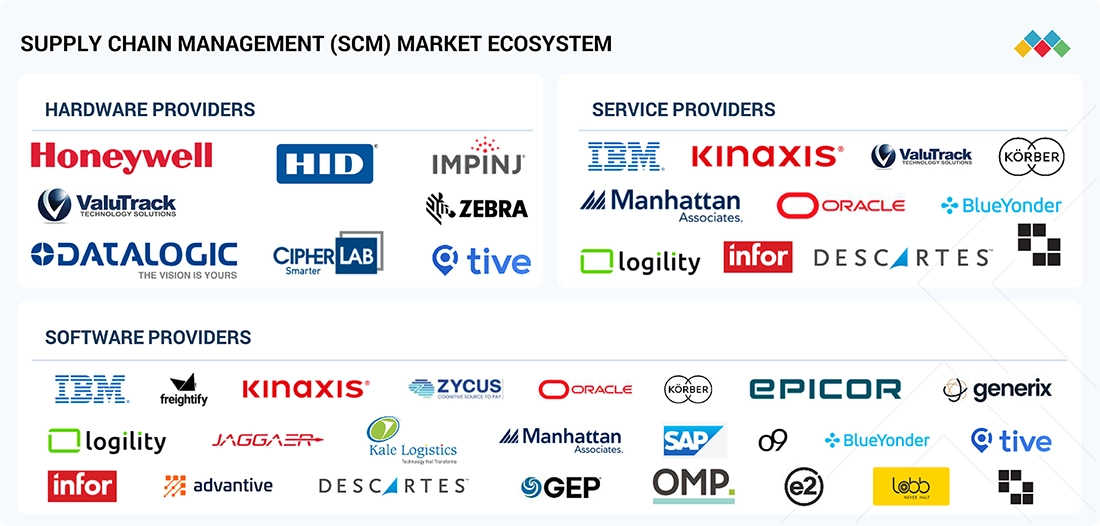
Supply Chain Management Market: COMMERCIAL USE CASES ACROSS INDUSTRIES
| COMPANY | USE CASE DESCRIPTION | BENEFITS |
|---|---|---|
 |
Maersk and IBM launched TradeLens, a blockchain-based platform built on Hyperledger Fabric, to digitize shipping documentation and enhance transparency across global container logistics. | Connected 175+ organizations and 600+ ports, enabled faster and more secure data exchange, strengthened collaboration among stakeholders, reduced process time and errors, and improved shipping reliability |
 |
BMW enhances spare part traceability with the PartChain project, leveraging blockchain and IoT sensors to secure its complex global supply chain and prevent the introduction of counterfeit components. | Reduced time spent locating delayed parts, thwarted counterfeit components, streamlined cross-border customs documentation, and enabled just-in-time delivery for production lines. |
|
|
Walmart partnered with IBM to implement a blockchain-based system that tracks food provenance, transit conditions, and safety data, enabling rapid and reliable traceability across its global supply chain. | Reduced trace time from 6 days to 2 seconds, enabled swift removal of contaminated batches, improved food safety, minimized waste, and boosted consumer trust. |
Logos and trademarks shown above are the property of their respective owners. Their use here is for informational and illustrative purposes only.
Related Ecosystem
Application Security
- Cloud Security
- Security Analytics
- Network Testing
- Biometric Security and Authentication System
- Cloud Encryption
- International Business Machines Corporation
- MICROSOFT CORPORATION
- Cisco Systems, Inc.
- PALO ALTO NETWORKS, INC
- Fortinet, Inc.
Endpoint Security
- Cloud Security
- Security Analytics
- Multi-Factor Authentication
- Biometric Security and Authentication System
- Critical Communication Network
- International Business Machines Corporation
- MICROSOFT CORPORATION
- Cisco Systems, Inc.
- PALO ALTO NETWORKS, INC
- Fortinet, Inc.
Key Takeaways
- Latin America's SCM market will grow from USD 275.3M (2025) to USD 449.0M (2030) at a 10.3% CAGR, outpacing global growth.
- Latin America is experiencing accelerated cloud adoption and AI-driven supply chain analytics as enterprises modernize operations.
- Latin America's e-commerce expansion and regulatory compliance requirements are primary drivers of SCM investment.
- Latin America's regional and global vendors are competing to capture market share through localized solutions and partnerships.
Supply Chain Management (SCM) Market Report Scope
| Report Metric | Details |
|---|---|
| Base Year | 2025 |
| Fastest Growing Segment | MANAGED SERVICES (Service) |
| Forecast Period | 2025–2030 |
| Growth Rate | CAGR of 8.7% from 2025 to 2030 |
| Largest Segment | ON-PREMISES (Deployment Mode) |
| Market Size Base Year (Billions) | ~USD 38.5 (2025) |
| Revenue Forecast (Billions) | ~USD 58.42 (2030) |
| Segments Covered | Offering, Hardware, Type, Deployment Mode, Organization Size, Vertical, Software, Purchasing Management Software, Inventory Management Software, Service, Security Type, Application Area, Function, Product Managed, Deployment Model, End User, Component |
Latin America Supply Chain Management (SCM) Market Report Segmentation
17 segment dimensions are covered across the global market.
By Offering
- Hardware
- Hardware Components
- Services
- Software
- Software Solutions
By Hardware
- Barcodes And Barcode Scanners
- Rfid Tags
- Rfid Tags And Readers
By Type
- Capital Purchasing Software
- Consignment Management Software
- Demand Planning Software
- Inventory Management Software
- Managed Services
- Order Management Software
- Professional Services
- Purchasing Management Software
- Standalone Procurement Management Software
- Strategic Sourcing Software
- Supply Management Software
- Transportation Management Software
- Warehouse Management Software
By Deployment Mode
- Cloud
- On-Premises
By Organization Size
- Large Enterprises
- Smes
By Vertical
- Automotive
- Energy And Utilities
- Fmcg
- Food And Beverage Manufacturing
- Government
- Healthcare
- Machinery And Industrial Equipment Manufacturing
- Manufacturing
- Other Verticals
- Other Verticals*
- Pharmaceutical
- Retail & Ecommerce
- Retail And Consumer Goods
- Retail And Ecommerce
- Transportation & Logistics
- Transportation And Logistics
By Software
- Inventory Management Software
- Purchasing Management Software
- Transportation Management Software
By Purchasing Management Software
- Capital Purchasing Software
- Standalone Procurement Management Software
- Strategic Sourcing Software
- Supply Management Software
By Inventory Management Software
- Consignment Management Software
- Demand Planning Software
- Order Management Software
- Warehouse Management Software
By Service
- Managed Services
- Professional Services
By Security Type
- Data Locality & Protection
- Data Visibility & Governance
- Fraud Prevention & Third-Party Risk Management
By Application Area
- Automotive
- Chemicals
- Fmcg
- Healthcare & Pharmaceuticals
- Other Application Areas
- Retail & Ecommerce
By Function
- Inventory Management
- Purchasing Management
By Product Managed
- Medical Devices & Equipment
- Other Products Managed
- Pharmaceutical & Biotechnology Products
By Deployment Model
- Cloud-Based Models
- On-Premise Models
By End User
- Distributors
- Healthcare Providers
- Manufacturers
By Component
- Services
- Software
Target Audience
- SCM Software Vendors : Evaluate market expansion opportunities in Latin America, understand regional customer needs, and benchmark competitive positioning to drive product localization and sales strategies.
- Enterprise Supply Chain Leaders : Assess regional market trends, identify best-in-class solutions, and benchmark operational performance against Latin American peers to optimize supply chain investments.
- Management Consulting Firms : Support client engagements with data-driven insights on Latin American SCM market dynamics, enabling informed recommendations for digital transformation and operational improvements.
- Investment & Private Equity Firms : Evaluate investment opportunities in Latin American SCM technology companies, assess market growth potential, and identify acquisition targets in the high-growth region.
- Logistics & Distribution Companies : Understand market demand for SCM solutions, identify technology partnerships, and plan digital infrastructure investments to enhance competitive positioning in Latin America.
Key Companies in the Latin America Supply Chain Management (SCM) Market
| Company | HQ | Ownership | Strongest segments |
|---|---|---|---|
| SAP | Germany | Public Company | Purchasing Management (Capital, Strategic Sourcing, Supply Management),Inventory Management (Demand Planning, Consignment Management, Order Management),Transport Management, |
| ORACLE | United States | ||
| DESCARTES | Canada | ||
| MANHATTAN ASSOCIATES | United States | ||
| IBM | United States | ||
| E2OPEN | United States |
SAP
SAP is a German multinational software corporation founded in 1972 that develops enterprise resource planning (ERP) software. As a public company with over 111,000 employees, SAP is one of the world's leading providers of business management applications.
ORACLE
Insufficient information provided.
DESCARTES
Insufficient information provided.
MANHATTAN ASSOCIATES
Insufficient information provided.
IBM
Insufficient information provided.
E2OPEN
E2open is a United States-based company that provides supply chain software and services.
Countries within Latin America - compare and drill down
| Country | 2025 size (native) |
|---|---|
| Brazil | USD 956.7 Million |
| Mexico | USD 1051.4 Million |
| Rest Of Latin America | USD 515.5 Million |
Country market size visualization
Reasons to Buy this Report
- Regional Market Sizing & Forecasts : Gain precise market valuations for Latin America's SCM sector with detailed 2025-2030 projections, enabling accurate budget allocation and investment planning specific to regional dynamics.
- Country-Level Intelligence : Access granular market data for Brazil, Mexico, and Rest of Latin America, identifying high-growth opportunities and market maturity levels across individual countries.
- Competitive Landscape Analysis : Understand regional vendor positioning, market consolidation trends, and competitive strategies tailored to Latin American supply chain requirements and customer preferences.
- Growth Driver Identification : Discover key catalysts including regulatory compliance, digitalization initiatives, and operational efficiency demands driving SCM adoption across Latin American enterprises.
- Strategic Market Entry Insights : Leverage regional market intelligence to develop targeted go-to-market strategies, partnership opportunities, and customer acquisition approaches for Latin American SCM solutions.
Frequently asked questions
What is the projected market size for SCM in Latin America by 2030?
Latin America's Supply Chain Management market is projected to reach USD 449.0 million by 2030, growing from USD 275.3 million in 2025.
What is the CAGR for the Latin America SCM market?
Latin America's SCM market is expected to grow at a compound annual growth rate (CAGR) of 10.3% between 2025 and 2030.
What are the main drivers of SCM adoption in Latin America?
Latin America's SCM growth is driven by e-commerce expansion, regulatory compliance needs, digital transformation initiatives, and supply chain resilience requirements.
Which technologies are gaining traction in Latin America's SCM market?
Latin America is seeing increased adoption of cloud-based platforms, AI-driven analytics, real-time tracking systems, and integrated planning solutions.
Who are the key players in Latin America's SCM market?
Latin America's SCM market includes both regional vendors and global technology providers establishing local operations to serve manufacturing, retail, and logistics sectors.
RESEARCH METHODOLOGY
The study significantly estimated the current supply chain management (SCM) market size. Exhaustive secondary research was done to collect information on the SCM industry. The next step was to validate these findings, assumptions, and sizing with industry experts across the value chain using primary research. Different approaches, such as top-down and bottom-up, were employed to estimate the total market size. After that, the market breakdown and data triangulation procedures were used to estimate the size of the segments and subsegments of the SCM market.
Secondary Research
The market for the companies offering SCM solutions and services is arrived at by secondary data available through paid and unpaid sources, analyzing the product portfolios of the major companies in the ecosystem, and rating the companies by their performance and quality. Various sources were referred to in the secondary research process to identify and collect information for this study. The secondary sources include annual reports, press releases, investor presentations of companies, white papers, journals, certified publications, and articles from recognized authors, directories, and databases.
In the secondary research process, various secondary sources were referred to for identifying and collecting information related to the study. Secondary sources included annual reports, press releases, and investor presentations of SCM vendors, forums, certified publications, and whitepapers. The secondary research was used to obtain essential information on the industry’s value chain, the total pool of key players, market classification, and segmentation from the market and technology-oriented perspectives.
Primary Research
In the primary research process, various supply and demand sources were interviewed to obtain qualitative and quantitative information for this report. The primary sources from the supply side included industry experts, such as Chief Executive Officers (CEOs), Vice Presidents (VPs), marketing directors, technology and innovation directors, and related key executives from various key companies and organizations operating in the SCM market.
After the complete market engineering (calculations for market statistics, market breakdown, market size estimations, market forecasting, and data triangulation), extensive primary research was conducted to gather information and verify and validate the critical numbers arrived at. Primary research was also undertaken to identify the segmentation types, industry trends, competitive landscape of SCM solutions offered by various market players, and fundamental market dynamics, such as drivers, restraints, opportunities, challenges, industry trends, and key player strategies.
In the complete market engineering process, the top-down and bottom-up approaches and several data triangulation methods were extensively used to perform the market estimation and market forecasting for the overall market segments and subsegments listed in this report. Extensive qualitative and quantitative analysis was performed on the complete market engineering process to list the key information/insights throughout the report.
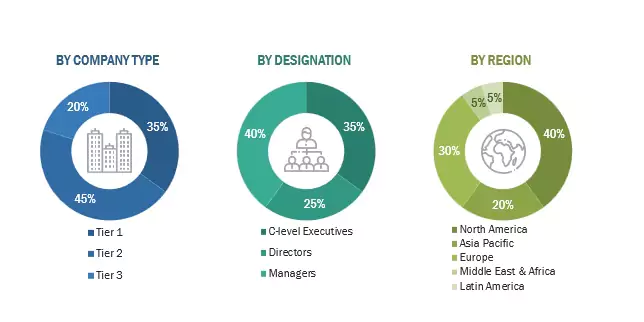
Note: The companies have been categorized based on their total annual revenue; tier
1 companies = revenue greater than USD 10 billion; tier 2 companies = revenue between USD 1 billion and USD 10
billion; tier 3 companies = revenue between USD 500 million and USD 1 billion.
Other levels include sales managers, marketing managers, and product managers.
Source: MarketsandMarkets Analysis
To know about the assumptions considered for the study, download the pdf brochure
Market Size Estimation
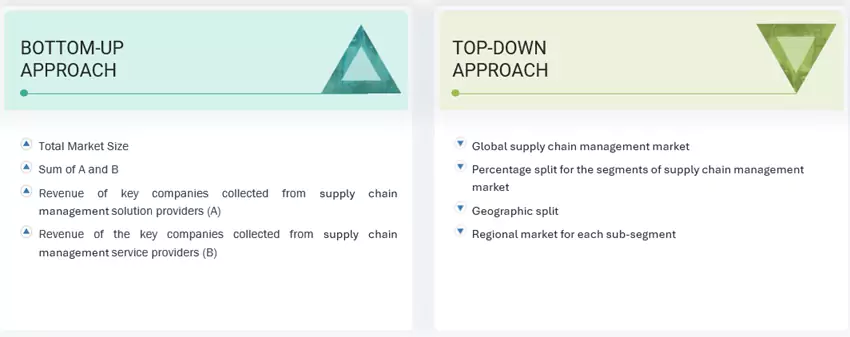
Top-down and bottom-up approaches were used to estimate and validate the size of the global SCM market and the size of various other dependent sub-segments. The research methodology used to estimate the market size includes the following details: key players in the market were identified through secondary research, and their market shares in the respective regions were determined through primary and secondary research. This entire procedure included the study of the annual and financial reports of the top market players, and extensive interviews were conducted for key insights from the industry leaders, such as CEOs, VPs, directors, and marketing executives.
All percentage splits and breakdowns were determined using secondary sources and verified through primary sources. All possible parameters that affect the market covered in this research study have been accounted for, viewed in extensive detail, verified through primary research, and analyzed to get the final quantitative and qualitative data. This data is consolidated and added to detailed input and analysis from MarketsandMarkets.
Supply Chain Management (SCM) Market : Top-Down and Bottom-Up Approach
Data Triangulation
After arriving at the overall market size using the market size estimation processes explained above, the market was split into several segments and subsegments. The data triangulation and market breakdown procedures were employed, wherever applicable, to complete the overall market engineering process and arrive at the exact statistics of each market segment and subsegment. The data was triangulated by studying various factors and trends from both the demand and supply sides.
Market Definition
SCM is managing the entire production flow of a good or a service, starting from the raw components to delivering the final product to the consumer. It controls the entire business process’ production, business forecasting, and demand planning.
Stakeholders
- SCM vendors
- Consulting firms
- Third-party vendors
- Mobile application developers
- Cloud platform providers
- Investors and venture capitalists
- System integrators (SIs)
- Technology providers
- Suppliers, distributors, and contractors
Report Objectives
- To define, describe, and forecast the SCM market based on offering, deployment mode, organization size, vertical, and region
- To forecast the market size of the five main regions: North America, Europe, Asia Pacific, Middle East & Africa (MEA), and Latin America
- To analyze the subsegments of the market concerning individual growth trends, prospects, and contributions to the overall market
- To provide detailed information related to the primary factors (drivers, restraints, opportunities, and challenges) influencing the growth of the SCM market
- To analyze opportunities in the market for stakeholders by identifying high-growth segments of the SCM market
- To profile the key players of the SCM market and comprehensively analyze their market size and core competencies
- Track and analyze competitive developments, such as product launches, mergers & acquisitions, partnerships, agreements, and collaborations in the global SCM market
Available Customizations
With the given market data, MarketsandMarkets offers customizations based on company-specific needs. The following customization options are available for the report:
Geographic Analysis as per Feasibility
- Further breakdown of the Asia Pacific market into countries contributing 75% to the regional market size
- Further breakdown of the North American market into countries contributing 75% to the regional market size
- Further breakdown of the Latin American market into countries contributing 75% to the regional market size
- Further breakdown of the Middle Eastern and African market into countries contributing 75% to the regional market size
- Further breakdown of the European market into countries contributing 75% to the regional market size
Company Information
- Detailed analysis and profiling of additional market players (up to 5)
Get the Full Supply Chain Management (SCM) Market Report
Full forecast, segment splits, and company analysis for all Supply Chain Management (SCM) Market.
- Canada Supply Chain Management (SCM) Market
- US Supply Chain Management (SCM) Market
- UK Supply Chain Management (SCM) Market
- Germany Supply Chain Management (SCM) Market
- France Supply Chain Management (SCM) Market
- Italy Supply Chain Management (SCM) Market
- China Supply Chain Management (SCM) Market
- Japan Supply Chain Management (SCM) Market
- India Supply Chain Management (SCM) Market
- UAE Supply Chain Management (SCM) Market
- Brazil Supply Chain Management (SCM) Market
- Mexico Supply Chain Management (SCM) Market
- Rest Of Europe Supply Chain Management (SCM) Market
- Rest Of Asia Pacific Supply Chain Management (SCM) Market
- Rest Of Latin America Supply Chain Management (SCM) Market
- Ksa Supply Chain Management (SCM) Market
- Rest Of GCC Supply Chain Management (SCM) Market
Need a Tailored Report?
Customize this report to your needs
Get 10% FREE Customization
Customize This Report
