
Canada Sustainable Aviation Fuel Market (2026-2031)

The Canada Sustainable Aviation Fuel Market was valued at $56.4 Million in 2026 and projected to reach to $783.6 Million by 2031, representing a compound annual growth rate of 69.3%. Canada's Sustainable Aviation Fuel market is poised for transformative growth over the next five years, driven by stringent environmental regulations and industry commitments to carbon neutrality.


| Market Size in | USD 26.32 MN |
| Market Forecast in | |
| CAGR | |
| Forecast Period | |
| Units Considered | Value (USD MN) |
Canada Sustainable Aviation Fuel Market Trends and Insights
- This represents a compound annual growth rate of 69.3%, significantly outpacing global market expansion.
- Canada's robust regulatory environment, including federal sustainability commitments and aviation decarbonization targets, is positioning the country as a key player in North American SAF production and adoption. The Canadian SAF market is driven by increasing airline commitments to net-zero emissions, government incentives for renewable fuel development, and growing demand from major carriers operating within Canadian airspace.
- Canada's abundant biomass resources and established refining infrastructure provide competitive advantages for SAF production.
- Between 2026 and 2031, Canada is expected to capture substantial market share as both domestic and international aviation operators scale sustainable fuel procurement to meet regulatory requirements and corporate sustainability goals..
Key Market Statistics
- CAGR (2026-2031) 69.3% CAGR
- Market Size, 2026 ~USD 56.4 Million
- Forecast, 2031 ~USD 783.6 Million
- Country Canada
Canada Sustainable Aviation Fuel Market Overview
Exceptional Growth Trajectory :
Canada's SAF market is projected to grow from $56.4 million in 2026 to $783.6 million by 2031, representing a 69.3% CAGR—significantly exceeding the global growth rate of 45.3%.
Regulatory Support & Policy Framework :
Canada's federal sustainability commitments and aviation decarbonization targets create a favorable regulatory environment, driving investment and adoption of sustainable aviation fuel across the sector.
Strategic Geographic Position :
Canada's proximity to major North American aviation hubs and its established aerospace manufacturing base position it as a critical hub for SAF production and distribution in the region.
Industry Collaboration & Innovation :
Canadian airlines, fuel producers, and government agencies are actively collaborating on SAF infrastructure development, creating opportunities for market participants and technology providers.
Canada Sustainable Aviation Fuel Market Dynamics
- The country's strong policy framework, combined with investments in SAF production capacity and distribution infrastructure, positions Canada as a regional leader in aviation decarbonization.
- Major Canadian airlines are increasingly mandating SAF blending requirements, while domestic producers are scaling operations to meet rising demand.
- This convergence of regulatory pressure, corporate sustainability goals, and technological advancement creates a compelling investment landscape for stakeholders across the value chain..
Market Ecosystem
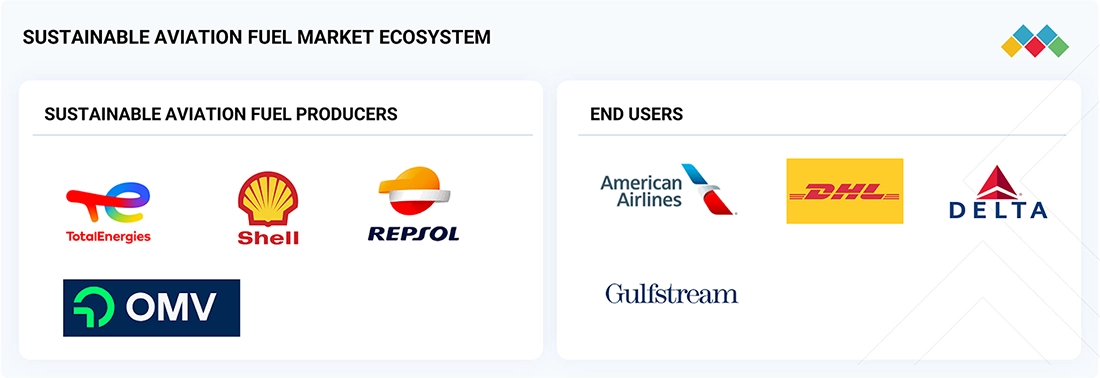
SUSTAINABLE AVIATION FUEL (BIOFUEL) MARKET SIZE, SHARE & ANALYSIS, 2025 TO 2030: COMMERCIAL USE CASES ACROSS INDUSTRIES
| COMPANY | USE CASE DESCRIPTION | BENEFITS |
|---|---|---|
 |
Production of sustainable aviation fuel from renewable waste oils and residue feedstocks for commercial aviation operations | Helps airlines reduce carbon emissions, supports sustainability targets, and improves renewable fuel availability |
 |
Development of renewable aviation fuel production facilities and fuel supply solutions for the aviation sector | Strengthens low-emission aviation operations, improves fuel supply capacity, and supports cleaner air transport activities |
 |
Production of sustainable aviation fuel for commercial airlines through renewable fuel refining operations | Supports carbon emission reduction goals, improves sustainable fuel adoption, and increases renewable fuel supply |
 |
Development of bio-refineries for sustainable aviation fuel production | Improves renewable fuel production efficiency, supports low-carbon aviation operations, and strengthens fuel availability |
 |
using renewable feedstock materials |
Logos and trademarks shown above are the property of their respective owners. Their use here is for informational and illustrative purposes only.
Related Ecosystem
Key Takeaways
- Canada's SAF market will grow from $56.4M (2026) to $783.6M (2031), representing a 69.3% CAGR.
- Canada's abundant biomass resources and refining infrastructure position it as a North American SAF production leader.
- Regulatory mandates and airline net-zero commitments are primary growth catalysts for Canada's SAF adoption.
- Canada's market growth rate significantly exceeds the global average, reflecting strong domestic policy support and investment.
Sustainable Aviation Fuel Market Report Scope
| Report Metric | Details |
|---|---|
| Base Year | 2026 |
| Fastest Growing Segment | MILITARY AIRCRAFT (Platform) |
| Forecast Period | 2026–2031 |
| Growth Rate | CAGR of 45.3% from 2026 to 2031 |
| Largest Segment | BIO-BASED (Fuel Type) |
| Market Size Base Year (Billions) | ~USD 4.86 (2026) |
| Revenue Forecast (Billions) | ~USD 31.45 (2031) |
| Segments Covered | Biofuel Conversion Pathway, Blending Capacity, Fuel Type, Platform, Feedstock Type, Ft Biofuel Conversion Pathway, Hefa Biofuel Conversion Pathway, Atj Biofuel Conversion Pathway, Biofuel Blending Capacity |
Canada Sustainable Aviation Fuel Market Report Segmentation
9 segment dimensions are covered across the global market.
By Biofuel Conversion Pathway
- Alcohol-To-Jet (Atj)
- Atj-Ska
- Atj-Spk
- Catalytic Hydrothermolysis Jet (Chj)
- Co-Processing
- Fischer-Tropsch (Ft)
- Ft-Spk
- Ft-Spk/A
- Hc-Hefa-Spk
- Hefa-Spk
- Hfs-Sip
- Hydroprocessed Esters & Fatty Acids (Hefa)
By Blending Capacity
- 10–30%
- <10%
- >30%
By Fuel Type
- Bio-Based
- Hydrogen
- Synthetic
By Platform
- Business & General Aviation
- Commercial Aircraft
- Military Aircraft
- Unmanned Aerial Vehicles (Uavs)
By Feedstock Type
- Agricultural Residues
- Algae & Advanced Feedstocks
- Forestry Residues
- Municipal Solid Waste (Msw)
- Renewable Electricity & Co2
- Sugarcane & Ethanol-Based Feedstocks
- Used Cooking Oil (Uci)
By Ft Biofuel Conversion Pathway
- Ft-Spk
- Ft-Spk/A
By Hefa Biofuel Conversion Pathway
- Hc-Hefa-Spk
- Hefa-Spk
- Hfs-Sip
By Atj Biofuel Conversion Pathway
- Atj-Ska
- Atj-Spk
By Biofuel Blending Capacity
- 10–30%
- <10%
- >30%
Target Audience
- Aviation Fuel Producers & Refineries : Need market sizing and growth forecasts to justify SAF production capacity investments and identify optimal entry points into Canada's rapidly expanding sustainable fuel market.
- Airlines & Aviation Operators : Require supply chain insights and market availability data to plan SAF procurement strategies, meet regulatory mandates, and achieve corporate sustainability targets in Canada.
- Investment & Private Equity Firms : Seek validated market data and growth projections to evaluate investment opportunities in Canadian SAF producers, infrastructure developers, and technology innovators.
- Government & Policy Makers : Need market intelligence to inform aviation decarbonization policies, incentive programs, and infrastructure investments that support Canada's sustainability commitments.
- Technology & Equipment Suppliers : Require market demand forecasts and industry trends to develop and commercialize SAF production technologies, distribution systems, and aviation fuel handling solutions for the Canadian market.
Reasons to Buy this Report
- Market Size & Growth Validation : Obtain precise market valuation data for Canada's SAF sector with verified forecasts through 2031, enabling accurate business planning and investment decisions specific to the Canadian market.
- Competitive Intelligence : Identify key market players, emerging competitors, and strategic partnerships within Canada's SAF ecosystem to benchmark your position and uncover partnership or acquisition opportunities.
- Regulatory & Policy Insights : Understand Canada's federal sustainability commitments, aviation decarbonization targets, and compliance requirements that directly impact market dynamics and business strategy.
- Investment & Expansion Strategy : Leverage detailed market segmentation and regional demand analysis to identify high-growth opportunities for production facilities, distribution networks, and technology deployment in Canada.
- Stakeholder Alignment : Access comprehensive data on Canadian airlines, fuel producers, and government initiatives to align partnerships, secure contracts, and demonstrate market credibility to investors and stakeholders.
Frequently asked questions
What is the projected size of Canada's SAF market by 2031?
Canada's Sustainable Aviation Fuel market is projected to reach $783.6 million by 2031, growing from $56.4 million in 2026.
What is Canada's SAF market CAGR?
Canada's SAF market is expected to grow at a compound annual growth rate of 69.3% between 2026 and 2031.
What are the primary drivers of growth in Canada's SAF market?
Canada's SAF market growth is driven by federal sustainability commitments, airline net-zero pledges, government incentives for renewable fuel development, and increasing regulatory requirements for aviation decarbonization.
Why is Canada well-positioned for SAF production?
Canada possesses abundant biomass resources, established refining infrastructure, and strong government support for sustainable fuel development, making it competitive for SAF manufacturing and supply.
How does Canada's SAF market growth compare to global trends?
Canada's 69.3% CAGR significantly exceeds the global average of 45.3%, reflecting stronger domestic policy support, regulatory frameworks, and investment in sustainable aviation fuel development.
RESEARCH METHODOLOGY
The study followed four main steps to estimate the size of the sustainable aviation fuel market. Secondary research was conducted to collect data on sustainable aviation fuel production technologies, renewable feedstocks, refinery operations, fuel supply agreements, and aviation decarbonization initiatives across major countries. These findings were validated through primary interviews with fuel producers, airport operators, OEMs, and industry experts. The research analyzed renewable fuel production capacity, government regulations, blending mandates, investment activities, and technological advancements to assess market demand. Market estimates were then segmented by biofuel conversion pathway, blending capacity, fuel type, platform, and feedstock type. Data triangulation was applied to validate the final figures for each segment and subsegment.
Secondary Research
Secondary research was conducted to build the foundation for this study. Data was collected from renewable fuel reports, aviation industry publications, government sustainability policies, fuel production companies, and regulatory bodies related to sustainable aviation fuel. Company information was reviewed through annual reports, product documents, press releases, and investor presentations of sustainable aviation fuel producers and aviation companies. The study also examined industry articles, white papers, and research studies related to renewable feedstocks, biofuel conversion technologies, fuel blending methods, and aviation decarbonization initiatives. Additional insights were gathered from industry associations and market platforms to analyze market trends, technology developments, and sustainable aviation fuel adoption patterns.
Primary Research
Primary research was conducted after key insights from secondary analysis were identified. The study team engaged with executives, refinery operators, fuel suppliers, airline representatives, OEMs (Original Equipment Manufacturers), and industry experts involved in the sustainable aviation fuel ecosystem. Discussions included sustainable aviation fuel producers, aviation companies, airport operators, feedstock suppliers, and regulatory stakeholders across major markets. Interviews were conducted through calls and written correspondence to validate market size estimates, production trends, customer requirements, and fuel adoption strategies. These inputs helped refine perspectives on competition, technology development, supply chain activities, and investment trends while improving overall data accuracy.
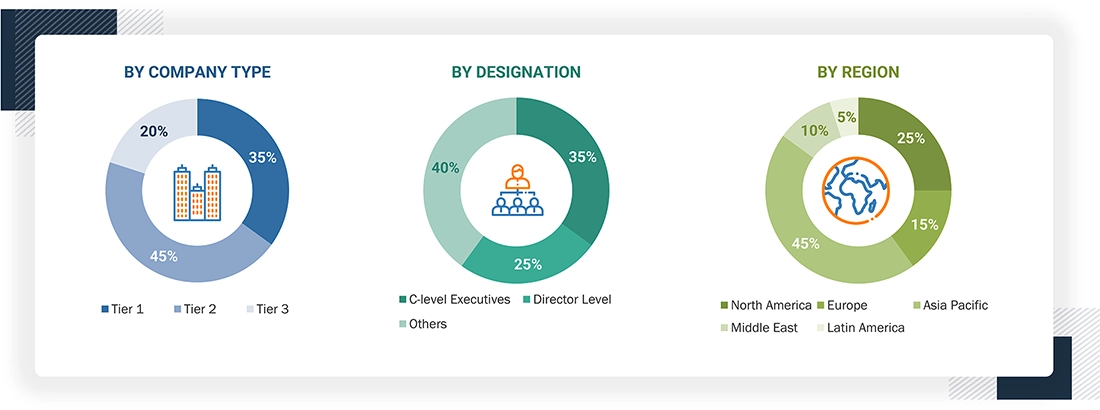
To know about the assumptions considered for the study, download the pdf brochure
Market Size Estimation
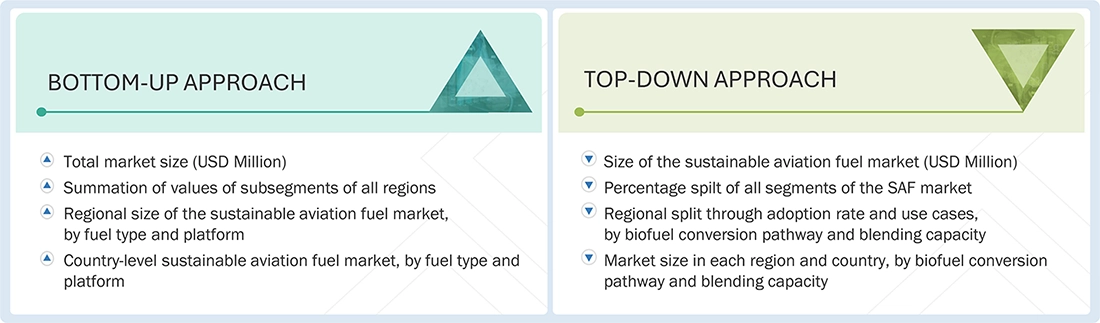
The top-down and bottom-up methods were used to estimate and validate the size of the sustainable aviation fuel market. The research process involved several steps to ensure accuracy.
- Key companies active in the sustainable aviation fuel market were identified through secondary research. Their market share was evaluated using a combination of primary inputs and published data. This included reviewing annual reports, financial disclosures, certification updates, and public filings from various organizations. Interviews were also conducted with industry participants such as company executives, program managers, operators, infrastructure providers, and aviation experts. These inputs were used to validate assumptions and refine market size estimates across regions.
- All percentage shares, segment splits, and market breakdowns were first developed using secondary information. These values were then verified through primary discussions with industry participants.
- The analysis evaluated key factors shaping the sustainable aviation fuel market, including defense spending trends, sustainable aviation fuel procurement programs, autonomous technology developments, payload integration capabilities, and surveillance requirements. Each factor was assessed through primary research and used to develop both quantitative and qualitative market estimates for this report.
Sustainable Aviation Fuel Market : Top-Down and Bottom-Up Approach
Data Triangulation
After determining the overall market size, the total market was divided into multiple segments and subsegments. The data triangulation and market breakdown procedures described below were carried out, where applicable, to complete the overall market analysis and determine the estimated market figures for the segments and subsegments. The data was triangulated by examining various factors and trends from both demand and supply sides. Additionally, the market size was validated using the top-down and bottom-up approaches.
Market Definition
The sustainable aviation fuel (SAF) market encompasses sustainable and low-carbon aviation fuels developed, produced, blended, distributed, and utilized as alternatives to conventional fossil-based jet fuel across commercial, military, business, and unmanned aviation platforms. These fuels are designed to reduce lifecycle greenhouse gas (GHG) emissions while supporting long-term aviation decarbonization, energy diversification, and regulatory sustainability targets. SAF solutions include bio-based fuels, synthetic e-fuels, and emerging hydrogen-based aviation fuels compatible with evolving aircraft propulsion technologies and airport fueling ecosystems.
Modern sustainable aviation fuel solutions are developed using multiple advanced feedstocks, conversion pathways, and fuel production technologies such as hydroprocessed esters and fatty acids (HEFA), Fischer-Tropsch (FT), alcohol-to-jet (ATJ), catalytic hydrothermolysis jet (CHJ), co-processing, and synthetic power-to-liquid (PtL) e-fuel systems. These fuels are produced from feedstocks including used cooking oil (UCO), agricultural residues, municipal solid waste (MSW), forestry residues, algae, ethanol-based sources, renewable electricity, and captured carbon dioxide (CO2). SAF deployment varies significantly based on fuel certification limits, blending capacities, feedstock availability, production economics, refinery infrastructure, regulatory incentives, and airline sustainability commitments.
As the aviation industry globally transitions toward net-zero emission targets and energy-resilient aviation ecosystems, sustainable aviation fuel is increasingly becoming a critical pillar of aviation decarbonization strategies. These fuels enable airlines, military operators, governments, and aviation stakeholders to reduce carbon emissions without requiring immediate replacement of existing aircraft fleets, while supporting long-term environmental compliance, fuel security, and sustainable aviation operations across both developed and emerging economies.
Key Stakeholders
- Airlines implementing sustainable aviation fuel adoption programs to reduce aviation emissions
- Sustainable aviation fuel manufacturers producing renewable aviation fuels from bio-based and waste feedstocks
- OEMs supporting fuel compatibility and aviation technology integration
- Refinery operators and fuel processing companies developing biofuel conversion and blending technologies
- Feedstock suppliers providing agricultural waste, used cooking oil, municipal waste, and other renewable raw materials
- Airport operators and aviation fuel distributors supporting sustainable aviation fuel storage, blending, and supply infrastructure
- Government organizations responsible for aviation emission regulations, fuel standards, and sustainability policies
- Maintenance, repair, and overhaul (MRO) service providers supporting fuel handling and operational integration
- Research institutions and industry associations supporting renewable fuel innovation and technology development
- Investment firms and energy companies funding renewable fuel production facilities and infrastructure expansion
Report Objectives
- To define, describe, and forecast the size of the sustainable aviation fuel market based on biofuel conversion pathway, blending capacity, fuel type, platform, and feedstock type
- To forecast the size of market segments with respect to key countries in the following regions: North America, Europe, Asia Pacific, the Middle East, and Latin America
- To identify and analyze drivers, restraints, opportunities, and challenges influencing the growth of the market
- To identify industry trends, market trends, and technology trends currently prevailing in the market
- To provide an overview of the regulatory landscape with respect to global sustainable aviation fuel market regulations
- To analyze micromarkets with respect to individual growth trends, prospects, and their contribution to the overall market
- To analyze opportunities in the market for stakeholders by identifying key market trends
- To profile key market players and comprehensively analyze their market share and core competencies
- To analyze the degree of competition in the market by identifying growth strategies, such as agreements, acquisitions, partnerships, collaborations, and product launches, adopted by leading market players
- To identify detailed financial positions, key products, and unique selling points of leading market players
Available customizations:
MarketsandMarkets offers the following customizations for this market report:
- Additional country-level analysis of the sustainable aviation fuel market
- Profiling of other market players (up to 5)
Product Analysis
-
Product matrix, which provides a detailed comparison of the product portfolio of each company in the sustainable aviation fuel market
Get the Full Sustainable Aviation Fuel Market Report
Full forecast, segment splits, and company analysis for all Sustainable Aviation Fuel Market.
- US Sustainable Aviation Fuel Market
- UK Sustainable Aviation Fuel Market
- France Sustainable Aviation Fuel Market
- Germany Sustainable Aviation Fuel Market
- Denmark Sustainable Aviation Fuel Market
- Finland Sustainable Aviation Fuel Market
- India Sustainable Aviation Fuel Market
- Australia Sustainable Aviation Fuel Market
- South Korea Sustainable Aviation Fuel Market
- Japan Sustainable Aviation Fuel Market
- China Sustainable Aviation Fuel Market
- Singapore Sustainable Aviation Fuel Market
- UAE Sustainable Aviation Fuel Market
- Qatar Sustainable Aviation Fuel Market
- Bahrain Sustainable Aviation Fuel Market
- Brazil Sustainable Aviation Fuel Market
- Mexico Sustainable Aviation Fuel Market
- Rest Of Europe Sustainable Aviation Fuel Market
- Rest Of Asia Pacific Sustainable Aviation Fuel Market
Need a Tailored Report?
Customize this report to your needs
Get 10% FREE Customization
Customize This Report
