
France SUV Market (2025-2030)

The France SUV Market was valued at $23150 Million in 2025 and projected to reach to $34420 Million by 2030, representing a compound annual growth rate of 5.8%. France's SUV market is poised for sustained growth through 2030, driven by shifting consumer preferences toward versatile, technology-enabled vehicles that align with modern lifestyle requirements.


| Market Size in | USD 26.32 MN |
| Market Forecast in | |
| CAGR | |
| Forecast Period | |
| Units Considered | Value (USD MN) |
France SUV Market Trends and Insights
- This expansion reflects France's increasing consumer preference for sport utility vehicles, driven by evolving lifestyle demands and enhanced vehicle technology.
- France's automotive sector is capitalizing on the SUV segment's momentum as buyers prioritize versatility, safety features, and premium comfort offerings. The French SUV market's trajectory from 2025 to 2030 demonstrates strong market fundamentals and sustained demand across multiple consumer segments.
- France's position within Europe's competitive automotive landscape positions the country as a key growth market, with domestic and international manufacturers investing in SUV portfolios tailored to French consumer preferences.
- France's regulatory environment and emphasis on sustainable mobility are shaping product innovation, with electric and hybrid SUVs gaining traction alongside traditional powertrains..
Key Market Statistics
- CAGR (2025-2030) 5.8% CAGR
- Market Size, 2025 ~USD 23150 Million
- Forecast, 2030 ~USD 34420 Million
- Country France
France SUV Market Overview
Market Valuation Growth :
France's SUV market is valued at $23,150 million in 2025 and is projected to reach $34,420 million by 2030, demonstrating strong market expansion and investor confidence in the segment.
Above-Global Growth Rate :
France's SUV market CAGR of 5.8% outpaces the global average of 5.1%, indicating that French consumers are adopting SUVs at a faster rate than the worldwide market trend.
Consumer Preference Shift :
French automotive buyers are increasingly favoring sport utility vehicles due to evolving lifestyle demands, improved safety features, and advanced vehicle technology that modern SUVs offer.
Automotive Sector Momentum :
France's automotive industry is leveraging technological innovations and market dynamics to capitalize on the growing SUV segment, positioning the country as a key growth market in Europe.
France SUV Market Dynamics
- The market's 5.8% CAGR reflects strong demand fundamentals and increasing purchasing power among French consumers seeking premium SUV offerings.
- Automotive manufacturers are responding with enhanced product portfolios, electric SUV variants, and advanced connectivity features tailored to French market preferences. The forecast expansion to $34,420 million by 2030 underscores France's strategic importance within the European automotive landscape.
- Government incentives for vehicle modernization, coupled with growing environmental consciousness driving demand for efficient SUVs, will further accelerate market penetration.
- Competitive dynamics among domestic and international manufacturers will intensify, fostering innovation and creating opportunities for market participants across the value chain..
Market Ecosystem
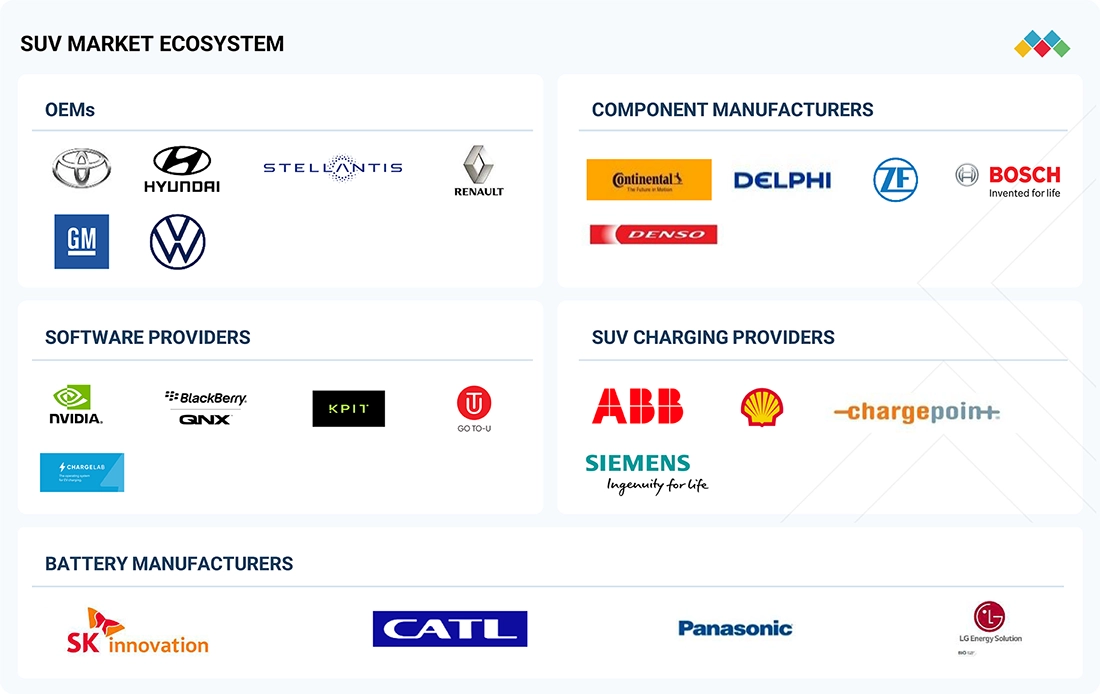
suv-market-trend-analysis: COMMERCIAL USE CASES ACROSS INDUSTRIES
| COMPANY | USE CASE DESCRIPTION | BENEFITS |
|---|---|---|
 |
Design and supply of SUV-specific components, including high-strength body structures, lightweight chassis modules, thermal systems, braking systems, batteries, motors, ADAS hardware, lighting systems, interiors, and ride/handling components | Improve SUV performance, safety, and durability | Enable electrification and weight reduction | Support higher range and efficiency | Enhance comfort, NVH, and premium differentiation across segments |
 |
Deploy public fast chargers, home chargers, and ultra-fast highway charging for long-range SUVs | Reduce range anxiety, enable long-distance travel, support EV SUV adoption, improve charging convenience and reliability |
 |
Develop and launch electric, hybrid, and premium SUVs, as well as integrate ADAS, connectivity, and long-range battery systems | Accelerate electrification | Improve profitability | Differentiate through technology | Enhance safety and user experience |
 |
Develop and integrate ADAS Level 2+, connectivity platforms, digital cockpit systems, battery-management software, predictive maintenance, OTA update frameworks, and vehicle-to-cloud data services for electric and premium SUVs | Enhance vehicle safety and autonomy | Improve energy efficiency and battery health | Enable OTA-based feature upgrades | Reduce warranty costs | Strengthen user experience | Support differentiation in premium and mass-market SUV segments |
Logos and trademarks shown above are the property of their respective owners. Their use here is for informational and illustrative purposes only.
Related Ecosystem
On Highway Off Highway Vehicles
- Internal Combustion Engine (ICE)
- Agricultural Tractors
- Crawler Excavator
- Battery Electric Vehicle (BEV)
- Excavators
- Visteon Corporation
- Deere & Company
- AB VOLVO PENTA
- Honda Motor Co., Ltd.
- Komatsu Ltd.
Key Takeaways
- France's SUV market will grow from $23.15B (2025) to $34.42B (2030) at a 5.8% CAGR, outpacing global growth.
- Consumer demand in France is shifting toward SUVs due to preferences for versatility, safety, and advanced technology features.
- France's regulatory focus on sustainability is accelerating adoption of electric and hybrid SUVs in the market.
- France represents a strategic growth opportunity for both domestic and international automotive manufacturers through 2030.
SUV Market Report Scope
| Report Metric | Details |
|---|---|
| Base Year | 2025 |
| Fastest Growing Segment | ELECTRIC (Propulsion) |
| Forecast Period | 2025–2030 |
| Growth Rate | CAGR of 5.1% from 2025 to 2030 |
| Largest Segment | GASOLINE (Propulsion) |
| Market Size Base Year (Billions) | ~USD 1181.48 (2025) |
| Revenue Forecast (Billions) | ~USD 1515.09 (2030) |
| Segments Covered | Type, Class, Seating Capacity, Propulsion |
France SUV Market Report Segmentation
4 segment dimensions are covered across the global market.
By Type
- Bev
- Compact
- Fcev
- Full-Size
- Mid-Size
- Mini
- Mpv/Muv
- Muv/Mpv
- Phev
By Class
- Class B
- Class C
- Class D
- Class E
By Seating Capacity
- 5-Seater
- >5-Seater
By Propulsion
- Diesel
- Electric
- Gasoline
Target Audience
- Automotive Manufacturers : OEMs and SUV producers need France-specific market data to assess market opportunity, benchmark competitive positioning, and develop localized product strategies for the high-growth French segment.
- Investment & Private Equity Firms : Investors evaluating automotive sector opportunities require detailed France market metrics and growth forecasts to identify acquisition targets, assess portfolio companies, and justify capital deployment decisions.
- Market Entry & Expansion Teams : Companies planning market entry or expansion in France need granular market sizing, growth rates, and consumer insights to develop business cases, set realistic revenue targets, and allocate resources effectively.
- Supply Chain & Logistics Providers : Suppliers and logistics operators require France SUV market data to forecast demand, plan capacity investments, optimize distribution networks, and identify partnership opportunities with growing manufacturers.
- Market Research & Strategy Consultants : Consulting firms and research teams need validated France market data to support client engagements, develop strategic recommendations, and provide competitive benchmarking for automotive clients.
Key Companies in the France SUV Market
| Company | HQ | Ownership | Strongest segments |
|---|---|---|---|
| TOYOTA MOTOR CORPORATION | Japan | Public Company | Conventional ICE passenger vehicles (Toyota and Lexus),Hybrid and battery electric vehicles plus batteries,Financial Services (retail and wholesale financing, leasing, insurance, credit cards), |
| HONDA MOTOR CO., LTD. | Japan | Public Company | Automobile Business,Motorcycle Business,Financial Services Business, |
| HYUNDAI MOTOR COMPANY | South Korea | Public Company | Passenger cars (sedans/hatchbacks),SUVs and crossovers,Eco and EV (IONIQ, hybrids, NEXO, KONA Electric), |
| GENERAL MOTORS | United States | Public Company | Trucks & Full-size SUVs,Crossovers & Mid-size SUVs,Cars (Sedans & Compacts), |
| FORD MOTOR COMPANY | United States | Public Company | Ford Blue (ICE and hybrid Ford-branded vehicles, parts, accessories),Ford Pro (commercial vehicles, services, telematics, charging),Ford Model e (EVs, software, digital services), |
| MERCEDES-BENZ | Germany | Public Company | Mercedes-Benz Cars (ICE and hybrid),Battery-Electric Cars (EQ and successors),Mercedes-Benz Vans, |
TOYOTA MOTOR CORPORATION
Toyota Motor Corporation is a Japanese automotive manufacturer founded in 1933 that employs 390,927 people and produces vehicles, engines, and automotive components globally.
HONDA MOTOR CO., LTD.
Honda Motor Co., Ltd. is a Japanese public company founded in 1946 with 195,109 employees that manufactures motorcycles, automobiles, and power equipment.
HYUNDAI MOTOR COMPANY
Hyundai Motor Company is a South Korean automotive manufacturer founded in 1967 that designs, manufactures, and sells passenger vehicles and commercial vehicles worldwide.
GENERAL MOTORS
General Motors is an American automotive manufacturer founded in 1908 with 156,000 employees that produces cars, trucks, and automotive systems.
FORD MOTOR COMPANY
Ford Motor Company is an American automotive manufacturer founded in 1903 with 169,000 employees that produces passenger vehicles, commercial vehicles, and automotive parts.
MERCEDES-BENZ
Mercedes-Benz is a German luxury automotive manufacturer founded in 1886 with 158,324 employees that produces premium cars, commercial vehicles, and automotive systems.
Reasons to Buy this Report
- Precise Market Sizing : Access validated market valuations for France's SUV segment with exact figures for 2025 ($23,150M) and 2030 forecasts ($34,420M), enabling accurate financial planning and investment decisions.
- Competitive Intelligence : Understand France-specific growth dynamics and consumer preferences that differentiate the market from global trends, providing strategic advantages in market positioning and product development.
- Investment Decision Support : Leverage the 5.8% CAGR data and market expansion projections to evaluate France as a priority market for capital allocation, manufacturing expansion, or distribution network development.
- Consumer Insight Clarity : Gain detailed understanding of French consumer behavior shifts toward SUVs, including lifestyle drivers and technology preferences, to inform marketing strategies and product customization.
- Regulatory & Market Context : Receive France-specific market analysis that accounts for local automotive regulations, government incentives, and competitive landscape to mitigate market entry risks and optimize go-to-market strategies.
Frequently asked questions
What is the current size of France's SUV market?
France's SUV market is valued at $23,150 million in 2025 and is projected to reach $34,420 million by 2030.
What is the growth rate of France's SUV market?
France's SUV market is expected to grow at a compound annual growth rate (CAGR) of 5.8% from 2025 to 2030.
What factors are driving SUV demand in France?
Key drivers include consumer preference for versatility and safety, advanced technology features, and increasing adoption of electric and hybrid powertrains aligned with France's sustainability regulations.
How does France's SUV market compare to global trends?
France's SUV market CAGR of 5.8% exceeds the global average of 5.1%, indicating stronger growth momentum in the French market through 2030.
What role does sustainability play in France's SUV market?
France's regulatory environment and emphasis on sustainable mobility are driving significant growth in electric and hybrid SUV segments, reshaping manufacturer product strategies.
RESEARCH METHODOLOGY
The research study involved extensive use of secondary sources such as company annual reports/presentations, industry association publications, magazines, directories, technical handbooks, World Economic Outlook, trade websites, technical articles, and databases to identify and collect information on the SUV market. In-depth interviews were conducted with various primary sources, including experts from related industry players, component suppliers, and automotive OEMs, to obtain and verify critical information and assess the growth prospects and market estimations.
Secondary Research
During secondary research, various secondary sources were used to identify and collect information on the SUV market. Secondary sources referred to for this research study include automobile organizations (OICA, CAAM, JAMA, ACEA, etc.), regulatory bodies, corporate filings (annual reports, investor presentations, and financial statements), and trade, business, and automotive associations. Secondary data has been collected and analyzed to arrive at the overall market size, which has been further validated through primary research.
Primary Research
Extensive primary research has been conducted after acquiring an understanding of the SUV market scenario through secondary research. Several primary interviews were conducted with market experts from both the demand (automotive OEMs) and supply (SUV component manufacturers and distributors) sides across four major regions, namely North America, Europe, Asia Pacific, and the Rest of the World. Approximately 90% primary interviews were conducted from the demand side and 10% from the supply side. Primary data has been collected through questionnaires, emails, and telephonic interviews.
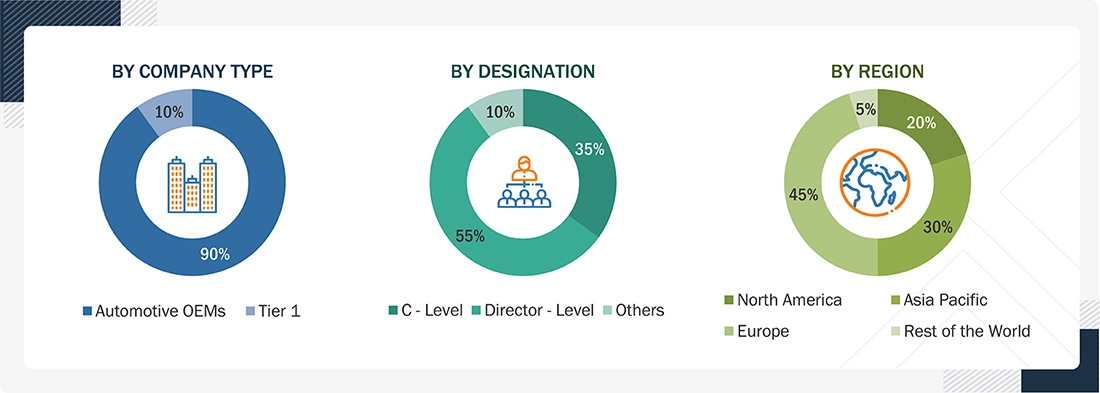
To know about the assumptions considered for the study, download the pdf brochure
Market Size Estimation
A detailed market estimation approach was followed to estimate and validate the size of the SUV market and other dependent submarkets, as mentioned below:
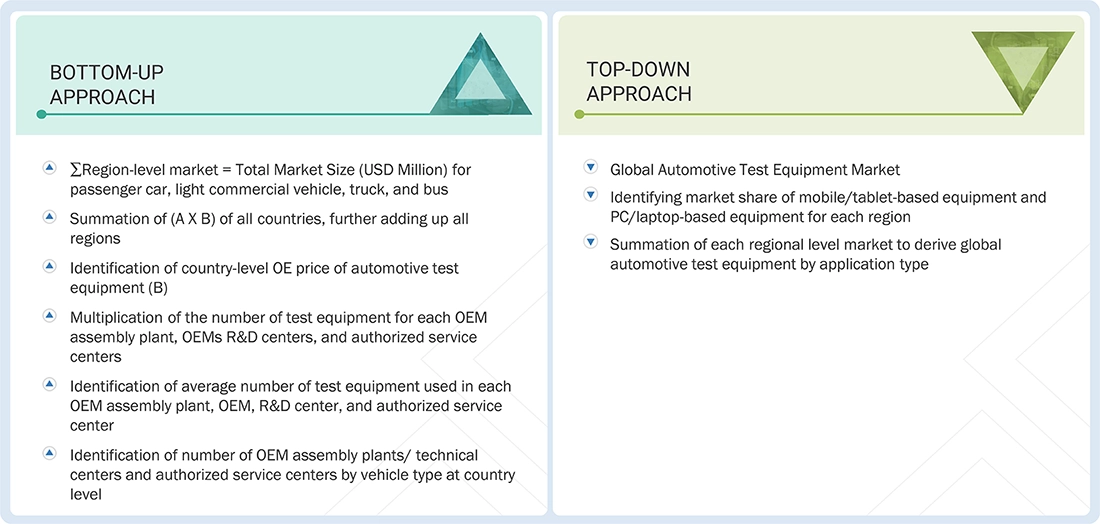
Bottom-up Approach
- Key players in the SUV market were identified through secondary research, and their global market share was determined through primary and secondary research.
- The research methodology included the study of country-level penetration share of SUV production, by type (mini, compact, mid-size, full-size, and MPV/MUV). These penetrations have been derived through secondary sources and validated through primary interviews.
- At the country level, the penetration of each SUV type is multiplied by the total SUV production numbers to estimate the volume of the SUV market by type (ICE).
- The average selling price of each SUV type is derived at the country level from OEM websites.
- It is then multiplied by the volume of the country-level SUV market by type to derive the country-level market in terms of value.
- The summation of country-level markets provides the regional-level SUV market, by type, in terms of volume and value.
- All major penetration rates, percentage shares, splits, and breakdowns for the vehicle type of the SUV market were determined by using secondary sources and verified through primary sources.
- All key macro indicators affecting the revenue growth of the market segments and subsegments were accounted for, viewed in extensive detail, verified through primary research, and analyzed to get the validated and verified quantitative & qualitative data.
- The gathered market data was consolidated and added with detailed inputs, analyzed, and presented in this report.
SUV Market : Top-Down and Bottom-Up Approach
Data Triangulation
After arriving at the overall market size of the global SUV market through the above-mentioned methodology, this market was split into several segments and subsegments. The data triangulation and market breakdown procedures were employed, wherever applicable, to complete the overall market engineering process and arrive at the exact data for the market by value for key segments and subsegments. The extrapolated market data was triangulated by studying various macro indicators and regional trends from both the demand and supply participants.
Market Definition
A sport utility vehicle or SUV combines characteristics of both on- and off-road vehicles, such as increased ground clearance and four-wheel drive. SUVs are similar to station wagons or minivans, but they have a tough look and design suited for off-road activities.
According to KIA (South Korea), MPV stands for a multi-purpose vehicle. It is characterized by a spacious cabin and ample occupancy. MPV is considered a category under recreational vehicles.
According to KIA (Seoul, South Korea), a full-size SUV is distinguishable by its ability to tow large items, handle rough terrain, contain ample space for passengers and cargo, and have 3 rows of seats. A full-size SUV is distinctive compared to other SUV sizes and car classifications since it combines multiple characteristics into a single vehicle.
Key Stakeholders
- SUV manufacturers
- Automotive raw material suppliers
- R&D centers
- Associations, forums, and alliances related to automobiles
- Automobile organizations/associations
- EV component manufacturers
- EV manufacturers
- Government agencies and policymakers
- SUV traders and distributors
Report Objectives
-
To segment and forecast the size of the SUV market in terms of volume (thousand units) and value (USD million) from 2021 to 2032, based on
- Type (mini, compact, mid-size, full-size, MPV/MUV)
- Seating capacity (5-seater and >5-seater)
- Propulsion (diesel, gasoline, and electric)
- Class (B, C, D, and E)
- Electric & hybrid vehicle type (BEV, PHEV, and FCEV)
- Region (Asia Pacific, Europe, and Americas)
- To identify and analyze key drivers, restraints, opportunities, and challenges influencing market growth
- To strategically analyze markets with respect to individual growth trends, prospects, and contributions to the total market
- To strategically profile key players and comprehensively analyze their market share and core competencies
-
To study the following with respect to the market:
- Supply Chain Analysis
- Ecosystem Analysis
- Technology Analysis
- Trade Analysis
- Case Study Analysis
- Patent Analysis
- Regulatory Landscape
- Conferences and Events
- Key Stakeholders and Buying Criteria
- Investment and Funding Scenario
- To track and analyze competitive developments such as product launches, deals, and others undertaken by key market players
Get the Full SUV Market Report
Full forecast, segment splits, and company analysis for all SUV Market.
- China SUV Market
- India SUV Market
- Japan SUV Market
- South Korea SUV Market
- Indonesia SUV Market
- Germany SUV Market
- Italy SUV Market
- Spain SUV Market
- UK SUV Market
- Russia SUV Market
- Czech Republic SUV Market
- Canada SUV Market
- Mexico SUV Market
- Brazil SUV Market
- US SUV Market
- Rest Of Europe SUV Market
- Slovakia SUV Market
- Rest Of Asia Pacific SUV Market
Need a Tailored Report?
Customize this report to your needs
Get 10% FREE Customization
Customize This Report
