
Rest Of GCC Countries Synthetic Biology Market (2024-2029)

The Rest Of GCC Countries Synthetic Biology Market was valued at $5.5 Million in 2024 and projected to reach to $13.6 Million by 2029, representing a compound annual growth rate of 19.9%. Rest Of GCC Countries is positioned for significant synthetic biology market expansion through 2029, driven by strategic healthcare sector investments and growing biotechnology infrastructure.


| Market Size in | USD 26.32 MN |
| Market Forecast in | |
| CAGR | |
| Forecast Period | |
| Units Considered | Value (USD MN) |
Rest Of GCC Countries Synthetic Biology Market Trends and Insights
- Rest Of GCC Countries demonstrates strong momentum driven by increasing healthcare investments and biotechnology infrastructure development across the region.
- The 19.9% compound annual growth rate reflects Rest Of GCC Countries' commitment to advancing life sciences capabilities and fostering innovation in synthetic biology applications. Rest Of GCC Countries is positioning itself as an emerging hub for synthetic biology research and commercialization within the Middle East.
- The market growth in Rest Of GCC Countries is supported by government initiatives, private sector investments, and growing demand for advanced therapeutic solutions.
- Rest Of GCC Countries' strategic focus on diversifying its economy beyond traditional sectors is accelerating adoption of cutting-edge biotechnology platforms and synthetic biology-based drug development..
Key Market Statistics
- CAGR (2024-2029) 19.9% CAGR
- Market Size, 2024 ~USD 5.5 Million
- Forecast, 2029 ~USD 13.6 Million
- Country Rest Of GCC Countries
Rest Of GCC Countries Synthetic Biology Market Overview
Market Valuation Growth :
Rest Of GCC Countries synthetic biology market valued at $5.5 million in 2024, expanding to $13.6 million by 2029, representing a 19.9% CAGR and outpacing broader regional biotech adoption.
Healthcare Investment Surge :
Increased government and private sector healthcare investments across Rest Of GCC Countries are driving synthetic biology adoption, with focus on precision medicine and local biotech capability development.
Infrastructure Development :
Emerging biotechnology research centers and manufacturing facilities in Rest Of GCC Countries are establishing the foundation for sustainable synthetic biology ecosystem growth and innovation.
Regional Competitive Positioning :
Rest Of GCC Countries maintains strong growth momentum at 19.9% CAGR, slightly below global average of 20.6%, indicating accelerating market maturation and increasing regional biotech competitiveness.
Rest Of GCC Countries Synthetic Biology Market Dynamics
- Government initiatives supporting life sciences research and development are creating favorable conditions for market participants.
- The region's increasing focus on developing indigenous biotech capabilities and reducing dependency on imported solutions is accelerating adoption across pharmaceutical, diagnostics, and agricultural biotechnology segments. The 19.9% CAGR trajectory reflects strengthening demand for synthetic biology applications in personalized medicine and disease management.
- Emerging partnerships between regional healthcare institutions and international biotech firms are facilitating technology transfer and capability building.
- Continued investment in research facilities, regulatory framework development, and skilled workforce training will sustain market momentum, positioning Rest Of GCC Countries as an emerging hub for synthetic biology innovation within the broader Middle East region..
Market Ecosystem
Related Ecosystem
Advanced Genetic Sequencing
- Polymerase Chain Reaction (PCR)
- Reagents
- Assay Kits
- Bioinformatics
- Flow Cytometry
- Thermo Fisher Scientific Inc.
- Illumina, Inc.
- Agilent Technologies, Inc.
- Qiagen N.V.
- Danaher Corporation
Biotechnology
- Reagents
- Polymerase Chain Reaction (PCR)
- Stem Cells
- Assay Kits
- Flow Cytometers
- Thermo Fisher Scientific Inc.
- Merck KGaA
- Danaher Corporation
- Agilent Technologies, Inc.
- Bio-Rad Laboratories, Inc.
Key Takeaways
- Rest Of GCC Countries synthetic biology market valued at $5.5 million in 2024, expanding to $13.6 million by 2029
- Rest Of GCC Countries exhibits 19.9% CAGR, outpacing broader regional biotech adoption trends
- Rest Of GCC Countries government support and healthcare modernization initiatives drive market acceleration
- Rest Of GCC Countries emerging biotech ecosystem attracts regional and international synthetic biology investments
Synthetic Biology Market Report Scope
| Report Metric | Details |
|---|---|
| Base Year | 2024 |
| Fastest Growing Segment | GENOME ENGINEERING (Technology) |
| Forecast Period | 2024-2029 |
| Growth Rate | CAGR of 20.6% from 2024 to 2029 |
| Largest Segment | MEDICAL APPLICATIONS (Application) |
| Market Size Base Year (Billions) | ~USD 12.36 (2024) |
| Revenue Forecast (Billions) | ~USD 31.52 (2029) |
| Segments Covered | Tool, Technology, Application, Type, Industry |
Rest Of GCC Countries Synthetic Biology Market Report Segmentation
5 segment dimensions are covered across the global market.
By Tool
- Chassis Organisms
- Cloning Technology Kits
- Enzymes
- Oligonucleotides & Synthetic Dna
- Synthetic Cells
- Xeno Nucleic Acids
By Technology
- Bioinformatics
- Cloning
- Gene Synthesis
- Genome Engineering
- Measurement & Modeling
- Microfluidics
- Nanotechnology
- Sequencing
- Site-Directed Mutagenesis
By Application
- Environmental Applications
- Food, Animal Health, And Agricultural Applications
- Industrial Applications
- Medical Applications
By Type
- Artificial Tissue & Tissue Regeneration
- Biofuel & Renewable Energy
- Biofuels & Renewable Energy
- Biomaterials & Green Chemicals
- Bioremediation
- Biosensing
- Biosynthesis
- Cancer Detection & Diagnostics
- Drug Discovery & Therapeutics
- Flavors & Fragrances
- Industrial Enzymes
- Other Artificial Tissue & Tissue Regeneration Applications
- Other Consumer Care Products
- Other Drug Discovery & Therapeutic Applications
- Other Food, Animal Health, And Agricultural Applications
- Pharmaceuticals
- Skincare & Cosmetics
- Stem Cell Regulation
By Industry
- Consumer Care Industry
- Other Industries
- Paper Industry
- Textile Industry
Target Audience
- Biotech Companies & Startups : Evaluate market entry feasibility and growth potential in Rest Of GCC Countries, with actionable insights on healthcare demand, investment climate, and competitive landscape for synthetic biology solutions.
- Healthcare Investors & VCs : Assess investment opportunities in Rest Of GCC Countries' emerging synthetic biology sector, with detailed market sizing, growth projections, and sector-specific risk analysis for portfolio decisions.
- Pharmaceutical & Diagnostics Companies : Understand Rest Of GCC Countries' market demand for synthetic biology applications in drug development and diagnostics, enabling informed expansion and partnership strategies in the region.
- Government & Policy Makers : Leverage market intelligence to develop evidence-based biotechnology policies, research funding priorities, and healthcare innovation strategies tailored to Rest Of GCC Countries' development goals.
- Research Institutions & Academics : Identify collaboration and commercialization opportunities within Rest Of GCC Countries' growing synthetic biology ecosystem, supported by market data on funding availability and sector priorities.
Reasons to Buy this Report
- Market-Specific Growth Data : Access precise valuation metrics and forecasts exclusive to Rest Of GCC Countries, enabling accurate investment decisions and resource allocation for market entry or expansion strategies.
- Regional Investment Opportunities : Identify high-potential segments and emerging opportunities within Rest Of GCC Countries' synthetic biology landscape, supported by detailed market analysis and growth trajectory insights.
- Competitive Intelligence : Understand Rest Of GCC Countries' market positioning relative to global trends, with localized insights on healthcare infrastructure development and biotechnology ecosystem maturation.
- Strategic Planning Framework : Leverage comprehensive market data to develop targeted go-to-market strategies, partnership models, and investment timelines specific to Rest Of GCC Countries' unique market dynamics.
- Risk Mitigation : Reduce market entry risks through detailed understanding of Rest Of GCC Countries' regulatory environment, healthcare spending patterns, and biotechnology adoption rates across key sectors.
Frequently asked questions
What is the current market size of synthetic biology in Rest Of GCC Countries?
Rest Of GCC Countries synthetic biology market was valued at $5.5 million in 2024 and is projected to reach $13.6 million by 2029.
What is the expected growth rate for synthetic biology in Rest Of GCC Countries?
Rest Of GCC Countries synthetic biology market is expected to grow at a compound annual growth rate (CAGR) of 19.9% from 2024 to 2029.
What factors are driving synthetic biology market growth in Rest Of GCC Countries?
Rest Of GCC Countries market growth is driven by increased healthcare investments, government biotechnology initiatives, infrastructure development, and rising demand for advanced therapeutic solutions.
How does Rest Of GCC Countries synthetic biology market compare to the global market?
Rest Of GCC Countries CAGR of 19.9% is competitive with the global synthetic biology market CAGR of 20.6%, reflecting strong regional momentum and market maturation.
What opportunities exist for synthetic biology companies in Rest Of GCC Countries?
Rest Of GCC Countries offers opportunities in drug development, therapeutic innovation, biotech infrastructure partnerships, and government-backed research initiatives targeting healthcare advancement.
RESEARCH METHODOLOGY
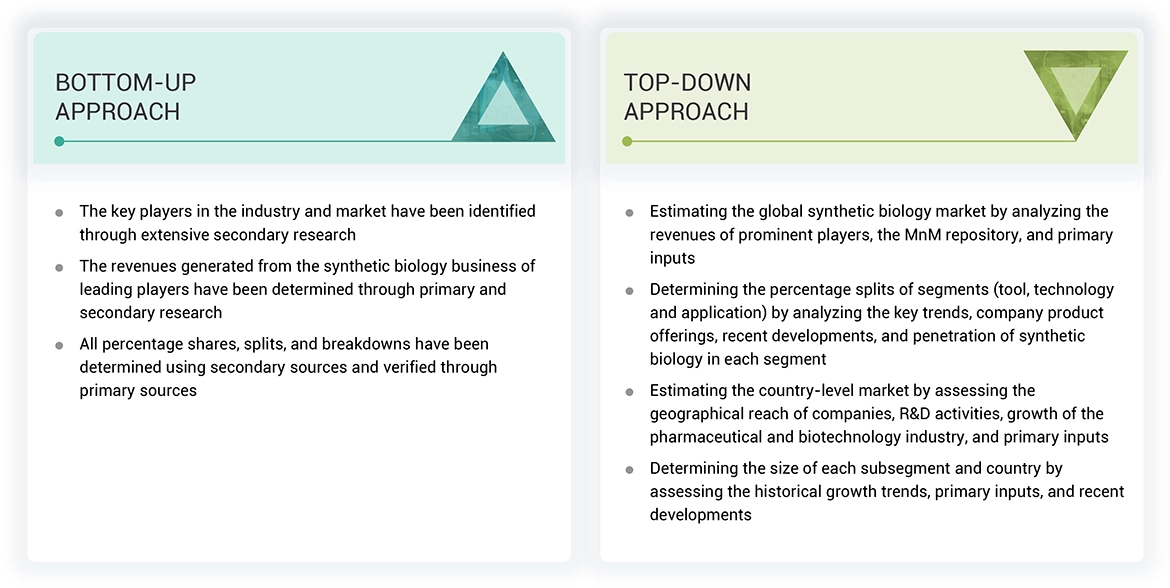
The research study involved the wide use of secondary sources, directories, and databases to identify and collect valuable information for the analysis of the global synthetic biology market. Extensive interviews were conducted with various primary participants, including key industry members, subject-matter experts (SMEs), C-level managers of leading market players, and industry consultants, to obtain and verify qualitative and quantitative information and evaluate the growth scenarios of the market. The global market size is estimated through secondary research (top-down and bottom-up) followed by data triangulation with inputs from industry experts to arrive at the final market size.
Secondary Research
Secondary research was used mainly to identify and collect information for the technical, market-oriented, and commercial study of the synthetic biology market. The secondary sources used for this study include World Health Organization (WHO), Organisation for Economic Co-operation and Development (OECD), Lens.org, National Center for Biotechnology Information (NCBI), Imperial College Centre for Synthetic Biology, Institute of Systems & Synthetic Biology (iSSB), University of California San Francisco (UCSF), Center for Systems and Synthetic Biology, Synthetic Biology Leadership Council (SBLC), Engineering Biology Advisory Committee, Synthetic Biology Engineering Research Center (SynBERC), Biotechnology and Biological Sciences Research Council (BBSRC), Helmholtz Association of German Research Centres, Asian Synthetic Biology Association, World Bank, Academic Journals and Company Websites, corporate & regulatory filings, such as annual reports, SEC filings, investor presentations, and financial statements; business magazines & research journals; press releases; and trade, business, and professional associations among others. These secondary sources were also used to obtain major information about key market players, and market segmentation corresponding to industry trends, regional/country-level markets, market developments, and technology prospects. Secondary data was collected and analysed to arrive at the market size of the global synthetic biology market, which was further validated through primary research.
Primary Research
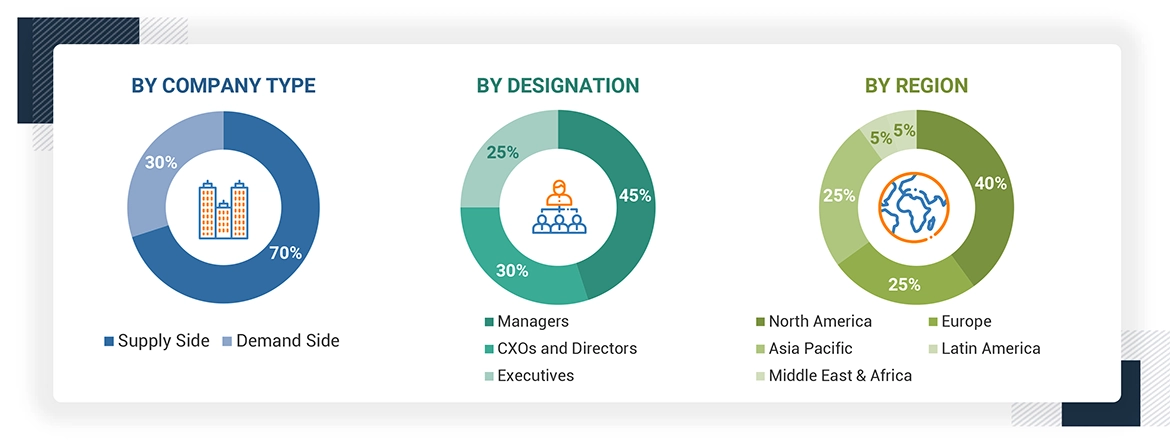
Extensive primary research was conducted after acquiring basic knowledge about the global synthetic biology market scenario through secondary research. Several primary interviews were conducted with market experts from the demand side, such as pharmaceutical & biopharmaceutical industries from the supply side, such as C-level and D-level executives, product managers, marketing & sales managers of key manufacturers, distributors, and channel partners. The primary interviews were conducted across six major regions, including the North America, Europe, Asia Pacific, Latin America, Middle East and Africa. Approximately 70% and 30% of the primary interviews were conducted with supply-side and demand-side participants, respectively. This primary data was collected through questionnaires, e-mails, online surveys, personal interviews, and telephonic interviews.
The following is a breakdown of the primary respondents:
To know about the assumptions considered for the study, download the pdf brochure
Market Size Estimation
Both top-down and bottom-up approaches were used to estimate and validate the total size of the synthetic biology market. These methods were also used extensively to estimate the size of various subsegments in the market. The research methodology used to estimate the market size includes the following:
Data Triangulation
After arriving at the market size from the market size estimation process explained above, the total market was divided into several segments and subsegments. To complete the overall market engineering process and arrive at the exact statistics for all segments and subsegments, data triangulation and market breakdown procedures were employed, wherever applicable. The data was triangulated by studying various factors and trends from both the demand and supply sides.
Market Definition
Synthetic biology involves the redesign of natural biological systems by engineering and designing new biological parts and functions, namely synthetic biological pathways and organisms, which are used to construct end products. It is an innovative research area broadly comprising of multiple disciplines, such as biotechnology, molecular biology, genetic engineering, and biophysics, among others.
Stakeholders
- Companies Providing Synthetic Biology Tools, Technologies, and Related Products & Services
- Research Institutes and Academic Centers
- Suppliers and Distributors of Synthetic Biology Tools & Technologies
- Pharmaceutical and Biotechnology Companies
- Agricultural and Veterinary companies
- Business Research and Consulting Service Providers
- Venture Capitalists
- Contract Research Organizations and Contract Development Manufacturing Organizations
- Market research and consulting firms
Report Objectives
- To define, describe, and forecast the synthetic biology market by value by tool, technology, application, and region
- To provide detailed information regarding the major factors influencing the market growth (such as drivers, restraints, opportunities, and challenges)
- To analyze the micromarkets1 with respect to individual growth trends, prospects, and contributions to the overall Synthetic biology market
- To analyze the opportunities for stakeholders and provide details of the competitive landscape for market leaders
- To forecast the size of the market segments with respect to six regions: North America, Europe, the Asia Pacific, Latin America, Middle East and Africa
- To profile the key players and analyze their market shares and core competencies2
- To track and analyze competitive developments, such as product launches, partnerships, agreements, collaborations, and expansions
- To benchmark players within the market using the proprietary “Company Evaluation Matrix” framework, which analyzes market players on various parameters within the broad categories of business and product excellence strategy
Get the Full Synthetic Biology Market Report
Full forecast, segment splits, and company analysis for all Synthetic Biology Market.
- Canada Synthetic Biology Market
- US Synthetic Biology Market
- Germany Synthetic Biology Market
- UK Synthetic Biology Market
- France Synthetic Biology Market
- Switzerland Synthetic Biology Market
- Denmark Synthetic Biology Market
- Italy Synthetic Biology Market
- Spain Synthetic Biology Market
- China Synthetic Biology Market
- Japan Synthetic Biology Market
- India Synthetic Biology Market
- Australia Synthetic Biology Market
- South Korea Synthetic Biology Market
- Brazil Synthetic Biology Market
- Mexico Synthetic Biology Market
- UAE Synthetic Biology Market
- Rest Of Europe Synthetic Biology Market
- Rest Of Asia Pacific Synthetic Biology Market
- Rest Of Latin America Synthetic Biology Market
- GCC Countries Synthetic Biology Market
- Rest Of Middle East Synthetic Biology Market
- Ksa Synthetic Biology Market
Need a Tailored Report?
Customize this report to your needs
Get 10% FREE Customization
Customize This Report
