
Europe Synthetic Biology Market (2024-2029)

The Europe Synthetic Biology Market was valued at $3600.3 Million in 2024 and projected to reach to $8967.1 Million by 2029, representing a compound annual growth rate of 20.0%. Europe's synthetic biology market is poised for substantial growth, driven by strong government support, world-class research institutions, and a collaborative biotech ecosystem.


| Market Size in | USD 26.32 MN |
| Market Forecast in | |
| CAGR | |
| Forecast Period | |
| Units Considered | Value (USD MN) |
Europe Synthetic Biology Market Trends and Insights
- This 20.0% compound annual growth rate reflects Europe's strong commitment to biotechnology innovation, regulatory frameworks, and research infrastructure.
- Europe is positioning itself as a global leader in synthetic biology applications across therapeutics, diagnostics, and industrial biotech. The European market benefits from substantial government funding, collaborative research initiatives, and a mature healthcare ecosystem.
- Europe's emphasis on precision medicine and sustainable biomanufacturing is driving adoption across pharmaceutical and agricultural sectors.
- By 2029, Europe is expected to capture significant market share through advances in gene editing, cell engineering, and biofabrication technologies. Key European markets including Germany, the United Kingdom, and France are spearheading innovation in synthetic biology.
- Europe's regulatory clarity and intellectual property protections continue to attract investment and accelerate commercialization of synthetic biology solutions through 2029..
Key Market Statistics
- CAGR (2024-2029) 20.0% CAGR
- Market Size, 2024 ~USD 3600.3 Million
- Forecast, 2029 ~USD 8967.1 Million
- Geography Europe
Europe Synthetic Biology Market Overview
Market Leadership Position :
Europe commands a significant share of the global synthetic biology market, valued at $3,600.3 million in 2024. With a 20.0% CAGR through 2029, Europe is establishing itself as a key innovation hub alongside North America, driven by advanced research institutions and biotech clusters.
Regulatory Excellence & Framework :
Europe's robust regulatory environment, including EU biotech directives and GDPR compliance standards, provides a competitive advantage for synthetic biology development. This framework attracts investment and ensures ethical innovation across gene therapy, biomanufacturing, and synthetic organisms.
Germany's Dominance :
Germany leads European synthetic biology with a market size of $1,043.2 million, reflecting its strong pharmaceutical and biotech infrastructure. The UK ($917.7M) and France ($313.8M) follow, creating a powerful innovation triangle driving regional growth.
Forecast Growth Trajectory :
Europe's synthetic biology market is projected to nearly triple to $8,967.1 million by 2029. This expansion reflects increasing investment in personalized medicine, sustainable biomanufacturing, and agricultural biotechnology applications across the continent.
Europe Synthetic Biology Market Dynamics
- The region's commitment to innovation in gene editing, cell therapy, and biofabrication positions it as a global leader.
- Key growth drivers include increased R&D funding, strategic partnerships between academia and industry, and expanding applications in healthcare and industrial biotechnology. The forecast period through 2029 will see accelerated adoption of synthetic biology solutions across pharmaceutical development, diagnostics, and sustainable manufacturing.
- Europe's emphasis on ethical innovation and regulatory compliance will continue attracting multinational investments.
- Emerging biotech hubs in Switzerland, Denmark, and the Nordic region will complement established centers in Germany and the UK, creating a diversified and resilient market landscape..
Market Ecosystem
Related Ecosystem
Advanced Genetic Sequencing
- Polymerase Chain Reaction (PCR)
- Reagents
- Assay Kits
- Bioinformatics
- Flow Cytometry
- Thermo Fisher Scientific Inc.
- Illumina, Inc.
- Agilent Technologies, Inc.
- Qiagen N.V.
- Danaher Corporation
Biotechnology
- Reagents
- Polymerase Chain Reaction (PCR)
- Stem Cells
- Assay Kits
- Flow Cytometers
- Thermo Fisher Scientific Inc.
- Merck KGaA
- Danaher Corporation
- Agilent Technologies, Inc.
- Bio-Rad Laboratories, Inc.
Key Takeaways
- Europe's synthetic biology market will grow from $3,600.3M (2024) to $8,967.1M (2029) at a 20.0% CAGR, demonstrating strong regional momentum.
- Europe leads in regulatory harmonization and research funding, positioning the region as a preferred hub for synthetic biology innovation and commercialization.
- Therapeutic applications, industrial biotech, and agricultural biotechnology are primary growth drivers across Europe's synthetic biology ecosystem.
- Germany, the United Kingdom, and France represent Europe's largest markets, supported by advanced infrastructure and substantial R&D investment.
Synthetic Biology Market Report Scope
| Report Metric | Details |
|---|---|
| Base Year | 2024 |
| Fastest Growing Segment | GENOME ENGINEERING (Technology) |
| Forecast Period | 2024-2029 |
| Growth Rate | CAGR of 20.6% from 2024 to 2029 |
| Largest Segment | MEDICAL APPLICATIONS (Application) |
| Market Size Base Year (Billions) | ~USD 12.36 (2024) |
| Revenue Forecast (Billions) | ~USD 31.52 (2029) |
| Segments Covered | Tool, Technology, Application, Type, Industry |
Europe Synthetic Biology Market Report Segmentation
5 segment dimensions are covered across the global market.
By Tool
- Chassis Organisms
- Cloning Technology Kits
- Enzymes
- Oligonucleotides & Synthetic Dna
- Synthetic Cells
- Xeno Nucleic Acids
By Technology
- Bioinformatics
- Cloning
- Gene Synthesis
- Genome Engineering
- Measurement & Modeling
- Microfluidics
- Nanotechnology
- Sequencing
- Site-Directed Mutagenesis
By Application
- Environmental Applications
- Food, Animal Health, And Agricultural Applications
- Industrial Applications
- Medical Applications
By Type
- Artificial Tissue & Tissue Regeneration
- Biofuel & Renewable Energy
- Biofuels & Renewable Energy
- Biomaterials & Green Chemicals
- Bioremediation
- Biosensing
- Biosynthesis
- Cancer Detection & Diagnostics
- Drug Discovery & Therapeutics
- Flavors & Fragrances
- Industrial Enzymes
- Other Artificial Tissue & Tissue Regeneration Applications
- Other Consumer Care Products
- Other Drug Discovery & Therapeutic Applications
- Other Food, Animal Health, And Agricultural Applications
- Pharmaceuticals
- Skincare & Cosmetics
- Stem Cell Regulation
By Industry
- Consumer Care Industry
- Other Industries
- Paper Industry
- Textile Industry
REST OF EUROPE: SYNTHETIC BIOLOGY MARKET FOR INDUSTRIAL ENZYMES, BY INDUSTRY, 2022–2029
| Segment | 2022 | 2023 | 2024 | 2025 | 2026 | 2027 | 2028 | 2029 | CAGR (%) |
|---|---|---|---|---|---|---|---|---|---|
| CONSUMER CARE INDUSTRY | 4.4 | 4.7 | 4.7 | 5.1 | 5.9 | 7.1 | 9 | 11.7 | 20.1 |
| OTHER INDUSTRIES | 5.4 | 5.4 | 5.5 | 5.7 | 6.3 | 7.3 | 8.8 | 11 | 15.1 |
| PAPER INDUSTRY | 5.3 | 5.4 | 5.4 | 5.7 | 6.4 | 7.5 | 9.1 | 11.5 | 16.1 |
| TEXTILE INDUSTRY | 11.6 | 12 | 12.2 | 13.1 | 14.9 | 17.6 | 21.7 | 28 | 18 |
| TOTAL | 26.6 | 27.5 | 27.8 | 29.7 | 33.5 | 39.5 | 48.6 | 62.1 | 17.4 |
EUROPE: SYNTHETIC BIOLOGY MARKET FOR INDUSTRIAL ENZYMES, BY INDUSTRY, 2022–2029
| Segment | 2022 | 2023 | 2024 | 2025 | 2026 | 2027 | 2028 | 2029 | CAGR (%) |
|---|---|---|---|---|---|---|---|---|---|
| CONSUMER CARE INDUSTRY | 37.3 | 39.4 | 39.8 | 43.8 | 50.9 | 61.7 | 78.2 | 103 | 20.9 |
| OTHER INDUSTRIES | 44.6 | 45.4 | 46.1 | 48.5 | 54 | 62.8 | 76.2 | 96.2 | 15.9 |
| PAPER INDUSTRY | 44.5 | 45.5 | 46 | 48.8 | 54.8 | 64.3 | 78.7 | 100.3 | 16.9 |
| TEXTILE INDUSTRY | 98.2 | 101.9 | 103.6 | 111.8 | 127.5 | 152 | 189.3 | 245 | 18.8 |
| TOTAL | 224.7 | 232.2 | 235.6 | 253 | 287.2 | 340.9 | 422.4 | 544.4 | 18.2 |
Target Audience
- Biotech & Pharmaceutical Companies : European and global biotech firms need detailed market intelligence to identify expansion opportunities, assess competitive positioning, and allocate R&D budgets across high-growth European markets in synthetic biology applications.
- Investment & Venture Capital Firms : VC investors and private equity firms require comprehensive market data to evaluate investment opportunities in European synthetic biology startups and established players, with country-level insights for portfolio diversification.
- Government & Policy Makers : European regulatory bodies and government agencies need market analysis to inform biotech policy, funding allocation, and innovation strategy. Data supports evidence-based decision-making for supporting synthetic biology development.
- Research Institutions & Universities : Academic centers and research organizations use market intelligence to identify commercialization opportunities, secure funding, and align research initiatives with market demand across European synthetic biology sectors.
- Strategic Consultants & Analysts : Management consulting firms and market analysts require granular European data to advise clients on market entry, competitive strategy, and growth opportunities in the rapidly expanding synthetic biology landscape.
Countries within Europe - compare and drill down
| Country | 2025 size (native) |
|---|---|
| Germany | USD 1043.2 Million |
| UK | USD 917.7 Million |
| France | USD 313.8 Million |
| Switzerland | USD 184.4 Million |
| Denmark | USD 174.1 Million |
| Italy | USD 102.6 Million |
| Spain | USD 90.6 Million |
| Rest Of Europe | USD 234.6 Million |
Country market size visualization
Reasons to Buy this Report
- Country-Level Market Segmentation : Access detailed market sizing for Germany, UK, France, Switzerland, Denmark, Italy, and Spain. Understand regional variations in synthetic biology adoption, regulatory environments, and investment patterns to tailor market entry strategies.
- Competitive Landscape Intelligence : Identify leading European biotech companies, research institutions, and innovation clusters. Benchmark your organization against regional competitors and discover partnership opportunities across the continent's thriving synthetic biology ecosystem.
- Growth Opportunity Mapping : Leverage the 20% CAGR forecast to identify high-growth segments and emerging applications in Europe. Pinpoint underserved markets and regions with accelerating adoption of synthetic biology solutions in healthcare and industrial sectors.
- Regulatory & Investment Insights : Understand Europe's unique regulatory framework, funding mechanisms, and government incentives for synthetic biology innovation. Navigate compliance requirements and access information on EU grants, venture capital trends, and strategic investment patterns.
- Strategic Market Planning : Develop data-driven expansion strategies for European markets with projected growth to $9.0 billion by 2029. Make informed decisions on market prioritization, resource allocation, and go-to-market approaches based on country-specific dynamics.
Frequently asked questions
What is the projected size of Europe's synthetic biology market by 2029?
Europe's synthetic biology market is projected to reach $8,967.1 million by 2029, growing from $3,600.3 million in 2024 at a 20.0% CAGR.
Which European countries are leading the synthetic biology market?
Germany, the United Kingdom, and France are the primary drivers of Europe's synthetic biology market, supported by robust research infrastructure and government funding.
What are the main applications of synthetic biology in Europe?
Europe's synthetic biology applications span therapeutics, diagnostics, industrial biotech, agricultural biotechnology, and sustainable biomanufacturing.
What factors are driving growth in Europe's synthetic biology market?
Key growth drivers include government R&D funding, regulatory clarity, precision medicine adoption, sustainable manufacturing initiatives, and collaborative research ecosystems across Europe.
How does Europe's synthetic biology market compare to global trends?
Europe's 20.0% CAGR aligns closely with the global 20.6% CAGR, reflecting Europe's significant contribution to worldwide synthetic biology advancement and innovation.
RESEARCH METHODOLOGY
The research study involved the wide use of secondary sources, directories, and databases to identify and collect valuable information for the analysis of the global synthetic biology market. Extensive interviews were conducted with various primary participants, including key industry members, subject-matter experts (SMEs), C-level managers of leading market players, and industry consultants, to obtain and verify qualitative and quantitative information and evaluate the growth scenarios of the market. The global market size is estimated through secondary research (top-down and bottom-up) followed by data triangulation with inputs from industry experts to arrive at the final market size.
Secondary Research
Secondary research was used mainly to identify and collect information for the technical, market-oriented, and commercial study of the synthetic biology market. The secondary sources used for this study include World Health Organization (WHO), Organisation for Economic Co-operation and Development (OECD), Lens.org, National Center for Biotechnology Information (NCBI), Imperial College Centre for Synthetic Biology, Institute of Systems & Synthetic Biology (iSSB), University of California San Francisco (UCSF), Center for Systems and Synthetic Biology, Synthetic Biology Leadership Council (SBLC), Engineering Biology Advisory Committee, Synthetic Biology Engineering Research Center (SynBERC), Biotechnology and Biological Sciences Research Council (BBSRC), Helmholtz Association of German Research Centres, Asian Synthetic Biology Association, World Bank, Academic Journals and Company Websites, corporate & regulatory filings, such as annual reports, SEC filings, investor presentations, and financial statements; business magazines & research journals; press releases; and trade, business, and professional associations among others. These secondary sources were also used to obtain major information about key market players, and market segmentation corresponding to industry trends, regional/country-level markets, market developments, and technology prospects. Secondary data was collected and analysed to arrive at the market size of the global synthetic biology market, which was further validated through primary research.
Primary Research
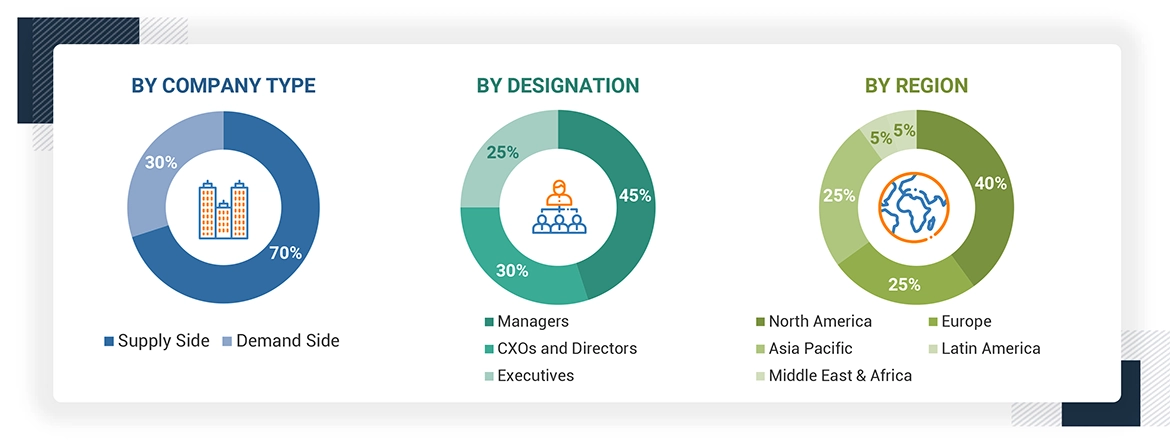
Extensive primary research was conducted after acquiring basic knowledge about the global synthetic biology market scenario through secondary research. Several primary interviews were conducted with market experts from the demand side, such as pharmaceutical & biopharmaceutical industries from the supply side, such as C-level and D-level executives, product managers, marketing & sales managers of key manufacturers, distributors, and channel partners. The primary interviews were conducted across six major regions, including the North America, Europe, Asia Pacific, Latin America, Middle East and Africa. Approximately 70% and 30% of the primary interviews were conducted with supply-side and demand-side participants, respectively. This primary data was collected through questionnaires, e-mails, online surveys, personal interviews, and telephonic interviews.
The following is a breakdown of the primary respondents:
To know about the assumptions considered for the study, download the pdf brochure
Market Size Estimation
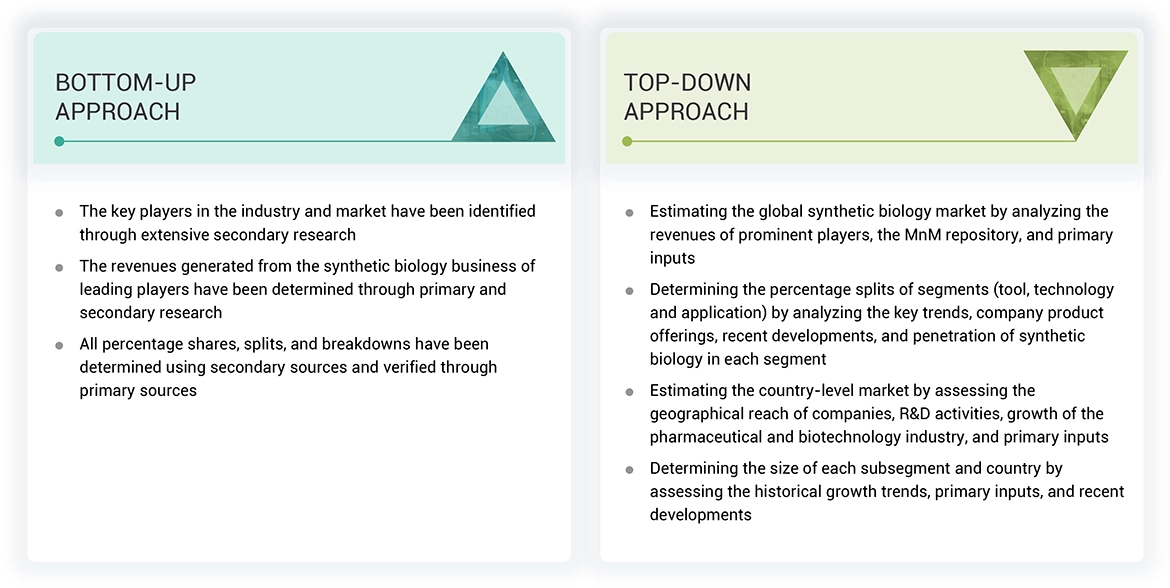
Both top-down and bottom-up approaches were used to estimate and validate the total size of the synthetic biology market. These methods were also used extensively to estimate the size of various subsegments in the market. The research methodology used to estimate the market size includes the following:
Data Triangulation
After arriving at the market size from the market size estimation process explained above, the total market was divided into several segments and subsegments. To complete the overall market engineering process and arrive at the exact statistics for all segments and subsegments, data triangulation and market breakdown procedures were employed, wherever applicable. The data was triangulated by studying various factors and trends from both the demand and supply sides.
Market Definition
Synthetic biology involves the redesign of natural biological systems by engineering and designing new biological parts and functions, namely synthetic biological pathways and organisms, which are used to construct end products. It is an innovative research area broadly comprising of multiple disciplines, such as biotechnology, molecular biology, genetic engineering, and biophysics, among others.
Stakeholders
- Companies Providing Synthetic Biology Tools, Technologies, and Related Products & Services
- Research Institutes and Academic Centers
- Suppliers and Distributors of Synthetic Biology Tools & Technologies
- Pharmaceutical and Biotechnology Companies
- Agricultural and Veterinary companies
- Business Research and Consulting Service Providers
- Venture Capitalists
- Contract Research Organizations and Contract Development Manufacturing Organizations
- Market research and consulting firms
Report Objectives
- To define, describe, and forecast the synthetic biology market by value by tool, technology, application, and region
- To provide detailed information regarding the major factors influencing the market growth (such as drivers, restraints, opportunities, and challenges)
- To analyze the micromarkets1 with respect to individual growth trends, prospects, and contributions to the overall Synthetic biology market
- To analyze the opportunities for stakeholders and provide details of the competitive landscape for market leaders
- To forecast the size of the market segments with respect to six regions: North America, Europe, the Asia Pacific, Latin America, Middle East and Africa
- To profile the key players and analyze their market shares and core competencies2
- To track and analyze competitive developments, such as product launches, partnerships, agreements, collaborations, and expansions
- To benchmark players within the market using the proprietary “Company Evaluation Matrix” framework, which analyzes market players on various parameters within the broad categories of business and product excellence strategy
Get the Full Synthetic Biology Market Report
Full forecast, segment splits, and company analysis for all Synthetic Biology Market.
- Canada Synthetic Biology Market
- US Synthetic Biology Market
- Germany Synthetic Biology Market
- UK Synthetic Biology Market
- France Synthetic Biology Market
- Switzerland Synthetic Biology Market
- Denmark Synthetic Biology Market
- Italy Synthetic Biology Market
- Spain Synthetic Biology Market
- China Synthetic Biology Market
- Japan Synthetic Biology Market
- India Synthetic Biology Market
- Australia Synthetic Biology Market
- South Korea Synthetic Biology Market
- Brazil Synthetic Biology Market
- Mexico Synthetic Biology Market
- UAE Synthetic Biology Market
- Rest Of Europe Synthetic Biology Market
- Rest Of Asia Pacific Synthetic Biology Market
- Rest Of Latin America Synthetic Biology Market
- GCC Countries Synthetic Biology Market
- Rest Of Middle East Synthetic Biology Market
- Rest Of GCC Countries Synthetic Biology Market
- Ksa Synthetic Biology Market
Need a Tailored Report?
Customize this report to your needs
Get 10% FREE Customization
Customize This Report
