
Latin America System Integration Services Market (2025-2030)

The Latin America System Integration Services Market was valued at $26858.9 Million in 2025 and projected to reach to $39718.5 Million by 2030, representing a compound annual growth rate of 8.1%. Latin America's System Integration Services Market is positioned for sustained growth as enterprises across the region accelerate their digital transformation agendas.


| Market Size in | USD 26.32 MN |
| Market Forecast in | |
| CAGR | |
| Forecast Period | |
| Units Considered | Value (USD MN) |
Latin America System Integration Services Market Trends and Insights
- This 8.1% compound annual growth rate reflects Latin America's accelerating digital transformation across enterprise sectors, driven by increasing cloud adoption, legacy system modernization, and regulatory compliance requirements.
- Latin America is emerging as a strategic hub for system integration investments as organizations prioritize operational efficiency and technology convergence. The market expansion in Latin America is underpinned by rising IT spending among multinational corporations and local enterprises seeking to optimize infrastructure and integrate disparate business systems.
- Latin America's growing middle class and expanding e-commerce sector are compelling businesses to invest in integrated technology solutions.
- Between 2025 and 2030, Latin America is expected to capture significant market share as regional service providers enhance capabilities and global integrators expand their footprint in the region..
Key Market Statistics
- CAGR (2025-2030) 8.1% CAGR
- Market Size, 2025 ~USD 26858.9 Million
- Forecast, 2030 ~USD 39718.5 Million
- Geography Latin America
Latin America System Integration Services Market Overview
Strong Regional Growth Trajectory :
Latin America's System Integration Services Market is expanding at 8.1% CAGR, outpacing the global average of 6.7%, driven by accelerated digital transformation initiatives across enterprise sectors and increasing technology investments.
Cloud Adoption & Legacy Modernization :
Organizations across Latin America are prioritizing cloud migration and legacy system modernization to enhance operational efficiency, reduce costs, and improve competitive positioning in an increasingly digital economy.
Regulatory Compliance Drivers :
Stringent regulatory requirements across financial services, healthcare, and telecommunications sectors in Latin America are compelling enterprises to invest in comprehensive system integration solutions for compliance and risk management.
Market Expansion Opportunity :
The market is projected to grow from USD 26,858.9 million in 2025 to USD 39,718.5 million by 2030, representing a USD 12.86 billion expansion opportunity for service providers and technology vendors targeting the region.
Latin America System Integration Services Market Dynamics
- The 8.1% CAGR reflects strong demand for modernization services, cloud infrastructure integration, and legacy system upgrades driven by competitive pressures and evolving customer expectations.
- Key sectors including financial services, retail, manufacturing, and telecommunications are leading investment in system integration capabilities. By 2030, the market's expansion to USD 39.7 billion will be supported by increasing adoption of cloud-native architectures, artificial intelligence integration, and cybersecurity-enhanced system designs.
- Latin American enterprises are recognizing system integration as critical infrastructure for achieving operational agility and regulatory compliance.
- Regional service providers and global integrators are expanding capabilities to capture this growing demand, particularly in Brazil and Mexico, which represent the largest market opportunities..
Market Ecosystem
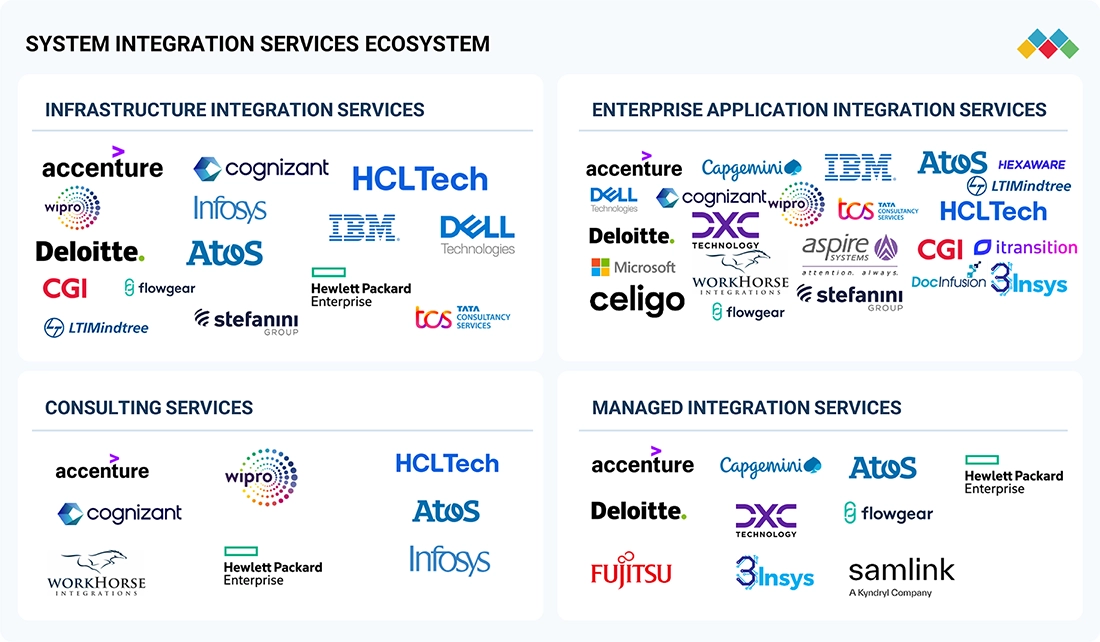
System Integration Services Market: COMMERCIAL USE CASES ACROSS INDUSTRIES
| COMPANY | USE CASE DESCRIPTION | BENEFITS |
|---|---|---|
 |
BÜCHI Labortechnik modernized its fragmented IT landscape with Microsoft Solutions Partner CloudFronts using Azure Integration Services. The deployment connected 20 business applications, streamlined workflows, and enabled real-time data exchange across hybrid environments. | 60+ interfaces integrated across ERP, CRM, and PIM | 1 million integration requests processed daily | Faster deployment of new integrations (within 3 days) | Reduced operational costs and improved efficiency | Centralized, secure API management and real-time monitoring |
 |
Komatsu modernized its legacy ERP in Australia by implementing IBM’s webMethods iPaaS. The solution enabled real-time data flow between Microsoft Dynamics, Salesforce, and IBM AS/400, automated workflows, and streamlined supplier integrations, creating a unified business transaction platform. | 30% faster deployment and 80% reduction in integration time | Real-time data sharing across ERP, CRM, and partner systems | Streamlined procurement and supplier collaboration | Automated workflows with no additional headcount | Unified “single source of truth” for business transactions |
Logos and trademarks shown above are the property of their respective owners. Their use here is for informational and illustrative purposes only.
Related Ecosystem
Application Security
- Cloud Security
- Security Analytics
- Network Testing
- Web Application Security
- Biometric Security and Authentication System
- International Business Machines Corporation
- MICROSOFT CORPORATION
- Cisco Systems, Inc.
- PALO ALTO NETWORKS, INC
- Fortinet, Inc.
Cloud Computing
- Software as A Service (SaaS)
- Natural Language Processing (NLP)
- Platform as A Service (PaaS)
- Machine Learning
- Supply Chain Management
- International Business Machines Corporation
- MICROSOFT CORPORATION
- Oracle Corporation
- Amazon.com, Inc.
Digitalization And Iot
- Sensors
- Remote Monitoring
- Supply Chain Management
- Passenger Information System (PIS)
- Platform as A Service (PaaS)
- International Business Machines Corporation
- Cisco Systems, Inc.
- MICROSOFT CORPORATION
- Oracle Corporation
- HUAWEI TECHNOLOGIES CO LTD
Key Takeaways
- Latin America's System Integration Services Market is valued at USD 26,858.9 million in 2025 and will reach USD 39,718.5 million by 2030, representing an 8.1% CAGR.
- Latin America's growth rate outpaces the global average of 6.7%, positioning the region as a high-growth market for system integration services.
- Digital transformation initiatives and cloud migration projects are primary drivers accelerating system integration demand across Latin America.
- Latin America's expanding enterprise base and regulatory pressures are creating sustained demand for integrated technology solutions through 2030.
System Integration Services Market Report Scope
| Report Metric | Details |
|---|---|
| Base Year | 2025 |
| Fastest Growing Segment | MANUFACTURING (Vertical) |
| Forecast Period | 2025–2030 |
| Growth Rate | CAGR of 6.7% from 2025 to 2030 |
| Largest Segment | LARGE ENTERPRISES (Organization Size) |
| Market Size Base Year (Billions) | ~USD 552.28 (2025) |
| Revenue Forecast (Billions) | ~USD 763.81 (2030) |
| Segments Covered | Service Type, Organization Size, Vertical, Professional Service |
Latin America System Integration Services Market Report Segmentation
4 segment dimensions are covered across the global market.
By Service Type
- Application Development & Modernization
- Consulting
- Consulting Services
- Enterprise Application Integration Services
- Implementation & Migration
- Infrastructure Integration Services
- Integration & Optimization
- Managed Integration Services
- Managed Services
- Professional Services
- Telecom Services
By Organization Size
- Large Enterprises
- Smes
By Vertical
- Bfsi
- Government & Defense
- Healthcare & Life Sciences
- It & Telecom
- Manufacturing
- Media & Entertainment
- Other Verticals
- Retail & E-Commerce
- Transport & Logistics
By Professional Service
- Consulting Services
- System Integration Services
- Training And Education Services
Target Audience
- System Integration Service Providers : Regional and global SI firms need detailed Latin America market intelligence to assess growth opportunities, benchmark competitive positioning, and develop service offerings aligned with regional enterprise requirements.
- Enterprise Technology Leaders : CIOs and IT directors across Latin American enterprises require market insights to validate technology investment decisions, understand peer adoption patterns, and optimize system integration project planning.
- Software & Cloud Platform Vendors : Technology vendors targeting Latin America need regional market data to identify integration service demand, develop channel partnerships with SI firms, and tailor solutions for regional compliance and operational requirements.
- Management Consulting Firms : Consulting organizations advising Latin American enterprises on digital transformation require market-validated insights to support client recommendations, benchmark industry practices, and identify integration service requirements.
- Investment & Private Equity Firms : Investors evaluating acquisition targets or growth opportunities in Latin America's IT services sector need comprehensive market analysis to assess market attractiveness, growth potential, and valuation benchmarks.
Key Companies in the Latin America System Integration Services Market
| Company | HQ | Ownership | Strongest segments |
|---|---|---|---|
| ACCENTURE | Ireland | Public Company | Infrastructure Integration Services,Enterprise Application Integration Services,Consulting Services, |
| TCS | India | Public Company | Infrastructure Integration Services,Enterprise Application Integration Services,Consulting Services, |
| COGNIZANT | United States | Public Company | Infrastructure Integration Services,Enterprise Application Integration Services,Consulting Services, |
| IBM | United States | Public Company | Infrastructure Integration Services,Enterprise Application Integration Services,Consulting Services, |
| CAPGEMINI | France | Public Company | Infrastructure Integration Services,Enterprise Application Integration Services,Consulting Services, |
| WIPRO | India | Public Company | Infrastructure Integration Services,Enterprise Application Integration Services,Consulting Services, |
| DXC TECHNOLOGY | United States | Public Company | Infrastructure Integration Services,Enterprise Application Integration Services,Consulting Services, |
| HCLTECH | India | ||
| INFOSYS | India | ||
| ATOS | United States | ||
| ORACLE | United States | ||
| HPE | United States | Public Company | Infrastructure Integration Services,Enterprise Application Integration Services,Consulting Services, |
| DELL TECHNOLOGIES | United States | Public Company | Infrastructure Integration Services,Enterprise Application Integration Services,Consulting Services, |
| MICROSOFT | United States | Public Company | Infrastructure Integration Services,Enterprise Application Integration Services,Consulting Services, |
ACCENTURE
Accenture is a publicly traded Irish consulting and technology services company founded in 1951, employing approximately 799,000 people worldwide. The company provides digital transformation, consulting, and managed services to clients across various industries.
TCS
Tata Consultancy Services (TCS) is a publicly traded Indian information technology and business services company founded in 1968 with approximately 584,519 employees. TCS offers IT consulting, software development, and business process outsourcing services globally.
COGNIZANT
Cognizant is a publicly traded American information technology services and consulting company founded in 1988 with approximately 357,600 employees. The company specializes in digital transformation, cloud services, and IT consulting for enterprises worldwide.
IBM
IBM is a publicly traded American technology and consulting company founded in 1911 with approximately 264,300 employees. The company offers cloud computing, artificial intelligence, software, and IT infrastructure services and solutions.
CAPGEMINI
Capgemini is a publicly traded French consulting and technology services company founded in 1967 with approximately 423,405 employees. The company provides digital transformation, consulting, technology, and outsourcing services to clients globally.
WIPRO
Wipro is a publicly traded Indian information technology services and consulting company founded in 1945 with approximately 240,000 employees. The company offers IT services, digital transformation, and business process outsourcing solutions worldwide.
DXC TECHNOLOGY
DXC Technology is a publicly traded American information technology services company founded in 1959 with approximately 115,000 employees. The company provides IT outsourcing, cloud services, and enterprise solutions to global clients.
HCLTECH
Insufficient data provided for company description.
INFOSYS
Insufficient data provided for company description.
ATOS
Insufficient data provided for company description.
ORACLE
Insufficient data provided for company description.
HPE
Hewlett Packard Enterprise (HPE) is a publicly traded American technology company founded in 1939 with approximately 67,000 employees. The company provides enterprise servers, storage, networking, and IT services to organizations worldwide.
DELL TECHNOLOGIES
Dell Technologies is a publicly traded American technology company founded in 1984 with approximately 97,000 employees. The company manufactures and sells personal computers, servers, storage systems, and provides IT solutions and services.
MICROSOFT
Microsoft is a publicly traded American technology company founded in 1975 with approximately 228,000 employees. The company develops and provides software, cloud computing services, and enterprise solutions including Windows, Office, and Azure.
Countries within Latin America - compare and drill down
| Country | 2025 size (native) |
|---|---|
| Brazil | USD 12751.2 Million |
| Mexico | USD 6622.3 Million |
| Rest Of Latin America | USD 6596.3 Million |
Country market size visualization
Reasons to Buy this Report
- Regional Market Sizing & Forecasts : Obtain precise market valuations for Latin America's system integration services sector with detailed projections through 2030, enabling accurate budget allocation and revenue forecasting for regional operations.
- Country-Level Competitive Intelligence : Access granular market data for Brazil, Mexico, and Rest of Latin America to identify high-growth opportunities, competitive dynamics, and market entry strategies tailored to specific country conditions.
- Sector-Specific Growth Drivers : Understand key demand catalysts including cloud adoption rates, legacy modernization initiatives, and regulatory compliance requirements driving system integration investments across Latin American enterprises.
- Strategic Investment Decisions : Leverage comprehensive market analysis to prioritize resource allocation, identify partnership opportunities, and develop go-to-market strategies for capturing share in Latin America's expanding integration services market.
- Competitive Benchmarking : Compare regional performance metrics against global trends and identify competitive gaps, emerging service categories, and technology adoption patterns specific to Latin American market segments.
Frequently asked questions
What is the current market size of System Integration Services in Latin America?
Latin America's System Integration Services Market is valued at USD 26,858.9 million in 2025.
What is the projected market size for System Integration Services in Latin America by 2030?
Latin America's System Integration Services Market is projected to reach USD 39,718.5 million by 2030.
What is the CAGR for System Integration Services in Latin America?
Latin America's System Integration Services Market is expected to grow at a compound annual growth rate of 8.1% from 2025 to 2030.
How does Latin America's growth compare to the global market?
Latin America's 8.1% CAGR exceeds the global average of 6.7%, indicating stronger regional growth momentum in system integration services.
What factors are driving growth in Latin America's System Integration Services Market?
Key drivers in Latin America include digital transformation initiatives, cloud migration, legacy system modernization, regulatory compliance requirements, and rising IT spending among enterprises.
RESEARCH METHODOLOGY
The study involved major activities in estimating the current size of the lithium iron phosphate batteries market. Exhaustive secondary research was done to collect information on the peer and parent markets. The next step was to validate these findings, assumptions, and sizing with industry experts across the value chain through primary research. Both top-down and bottom-up approaches were employed to estimate the total market size. Thereafter, data triangulation was done to estimate the market size of the segments and subsegments.
Secondary Research
Secondary sources referred to for this research study include annual reports, press releases, and investor presentations of companies; white papers; certified publications; articles by recognized authors; and databases of various companies and associations. Secondary research was mainly used to obtain key information about the industry’s supply chain, the total pool of key players, market classification, and segmentation according to industry trends to the bottom-most level, regional markets, and key developments from both market- and technology-oriented perspectives.
Primary Research
During the primary research phase, a wide range of respondents from both the supply and demand sides were interviewed to gather qualitative and quantitative insights for this report. On the supply side, participants included industry leaders such as chief executive officers (CEOs), vice presidents (VPs), marketing directors, and other senior executives from companies and organizations active in the lithium iron phosphate batteries market. The overall market engineering process employed a combination of top-down and bottom-up approaches, supplemented by multiple data triangulation techniques, to estimate and forecast the market across all defined segments and subsegments. Comprehensive qualitative and quantitative analyses were carried out to validate the findings and highlight key insights throughout the study. The following section provides a detailed breakdown of the primary respondents:
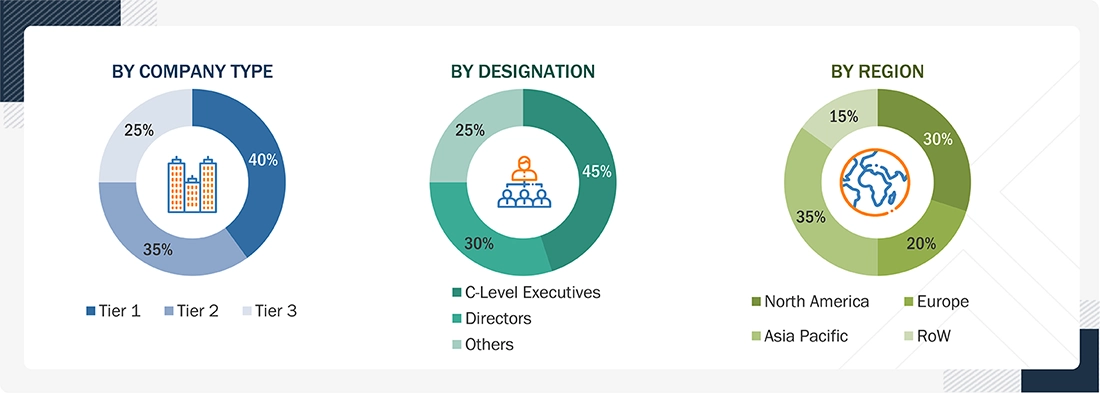
Notes: “Others” include sales managers, engineers, and regional managers
The tiers of the companies are defined based on their total revenue as of 2024; Tier 1: > USD 1 billion, Tier 2: USD 500 million–1 billion, and Tier 3: < USD 500 million
To know about the assumptions considered for the study, download the pdf brochure
Market Size Estimation
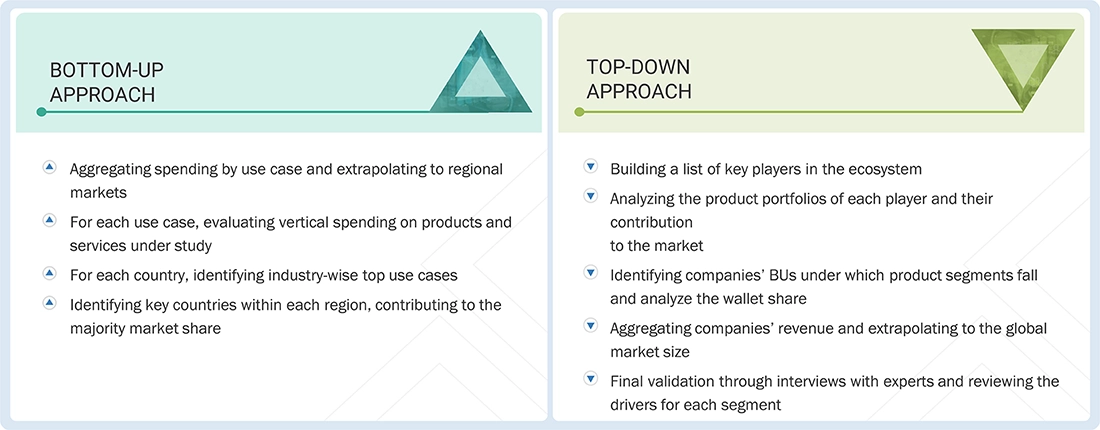
Both top-down and bottom-up approaches were used to estimate and validate the size of the lithium iron phosphate batteries market. These methods were also used extensively to estimate the size of various subsegments in the market. The research methodology used to estimate the market size includes the following:
System Integration Services Market : Top-Down and Bottom-Up Approach
Data Triangulation
Once the overall market size was determined through the estimation process outlined above, it was further divided into multiple segments and subsegments. To ensure accuracy, the data triangulation technique was applied wherever relevant, enabling precise calculations for each category. The triangulation process incorporated an analysis of key factors and trends from both the demand and supply sides. Additionally, the market size was validated through the use of both top-down and bottom-up methodologies.
Market Definition
A lithium iron phosphate (LiFePO4) battery is a type of lithium-ion battery that charges and discharges at high speed. It uses lithium iron phosphate as the cathode and graphite as the anode. The battery delivers a constant voltage and has a higher charge cycle. The charge cycle is 2,000–3,000 per battery; these properties differentiate it from other lithium-ion batteries. Low cost, natural abundance of iron, safety characteristics, nontoxicity, excellent thermal stability, better electrochemical performance, and high specific capacity are the other properties that have helped lithium iron phosphate batteries gain considerable market acceptance. Improvements in coating and the usage of nanoscale phosphate have made these batteries more efficient.
The market for lithium iron phosphate batteries is defined as the sum of revenues generated by global companies through the sales of their lithium iron phosphate batteries. The scope of the current study includes the bifurcation of this market by design, capacity, industry, application, voltage, and region.
Stakeholders
- Lithium iron phosphate battery manufacturers and providers
- Electric vehicle (EV) manufacturing companies
- Lithium-ion battery manufacturers & providers
- R&D laboratories
- Energy & power sector consulting companies
- Distributors of lithium iron phosphate batteries
- Government and research organizations
- State and national regulatory authorities
Report Objectives
- To define, describe, segment, and forecast the lithium iron phosphate batteries market based on capacity, industry, application, voltage, and region, in terms of value
- To forecast the market sizes for five major regions, namely North America, Europe, Asia Pacific, South America, the Middle East & Africa, along with their key countries, in terms of value
- To provide information on the design of lithium iron phosphate batteries
- To forecast the lithium iron phosphate batteries market by industry and region, in terms of volume
- To provide detailed information regarding key drivers, restraints, opportunities, and challenges influencing the growth of the lithium iron phosphate batteries market
- To provide the supply chain analysis, trends/disruptions impacting customer business, ecosystem analysis, regulatory landscape, patent analysis, case study analysis, technology analysis, key conferences & events, the impact of AI/Gen AI, macroeconomic outlook, pricing analysis, Porter’s five forces analysis, and regulatory analysis, the impact of the 2025 US tariffs on the market
- To analyze opportunities for stakeholders in the lithium iron phosphate batteries market and draw a competitive landscape of the market
- To strategically analyze the ecosystem, tariffs and regulations, patent landscape, trade landscape, Porter’s five forces, and case studies pertaining to the market under study
- To benchmark market players using the company evaluation quadrant, which analyzes market players on the broad categories of business and product strategies adopted by them
- To compare key market players with respect to product specifications and applications
- To strategically profile key players and comprehensively analyze their market rankings and core competencies
- To analyze competitive developments, such as contracts & agreements, investments & expansions, mergers & acquisitions, product launches, partnerships, joint ventures & collaborations, in the lithium iron phosphate batteries market
Available Customizations
MarketsandMarkets offers customizations according to the specific needs of the companies with the given market data.
The following customization options are available for the report:
Product Analysis
- Product matrix, which gives a detailed comparison of the product portfolio of each company
Geographic Analysis as per Feasibility
- Further breakdown of the lithium iron phosphate batteries by country
Company Information
- Detailed analysis and profiling of additional market players (up to five)
Get the Full System Integration Services Market Report
Full forecast, segment splits, and company analysis for all System Integration Services Market.
- US System Integration Services Market
- Canada System Integration Services Market
- UK System Integration Services Market
- Germany System Integration Services Market
- France System Integration Services Market
- Italy System Integration Services Market
- Spain System Integration Services Market
- China System Integration Services Market
- Japan System Integration Services Market
- India System Integration Services Market
- Brazil System Integration Services Market
- Mexico System Integration Services Market
- UAE System Integration Services Market
- Saudi Arabia System Integration Services Market
- South Africa System Integration Services Market
- Rest Of Europe System Integration Services Market
- Rest Of Asia Pacific System Integration Services Market
- Rest Of Latin America System Integration Services Market
- GCC System Integration Services Market
- Rest Of GCC System Integration Services Market
Need a Tailored Report?
Customize this report to your needs
Get 10% FREE Customization
Customize This Report
