
Mexico Tax Management Market (2025-2030)

The Mexico Tax Management Market was valued at $341.2 Million in 2025 and projected to reach to $515.9 Million by 2030, representing a compound annual growth rate of 8.6%. Mexico's tax management market is positioned for sustained growth through 2030, driven by continuous regulatory evolution and mandatory digital compliance frameworks.


| Market Size in | USD 26.32 MN |
| Market Forecast in | |
| CAGR | |
| Forecast Period | |
| Units Considered | Value (USD MN) |
Mexico Tax Management Market Trends and Insights
- This 8.6% compound annual growth rate reflects Mexico's increasing digital transformation in tax compliance and administration.
- Mexico's market expansion is driven by regulatory complexity, growing business digitalization, and heightened demand for automated tax solutions among enterprises and mid-market organizations. The tax management sector in Mexico is benefiting from stricter compliance requirements and the adoption of cloud-based technologies.
- Mexico's businesses are increasingly investing in integrated tax platforms to streamline operations and reduce compliance risks.
- By 2030, Mexico is expected to solidify its position as a key market for tax management solutions in Latin America, with sustained investment in software and services that address local regulatory frameworks and international tax obligations..
Key Market Statistics
- CAGR (2025-2030) 8.6% CAGR
- Market Size, 2025 ~USD 341.2 Million
- Forecast, 2030 ~USD 515.9 Million
- Country Mexico
Mexico Tax Management Market Overview
Market Valuation Growth :
Mexico's tax management market is valued at $341.2 million in 2025, with projections reaching $515.9 million by 2030, representing a robust 8.6% CAGR that outpaces the global average of 6.3%.
Digital Transformation Acceleration :
Mexican businesses are rapidly adopting digital tax compliance solutions driven by SAT (Servicio de Administración Tributaria) modernization initiatives and increased regulatory requirements for electronic invoicing and real-time reporting.
Regulatory Complexity Driver :
Mexico's evolving tax regulations, including CFDI requirements and transfer pricing rules, are compelling organizations to invest in automated tax management solutions to ensure compliance and reduce operational risks.
SME Market Expansion :
Growing adoption among small and medium enterprises in Mexico reflects increased accessibility of cloud-based tax solutions and government incentives for digital transformation across the business ecosystem.
Mexico Tax Management Market Dynamics
- The country's increasing business digitalization, coupled with SAT's push for real-time tax reporting and electronic documentation, creates strong demand for integrated tax management platforms.
- Organizations across sectors are prioritizing automation to streamline compliance processes and reduce manual errors. The market will benefit from rising awareness among Mexican enterprises regarding the cost-efficiency of tax management software solutions.
- As businesses expand internationally, demand for multi-jurisdictional tax compliance tools will accelerate.
- Cloud-based solutions tailored to Mexican regulatory requirements are expected to capture significant market share, particularly among mid-market and enterprise organizations seeking scalable, cost-effective alternatives to legacy systems..
Market Ecosystem
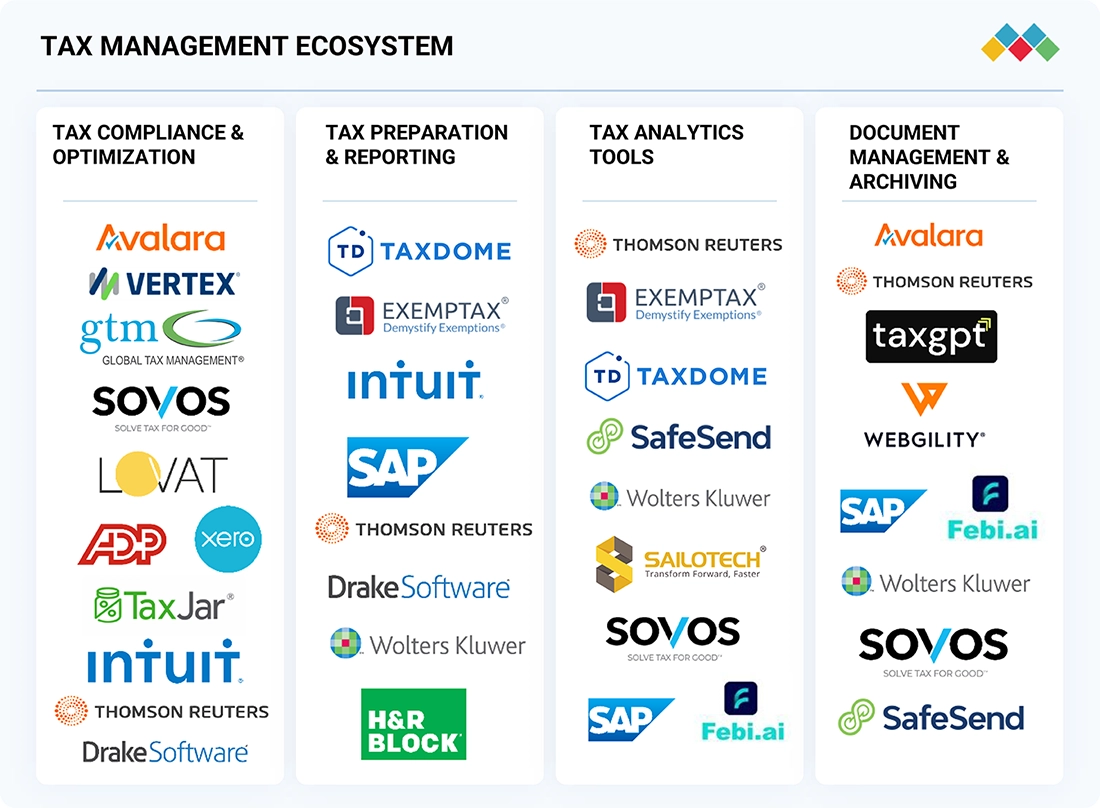
Tax Management Market: COMMERCIAL USE CASES ACROSS INDUSTRIES
| COMPANY | USE CASE DESCRIPTION | BENEFITS |
|---|---|---|
 |
Inovonics faced multi-state tax compliance and certificate management challenges; solved them by adopting Avalara’s full tax compliance suite | Avalara automated tax calculations, returns filing, and certificate management, reducing compliance risks and manual effort. Inovonics gained peace of mind, confident compliance across 20 states, and streamlined processes that scale effortlessly with business growth. |
 |
Presti & Naegele used CCH ProSystem fx Tax and CCH Axcess to streamline tax compliance and manage a growing remote workforce efficiently. | The firm improved accuracy and reliability in tax calculations, gained real-time visibility into workflows, and optimized staff management. Automated document handling and secure portals enhanced client collaboration, while hybrid operations supported remote hiring and scalable growth. |
 |
Wesleyan University automated its paper-heavy payroll and tax processes using ADP SmartCompliance, improving compliance and efficiency. | Streamlined W-2C processing, reduced tax notices, real-time tax updates, and reliable ADP support enhanced payroll accuracy and reporting. |
 |
LEGO automated complex e-commerce sales tax and holiday management by partnering with Vertex. | Sales tax is now calculated automatically and accurately on every online transaction, ensuring compliance and a seamless customer experience. Automated handling of sales tax holidays reduces manual effort and errors, freeing the Tax Operations team to focus on strategic projects. |
Logos and trademarks shown above are the property of their respective owners. Their use here is for informational and illustrative purposes only.
Related Ecosystem
Analytics
- Natural Language Processing (NLP)
- Machine Learning
- Supply Chain Management
- Predictive Analytics
- Image Sensors
- International Business Machines Corporation
- MICROSOFT CORPORATION
- Oracle Corporation
- SAP SE
Software And Services
- Natural Language Processing (NLP)
- Machine Learning
- Supply Chain Management
- Predictive Analytics
- Image Sensors
- International Business Machines Corporation
- MICROSOFT CORPORATION
- Oracle Corporation
- SAP SE
- Amazon.com, Inc.
Ngn Sdx
- Software-Defined Networking (SDN)
- Customer Analytics
- Supply Chain Management
- MITSUBISHI ELECTRIC INFORMATION SYSTEMS CORPORATION
- MITSUBISHI ELECTRIC INFORMATION NETWORK CORPORATION
- Hewlett Packard Enterprise Company
- Cisco Systems, Inc.
- International Business Machines Corporation
Key Takeaways
- Mexico's tax management market is valued at $341.2 million in 2025 and will reach $515.9 million by 2030, representing an 8.6% CAGR.
- Mexico's regulatory environment and compliance complexity are primary drivers of tax management solution adoption across enterprises.
- Cloud-based and automated tax platforms are gaining traction in Mexico as businesses prioritize digital transformation and operational efficiency.
- Mexico's market growth outpaces the global average, positioning the country as a high-growth opportunity in the Latin American tax management sector.
Tax Management Market Report Scope
| Report Metric | Details |
|---|---|
| Base Year | 2025 |
| Fastest Growing Segment | PRIVATE CLOUD (Deployment Type) |
| Forecast Period | 2025-2030 |
| Growth Rate | CAGR of 6.3% from 2025 to 2030 |
| Largest Segment | PUBLIC CLOUD (Deployment Type) |
| Market Size Base Year (Billions) | ~USD 24.47 (2025) |
| Revenue Forecast (Billions) | ~USD 33.21 (2030) |
| Segments Covered | Offering, Solution, Service, Deployment Mode, Organization Size, Tax Type, Vertical, Solution Type, Offerings, Deployment Type |
Mexico Tax Management Market Report Segmentation
10 segment dimensions are covered across the global market.
By Offering
- Service
- Services
- Solution
- Solutions
By Solution
- Audit & Risk Management Tools
- Document Management & Archiving
- Other Solutions
- Tax Analytics Tools
- Tax Compliance & Optimization
- Tax Preparation & Reporting
By Service
- Implementation & System Integration
- Support & Regulatory Maintenance
- Tax Configuration & Advisory
By Deployment Mode
- Cloud
- On-Premises
By Organization Size
- Large Enterprises
- Smes
By Tax Type
- Direct Taxes
- Indirect Taxes
By Vertical
- Bfsi
- Energy & Utilities
- Government & Public Sector
- Healthcare & Life Science
- Healthcare & Lifescience
- It & Telecom
- Manufacturing
- Other Verticals
- Retail & E-Commerce
By Solution Type
- Audit & Risk Management Tools
- Document Management & Archiving
- Tax Analytics Tools
- Tax Compliance & Optimization
- Tax Preparation & Reporting
By Offerings
- Professional Services
- Service
- Software
- Solutions
By Deployment Type
- Hybrid Cloud
- Private Cloud
- Public Cloud
Target Audience
- Tax Software Vendors : Develop and refine Mexico-specific tax management solutions by understanding local regulatory requirements, competitive landscape, and customer preferences to capture growing market demand.
- Management Consulting Firms : Advise Mexican enterprises on digital tax transformation initiatives with market-validated insights on solution adoption trends, ROI benchmarks, and implementation best practices.
- Private Equity & Investors : Evaluate investment opportunities in Mexico's tax technology sector with quantified market sizing, growth projections, and competitive dynamics to support acquisition and funding decisions.
- Enterprise Finance Leaders : Make informed procurement decisions for tax management platforms by understanding market offerings, pricing trends, and solution capabilities tailored to Mexico's regulatory environment.
- Government & Regulatory Bodies : Assess the effectiveness of digital tax compliance initiatives and market readiness for regulatory changes by analyzing adoption rates and technology penetration across Mexican business sectors.
Reasons to Buy this Report
- Market Size & Growth Validation : Quantified market data for Mexico demonstrates 8.6% CAGR through 2030, providing investors and stakeholders with concrete evidence of market expansion opportunities and revenue potential in the region.
- Competitive Positioning Intelligence : Understand Mexico-specific market dynamics, regulatory drivers, and customer adoption patterns to identify competitive advantages and develop targeted go-to-market strategies for tax management solutions.
- Regulatory Compliance Insights : Detailed analysis of Mexico's unique tax requirements, SAT mandates, and CFDI compliance frameworks enables organizations to align product development and service offerings with local regulatory demands.
- Customer Segmentation Data : Identify high-growth segments within Mexico's market, including SMEs, mid-market enterprises, and multinational corporations, to prioritize sales efforts and customize solutions for maximum market penetration.
- Investment Decision Support : Comprehensive Mexico market analysis supports strategic investment decisions, partnership evaluations, and expansion planning with data-driven insights on market maturity, growth trajectories, and emerging opportunities.
Frequently asked questions
What is the current size of Mexico's tax management market?
Mexico's tax management market is estimated at $341.2 million in 2025 and is projected to grow to $515.9 million by 2030.
What is the growth rate of Mexico's tax management market?
Mexico's tax management market is growing at a compound annual growth rate (CAGR) of 8.6% from 2025 to 2030.
What factors are driving growth in Mexico's tax management market?
Mexico's market growth is driven by increasing regulatory complexity, digital transformation initiatives, cloud adoption, and demand for automated compliance solutions among businesses.
How does Mexico's tax management market compare to global trends?
Mexico's 8.6% CAGR outpaces the global tax management market CAGR of 6.3%, indicating stronger growth momentum in the country.
What types of solutions are in demand in Mexico's tax management market?
Mexico's businesses are increasingly adopting cloud-based platforms, integrated tax software, and automated compliance tools to address local regulatory requirements and streamline operations.
RESEARCH METHODOLOGY
This research study on the tax management market involved extensive secondary sources, directories, IEEE Communication-Efficient: Algorithms and Systems, International Journal of Innovation and Technology Management, and paid databases. Primary sources were mainly industry experts from the core and related industries, preferred tax management software providers, third-party service providers, consulting service providers, end users, and other commercial enterprises. In-depth interviews with primary respondents, including key industry participants and subject matter experts, were conducted to obtain and verify critical qualitative and quantitative information and assess the market's prospects.
Secondary Research
In the secondary research process, various sources were referred to identify and collect information for this study. Secondary sources included annual reports, press releases, and investor presentations of companies; white papers, journals, and certified publications; and articles from recognized authors, directories, and databases. The data was also collected from other secondary sources, such as journals, government websites, blogs, and vendors' websites. Additionally, the tax management spending of various countries was extracted from the respective sources.
Primary Research
In the primary research process, various sources from the supply and demand sides were interviewed to obtain qualitative and quantitative information on the market. The primary sources from the supply side included various industry experts, such as Chief Experience Officers (CXOs), Vice Presidents (VPs), and directors specializing in business development, marketing, and tax management providers. It also included key executives from tax management vendors, system integrators (SIs), professional service providers, industry associations, and other key opinion leaders.
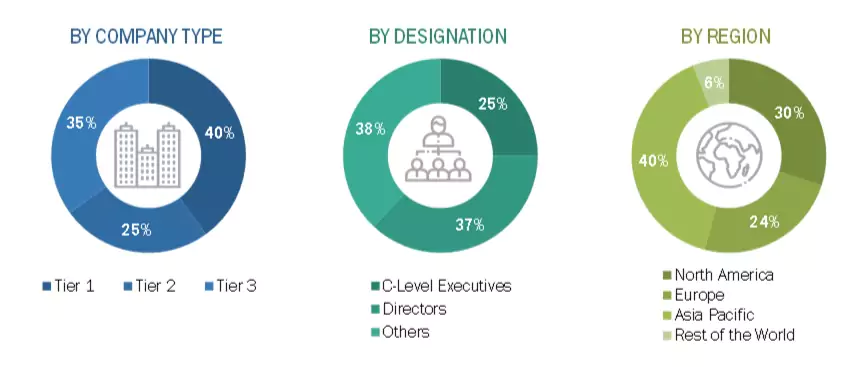
Note: Tier 1 companies' revenues are more than USD 10 billion; tier 2 companies' revenues range between
USD 1 and 10 billion; and tier 3 companies' revenues range between USD 500 million and USD 1 billion. Other designations include sales
managers, marketing managers, and product managers.
Source: Industry Experts
To know about the assumptions considered for the study, download the pdf brochure
Market Size Estimation
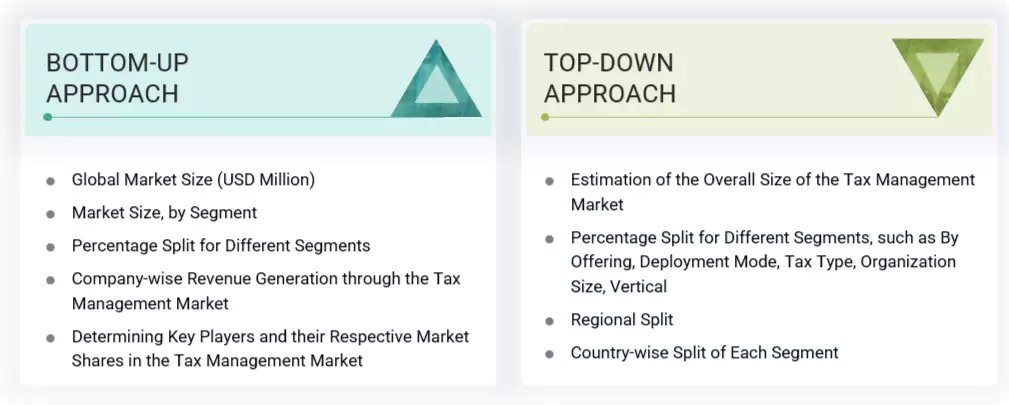
Multiple approaches were adopted to estimate and forecast the tax management market. The first approach involved estimating the market size by companies' revenue generated through the sale of tax management solutions.
Market Size Estimation Methodology: Top-down Approach
The top-down approach prepared an exhaustive list of all the vendors offering products in the tax management market. The revenue contribution of the market vendors was estimated through annual reports, press releases, funding, investor presentations, paid databases, and primary interviews. Each vendor's offerings were evaluated based on platform, degree of customization, type, application, end user, and region. The markets were triangulated through primary and secondary research. The primary procedure included extensive interviews for key insights from industry leaders, such as CIOs, CEOs, VPs, directors, and marketing executives. The market numbers were further triangulated with the existing MarketsandMarkets' repository for validation.
Market Size Estimation Methodology: Bottom-up Approach
The bottom-up approach identified the adoption rate of tax management solutions among different verticals in key countries, considering their regions contributing the most to the market share. The adoption of tax management solutions among enterprises and various use cases for their regions was identified and extrapolated for cross-validation. Use cases identified in other areas were weighted for the market size calculation.
Based on the market numbers, the regional split was determined by primary and secondary sources. The procedure included an analysis of the tax management market's regional penetration. Based on secondary research, the regional spending on Information and Communications Technology (ICT), socioeconomic Analysis of each country, strategic vendor analysis of major tax management solution providers, and organic and inorganic business development activities of regional and global players were estimated.
Tax Management Market : Top-Down and Bottom-Up Approach
Data Triangulation
After determining the overall market size using the market size estimation processes explained above, the market was split into several segments and subsegments. Where applicable, data triangulation and market breakup procedures were employed to complete the overall market engineering process and determine each market segment's and subsegment's exact statistics. The overall market size was then used in the top-down procedure to estimate the size of other individual markets via percentage splits of the market segmentation.
Market Definition
Tax management refers to the software solutions, platforms, and services ecosystem that enable organizations to automate, manage, and ensure compliance across direct and indirect tax functions. It includes tools for tax compliance & optimization, tax preparation & reporting, audit & risk management tools, tax analytics tools, document management & archiving, tax configuration & advisory services, and support & regulatory maintenance.
Stakeholders
- Tax software vendors
- Government & regulatory bodies
- Tax advisory firms
- Financial institutions & payment providers
- Tax policy advocacy organizations
- Digital payment platforms
- Legal firms
- ERP & accounting software providers
Report Objectives
- To define, describe, and forecast the tax management market based on offering - solutions (tax compliance & optimization, tax preparation & reporting, audit & risk management tools, tax, analytics tools, document management & archiving) and services (implementation & system integration, tax configuration & advisory services, support & regulatory maintenance), deployment mode (on-premises, cloud), organization size (large enterprises, small & medium sized enterprises), tax type (indirect tax, direct tax), vertical (BFSI, IT & telecom, manufacturing, retail & e-commerce, healthcare & life sciences, government & public sector, energy & utilities, and others), and region
- To forecast the market size of five major regional segments: North America, Europe, Asia Pacific, the Middle East & Africa, and Latin America
- To strategically analyze the market subsegments to individual growth trends, prospects, and contributions to the total market
- To provide detailed information on the significant factors influencing the market's growth (drivers, restraints, opportunities, and challenges)
- To strategically analyze macro and micro markets concerning growth trends, prospects, and their contributions to the overall market
- To analyze industry trends, patents, innovations, and pricing data related to the market
- To analyze the opportunities in the market for stakeholders and provide details of the competitive landscape for major players
- To analyze the impact of AI/generative AI on the market
- To profile key players in the market and comprehensively analyze their market share/ranking and core competencies
- To track and analyze competitive developments such as mergers & acquisitions, product launches, and partnerships & collaborations in the market
Available Customizations
With the given market data, MarketsandMarkets offers customizations to meet the company's needs. The following customization options are available for the report:
Product Analysis
- The product matrix provides a detailed comparison of each company's product portfolio.
Geographic Analysis as per Feasibility
- Further breakup of the North American tax management market
- Further breakup of the European tax management market
- Further breakup of the Asia Pacific tax management market
- Further breakup of the Middle East & African tax management market
- Further breakup of the Latin American tax management market
Company Information
- Detailed analysis and profiling of additional market players (up to five)
Get the Full Tax Management Market Report
Full forecast, segment splits, and company analysis for all Tax Management Market.
- Canada Tax Management Market
- US Tax Management Market
- UK Tax Management Market
- Germany Tax Management Market
- France Tax Management Market
- Italy Tax Management Market
- China Tax Management Market
- Japan Tax Management Market
- India Tax Management Market
- UAE Tax Management Market
- South Africa Tax Management Market
- Brazil Tax Management Market
- Rest Of Europe Tax Management Market
- Rest Of Asia Pacific Tax Management Market
- Rest Of Latin America Tax Management Market
- GCC Tax Management Market
- Ksa Tax Management Market
- Rest Of GCC Countries Tax Management Market
Need a Tailored Report?
Customize this report to your needs
Get 10% FREE Customization
Customize This Report
