
Japan Theranostics Market (2023-2028)

The Japan Theranostics Market was valued at $111.7 Million in 2023 and projected to reach to $273.4 Million by 2028, representing a compound annual growth rate of CAGR 19.6%. Japan's theranostics market is poised for substantial growth through 2028, with the market expanding from USD 111.7 million to USD 273.4 million.


| Market Size in | USD 26.32 MN |
| Market Forecast in | |
| CAGR | |
| Forecast Period | |
| Units Considered | Value (USD MN) |
Japan Theranostics Market Trends and Insights
- Japan's advanced healthcare infrastructure, aging population, and strong investment in precision medicine are driving adoption of theranostic solutions across oncology and cardiovascular applications.
- The country's regulatory environment and technological capabilities position Japan as a key growth hub within the Asia Pacific region. Japan's theranostics sector benefits from high healthcare spending, increasing prevalence of chronic diseases, and growing demand for personalized treatment approaches.
- Between 2023 and 2028, Japan is expected to see accelerated market penetration driven by collaborations between domestic pharmaceutical companies and diagnostic firms.
- Japan's commitment to innovation in medical imaging and targeted therapeutics continues to strengthen its competitive position in the global theranostics landscape..
Key Market Statistics
- CAGR (2023-2028) CAGR 19.6%
- Market Size, 2023 ~USD 111.7 Million
- Forecast, 2028 ~USD 273.4 Million
- Country Japan
Japan Theranostics Market Overview
Rapid Market Expansion :
Japan's theranostics market is growing at 19.6% CAGR, significantly outpacing the global rate of 15.5%, driven by increasing adoption of precision medicine and diagnostic-therapeutic integration in clinical practice.
Aging Population Catalyst :
With over 29% of Japan's population aged 65+, demand for advanced theranostic solutions in oncology and cardiovascular disease management is accelerating, creating substantial market opportunities.
Healthcare Infrastructure Excellence :
Japan's world-class healthcare system, high healthcare spending, and strong regulatory framework support rapid commercialization and adoption of innovative theranostic technologies and companion diagnostics.
Precision Medicine Investment :
Japanese government and private sector investments in genomics, molecular imaging, and personalized treatment approaches are positioning the country as a regional leader in theranostic innovation.
Japan Theranostics Market Dynamics
- This 19.6% CAGR reflects strong demand for integrated diagnostic-therapeutic solutions in oncology and cardiovascular applications, supported by Japan's aging demographics and advanced healthcare infrastructure.
- The country's commitment to precision medicine and personalized healthcare is driving hospital and diagnostic center investments in theranostic platforms. Key growth drivers include increasing cancer incidence, rising cardiovascular disease prevalence, and growing physician adoption of companion diagnostics.
- Japanese pharmaceutical companies and medical device manufacturers are actively developing theranostic solutions tailored to local patient populations.
- Regulatory support from the PMDA and reimbursement improvements for precision medicine are expected to further accelerate market penetration across major metropolitan and regional healthcare centers..
Market Ecosystem
Related Ecosystem
Pharmaceuticals
- Bioreactors
- Analytical Testing
- Bioanalytical Testing Services
- Cell Counters
- Data Management Services
- Thermo Fisher Scientific Inc.
- SANOFI
- Merck KGaA
- NOVARTIS
- Pfizer Inc.
Key Takeaways
- Japan's theranostics market is projected to grow from USD 111.7 million in 2023 to USD 273.4 million by 2028 at a 19.6% CAGR.
- Japan's aging demographic and high healthcare expenditure are primary drivers of theranostic adoption and market expansion.
- Japan leads Asia Pacific in precision medicine infrastructure, supporting rapid integration of theranostic solutions.
- Oncology and cardiovascular segments represent the largest application areas for theranostics in Japan.
Theranostics Market Report Scope
| Report Metric | Details |
|---|---|
| Base Year | 2023 |
| Fastest Growing Segment | THERANOSTICS CENTERS (End User) |
| Forecast Period | 2023-2028 |
| Growth Rate | CAGR of 15.5% from 2023 to 2028 |
| Largest Segment | RADIOPHARMACEUTICALS (Product) |
| Market Size Base Year (Billions) | ~USD 2.09 (2023) |
| Revenue Forecast (Billions) | ~USD 4.3 (2028) |
| Segments Covered | Product, Type, Application, End User |
Japan Theranostics Market Report Segmentation
4 segment dimensions are covered across the global market.
By Product
- Diagnostic Imaging
- Ivd/Biomarker Screening
- Radiopharmaceuticals
- Software & Services
By Type
- Iodine-131
- Lutetium-177
- Other Radiopharmaceuticals
- Radium-223
- Samarium-153
- Yttrium-90
By Application
- Bone Metastasis
- Other Applications
- Other Cancer
- Other Cancers
- Prostate Cancer
By End User
- Hospitals And Cancer Care Centers
- Research And Academic Centers
- Theranostics Centers
Target Audience
- Pharmaceutical & Biotech Companies : Develop theranostic drug-diagnostic combinations and companion diagnostic strategies tailored to Japan's precision medicine market, with validated market sizing and clinical adoption forecasts.
- Medical Device & Diagnostics Manufacturers : Evaluate market entry strategies, competitive positioning, and revenue potential for theranostic platforms and molecular imaging solutions in Japan's advanced healthcare infrastructure.
- Healthcare Investors & Private Equity : Assess investment opportunities in Japanese theranostic companies and healthcare providers with detailed market growth projections, profitability drivers, and exit potential analysis.
- Hospital & Diagnostic Center Operators : Plan capital investments in theranostic capabilities and precision medicine infrastructure with market demand forecasts and clinical adoption trends specific to Japan's patient populations.
- Healthcare Consultants & Advisors : Support client strategy development with Japan-specific market intelligence, competitive analysis, and growth opportunity identification for theranostics and precision medicine initiatives.
Reasons to Buy this Report
- Market Size & Growth Validation : Obtain precise market valuation (USD 111.7M in 2023) and verified 19.6% CAGR projections for Japan, enabling accurate financial forecasting and investment decision-making specific to this high-growth market.
- Competitive Landscape Intelligence : Understand Japan-specific competitive dynamics, key players, market share distribution, and strategic positioning to identify partnership and acquisition opportunities in this precision medicine-focused market.
- Demographic & Clinical Insights : Access detailed analysis of Japan's aging population impact on theranostic demand, disease prevalence trends, and clinical adoption patterns across oncology and cardiovascular segments.
- Regulatory & Reimbursement Guidance : Gain clarity on PMDA approval pathways, reimbursement policies, and healthcare system dynamics specific to Japan to accelerate market entry and commercialization strategies.
- Strategic Growth Opportunities : Identify high-potential segments, emerging applications, and geographic expansion opportunities within Japan's healthcare system to maximize market penetration and revenue growth.
Frequently asked questions
What is the current size of Japan's theranostics market?
Japan's theranostics market was valued at USD 111.7 million in 2023 and is expected to grow significantly through 2028.
What is the projected growth rate for Japan's theranostics market?
Japan's theranostics market is expected to grow at a compound annual growth rate of 19.6% from 2023 to 2028.
What will Japan's theranostics market size be in 2028?
Japan's theranostics market is forecasted to reach USD 273.4 million by 2028.
What factors are driving growth in Japan's theranostics market?
Japan's theranostics market growth is driven by an aging population, high healthcare spending, precision medicine adoption, and strong regulatory support for innovative diagnostics and therapeutics.
Which therapeutic areas dominate Japan's theranostics market?
Oncology and cardiovascular disease represent the primary application segments for theranostic solutions in Japan.
RESEARCH METHODOLOGY
The study involved four major activities in estimating the current size of the theranostics market. Exhaustive secondary research was done to collect information on the market, peer, and parent markets. The next step was to validate these findings, assumptions, and sizing with industry experts across the value chain through primary research. Both top-down and bottom-up approaches were employed to estimate the complete market size. After that, market breakdown and data triangulation were used to estimate the market size of segments and subsegments.
Secondary Research
The secondary research process involves the widespread use of secondary sources, directories, databases (such as Bloomberg Businessweek, Factiva, and D&B Hoovers), white papers, annual reports, company house documents, investor presentations, and SEC filings of companies. Secondary research was used to identify and collect information useful for the extensive, technical, market-oriented, and commercial theranostics market study. It was also used to obtain important information about the key players and market classification & segmentation according to industry trends to the bottom-most level, and key developments related to market and technology perspectives. A database of the key industry leaders was also prepared using secondary research.
Primary Research
In the primary research process, various supply and demand sources were interviewed to obtain qualitative and quantitative information for this report. The primary sources from the supply side include industry experts such as OEMs, CEOs, vice presidents, marketing and sales directors, technology & innovation directors, and related key executives from various key companies and organizations in the theranostics market. The primary sources from the demand side include medical CDMOs, oncologists, doctors, radiologists, technicians, and service providers. Primary research was conducted to validate the market segmentation, identify key players, and gather insights on key industry trends & key market dynamics.
A breakdown of the primary respondents is provided below:
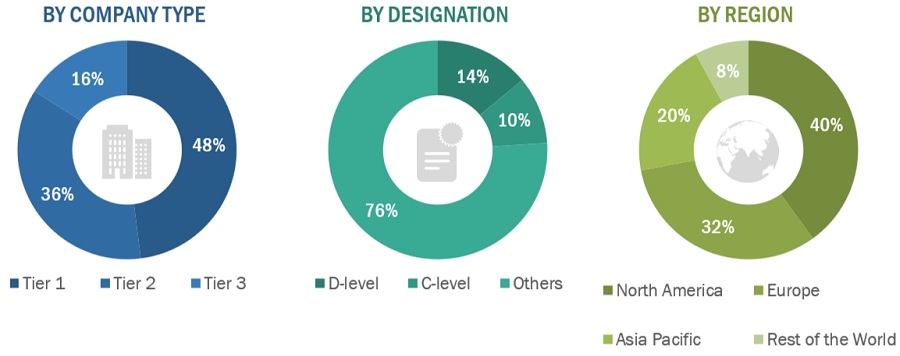
*Others include sales managers, marketing managers, business development managers, product managers, distributors, and suppliers.
Note: Companies are classified into tiers based on their total revenue. As of 2021, Tier 1 = >USD 1,000 million, Tier 2 = USD 500–1,000 million, and Tier 3 = <USD 500 million.
To know about the assumptions considered for the study, download the pdf brochure
Market Estimation Methodology
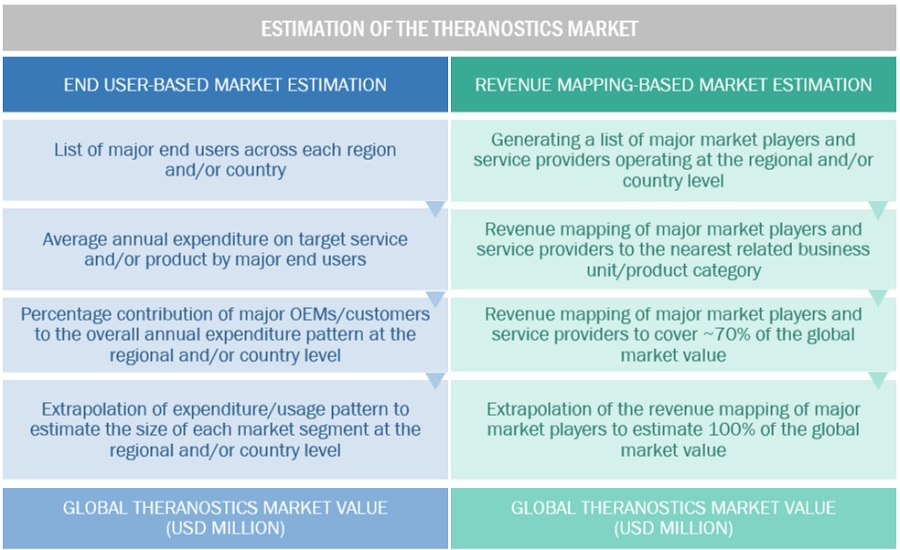
In this report, the theranostics market’s size was determined using the revenue share analysis of leading players. For this purpose, key players in the market were identified, and their revenues from the market business were determined through various insigh ts gathered during the primary and secondary research phases. Secondary research included the study of the annual and financial reports of the top market players. In contrast, primary research included extensive interviews with key opinion leaders, such as CEOs, directors, and key marketing executives.
Segmental revenues were calculated based on the revenue mapping of major solution/service providers to calculate the global market value. This process involved the following steps:
- Generating a list of major global players operating in the theranostics market.
- Mapping annual revenues generated by major global players from the product segment (or nearest reported business unit/category)
- Revenue mapping of major players to cover a major share of the global market share, as of 2022
- Extrapolating the global value of the theranostics market industry
Data Triangulation
After arriving at the overall market size from the market size estimation process explained above, the global theranostics market was split into segments and subsegments. Data triangulation and market breakdown procedures were employed to complete the overall market engineering process and arrive at the exact statistics for all segments and subsegments. The data was triangulated by studying various factors and trends from both the demand and supply sides. Additionally, the market was validated using top-down and bottom-up approaches.
Market Definition
Theranostics is a term used for diagnosis and therapy. Theranostics can be broadly defined as a combination of molecularly targeted imaging and therapy, whereas imaging helps to gain information regarding presence of targeted moleculaes on cell surface and therapy progression. Radiotheranostics involves the use of radionuclide/radiopharmaceutical that delivers targeted radiation to kill the cancerous cells and imaging modality such as positron emission tomography (PET) is used to locate the cancer. FDA approved theranostics procedures are performed for different applications such as prostate cancer, neuroendocrine tumor, etc. These procedures are mainly performed in hospitals, cancer care centers, and theranostics centers.
Key Stakeholders
- Senior Management
- End Users
- R&D Department
- Finance/Procurement Department
Objectives of the Study
- To define, describe, and forecast the size of theranostics market based on product, application, end user, and region
- To provide detailed information regarding the major factors influencing the growth potential of the global market (drivers, restraints, opportunities, challenges, and trends)
- To analyze the micro markets with respect to individual growth trends, prospects, and contributions to the global market.
- To analyze key growth opportunities in the global market for key stakeholders and provide details of the competitive landscape for market leaders
- To forecast the size of market segments and/or subsegments with respect to three major regions, namely, North America (US and Canada), Europe (Germany, France, the UK, and the RoE), Asia Pacific (Japan, China, India, and the RoAPAC), and Rest of the World (Latin America and Middle East and Africa).
- To profile the key players in the market and comprehensively analyze their market shares and core competencies.
- To track and analyze the competitive developments undertaken in the global market, such as product launches; agreements; expansions; and mergers & acquisitions.
Available Customizations
With the given market data, MarketsandMarkets offers customizations per the company’s specific needs. The following customization options are available for the present global theranostics market report:
Product Analysis
- Product matrix, which gives a detailed comparison of the product portfolios of the top fifteen companies
Company Information
- Detailed analysis and profiling of additional market players (up to five)
Geographic Analysis
- Further breakdown of the Rest of Europe theranostics market into Italy, Spain Russia, Belgium, the Netherlands, Switzerland, Austria, Finland, Sweden, Poland, and Portugal, among others
- Further breakdown of the Rest of Asia Pacific theranostics market into Australia, South Korea, Singapore, Taiwan, New Zealand, Philippines, Malaysia, and other APAC countries
Get the Full Theranostics Market Report
Full forecast, segment splits, and company analysis for all Theranostics Market.
Need a Tailored Report?
Customize this report to your needs
Get 10% FREE Customization
Customize This Report
