
South America Thin-Film Electrode Market (2025-2030)

The South America Thin-Film Electrode Market was valued at $27.4 Million in 2025 and projected to reach to $43.8 Million by 2030, representing a compound annual growth rate of 9.9%. South America's thin-film electrode market is positioned for sustained growth through 2030, driven by regional industrialization and the transition toward renewable energy infrastructure.


| Market Size in | USD 26.32 MN |
| Market Forecast in | |
| CAGR | |
| Forecast Period | |
| Units Considered | Value (USD MN) |
South America Thin-Film Electrode Market Trends and Insights
- South America's market is projected to grow to $43.8 million by 2030, driven by increasing demand for advanced energy storage solutions and semiconductor applications across the region.
- South America's growth trajectory reflects rising industrial investment and technological adoption in emerging economies. South America's 9.9% compound annual growth rate demonstrates strong regional momentum, slightly below the global average of 11.3%, indicating a maturing but resilient market.
- South America benefits from growing manufacturing capabilities and expanding renewable energy initiatives that require thin-film electrode technologies.
- The forecast period through 2030 positions South America as a key growth market within the broader Latin American industrial landscape..
Key Market Statistics
- CAGR (2025-2030) 9.9% CAGR
- Market Size, 2025 ~USD 27.4 Million
- Forecast, 2030 ~USD 43.8 Million
- Geography South America
South America Thin-Film Electrode Market Overview
Market Growth Trajectory :
South America's thin-film electrode market is projected to grow from $27.4 million in 2025 to $43.8 million by 2030, representing a robust 9.9% CAGR, outpacing many emerging markets in the region.
Energy Storage Demand :
Rising demand for advanced energy storage solutions across South America is driving thin-film electrode adoption, particularly in renewable energy integration and battery technology applications.
Semiconductor Applications :
Expanding semiconductor manufacturing and electronics industries in South America are creating significant opportunities for thin-film electrode deployment in microelectronic devices and integrated circuits.
Industrial Investment Surge :
Increased industrial investment and infrastructure development across South American economies are accelerating the adoption of advanced materials and thin-film electrode technologies in manufacturing sectors.
South America Thin-Film Electrode Market Dynamics
- The market's 9.9% CAGR reflects growing adoption in energy storage systems, semiconductor manufacturing, and advanced electronics applications across major South American economies. Key growth catalysts include rising government investments in clean energy initiatives, expanding electronics manufacturing capabilities, and increasing demand from battery and power storage sectors.
- As South American industries modernize and integrate advanced technologies, thin-film electrode solutions are becoming critical components in next-generation applications, positioning the region as an emerging hub for specialized electrode manufacturing and deployment..
Market Ecosystem

thin-film-electrode-market: COMMERCIAL USE CASES ACROSS INDUSTRIES
| COMPANY | USE CASE DESCRIPTION | BENEFITS |
|---|---|---|
 |
Used in advanced semiconductor fabrication for precise current control and wafer-level sensing during microchip production | Enables high conductivity, miniaturization, and improved device reliability in next-generation semiconductor processes |
 |
Integrated into flexible displays, wearable sensors, and advanced microelectronic components | Supports lightweight, bendable designs, and enhances performance in flexible and wearable electronics |
 |
Applied in OLED panels, touch sensors, and energy devices like thin-film batteries | Improves energy efficiency, sensitivity, and device durability for consumer electronics |
 |
Utilized in electrochemical biosensors and point-of-care diagnostic strips for glucose and coagulation testing | Provides high sensitivity, rapid signal response, and miniaturized diagnostic platforms for healthcare applications |
Logos and trademarks shown above are the property of their respective owners. Their use here is for informational and illustrative purposes only.
Related Ecosystem
Key Takeaways
- South America's thin-film electrode market will grow from $27.4M (2025) to $43.8M (2030) at a 9.9% CAGR.
- South America's growth rate of 9.9% is competitive but trails the global CAGR of 11.3%, reflecting regional market maturity.
- South America's renewable energy expansion and manufacturing growth are primary drivers of thin-film electrode adoption.
- South America represents a strategic emerging market with significant untapped potential in energy storage and semiconductor sectors.
Thin-Film Electrode Market Report Scope
| Report Metric | Details |
|---|---|
| Base Year | 2025 |
| Fastest Growing Segment | CARBON-BASED (Material) |
| Forecast Period | 2025–2030 |
| Growth Rate | CAGR of 11.3% from 2025 to 2030 |
| Largest Segment | METAL BASED (Material) |
| Market Size Base Year (Billions) | ~USD 0.57 (2025) |
| Revenue Forecast (Billions) | ~USD 0.97 (2030) |
| Segments Covered | Material, Manufacturing Technology, End-Use Industry |
South America Thin-Film Electrode Market Report Segmentation
3 segment dimensions are covered across the global market.
By Material
- Boron-Dopes Diamond Based
- Carbon Based
- Carbon-Based
- Metal Based
- Other Materials
By Manufacturing Technology
- Chemical Vapor Deposition
- Electrochemical Deposition/ Electroplating
- Fluorination & Analytical Reagent
- Flux
- Glass Etching
- Metal Surface Treatment
- Other Manufacturing Technologies
- Other Technologies
- Physical Vapor Deposition
By End-Use Industry
- Chemical & Petrochemical
- Electronics & Semiconductor
- Energy & Power
- Healthcare & Biotechnology
- Other End-Use Industries
Target Audience
- Materials & Chemical Manufacturers : Manufacturers need South America market intelligence to identify demand for thin-film electrode materials, assess regional production opportunities, and develop localized supply chain strategies.
- Energy Storage & Battery Companies : Battery and energy storage firms require regional market data to evaluate South America's renewable energy growth potential and plan electrode component sourcing and technology deployment.
- Semiconductor & Electronics Producers : Electronics manufacturers need insights into South America's semiconductor sector growth to identify thin-film electrode application opportunities and plan regional manufacturing expansion.
- Investment & Private Equity Firms : Investors require detailed South America market analysis to identify acquisition targets, assess growth potential in emerging markets, and make informed capital deployment decisions in the region.
- Government & Policy Organizations : Regional policymakers and development agencies need market data to inform industrial policy, renewable energy initiatives, and technology investment strategies supporting South America's economic growth.
Key Companies in the South America Thin-Film Electrode Market
| Company | HQ | Ownership | Strongest segments |
|---|---|---|---|
| BASI RESEARCH PRODUCTS, INC | United States | Private | Core research reagents and consumables,Specialized or custom research products,Ancillary services and other, |
| MICRUX TECHNOLOGIES | Spain | Private | Core hardware / platforms,Custom engineering & integration,Software, analytics & control, |
| MERCK KGAA | Germany | Public Company | Life Science (reagents, consumables, bioprocessing, CDMO/testing services),Healthcare (oncology, neurology, fertility, rare disease, cardiovascular and metabolic drugs),Electronics (semiconductor materials, specialty gases, display and OLED materials, delivery equipment), |
| METROHM DROPSENS | Spain | Subsidiary | Screen-printed electrodes and consumables,Portable and benchtop electrochemical instruments,Kits, accessories, and software, |
BASI RESEARCH PRODUCTS, INC
Insufficient data available to provide a factual business description.
MICRUX TECHNOLOGIES
Insufficient data available to provide a factual business description.
MERCK KGAA
Merck KGaA is a German public company founded in 1668 with 59,077 employees. The company operates as a global science and technology enterprise serving the pharmaceutical, life science, and performance materials sectors.
METROHM DROPSENS
Metrohm DropSens is a subsidiary company based in Spain that was established in 2006. The company specializes in electrochemical sensors and analytical instrumentation.
Countries within South America - compare and drill down
| Country | 2025 size (native) |
|---|---|
| Brazil | USD 18.3 Million |
| Argentina | USD 11.7 Million |
| Rest Of South America | USD 13.8 Million |
Country market size visualization
Reasons to Buy this Report
- Regional Market Sizing & Forecasts : Obtain precise market valuations for South America's thin-film electrode sector with detailed 2025-2030 projections, enabling accurate business planning and investment decisions specific to the region.
- Country-Level Breakdown : Access granular market data for Brazil, Argentina, and other South American nations, identifying high-potential markets and tailoring go-to-market strategies for individual country opportunities.
- Growth Driver Analysis : Understand key demand catalysts including renewable energy expansion, semiconductor growth, and industrial modernization unique to South America's economic landscape and development trajectory.
- Competitive Landscape Intelligence : Benchmark market positioning against regional competitors and identify white-space opportunities in South America's emerging thin-film electrode sector before market saturation occurs.
- Investment & Expansion Strategy : Leverage South America-specific insights to evaluate market entry feasibility, assess regional supply chain dynamics, and prioritize capital allocation across the region's most promising markets.
Frequently asked questions
What is the current market size of thin-film electrodes in South America?
South America's thin-film electrode market was valued at $27.4 million in 2025 and is expected to reach $43.8 million by 2030.
What is the projected growth rate for South America's thin-film electrode market?
South America's thin-film electrode market is projected to grow at a compound annual growth rate (CAGR) of 9.9% from 2025 to 2030.
How does South America's growth compare to global market trends?
South America's CAGR of 9.9% is slightly below the global CAGR of 11.3%, indicating steady regional growth with room for acceleration.
What industries in South America are driving thin-film electrode demand?
South America's demand is primarily driven by renewable energy initiatives, semiconductor manufacturing, and advanced energy storage applications.
Which countries in South America represent the largest opportunities?
South America's largest opportunities are concentrated in Brazil, Chile, and Argentina, which have significant renewable energy and manufacturing sectors.
RESEARCH METHODOLOGY
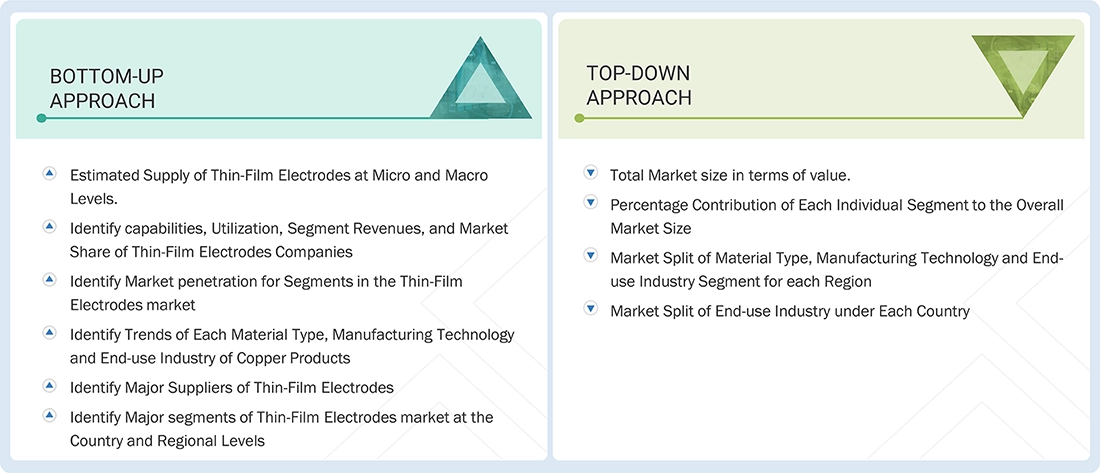
The study involved four major activities in estimating the market size of the thin-film electrode market. Exhaustive secondary research was conducted to gather information on the market, its peer market, and the parent market. The next step was to validate these findings, assumptions, and sizing with industry experts across the value chain through primary research. Both top-down and bottom-up approaches were employed to estimate the complete market size. Thereafter, the market breakdown and data triangulation procedures were used to estimate the market size of the segments and subsegments.
Secondary Research
In the secondary research process, various secondary sources have been referred to for identifying and collecting information for this study. These secondary sources include annual reports, press releases, investor presentations of companies, white papers, certified publications, trade directories, certified publications, articles from recognized authors, gold standard and silver standard websites, and databases.
Secondary research has been used to obtain key information about the value chain of the industry, monetary chain of the market, the total pool of key thin-film electrodes, market classification and segmentation according to industry trends to the bottom-most level, and regional markets. It was also used to obtain information about the key developments from a market-oriented perspective.
Primary Research
The thin-film electrode market comprises several stakeholders in the value chain, including raw material suppliers, manufacturers, and end users. Various primary sources from the supply and demand sides of the thin-film electrode market have been interviewed to obtain qualitative and quantitative information. The primary interviewees from the demand side include key opinion leaders in end-use sectors. The primary sources from the supply side include manufacturers, associations, and institutions involved in the thin-film electrode industry.
Primary interviews were conducted to gather insights, including market statistics, revenue data collected from products and services, market breakdowns, market size estimations, market forecasting, and data triangulation. Primary research also helped in understanding the various trends related to material, manufacturing technology, end-use industry, and region. Stakeholders from the demand side, such as CIOs, CTOs, and CSOs, were interviewed to understand the buyer’s perspective on the suppliers, products, component providers, and their current usage of thin-film electrode and future outlook for their business, which will affect the overall market.
The breakdown of profiles of the primary interviewees is illustrated in the figure below:
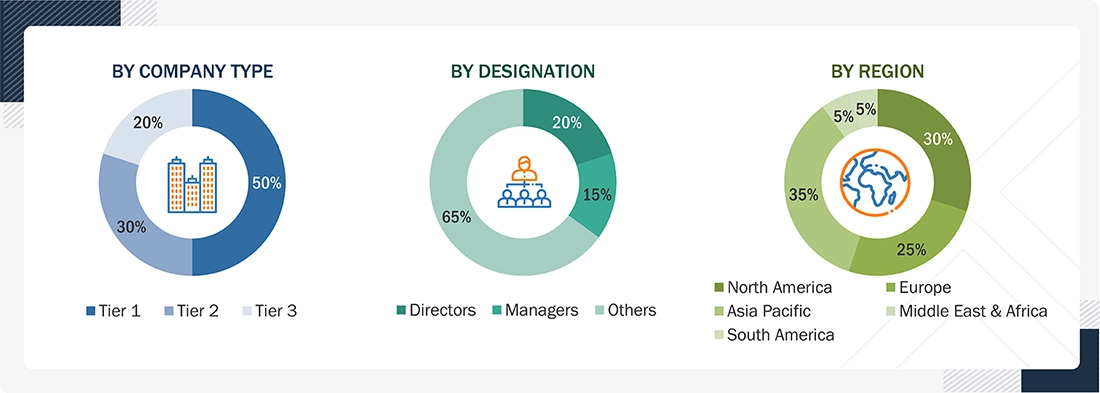
Notes: Tier 1, Tier 2, and Tier 3 companies are classified based on their market revenue in 2024, available in the public domain, product portfolios, and geographical presence.
Other designations include sales representatives, production heads, and technicians.
To know about the assumptions considered for the study, download the pdf brochure
Market Size Estimation
A top-down approach was used to estimate and validate the size of various submarkets for thin-film electrodes in each region. The research methodology used to estimate the market size
included the following steps:
- The key players in the industry have been identified through extensive secondary research.
- The supply chain of the industry has been determined through primary and secondary research.
- The global market was then segmented into five major regions and validated by industry experts.
- All percentage shares, splits, and breakdowns based on material, manufacturing technology, end-use industry, and regions were determined using secondary sources and verified through primary sources.
- All possible parameters that affect the markets covered in this research study were accounted for, viewed in extensive detail, verified through primary research, and analyzed to get the final quantitative and qualitative data. This data was consolidated, supplemented with detailed inputs and analysis, and presented in this report.
Thin-Film Electrode Market : Top-Down and Bottom-Up Approach
Data Triangulation
After determining the total market size through the estimation process mentioned above, the overall market has been divided into several segments and sub-segments. To complete the overall market engineering process and arrive at the exact statistics for all the segments and sub-segments, the data triangulation and market breakdown procedures have been employed, wherever applicable. The data has been triangulated by studying various factors and trends from both the demand and supply sides. Additionally, the market size has been validated using both top-down and bottom-up approaches, as well as primary interviews. Hence, for every data segment, there have been three sources—top-down approach, bottom-up approach, and expert interviews. The data was assumed correct when the values arrived from the three sources matched.
Market Definition
A thin-film electrode is an ultra-thin conductive layer, typically a few nanometers to micrometers thick, deposited on a solid substrate such as silicon, glass, ceramic, or flexible polymer to enable precise electrical or electrochemical performance. These electrodes are manufactured using advanced deposition technologies such as Physical Vapor Deposition (PVD), Chemical Vapor Deposition (CVD), or sputtering, ensuring uniform thickness, strong adhesion, and high conductivity. Common materials include metals (gold, platinum, titanium, silver), carbon-based compounds (graphene, graphite), and boron-doped diamond (BDD), chosen for their superior chemical stability and electrical efficiency. Thin-film electrodes are widely used in biosensors, medical diagnostics, microelectronics, energy storage, and environmental monitoring systems. In healthcare, they power wearable and implantable sensors, while in the electronics and semiconductor industries, they are vital for integrated circuits and microdevices. Their use in fuel cells, batteries, and electrochemical reactors supports the global shift toward clean energy. Market growth is driven by the demand for miniaturized, high-performance, and flexible electronic components, along with advances in nanomaterials and deposition technology.
Key Stakeholders
- Thin-Film Electrode Manufacturers
- Thin-Film Electrode Traders, Distributors, and Suppliers
- Raw Type Suppliers
- Government and Private Research Organizations
- Associations and Industrial Bodies
- R&D Institutions
- Environmental Support Agencies
Report Objectives
- To define, describe, and forecast the size of the thin-film electrode market, in terms of value and volume
- To provide detailed information about the significant drivers, opportunities, restraints, and challenges influencing the growth of the market
- To estimate and forecast the market size based on material, manufacturing technology, end-use industry, and region
- To forecast the size of the market with respect to major regions, namely, Europe, North America, Asia Pacific, Middle East & Africa, and South America, along with their key countries
- To strategically analyze micromarkets with respect to individual growth trends, prospects, and their contribution to the overall market
- To analyze opportunities in the market for stakeholders and provide a competitive landscape of market leaders
- To track and analyze recent developments such as product launches and deals in the market
- To strategically profile key market players and comprehensively analyze their core competencies
Available Customizations
Along with the given market data, MarketsandMarkets offers customizations according to the company’s specific needs. The following customization options are available for the report:
Regional Analysis
- Further breakdown of a region with respect to a particular country or additional application
Company Information
- Detailed analysis and profiles of additional market players
Tariff & Regulations
- Regulations and impact on thin-film electrode market
Get the Full Thin-Film Electrode Market Report
Full forecast, segment splits, and company analysis for all Thin-Film Electrode Market.
- – Rest Of GCC Countries Thin-Film Electrode Market
- Argentina Thin-Film Electrode Market
- Brazil Thin-Film Electrode Market
- Canada Thin-Film Electrode Market
- China Thin-Film Electrode Market
- France Thin-Film Electrode Market
- GCC Countries Thin-Film Electrode Market
- Germany Thin-Film Electrode Market
- India Thin-Film Electrode Market
- Italy Thin-Film Electrode Market
- Japan Thin-Film Electrode Market
- Mexico Thin-Film Electrode Market
- Rest Of Asia Pacific Thin-Film Electrode Market
- Rest Of Europe Thin-Film Electrode Market
- Rest Of South America Thin-Film Electrode Market
- South Africa Thin-Film Electrode Market
- South Korea Thin-Film Electrode Market
- Spain Thin-Film Electrode Market
- Taiwan Thin-Film Electrode Market
- UK Thin-Film Electrode Market
- US Thin-Film Electrode Market
Need a Tailored Report?
Customize this report to your needs
Get 10% FREE Customization
Customize This Report
