
Brazil Thin-Film Electrode Market (2025-2030)

The Brazil Thin-Film Electrode Market was valued at $11.2 Million in 2025 and projected to reach to $18.3 Million by 2030, representing a compound annual growth rate of 10.2%. Brazil's thin-film electrode market is positioned for sustained growth through 2030, driven by the nation's commitment to renewable energy expansion and technological advancement in energy storage solutions.


| Market Size in | USD 26.32 MN |
| Market Forecast in | |
| CAGR | |
| Forecast Period | |
| Units Considered | Value (USD MN) |
Brazil Thin-Film Electrode Market Trends and Insights
- This expansion reflects Brazil's increasing adoption of advanced electrode technologies across energy storage, electronics, and industrial applications.
- Brazil's market growth trajectory, driven by rising demand for renewable energy solutions and technological innovation, positions the country as a key player in South America's thin-film electrode sector. The 10.2% compound annual growth rate (CAGR) through 2030 underscores Brazil's commitment to modernizing its manufacturing and energy infrastructure.
- Brazil's market benefits from favorable government policies supporting clean energy transitions and growing investment in battery and semiconductor technologies.
- As Brazil continues to develop its industrial base, the thin-film electrode market is expected to capture increasing market share within the broader chemicals and materials sector..
Key Market Statistics
- CAGR (2025-2030) 10.2% CAGR
- Market Size, 2025 ~USD 11.2 Million
- Forecast, 2030 ~USD 18.3 Million
- Country Brazil
Brazil Thin-Film Electrode Market Overview
Market Valuation Growth :
Brazil's thin-film electrode market is valued at USD 11.2 million in 2025, with a projected CAGR of 10.2% through 2030, reaching USD 18.3 million by forecast end.
Renewable Energy Catalyst :
Rising demand for renewable energy solutions in Brazil is driving adoption of advanced thin-film electrode technologies across solar, wind, and energy storage applications.
Diversified Application Base :
Brazil's market spans energy storage systems, electronics manufacturing, and industrial applications, creating multiple growth vectors for thin-film electrode deployment.
Regional Growth Momentum :
Brazil's 10.2% CAGR demonstrates strong market momentum, supported by industrial modernization and increased investment in clean energy infrastructure across the country.
Brazil Thin-Film Electrode Market Dynamics
- The market benefits from Brazil's abundant hydroelectric resources and growing solar and wind capacity, creating demand for efficient electrode technologies.
- Industrial sectors are increasingly adopting thin-film electrodes for enhanced performance and cost efficiency.
- Government initiatives supporting clean energy transition and domestic manufacturing capabilities further strengthen market prospects.
- By 2030, Brazil is expected to emerge as a significant regional hub for thin-film electrode applications, with expanding opportunities in battery technology, supercapacitors, and advanced electronics manufacturing..
Market Ecosystem

thin-film-electrode-market: COMMERCIAL USE CASES ACROSS INDUSTRIES
| COMPANY | USE CASE DESCRIPTION | BENEFITS |
|---|---|---|
 |
Used in advanced semiconductor fabrication for precise current control and wafer-level sensing during microchip production | Enables high conductivity, miniaturization, and improved device reliability in next-generation semiconductor processes |
 |
Integrated into flexible displays, wearable sensors, and advanced microelectronic components | Supports lightweight, bendable designs, and enhances performance in flexible and wearable electronics |
 |
Applied in OLED panels, touch sensors, and energy devices like thin-film batteries | Improves energy efficiency, sensitivity, and device durability for consumer electronics |
 |
Utilized in electrochemical biosensors and point-of-care diagnostic strips for glucose and coagulation testing | Provides high sensitivity, rapid signal response, and miniaturized diagnostic platforms for healthcare applications |
Logos and trademarks shown above are the property of their respective owners. Their use here is for informational and illustrative purposes only.
Related Ecosystem
Key Takeaways
- Brazil's thin-film electrode market is valued at USD 11.2 million in 2025 and is forecast to reach USD 18.3 million by 2030, representing a 10.2% CAGR.
- Brazil's market growth is driven by increasing demand for renewable energy storage solutions and advanced battery technologies across the region.
- Brazil's favorable regulatory environment and government support for clean energy initiatives are accelerating thin-film electrode adoption.
- Brazil's strategic position in South America makes it a critical hub for thin-film electrode manufacturing and distribution.
Thin-Film Electrode Market Report Scope
| Report Metric | Details |
|---|---|
| Base Year | 2025 |
| Fastest Growing Segment | CARBON-BASED (Material) |
| Forecast Period | 2025–2030 |
| Growth Rate | CAGR of 11.3% from 2025 to 2030 |
| Largest Segment | METAL BASED (Material) |
| Market Size Base Year (Billions) | ~USD 0.57 (2025) |
| Revenue Forecast (Billions) | ~USD 0.97 (2030) |
| Segments Covered | Material, Manufacturing Technology, End-Use Industry |
Brazil Thin-Film Electrode Market Report Segmentation
3 segment dimensions are covered across the global market.
By Material
- Boron-Dopes Diamond Based
- Carbon Based
- Carbon-Based
- Metal Based
- Other Materials
By Manufacturing Technology
- Chemical Vapor Deposition
- Electrochemical Deposition/ Electroplating
- Fluorination & Analytical Reagent
- Flux
- Glass Etching
- Metal Surface Treatment
- Other Manufacturing Technologies
- Other Technologies
- Physical Vapor Deposition
By End-Use Industry
- Chemical & Petrochemical
- Electronics & Semiconductor
- Energy & Power
- Healthcare & Biotechnology
- Other End-Use Industries
BRAZIL: THIN-FILM ELECTRODE MARKET, BY END-USE INDUSTRY, 2025–2030
| Segment | 2025 | 2026 | 2027 | 2028 | 2029 | 2030 | CAGR (%) |
|---|---|---|---|---|---|---|---|
| CHEMICAL & PETROCHEMICAL | 1.4 | 1.6 | 1.7 | 1.9 | 2.1 | 2.4 | 10.2 |
| ELECTRONICS & SEMICONDUCTOR | 4.7 | 5.2 | 5.7 | 6.3 | 7 | 7.9 | 10.9 |
| ENERGY & POWER | 1.4 | 1.5 | 1.6 | 1.8 | 2 | 2.2 | 10.5 |
| HEALTHCARE & BIOTECHNOLOGY | 3 | 3.2 | 3.5 | 3.8 | 4.2 | 4.6 | 9.2 |
| OTHER END-USE INDUSTRIES | 0.8 | 0.8 | 0.9 | 1 | 1.1 | 1.2 | 9.6 |
| TOTAL | 11.2 | 12.2 | 13.4 | 14.8 | 16.4 | 18.3 | 10.2 |
Target Audience
- Materials & Chemical Manufacturers : Need Brazil market data to assess demand for thin-film electrode materials, plan production capacity, and develop localized product offerings for the growing market.
- Energy Storage Companies : Require market intelligence on Brazil's battery and supercapacitor electrode adoption rates to guide R&D investments and commercialization strategies in the region.
- Electronics & Industrial Equipment Suppliers : Seek Brazil-specific insights on thin-film electrode integration in manufacturing processes to enhance product competitiveness and identify new application opportunities.
- Investment & Private Equity Firms : Need detailed market forecasts and growth projections for Brazil to evaluate investment opportunities in electrode manufacturers and clean energy technology companies.
- Government & Policy Organizations : Require market data to inform renewable energy policies, industrial development initiatives, and technology adoption programs supporting Brazil's clean energy transition.
Key Companies in the Brazil Thin-Film Electrode Market
| Company | HQ | Ownership | Strongest segments |
|---|---|---|---|
| METROHM DROPSENS | Spain | Subsidiary | Screen-printed electrodes and consumables,Portable and benchtop electrochemical instruments,Kits, accessories, and software, |
METROHM DROPSENS
Metrohm Dropsens is a subsidiary company based in Spain, founded in 2006.
Reasons to Buy this Report
- Market Entry Strategy : Gain comprehensive insights into Brazil's thin-film electrode market dynamics, competitive landscape, and growth drivers to develop effective market entry and expansion strategies.
- Investment Decision Support : Access detailed market sizing, CAGR projections, and forecast data through 2030 to support investment decisions and capital allocation in Brazil's growing electrode sector.
- Competitive Intelligence : Understand Brazil-specific market trends, application segments, and emerging opportunities to benchmark against competitors and identify differentiation strategies.
- Supply Chain Optimization : Identify key application areas and demand patterns across energy storage, electronics, and industrial sectors to optimize sourcing and distribution networks in Brazil.
- Growth Opportunity Identification : Leverage Brazil-specific market insights to identify high-potential segments, emerging technologies, and partnership opportunities aligned with renewable energy expansion.
Frequently asked questions
What is the current market size of thin-film electrodes in Brazil?
Brazil's thin-film electrode market was valued at USD 11.2 million in 2025 and is expected to grow to USD 18.3 million by 2030.
What is the projected growth rate for Brazil's thin-film electrode market?
Brazil's thin-film electrode market is projected to grow at a compound annual growth rate (CAGR) of 10.2% from 2025 to 2030.
What are the primary drivers of growth in Brazil's thin-film electrode market?
Brazil's market growth is driven by rising demand for renewable energy storage, battery technology advancement, government clean energy policies, and expanding industrial applications.
Which industries are the largest consumers of thin-film electrodes in Brazil?
Brazil's primary consumers include energy storage systems, semiconductor manufacturing, electronics, and renewable energy sectors.
How does Brazil's market compare to other South American countries?
Brazil represents the largest and most developed thin-film electrode market in South America, with significant infrastructure and investment supporting continued expansion.
RESEARCH METHODOLOGY
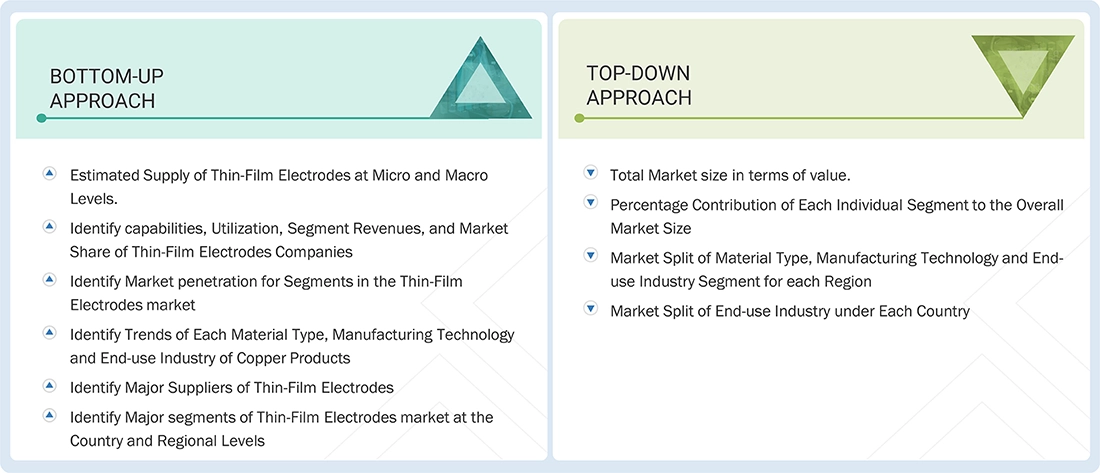
The study involved four major activities in estimating the market size of the thin-film electrode market. Exhaustive secondary research was conducted to gather information on the market, its peer market, and the parent market. The next step was to validate these findings, assumptions, and sizing with industry experts across the value chain through primary research. Both top-down and bottom-up approaches were employed to estimate the complete market size. Thereafter, the market breakdown and data triangulation procedures were used to estimate the market size of the segments and subsegments.
Secondary Research
In the secondary research process, various secondary sources have been referred to for identifying and collecting information for this study. These secondary sources include annual reports, press releases, investor presentations of companies, white papers, certified publications, trade directories, certified publications, articles from recognized authors, gold standard and silver standard websites, and databases.
Secondary research has been used to obtain key information about the value chain of the industry, monetary chain of the market, the total pool of key thin-film electrodes, market classification and segmentation according to industry trends to the bottom-most level, and regional markets. It was also used to obtain information about the key developments from a market-oriented perspective.
Primary Research
The thin-film electrode market comprises several stakeholders in the value chain, including raw material suppliers, manufacturers, and end users. Various primary sources from the supply and demand sides of the thin-film electrode market have been interviewed to obtain qualitative and quantitative information. The primary interviewees from the demand side include key opinion leaders in end-use sectors. The primary sources from the supply side include manufacturers, associations, and institutions involved in the thin-film electrode industry.
Primary interviews were conducted to gather insights, including market statistics, revenue data collected from products and services, market breakdowns, market size estimations, market forecasting, and data triangulation. Primary research also helped in understanding the various trends related to material, manufacturing technology, end-use industry, and region. Stakeholders from the demand side, such as CIOs, CTOs, and CSOs, were interviewed to understand the buyer’s perspective on the suppliers, products, component providers, and their current usage of thin-film electrode and future outlook for their business, which will affect the overall market.
The breakdown of profiles of the primary interviewees is illustrated in the figure below:
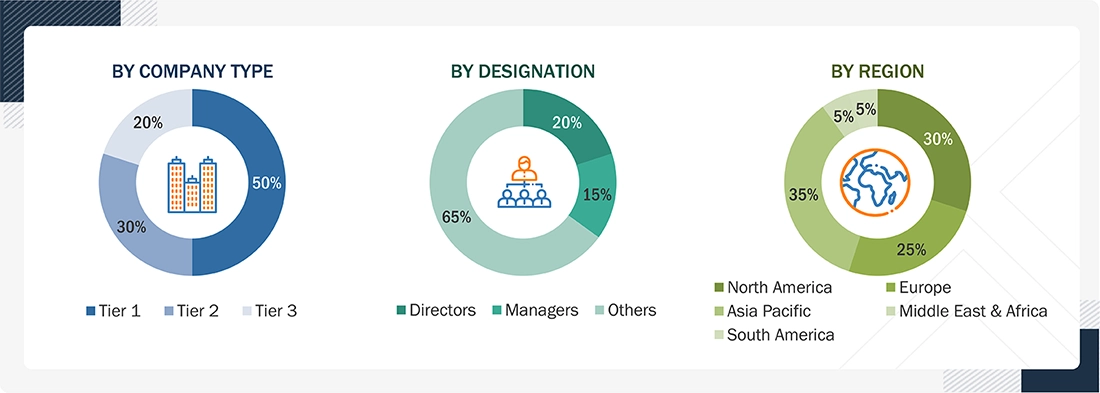
Notes: Tier 1, Tier 2, and Tier 3 companies are classified based on their market revenue in 2024, available in the public domain, product portfolios, and geographical presence.
Other designations include sales representatives, production heads, and technicians.
To know about the assumptions considered for the study, download the pdf brochure
Market Size Estimation
A top-down approach was used to estimate and validate the size of various submarkets for thin-film electrodes in each region. The research methodology used to estimate the market size
included the following steps:
- The key players in the industry have been identified through extensive secondary research.
- The supply chain of the industry has been determined through primary and secondary research.
- The global market was then segmented into five major regions and validated by industry experts.
- All percentage shares, splits, and breakdowns based on material, manufacturing technology, end-use industry, and regions were determined using secondary sources and verified through primary sources.
- All possible parameters that affect the markets covered in this research study were accounted for, viewed in extensive detail, verified through primary research, and analyzed to get the final quantitative and qualitative data. This data was consolidated, supplemented with detailed inputs and analysis, and presented in this report.
Thin-Film Electrode Market : Top-Down and Bottom-Up Approach
Data Triangulation
After determining the total market size through the estimation process mentioned above, the overall market has been divided into several segments and sub-segments. To complete the overall market engineering process and arrive at the exact statistics for all the segments and sub-segments, the data triangulation and market breakdown procedures have been employed, wherever applicable. The data has been triangulated by studying various factors and trends from both the demand and supply sides. Additionally, the market size has been validated using both top-down and bottom-up approaches, as well as primary interviews. Hence, for every data segment, there have been three sources—top-down approach, bottom-up approach, and expert interviews. The data was assumed correct when the values arrived from the three sources matched.
Market Definition
A thin-film electrode is an ultra-thin conductive layer, typically a few nanometers to micrometers thick, deposited on a solid substrate such as silicon, glass, ceramic, or flexible polymer to enable precise electrical or electrochemical performance. These electrodes are manufactured using advanced deposition technologies such as Physical Vapor Deposition (PVD), Chemical Vapor Deposition (CVD), or sputtering, ensuring uniform thickness, strong adhesion, and high conductivity. Common materials include metals (gold, platinum, titanium, silver), carbon-based compounds (graphene, graphite), and boron-doped diamond (BDD), chosen for their superior chemical stability and electrical efficiency. Thin-film electrodes are widely used in biosensors, medical diagnostics, microelectronics, energy storage, and environmental monitoring systems. In healthcare, they power wearable and implantable sensors, while in the electronics and semiconductor industries, they are vital for integrated circuits and microdevices. Their use in fuel cells, batteries, and electrochemical reactors supports the global shift toward clean energy. Market growth is driven by the demand for miniaturized, high-performance, and flexible electronic components, along with advances in nanomaterials and deposition technology.
Key Stakeholders
- Thin-Film Electrode Manufacturers
- Thin-Film Electrode Traders, Distributors, and Suppliers
- Raw Type Suppliers
- Government and Private Research Organizations
- Associations and Industrial Bodies
- R&D Institutions
- Environmental Support Agencies
Report Objectives
- To define, describe, and forecast the size of the thin-film electrode market, in terms of value and volume
- To provide detailed information about the significant drivers, opportunities, restraints, and challenges influencing the growth of the market
- To estimate and forecast the market size based on material, manufacturing technology, end-use industry, and region
- To forecast the size of the market with respect to major regions, namely, Europe, North America, Asia Pacific, Middle East & Africa, and South America, along with their key countries
- To strategically analyze micromarkets with respect to individual growth trends, prospects, and their contribution to the overall market
- To analyze opportunities in the market for stakeholders and provide a competitive landscape of market leaders
- To track and analyze recent developments such as product launches and deals in the market
- To strategically profile key market players and comprehensively analyze their core competencies
Available Customizations
Along with the given market data, MarketsandMarkets offers customizations according to the company’s specific needs. The following customization options are available for the report:
Regional Analysis
- Further breakdown of a region with respect to a particular country or additional application
Company Information
- Detailed analysis and profiles of additional market players
Tariff & Regulations
- Regulations and impact on thin-film electrode market
Get the Full Thin-Film Electrode Market Report
Full forecast, segment splits, and company analysis for all Thin-Film Electrode Market.
- China Thin-Film Electrode Market
- Japan Thin-Film Electrode Market
- India Thin-Film Electrode Market
- South Korea Thin-Film Electrode Market
- Taiwan Thin-Film Electrode Market
- Germany Thin-Film Electrode Market
- France Thin-Film Electrode Market
- UK Thin-Film Electrode Market
- Italy Thin-Film Electrode Market
- Spain Thin-Film Electrode Market
- US Thin-Film Electrode Market
- Canada Thin-Film Electrode Market
- Mexico Thin-Film Electrode Market
- Argentina Thin-Film Electrode Market
- South Africa Thin-Film Electrode Market
- Rest Of Europe Thin-Film Electrode Market
- Rest Of Asia Pacific Thin-Film Electrode Market
Need a Tailored Report?
Customize this report to your needs
Get 10% FREE Customization
Customize This Report
