
Rest Of South America Thin-Film Electrode Market (2025-2030)

The Rest Of South America Thin-Film Electrode Market was valued at $8.8 Million in 2025 and projected to reach to $13.8 Million by 2030, representing a compound annual growth rate of 9.4%. Rest Of South America's thin-film electrode market demonstrates promising growth potential as regional economies increasingly prioritize energy efficiency and advanced manufacturing capabilities.


| Market Size in | USD 26.32 MN |
| Market Forecast in | |
| CAGR | |
| Forecast Period | |
| Units Considered | Value (USD MN) |
Rest Of South America Thin-Film Electrode Market Trends and Insights
- This 9.4% compound annual growth rate reflects increasing adoption of thin-film electrode technologies across energy storage, electronics, and industrial applications throughout the region.
- Rest Of South America is experiencing rising demand driven by infrastructure development, renewable energy initiatives, and growing manufacturing capabilities. The thin-film electrode sector in Rest Of South America benefits from regional investments in clean energy and technological advancement.
- Rest Of South America's market dynamics are shaped by both local production capacity and import dependencies, with key applications emerging in battery technology and semiconductor manufacturing.
- Rest Of South America's growth trajectory aligns with broader Latin American trends toward electrification and advanced materials adoption, positioning the region as an increasingly important market for thin-film electrode suppliers and manufacturers..
Key Market Statistics
- CAGR (2025-2030) 9.4% CAGR
- Market Size, 2025 ~USD 8.8 Million
- Forecast, 2030 ~USD 13.8 Million
- Country Rest Of South America
Rest Of South America Thin-Film Electrode Market Overview
Regional Market Expansion :
Rest Of South America's thin-film electrode market is experiencing steady growth with a 9.4% CAGR, driven by increasing industrialization and adoption of advanced energy storage solutions across multiple sectors.
Market Size Trajectory :
The market is projected to grow from $8.8 million in 2025 to $13.8 million by 2030, representing a 56.8% increase over the five-year forecast period, outpacing many emerging regional markets.
Application Diversification :
Thin-film electrode technologies are gaining traction across energy storage systems, consumer electronics, and industrial applications, reflecting diversified demand patterns unique to Rest Of South America's economic landscape.
Growth Drivers :
Regional growth is fueled by rising investments in renewable energy infrastructure, expanding electronics manufacturing, and increasing demand for efficient battery technologies in emerging economies.
Rest Of South America Thin-Film Electrode Market Dynamics
- The 9.4% CAGR reflects growing adoption across diverse industrial sectors, particularly in energy storage and electronics applications.
- Key drivers include infrastructure development, rising consumer electronics demand, and investments in renewable energy projects throughout the region. Looking ahead to 2030, the market is expected to benefit from technological advancements, improved manufacturing capabilities, and expanding industrial applications.
- Regional players are positioning themselves to capture emerging opportunities in battery technology and electronic components.
- Strategic partnerships and localized production facilities will likely accelerate market penetration, supporting the projected expansion to $13.8 million by 2030..
Market Ecosystem

thin-film-electrode-market: COMMERCIAL USE CASES ACROSS INDUSTRIES
| COMPANY | USE CASE DESCRIPTION | BENEFITS |
|---|---|---|
 |
Used in advanced semiconductor fabrication for precise current control and wafer-level sensing during microchip production | Enables high conductivity, miniaturization, and improved device reliability in next-generation semiconductor processes |
 |
Integrated into flexible displays, wearable sensors, and advanced microelectronic components | Supports lightweight, bendable designs, and enhances performance in flexible and wearable electronics |
 |
Applied in OLED panels, touch sensors, and energy devices like thin-film batteries | Improves energy efficiency, sensitivity, and device durability for consumer electronics |
 |
Utilized in electrochemical biosensors and point-of-care diagnostic strips for glucose and coagulation testing | Provides high sensitivity, rapid signal response, and miniaturized diagnostic platforms for healthcare applications |
Logos and trademarks shown above are the property of their respective owners. Their use here is for informational and illustrative purposes only.
Related Ecosystem
Key Takeaways
- Rest Of South America's thin-film electrode market is valued at $8.8 million in 2025 and is forecast to reach $13.8 million by 2030, representing a 9.4% CAGR.
- Rest Of South America is experiencing accelerating demand from renewable energy and battery technology sectors, driving regional market expansion.
- Rest Of South America's market growth is supported by infrastructure investments and increasing local manufacturing capabilities for advanced materials.
- Rest Of South America represents a strategic growth opportunity for thin-film electrode suppliers seeking to expand in emerging Latin American markets.
Thin-Film Electrode Market Report Scope
| Report Metric | Details |
|---|---|
| Base Year | 2025 |
| Fastest Growing Segment | CARBON-BASED (Material) |
| Forecast Period | 2025–2030 |
| Growth Rate | CAGR of 11.3% from 2025 to 2030 |
| Largest Segment | METAL BASED (Material) |
| Market Size Base Year (Billions) | ~USD 0.57 (2025) |
| Revenue Forecast (Billions) | ~USD 0.97 (2030) |
| Segments Covered | Material, Manufacturing Technology, End-Use Industry |
Rest Of South America Thin-Film Electrode Market Report Segmentation
3 segment dimensions are covered across the global market.
By Material
- Boron-Dopes Diamond Based
- Carbon Based
- Carbon-Based
- Metal Based
- Other Materials
By Manufacturing Technology
- Chemical Vapor Deposition
- Electrochemical Deposition/ Electroplating
- Fluorination & Analytical Reagent
- Flux
- Glass Etching
- Metal Surface Treatment
- Other Manufacturing Technologies
- Other Technologies
- Physical Vapor Deposition
By End-Use Industry
- Chemical & Petrochemical
- Electronics & Semiconductor
- Energy & Power
- Healthcare & Biotechnology
- Other End-Use Industries
Target Audience
- Regional Manufacturers : Rest Of South America-based electrode and battery manufacturers need detailed market sizing and growth forecasts to optimize production capacity and supply chain investments.
- Energy Sector Investors : Investment firms targeting renewable energy and energy storage projects in Rest Of South America require regional market data to evaluate thin-film electrode technology adoption rates.
- Electronics Companies : Electronics manufacturers expanding operations in Rest Of South America need insights into local thin-film electrode demand, supplier availability, and market growth potential.
- Strategic Consultants : Business consultants advising clients on market entry or expansion in Rest Of South America require region-specific electrode market analysis and competitive intelligence.
- Government & Policy Makers : Regional economic development agencies and policymakers need market data to support industrial policy decisions and infrastructure investments in advanced materials sectors.
Key Companies in the Rest Of South America Thin-Film Electrode Market
| Company | HQ | Ownership | Strongest segments |
|---|---|---|---|
| BASI RESEARCH PRODUCTS, INC | United States | Private | Core research reagents and consumables,Specialized or custom research products,Ancillary services and other, |
| MICRUX TECHNOLOGIES | Spain | Private | Core hardware / platforms,Custom engineering & integration,Software, analytics & control, |
| MERCK KGAA | Germany | Public Company | Life Science (reagents, consumables, bioprocessing, CDMO/testing services),Healthcare (oncology, neurology, fertility, rare disease, cardiovascular and metabolic drugs),Electronics (semiconductor materials, specialty gases, display and OLED materials, delivery equipment), |
| METROHM DROPSENS | Spain | Subsidiary | Screen-printed electrodes and consumables,Portable and benchtop electrochemical instruments,Kits, accessories, and software, |
BASI RESEARCH PRODUCTS, INC
Insufficient data available to provide a factual business description.
MICRUX TECHNOLOGIES
Insufficient data available to provide a factual business description.
MERCK KGAA
Merck KGaA is a German public company founded in 1668 with 59,077 employees. The company operates as a global science and technology enterprise serving the pharmaceutical, life science, and performance materials sectors.
METROHM DROPSENS
Metrohm DropSens is a subsidiary company based in Spain that was established in 2006. The company specializes in electrochemical sensors and analytical instrumentation.
Reasons to Buy this Report
- Regional Market Intelligence : Gain exclusive insights into Rest Of South America's thin-film electrode market dynamics, competitive landscape, and growth opportunities specific to this emerging region.
- Accurate Forecasting Data : Access validated market projections from $8.8M (2025) to $13.8M (2030), enabling precise business planning and investment decisions tailored to regional growth trajectories.
- Sector-Specific Applications : Understand how thin-film electrode technologies are being deployed across energy storage, electronics, and industrial sectors within Rest Of South America's unique market context.
- Competitive Positioning : Identify market entry strategies, competitive advantages, and partnership opportunities specific to Rest Of South America's developing thin-film electrode ecosystem.
- Investment Decision Support : Make informed capital allocation decisions with comprehensive regional analysis, growth drivers, and market sizing data exclusive to Rest Of South America's electrode market segment.
Frequently asked questions
What is the current market size of thin-film electrodes in Rest Of South America?
Rest Of South America's thin-film electrode market is estimated at $8.8 million in 2025, with projections to grow to $13.8 million by 2030.
What is the expected growth rate for Rest Of South America's thin-film electrode market?
Rest Of South America's thin-film electrode market is expected to grow at a compound annual growth rate (CAGR) of 9.4% from 2025 to 2030.
Which industries are driving demand for thin-film electrodes in Rest Of South America?
Rest Of South America's demand for thin-film electrodes is primarily driven by renewable energy, battery technology, semiconductor manufacturing, and industrial electronics applications.
What factors are contributing to market growth in Rest Of South America?
Rest Of South America's market growth is supported by regional infrastructure development, renewable energy investments, technological advancement, and expanding local manufacturing capabilities.
How does Rest Of South America's market compare to the global thin-film electrode market?
Rest Of South America's 9.4% CAGR is slightly below the global average of 11.3%, reflecting the region's emerging market status and developing industrial base.
RESEARCH METHODOLOGY
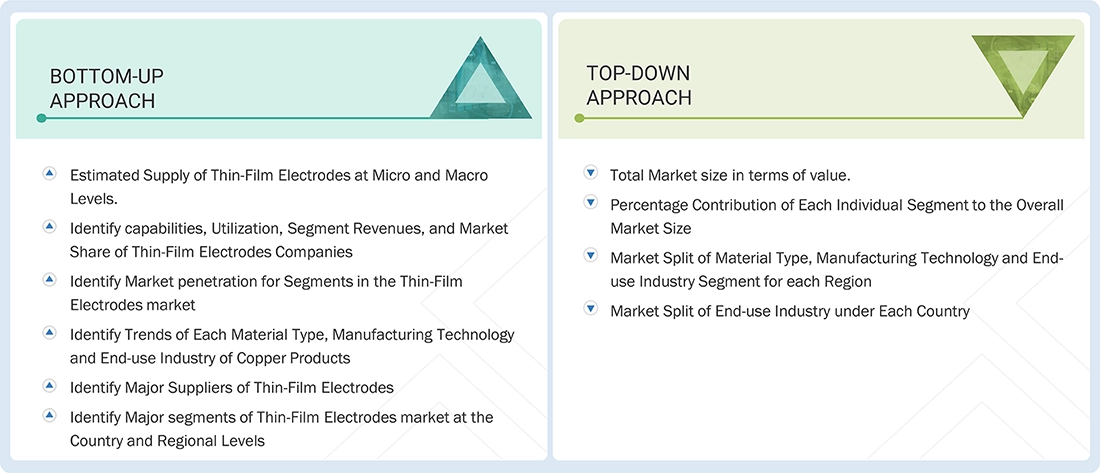
The study involved four major activities in estimating the market size of the thin-film electrode market. Exhaustive secondary research was conducted to gather information on the market, its peer market, and the parent market. The next step was to validate these findings, assumptions, and sizing with industry experts across the value chain through primary research. Both top-down and bottom-up approaches were employed to estimate the complete market size. Thereafter, the market breakdown and data triangulation procedures were used to estimate the market size of the segments and subsegments.
Secondary Research
In the secondary research process, various secondary sources have been referred to for identifying and collecting information for this study. These secondary sources include annual reports, press releases, investor presentations of companies, white papers, certified publications, trade directories, certified publications, articles from recognized authors, gold standard and silver standard websites, and databases.
Secondary research has been used to obtain key information about the value chain of the industry, monetary chain of the market, the total pool of key thin-film electrodes, market classification and segmentation according to industry trends to the bottom-most level, and regional markets. It was also used to obtain information about the key developments from a market-oriented perspective.
Primary Research
The thin-film electrode market comprises several stakeholders in the value chain, including raw material suppliers, manufacturers, and end users. Various primary sources from the supply and demand sides of the thin-film electrode market have been interviewed to obtain qualitative and quantitative information. The primary interviewees from the demand side include key opinion leaders in end-use sectors. The primary sources from the supply side include manufacturers, associations, and institutions involved in the thin-film electrode industry.
Primary interviews were conducted to gather insights, including market statistics, revenue data collected from products and services, market breakdowns, market size estimations, market forecasting, and data triangulation. Primary research also helped in understanding the various trends related to material, manufacturing technology, end-use industry, and region. Stakeholders from the demand side, such as CIOs, CTOs, and CSOs, were interviewed to understand the buyer’s perspective on the suppliers, products, component providers, and their current usage of thin-film electrode and future outlook for their business, which will affect the overall market.
The breakdown of profiles of the primary interviewees is illustrated in the figure below:
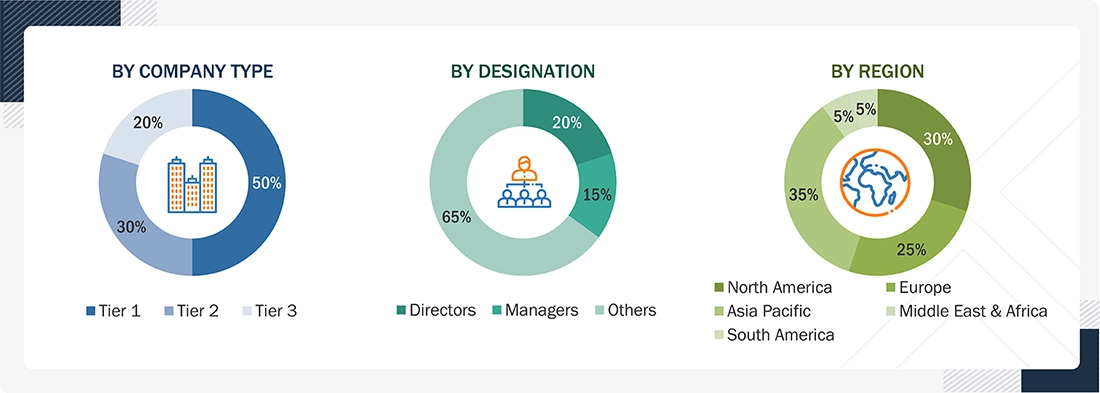
Notes: Tier 1, Tier 2, and Tier 3 companies are classified based on their market revenue in 2024, available in the public domain, product portfolios, and geographical presence.
Other designations include sales representatives, production heads, and technicians.
To know about the assumptions considered for the study, download the pdf brochure
Market Size Estimation
A top-down approach was used to estimate and validate the size of various submarkets for thin-film electrodes in each region. The research methodology used to estimate the market size
included the following steps:
- The key players in the industry have been identified through extensive secondary research.
- The supply chain of the industry has been determined through primary and secondary research.
- The global market was then segmented into five major regions and validated by industry experts.
- All percentage shares, splits, and breakdowns based on material, manufacturing technology, end-use industry, and regions were determined using secondary sources and verified through primary sources.
- All possible parameters that affect the markets covered in this research study were accounted for, viewed in extensive detail, verified through primary research, and analyzed to get the final quantitative and qualitative data. This data was consolidated, supplemented with detailed inputs and analysis, and presented in this report.
Thin-Film Electrode Market : Top-Down and Bottom-Up Approach
Data Triangulation
After determining the total market size through the estimation process mentioned above, the overall market has been divided into several segments and sub-segments. To complete the overall market engineering process and arrive at the exact statistics for all the segments and sub-segments, the data triangulation and market breakdown procedures have been employed, wherever applicable. The data has been triangulated by studying various factors and trends from both the demand and supply sides. Additionally, the market size has been validated using both top-down and bottom-up approaches, as well as primary interviews. Hence, for every data segment, there have been three sources—top-down approach, bottom-up approach, and expert interviews. The data was assumed correct when the values arrived from the three sources matched.
Market Definition
A thin-film electrode is an ultra-thin conductive layer, typically a few nanometers to micrometers thick, deposited on a solid substrate such as silicon, glass, ceramic, or flexible polymer to enable precise electrical or electrochemical performance. These electrodes are manufactured using advanced deposition technologies such as Physical Vapor Deposition (PVD), Chemical Vapor Deposition (CVD), or sputtering, ensuring uniform thickness, strong adhesion, and high conductivity. Common materials include metals (gold, platinum, titanium, silver), carbon-based compounds (graphene, graphite), and boron-doped diamond (BDD), chosen for their superior chemical stability and electrical efficiency. Thin-film electrodes are widely used in biosensors, medical diagnostics, microelectronics, energy storage, and environmental monitoring systems. In healthcare, they power wearable and implantable sensors, while in the electronics and semiconductor industries, they are vital for integrated circuits and microdevices. Their use in fuel cells, batteries, and electrochemical reactors supports the global shift toward clean energy. Market growth is driven by the demand for miniaturized, high-performance, and flexible electronic components, along with advances in nanomaterials and deposition technology.
Key Stakeholders
- Thin-Film Electrode Manufacturers
- Thin-Film Electrode Traders, Distributors, and Suppliers
- Raw Type Suppliers
- Government and Private Research Organizations
- Associations and Industrial Bodies
- R&D Institutions
- Environmental Support Agencies
Report Objectives
- To define, describe, and forecast the size of the thin-film electrode market, in terms of value and volume
- To provide detailed information about the significant drivers, opportunities, restraints, and challenges influencing the growth of the market
- To estimate and forecast the market size based on material, manufacturing technology, end-use industry, and region
- To forecast the size of the market with respect to major regions, namely, Europe, North America, Asia Pacific, Middle East & Africa, and South America, along with their key countries
- To strategically analyze micromarkets with respect to individual growth trends, prospects, and their contribution to the overall market
- To analyze opportunities in the market for stakeholders and provide a competitive landscape of market leaders
- To track and analyze recent developments such as product launches and deals in the market
- To strategically profile key market players and comprehensively analyze their core competencies
Available Customizations
Along with the given market data, MarketsandMarkets offers customizations according to the company’s specific needs. The following customization options are available for the report:
Regional Analysis
- Further breakdown of a region with respect to a particular country or additional application
Company Information
- Detailed analysis and profiles of additional market players
Tariff & Regulations
- Regulations and impact on thin-film electrode market
Get the Full Thin-Film Electrode Market Report
Full forecast, segment splits, and company analysis for all Thin-Film Electrode Market.
- – Rest Of GCC Countries Thin-Film Electrode Market
- Argentina Thin-Film Electrode Market
- Brazil Thin-Film Electrode Market
- Canada Thin-Film Electrode Market
- China Thin-Film Electrode Market
- France Thin-Film Electrode Market
- GCC Countries Thin-Film Electrode Market
- Germany Thin-Film Electrode Market
- India Thin-Film Electrode Market
- Italy Thin-Film Electrode Market
- Japan Thin-Film Electrode Market
- Mexico Thin-Film Electrode Market
- Rest Of Asia Pacific Thin-Film Electrode Market
- Rest Of Europe Thin-Film Electrode Market
- South Africa Thin-Film Electrode Market
- South Korea Thin-Film Electrode Market
- Spain Thin-Film Electrode Market
- Taiwan Thin-Film Electrode Market
- UK Thin-Film Electrode Market
- US Thin-Film Electrode Market
Need a Tailored Report?
Customize this report to your needs
Get 10% FREE Customization
Customize This Report