
Italy Time-Sensitive Networking Market (2025-2030)

The Italy Time-Sensitive Networking Market was valued at $6 Million in 2025 and projected to reach to $29.8 Million by 2030, representing a compound annual growth rate of 37.6%. Italy's Time-Sensitive Networking market is poised for transformative growth driven by industrial modernization and digital infrastructure investments.


| Market Size in | USD 26.32 MN |
| Market Forecast in | |
| CAGR | |
| Forecast Period | |
| Units Considered | Value (USD MN) |
Italy Time-Sensitive Networking Market Trends and Insights
- This represents a compound annual growth rate of 37.6%, reflecting Italy's increasing adoption of deterministic networking solutions across industrial automation, automotive, and telecommunications sectors.
- Italy's strategic position within the European manufacturing ecosystem drives demand for real-time communication protocols essential for Industry 4.0 implementations. The Italian market benefits from strong industrial heritage and growing investment in smart manufacturing infrastructure.
- Between 2025 and 2030, Italy is expected to capture significant opportunities in time-critical applications where network latency and reliability are paramount.
- Italy's participation in EU digital transformation initiatives and the presence of leading automotive and machinery manufacturers accelerate the deployment of Time-Sensitive Networking technologies throughout the country's industrial base..
Key Market Statistics
- CAGR (2025-2030) 37.6% CAGR
- Market Size, 2025 ~USD 6 Million
- Forecast, 2030 ~USD 29.8 Million
- Country Italy
Italy Time-Sensitive Networking Market Overview
Rapid Market Expansion :
Italy's Time-Sensitive Networking market is experiencing explosive growth with a 37.6% CAGR, significantly outpacing many European counterparts. The market is projected to grow from $6.0 million in 2025 to $29.8 million by 2030, representing nearly a 5x increase in market value over five years.
Industrial Automation Leadership :
Italian manufacturing and industrial automation sectors are driving TSN adoption, leveraging the technology for real-time control systems and predictable network performance. Italy's strong industrial base, particularly in machinery and automotive, creates substantial demand for deterministic networking solutions.
Automotive & Telecommunications Integration :
Italy's automotive industry and telecommunications providers are increasingly implementing TSN for connected vehicle systems and 5G infrastructure. This dual-sector adoption accelerates market penetration and creates cross-industry synergies for networking standardization.
European Strategic Position :
As a key European manufacturing hub, Italy benefits from EU digital transformation initiatives and Industry 4.0 investments. The country's proximity to global supply chains and established tech partnerships position it as a critical TSN adoption center in Southern Europe.
Italy Time-Sensitive Networking Market Dynamics
- The 37.6% CAGR reflects strong momentum across manufacturing, automotive, and telecommunications sectors, where deterministic networking is becoming essential for competitive advantage.
- Italian enterprises are increasingly recognizing TSN's value in enabling real-time communication, reducing latency, and improving operational efficiency in complex industrial environments. Looking ahead to 2030, Italy's TSN market will benefit from continued EU funding for digital transformation, growing adoption of Industry 4.0 practices, and expanding 5G deployments.
- Strategic partnerships between Italian technology providers and global networking vendors will accelerate market maturation.
- The convergence of IT and OT networks, coupled with rising cybersecurity requirements, will further drive TSN implementation across enterprise and industrial segments..
Market Ecosystem
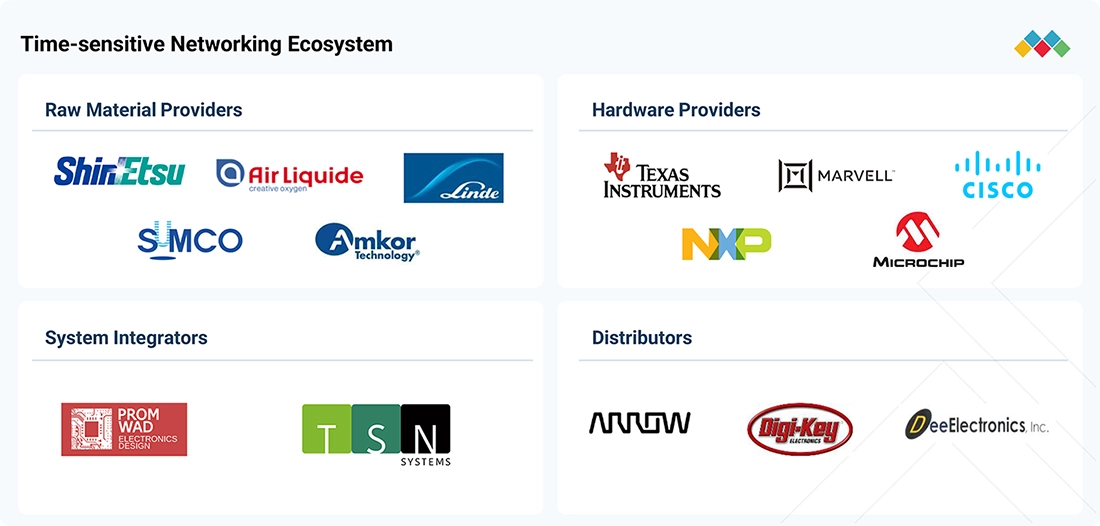
TIME-SENSITIVE NETWORKING MARKET: COMMERCIAL USE CASES ACROSS INDUSTRIES
| COMPANY | USE CASE DESCRIPTION | BENEFITS |
|---|---|---|
 |
Texas Instruments integrates TSN hardware support into Sitara microprocessors and microcontrollers for industrial field devices and factory automation systems. The processors run IEEE 802.1AS time synchronization and IEEE 802.1Qbv traffic scheduling across multi-axis motion drives, remote I/O nodes, and robotics. | Eliminates dedicated fieldbus wiring by converging operational technology and data traffic on standard Ethernet | Delivers microsecond-level synchronization accuracy for multi-axis servo control | Minimizes communication jitter across distributed robotic workcells | Simplifies firmware development through integrated royalty-free software development kits |
 |
NXP deploys TSN-enabled microcontrollers, processors, and automotive Ethernet switches for software-defined vehicles and industrial robotics. The hardware acts as the deterministic backbone for vehicle central compute clusters, zonal gateways, ADAS perception systems, and industrial real-time control modules. | Enables predictable packet delivery for mission-critical Advanced Driver Assistance Systems (ADAS) | Accelerates automotive transition to lean zonal wiring architectures | Reduces vehicle harness weight and installation costs | Guarantees bounded latency for coexisting infotainment, diagnostic, and vehicle safety data |
 |
Siemens implements TSN across its Scalance industrial switch portfolio and Simatic automation controllers for manufacturing lines and process plants. The infrastructure utilizes OPC UA over TSN to connect programmable logic controllers, human-machine interfaces, and cloud management layers over unified physical links. | Unifies real-time control and high-bandwidth information technology traffic on a single network plant | Eliminates proprietary communication bottlenecks across multivendor automation setups | Preserves continuous deterministic operation during heavy background diagnostics data transfers | Minimizes machine downtime with standard protocol diagnostics |
 |
Marvell provides automotive and industrial Gigabit Ethernet switch silicon supporting complete IEEE 802.1 TSN protocol suites. The silicon connects high-performance edge compute platforms, multi-camera radar sensor arrays, and domain controllers within autonomous driving test fleets and connected vehicle platforms. | Delivers multi-gigabit wire-speed packet processing with zero packet loss for safety-critical streams | Isolates critical vehicle sensor traffic from bulk data using strict time-aware traffic policing | Enhances safety compliance with automotive functional safety standards | Lowers system bill-of-materials by integrating multi-port switching into compact system-on-chips |
 |
Broadcom incorporates TSN capabilities into high-density Ethernet switch chips and physical layer transceivers for industrial IoT networks and automotive communication backbones. The switches schedule critical traffic across industrial automation plants, automated guided vehicles, and enterprise edge aggregation points. | Supports high-bandwidth real-time industrial and automotive communications over standard twisted-pair Ethernet | Enforces deterministic traffic priority queues across complex network topologies | Lowers latency variations across high-port-count industrial control switches | Provides reliable, energy-efficient operational performance in harsh industrial environments |
Logos and trademarks shown above are the property of their respective owners. Their use here is for informational and illustrative purposes only.
Related Ecosystem
Cyber Security
- Cloud Security
- Biometric Systems
- Data Loss Prevention (DLP)
- Multi-Factor Authentication
- Security Analytics
- International Business Machines Corporation
- MITSUI BUSSAN SECURE DIRECTIONS INC
- Cisco Systems, Inc.
- MICROSOFT CORPORATION
- Allot Ltd.
Communication And Connectivity Technology
- Sensors
- Smart Card & Readers
- Cellular Network
- Femtocell
- Image Sensors
- Cisco Systems, Inc.
- HUAWEI TECHNOLOGIES CO LTD
- Lenovo
- CommScope Holding Company, Inc.
- Nokia corporation
Key Takeaways
- Italy's Time-Sensitive Networking market will grow from $6.0M (2025) to $29.8M (2030) at a 37.6% CAGR, nearly five-fold expansion.
- Italy's manufacturing sector, particularly automotive and machinery industries, drives adoption of deterministic networking for real-time industrial applications.
- Italy's alignment with EU Industry 4.0 and digital transformation mandates accelerates Time-Sensitive Networking deployment across the country.
- Italy's growth rate of 37.6% exceeds the global CAGR of 40.7%, positioning the country as a strong regional performer in European Time-Sensitive Networking adoption.
Time-Sensitive Networking Market Report Scope
| Report Metric | Details |
|---|---|
| Base Year | 2025 |
| Fastest Growing Segment | IEEE 802.11BE (Type) |
| Forecast Period | 2025-2030 |
| Growth Rate | CAGR of 40.7% from 2025 to 2030 |
| Largest Segment | IEEE 802.1AS (Type) |
| Market Size Base Year (Billions) | ~USD 0.36 (2025) |
| Revenue Forecast (Billions) | ~USD 1.97 (2030) |
| Segments Covered | Type, Component, End User |
Italy Time-Sensitive Networking Market Report Segmentation
3 segment dimensions are covered across the global market.
By Type
- Ieee 802.11Be
- Ieee 802.1As
- Ieee 802.1Cb
- Ieee 802.1Cm
- Ieee 802.1Qbu
- Ieee 802.1Qcc
- Ieee802.1Qbv
- Other Types
By Component
- Controllers And Processors
- Hubs, Routers, And Gateways
- Isolators And Converters
- Switches
By End User
- Aerospace
- Automotive
- Industrial
- Oil & Gas
- Other End Users
- Telecom & Data Center
- Transportation
ITALY: TIME-SENSITIVE NETWORKING MARKET, BY END USER, 2025–2030
| Segment | 2025 | 2026 | 2027 | 2028 | 2029 | 2030 | CAGR (%) |
|---|---|---|---|---|---|---|---|
| AEROSPACE | 0.23 | 0.32 | 0.43 | 0.59 | 0.82 | 1.13 | 37.3 |
| AUTOMOTIVE | 1.55 | 2.15 | 2.99 | 4.18 | 5.86 | 8.25 | 39.7 |
| INDUSTRIAL | 2.27 | 3.12 | 4.3 | 5.95 | 8.27 | 11.53 | 38.4 |
| OIL & GAS | 0.71 | 0.96 | 1.3 | 1.77 | 2.41 | 3.31 | 36.1 |
| OTHER END USERS | 0.16 | 0.2 | 0.24 | 0.29 | 0.33 | 0.36 | 17.6 |
| TELECOM & DATA CENTER | 0.25 | 0.33 | 0.44 | 0.59 | 0.8 | 1.08 | 34.1 |
| TRANSPORTATION | 0.87 | 1.18 | 1.6 | 2.2 | 3.02 | 4.17 | 36.9 |
| TOTAL | 6.05 | 8.25 | 11.31 | 15.56 | 21.51 | 29.84 | 37.6 |
Target Audience
- Italian Industrial Equipment Manufacturers : Need TSN market intelligence to integrate deterministic networking into machinery and control systems. Understanding Italy's adoption trajectory helps prioritize R&D investments and product roadmap decisions.
- Automotive Suppliers & OEMs : Require insights into connected vehicle and in-vehicle networking trends specific to Italy's automotive sector. Market data supports technology selection and supply chain planning for TSN-enabled components.
- Telecommunications & Network Infrastructure Providers : Need Italy-focused TSN market analysis to support 5G deployment strategies and enterprise networking solutions. Country-level data informs service offerings and infrastructure investment priorities.
- Technology Investors & Private Equity : Seek validated market sizing and growth forecasts for Italy's TSN segment to evaluate investment opportunities. High CAGR and market expansion potential support acquisition and portfolio strategy decisions.
- System Integrators & Solution Providers : Require Italy-specific market insights to develop localized TSN solutions and service offerings. Understanding sector adoption patterns and customer needs enables competitive positioning in this emerging market.
Reasons to Buy this Report
- Italy-Specific Market Sizing : Access precise market valuation data for Italy's TSN segment with validated 2025-2030 forecasts. Make informed investment and expansion decisions based on country-level metrics rather than regional aggregates.
- Competitive Landscape Intelligence : Understand Italy's unique competitive dynamics, local vendor positioning, and market entry barriers. Identify opportunities to differentiate your offerings in this high-growth Southern European market.
- Sector-Specific Adoption Trends : Gain insights into how Italian industrial automation, automotive, and telecommunications sectors are implementing TSN. Tailor your go-to-market strategy to Italy's dominant verticals and use cases.
- Growth Driver Analysis : Understand the specific factors fueling Italy's 37.6% CAGR, including EU digital initiatives, Industry 4.0 investments, and 5G infrastructure expansion. Align your business strategy with these growth catalysts.
- Strategic Partnership Opportunities : Identify potential collaboration points with Italian technology providers, system integrators, and enterprise customers. Leverage Italy's position as a European manufacturing and innovation hub for market expansion.
Frequently asked questions
What is the projected market size for Time-Sensitive Networking in Italy by 2030?
Italy's Time-Sensitive Networking market is projected to reach $29.8 million by 2030, up from $6.0 million in 2025.
What is the CAGR for Italy's Time-Sensitive Networking market?
Italy's Time-Sensitive Networking market is expected to grow at a compound annual growth rate of 37.6% between 2025 and 2030.
Which industries in Italy are driving Time-Sensitive Networking adoption?
Italy's automotive, industrial machinery, manufacturing automation, and telecommunications sectors are primary drivers of Time-Sensitive Networking adoption.
How does Italy's Time-Sensitive Networking growth compare to global trends?
Italy's 37.6% CAGR is competitive with the global average of 40.7%, demonstrating strong regional market momentum in the European context.
What factors support Time-Sensitive Networking expansion in Italy?
Italy's robust manufacturing base, EU digital transformation initiatives, Industry 4.0 investments, and need for real-time industrial communication drive market expansion.
RESEARCH METHODOLOGY
The research process for this study involved the systematic gathering, recording, and analysis of data on customers and companies operating in the time-sensitive networking market. This process involved the extensive use of secondary sources, directories, and databases (Factiva and OANDA) to identify and collect valuable information for the comprehensive, technical, market-oriented, and commercial study of the time-sensitive networking market. In-depth interviews were conducted with primary respondents, including experts from core and related industries, as well as preferred manufacturers, to obtain and verify critical qualitative and quantitative information and assess growth prospects. Key players in the time-sensitive networking market were identified through secondary research, and their market rankings were determined through a combination of primary and secondary research. This research involved studying the annual reports of top players and conducting interviews with key industry experts, including CEOs, directors, and marketing executives.
Secondary Research
Various sources were utilized in the secondary research process to identify and collect information relevant to this study. These include company annual reports, press releases, investor presentations, white papers, technology journals, certified publications, articles by recognized authors, directories, and databases.
Secondary research was primarily used to gather key information on the industry’s value chain, the total pool of market players, market classification by industry trends at the most detailed level, regional markets, and key developments from both market- and technology-oriented perspectives.
Primary Research
Primary research was also conducted to identify the segmentation types, key players, competitive landscape, and key market dynamics, including drivers, restraints, opportunities, challenges, and industry trends, as well as the key strategies adopted by players operating in the time-sensitive networking market. Extensive qualitative and quantitative analyses were conducted across the complete market engineering process to present key information and insights throughout the report.
Extensive primary research has been conducted following the acquisition of knowledge about the time-sensitive networking market scenarios through secondary research. Several primary interviews were conducted with experts from the demand side (end user and region) and the supply side (type, component, and end user) across four major geographic regions: North America, Europe, Asia Pacific, and RoW. Approximately 60% and 40% of the primary interviews were conducted from the supply and demand sides, respectively. These primary data have been collected through questionnaires, emails, and telephonic interviews.
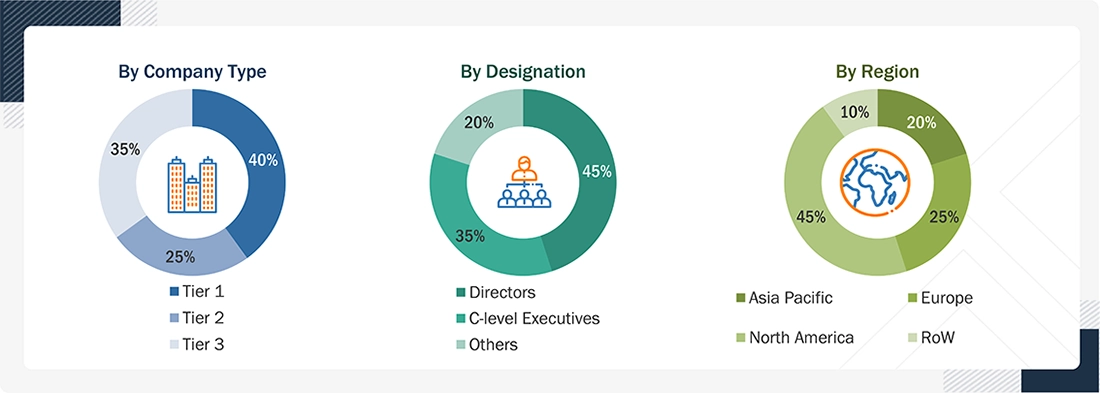
Notes: The three tiers of companies have been defined based on their total/segmental revenue as of 2025: Tier 1 = > USD 1 billion, Tier 2 = USD 1 billion to USD 500 million, and Tier 3 = < USD 500 million.
Other designations include sales, marketing, and product managers.
To know about the assumptions considered for the study, download the pdf brochure
Market Size Estimation
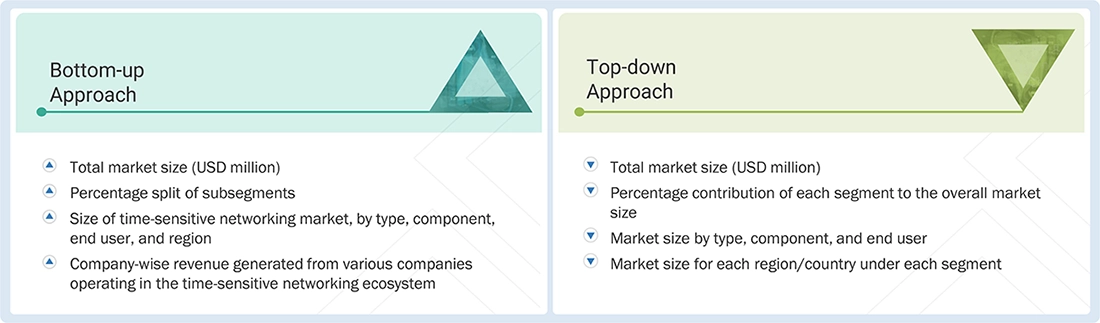
In the complete market engineering process, top-down and bottom-up approaches, along with several data triangulation methods, were used to estimate and validate the size of the time-sensitive networking market and various other dependent submarkets. Key players in the market were identified through secondary research, and their market share in each region was determined through a combination of primary and secondary research. This research methodology involved analyzing the annual and financial reports of the top players and conducting interviews with experts (including CEOs, VPs, directors, and marketing executives) to gather key insights (both quantitative and qualitative).
All percentage shares, splits, and breakdowns were determined using secondary sources and verified through primary sources. All possible parameters affecting the markets covered in this study were accounted for, examined in detail, verified through primary research, and analyzed to obtain final quantitative and qualitative data. This data was consolidated and supplemented with detailed inputs and analysis from MarketsandMarkets and presented in this report.
Time-Sensitive Networking Market: Top-Down and Bottom-Up Approach
Data Triangulation
After determining the overall market size through the estimation process, as explained above, the total market was divided into several segments and subsegments. To complete the overall market engineering process and obtain precise statistics for all segments and subsegments, the data triangulation procedure was employed, as applicable. The data was triangulated by studying various factors and trends from the demand and supply sides. Additionally, the market has been validated using both top-down and bottom-up approaches.
Market Definition
Time-sensitive networking is a set of IEEE 802.1 standards that aim to determine the standard Ethernet networks, initially designed for best-effort communication. It provides time synchronization, low-latency communication, and quality of service (QoS) for real-time industrial applications such as factory automation, automotive systems, and avionics. With time-sensitive networking, periodic and aperiodic data can be transmitted over the same network, enabling a wide range of applications to coexist on a unified Ethernet network. Time-sensitive networking is becoming increasingly popular in industrial communication systems, as it offers a cost-effective, standardized, and flexible solution that can enhance system performance, reliability, and safety.
Key Stakeholders
- Providers of components and materials for time-sensitive networking products
- Distributors, suppliers, and service providers for time-sensitive networking products
- Technology standards organizations, forums, alliances, and associations
- End users from various sectors such as industrial automation, automotive, and energy and power
- Research organizations
- Analysts and strategic business planners
- Venture capitalists, private equity firms, and startup companies
Report Objectives
- To describe and forecast the time-sensitive networking market, in terms of value, based on type, component, and end user
- To define and forecast the market size, in terms of value, with regard to four main regions: North America, Europe, Asia Pacific, and RoW (Rest of the World)
- To provide detailed information regarding drivers, restraints, opportunities, and challenges influencing the growth of the market
- To understand the impact of artificial intelligence (AI) on the market
- To strategically analyze micromarkets with respect to individual growth trends, prospects, and contributions to the total market
- To provide a qualitative overview of different technologies of time-sensitive networking
- To analyze opportunities for various stakeholders by identifying high-growth segments of the market
- To strategically profile key players and comprehensively analyze their market position in terms of ranking and core competencies, along with detailing the competitive landscape of the market
- To analyze competitive developments, such as acquisitions, product launches, developments, and partnerships in the market
- To provide a detailed overview of the ecosystem analysis, case study analysis, patent analysis, trade analysis, technology analysis, average selling price (ASP) analysis, AI/Gen AI impact analysis, Porter’s five forces analysis, macroeconomic outlook, and regulatory landscape pertaining to the time-sensitive networking market.
Available customizations:
With the given market data, MarketsandMarkets offers customizations according to the company’s specific needs. The following customization options are available for the report:
Comapany Information
-
Detailed analysis and profiling of additional market players (up to 5)
Get the Full Time-Sensitive Networking Market Report
Full forecast, segment splits, and company analysis for all Time-Sensitive Networking Market.
- Rest Of Asia Pacific Time-Sensitive Networking Market
- Romania Time-Sensitive Networking Market
- Hungary Time-Sensitive Networking Market
- Poland Time-Sensitive Networking Market
- Rest Of Eastern Europe Time-Sensitive Networking Market
- Slovakia Time-Sensitive Networking Market
- Ukraine Time-Sensitive Networking Market
- Bahrain Time-Sensitive Networking Market
- Kuwait Time-Sensitive Networking Market
- Oman Time-Sensitive Networking Market
- Qatar Time-Sensitive Networking Market
- Rest Of Middle East Time-Sensitive Networking Market
- Saudi Arabia Time-Sensitive Networking Market
- UAE Time-Sensitive Networking Market
- Rest Of Africa Time-Sensitive Networking Market
- South Africa Time-Sensitive Networking Market
- US Time-Sensitive Networking Market
- Canada Time-Sensitive Networking Market
- Mexico Time-Sensitive Networking Market
- Germany Time-Sensitive Networking Market
- UK Time-Sensitive Networking Market
- France Time-Sensitive Networking Market
- Spain Time-Sensitive Networking Market
- China Time-Sensitive Networking Market
- Japan Time-Sensitive Networking Market
- South Korea Time-Sensitive Networking Market
- India Time-Sensitive Networking Market
- Australia Time-Sensitive Networking Market
- Indonesia Time-Sensitive Networking Market
- Malaysia Time-Sensitive Networking Market
- Thailand Time-Sensitive Networking Market
- Vietnam Time-Sensitive Networking Market
- Eastern Europe Time-Sensitive Networking Market
- Nordics Time-Sensitive Networking Market
- Rest Of Europe Time-Sensitive Networking Market
Need a Tailored Report?
Customize this report to your needs
Get 10% FREE Customization
Customize This Report
