
Qatar Time-Sensitive Networking Market (2025-2030)

The Qatar Time-Sensitive Networking Market was valued at $0.68 Million in 2025 and projected to reach to $2.97 Million by 2030, representing a compound annual growth rate of 34.3%. Qatar's Time-Sensitive Networking market is experiencing accelerated growth fueled by the nation's ambitious digital transformation agenda and substantial investments in industrial automation.


| Market Size in | USD 26.32 MN |
| Market Forecast in | |
| CAGR | |
| Forecast Period | |
| Units Considered | Value (USD MN) |
Qatar Time-Sensitive Networking Market Trends and Insights
- This robust growth trajectory reflects Qatar's strategic investments in industrial automation, smart infrastructure, and digital transformation initiatives across critical sectors including oil and gas, telecommunications, and smart city development.
- Qatar's adoption of time-sensitive networking technologies is accelerating as enterprises seek deterministic, low-latency communication solutions to enhance operational efficiency and support Industry 4.0 implementations. The expansion of Qatar's Time-Sensitive Networking market is driven by increasing demand for real-time data processing, enhanced cybersecurity requirements, and the nation's Vision 2030 economic diversification agenda.
- Qatar's focus on becoming a regional technology hub and its investments in 5G infrastructure create favorable conditions for TSN deployment across manufacturing, logistics, and critical infrastructure sectors.
- By 2030, Qatar is expected to emerge as a growing market for advanced networking solutions, supported by government initiatives and private sector collaboration in digital innovation..
Key Market Statistics
- CAGR (2025-2030) 34.3% CAGR
- Market Size, 2025 ~USD 0.68 Million
- Forecast, 2030 ~USD 2.97 Million
- Country Qatar
Qatar Time-Sensitive Networking Market Overview
Rapid Market Expansion :
Qatar's Time-Sensitive Networking market is projected to grow from $0.68 million in 2025 to $2.97 million by 2030, representing a 34.3% CAGR, driven by industrial modernization and smart infrastructure initiatives.
Strategic Digital Transformation :
Qatar's Vision 2030 roadmap and investments in industrial automation are accelerating TSN adoption across manufacturing, energy, and telecommunications sectors, positioning the nation as a regional technology hub.
Critical Infrastructure Development :
Government-backed smart city projects and industrial IoT deployments in Qatar are creating substantial demand for time-sensitive networking solutions to support real-time data processing and operational efficiency.
Regional Leadership Opportunity :
As a high-income Gulf nation with significant capital investment capacity, Qatar presents a premium market opportunity for TSN vendors targeting the Middle East and establishing regional headquarters.
Qatar Time-Sensitive Networking Market Dynamics
- The country's strategic focus on diversifying its economy beyond hydrocarbons has catalyzed adoption of advanced networking technologies across manufacturing, energy, and smart infrastructure sectors.
- Government initiatives aligned with Qatar Vision 2030 are driving demand for reliable, low-latency networking solutions essential for critical industrial operations. The forecast period through 2030 anticipates sustained expansion as Qatar continues deploying smart city infrastructure and modernizing industrial facilities.
- Increased foreign direct investment in technology sectors, coupled with local enterprise digitalization efforts, will create sustained demand for TSN solutions.
- The market's 34.3% CAGR reflects Qatar's commitment to becoming a regional technology leader and the critical role time-sensitive networking plays in enabling next-generation industrial and infrastructure applications..
Market Ecosystem
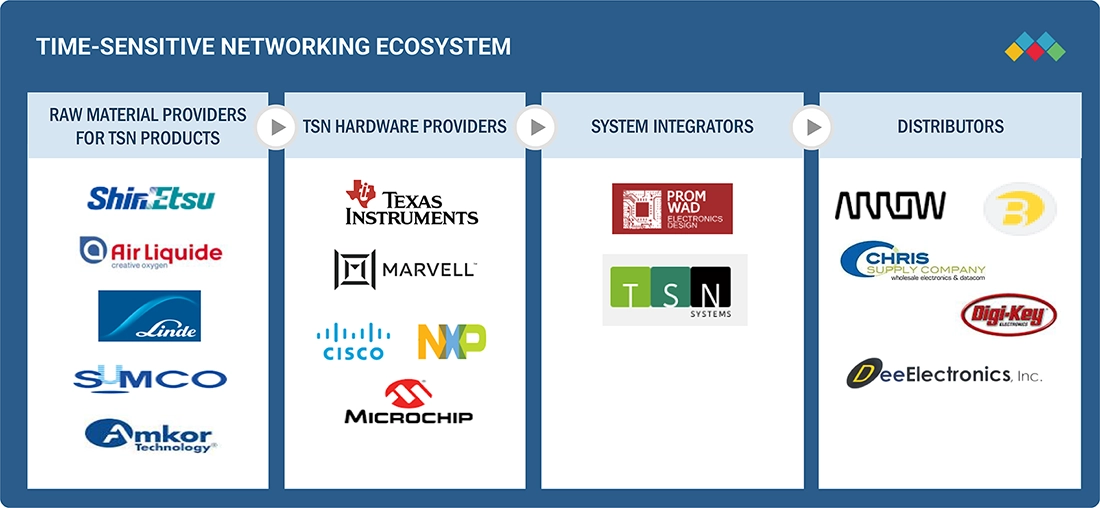
Time-Sensitive Networking Market: COMMERCIAL USE CASES ACROSS INDUSTRIES
| COMPANY | USE CASE DESCRIPTION | BENEFITS |
|---|---|---|
 |
Processors and Ethernet PHYs used in factory robots and motion controllers | Enable real-time synchronization, reduce communication jitter, and ensure precise motor control in industrial automation |
 |
Automotive Ethernet switches and MCUs integrated into zonal and domain controllers | Support deterministic data flow for ADAS and infotainment systems, enhancing safety and in-vehicle user experience |
 |
TSN-enabled industrial switches in PLCs and edge devices for synchronized machine communication | Improve data reliability and timing accuracy across machines, enabling seamless operation in smart manufacturing environments |
 |
TSN-integrated Ethernet switch SoCs used in smart factories and autonomous mobile robots (AMRs) | Deliver low-latency, high-reliability data paths critical for autonomous navigation and safety systems |
 |
TSN-compliant switch ICs embedded in industrial gateways and connected vehicle platforms | Facilitate deterministic networking for mixed-criticality applications, ensuring real-time performance and secure data flow |
Logos and trademarks shown above are the property of their respective owners. Their use here is for informational and illustrative purposes only.
Related Ecosystem
Cyber Security
- Cloud Security
- Biometric Systems
- Data Loss Prevention (DLP)
- Multi-Factor Authentication
- Security Analytics
- International Business Machines Corporation
- MITSUI BUSSAN SECURE DIRECTIONS INC
- Cisco Systems, Inc.
- MICROSOFT CORPORATION
- Allot Ltd.
Communication And Connectivity Technology
- Sensors
- Smart Card & Readers
- Cellular Network
- Femtocell
- Image Sensors
- Cisco Systems, Inc.
- HUAWEI TECHNOLOGIES CO LTD
- Lenovo
- CommScope Holding Company, Inc.
- Nokia corporation
Key Takeaways
- Qatar's Time-Sensitive Networking market is projected to grow from $0.68 million in 2025 to $2.97 million by 2030 at a 34.3% CAGR.
- Qatar's oil and gas sector is a primary driver of TSN adoption, requiring deterministic communication for critical operational processes.
- Qatar's Vision 2030 economic diversification strategy and smart city initiatives are accelerating demand for advanced networking infrastructure.
- Qatar's strategic positioning as a regional technology hub creates opportunities for TSN vendors and system integrators to establish market presence.
Time-Sensitive Networking Market Report Scope
| Report Metric | Details |
|---|---|
| Base Year | 2025 |
| Fastest Growing Segment | IEEE 802.11BE (Type) |
| Forecast Period | 2025-2030 |
| Growth Rate | CAGR of 40.7% from 2025 to 2030 |
| Largest Segment | IEEE 802.1AS (Type) |
| Market Size Base Year (Billions) | ~USD 0.36 (2025) |
| Revenue Forecast (Billions) | ~USD 1.97 (2030) |
| Segments Covered | Type, Component, End User |
Qatar Time-Sensitive Networking Market Report Segmentation
3 segment dimensions are covered across the global market.
By Type
- Ieee 802.11Be
- Ieee 802.1As
- Ieee 802.1Cb
- Ieee 802.1Cm
- Ieee 802.1Qbu
- Ieee 802.1Qcc
- Ieee802.1Qbv
- Other Types
By Component
- Controllers And Processors
- Hubs, Routers, And Gateways
- Isolators And Converters
- Switches
By End User
- Aerospace
- Automotive
- Industrial
- Oil & Gas
- Other End Users
- Telecom & Data Center
- Transportation
Target Audience
- Industrial Automation Vendors : TSN solution providers targeting Qatar's manufacturing and industrial sectors need market-specific data to identify customer segments, quantify opportunity size, and develop localized product strategies.
- Telecommunications & Infrastructure Companies : Telecom operators and infrastructure providers expanding in Qatar require detailed market intelligence on TSN adoption drivers, smart city projects, and connectivity requirements for competitive positioning.
- Technology Investment Firms : Private equity and venture capital investors evaluating opportunities in Qatar's digital transformation need validated market sizing, growth projections, and sector-specific insights for investment decisions.
- Government & Policy Makers : Qatari government agencies and economic development authorities need market analysis to inform Vision 2030 implementation, technology roadmaps, and industrial policy decisions.
- System Integrators & Consultants : IT consultants and system integrators serving Qatari enterprises require market data to advise clients on TSN adoption timelines, ROI projections, and technology implementation roadmaps.
Reasons to Buy this Report
- Market-Specific Growth Data : Access precise Qatar market sizing ($0.68M in 2025) and 5-year forecasts with 34.3% CAGR, enabling accurate investment planning and resource allocation for the Qatari market segment.
- Competitive Positioning Intelligence : Understand Qatar's unique market dynamics, government initiatives, and industrial priorities to develop targeted go-to-market strategies and competitive advantages in this high-growth emerging market.
- Sector-Specific Opportunity Mapping : Identify critical sectors driving TSN adoption in Qatar including industrial automation, energy infrastructure, and smart city projects aligned with Vision 2030 objectives.
- Regional Expansion Strategy : Leverage Qatar market insights to establish regional headquarters, develop partnerships with local enterprises, and expand across the Gulf Cooperation Council with a proven market entry model.
- Investment Decision Support : Make informed capital allocation decisions with comprehensive Qatar market analysis, growth trajectory validation, and risk assessment specific to the semiconductor and electronics sector.
Frequently asked questions
What is the current market size of Time-Sensitive Networking in Qatar?
Qatar's Time-Sensitive Networking market was valued at $0.68 million in 2025 and is expected to reach $2.97 million by 2030.
What is the projected growth rate for Qatar's Time-Sensitive Networking market?
Qatar's Time-Sensitive Networking market is projected to grow at a compound annual growth rate (CAGR) of 34.3% from 2025 to 2030.
Which industries in Qatar are driving Time-Sensitive Networking adoption?
Qatar's oil and gas, telecommunications, manufacturing, logistics, and smart city infrastructure sectors are primary drivers of TSN adoption.
How does Qatar's Vision 2030 impact the Time-Sensitive Networking market?
Qatar's Vision 2030 economic diversification agenda and investments in digital transformation and smart infrastructure are creating favorable conditions for TSN deployment and market growth.
What role does 5G infrastructure play in Qatar's Time-Sensitive Networking market?
Qatar's 5G infrastructure investments support TSN deployment by providing the underlying connectivity and low-latency capabilities required for time-sensitive applications.
RESEARCH METHODOLOGY
The study used four major activities to estimate the time-sensitive networking market size. Exhaustive secondary research was conducted to gather information on the market and its peer and parent markets. The next step was to validate these findings, assumptions, and market size with industry experts across the value chain through primary research. Both top-down and bottom-up approaches were employed to estimate the total market size. Finally, market breakdown and data triangulation methods were used to estimate the market size for different segments and subsegments.
Secondary Research
In the secondary research process, various sources were used to identify and collect information on the time-sensitive networking market. Secondary sources for this research study include corporate filings (such as annual reports, investor presentations, and financial statements); trade, business, and professional associations; white papers; certified publications; and articles by recognized authors, directories, and databases. The secondary data was collected and analyzed to determine the overall market size, and was further validated through primary research.
List of key secondary sources
|
Source |
Web Link |
|
UK Competitive Telecommunications Association |
www.ukcta.org.uk |
|
ASTM International |
www.astm.org |
|
European Research Council |
www.erc.europa.eu |
|
World Trade Organization |
www.wto.gov |
|
International Trade Centre (ITC) |
www.intracen.org |
|
United States Telecom Association |
www.ustelecom.org |
Primary Research
Primary interviews were conducted to gather insights on market statistics, revenue data, market breakdowns, size estimations, and forecasting. Additionally, primary research was used to comprehend various technologies, types, applications, and regional trends. Interviews with stakeholders from the demand side, including CIOs, CTOs, CSOs, and customer/end user installation teams using time-sensitive networking offerings and processes, were also conducted to understand their perspective on suppliers, products, component providers, and their current and future use of time-sensitive networking, which will impact the overall market. Several primary interviews were conducted across major countries in North America, Europe, Asia Pacific, and RoW.
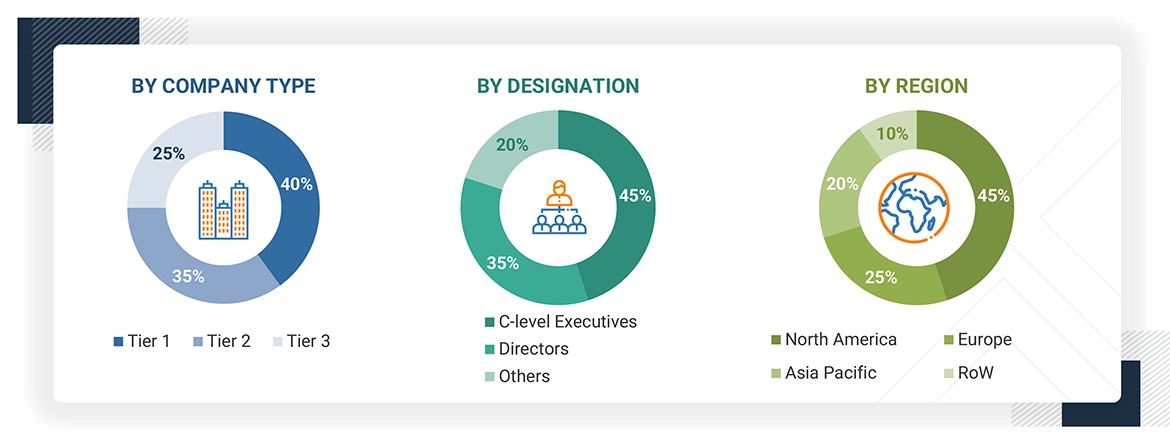
To know about the assumptions considered for the study, download the pdf brochure
Market Size Estimation
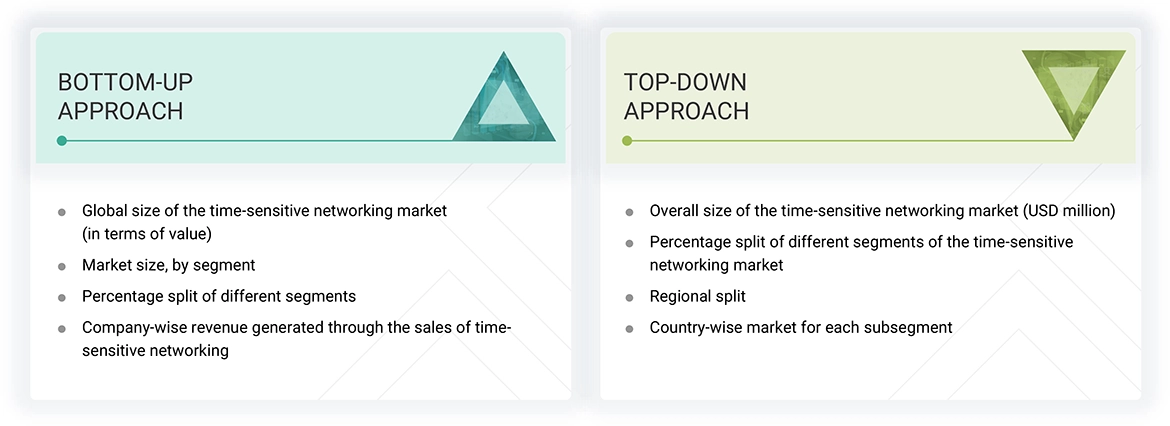
In the complete market engineering process, top-down and bottom-up approaches and several data triangulation methods have been used to estimate and forecast the overall market segments and subsegments listed in this report. Key players in the market have been identified through secondary research, and their market shares in the respective regions have been determined through primary and secondary research. This entire procedure included the study of annual and financial reports of the top market players and extensive interviews for key insights (quantitative and qualitative) with industry experts (CEOs, VPs, directors, and marketing executives).
All percentage shares, splits, and breakdowns have been determined using secondary sources and verified through primary sources. All the parameters affecting the markets covered in this research study have been accounted for, viewed in detail, verified through primary research, and analyzed to obtain the final quantitative and qualitative data. This data has been consolidated and supplemented with detailed inputs and analysis from MarketsandMarkets and presented in this report. The following figure represents this study's overall market size estimation process.
Time-Sensitive Networking Market : Top-Down and Bottom-Up Approach
Data Triangulation
Once the overall size of the time-sensitive networking market has been determined using the methods described above, it has been divided into multiple segments and subsegments. Market engineering has been performed for each segment and subsegment using market breakdown and data triangulation methods, as applicable, to obtain accurate statistics. Various factors and trends from the demand and supply sides have been studied to triangulate the data. The market size has been validated using both top-down and bottom-up approaches..
Market Definition
Time-sensitive networking is a set of IEEE 802.1 standards that aim to determine the standard Ethernet networks, initially designed for best-effort communication. It provides time synchronization, low-latency communication, and quality of service (QoS) for real-time industrial applications such as factory automation, automotive systems, and avionics. With time-sensitive networking, periodic and aperiodic data can be transmitted over the same network, enabling a wide range of applications to coexist on a single Ethernet infrastructure. Time-sensitive networking is becoming increasingly popular in industrial communication systems, as it offers a cost-effective, standardized, and flexible solution that can enhance system performance, reliability, and safety.
Key Stakeholders
- Providers of components and materials for time-sensitive networking products
- Distributors, suppliers, and service providers for time-sensitive networking products
- Technology standards organizations, forums, alliances, and associations
- End users from various sectors such as industrial automation, automotive, and energy and power
- Research organizations
- Analysts and strategic business planners
- Venture capitalists, private equity firms, and start-up companies
Report Objectives
- To describe and forecast the time-sensitive networking market, by type, component, end user, and region, in terms of value
- To describe and forecast the market for various segments across four main regions, namely, North America, Europe, Asia Pacific, and RoW, in terms of value
- To strategically analyze micromarkets with regard to individual growth trends, prospects, and contributions to the markets
- To provide detailed information regarding drivers, restraints, opportunities, and challenges influencing market growth
- To analyze opportunities for stakeholders by identifying high-growth segments in the market
- To provide a detailed overview of the time-sensitive networking value chain
- To strategically analyze key technologies, average selling price trends, trends impacting customer business, ecosystem, regulatory landscape, patent landscape, Porter's Five Forces, import and export scenarios, trade landscape, key stakeholders, buying criteria, and case studies pertaining to the market under study
- To strategically profile key players in the time-sensitive networking market and comprehensively analyze their market share and core competencies
- To analyze competitive developments such as partnerships, acquisitions, expansions, collaborations, and product launches, along with R&D in the time-sensitive networking market
Available Customizations:
With the given market data, MarketsandMarkets offers customizations according to the specific requirements of companies. The following customization options are available for the report:
- Detailed analysis and profiling of additional market players (up to 5)
- Additional country-level analysis of the time-sensitive networking market
Product Analysis
- The product matrix provides a detailed comparison of the product portfolio of each company in the time-sensitive networking market.
Get the Full Time-Sensitive Networking Market Report
Full forecast, segment splits, and company analysis for all Time-Sensitive Networking Market.
- Rest Of Asia Pacific Time-Sensitive Networking Market
- Romania Time-Sensitive Networking Market
- Hungary Time-Sensitive Networking Market
- Poland Time-Sensitive Networking Market
- Rest Of Eastern Europe Time-Sensitive Networking Market
- Slovakia Time-Sensitive Networking Market
- Ukraine Time-Sensitive Networking Market
- Bahrain Time-Sensitive Networking Market
- Kuwait Time-Sensitive Networking Market
- Oman Time-Sensitive Networking Market
- Rest Of Middle East Time-Sensitive Networking Market
- Saudi Arabia Time-Sensitive Networking Market
- UAE Time-Sensitive Networking Market
- Rest Of Africa Time-Sensitive Networking Market
- South Africa Time-Sensitive Networking Market
- US Time-Sensitive Networking Market
- Canada Time-Sensitive Networking Market
- Mexico Time-Sensitive Networking Market
- Germany Time-Sensitive Networking Market
- UK Time-Sensitive Networking Market
- France Time-Sensitive Networking Market
- Italy Time-Sensitive Networking Market
- Spain Time-Sensitive Networking Market
- China Time-Sensitive Networking Market
- Japan Time-Sensitive Networking Market
- South Korea Time-Sensitive Networking Market
- India Time-Sensitive Networking Market
- Australia Time-Sensitive Networking Market
- Indonesia Time-Sensitive Networking Market
- Malaysia Time-Sensitive Networking Market
- Thailand Time-Sensitive Networking Market
- Vietnam Time-Sensitive Networking Market
- Eastern Europe Time-Sensitive Networking Market
- Nordics Time-Sensitive Networking Market
- Rest Of Europe Time-Sensitive Networking Market
Need a Tailored Report?
Customize this report to your needs
Get 10% FREE Customization
Customize This Report
