
Spain Time-Sensitive Networking Market (2025-2030)

The Spain Time-Sensitive Networking Market was valued at $3.4 Million in 2025 and projected to reach to $15.9 Million by 2030, representing a compound annual growth rate of 36.3%. Spain's Time-Sensitive Networking market is poised for substantial growth, expanding from $3.4 million in 2025 to $15.9 million by 2030.


| Market Size in | USD 26.32 MN |
| Market Forecast in | |
| CAGR | |
| Forecast Period | |
| Units Considered | Value (USD MN) |
Spain Time-Sensitive Networking Market Trends and Insights
- This represents a compound annual growth rate of 36.3%, reflecting Spain's increasing adoption of deterministic networking solutions across industrial automation, automotive, and telecommunications sectors.
- Spain's strategic location within Europe and its growing manufacturing base are driving demand for real-time communication protocols essential for Industry 4.0 applications. The expansion of Spain's Time-Sensitive Networking market is underpinned by rising investments in smart factory infrastructure and the country's commitment to digital transformation.
- Spain's semiconductor and electronics ecosystem is increasingly integrating TSN technologies to enhance operational efficiency and reduce latency-sensitive applications.
- Between 2025 and 2030, Spain is expected to emerge as a key adopter of Time-Sensitive Networking solutions, supported by regulatory frameworks promoting industrial modernization and cross-border European connectivity standards..
Key Market Statistics
- CAGR (2025-2030) 36.3% CAGR
- Market Size, 2025 ~USD 3.4 Million
- Forecast, 2030 ~USD 15.9 Million
- Country Spain
Spain Time-Sensitive Networking Market Overview
Rapid Market Expansion :
Spain's Time-Sensitive Networking market is experiencing explosive growth with a 36.3% CAGR from 2025 to 2030, driven by industrial digitalization and smart manufacturing initiatives across the country.
Strategic Industrial Hub :
Spain's automotive and manufacturing sectors are increasingly adopting deterministic networking solutions to enhance production efficiency, positioning the country as a key European market for TSN technology deployment.
Telecommunications Integration :
Spanish telecom operators are investing in TSN infrastructure to support low-latency, mission-critical applications, creating new revenue streams and competitive advantages in the European market.
EU Regulatory Alignment :
Spain's compliance with EU Industry 4.0 standards and digital transformation mandates is accelerating TSN adoption, with government incentives supporting technology integration in manufacturing and logistics sectors.
Spain Time-Sensitive Networking Market Dynamics
- This 36.3% CAGR reflects Spain's strategic positioning within Europe's industrial automation landscape and increasing demand for deterministic networking solutions.
- Key drivers include the automotive sector's modernization, smart factory implementations, and telecommunications infrastructure upgrades. The Spanish market benefits from strong government support for digital transformation initiatives and EU funding for Industry 4.0 projects.
- Manufacturing hubs in Catalonia, Valencia, and the Basque Country are leading adoption rates.
- As enterprises prioritize operational reliability and real-time data processing, TSN technology will become increasingly critical for competitive advantage in Spain's industrial ecosystem..
Market Ecosystem
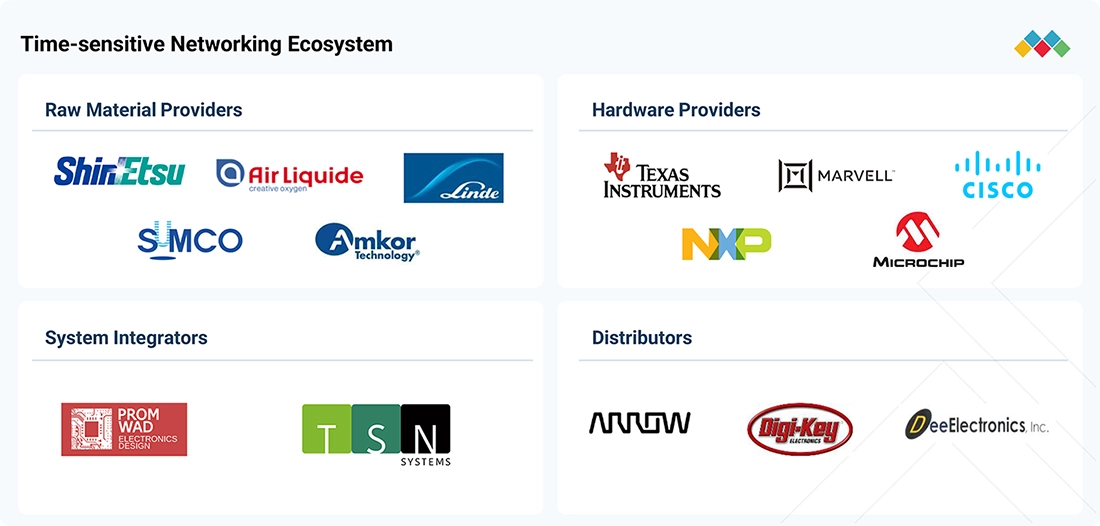
TIME-SENSITIVE NETWORKING MARKET: COMMERCIAL USE CASES ACROSS INDUSTRIES
| COMPANY | USE CASE DESCRIPTION | BENEFITS |
|---|---|---|
 |
Texas Instruments integrates TSN hardware support into Sitara microprocessors and microcontrollers for industrial field devices and factory automation systems. The processors run IEEE 802.1AS time synchronization and IEEE 802.1Qbv traffic scheduling across multi-axis motion drives, remote I/O nodes, and robotics. | Eliminates dedicated fieldbus wiring by converging operational technology and data traffic on standard Ethernet | Delivers microsecond-level synchronization accuracy for multi-axis servo control | Minimizes communication jitter across distributed robotic workcells | Simplifies firmware development through integrated royalty-free software development kits |
 |
NXP deploys TSN-enabled microcontrollers, processors, and automotive Ethernet switches for software-defined vehicles and industrial robotics. The hardware acts as the deterministic backbone for vehicle central compute clusters, zonal gateways, ADAS perception systems, and industrial real-time control modules. | Enables predictable packet delivery for mission-critical Advanced Driver Assistance Systems (ADAS) | Accelerates automotive transition to lean zonal wiring architectures | Reduces vehicle harness weight and installation costs | Guarantees bounded latency for coexisting infotainment, diagnostic, and vehicle safety data |
 |
Siemens implements TSN across its Scalance industrial switch portfolio and Simatic automation controllers for manufacturing lines and process plants. The infrastructure utilizes OPC UA over TSN to connect programmable logic controllers, human-machine interfaces, and cloud management layers over unified physical links. | Unifies real-time control and high-bandwidth information technology traffic on a single network plant | Eliminates proprietary communication bottlenecks across multivendor automation setups | Preserves continuous deterministic operation during heavy background diagnostics data transfers | Minimizes machine downtime with standard protocol diagnostics |
 |
Marvell provides automotive and industrial Gigabit Ethernet switch silicon supporting complete IEEE 802.1 TSN protocol suites. The silicon connects high-performance edge compute platforms, multi-camera radar sensor arrays, and domain controllers within autonomous driving test fleets and connected vehicle platforms. | Delivers multi-gigabit wire-speed packet processing with zero packet loss for safety-critical streams | Isolates critical vehicle sensor traffic from bulk data using strict time-aware traffic policing | Enhances safety compliance with automotive functional safety standards | Lowers system bill-of-materials by integrating multi-port switching into compact system-on-chips |
 |
Broadcom incorporates TSN capabilities into high-density Ethernet switch chips and physical layer transceivers for industrial IoT networks and automotive communication backbones. The switches schedule critical traffic across industrial automation plants, automated guided vehicles, and enterprise edge aggregation points. | Supports high-bandwidth real-time industrial and automotive communications over standard twisted-pair Ethernet | Enforces deterministic traffic priority queues across complex network topologies | Lowers latency variations across high-port-count industrial control switches | Provides reliable, energy-efficient operational performance in harsh industrial environments |
Logos and trademarks shown above are the property of their respective owners. Their use here is for informational and illustrative purposes only.
Related Ecosystem
Cyber Security
- Cloud Security
- Biometric Systems
- Data Loss Prevention (DLP)
- Multi-Factor Authentication
- Security Analytics
- International Business Machines Corporation
- MITSUI BUSSAN SECURE DIRECTIONS INC
- Cisco Systems, Inc.
- MICROSOFT CORPORATION
- Allot Ltd.
Communication And Connectivity Technology
- Sensors
- Smart Card & Readers
- Cellular Network
- Femtocell
- Image Sensors
- Cisco Systems, Inc.
- HUAWEI TECHNOLOGIES CO LTD
- Lenovo
- CommScope Holding Company, Inc.
- Nokia corporation
Key Takeaways
- Spain's Time-Sensitive Networking market will grow from $3.4M (2025) to $15.9M (2030) at a 36.3% CAGR.
- Spain's industrial automation and automotive sectors are primary drivers of TSN adoption and market expansion.
- Spain's position within the European Union enables cross-border standardization and accelerates TSN technology deployment.
- Spain's digital transformation initiatives and Industry 4.0 investments are catalyzing demand for deterministic networking solutions.
Time-Sensitive Networking Market Report Scope
| Report Metric | Details |
|---|---|
| Base Year | 2025 |
| Fastest Growing Segment | IEEE 802.11BE (Type) |
| Forecast Period | 2025-2030 |
| Growth Rate | CAGR of 40.7% from 2025 to 2030 |
| Largest Segment | IEEE 802.1AS (Type) |
| Market Size Base Year (Billions) | ~USD 0.36 (2025) |
| Revenue Forecast (Billions) | ~USD 1.97 (2030) |
| Segments Covered | Type, Component, End User |
Spain Time-Sensitive Networking Market Report Segmentation
3 segment dimensions are covered across the global market.
By Type
- Ieee 802.11Be
- Ieee 802.1As
- Ieee 802.1Cb
- Ieee 802.1Cm
- Ieee 802.1Qbu
- Ieee 802.1Qcc
- Ieee802.1Qbv
- Other Types
By Component
- Controllers And Processors
- Hubs, Routers, And Gateways
- Isolators And Converters
- Switches
By End User
- Aerospace
- Automotive
- Industrial
- Oil & Gas
- Other End Users
- Telecom & Data Center
- Transportation
SPAIN: TIME-SENSITIVE NETWORKING MARKET, BY END USER, 2025–2030
| Segment | 2025 | 2026 | 2027 | 2028 | 2029 | 2030 | CAGR (%) |
|---|---|---|---|---|---|---|---|
| AEROSPACE | 0.14 | 0.19 | 0.26 | 0.35 | 0.47 | 0.64 | 35.5 |
| AUTOMOTIVE | 0.76 | 1.05 | 1.45 | 2 | 2.79 | 3.89 | 38.5 |
| INDUSTRIAL | 1.19 | 1.61 | 2.21 | 3.03 | 4.17 | 5.77 | 37.2 |
| OIL & GAS | 0.46 | 0.62 | 0.83 | 1.13 | 1.53 | 2.08 | 35.1 |
| OTHER END USERS | 0.09 | 0.11 | 0.13 | 0.15 | 0.17 | 0.18 | 15.7 |
| TELECOM & DATA CENTER | 0.17 | 0.22 | 0.3 | 0.39 | 0.53 | 0.71 | 33.2 |
| TRANSPORTATION | 0.57 | 0.76 | 1.03 | 1.4 | 1.91 | 2.62 | 35.8 |
| TOTAL | 3.37 | 4.56 | 6.19 | 8.44 | 11.56 | 15.88 | 36.3 |
Target Audience
- Spanish Automotive Manufacturers : Need TSN market intelligence to evaluate technology adoption for production line optimization, supply chain integration, and competitive positioning within Spain's automotive manufacturing sector.
- Industrial Automation Integrators : Require detailed market analysis to identify customer opportunities, assess demand for deterministic networking solutions, and develop service offerings aligned with Spanish manufacturing modernization trends.
- Telecommunications Operators : Seek market insights to understand TSN infrastructure investment opportunities, identify enterprise customers, and develop service portfolios supporting low-latency applications in Spain.
- Technology Solution Providers : Need Spain-specific market data to evaluate market viability, understand competitive dynamics, and develop localized product strategies for TSN hardware and software solutions.
- Investment & Strategy Consultants : Require comprehensive market analysis to advise clients on investment opportunities, market entry strategies, and growth potential within Spain's Time-Sensitive Networking ecosystem.
Reasons to Buy this Report
- Market Size & Growth Validation : Obtain precise market valuation data for Spain ($3.4M in 2025, $15.9M in 2030) with verified 36.3% CAGR to support investment decisions and business planning in the Spanish TSN market.
- Competitive Landscape Intelligence : Identify key players, market share distribution, and competitive positioning specific to Spain's Time-Sensitive Networking ecosystem to inform go-to-market strategies and partnership opportunities.
- Sector-Specific Opportunity Analysis : Understand adoption patterns across Spanish automotive, manufacturing, and telecommunications sectors to target high-potential customer segments and tailor product offerings for maximum market penetration.
- Regional Growth Drivers : Access detailed insights into Spain-specific catalysts including EU funding, government digitalization initiatives, and regional manufacturing hubs driving TSN technology adoption and investment.
- Strategic Market Entry Planning : Leverage comprehensive Spain market data to develop localized business strategies, identify regulatory requirements, and establish realistic revenue projections for market entry or expansion initiatives.
Frequently asked questions
What is the projected market size of Time-Sensitive Networking in Spain by 2030?
Spain's Time-Sensitive Networking market is projected to reach $15.9 million by 2030, up from $3.4 million in 2025.
What is the CAGR for Spain's Time-Sensitive Networking market?
Spain's Time-Sensitive Networking market is expected to grow at a compound annual growth rate of 36.3% between 2025 and 2030.
Which industries in Spain are driving Time-Sensitive Networking adoption?
Spain's industrial automation, automotive manufacturing, and telecommunications sectors are the primary drivers of TSN market growth and technology adoption.
How does Spain's EU membership influence its Time-Sensitive Networking market?
Spain's EU membership facilitates harmonized standards, cross-border connectivity initiatives, and regulatory alignment that accelerate TSN technology deployment across the region.
What role does Industry 4.0 play in Spain's Time-Sensitive Networking market expansion?
Spain's commitment to Industry 4.0 digital transformation drives demand for deterministic, low-latency networking solutions essential for smart manufacturing and real-time industrial applications.
RESEARCH METHODOLOGY
The research process for this study involved the systematic gathering, recording, and analysis of data on customers and companies operating in the time-sensitive networking market. This process involved the extensive use of secondary sources, directories, and databases (Factiva and OANDA) to identify and collect valuable information for the comprehensive, technical, market-oriented, and commercial study of the time-sensitive networking market. In-depth interviews were conducted with primary respondents, including experts from core and related industries, as well as preferred manufacturers, to obtain and verify critical qualitative and quantitative information and assess growth prospects. Key players in the time-sensitive networking market were identified through secondary research, and their market rankings were determined through a combination of primary and secondary research. This research involved studying the annual reports of top players and conducting interviews with key industry experts, including CEOs, directors, and marketing executives.
Secondary Research
Various sources were utilized in the secondary research process to identify and collect information relevant to this study. These include company annual reports, press releases, investor presentations, white papers, technology journals, certified publications, articles by recognized authors, directories, and databases.
Secondary research was primarily used to gather key information on the industry’s value chain, the total pool of market players, market classification by industry trends at the most detailed level, regional markets, and key developments from both market- and technology-oriented perspectives.
Primary Research
Primary research was also conducted to identify the segmentation types, key players, competitive landscape, and key market dynamics, including drivers, restraints, opportunities, challenges, and industry trends, as well as the key strategies adopted by players operating in the time-sensitive networking market. Extensive qualitative and quantitative analyses were conducted across the complete market engineering process to present key information and insights throughout the report.
Extensive primary research has been conducted following the acquisition of knowledge about the time-sensitive networking market scenarios through secondary research. Several primary interviews were conducted with experts from the demand side (end user and region) and the supply side (type, component, and end user) across four major geographic regions: North America, Europe, Asia Pacific, and RoW. Approximately 60% and 40% of the primary interviews were conducted from the supply and demand sides, respectively. These primary data have been collected through questionnaires, emails, and telephonic interviews.
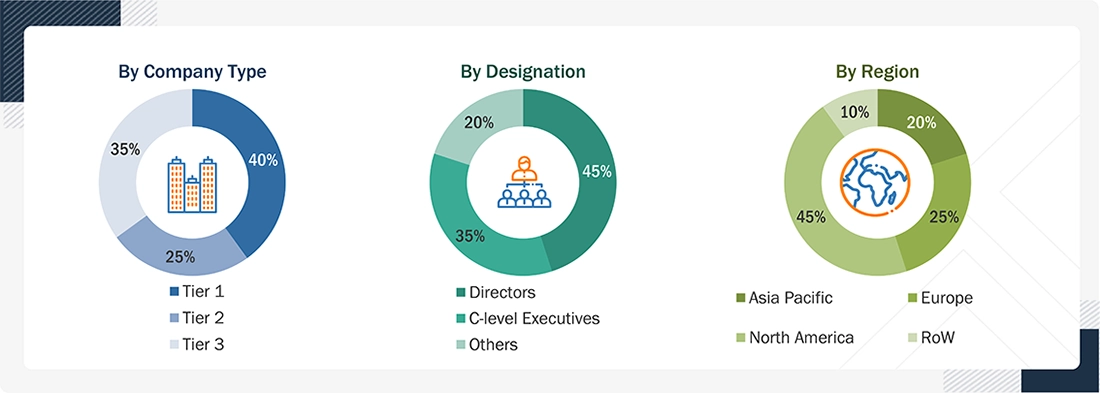
Notes: The three tiers of companies have been defined based on their total/segmental revenue as of 2025: Tier 1 = > USD 1 billion, Tier 2 = USD 1 billion to USD 500 million, and Tier 3 = < USD 500 million.
Other designations include sales, marketing, and product managers.
To know about the assumptions considered for the study, download the pdf brochure
Market Size Estimation
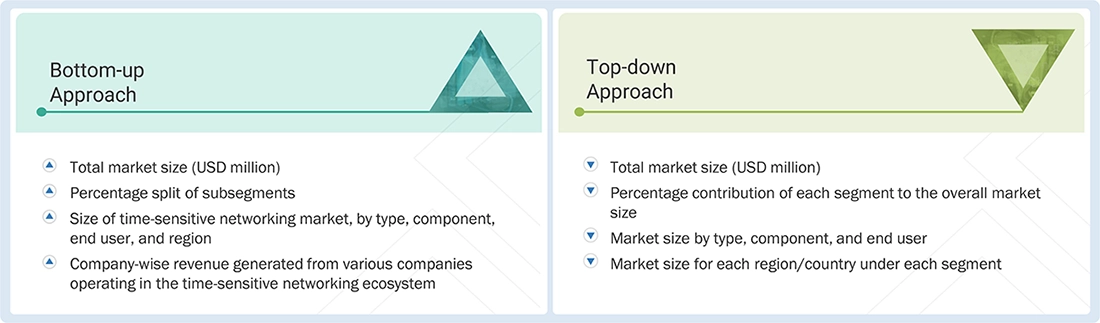
In the complete market engineering process, top-down and bottom-up approaches, along with several data triangulation methods, were used to estimate and validate the size of the time-sensitive networking market and various other dependent submarkets. Key players in the market were identified through secondary research, and their market share in each region was determined through a combination of primary and secondary research. This research methodology involved analyzing the annual and financial reports of the top players and conducting interviews with experts (including CEOs, VPs, directors, and marketing executives) to gather key insights (both quantitative and qualitative).
All percentage shares, splits, and breakdowns were determined using secondary sources and verified through primary sources. All possible parameters affecting the markets covered in this study were accounted for, examined in detail, verified through primary research, and analyzed to obtain final quantitative and qualitative data. This data was consolidated and supplemented with detailed inputs and analysis from MarketsandMarkets and presented in this report.
Time-Sensitive Networking Market: Top-Down and Bottom-Up Approach
Data Triangulation
After determining the overall market size through the estimation process, as explained above, the total market was divided into several segments and subsegments. To complete the overall market engineering process and obtain precise statistics for all segments and subsegments, the data triangulation procedure was employed, as applicable. The data was triangulated by studying various factors and trends from the demand and supply sides. Additionally, the market has been validated using both top-down and bottom-up approaches.
Market Definition
Time-sensitive networking is a set of IEEE 802.1 standards that aim to determine the standard Ethernet networks, initially designed for best-effort communication. It provides time synchronization, low-latency communication, and quality of service (QoS) for real-time industrial applications such as factory automation, automotive systems, and avionics. With time-sensitive networking, periodic and aperiodic data can be transmitted over the same network, enabling a wide range of applications to coexist on a unified Ethernet network. Time-sensitive networking is becoming increasingly popular in industrial communication systems, as it offers a cost-effective, standardized, and flexible solution that can enhance system performance, reliability, and safety.
Key Stakeholders
- Providers of components and materials for time-sensitive networking products
- Distributors, suppliers, and service providers for time-sensitive networking products
- Technology standards organizations, forums, alliances, and associations
- End users from various sectors such as industrial automation, automotive, and energy and power
- Research organizations
- Analysts and strategic business planners
- Venture capitalists, private equity firms, and startup companies
Report Objectives
- To describe and forecast the time-sensitive networking market, in terms of value, based on type, component, and end user
- To define and forecast the market size, in terms of value, with regard to four main regions: North America, Europe, Asia Pacific, and RoW (Rest of the World)
- To provide detailed information regarding drivers, restraints, opportunities, and challenges influencing the growth of the market
- To understand the impact of artificial intelligence (AI) on the market
- To strategically analyze micromarkets with respect to individual growth trends, prospects, and contributions to the total market
- To provide a qualitative overview of different technologies of time-sensitive networking
- To analyze opportunities for various stakeholders by identifying high-growth segments of the market
- To strategically profile key players and comprehensively analyze their market position in terms of ranking and core competencies, along with detailing the competitive landscape of the market
- To analyze competitive developments, such as acquisitions, product launches, developments, and partnerships in the market
- To provide a detailed overview of the ecosystem analysis, case study analysis, patent analysis, trade analysis, technology analysis, average selling price (ASP) analysis, AI/Gen AI impact analysis, Porter’s five forces analysis, macroeconomic outlook, and regulatory landscape pertaining to the time-sensitive networking market.
Available customizations:
With the given market data, MarketsandMarkets offers customizations according to the company’s specific needs. The following customization options are available for the report:
Comapany Information
-
Detailed analysis and profiling of additional market players (up to 5)
Get the Full Time-Sensitive Networking Market Report
Full forecast, segment splits, and company analysis for all Time-Sensitive Networking Market.
- Rest Of Asia Pacific Time-Sensitive Networking Market
- Romania Time-Sensitive Networking Market
- Hungary Time-Sensitive Networking Market
- Poland Time-Sensitive Networking Market
- Rest Of Eastern Europe Time-Sensitive Networking Market
- Slovakia Time-Sensitive Networking Market
- Ukraine Time-Sensitive Networking Market
- Bahrain Time-Sensitive Networking Market
- Kuwait Time-Sensitive Networking Market
- Oman Time-Sensitive Networking Market
- Qatar Time-Sensitive Networking Market
- Rest Of Middle East Time-Sensitive Networking Market
- Saudi Arabia Time-Sensitive Networking Market
- UAE Time-Sensitive Networking Market
- Rest Of Africa Time-Sensitive Networking Market
- South Africa Time-Sensitive Networking Market
- US Time-Sensitive Networking Market
- Canada Time-Sensitive Networking Market
- Mexico Time-Sensitive Networking Market
- Germany Time-Sensitive Networking Market
- UK Time-Sensitive Networking Market
- France Time-Sensitive Networking Market
- Italy Time-Sensitive Networking Market
- China Time-Sensitive Networking Market
- Japan Time-Sensitive Networking Market
- South Korea Time-Sensitive Networking Market
- India Time-Sensitive Networking Market
- Australia Time-Sensitive Networking Market
- Indonesia Time-Sensitive Networking Market
- Malaysia Time-Sensitive Networking Market
- Thailand Time-Sensitive Networking Market
- Vietnam Time-Sensitive Networking Market
- Eastern Europe Time-Sensitive Networking Market
- Nordics Time-Sensitive Networking Market
- Rest Of Europe Time-Sensitive Networking Market
Need a Tailored Report?
Customize this report to your needs
Get 10% FREE Customization
Customize This Report