
Canada Trade Management Market (2026-2031)

The Canada Trade Management Market was valued at $74.01 Million in 2026 and projected to reach to $146.15 Million by 2031, representing a compound annual growth rate of 12.0%. Canada's Trade Management Market is poised for sustained expansion as businesses prioritize digital transformation and regulatory compliance.


| Market Size in | USD 26.32 MN |
| Market Forecast in | |
| CAGR | |
| Forecast Period | |
| Units Considered | Value (USD MN) |
Canada Trade Management Market Trends and Insights
- This expansion reflects Canada's increasing adoption of digital trade solutions and supply chain optimization technologies across key sectors.
- Canada's market growth is driven by regulatory compliance requirements, cross-border trade complexity, and the need for real-time visibility in international commerce. The Canadian trade management landscape is characterized by rising demand from mid-market and enterprise organizations seeking to streamline customs documentation, tariff management, and logistics coordination.
- Canada's strategic position in North American trade, coupled with evolving trade agreements and tariff regulations, creates sustained demand for sophisticated trade management platforms.
- By 2031, Canada's market is expected to nearly double, reflecting the country's commitment to digital transformation in trade operations and supply chain resilience..
Key Market Statistics
- CAGR (2026-2031) 12.0% CAGR
- Market Size, 2026 ~USD 74.01 Million
- Forecast, 2031 ~USD 146.15 Million
- Country Canada
Canada Trade Management Market Overview
Market Valuation Growth :
Canada's Trade Management Market is valued at $74.01 million in 2026 and is projected to reach $146.15 million by 2031, representing a robust 12% CAGR over the forecast period.
Regulatory Compliance Driver :
Canadian businesses face stringent regulatory requirements including CBSA compliance, USMCA regulations, and anti-money laundering directives, driving adoption of automated trade management solutions.
Cross-Border Trade Complexity :
Canada's significant trade relationships with the US and Mexico, combined with evolving tariff structures and trade agreements, necessitate sophisticated trade management platforms for competitive advantage.
Digital Supply Chain Transformation :
Canadian enterprises across manufacturing, retail, and logistics sectors are increasingly investing in digital trade solutions to optimize supply chain visibility and reduce operational costs.
Canada Trade Management Market Dynamics
- The market's 12% CAGR reflects growing investment in automated trade documentation, tariff classification, and supply chain visibility tools.
- Key drivers include USMCA implementation complexities, increasing cross-border e-commerce, and the need for real-time trade intelligence. Looking ahead to 2031, Canadian organizations will increasingly adopt AI-powered trade management solutions to streamline customs clearance and reduce compliance risks.
- The market will benefit from consolidation among mid-market players and heightened focus on supply chain resilience following global disruptions.
- Investment in cloud-based platforms and integration capabilities will remain critical for Canadian enterprises competing in North American trade corridors..
Market Ecosystem
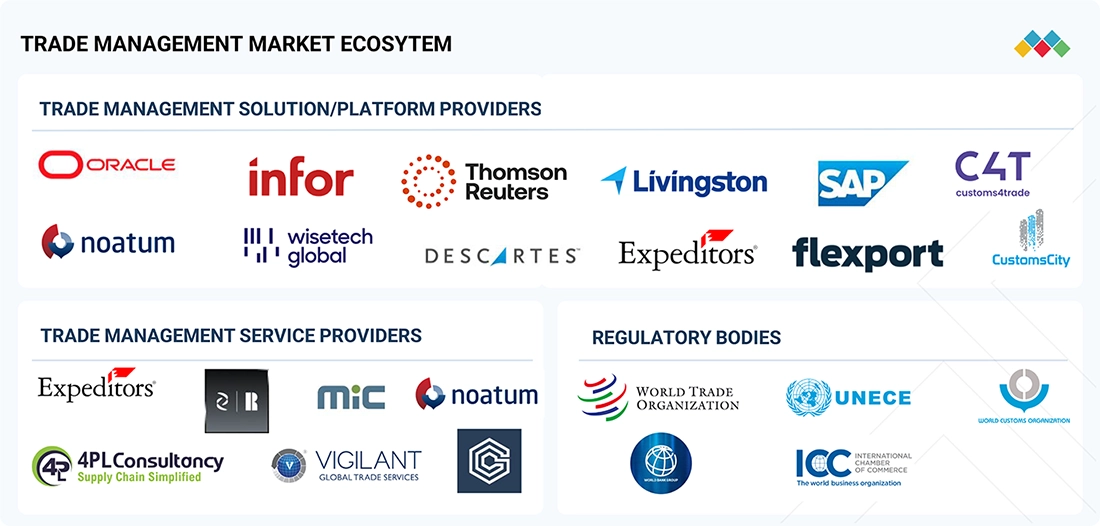
TRADE MANAGEMENT MARKET: COMMERCIAL USE CASES ACROSS INDUSTRIES
| COMPANY | USE CASE DESCRIPTION | BENEFITS |
|---|---|---|
 |
J.M. Huber, a global diversified industrial company, implemented ONESOURCE Global Trade Management to modernize its import and export compliance processes across global operations. The solution enabled automated product classification, centralized trade compliance, and standardized customs procedures, helping the company improve regulatory compliance while reducing manual effort and operational risk. | Automated import & export compliance | Centralized product classification | Reduced regulatory risk | Standardized global trade operations |
 |
Evonik, a global specialty chemicals company, leveraged SAP Global Trade Services (GTS) to modernize its international trade operations through automated preference management and digital trade compliance processes. The solution helped simplify customs procedures, improve compliance with changing trade regulations, and unlock financial benefits through more efficient free trade agreement management. | Automated preference management | Improved customs compliance |Optimized free trade agreement utilization | Reduced manual trade processes |
 |
Omron, a global automation company, implemented ONESOURCE Global Trade to centralize HS code classification and standardize trade compliance across more than 60 import and export locations worldwide. The platform replaced spreadsheet-based classification with a centralized system, improving visibility, classification accuracy, and compliance with changing global trade regulations. | Centralized HS code classification| Improved classification accuracy|Standardized global trade compliance| Better visibility across import/export operations |
Logos and trademarks shown above are the property of their respective owners. Their use here is for informational and illustrative purposes only.
Related Ecosystem
Software And Services
- Natural Language Processing (NLP)
- Machine Learning
- Supply Chain Management
- Predictive Analytics
- Image Sensors
- International Business Machines Corporation
- MICROSOFT CORPORATION
- Oracle Corporation
- SAP SE
- Amazon.com, Inc.
Key Takeaways
- Canada's Trade Management Market will grow from $74.01M (2026) to $146.15M (2031) at a 12.0% CAGR.
- Canada's regulatory environment and cross-border trade complexity drive demand for automated trade compliance solutions.
- Canada's mid-market and enterprise segments are increasingly investing in real-time supply chain visibility platforms.
- Canada's position in North American trade networks positions the country as a key growth hub for trade management technology adoption.
Trade Management Market Report Scope
| Report Metric | Details |
|---|---|
| Base Year | 2026 |
| Fastest Growing Segment | MANAGED SERVICES (Service) |
| Forecast Period | 2026-2031 |
| Growth Rate | CAGR of 12.3% from 2026 to 2031 |
| Largest Segment | SOLUTIONS (Offering) |
| Market Size Base Year (Billions) | ~USD 1.52 (2026) |
| Revenue Forecast (Billions) | ~USD 2.71 (2031) |
| Segments Covered | Offering, Solution, Service, Professional Service, Vertical |
Canada Trade Management Market Report Segmentation
5 segment dimensions are covered across the global market.
By Offering
- Services
- Solutions
By Solution
- Other Solutions
- Trade Execution & Settlement
- Trade Finance & Risk Enablement
- Trade Governance & Compliance
- Trade Intelligence & Collaboration
- Trade Planning & Commercial Optimization
By Service
- Managed Services
- Professional Services
By Professional Service
- Consulting
- Implementation
- Support & Maintenance
By Vertical
- Aerospace, Defense, & Government Programs
- Automotive, Mobility, & Transportation Equipment
- Consumer Goods, Retail, & Distribution
- Energy, Chemicals, & Natural Resources
- Food, Agriculture, & Agribusiness
- Healthcare, Pharmaceuticals, & Life Sciences
- Manufacturing & Industrial
- Other Verticals
- Technology, Electronics, & Semiconductor
Target Audience
- Trade Management Software Vendors : Evaluate Canada's market opportunity, competitive dynamics, and customer segments to refine product positioning, pricing strategies, and localization requirements for Canadian buyers.
- Supply Chain & Logistics Enterprises : Assess technology investment priorities and market trends to optimize trade operations, reduce compliance costs, and enhance cross-border efficiency within Canadian and North American supply chains.
- Management Consulting Firms : Utilize Canada-specific market data to support digital transformation advisory, vendor selection recommendations, and supply chain optimization engagements with Canadian enterprise clients.
- Investment & Private Equity Firms : Analyze market growth potential, consolidation opportunities, and exit valuations within Canada's Trade Management sector to inform investment thesis development and portfolio company strategies.
- Government & Trade Policy Organizations : Understand technology adoption trends and market dynamics to inform trade facilitation initiatives, regulatory frameworks, and competitiveness programs supporting Canadian businesses.
Reasons to Buy this Report
- Market-Specific Sizing & Forecasts : Access precise valuation data for Canada's Trade Management Market with detailed 2026-2031 projections, enabling accurate budget allocation and ROI forecasting for Canadian market entry or expansion strategies.
- Regulatory & Compliance Insights : Understand Canada-specific regulatory drivers including CBSA requirements, USMCA compliance obligations, and anti-money laundering directives that directly influence technology adoption and vendor selection.
- Competitive Landscape Analysis : Identify key players, market consolidation trends, and competitive positioning within Canada's Trade Management ecosystem to inform partnership, acquisition, or go-to-market strategies.
- Sector-Specific Opportunities : Discover high-growth segments across Canadian manufacturing, retail, logistics, and e-commerce sectors with tailored insights on technology adoption rates and investment priorities by vertical.
- Strategic Decision Support : Leverage Canada-focused market intelligence to support product development, sales strategy, and customer acquisition initiatives with data-driven insights on buyer personas and pain points.
Frequently asked questions
What is the current size of Canada's Trade Management Market?
Canada's Trade Management Market is valued at $74.01 million in 2026 and is projected to reach $146.15 million by 2031.
What is the growth rate of Canada's Trade Management Market?
Canada's Trade Management Market is growing at a compound annual growth rate (CAGR) of 12.0% from 2026 to 2031.
What factors are driving growth in Canada's Trade Management Market?
Canada's market growth is driven by regulatory compliance requirements, increasing cross-border trade complexity, digital transformation initiatives, and demand for real-time supply chain visibility.
Which sectors are leading adoption in Canada's Trade Management Market?
Canada's mid-market and enterprise organizations across manufacturing, retail, logistics, and import-export sectors are leading adoption of trade management solutions.
How does Canada's market compare to North America?
Canada represents a significant segment of the North American Trade Management Market, with strong growth driven by its strategic position in continental trade networks and evolving regulatory frameworks.
RESEARCH METHODOLOGY
This research study involved the extensive use of secondary sources, directories, and databases, such as Dun & Bradstreet (D&B), Hoover's, Bloomberg Businessweek, company annual reports, investor presentations, and official websites, to identify and collect information for a technical, market-oriented, and commercial study of the trade management market. The primary sources mainly included industry experts from trade compliance, customs, logistics, manufacturing, technology providers, distributors, service providers, and organizations across the global trade ecosystem. In-depth interviews were conducted with key industry participants, subject matter experts, C-level executives of leading market players, customs and trade compliance professionals, and industry consultants to obtain and validate critical qualitative and quantitative information across all segments of the trade management market.
Secondary Research
The market for companies offering trade management solutions and services across different industries has been estimated and projected based on extensive secondary research and analysis of vendor product portfolios within the trade management ecosystem. The study also evaluated vendors based on their product capabilities, technology innovation, and market presence. Various secondary sources, including journals published by the Institute of Electrical and Electronics Engineers (IEEE), ScienceDirect, ResearchGate, industry publications, government trade portals, customs authorities, and trade associations, were consulted to collect and validate information related to the trade management market.
The secondary sources included annual reports, SEC filings, investor presentations, company websites, press releases, white papers, technical papers, industry journals, certified publications, recognized authors, directories, and commercial databases. Secondary research was primarily used to identify the overall market size, key market participants, competitive landscape, market segmentation, regional trends, technology developments, regulatory updates, and major business strategies, which were subsequently validated through primary research.
Primary Research
In the primary research process, various stakeholders from both the supply and demand sides were interviewed to obtain qualitative and quantitative insights into the trade management market. On the supply side, respondents included Chief Executive Officers (CEOs), Vice Presidents (VPs), Directors, product managers, business development executives, trade compliance specialists, customs experts, executives from trade management solution vendors, service providers, logistics partners, and industry associations.
Primary interviews were conducted to gather market statistics, revenue insights, market segmentation, growth forecasts, technology trends, and data required for market estimation and triangulation. On the demand side, respondents included Chief Information Officers (CIOs), Chief Supply Chain Officers (CSCOs), Chief Procurement Officers (CPOs), Global Trade Compliance Managers, Logistics & Customs Managers, Import/Export Managers, and end users of trade management solutions to understand purchasing priorities, deployment trends, vendor preferences, and the adoption of trade management technologies across industries.
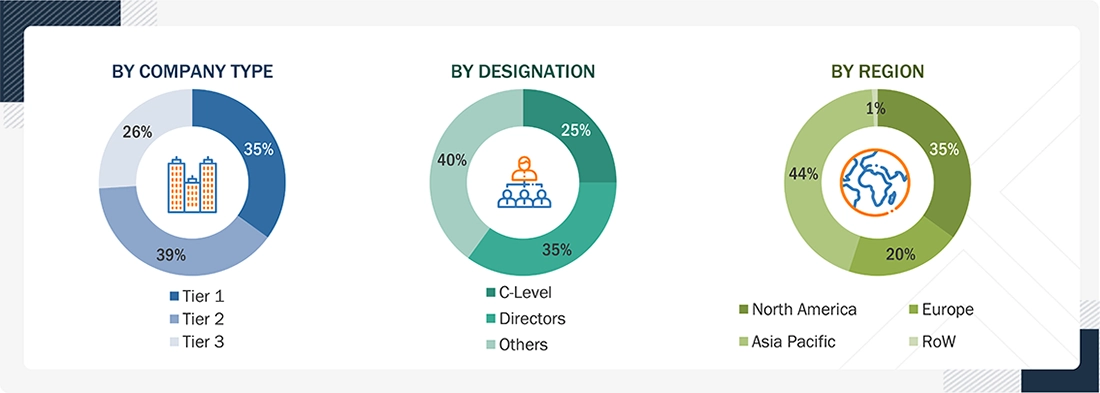
Others include sales managers, marketing managers, and product managers.
Note: Tier 1 companies’ revenue is more than USD 1 billion; Tier 2 companies’ revenue ranges between USD 500 million and 1 billion; and Tier 3 companies’ revenue ranges between USD 100 million and USD 500 million
To know about the assumptions considered for the study, download the pdf brochure
Market Size Estimation
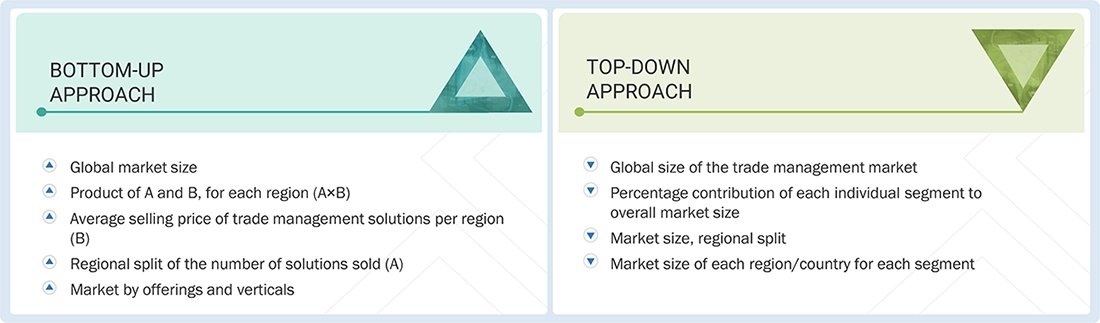
Multiple approaches were adopted to estimate and forecast the size of the trade management market. The first approach involves estimating market size by summing up the revenue generated by companies through the sale of trade management offerings.
Top-down and bottom-up approaches were used to estimate and validate the total size of the trade management market. These methods were used extensively to estimate the size of various market segments. The research methodology used to evaluate the market size is listed below.
- Key players in the market have been identified through extensive secondary research.
- In terms of value, the industry’s supply chain and market size have been determined through primary and secondary research processes.
- All shares, splits, and breakups have been determined using secondary sources and verified through primary sources.
Data Triangulation
After determining the overall market size, the trade management market was segmented into various offerings, verticals, and regions. A data triangulation methodology was applied to validate market estimates and derive accurate statistics for each segment and subsegment. The findings were validated by analyzing demand- and supply-side trends, vendor revenues, adoption patterns, and industry developments. The final market size and forecasts were verified using both top-down and bottom-up approaches to ensure consistency and accuracy across all market segments.
Market Definition
The trade management market comprises software solutions and services that enable organizations to manage and optimize end-to-end trade operations across global supply chains. These solutions support trade governance and compliance, trade planning, execution, trade finance, and trade intelligence by automating customs processes, ensuring regulatory compliance, facilitating import/export documentation, optimizing tariffs and duties, and providing real-time visibility into cross-border trade activities. Trade Management platforms integrate with enterprise systems such as ERP, TMS, WMS, and SCM to improve operational efficiency, mitigate trade risks, and support seamless international commerce.
Key Stakeholders
- Trade management software providers
- Cloud infrastructure providers
- System integrators and consulting firms
- Customs brokers and trade compliance service providers
- Freight forwarders and logistics providers
- Shipping carriers and transportation companies
- Importers and exporters
- Manufacturing, retail, healthcare, technology, automotive, and other end-user enterprises
- Banks and trade finance institutions
- Government customs and regulatory authorities
- ERP, SCM, TMS, and WMS vendors
- Industry associations and research organizations
Report Objectives
- To determine, segment, and forecast the trade management market based on offering, vertical, and region in terms of value
- To forecast the size of the market segments with respect to five main regions: North America, Europe, Asia Pacific, the Middle East & Africa, and Latin America
- To provide detailed information about the major factors (drivers, restraints, opportunities, and challenges) influencing the market growth
- To study the complete supply chain and related industry segments, and perform a supply chain analysis of the market landscape
- To strategically analyze the macro and micromarkets concerning individual growth trends, prospects, and contributions to the total market
- To analyze the industry trends, pricing data, patents, and innovations related to the market
- To analyze the opportunities for stakeholders by identifying the high-growth segments of the market
- To profile the key players in the market and comprehensively analyze their market share/ranking and core competencies
- To track and analyze competitive developments, such as mergers & acquisitions, product launches & developments, partnerships, agreements, collaborations, business expansions, and research & development (R&D) activities
- To provide a macroeconomic outlook for all regions considered under the study
Available customizations:
With the given market data, MarketsandMarkets offers customizations to meet the company’s specific needs. The following customization options are available for the report:
Country-wise information
- Analysis for additional countries (up to five)
Company information
- Detailed analysis and profiling of additional market players (up to 5)
Get the Full Trade Management Market Report
Full forecast, segment splits, and company analysis for all Trade Management Market.
- US Trade Management Market
- UK Trade Management Market
- Germany Trade Management Market
- France Trade Management Market
- China Trade Management Market
- Japan Trade Management Market
- India Trade Management Market
- UAE Trade Management Market
- South Africa Trade Management Market
- Brazil Trade Management Market
- Mexico Trade Management Market
- Rest Of Europe Trade Management Market
- Rest Of Asia Pacific Trade Management Market
- Rest Of Latin America Trade Management Market
- Ksa Trade Management Market
Need a Tailored Report?
Customize this report to your needs
Get 10% FREE Customization
Customize This Report
