
Spain Train Battery Market (2026-2031)

The Spain Train Battery Market was valued at $1152 Million in 2026 and projected to reach to $1393 Million by 2031, representing a compound annual growth rate of 2.7%. Spain's train battery market is positioned for steady growth as the country prioritizes sustainable rail transportation and infrastructure modernization.


| Market Size in | USD 26.32 MN |
| Market Forecast in | |
| CAGR | |
| Forecast Period | |
| Units Considered | Value (USD MN) |
Spain Train Battery Market Trends and Insights
- This moderate expansion reflects Spain's ongoing investment in rail electrification and modernization of its transportation infrastructure.
- Spain's railway sector is increasingly adopting battery technologies to support regional and commuter rail operations, driven by European sustainability mandates and decarbonization targets. The Spanish train battery market benefits from government support for green mobility initiatives and EU funding for rail infrastructure upgrades.
- Between 2026 and 2031, Spain is expected to see steady demand for advanced battery systems in both mainline and regional rail applications.
- The market's growth trajectory is tempered by the high capital costs of battery integration and the existing prevalence of diesel and overhead electrification systems across Spain's rail network..
Key Market Statistics
- CAGR (2026-2031) 2.7% CAGR
- Market Size, 2026 ~USD 1152 Million
- Forecast, 2031 ~USD 1393 Million
- Country Spain
Spain Train Battery Market Overview
Moderate Growth Trajectory :
Spain's train battery market is valued at USD 1,152 million in 2026 and is expected to reach USD 1,393 million by 2031, with a CAGR of 2.7%, reflecting steady but conservative expansion driven by rail modernization initiatives.
Rail Electrification Focus :
Spain is investing significantly in electrifying its railway network, particularly regional and suburban lines, creating sustained demand for advanced battery technologies to support hybrid and fully electric train operations.
Infrastructure Modernization :
Government-backed rail infrastructure projects and EU funding for sustainable transportation are accelerating the adoption of battery solutions across Spain's commuter and freight rail segments.
Below-Global Growth Rate :
Spain's 2.7% CAGR trails the global market's 5.3%, indicating a more mature market with slower adoption compared to emerging regions, but with stable long-term demand from established rail operators.
Spain Train Battery Market Dynamics
- The Spanish government's commitment to reducing carbon emissions and improving rail connectivity across regions supports continued investment in battery technologies for both passenger and freight operations.
- Regional rail operators are increasingly evaluating battery-electric solutions to complement existing electrified networks and serve non-electrified routes. The market's moderate 2.7% CAGR reflects Spain's mature rail infrastructure and measured adoption pace compared to global peers.
- However, EU sustainability mandates, renewable energy integration, and potential stimulus funding create opportunities for battery technology providers.
- Key growth will emerge from retrofitting existing trains, developing battery storage systems for peak demand management, and supporting the transition of regional rail services to cleaner energy sources through 2031..
Market Ecosystem
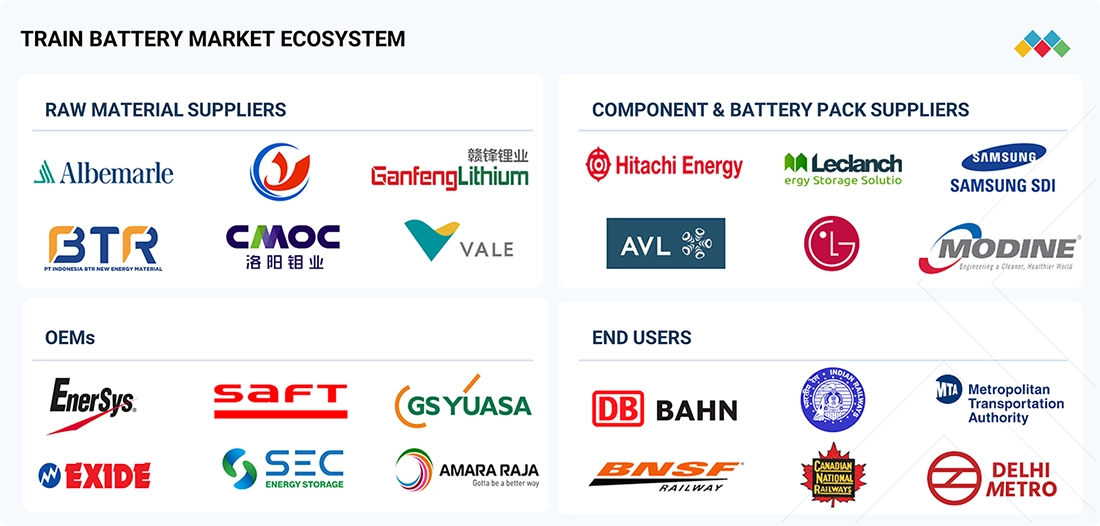
TRAIN BATTERY MARKET SIZE, SHARE & ANALYSIS: COMMERCIAL USE CASES ACROSS INDUSTRIES
| COMPANY | USE CASE DESCRIPTION | BENEFITS |
|---|---|---|
 |
Expanding its NexSys iON lithium-ion battery platform, advanced Thin Plate Pure Lead (TPPL) batteries, and intelligent Battery Management Systems (BMS) for transportation and industrial applications | Enables EnerSys to address growing demand for maintenance-free, longer-life, and digitally connected battery systems in modern rail fleets |
 |
Investing in Intensium lithium-ion battery systems, rail-certified LFP (Lithium Iron Phosphate) and NMC-based energy storage solutions, and modular traction battery platforms for battery-electric and hybrid trains | Strengthens its position in battery-electric rolling stock, hybrid train projects, and railway decarbonization initiatives |
 |
Focusing on industrial lithium-ion batteries, high-capacity LIM series lithium-ion systems, energy storage systems (ESS), and next-generation high-cycle-life battery technologies | Supports demand for reliable, long-life batteries in metros, passenger trains, and railway backup power applications while expanding into future traction battery opportunities |
 |
Investing in LFP lithium-ion cell manufacturing, battery pack assembly, Battery Management Systems (BMS), and gigafactory development through its advanced energy business | Positions the company to benefit from India's railway electrification, metro expansion, and increasing localization of lithium-ion battery sourcing |
Logos and trademarks shown above are the property of their respective owners. Their use here is for informational and illustrative purposes only.
Related Ecosystem
Automotive Materials
- Light Commercial Vehicles (LCVs)
- Battery Electric Vehicle (BEV)
- Hybrid Electric Vehicle (HEV)
- Fuel Cell Electric Vehicle (FCEV)
- Agricultural Tractors
- AISIN CORPORATION
- GORKOVSKY AVTOMOBILNY ZAVOD
- Basf se
- BOSCH LIMITED
- Continental ag
Locomotives And Rolling Stock
- Sensors
- Passenger Information System (PIS)
- Cartesian Robots
- Flow Sensors
- Gas Sensors
- Alstom s.a.
- Siemens ag
- Hitachi, Ltd.
- SYSTRA LTD.
- Knorr-bremse ag
Logistics And Transportation
- Internal Combustion Engine (ICE)
- Crawler Excavator
- Fuel Cell
- Light Commercial Vehicles (LCVs)
- Sensors
- Siemens ag
- Alstom s.a.
- Hitachi, Ltd.
- Godrej Industries Limited
- Toshiba Corporation
Key Takeaways
- Spain's train battery market will grow from USD 1,152M (2026) to USD 1,393M (2031) at a 2.7% CAGR.
- Spain is leveraging EU green mobility funding and decarbonization policies to drive battery adoption in regional rail.
- Spain's market growth is constrained by high battery integration costs and competition from established electrification infrastructure.
- Spain's railway modernization initiatives focus on battery solutions for non-electrified regional and commuter routes.
Train Battery Market Report Scope
| Report Metric | Details |
|---|---|
| Base Year | 2026 |
| Fastest Growing Segment | FULLY BATTERY-OPERATED TRAINS (Advanced Train Type) |
| Forecast Period | 2026-2031 |
| Growth Rate | CAGR of 5.3% from 2026 to 2031 |
| Largest Segment | VALVE-REGULATED LEAD-ACID (VRLA) BATTERIES (Battery Technology) |
| Market Size Base Year (Billions) | ~USD 0.38 (2026) |
| Revenue Forecast (Billions) | ~USD 0.5 (2031) |
| Segments Covered | Battery Type, Battery Technology, Application & Battery Type, Engine/Head, Application, Advanced Train Type, Rolling Stock |
Spain Train Battery Market Report Segmentation
7 segment dimensions are covered across the global market.
By Battery Type
- Lead-Acid Batteries
- Lithium-Ion Batteries
- Nickel-Cadmium Batteries
By Battery Technology
- Conventional Lead-Acid Batteries
- Fiber/Pne Nickel-Cadmium Batteries
- Gel Tubular Lead-Acid Batteries
- Lithium Iron Phosphate (Lfp)
- Lithium Titanate Oxide (Lto)
- Pocket Plate Nickel-Cadmium Batteries
- Sinter/Pne Nickel-Cadmium Batteries
- Valve-Regulated Lead-Acid (Vrla) Batteries
By Application & Battery Type
- Auxiliary Batteries
- Starter Batteries
By Engine/Head
- Diesel Locomotives
- Diesel Multiple Units (Dmus)
- Electric Locomotives
- Electric Multiple Units (Emus)
By Application
- Auxiliary Batteries
- High-Speed Trains
- Light Rails/Trams/ Monorails
- Light Rails/Trams/Monorails
- Metros
- Passenger Coaches
- Starter Batteries
By Advanced Train Type
- Fully Battery-Operated Trains
- Hybrid Trains
By Rolling Stock
- Locomotives
- Multiple Units
- Passenger Coaches
Target Audience
- Battery Manufacturers & Suppliers : Need Spain-specific market sizing and growth forecasts to identify revenue opportunities, plan production capacity, and develop localized product strategies for Spanish rail operators and OEMs.
- Rail Operators & Transportation Companies : Require market intelligence on battery technology trends, cost projections, and competitive offerings to make informed procurement decisions and plan fleet electrification investments in Spain.
- Investment & Private Equity Firms : Seek detailed market valuations and growth trajectories for Spain to evaluate investment opportunities in battery technology companies, rail infrastructure projects, and transportation modernization initiatives.
- Government & Policy Makers : Need market data to inform rail electrification policies, infrastructure funding decisions, sustainability targets, and regulatory frameworks supporting battery adoption in Spanish transportation.
- Automotive & Transportation Consultants : Require Spain market-specific insights to advise clients on market entry strategies, competitive positioning, technology trends, and long-term growth opportunities in the train battery sector.
Reasons to Buy this Report
- Market Size & Valuation Data : Access precise market valuations for Spain's train battery sector with 2026 baseline (USD 1,152M) and 2031 projections (USD 1,393M), enabling accurate financial forecasting and investment planning specific to the Spanish market.
- Growth Rate Analysis : Understand Spain's 2.7% CAGR in context of the 5.3% global rate, identifying market maturity levels and competitive positioning to inform strategic entry or expansion decisions in the Spanish rail sector.
- Infrastructure Investment Trends : Gain insights into Spain's rail electrification programs, government funding initiatives, and modernization projects driving battery technology adoption across regional and suburban rail networks.
- Competitive Landscape Intelligence : Benchmark your offerings against market dynamics specific to Spain, including local rail operator requirements, regulatory frameworks, and technology preferences shaping the battery market.
- Strategic Market Entry Planning : Develop targeted go-to-market strategies for Spain with data-driven insights on market segments, growth drivers, and regional demand patterns for train battery solutions through 2031.
Frequently asked questions
What is the current size of Spain's train battery market?
Spain's train battery market is valued at USD 1,152 million in 2026 and is expected to reach USD 1,393 million by 2031.
What is the growth rate of Spain's train battery market?
Spain's train battery market is projected to grow at a compound annual growth rate (CAGR) of 2.7% from 2026 to 2031.
What factors are driving growth in Spain's train battery market?
Spain's market growth is driven by EU decarbonization mandates, government support for green mobility, and modernization of regional rail infrastructure to reduce diesel dependency.
What challenges does Spain's train battery market face?
Spain's market faces challenges including high capital costs for battery integration, competition from existing overhead electrification systems, and the need for specialized charging infrastructure.
Which rail segments in Spain are adopting battery technology?
Spain is primarily adopting battery solutions for regional and commuter rail routes that lack overhead electrification, while mainline services continue to rely on traditional electrification.
RESEARCH METHODOLOGY
This research study relied on extensive secondary sources, including company annual reports and presentations, industry association publications, industry magazine articles, directories, technical handbooks, the World Economic Outlook, technical articles, and databases, to identify and collect information on the train battery market. In-depth interviews were conducted with primary respondents, including key industry participants, subject-matter experts, C-level executives of key market players (train battery manufacturers, battery component manufacturers), and industry consultants, among other experts, to obtain and verify critical qualitative and quantitative information and to assess market prospects.
Secondary Research
Secondary sources for this research study included train battery associations and organizations, corporate filings (such as annual reports, investor presentations, and financial statements), and trade, business, and industry associations. Secondary data were collected and analyzed to determine the overall market size, which was further validated by primary research.
Primary Research
Extensive primary research was conducted after understanding the train battery market through secondary research. Several primary interviews were conducted with market experts from the demand side (OEMs) across major regions, namely, North America, Europe, and Asia Pacific. Approximately 80% of primary interviews were conducted with the demand side, and 20% with train battery component manufacturers. Primary data was collected through questionnaires, emails, and telephonic interviews.
The canvassing of primary sources covered various departments within organizations, such as sales, operations, and marketing, to provide a holistic view in the report. After interacting with industry experts, brief sessions were held with highly experienced independent consultants to reinforce the findings from primary sources. These sessions, along with the opinions of in-house subject matter experts, led to the conclusions described in the remainder of this report.
Breakdown of Primaries
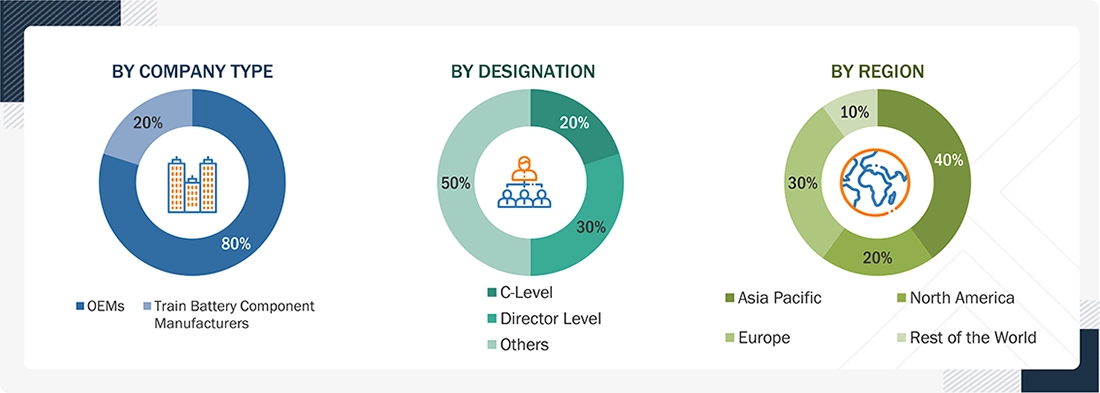
Note: Others include sales managers, marketing managers, product managers, etc.
To know about the assumptions considered for the study, download the pdf brochure
Market Size Estimation
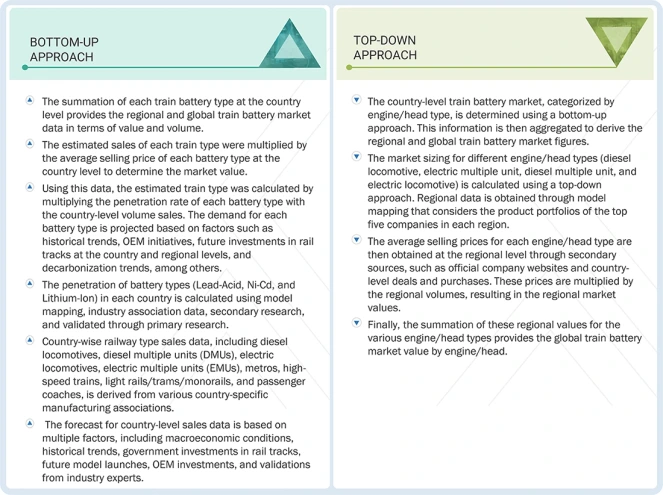
Bottom-up Approach
The bottom-up approach was used to estimate and validate the size of the train battery market by battery type. In this approach, country-wise sales data for different railway types (diesel locomotives, diesel multiple units (DMUs), electric locomotives, electric multiple units (EMUs), metros, high-speed trains, light rails/trams/monorails, and passenger coaches) were obtained from secondary sources, and sales statistics from industry associations and organizations were compiled. Following this, secondary research was used to determine the percentage penetration of battery types (Lead-acid Batteries, Ni-Cd Batteries, and Lithium-ion Batteries) by railway type per country. Then the Average Selling Price (ASP) was multiplied by each battery type for all train types to arrive at the country-wise value of the train and battery types. These numbers, when collated, represent the regional and global market size and forecast (volume as well as value) for train and battery types. The forecasting was based on factors such as GDP, economic stability, war conditions in the Middle East and Europe, regulations, investments and deals for battery technology by the key players, and investments by governing bodies for new railway tracks, etc.
Country-level tractor sales were multiplied by the battery-type penetration at the country level to determine the market size of the train battery market for each battery type in terms of volume. The forecast was based on factors such as war conditions, GDP growth rate, government investments, and others. In terms of volume, the country-level railway-type market size for each train-type category was summed to derive the regional market. All the regional markets were summed to derive the global market's power output by battery type.
The country-wise forecast for train types is based on multiple factors, including OEM investments in the country for train battery manufacturing plants, emissions regulations, the technological landscape, economic conditions, increasing demand for electric trains, and future train battery model launches.
The country-level train battery market was then multiplied by the country-level average selling price of train batteries, which resulted in the country-level market size.
The train battery ASP by battery type for each country was derived from secondary sources and model mapping, and validated through primary sources. The addition of the respective countries provides the regional-level market. Then, the summation of regional-level markets provides the global market by battery type in terms of value. A similar approach was used to derive the train aftermarket by battery type. However, these submarkets were analyzed at the regional level.
Top-down Approach
The top-down approach estimated and validated the market by engine/head (diesel locomotive, electric multiple units, diesel multiple units, and electric locomotive) in terms of volume and value. The train battery market value (USD million) and volume (units) by region were derived from the global market. The penetration of each engine/head type at the regional level was derived from secondary sources and model mapping, and validated through interviews with experts. The model mapping provided information such as the dominant drive type (head (diesel locomotive, electric multiple units, diesel multiple units, and electric locomotive)) and model with drive type offerings by key OEMs. The penetration of each drive type was multiplied by the regional train type market to obtain the market for engine/head by value and volume by drive type for each region. All region-wise markets were summed to derive the total train market value and volume by engine/head type. The top-down approach was followed by train type, by passenger coaches, advanced train type, by application, aftermarket by battery type, and aftermarket by application segments.
Train Battery Market : Top-Down and Bottom-Up Approach
Data Triangulation
After determining the overall market size, the market was segmented into several segments and subsegments using the market size estimation processes explained above. Data triangulation and market breakdown procedures were employed to complete the overall market engineering process and arrive at the exact statistics for each market segment and subsegment, wherever applicable. The data was triangulated by analyzing various factors and trends from both the demand and supply sides.
Market Definition
According to Saft, rail batteries are an important component of energy storage systems used for end-use applications such as starters, lighting, air conditioning, access mechanisms, water-filling systems, isolators, connectors, and battery management control (BMC) systems.
According to Exide Industries, the train battery is securely housed within a battery enclosure located beneath the coach. In railway applications, the battery operates in a dusty environment, experiences moderate to high levels of vibration, encounters fluctuating temperatures, has limited windows for inspection and maintenance, and operates continuously in a charge-discharge cycle. This represents the most rigorous evaluation of a battery's performance and longevity, emphasizing the critical importance of reliability.
Key Stakeholders
- Battery Manufacturers
- Battery Material & Component Suppliers
- Battery Management System (BMS) Providers
- Rolling Stock Manufacturers
- Locomotive Manufacturers
- Railway Operators
- Metro & Urban Transit Authorities
- High-Speed Rail Operators
- Rail Leasing Companies
- Maintenance, Repair & Overhaul (MRO) Service Providers
- Rail Infrastructure Developers
- Signaling & Electrification Solution Providers
- Charging & Energy Storage Solution Providers
- Engineering, Procurement & Construction (EPC) Contractors
- Government & Transport Authorities
- Rail Safety & Regulatory Bodies
- Industry Associations & Standardization Organizations
- Technology & Automation Providers
- Research Institutes & Testing Organizations
Report Objectives
- To define, segment, analyze, and forecast (2023–2030) the train battery market size, in terms of volume (units) and value (USD million) based on:
- OE By Battery Type (Lead-Acid, Nickel-Cadmium, and Lithium-ion)
- OE By Battery Technology (Conventional Lead-Acid, Valve Regulated Lead-Acid, Gel Tubular Lead-Acid, Sinter/PNE Ni-Cd Battery, Pocket Plate Ni-Cd Battery, Fiber/PNE Ni-Cd Battery, Lithium Iron Phosphate, Titanate Oxide, and Others)
- OE By Application (Starter and Auxiliary)
- OE By Engine/Head (Diesel Locomotive, Diesel Multiple Units (DMUs), Electric Locomotive, and Electric Multiple Units (EMUs))
- OE By Application (Metro, High-Speed Trains, Light Rail/ Trams/Monorail, Passenger Coaches)
- OE By Advanced Train Type (Fully Battery-Powered Train, and Hybrid Train)
- Aftermarket By Battery Type (Lead-Acid, Nickel-Cadmium)
- Aftermarket By Application (Starter, and Auxiliary)
- Aftermarket By Rolling Stock (Locomotives, Multiple Units, and Passenger Coaches)
- Aftermarket By Region (Asia Pacific, Europe, and North America)
- OE By Region (North America, Europe, Asia Pacific, and the Rest of the World (RoW))
- To understand the market dynamics (drivers, restraints, opportunities, and challenges) of the train battery market
- To analyze the impact of the Israel-Iran war on the market
- To strategically analyze markets concerning individual growth trends, prospects, and contributions to the total market
- To analyze opportunities for stakeholders and details of the competitive landscape for market leaders
- To analyze the market share of the key players in the market
- To analyze competitive developments such as deals (joint ventures, mergers & acquisitions, partnerships, collaborations), new product developments, and other activities carried out by key industry participant.
-
To study the following concerning the market:
- Supply Chain Analysis
- Ecosystem Analysis
- Technology Analysis
- Trade Analysis
- Case Study Analysis
- Patent Analysis
- Regulatory Landscape
- Conferences and Events
- Average Selling Price Analysis
- Buying Criteria
- OEM Analysis
- OEM Strategies: Future Investments by the key players
- Total Cost of Ownership: Train Battery
Available customizations:
With the given market data, MarketsandMarkets offers customizations based on the company’s needs.
Get the Full Train Battery Market Report
Full forecast, segment splits, and company analysis for all Train Battery Market.
- South Korea Train Battery Market
- Germany Train Battery Market
- France Train Battery Market
- Italy Train Battery Market
- UK Train Battery Market
- Switzerland Train Battery Market
- Poland Train Battery Market
- Sweden Train Battery Market
- Canada Train Battery Market
- Mexico Train Battery Market
- Brazil Train Battery Market
- Russia Train Battery Market
- US Train Battery Market
- China Train Battery Market
- India Train Battery Market
- Japan Train Battery Market
Need a Tailored Report?
Customize this report to your needs
Get 10% FREE Customization
Customize This Report
