
Latin America Vaccines Market (2025-2030)

The Latin America Vaccines Market was valued at $454.7 Million in 2025 and projected to reach to $690 Million by 2030, representing a compound annual growth rate of 8.7%. Latin America's vaccines market is positioned for sustained growth through 2030, supported by strengthening healthcare systems and increased government commitment to immunization programs.


| Market Size in | USD 26.32 MN |
| Market Forecast in | |
| CAGR | |
| Forecast Period | |
| Units Considered | Value (USD MN) |
Latin America Vaccines Market Trends and Insights
- Latin America's vaccine market growth is driven by increasing government immunization initiatives, rising healthcare spending, and expanding access to preventive care across the region.
- Latin America continues to strengthen its vaccination infrastructure through public health programs and partnerships with international health organizations, positioning the region as a key growth market within the global vaccines sector..
Key Market Statistics
- CAGR (2025-2030) 8.7% CAGR
- Market Size, 2025 ~USD 454.7 Million
- Forecast, 2030 ~USD 690 Million
- Geography Latin America
Latin America Vaccines Market Overview
Strong Regional Growth Trajectory :
Latin America's vaccines market is expanding at 8.7% CAGR, outpacing the global growth rate of 7.3%, driven by increased immunization coverage and preventive healthcare adoption across the region.
Government-Led Immunization Initiatives :
Expanding public health programs and mandatory vaccination campaigns across Latin American countries are significantly boosting market demand and accessibility to vaccine products.
Rising Healthcare Investment :
Increased government and private sector spending on healthcare infrastructure and preventive medicine is creating favorable conditions for vaccine market expansion throughout Latin America.
Market Valuation & Forecast :
The region's vaccine market is valued at $454.7 million in 2025 and is projected to reach $690.0 million by 2030, representing substantial growth opportunities for stakeholders.
Latin America Vaccines Market Dynamics
- Rising awareness of vaccine-preventable diseases and expanding middle-class populations with greater healthcare access are key growth catalysts.
- The region's market is benefiting from improved distribution networks and partnerships with international vaccine manufacturers, enhancing product availability across urban and rural areas.
- Brazil and Mexico remain dominant markets, while emerging economies in the region present untapped opportunities for vaccine penetration and market expansion..
Market Ecosystem
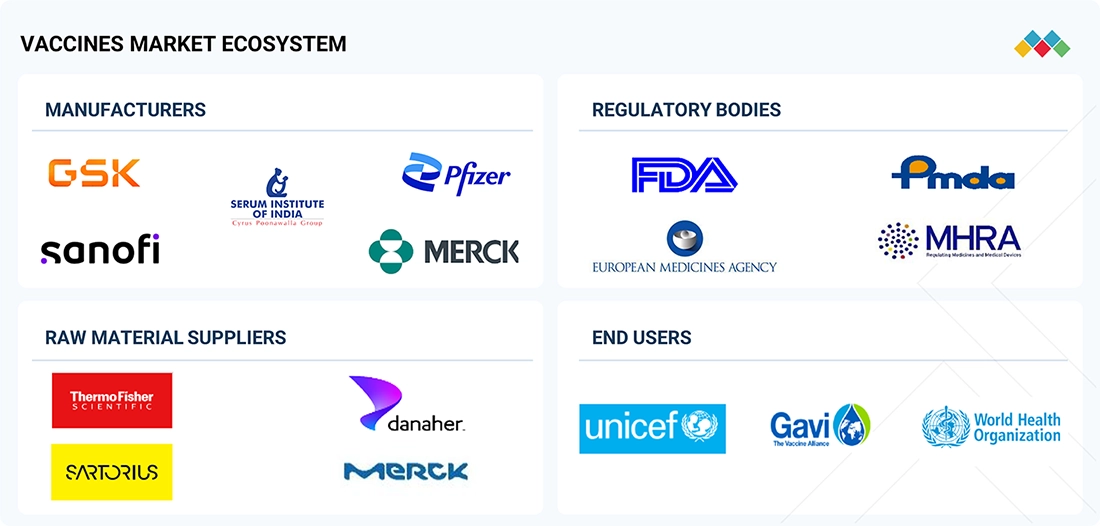
VACCINES MARKET: COMMERCIAL USE CASES ACROSS INDUSTRIES
| COMPANY | USE CASE DESCRIPTION | BENEFITS |
|---|---|---|
 |
Moderna’s new center at the Harwell science campus, which is home to over 250 organizations in health, technology, and energy, will manufacture mRNA vaccines for the NHS’s seasonal immunization programs | The facility already has a license to produce COVID-19 vaccines and is preparing to apply for regulatory approval to manufacture flu vaccines as well. | Strengthens domestic mRNA vaccine manufacturing capacity, enhancing the UK’s preparedness against emerging infectious diseases and seasonal threats | Accelerates the availability of advanced vaccines within the NHS, reducing reliance on international supply chains | The new facility also encourages further innovation in mRNA vaccine technology and supports rapid scale-up during future public health emergencies. |
 |
After a series of vaccine expansion projects, Sanofi is pursuing a new strategy to extend the reach of its immunizations in Vietnam | Partnering with the Vietnam Vaccine Company (VNVC), Sanofi has initiated a technology transfer for vaccine production, aiming to eventually manufacture select Sanofi vaccines locally within Vietnam. | Crucial as it expands local manufacturing capabilities, reducing dependence on imports and strengthening supply chain resilience in Southeast Asia | Access and affordability could significantly improve, helping to address public health needs more efficiently. |
Logos and trademarks shown above are the property of their respective owners. Their use here is for informational and illustrative purposes only.
Related Ecosystem
Pharmaceuticals
Key Takeaways
- Latin America's vaccines market is valued at $454.7 million in 2025 and is forecast to grow to $690.0 million by 2030.
- Latin America is experiencing an 8.7% CAGR, outpacing the global average of 7.3%, indicating accelerating regional demand.
- Latin America's growth is supported by strengthened immunization programs and increased public health investment across the region.
- Latin America represents a high-potential market segment within the broader global vaccines industry through 2030.
Vaccines Market Report Scope
| Report Metric | Details |
|---|---|
| Base Year | 2025 |
| Fastest Growing Segment | PNEUMOCOCCAL DISEASE (Disease Indication) |
| Forecast Period | 2025–2030 |
| Growth Rate | CAGR of 7.3% from 2025 to 2030 |
| Largest Segment | INTRAMUSCULAR & SUBCUTANEOUS ADMINISTRATION (Route Of Administration) |
| Market Size Base Year (Billions) | ~USD 47.75 (2025) |
| Revenue Forecast (Billions) | ~USD 67.91 (2030) |
| Segments Covered | Disease Indication, Technology, Type, Route Of Administration, End User |
Latin America Vaccines Market Report Segmentation
5 segment dimensions are covered across the global market.
By Disease Indication
- Combination Vaccines
- Covid-19
- Dtp
- Hepatitis
- Herpes Zoster
- Hpv
- Influenza
- Meningococcal Disease
- Mmr
- Other Disease Indications
- Pneumococcal Disease
- Polio
- Rotavirus
- Rsv
- Varicella
By Technology
- Conjugate Vaccines
- Inactivated & Subunit Vaccines
- Live Attenuated Vaccines
- Mrna Vaccines
- Other Covid-19 Vaccines
- Other Vaccines
- Recombinant Vaccines
- Toxoid Vaccines
- Viral Vector Vaccines
By Type
- Monovalent Vaccines
- Multivalent Vaccines
By Route Of Administration
- Intramuscular & Subcutaneous Administration
- Oral Administration
- Other Routes Of Administration
By End User
- Adult Vaccines
- Pediatric Vaccines
Target Audience
- Vaccine Manufacturers & Pharma Companies : Need market sizing, growth forecasts, and regional demand analysis to guide product launches, manufacturing investments, and distribution strategies in Latin America.
- Healthcare Policy Makers & Government Agencies : Require data-driven insights on vaccine market trends, immunization coverage gaps, and healthcare spending patterns to inform public health policy and budget allocation.
- Medical Device & Distribution Partners : Seek market intelligence on vaccine demand, supply chain opportunities, and regional growth drivers to optimize distribution networks and partnership strategies.
- Investment & Private Equity Firms : Need comprehensive market analysis and growth projections to evaluate investment opportunities in Latin American vaccine manufacturers, distributors, and healthcare companies.
- Healthcare Consultants & Market Researchers : Require detailed regional market data, forecasts, and trend analysis to support client advisory services, competitive analysis, and strategic planning initiatives.
Key Companies in the Latin America Vaccines Market
| Company | HQ | Ownership | Strongest segments |
|---|---|---|---|
| ATS AUTOMATION TOOLING SYSTEMS INC | Canada | Public Company | Engineered automated manufacturing and assembly systems,Pre- and post-automation services,Contract manufacturing and integration services, |
| BIOTEST AG | Germany | Public Company | Immunoglobulins (Intratect, Yimmugo, Pentaglobin, Cytotect, Varitect, Hepatect, Fovepta),Coagulation factors and hemostasis (Haemoctin, Haemonine, Cofact, Fibrinogen),Albumin and volume replacement (Albiomin, Biseko), |
| GREEN CROSS | Australia | Private Company | Retail (pet food, products, accessories, in-store services),Veterinary (general practice, emergency, specialty, pathology, crematoria), |
| TAKEDA PHARMACEUTICAL COMPANY | Japan | Public Company | Gastroenterology (Entyvio, Gattex/Revestive, Takecab/Vocinti, EOHILIA),Rare Diseases & Plasma-Derived Therapies (Takhzyro, Advate, Elaprase, Replagal, Vpriv, Adynovate/Adynovi, ADZYNMA, Gammagard Liquid/Kiovig, Hyqvia, Cuvitru, Flexbumin),Oncology (Adcetris, Leuplin/Enantone, Ninlaro, Iclusig, FRUZAQLA, Alunbrig), |
| ZYDUS CADILA | India | Public Company | Pharmaceuticals (APIs, generics, branded generics, specialty formulations, biosimilars, vaccines, novel therapeutics),Consumer Products (consumer wellness, seasonal, skin and healthcare, food and nutrition),Medical Technologies and Animal Health, |
| FLUOR CORPORATION | United States | Public Company | Energy Solutions,Urban Solutions,Mission Solutions, |
| MAXCYTE, INC | United States | Public Company | ExPERT GTx and VLx (therapeutic-scale electroporation),ExPERT STx (flow electroporation for protein and drug discovery),ExPERT ATx (static electroporation, small–medium scale), |
| HELM AG | Germany | Private Company | Fertilizers and crop protection,Industrial chemicals (organic/inorganic, acids, lyes),Plastics and polyurethane chemicals, |
| MODERNA INC | United States | Public Company | COVID/Spikevax and pandemic influenza vaccines,Respiratory vaccines (RSV, seasonal influenza, combinations),Oncology therapeutics (intismeran autogene, cancer antigen, T-cell engagers), |
| BIONTECH SE | Germany | Public Company | BNT162 COVID-19 vaccine,Oncology pipeline (late-stage: Gotistobart, Pumitamig, Trastuzumab pamirtecan, BNT113),Oncology pipeline (mid/early-stage: BNT116, BNT326/YL202, Autogene cevumeran, others), |
| CANSINO BIOLOGICS INC | China | Public Company | COVID-19 vaccines (including Ad5-nCoV for inhalation),Meningococcal vaccines (MCV2, MCV4, CS-2023 pipeline),Pediatric pertussis-containing vaccines (DTcP, DTcP Booster, Tdcp adolescent/adult, DTcP-Hib combo), |
| SAMSUNG BIOLOGICS | South Korea | Public Company | Drug substance manufacturing (mAbs and biologics),Fill-finish, lyophilization, and cold-chain services,Development and analytical services, |
| AZELIS HOLDINGS SA | Belgium | Private Company | Food and Nutrition Ingredients,Personal Care and Home Care Ingredients,Pharma and Life Sciences, |
| GSK PLC | United Kingdom | Public Company | Vaccines,Specialty Medicines,General Medicines, |
| MERCK & CO., INC. | United States | Public Company | Human pharmaceuticals – oncology and specialty,Human pharmaceuticals – vaccines,Human pharmaceuticals – infectious disease, cardiometabolic, and other, |
| PFIZER INC. | India | Public Company | Internal medicine (cardiovascular, respiratory, gastroenterology, pain, multivitamins, nutrition),Anti-infectives and injectables (hospital-focused),Vaccines, |
| SANOFI | France | Public Company | Vaccines (pediatric, RSV, hexavalent, travel and endemic vaccines),Immunology and inflammation therapies,Rare diseases and neurology, |
| CSL | Australia | Public Company | Licensing & other IP-related income, |
| EMERGENT | United States | Public Company | Anthrax vaccines and therapeutics (BioThrax, CYFENDUS, ANTHRASIL, Raxibacumab),Smallpox/mpox vaccines and antivirals (ACAM2000, TEMBEXA, CNJ-016),Opioid overdose reversal (NARCAN, KLOXXADO), |
| ASTRAZENECA | United Kingdom | Public Company | Oncology (Tagrisso, Imfinzi, Lynparza, Calquence, Enhertu, Imjudo, Orpathys, Truqap, Faslodex, Zoladex, others),Cardiovascular, Renal & Metabolism (Farxiga/Forxiga, Brilinta/Brilique, Crestor, Onglyza, XIGDUO, Komboglyze, Qtern, others),Respiratory & Immunology (Symbicort, Pulmicort, Fasenra, Tezspire, Breztri, Airsupra, Saphnelo, others), |
| BAVARIAN NORDIC | Denmark | Public Company | Non-replicating smallpox and monkeypox vaccines (IMVAMUNE/IMVANEX/JYNNEOS),Rabies vaccine (Rabipur/RabAvert),Tick-borne encephalitis vaccine (Encepur), |
| MITSUBISHI TANABE PHARMA CORPORATION | Japan | Private Company | Prescription pharmaceuticals – CNS, immuno-inflammation, diabetes, kidney disorders,Vaccines (influenza and pediatric/combined indications),OTC products (skin-treating agents, digestive drinks and medicines, nutrient foods), |
| DAIICHI SANKYO COMPANY, LIMITED | Japan | Public Company | Oncology (Enhertu, Turalio, Vanflyta, Datroway, NSCLC and solid tumor portfolio),Cardiovascular and metabolic (Lixiana/Savaysa, antihypertensives, Nilemdo, Nustendi, Efient, Canalia),Neurology, pain, bone health, and iron therapies (Emgality, Reyvow, Tarlige, Pralia, Ranmark, Vimpat, Injectafer, Venofer), |
| PANACEA BIOTEC | India | Public Company | Vaccines,Pharmaceutical Formulations,Nutrition, Nutraceuticals, and Other (including Real Estate), |
ATS AUTOMATION TOOLING SYSTEMS INC
ATS Automation Tooling Systems Inc is a Canadian public company founded in 1978 that employs 7,000 people. The company specializes in automation and tooling systems for industrial applications.
BIOTEST AG
Biotest AG is a German public company founded in 1946 with 2,698 employees. The company operates in the pharmaceutical and biotechnology sectors.
GREEN CROSS
Green Cross is an Australian private company founded in 1994 with 5,109 employees. The company operates in the healthcare and pharmaceutical industries.
TAKEDA PHARMACEUTICAL COMPANY
Takeda Pharmaceutical Company is a Japanese public company founded in 1781 with 47,029 employees. The company is a major global pharmaceutical manufacturer and developer.
ZYDUS CADILA
Zydus Cadila is an Indian public company founded in 1952 with 29,980 employees. The company is a leading pharmaceutical and biotechnology manufacturer.
FLUOR CORPORATION
Fluor Corporation is a United States-based public company founded in 1912 with 22,995 employees. The company provides engineering, procurement, and construction services across multiple industries.
MAXCYTE, INC
MaxCyte, Inc. is a United States-based public company founded in 1998 with 91 employees. The company develops cell engineering technologies and solutions.
HELM AG
Helm AG is a German private company founded in 1900 with 1,430 employees. The company operates in the chemical and pharmaceutical distribution sectors.
MODERNA INC
Moderna Inc is a United States-based public company founded in 2010 with 4,700 employees. The company specializes in messenger RNA (mRNA) technology and vaccine development.
BIONTECH SE
BioNTech SE is a German public company founded in 2008 with 7,807 employees. The company develops immunotherapies and vaccines using biotechnology platforms.
CANSINO BIOLOGICS INC
CanSino Biologics Inc is a Chinese public company founded in 2009 with 1,134 employees. The company develops and manufactures vaccines and biopharmaceuticals.
SAMSUNG BIOLOGICS
Samsung Biologics is a South Korean public company founded in 2011 with 5,195 employees. The company provides contract manufacturing and biopharmaceutical production services.
AZELIS HOLDINGS SA
Azelis Holdings SA is a Belgian private company founded in 2001 with 1,325 employees. The company specializes in specialty chemicals and ingredients.
GSK PLC
GSK PLC is a United Kingdom-based public company founded in 1715 with 66,841 employees. The company is a major global pharmaceutical, vaccine, and consumer healthcare manufacturer.
MERCK & CO., INC.
Merck & Co., Inc. is a United States-based public company founded in 1891 with 74,000 employees. The company is a leading global pharmaceutical and healthcare products manufacturer.
PFIZER INC.
Pfizer Inc. is an India-based public company founded in 1950 with 1,244 employees. The company manufactures and distributes pharmaceutical products.
SANOFI
Sanofi is a French public company founded in 1994 with 74,846 employees. The company is a major global pharmaceutical manufacturer specializing in vaccines, drugs, and consumer healthcare.
CSL
CSL is an Australian public company founded in 1916 with 29,904 employees. The company is a leading global biopharmaceutical manufacturer specializing in plasma-derived therapies and vaccines.
EMERGENT
Emergent is a United States-based public company founded in 1998 with 900 employees. The company provides contract manufacturing and development services for vaccines and biopharmaceuticals.
ASTRAZENECA
AstraZeneca is a United Kingdom-based public company founded in 1992 with 96,100 employees. The company is a major global pharmaceutical manufacturer specializing in oncology, cardiovascular, and respiratory medicines.
BAVARIAN NORDIC
Bavarian Nordic is a Danish public company founded in 1992 with 1,861 employees. The company develops and manufactures vaccines for infectious diseases.
MITSUBISHI TANABE PHARMA CORPORATION
Mitsubishi Tanabe Pharma Corporation is a Japanese private company founded in 2007 with 6,756 employees. The company develops and manufactures pharmaceutical products.
DAIICHI SANKYO COMPANY, LIMITED
Daiichi Sankyo Company, Limited is a Japanese public company founded in 1899 with 20,171 employees. The company is a global pharmaceutical manufacturer specializing in innovative medicines.
PANACEA BIOTEC
Panacea Biotec is an Indian public company founded in 1984 with 2,149 employees. The company develops and manufactures vaccines and biopharmaceuticals.
Countries within Latin America - compare and drill down
| Country | 2025 size (native) |
|---|---|
| Brazil | USD 284 Million |
| Mexico | USD 174.9 Million |
| Rest Of Latin America | USD 231.1 Million |
Country market size visualization
Reasons to Buy this Report
- Regional Market Intelligence : Gain comprehensive insights into Latin America's $454.7M vaccine market with detailed forecasts through 2030, enabling informed strategic decisions for market entry and expansion.
- Growth Opportunity Identification : Identify high-growth segments and emerging opportunities within Latin America's 8.7% CAGR market, outpacing global averages and presenting competitive advantages.
- Government & Policy Analysis : Understand Latin American government immunization initiatives, regulatory frameworks, and healthcare spending trends shaping vaccine market dynamics and investment opportunities.
- Country-Level Breakdown : Access detailed market data for Brazil, Mexico, and other Latin American countries, enabling targeted market strategies and resource allocation decisions.
- Competitive Positioning : Benchmark your organization against regional competitors and identify market gaps, distribution channels, and partnership opportunities specific to Latin America's vaccine landscape.
Frequently asked questions
What is the current size of the vaccines market in Latin America?
The Latin America vaccines market is estimated at $454.7 million in 2025.
What is the projected size of the Latin America vaccines market by 2030?
Latin America's vaccines market is forecast to reach $690.0 million by 2030.
What is the CAGR for the vaccines market in Latin America?
Latin America's vaccines market is growing at a compound annual growth rate of 8.7% from 2025 to 2030.
How does Latin America's growth rate compare to the global vaccines market?
Latin America's 8.7% CAGR exceeds the global vaccines market CAGR of 7.3%, demonstrating stronger regional momentum.
What factors are driving growth in the Latin America vaccines market?
Latin America's vaccine market growth is driven by government immunization initiatives, rising healthcare spending, and expanded access to preventive care.
RESEARCH METHODOLOGY
This research study involved the extensive use of secondary sources, directories, and databases to identify and collect valuable information for the analysis of the global vaccines market. In-depth interviews were conducted with various primary respondents, including key industry participants, subject-matter experts (SMEs), C-level executives of key market players, and industry consultants, to obtain and verify critical qualitative and quantitative information and assess the growth prospects of the market. The global market size estimated through secondary research was then triangulated with inputs from primary research to arrive at the final market size.
Secondary Research
Secondary research was used mainly to identify and collect information for the extensive technical, market-oriented, and commercial study of the vaccines market. The secondary sources used for this study include World Health Organization (WHO), the Organisation for Economic Co-operation and Development (OECD), National Center for Biotechnology Information (NCBI), Centers for Disease Control and Prevention (CDC), the Global Cancer Observatory (GLOBOCAN), the National Institutes of Health (NIH), Center of Disease Control & Prevention (CDC), US Department of Health and Human Services, National Institutes of Health (NIH), National Library of Medicine, National Center for Biotechnology Information (NCBI), National Institute of Allergy and Infectious Diseases (NIAID), World Cancer Research Fund International (WCRF International), European Medicines Agency (EMA), The National Medical Products Administration (NMPA), Global Alliance for Vaccines and Immunization (GAVI), United States Food & Drug Administration (US FDA), Orange book, Purple book, Clinical trials.gov, Pan American Health Organization (PAHO), United Nation International Children’s Emergency Fund (UNICEF), Department of health and Human Services (HHS), and International Society for Vaccines (ISV). Corporate filings include annual reports, SEC filings, investor presentations, and financial statements; research journals; press releases; and trade, business, and professional associations. Secondary data was collected and analyzed to determine the overall size of the global vaccines market, which was validated through primary research. These sources were also used to obtain key information about major players, market classification, and segmentation according to industry trends, regional/country-level markets, market developments, and technology perspectives.
Primary Research
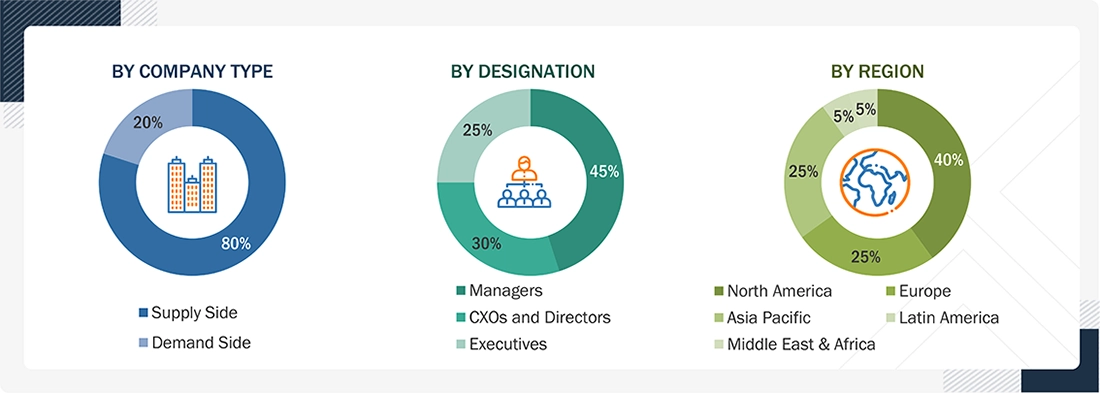
In-depth interviews were conducted with various primary respondents, including key industry participants, subject-matter experts (SMEs), C-level executives of key market players, and industry consultants, among other experts, to obtain and verify critical qualitative and quantitative information and assess future market prospects. Various primary sources from both the supply and demand sides of the market were interviewed to obtain qualitative and quantitative information. The following is a breakdown of the primary respondents:
To know about the assumptions considered for the study, download the pdf brochure
Market Size Estimation
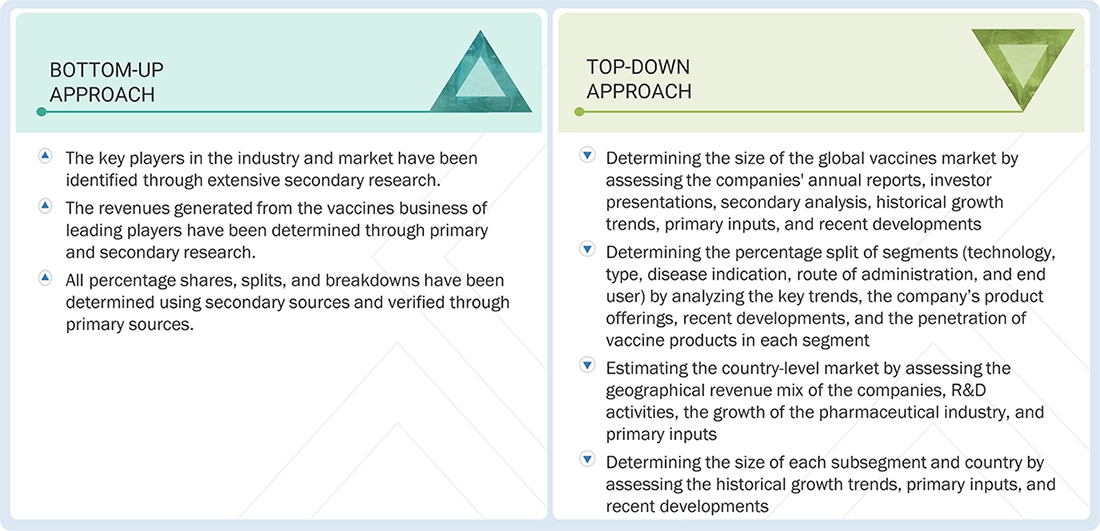
Both top-down and bottom-up approaches were employed to estimate and validate the overall size of the vaccines market. These methods were also widely used to determine the size of various market segments. The research methodology used to estimate the market size includes the following:
Vaccines Market: Top-Down and Bottom-Up Approach
Data Triangulation
After estimating the overall market size through the market size estimation process, the total market was divided into several segments and subsegments. Data triangulation and market breakdown techniques were used where applicable to finalize the overall market analysis and obtain precise statistics for all segments and subsegments. The data was triangulated by examining various factors and trends from both demand and supply sides.
Market Definition
A vaccine is a biologically formulated product designed to trigger active acquired immunity against a specific infectious or malignant disease. Vaccines work by stimulating the immune system to identify and fight harmful agents, such as viruses or bacteria. They generally consist of parts that resemble the disease-causing microorganism, often in weakened or deactivated forms, along with their toxins or surface proteins.
The vaccines market comprises commercially available biological preparations administered to humans to stimulate active immunity against specific infectious diseases. The report solely focuses on human vaccines and does not include veterinary vaccines, which are outside the scope of this study. The scope of this report includes conjugate vaccines, inactivated & subunit vaccines, live attenuated vaccines, recombinant vaccines, toxoid vaccines, and other vaccines.
Key Stakeholders
- Vaccine product manufacturers and suppliers
- Distributors and suppliers of vaccine products
- Vaccine research institutes
- Biotechnology and biopharmaceutical companies
- Contract manufacturing organizations (CMOs)
- Contract development and manufacturing organizations (CDMO)
- Suppliers and distributors of pharmaceutical products
- Research and development (R&D) companies
- Drug Manufacturers, Vendors, and Distributors
- Immunization centres
- Hospitals and laboratories
- Trade associations and industry bodies
- Regulatory bodies and government organizations
- Venture capitalists and investors
- Hospitals
- Specialty Clinics
Report Objectives
- To define, describe, and forecast the vaccines market by technology, type, disease indication, route of administration, end user, and region
- To provide detailed information regarding the major factors influencing the market growth (such as drivers, restraints, opportunities, and challenges)
- To analyze the micromarkets with respect to individual growth trends, prospects, and contributions to the overall vaccines market
- To analyze the opportunities for stakeholders and provide details of the competitive landscape for market leaders
- To forecast the size of the market segments with respect to six regions: North America, Europe, the Asia Pacific, Latin America, Middle East, and Africa
- To profile the key players and analyze their market shares and core competencies
- To track and analyze competitive developments, such as product launches, agreements, partnerships, acquisitions, regulatory approvals, and research & development activities
- To analyze and provide funding & investment activities, brand/product comparative analysis, and vendor valuation & financial metrics of the vaccines market
Available customizations:
With the given market data, MarketsandMarkets offers customizations to meet the company’s specific needs. The following customization options are available for this report:
Portfolio Assesment
- Product Matrix gives a detailed comparison of the product portfolios of the top five companies.
Company Information
- Detailed analysis and profiling of additional market players (up to five).
Geographic Analysis
- Further breakdown of the Rest of Europe vaccines market, by country
- Further breakdown of the Rest of Asia Pacific vaccines market, by country
- Further breakdown of the Rest of Latin America vaccines market, by country
Get the Full Vaccines Market Report
Full forecast, segment splits, and company analysis for all Vaccines Market.
- Canada Vaccines Market
- US Vaccines Market
- France Vaccines Market
- Germany Vaccines Market
- Italy Vaccines Market
- Spain Vaccines Market
- UK Vaccines Market
- China Vaccines Market
- India Vaccines Market
- Japan Vaccines Market
- South Korea Vaccines Market
- Brazil Vaccines Market
- Mexico Vaccines Market
- Rest Of Europe Vaccines Market
- Rest Of Latin America Vaccines Market
- Rest Of Asia Pacific Vaccines Market
Need a Tailored Report?
Customize this report to your needs
Get 10% FREE Customization
Customize This Report
