
Mexico Veterinary Biologics Market (2025-2030)

The Mexico Veterinary Biologics Market was valued at $20.76 Million in 2025 and projected to reach to $25.92 Million by 2030, representing a compound annual growth rate of 4.5%. Mexico's veterinary biologics market is positioned for steady growth at a 4.5% CAGR through 2030, supported by expanding livestock industries and increasing urbanization driving pet ownership.


| Market Size in | USD 26.32 MN |
| Market Forecast in | |
| CAGR | |
| Forecast Period | |
| Units Considered | Value (USD MN) |
Mexico Veterinary Biologics Market Trends and Insights
- Mexico's market growth is driven by increasing livestock production, rising pet ownership, and growing awareness of animal health management across both commercial and companion animal segments.
- The country's strategic position within Latin America and its expanding agricultural sector support steady demand for vaccines, immunologics, and other biologic products. During the forecast period from 2025 to 2030, Mexico is anticipated to benefit from improved veterinary infrastructure, regulatory harmonization efforts, and heightened investment in animal disease prevention.
- Mexico's market dynamics reflect broader regional trends toward modernization of animal husbandry practices and stricter biosecurity protocols.
- The incremental growth in Mexico underscores the nation's role as a key market within the Latin American veterinary biologics landscape, with opportunities emerging in both rural and urban veterinary practice settings..
Key Market Statistics
- CAGR (2025-2030) 4.5% CAGR
- Market Size, 2025 ~USD 20.76 Million
- Forecast, 2030 ~USD 25.92 Million
- Country Mexico
Mexico Veterinary Biologics Market Overview
Market Valuation :
Mexico's veterinary biologics market is valued at USD 20.76 million in 2025, with projected growth to USD 25.92 million by 2030, reflecting steady expansion in the region.
Livestock Production Growth :
Increasing livestock production across Mexico's agricultural sector is driving demand for veterinary biologics, particularly vaccines and immunological products for cattle, poultry, and swine operations.
Pet Ownership Surge :
Rising pet ownership in urban areas of Mexico is expanding the companion animal segment, creating new opportunities for biologics manufacturers targeting dogs, cats, and exotic pets.
Animal Health Awareness :
Growing awareness of preventive animal health management among Mexican farmers and pet owners is accelerating adoption of biologics over traditional treatments.
Mexico Veterinary Biologics Market Dynamics
- The market benefits from Mexico's strategic location in North America and its significant agricultural sector, which requires robust animal health solutions.
- Government initiatives promoting food safety and animal welfare standards are expected to further boost demand for quality biologics products. The companion animal segment presents emerging opportunities as Mexican consumers increasingly invest in pet healthcare.
- However, market growth remains slightly below the global 5.2% CAGR, reflecting pricing pressures and competition from generic alternatives.
- Manufacturers focusing on locally-relevant products and distribution partnerships with regional veterinary networks will be best positioned to capture market share in Mexico's evolving veterinary biologics landscape..
Market Ecosystem
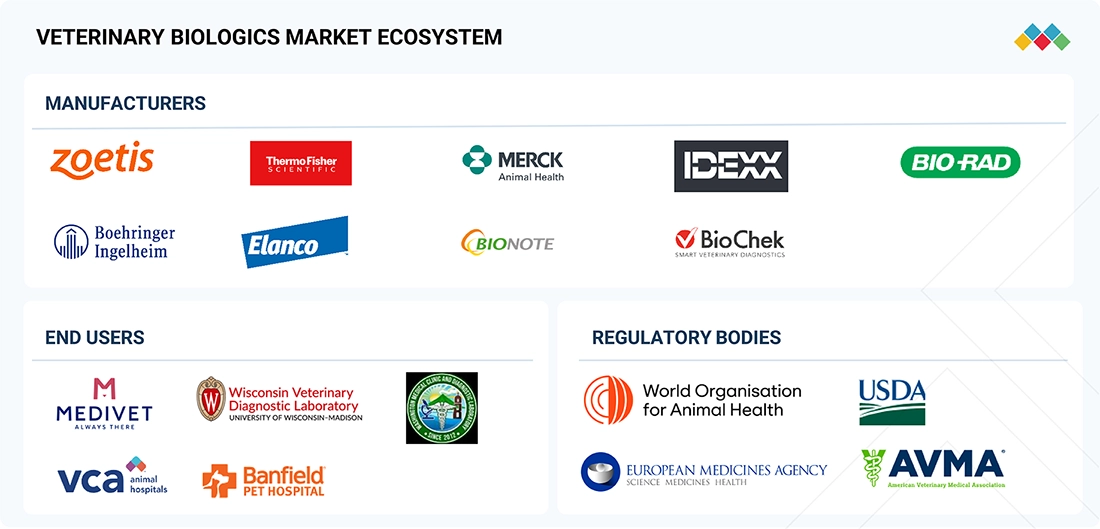
Veterinary Biologics Market: COMMERCIAL USE CASES ACROSS INDUSTRIES
| COMPANY | USE CASE DESCRIPTION | BENEFITS |
|---|---|---|
 |
Development and commercialization of monoclonal antibody therapies for pets | Targeted treatments for chronic conditions like osteoarthritis, fewer side effects |
 |
Immunomodulatory therapies and dermatology-related biologics for companion animals | Long-lasting allergy relief, improved immune regulation |
 |
Biologics targeting chronic inflammatory and parasitic diseases | Better disease control, increased pet quality of life |
 |
Development of novel biologics for companion animals focusing on chronic diseases | Enhances quality of life, extends lifespan, personalized treatment options |
 |
Diagnostic testing kits and platforms for early disease detection | Early diagnosis, preventive care, improved treatment outcomes |
Logos and trademarks shown above are the property of their respective owners. Their use here is for informational and illustrative purposes only.
Related Ecosystem
Animal Health
- Polymerase Chain Reaction (PCR) Tests
- Porcine
- Immunodiagnostics
- Lateral Flow Assays
- Microarrays
- Zoetis Inc.
- Patterson Companies, Inc.
- Virbac
- Elanco Animal Health Incorporated
- BOEHRINGER INGELHEIM GMBH
Key Takeaways
- Mexico's veterinary biologics market is valued at USD 20.76 million in 2025 and will reach USD 25.92 million by 2030.
- Mexico is experiencing a 4.5% CAGR, reflecting steady growth driven by livestock expansion and companion animal care demand.
- Mexico's market benefits from improving veterinary infrastructure and increased biosecurity awareness across agricultural regions.
- Mexico represents a significant opportunity within Latin America for veterinary biologic manufacturers and distributors.
Veterinary Biologics Market Report Scope
| Report Metric | Details |
|---|---|
| Base Year | 2025 |
| Fastest Growing Segment | CANINE (Type) |
| Forecast Period | 2025–2030 |
| Growth Rate | CAGR of 5.2% from 2025 to 2030 |
| Largest Segment | INJECTABLE ROUTE OF ADMINISTRATION (Route Of Administration) |
| Market Size Base Year (Billions) | ~USD 2.72 (2025) |
| Revenue Forecast (Billions) | ~USD 3.51 (2030) |
| Segments Covered | Product Type, Animal Type, Type, Route Of Administration, Application, End User |
Mexico Veterinary Biologics Market Report Segmentation
6 segment dimensions are covered across the global market.
By Product Type
- Diagnostic Kits
- Immunodmodulators & Immunostimulants
- Immunoglobulins & Antitoxins
- Immunomodulators & Immunostimulants
- Immuoglobulins & Antitoxins
- Monoclonal Anitbodies
- Monoclonal Antibodies
By Animal Type
- Companion Animal
- Companion Animals
- Livestock Animal
- Livestock Animals
By Type
- Bovine
- Canine
- Equine
- Feline
- Intramuscular Route Of Administration
- Intravenous Route Of Administration
- Other Injectable Route Of Administration
- Porcine
- Poultry
- Small Ruminant
- Subcutaneous Route Of Administration
By Route Of Administration
- Injectable Route Of Administration
- Oral Route Of Administration
- Other Routes Of Administration
By Application
- Dermatology
- Diagnostic Testing
- Diagnostic Tetsing
- Infectious Disease Prevention
- Oncology
- Other Applications
- Pain Management
By End User
- Other End Users
- Veterinary Diagnostic Labs
- Veterinary Hospitals & Clinics
MEXICO: VETERINARY BIOLOGICS MARKET, BY END USER, 2023–2030
| Segment | 2023 | 2024 | 2025 | 2026 | 2027 | 2028 | 2029 | 2030 | CAGR (%) |
|---|---|---|---|---|---|---|---|---|---|
| OTHER END USERS | 1.64 | 1.66 | 1.69 | 1.72 | 1.75 | 1.79 | 1.84 | 1.89 | 2.3 |
| VETERINARY DIAGNOSTIC LABS | 9.91 | 10.11 | 10.33 | 10.6 | 10.89 | 11.22 | 11.6 | 12.01 | 3 |
| VETERINARY HOSPITALS & CLINICS | 29.65 | 30.7 | 31.87 | 33.18 | 34.61 | 36.2 | 38 | 39.91 | 4.6 |
| TOTAL | 41.2 | 42.47 | 43.89 | 45.49 | 47.25 | 49.22 | 51.44 | 53.81 | 4.2 |
Target Audience
- Veterinary Biologics Manufacturers : Manufacturers need Mexico-specific market data to assess expansion opportunities, localize product portfolios, and develop distribution strategies in this growing Latin American market.
- Livestock & Poultry Producers : Mexican agricultural operators require market insights to understand available biologics solutions, pricing trends, and efficacy data for improving herd and flock health management.
- Veterinary Distributors & Retailers : Regional distributors need detailed market forecasts and segment analysis to optimize inventory, identify high-growth product categories, and plan expansion within Mexico.
- Investment & Private Equity Firms : Investors evaluating opportunities in Mexico's animal health sector need validated market sizing, growth projections, and competitive dynamics to support acquisition and funding decisions.
- Government & Agricultural Agencies : Mexican agricultural and health authorities require market data to inform policy decisions, food safety initiatives, and animal welfare programs affecting the veterinary biologics sector.
Key Companies in the Mexico Veterinary Biologics Market
| Company | HQ | Ownership | Strongest segments |
|---|---|---|---|
| IDEXX | United States | Public Company | Companion Animal Group (in-clinic diagnostics, reference labs, services, software),Water Quality Products,Livestock, Poultry and Dairy (including related diagnostics), |
| ELANCO | United States | Public Company | Companion animal parasiticides (Seresto, K-9 Advantage, Advantix, Advocate, Credelio Family, Interceptor Plus, Drontal),Companion animal vaccines and therapeutics (Galliprant, Atopica, Milbemax, Onsior, Tru Family),Farm animal feed additives and productivity enhancers (Rumensin, Experior, Hemicell, Surmax, Pulmotil), |
| MERCK & CO., INC. | United States | Public Company | Oncology (Keytruda, Keytruda Qlex, Welireg, ADC collaborations),Vaccines (Gardasil, pediatric and adult vaccines including Vaxneuvance, Capvaxive),Cardiovascular, pulmonary hypertension and specialty (Winrevair, Adempas/Verquvo, Ohtuvayre, others), |
| THERMO FISHER SCIENTIFIC INC. | United States | Public Company | Life Sciences Solutions,Analytical Instruments,Specialty Diagnostics, |
| NEOGEN CORPORATION | United States | Public Company | Food Safety diagnostics, media, and sanitation,Animal Safety instruments, care products, and biosecurity,Genomics services for livestock and companion animals, |
| BIO-RAD LABORATORIES, INC. | United States | Public Company | Clinical Diagnostics,Life Science Research Instruments and Systems,Life Science Reagents and Consumables, |
| IMMUCELL CORPORATION | United States | Public Company | First Defense (core scours prevention),Tri-Shield First Defense,Dual-Force First Defense and related formulations, |
IDEXX
IDEXX is a public company founded in 1983 and headquartered in the United States, employing 11,000 people.
ELANCO
Elanco is a public company founded in 1954 in the United States with 9,650 employees.
MERCK & CO., INC.
Merck & Co., Inc. is a public pharmaceutical company founded in 1891 and based in the United States, with 74,000 employees.
THERMO FISHER SCIENTIFIC INC.
Thermo Fisher Scientific Inc. is a public company founded in 1956 in the United States and employs 125,000 people.
NEOGEN CORPORATION
Neogen Corporation is a public company founded in 1981 in the United States with 2,974 employees.
BIO-RAD LABORATORIES, INC.
Bio-Rad Laboratories, Inc. is a public company founded in 1952 in the United States and employs 7,450 people.
IMMUCELL CORPORATION
ImmuCell Corporation is a public company founded in 1982 in the United States with 73 employees.
Reasons to Buy this Report
- Market-Specific Sizing Data : Access precise valuation figures for Mexico's veterinary biologics market with verified 2025 baseline (USD 20.76M) and 2030 forecasts, enabling accurate business planning and investment decisions.
- Segment Breakdown Analysis : Understand the distinct dynamics of Mexico's livestock and companion animal biologics segments, including growth drivers specific to cattle, poultry, swine, and pet markets.
- Competitive Landscape Intelligence : Identify market opportunities and competitive positioning within Mexico's veterinary biologics sector, including gaps in distribution and underserved animal health categories.
- Regulatory & Growth Drivers : Gain insights into Mexico-specific factors driving market growth, including agricultural policies, food safety standards, and consumer behavior trends affecting biologics adoption.
- Strategic Market Entry Planning : Develop informed go-to-market strategies for Mexico with localized data on pricing dynamics, distribution channels, and partnership opportunities in the veterinary biologics sector.
Frequently asked questions
What is the current size of Mexico's veterinary biologics market?
Mexico's veterinary biologics market is valued at USD 20.76 million in 2025.
What is the projected market size for Mexico by 2030?
Mexico's veterinary biologics market is projected to reach USD 25.92 million by 2030.
What is the growth rate for Mexico's veterinary biologics market?
Mexico's veterinary biologics market is growing at a compound annual growth rate (CAGR) of 4.5% from 2025 to 2030.
What factors are driving growth in Mexico's veterinary biologics market?
Growth in Mexico is driven by increasing livestock production, rising pet ownership, improved veterinary infrastructure, and heightened biosecurity awareness.
How does Mexico's market compare to the global veterinary biologics market?
Mexico's 4.5% CAGR is slightly lower than the global CAGR of 5.2%, reflecting regional market maturity and specific growth dynamics within Latin America.
RESEARCH METHODOLOGY
This study extensively used both primary and secondary sources. The research process examined various factors affecting the industry to identify segmentation types, industry trends, key players, competitive landscape, market dynamics, and strategies of major players.
Secondary Research
This research involved the use of comprehensive secondary sources, including directories; databases such as Bloomberg Business, Factiva, and Dun & Bradstreet; white papers; annual reports; company house documents; investor presentations; and SEC filings of companies. Secondary research was employed to gather information for an extensive, technical, market-focused, and commercial analysis of the veterinary biologics market. It also helped obtain crucial details about key players, market classification, and segmentation based on industry trends at the most detailed levels, as well as significant developments related to market and technology perspectives. Additionally, a database of major industry leaders was created using secondary research.
Primary Research
In the primary research process, various sources from both the supply and demand sides were interviewed to gather qualitative and quantitative information for this report. Primary sources from the supply side include project managers, sales managers, marketing managers, business development managers, presidents, CEOs, vice presidents, chairpersons, chief operating officers, chief strategy officers, directors, chief information officers, and chief medical information officers related to the veterinary biologics market. Primary sources from the demand side consist of professionals from veterinary hospitals and clinics, diagnostic labs, academic and research institutes, and pet owners.
A breakdown of the primary respondents is provided below:

Note 1: C-level primaries include CEOs, CFOs, COOs, and VPs.
Note 2: Other designations include sales managers, marketing managers, business development managers, product managers, distributors, and suppliers.
Note 3: Companies are classified into tiers based on their total revenue. As of 2024, Tier 1 = >USD 10.00 billion, Tier 2 = USD 1.00 billion to USD 10.00 billion, and Tier 3 = < USD 1.00 billion.
Source: MarketsandMarkets Analysis
To know about the assumptions considered for the study, download the pdf brochure
Market Size Estimation
The total size of the veterinary biologics market was determined through data triangulation from three different approaches, as outlined below. After each approach, a weighted average was calculated based on the level of assumptions used in each method.
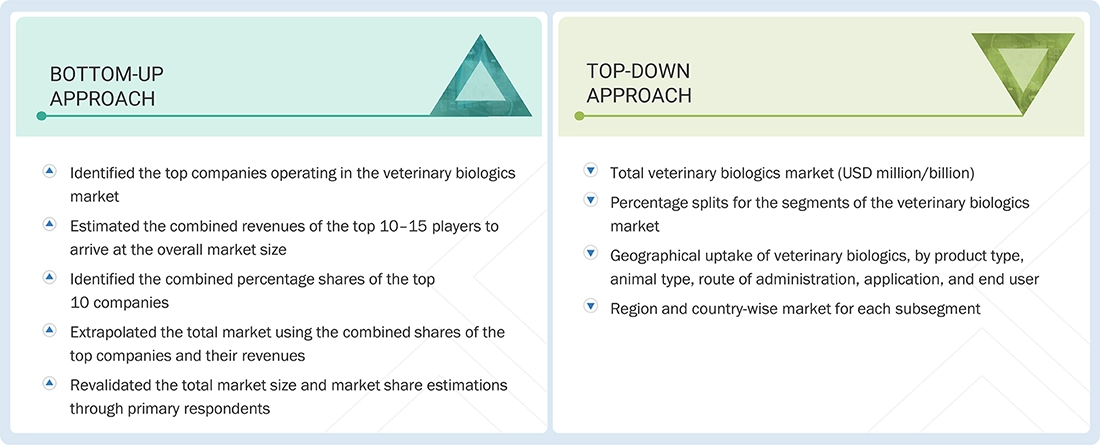
Data Triangulation
After defining the market size, the total market was divided into several segments and subsegments. Data triangulation and market breakdown methods were used where applicable to complete the overall market analysis and determine accurate statistics for all segments and subsegments. The following figure illustrates the market validation, source structure, and data triangulation approach used in the market analysis process.
Market Definition
The veterinary biologics market includes all USDA-regulated biologic products, such as monoclonal antibodies, immunoglobulins, immunomodulators, and diagnostic kits, which are used for the prevention, diagnosis, or treatment of animal diseases. These products serve companion animals, livestock, and poultry across veterinary clinics, hospitals, diagnostic labs, and farm or herd settings, enabling veterinarians and animal health professionals to provide targeted immune-based interventions and rapid diagnostic testing. This allows infected animals to be identified quickly for faster treatment, containment, or herd management decisions.
Stakeholders
- Veterinary Biologics Manufacturers
- Animal Healthcare Product Manufacturers
- Veterinary Biologics Distributors and Wholesalers
- Animal Welfare Associations
- Veterinary Clinics and Care Centers
- Research And Consulting Firms
- Veterinary Research and Development Organizations
- Contract Manufacturing Organizations
- Venture Capitalists
Report Objectives
- To define, describe, and forecast the veterinary biologics market by product type, animal type, route of administration, application, end user, and region.
- To provide detailed information about the key factors, such as drivers, restraints, opportunities, challenges, and industry trends, influencing the market growth
- To strategically analyze the regulatory scenario, value chain analysis, supply chain analysis, Porter’s Five Forces analysis, ecosystem analysis, trade analysis, pricing analysis, patent analysis, impact of AI on veterinary biologics market, case study analysis, adjacent market analysis, unmet needs/end user expectations in veterinary biologics market, and trends/disruption impacting customer business in the market
- To analyze the micromarkets with respect to individual growth trends, prospects, and contributions to the overall market
- To strategically analyze the market in five regions: North America, Europe, the Asia Pacific, Latin America, and the Middle East & Africa
- To analyze market opportunities for stakeholders and provide details of the competitive landscape for key players
- To strategically profile the key players in this market and comprehensively analyze their market shares and core competencies
- To track and analyze competitive developments such as product launches and approvals, partnerships, and expansions in the market
Get the Full Veterinary Biologics Market Report
Full forecast, segment splits, and company analysis for all Veterinary Biologics Market.
- Canada Veterinary Biologics Market
- US Veterinary Biologics Market
- Germany Veterinary Biologics Market
- UK Veterinary Biologics Market
- France Veterinary Biologics Market
- Italy Veterinary Biologics Market
- Spain Veterinary Biologics Market
- Netherlands Veterinary Biologics Market
- Japan Veterinary Biologics Market
- China Veterinary Biologics Market
- India Veterinary Biologics Market
- Australia Veterinary Biologics Market
- South Korea Veterinary Biologics Market
- New Zealand Veterinary Biologics Market
- Brazil Veterinary Biologics Market
- Rest Of Europe Veterinary Biologics Market
- Rest Of Asia Pacific Veterinary Biologics Market
- Rest Of Latin America Veterinary Biologics Market
- Kingdom Of Saudi Arabia Veterinary Biologics Market
- Rest Of GCC Countries Veterinary Biologics Market
- UAE Veterinary Biologics Market
Need a Tailored Report?
Customize this report to your needs
Get 10% FREE Customization
Customize This Report
