
North America Veterinary Biologics Market (2025-2030)

The North America Veterinary Biologics Market was valued at $1334.89 Million in 2025 and projected to reach to $1754.2 Million by 2030, representing a compound annual growth rate of 5.6%. North America's veterinary biologics market is poised for sustained expansion through 2030, supported by increasing awareness of animal health, rising disposable incomes, and growing adoption of preventive care practices among pet owners.


| Market Size in | USD 26.32 MN |
| Market Forecast in | |
| CAGR | |
| Forecast Period | |
| Units Considered | Value (USD MN) |
North America Veterinary Biologics Market Trends and Insights
- North America maintains a dominant position in the global veterinary biologics landscape, driven by advanced healthcare infrastructure, high pet ownership rates, and substantial investment in animal health innovation.
- The region's market growth is supported by increasing demand for preventive care solutions and rising awareness of zoonotic disease management across North America. In North America, the veterinary biologics sector is characterized by strong regulatory frameworks and a mature market for vaccines, immunotherapies, and diagnostic biologics.
- North America's forecast period (2025–2030) will witness accelerated adoption of biologics in both companion and livestock segments, fueled by technological advancements and strategic partnerships among key market players.
- North America's market expansion reflects broader trends in personalized animal healthcare and the integration of biologics into comprehensive veterinary treatment protocols..
Key Market Statistics
- CAGR (2025-2030) 5.6% CAGR
- Market Size, 2025 ~USD 1334.89 Million
- Forecast, 2030 ~USD 1754.2 Million
- Geography North America
North America Veterinary Biologics Market Overview
Market Leadership Position :
North America commands the largest share of the global veterinary biologics market, valued at $1,334.89 million in 2025, driven by advanced veterinary healthcare infrastructure and regulatory frameworks that support innovation.
Strong Growth Trajectory :
The region is projected to grow from $1,334.89 million in 2025 to $1,754.20 million by 2030, representing a robust 5.6% CAGR, outpacing the global average of 5.2%.
High Pet Ownership Rates :
North America's exceptionally high pet ownership rates and pet humanization trends drive substantial demand for preventive and therapeutic veterinary biologics across companion and livestock segments.
Innovation Investment Hub :
The region benefits from significant R&D investments, presence of leading biopharmaceutical companies, and supportive regulatory environments that accelerate development of novel veterinary biologics.
North America Veterinary Biologics Market Dynamics
- The region's mature healthcare infrastructure and established distribution networks provide competitive advantages for market players.
- Technological advancements in vaccine development and immunotherapy, coupled with regulatory support for novel biologics, will further accelerate market penetration.
- The companion animal segment, particularly in the US and Canada, will remain the primary growth driver as consumers increasingly prioritize pet wellness and longevity..
Market Ecosystem
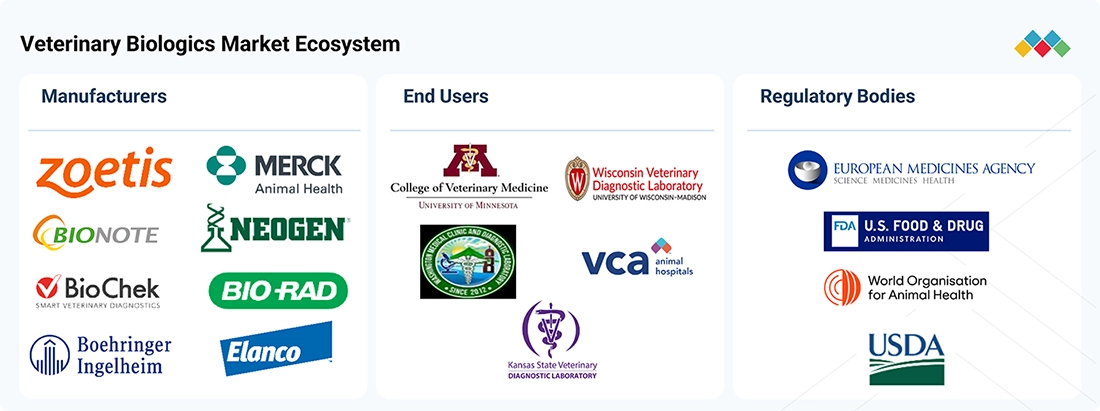
VETERINARY BIOLOGICS MARKET: COMMERCIAL USE CASES ACROSS INDUSTRIES
| COMPANY | USE CASE DESCRIPTION | BENEFITS |
|---|---|---|
 |
Develops and commercializes monoclonal antibody therapies for companion animals, including treatments for osteoarthritis pain and dermatological conditions | Targeted treatment of chronic conditions | Improved symptom control | Enhanced animal comfort and quality of life |
 |
Develops veterinary biologics, including monoclonal antibody therapies for canine dermatology and immunomodulatory treatments | Long-lasting allergy relief | Targeted treatment | Improved skin health and animal welfare |
 |
Offers veterinary vaccines, biologics, and immunological products for preventing and managing infectious diseases in companion animals and livestock | Improved disease prevention | Reduced disease transmission | Enhanced animal health and herd protection |
 |
Develops veterinary vaccines and biologic therapies, including monoclonal antibody-based treatments for companion-animal diseases | Improved disease prevention | Targeted treatment options | Enhanced animal health and quality of life |
 |
Provides veterinary diagnostic kits, assays, and testing platforms for detecting infectious diseases and supporting animal-health monitoring | Earlier disease detection | Improved diagnostic accuracy | Better treatment and disease-management decisions |
Logos and trademarks shown above are the property of their respective owners. Their use here is for informational and illustrative purposes only.
Related Ecosystem
Animal Health
- Polymerase Chain Reaction (PCR) Tests
- Porcine
- Immunodiagnostics
- Lateral Flow Assays
- Microarrays
- Zoetis Inc.
- Patterson Companies, Inc.
- Virbac
- Elanco Animal Health Incorporated
- BOEHRINGER INGELHEIM GMBH
Key Takeaways
- North America's veterinary biologics market is valued at $1,334.89 million in 2025 and will reach $1,754.20 million by 2030.
- North America exhibits a 5.6% CAGR, outpacing the global average of 5.2%, indicating strong regional market momentum.
- North America's market is driven by high pet ownership, advanced veterinary infrastructure, and increasing preventive care adoption.
- North America's regulatory environment and innovation ecosystem position the region as a leader in veterinary biologics development and commercialization.
Veterinary Biologics Market Report Scope
| Report Metric | Details |
|---|---|
| Base Year | 2025 |
| Fastest Growing Segment | CANINE (Type) |
| Forecast Period | 2025–2030 |
| Growth Rate | CAGR of 5.2% from 2025 to 2030 |
| Largest Segment | INJECTABLE ROUTE OF ADMINISTRATION (Route Of Administration) |
| Market Size Base Year (Billions) | ~USD 2.72 (2025) |
| Revenue Forecast (Billions) | ~USD 3.51 (2030) |
| Segments Covered | Product Type, Animal Type, Type, Route Of Administration, Application, End User |
North America Veterinary Biologics Market Report Segmentation
6 segment dimensions are covered across the global market.
By Product Type
- Diagnostic Kits
- Immunodmodulators & Immunostimulants
- Immunoglobulins & Antitoxins
- Immunomodulators & Immunostimulants
- Immuoglobulins & Antitoxins
- Monoclonal Anitbodies
- Monoclonal Antibodies
By Animal Type
- Companion Animal
- Companion Animals
- Livestock Animal
- Livestock Animals
By Type
- Bovine
- Canine
- Equine
- Feline
- Intramuscular Route Of Administration
- Intravenous Route Of Administration
- Other Injectable Route Of Administration
- Porcine
- Poultry
- Small Ruminant
- Subcutaneous Route Of Administration
By Route Of Administration
- Injectable Route Of Administration
- Oral Route Of Administration
- Other Routes Of Administration
By Application
- Dermatology
- Diagnostic Testing
- Diagnostic Tetsing
- Infectious Disease Prevention
- Oncology
- Other Applications
- Pain Management
By End User
- Other End Users
- Veterinary Diagnostic Labs
- Veterinary Hospitals & Clinics
Target Audience
- Veterinary Pharmaceutical Companies : Develop targeted product launches and market expansion strategies in North America's high-value veterinary biologics market with detailed competitive and regulatory insights.
- Investment & Private Equity Firms : Evaluate investment opportunities in North American veterinary biologics with comprehensive market sizing, growth projections, and profitability analysis through 2030.
- Veterinary Distributors & Retailers : Optimize inventory management and supplier relationships by understanding North America's market dynamics, demand patterns, and emerging therapeutic categories.
- Animal Health Consultants & Advisors : Provide clients with evidence-based market intelligence on North America's veterinary biologics landscape to support strategic planning and competitive positioning.
- Regulatory & Policy Organizations : Monitor market trends and growth drivers in North America's veterinary biologics sector to inform regulatory frameworks and industry standards development.
Key Companies in the North America Veterinary Biologics Market
| Company | HQ | Ownership | Strongest segments |
|---|---|---|---|
| IDEXX | United States | Public Company | Companion Animal Group (in-clinic diagnostics, reference labs, services, software),Water Quality Products,Livestock, Poultry and Dairy (including related diagnostics), |
| ELANCO | United States | Public Company | Companion animal parasiticides (Seresto, K-9 Advantage, Advantix, Advocate, Credelio Family, Interceptor Plus, Drontal),Companion animal vaccines and therapeutics (Galliprant, Atopica, Milbemax, Onsior, Tru Family),Farm animal feed additives and productivity enhancers (Rumensin, Experior, Hemicell, Surmax, Pulmotil), |
| MERCK & CO., INC. | United States | Public Company | Oncology (Keytruda, Keytruda Qlex, Welireg, ADC collaborations),Vaccines (Gardasil, pediatric and adult vaccines including Vaxneuvance, Capvaxive),Cardiovascular, pulmonary hypertension and specialty (Winrevair, Adempas/Verquvo, Ohtuvayre, others), |
| THERMO FISHER SCIENTIFIC INC. | United States | Public Company | Life Sciences Solutions,Analytical Instruments,Specialty Diagnostics, |
| NEOGEN CORPORATION | United States | Public Company | Food Safety diagnostics, media, and sanitation,Animal Safety instruments, care products, and biosecurity,Genomics services for livestock and companion animals, |
| BIO-RAD LABORATORIES, INC. | United States | Public Company | Clinical Diagnostics,Life Science Research Instruments and Systems,Life Science Reagents and Consumables, |
| IMMUCELL CORPORATION | United States | Public Company | First Defense (core scours prevention),Tri-Shield First Defense,Dual-Force First Defense and related formulations, |
IDEXX
IDEXX is a public company founded in 1983 and headquartered in the United States, employing 11,000 people.
ELANCO
Elanco is a public company founded in 1954 in the United States with 9,650 employees.
MERCK & CO., INC.
Merck & Co., Inc. is a public pharmaceutical company founded in 1891 and based in the United States, with 74,000 employees.
THERMO FISHER SCIENTIFIC INC.
Thermo Fisher Scientific Inc. is a public company founded in 1956 in the United States and employs 125,000 people.
NEOGEN CORPORATION
Neogen Corporation is a public company founded in 1981 in the United States with 2,974 employees.
BIO-RAD LABORATORIES, INC.
Bio-Rad Laboratories, Inc. is a public company founded in 1952 in the United States and employs 7,450 people.
IMMUCELL CORPORATION
ImmuCell Corporation is a public company founded in 1982 in the United States with 73 employees.
Countries within North America - compare and drill down
| Country | 2025 size (native) |
|---|---|
| US | USD 1040.41 Million |
| Canada | USD 80.77 Million |
Country market size visualization
Reasons to Buy this Report
- Regional Market Dominance Data : Gain comprehensive insights into North America's commanding 40%+ share of the global veterinary biologics market with detailed breakdowns by country, segment, and therapeutic category.
- Country-Level Intelligence : Access granular market data for the US ($1,040.41M) and Canada ($80.77M), enabling precise market sizing, competitive positioning, and localized growth strategy development.
- Growth Opportunity Identification : Identify high-growth segments and therapeutic areas within North America's 5.6% CAGR expansion, with forecasts through 2030 to support long-term business planning and investment decisions.
- Competitive Landscape Analysis : Understand market dynamics, key players, regulatory environment, and distribution channels specific to North America's mature yet expanding veterinary biologics ecosystem.
- Strategic Market Entry Planning : Leverage North America-specific insights on pet ownership trends, consumer behavior, reimbursement models, and veterinary practice patterns to optimize market entry and expansion strategies.
Frequently asked questions
What is the current size of North America's veterinary biologics market?
North America's veterinary biologics market is estimated at $1,334.89 million in 2025.
What is the projected market size for North America's veterinary biologics by 2030?
North America's veterinary biologics market is forecasted to reach $1,754.20 million by 2030.
What is the CAGR for North America's veterinary biologics market?
North America's veterinary biologics market is expected to grow at a compound annual growth rate of 5.6% from 2025 to 2030.
What factors are driving growth in North America's veterinary biologics market?
North America's market growth is driven by high pet ownership, advanced veterinary healthcare infrastructure, increasing demand for preventive care, and rising awareness of zoonotic disease management.
How does North America's veterinary biologics market compare to the global market?
North America's 5.6% CAGR exceeds the global average of 5.2%, demonstrating the region's stronger growth trajectory and market maturity in veterinary biologics.
RESEARCH METHODOLOGY
This study relied extensively on both primary and secondary sources. The research process examined various factors affecting the industry to identify segmentation types, industry trends, key players, the competitive landscape, key market dynamics, and key player strategies.
Secondary Research
This research study used comprehensive secondary sources, including directories, databases such as Bloomberg Business, Factiva, and Dun & Bradstreet, white papers, annual reports, company house documents, investor presentations, and SEC filings of companies. Secondary research was used to identify and collect information for an extensive, technical, market-oriented, and commercial study of the veterinary biologics market. It was also used to obtain important information about key players, market classification and segmentation according to industry trends down to the most granular level, and key developments from market and technology perspectives. A database of key industry leaders was also prepared using secondary research.
Primary Research
In the primary research process, various sources from both the supply and demand sides were interviewed to obtain qualitative and quantitative information for this report. Primary sources from the supply side include project, sales, marketing, and business development managers, presidents, CEOs, vice presidents, chairpersons, chief operating officers, chief strategy officers, directors, chief information officers, and chief medical information officers related to the veterinary biologics market. Primary sources from the demand side include professionals from veterinary hospitals & clinics, diagnostic labs, academic & research institutes, and pet owners.
A breakdown of the primary respondents is provided below:
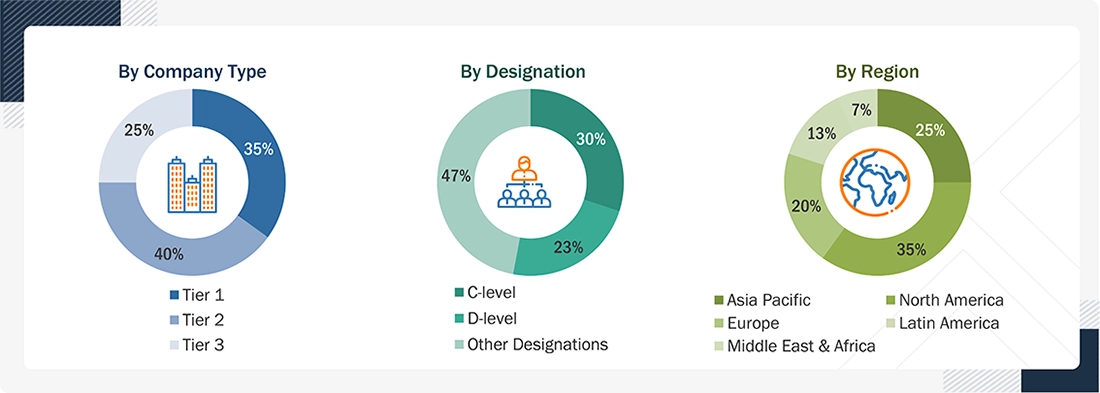
Note 1: C-level primaries include CEOs, CFOs, COOs, and VPs.
Note 2: Other designations include sales managers, marketing managers, business development managers, product managers, distributors, and suppliers.
Note 3: Companies are classified into tiers based on their total revenue. As of 2024, Tier 1 = >USD 10.00 billion, Tier 2 = USD 1.00 billion to USD 10.00 billion, and Tier 3 = <USD 1.00 billion.
Source: MarketsandMarkets Analysis
To know about the assumptions considered for the study, download the pdf brochure
Market Size Estimation
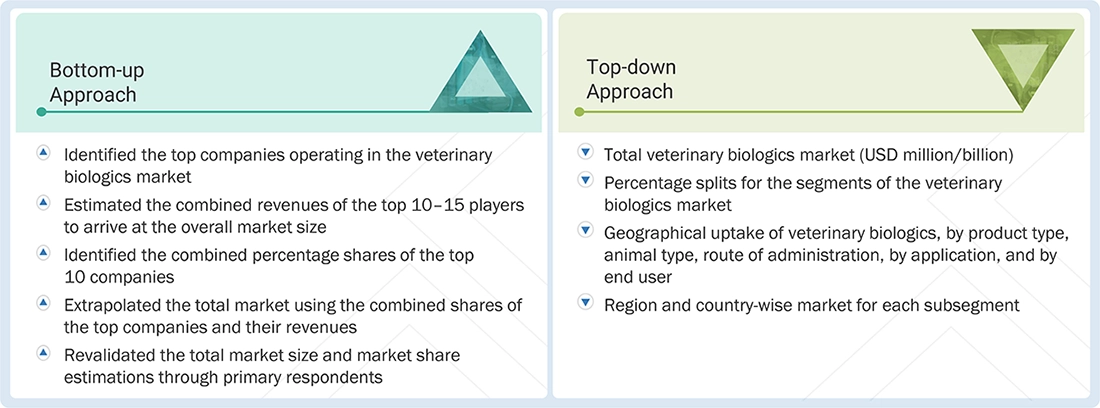
The total size of the veterinary biologics market was determined through data triangulation across three approaches, as outlined below. After each approach, the weighted average of the three approaches was calculated based on the level of assumptions used in each approach.
Veterinary Biologics Market: Top-Down and Bottom-Up Approach
Data Triangulation
After determining the market size, the total market was divided into several segments and subsegments. To complete the overall market engineering process and arrive at the exact statistics for all segments and subsegments, data triangulation and market breakdown procedures were employed wherever applicable. The following figure shows the market validation, source structure, and data triangulation methodology implemented in the market engineering process.
Market Definition
The veterinary biologics market includes all USDA-regulated biologic products, such as monoclonal antibodies, immunoglobulins, immunomodulators, and diagnostic kits, used to prevent, diagnose, or treat animal diseases. These products serve companion animals, livestock, and poultry across veterinary clinics, hospitals, diagnostic labs, and farm/herd settings, enabling veterinarians and animal health professionals to provide targeted immune-based interventions and rapid diagnostic testing, which help identify infected animals promptly for faster treatment, containment, or herd management decisions.
Key Stakeholders
- Veterinary Biologics Manufacturers
- Animal Healthcare Product Manufacturers
- Veterinary Biologics Distributors & Wholesalers
- Animal Welfare Associations
- Veterinary Clinics & Care Centers
- Research & Consulting Firms
- Veterinary Research & Development Organizations
- Contract Manufacturing Organizations
- Venture Capitalists
Report Objectives
- To define, describe, and forecast the veterinary biologics market by product type, animal type, route of administration, by application, by end user, and region
- To provide detailed information about the key factors, such as drivers, restraints, opportunities, challenges, and industry trends, influencing the market growth
- To strategically analyze the regulatory scenario, value chain analysis, supply chain analysis, Porter’s Five Forces analysis, ecosystem analysis, trade analysis, pricing analysis, patent analysis, impact of AI on the veterinary biologics market, case study analysis, adjacent market analysis, unmet needs/end user expectations in the veterinary biologics market, and trends/disruption impacting customer business in the market
- To analyze micromarkets with respect to individual growth trends, prospects, and contributions to the overall market
- To strategically analyze the market in five regions: North America, Europe, Asia Pacific, Latin America, and the Middle East & Africa
- To analyze market opportunities for stakeholders and provide details of the competitive landscape for key players
- To strategically profile the key players in this market and comprehensively analyze their market shares and core competencies
- To analyze competitive developments such as product launches and approvals, partnerships, and expansions in the market
Available customizations:
With the given market data, MarketsandMarkets offers customizations as per your company’s specific needs. The following customization options are available for the report:
Geographic Analysis
-
Further breakdown of the Rest of Europe veterinary biologics market into Austria, Finland, and others
-
Further breakdown of the Rest of Latin America veterinary biologics market into Argentina, Colombia, Chile, and others
Company Information
- Detailed analysis and profiling of additional market players (up to 5)
Competitive Landscape Assessment
- Market share analysis for the North America and Europe region, which provides market shares of the top 3–5 key players in the veterinary biologics market
Competitive leadership mapping for established players in the US
Get the Full Veterinary Biologics Market Report
Full forecast, segment splits, and company analysis for all Veterinary Biologics Market.
- Canada Veterinary Biologics Market
- US Veterinary Biologics Market
- Germany Veterinary Biologics Market
- UK Veterinary Biologics Market
- France Veterinary Biologics Market
- Italy Veterinary Biologics Market
- Spain Veterinary Biologics Market
- Netherlands Veterinary Biologics Market
- Japan Veterinary Biologics Market
- China Veterinary Biologics Market
- India Veterinary Biologics Market
- Australia Veterinary Biologics Market
- South Korea Veterinary Biologics Market
- New Zealand Veterinary Biologics Market
- Brazil Veterinary Biologics Market
- Mexico Veterinary Biologics Market
- Rest Of Europe Veterinary Biologics Market
- Rest Of Asia Pacific Veterinary Biologics Market
- Rest Of Latin America Veterinary Biologics Market
- Kingdom Of Saudi Arabia Veterinary Biologics Market
- Rest Of GCC Countries Veterinary Biologics Market
- UAE Veterinary Biologics Market
Need a Tailored Report?
Customize this report to your needs
Get 10% FREE Customization
Customize This Report
