
New Zealand Veterinary PoC Diagnostics Market (2026-2031)

The New Zealand Veterinary PoC Diagnostics Market was valued at $7.1 Million in 2026 and projected to reach to $10 Million by 2031, representing a compound annual growth rate of 7.1%. New Zealand's veterinary PoC diagnostics market is positioned for steady growth through 2031, driven by increasing pet ownership rates and growing consumer demand for rapid diagnostic services.


| Market Size in | USD 26.32 MN |
| Market Forecast in | |
| CAGR | |
| Forecast Period | |
| Units Considered | Value (USD MN) |
New Zealand Veterinary PoC Diagnostics Market Trends and Insights
- This growth reflects New Zealand's increasing adoption of rapid diagnostic solutions in veterinary clinics and animal healthcare facilities, driven by rising pet ownership and demand for faster disease detection.
- New Zealand's market expansion is supported by advances in portable diagnostic technologies and growing awareness among veterinarians of the clinical and operational benefits of point-of-care testing. New Zealand's veterinary PoC diagnostics sector benefits from the country's strong animal health infrastructure and regulatory environment.
- The market is characterized by steady investment in veterinary practice modernization, with New Zealand clinics increasingly integrating rapid diagnostic tools to improve patient outcomes and operational efficiency.
- New Zealand's geographic isolation and reliance on local veterinary services further support demand for accessible, on-site diagnostic capabilities that reduce turnaround times and enhance animal welfare standards..
Key Market Statistics
- CAGR (2026-2031) 7.1% CAGR
- Market Size, 2026 ~USD 7.1 Million
- Forecast, 2031 ~USD 10 Million
- Country New Zealand
New Zealand Veterinary PoC Diagnostics Market Overview
Market Size & Growth :
New Zealand's veterinary PoC diagnostics market is valued at USD 7.1 million in 2026, expanding to USD 10.0 million by 2031 at a 7.1% CAGR, outpacing broader economic growth trends.
Pet Ownership Surge :
Rising pet ownership across New Zealand is driving demand for rapid diagnostic solutions, with pet owners increasingly seeking faster, more accessible veterinary care for their animals.
Clinic Adoption Trends :
Veterinary clinics and animal healthcare facilities throughout New Zealand are rapidly adopting point-of-care diagnostic technologies to improve service delivery and operational efficiency.
Regional Healthcare Innovation :
New Zealand's advanced healthcare infrastructure and focus on animal welfare standards are creating favorable conditions for PoC diagnostic adoption in the veterinary sector.
New Zealand Veterinary PoC Diagnostics Market Dynamics
- The market benefits from New Zealand's strong animal healthcare standards and the willingness of pet owners to invest in preventive care solutions.
- Veterinary clinics are increasingly recognizing the operational advantages of point-of-care diagnostics, including faster turnaround times and improved patient outcomes.
- This trend is expected to accelerate as technology becomes more affordable and accessible across both urban and rural veterinary practices.
- The market's 7.1% CAGR reflects a balanced growth trajectory aligned with New Zealand's economic development and evolving pet care expectations..
Market Ecosystem
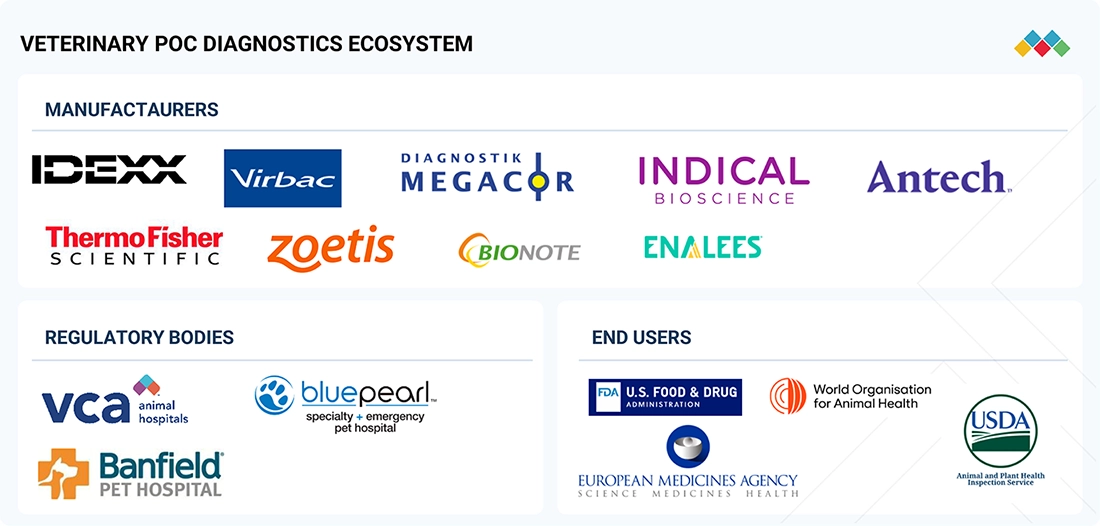
VETERINARY POC DIAGNOSTICS MARKET: COMMERCIAL USE CASES ACROSS INDUSTRIES
| COMPANY | USE CASE DESCRIPTION | BENEFITS |
|---|---|---|
 |
Offers in-clinic point-of-care analyzers and rapid diagnostic test kits for hematology, chemistry, urinalysis, and infectious diseases used directly in veterinary clinics | Enables real-time, highly accurate diagnostics during patient visits | Improvises clinical decision-making and workflow efficiency |
 |
Provides VetScan point-of-care diagnostic analyzers and rapid tests for chemistry, hematology, and immunodiagnostics across companion and livestock animals | Delivers fast, actionable insights at the point of care with integrated systems that enhance productivity and treatment accuracy |
 |
Develops in-clinic diagnostic analyzers, rapid tests, and cloud-based data platforms for hematology, immunodiagnostics, and imaging integration | Supports comprehensive in-house diagnostics with connected systems | Enables faster diagnosis and improved practice management |
 |
Offers rapid diagnostic kits and PoC testing solutions for infectious diseases, parasitology, and routine screening in veterinary settings | Provides easy-to-use, clinic-friendly diagnostics that support preventive care and early disease detection |
 |
Supplies portable PCR systems, reagents, and rapid testing kits adapted for veterinary PoC and near-patient applications | Ensures high-sensitivity molecular detection with scalable and reliable solutions suitable for both clinics and field use |
Logos and trademarks shown above are the property of their respective owners. Their use here is for informational and illustrative purposes only.
Related Ecosystem
Key Takeaways
- New Zealand's veterinary PoC diagnostics market is valued at USD 7.1 million in 2026 and expected to reach USD 10.0 million by 2031.
- New Zealand demonstrates a 7.1% CAGR, reflecting steady adoption of rapid diagnostic technologies in veterinary practices.
- New Zealand's market growth is driven by rising pet ownership, demand for faster diagnostics, and modernization of veterinary facilities.
- New Zealand's geographic isolation and strong animal health infrastructure create sustained demand for accessible, on-site diagnostic solutions.
Veterinary PoC Diagnostics Market Report Scope
| Report Metric | Details |
|---|---|
| Base Year | 2026 |
| Fastest Growing Segment | MOLECULAR DIAGNOSTICS (Technology) |
| Forecast Period | 2026–2031 |
| Growth Rate | CAGR of 7.7% from 2026 to 2031 |
| Largest Segment | CONSUMABLES (Product) |
| Market Size Base Year (Billions) | ~USD 1.19 (2026) |
| Revenue Forecast (Billions) | ~USD 1.72 (2031) |
| Segments Covered | Product, Animal Type, Type, Technology, Livestock Type, Molecular Diagnostics |
New Zealand Veterinary PoC Diagnostics Market Report Segmentation
6 segment dimensions are covered across the global market.
By Product
- Consumables
- Instruments
By Animal Type
- Companion Animals
- Livestock
By Type
- Cat
- Cattle
- Crispr-Based
- Dog
- Horse
- Isothermal Amplification
- Other Companion Animals
- Other Livestock
- Pcr-Based
- Pig
- Poultry
By Technology
- Immunodiagnostics
- Molecular Diagnostics
- Other Technologies
By Livestock Type
- Cattle
- Other Livestock
- Pig
- Poultry
By Molecular Diagnostics
- Crispr-Based
- Isothermal Amplification
- Pcr-Based
Target Audience
- Veterinary Diagnostic Manufacturers : Manufacturers need New Zealand-specific market data to assess market entry opportunities, competitive landscape, and demand forecasts for PoC diagnostic devices in this growing region.
- Veterinary Clinic Operators : Clinic owners and managers require market insights to justify investments in PoC diagnostic equipment and understand adoption trends among peer facilities across New Zealand.
- Healthcare Investors & PE Firms : Investment professionals need validated market sizing and growth projections for New Zealand to evaluate acquisition targets and portfolio companies in the veterinary diagnostics space.
- Veterinary Distributors & Suppliers : Distributors need regional market intelligence to optimize inventory, forecast demand, and identify high-growth opportunities within New Zealand's veterinary healthcare sector.
- Strategic Consultants & Advisors : Consultants require New Zealand-specific market data to advise clients on market entry strategies, competitive positioning, and growth opportunities in veterinary diagnostics.
Key Companies in the New Zealand Veterinary PoC Diagnostics Market
| Company | HQ | Ownership | Strongest segments |
|---|---|---|---|
| GENERAL ELECTRIC | United States | Public Company | Commercial Engines & Services,Defense & Propulsion Technologies,Additive and Advanced Components, |
| IDEXX LABORATORIES, INC. | United States | Public Company | Companion Animal Group (in-clinic analyzers, reference labs, software, services),Livestock, Poultry and Dairy Diagnostics,Water Quality Products, |
| THERMO FISHER SCIENTIFIC INC. | United States | Public Company | Life Sciences Solutions,Analytical Instruments,Specialty Diagnostics, |
| BIONOTE | South Korea | Public Company | Veterinary fluorescence immunoassay and molecular diagnostics,Veterinary clinical biochemistry systems and reagents,Veterinary rapid immunoassay and ELISA kits, |
| BIOMéRIEUX | France | Public Company | Microbiology ID/AST systems (VITEK 2, VITEK MS, VITEK REVEAL, API, ETEST),Syndromic and molecular diagnostics (BIOFIRE, BIOFIRE SPOTFIRE, ARGENE, EMAG/NUCLISENS),Sepsis, immunoassay, and specialty markers (VIDAS, Hybiome CLIA), |
| VIRBAC | France | Public Company | Companion animal parasiticides (e.g., Prevexto),Companion animal chronic-care nutrition (e.g., Vikaly, petfood),Behavior and stress management (Zenidog/Zenifel), |
GENERAL ELECTRIC
General Electric is a publicly traded United States company founded in 1892 that operates with 57,000 employees.
IDEXX LABORATORIES, INC.
IDEXX Laboratories, Inc. is a publicly traded United States company founded in 1983 with 11,000 employees.
THERMO FISHER SCIENTIFIC INC.
Thermo Fisher Scientific Inc. is a publicly traded United States company founded in 1956 with 125,000 employees.
BIONOTE
BioNote is a publicly traded South Korean company founded in 2003 with 298 employees.
BIOMéRIEUX
bioMérieux is a publicly traded French company founded in 1963 with 14,894 employees.
VIRBAC
Virbac is a publicly traded French company founded in 1968 with 6,442 employees.
Reasons to Buy this Report
- Market-Specific Sizing : Access precise market valuations for New Zealand's veterinary PoC diagnostics sector with validated 2026-2031 projections, enabling accurate business planning and investment decisions.
- Growth Driver Insights : Understand the specific factors driving New Zealand's 7.1% CAGR, including pet ownership trends, clinic adoption patterns, and regional healthcare dynamics unique to the market.
- Competitive Positioning : Benchmark your offerings against New Zealand market conditions and identify opportunities to capture share in this growing segment of animal healthcare diagnostics.
- Regional Expansion Strategy : Develop targeted go-to-market strategies for New Zealand veterinary practices with data-driven insights on adoption rates, facility types, and geographic distribution patterns.
- Investment Justification : Support funding decisions and stakeholder presentations with credible market research demonstrating New Zealand's veterinary diagnostics growth potential through 2031.
Frequently asked questions
What is the current size of New Zealand's veterinary PoC diagnostics market?
New Zealand's veterinary PoC diagnostics market is estimated at USD 7.1 million in 2026.
What is the projected market size for New Zealand by 2031?
New Zealand's veterinary PoC diagnostics market is forecast to reach USD 10.0 million by 2031.
What is the CAGR for New Zealand's veterinary PoC diagnostics market?
New Zealand's veterinary PoC diagnostics market is expected to grow at a CAGR of 7.1% from 2026 to 2031.
What factors are driving growth in New Zealand's veterinary PoC diagnostics market?
Growth in New Zealand is driven by rising pet ownership, increased demand for rapid disease detection, veterinary practice modernization, and the country's geographic isolation creating demand for accessible on-site diagnostics.
Why is New Zealand's market important for veterinary PoC diagnostics?
New Zealand's strong animal health infrastructure, regulatory environment, and reliance on local veterinary services make it a significant market for point-of-care diagnostic solutions that improve patient outcomes and operational efficiency.
RESEARCH METHODOLOGY
This research study extensively utilized both primary and secondary sources. It involved analyzing various factors influencing the industry to identify segmentation types, industry trends, key players, the competitive landscape, key market dynamics, and strategies employed by key players.
Secondary Research
This research study utilized a variety of comprehensive secondary sources, including directories; databases such as Bloomberg Business, Factiva, and Dun & Bradstreet; and white papers, annual reports, company house documents, investor presentations, and SEC filings from various companies. Secondary research was employed to gather information crucial for an in-depth, technical, market-oriented, and commercial analysis of the veterinary PoC diagnostics market. This approach also helped identify key players in the industry and allowed for classification and segmentation based on emerging trends at the most detailed level. Furthermore, significant developments pertaining to both market and technological perspectives were documented. A database of primary industry leaders was created as part of this secondary research.
Primary Research
In the primary research process, we interviewed a range of sources from both the supply and demand sides to gather qualitative and quantitative information for this report. Primary sources from the supply side include project/sales/marketing/business development managers, presidents, CEOs, vice presidents, chairpersons, chief operating officers, chief strategy officers, directors, chief information officers, and chief medical information officers related to the veterinary PoC diagnostics market. Primary sources from the demand side include small and large animal veterinarians, veterinary clinic and hospital owners, managers of livestock farms and dairy operations, directors of veterinary diagnostic laboratories, officials from government animal health and regulatory agencies, and procurement and purchasing teams from veterinary clinics, hospitals, and farm operations.
A breakdown of the primary respondents is provided below:
Breakdown Of Primary Interviews: Supply-Side Participants, By Company Type, Designation, And Region
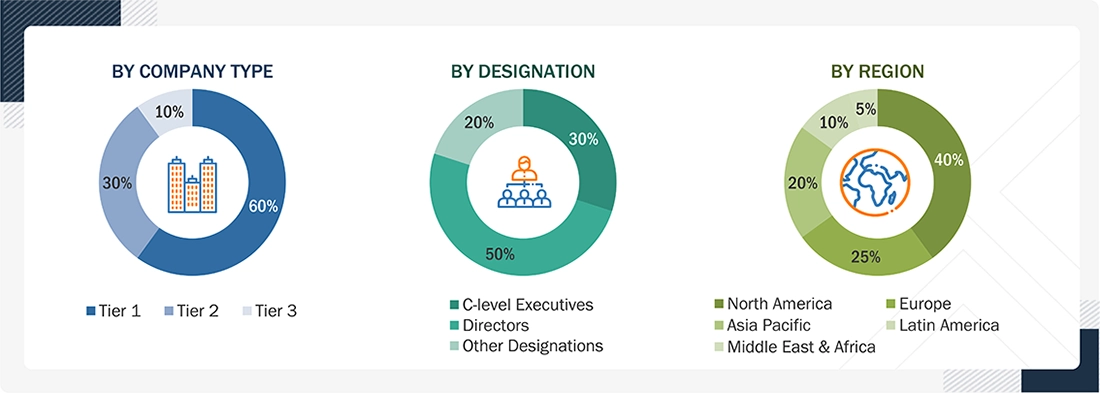
Note: C-level executives include CEOs, COOs, CTOs, and VPs.
Other designations include sales, marketing, and product managers.
Tiers are defined based on a company’s total revenue. As of 2025: Tier 1 = >USD 1 billion, Tier 2 = USD 500 million to USD 1 billion, and Tier 3 = USD 500 million.
To know about the assumptions considered for the study, download the pdf brochure
Market Size Estimation
The total size of the veterinary PoC diagnostics market was determined after data triangulation from three approaches, as mentioned below. After each approach, the weighted average of the three approaches was taken based on the level of assumptions used in each approach.
Veterinary PoC Diagnostics Market : Top-Down and Bottom-Up Approach
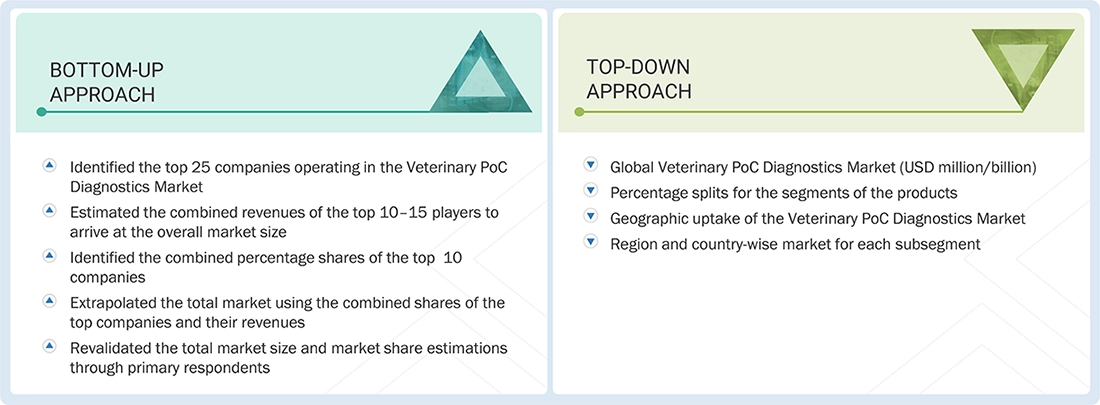
Data Triangulation
After arriving at the market size, the total market was divided into several segments and subsegments. Data triangulation and market breakdown procedures were employed wherever applicable to complete the overall market engineering process and arrive at the exact statistics for all segments and subsegments.
Market Definition
The veterinary PoC diagnostics market comprises products and technologies used for rapid, on-site diagnosis of diseases and health conditions in animals, enabling immediate clinical decision-making without reliance on centralized laboratories. The market includes consumables (such as test kits, cartridges, strips, and reagents) and instruments (including portable analyzers and handheld diagnostic devices) and covers key technologies such as molecular diagnostics (PCR-based, isothermal amplification, and CRISPR-based methods), immunodiagnostics, and other techniques, including clinical chemistry and hematology. It serves both companion animals (dogs, cats, horses, and others) and livestock (cattle, pigs, poultry, and others), with applications spanning infectious disease detection, routine health monitoring, and preventive care across veterinary clinics, farms, and field settings.
Key Stakeholders
- Veterinary PoC diagnostic kit manufacturers
- Molecular diagnostic technology providers & PoC instrument manufacturers
- Reagent & consumable suppliers
- Veterinary clinics & hospitals
- Livestock farms, dairy farms & integrated animal production companies
- Government animal health authorities & surveillance agencies
- Veterinary diagnostic laboratories
- Veterinarians & field-based animal health service providers
- Academic & veterinary research institutions
- Contract manufacturers & OEM partners
- Distributors & regional channel partners
- Market research & consulting firms
- Investors & venture capital firms
Report Objectives
- To define, describe, segment, and forecast the veterinary PoC diagnostics market by product, technology, animal type, and region, in terms of value
- To define, describe, segment, and forecast the veterinary PoC diagnostics market by product and region, in terms of volume
- To provide detailed information about the factors influencing market growth (such as drivers, restraints, opportunities, and challenges)
- To analyze micromarkets1 with respect to individual growth trends, prospects, and contributions to the overall veterinary PoC diagnostics market
- To strategically profile the key players in this market and comprehensively analyze their market shares and core competencies2
- To analyze market opportunities for stakeholders and provide details of the competitive landscape for key players
- To forecast the size of the veterinary PoC diagnostics market in five main regions (along with their respective key countries): North America, Europe, the Asia Pacific, Latin America, and the Middle East & Africa
- To profile the key players in the veterinary PoC diagnostics market and comprehensively analyze their core competencies and market shares
- To analyze competitive developments such as acquisitions, product launches, expansions, collaborations, agreements, and partnerships
1. Micromarkets are defined as the further segments and subsegments of the veterinary PoC diagnostics market included in the report.
2. Core competencies of companies are captured in terms of the key developments and strategies adopted by them to sustain their market positions.
Available customizations:
With the given market data, MarketsandMarkets offers customizations to meet your company’s specific needs. The following customization options are available for the report:
Company Information
- Detailed analysis and profiling of additional market players (up to 5)
Geographic Analysis
- Further breakdown of Rest of Europe veterinary PoC diagnostics market into Austria, Finland, Switzerland, and other countries
- Further breakdown of Rest of Latin America veterinary PoC diagnostics market into Colombia, Chile, and other countries
Competitive Landscape Assessment
Market share analysis for North America and Europe, which provides market shares of the top 3–5 key players in the veterinary PoC diagnostics market
- Competitive leadership mapping for established players in the US
Get the Full Veterinary PoC Diagnostics Market Report
Full forecast, segment splits, and company analysis for all Veterinary PoC Diagnostics Market.
- Canada Veterinary PoC Diagnostics Market
- US Veterinary PoC Diagnostics Market
- Germany Veterinary PoC Diagnostics Market
- UK Veterinary PoC Diagnostics Market
- France Veterinary PoC Diagnostics Market
- Italy Veterinary PoC Diagnostics Market
- Spain Veterinary PoC Diagnostics Market
- Netherlands Veterinary PoC Diagnostics Market
- Poland Veterinary PoC Diagnostics Market
- Sweden Veterinary PoC Diagnostics Market
- China Veterinary PoC Diagnostics Market
- Japan Veterinary PoC Diagnostics Market
- India Veterinary PoC Diagnostics Market
- Australia Veterinary PoC Diagnostics Market
- South Korea Veterinary PoC Diagnostics Market
- Thailand Veterinary PoC Diagnostics Market
- Brazil Veterinary PoC Diagnostics Market
- Mexico Veterinary PoC Diagnostics Market
- Argentina Veterinary PoC Diagnostics Market
- Rest Of Europe Veterinary PoC Diagnostics Market
- Rest Of Asia Pacific Veterinary PoC Diagnostics Market
- Kingdom Of Saudi Arabia (Ksa) Veterinary PoC Diagnostics Market
- Rest Of GCC Countries Veterinary PoC Diagnostics Market
- Rest Of Latin America Veterinary PoC Diagnostics Market
- United Arab Emirates (UAE) Veterinary PoC Diagnostics Market
Need a Tailored Report?
Customize this report to your needs
Get 10% FREE Customization
Customize This Report
