
Europe Vibration Damping Materials Market (2025-2030)

The Europe Vibration Damping Materials Market was valued at $2067.4 Million in 2025 and projected to reach to $2535.4 Million by 2030, representing a compound annual growth rate of 4.16%. Europe's vibration damping materials market is positioned for steady growth through 2030, driven by regulatory pressures and industrial modernization.


| Market Size in | USD 26.32 MN |
| Market Forecast in | |
| CAGR | |
| Forecast Period | |
| Units Considered | Value (USD MN) |
Europe Vibration Damping Materials Market Trends and Insights
- Europe represents a mature yet dynamic market driven by stringent automotive and industrial noise regulations, alongside increasing demand from the manufacturing and construction sectors.
- The region's focus on sustainability and noise reduction standards continues to propel adoption of advanced damping solutions across multiple end-use industries. In Europe, the vibration damping materials market benefits from strong industrial infrastructure and technological innovation hubs concentrated in Western and Central European nations.
- Europe's automotive sector, a primary consumer of these materials, increasingly integrates damping solutions to meet EU noise emission directives and enhance vehicle comfort.
- Between 2025 and 2030, Europe is expected to maintain steady growth momentum, supported by rising investments in railway infrastructure, renewable energy installations, and industrial equipment modernization across the continent..
Key Market Statistics
- CAGR (2025-2030) 4.16% CAGR
- Market Size, 2025 ~USD 2067.4 Million
- Forecast, 2030 ~USD 2535.4 Million
- Geography Europe
Europe Vibration Damping Materials Market Overview
Regulatory Compliance Driving Growth :
Europe's stringent automotive and industrial noise regulations are propelling demand for vibration damping materials. EU directives on vehicle noise emissions and workplace safety standards create sustained market opportunities for manufacturers and suppliers across the region.
Automotive Sector Leadership :
Germany leads Europe's vibration damping materials market with USD 673.6 million in market size. The country's robust automotive manufacturing base, including premium and mass-market producers, drives significant consumption of advanced damping solutions for noise and vibration control.
Mature Market with Steady Expansion :
Europe's market is valued at USD 2,067.4 million in 2025 and projected to reach USD 2,535.4 million by 2030, representing a 4.16% CAGR. This steady growth reflects the region's mature industrial base and continuous innovation in material science and engineering applications.
Manufacturing and Construction Demand :
Beyond automotive, Europe's vibration damping materials market benefits from increasing demand in manufacturing and construction sectors. Industrial machinery, HVAC systems, and building infrastructure applications create diversified revenue streams across the region.
Europe Vibration Damping Materials Market Dynamics
- The region's mature automotive sector continues to adopt advanced damping technologies to meet noise emission standards, while expanding applications in construction and industrial equipment create new growth vectors.
- Germany, France, UK, and Italy represent key markets, with Rest of Europe contributing significantly to regional expansion. The market's 4.16% CAGR reflects Europe's focus on sustainability and operational efficiency.
- Manufacturers are increasingly investing in eco-friendly damping materials and lightweight solutions to support automotive electrification and energy efficiency goals.
- Strategic partnerships between material suppliers and OEMs, coupled with ongoing R&D initiatives, will sustain market momentum through the forecast period..
Market Ecosystem
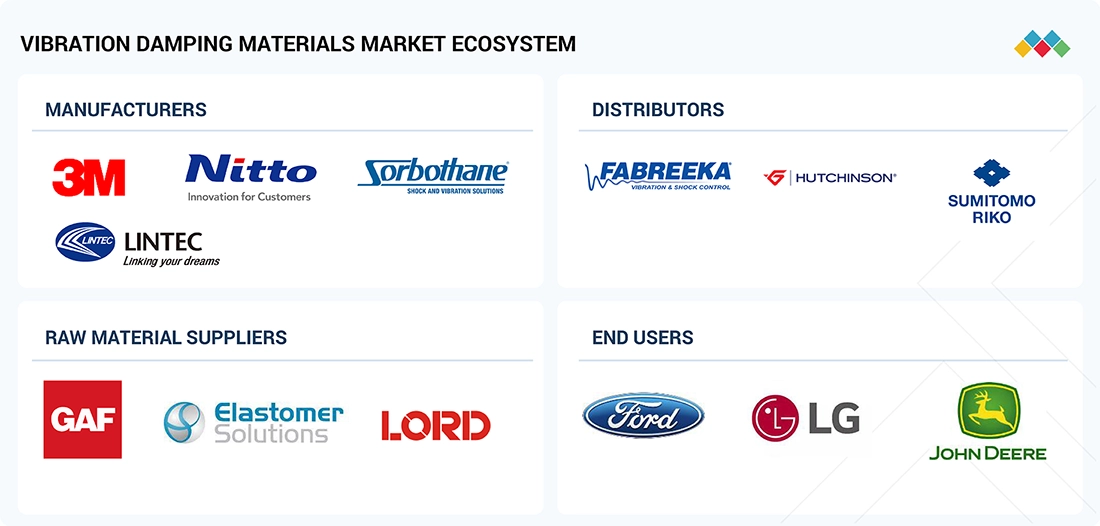
Vibration Damping Materials Market: COMMERCIAL USE CASES ACROSS INDUSTRIES
| COMPANY | USE CASE DESCRIPTION | BENEFITS |
|---|---|---|
 |
Used in vehicle body panels, engine compartments, and dashboards to reduce noise, vibration, and harshness (NVH). | Enhances ride comfort, lowers cabin noise, and improves overall vehicle quality and customer satisfaction. |
 |
Applied in fuselage structures and cabin interiors to minimize vibration transmission and enhance passenger comfort. | Improves passenger comfort, reduces structural fatigue, and extends aircraft component lifespan. |
 |
Integrated into appliances and electronic devices like washing machines and smartphones to reduce operational noise and improve stability. | Increases product durability, reduces operational noise, and enhances user experience. |
 |
Used in turbines, compressors, and generators to control vibration, improving equipment efficiency and lifespan. | Minimizes mechanical wear, improves energy efficiency, and reduces maintenance frequency. |
 |
Implemented in locomotives and rail systems to dampen structural vibrations, enhancing durability and passenger comfort. | Enhances ride smoothness, extends component life, and reduces noise levels for |
Logos and trademarks shown above are the property of their respective owners. Their use here is for informational and illustrative purposes only.
Related Ecosystem
Resins And Polymers
Building And Construction
Key Takeaways
- Europe's vibration damping materials market is valued at USD 2,067.4 million in 2025 and will reach USD 2,535.4 million by 2030.
- Europe is experiencing a 4.16% CAGR, driven by strict EU noise regulations and automotive sector demand.
- Europe's mature industrial base and focus on sustainability support steady market expansion through 2030.
- Europe's key growth drivers include railway modernization, renewable energy projects, and manufacturing equipment upgrades.
Vibration Damping Materials Market Report Scope
| Report Metric | Details |
|---|---|
| Base Year | 2025 |
| Fastest Growing Segment | ELECTRONICS (End-Use Industry) |
| Forecast Period | 2025–2030 |
| Growth Rate | CAGR of 4.8% from 2025 to 2030 |
| Largest Segment | COMPOSITES (Type) |
| Market Size Base Year (Billions) | ~USD 11.23 (2025) |
| Revenue Forecast (Billions) | ~USD 14.2 (2030) |
| Segments Covered | Type, Form, End-Use Industry |
Europe Vibration Damping Materials Market Report Segmentation
3 segment dimensions are covered across the global market.
By Type
- Composites
- Metals
- Polymers
By Form
- Films & Sheets
- Foam & Gaskets
- Foams & Gaskets
- Other Forms
- Pads & Tapes
By End-Use Industry
- Aerospace & Defense
- Automotive
- Building & Construction
- Electronics
- Industrial Machinery
- Other End-Use Industries
- Sports & Leisure
EUROPE: VIBRATION DAMPING MATERIALS MARKET, BY END-USE INDUSTRY, 2025–2030
| Segment | 2025 | 2026 | 2027 | 2028 | 2029 | 2030 | CAGR (%) |
|---|---|---|---|---|---|---|---|
| AEROSPACE & DEFENSE | 355.6 | 369.1 | 383.5 | 398.7 | 414.8 | 431.9 | 3.97 |
| AUTOMOTIVE | 495.8 | 517.3 | 540.2 | 564.4 | 590.2 | 617.6 | 4.49 |
| BUILDING & CONSTRUCTION | 408.5 | 423.2 | 438.8 | 455.3 | 472.9 | 491.5 | 3.77 |
| ELECTRONICS | 178.7 | 187.9 | 197.7 | 208.2 | 219.5 | 231.5 | 5.32 |
| INDUSTRIAL MACHINERY | 308.5 | 319.5 | 331.1 | 343.3 | 356.2 | 369.9 | 3.69 |
| OTHER END-USE INDUSTRIES | 284.9 | 296.5 | 308.9 | 321.9 | 335.9 | 350.6 | 4.24 |
| SPORTS & LEISURE | 35.4 | 36.6 | 37.9 | 39.3 | 40.8 | 42.3 | 3.64 |
| TOTAL | 2067.4 | 2150.2 | 2238 | 2331.2 | 2430.2 | 2535.4 | 4.16 |
Target Audience
- Automotive Manufacturers & Suppliers : OEMs and Tier-1/Tier-2 suppliers need market intelligence to optimize vibration damping material sourcing, meet EU noise regulations, and develop competitive vehicle platforms. Regional market data supports supply chain decisions and product innovation strategies.
- Material Science & Chemical Companies : Producers of damping polymers, elastomers, and composite materials require insights into European demand patterns, regulatory compliance requirements, and customer specifications. Market analysis guides R&D investments and commercialization strategies for new material formulations.
- Industrial Equipment Manufacturers : Producers of machinery, HVAC systems, and industrial equipment use vibration damping materials to enhance product performance and meet noise standards. Market intelligence supports material selection, supplier evaluation, and cost optimization across European operations.
- Construction & Building Systems Companies : Architects, builders, and construction material suppliers integrate vibration damping solutions into building infrastructure and acoustic systems. Regional market data informs product specifications, supplier partnerships, and compliance with European building codes and standards.
- Investment & Strategy Consultants : Private equity firms, management consultants, and strategic advisors evaluate market opportunities and acquisition targets within Europe's vibration damping materials sector. Detailed market analysis supports due diligence, valuation, and growth strategy development for portfolio companies.
Key Companies in the Europe Vibration Damping Materials Market
| Company | HQ | Ownership | Strongest segments |
|---|---|---|---|
| 3M | United States | Public Company | Safety and Industrial,Transportation and Electronics,Consumer, |
| NITTO DENKO CORPORATION | Japan | Public Company | Adhesive tapes & surface protective films,Electronics & FPD/touch panel materials (incl. FPC),Semiconductor manufacturing process products, |
| LINTEC CORPORATION | Japan | Public Company | Printing and variable information-related products (labels, barcode supplies, digital label systems),Industrial and automotive adhesive products, printers, and labeling machines,Construction-related films and interior finishing materials, |
| TRELLEBORG AB | Sweden | Public Company | Sealing solutions (industrial, automotive, tunnel, pipe, profiles, flat gaskets),Antivibration, noise and vibration damping, bearings and bushings,Marine and offshore (ship fenders, docking, mooring, floatover, oil sands, wear protection), |
| KITAGAWA INDUSTRIES CO., LTD. | Japan | Private Company | Electromagnetic wave protection / EMC components,Anti-vibration cushioning and sound damping,Thermal design products, |
3M
3M is a publicly traded American multinational company founded in 1902 with 60,500 employees. The company operates across diverse industrial and consumer markets globally.
NITTO DENKO CORPORATION
Nitto Denko Corporation is a Japanese public company established in 1918 with 26,477 employees. The company operates in various industrial and specialty materials sectors.
LINTEC CORPORATION
Lintec Corporation is a Japanese public company founded in 1927 with 5,237 employees. The company specializes in adhesive products and materials.
TRELLEBORG AB
Trelleborg AB is a Swedish public company established in 1905 with 15,756 employees. The company operates globally in engineered polymer solutions and industrial applications.
KITAGAWA INDUSTRIES CO., LTD.
Kitagawa Industries Co., Ltd. is a privately held Japanese company founded in 1963 with 507 employees. The company operates in specialized industrial manufacturing.
Countries within Europe - compare and drill down
| Country | 2025 size (native) |
|---|---|
| Germany | USD 673.6 Million |
| France | USD 326.8 Million |
| Italy | USD 217.9 Million |
| UK | USD 345 Million |
| Rest Of Europe | USD 972.2 Million |
Country market size visualization
Reasons to Buy this Report
- Regional Market Segmentation : Gain detailed insights into Europe's vibration damping materials market with country-level breakdowns including Germany, France, UK, and Italy. Understand regional variations in demand drivers, regulatory environments, and competitive landscapes specific to European markets.
- Regulatory Intelligence : Access comprehensive analysis of EU noise emission directives and workplace safety standards shaping market dynamics. Identify compliance requirements and regulatory trends that influence product development and market entry strategies across European jurisdictions.
- Competitive Landscape Analysis : Understand the competitive positioning of European and global players in the region's vibration damping materials market. Identify key manufacturers, their market share, product portfolios, and strategic initiatives targeting European automotive and industrial sectors.
- Growth Opportunity Identification : Discover emerging applications and market segments within Europe's manufacturing, construction, and industrial equipment sectors. Identify high-growth niches and underserved markets where vibration damping materials can create competitive advantages and revenue expansion.
- Strategic Planning Support : Leverage market forecasts and trend analysis to inform investment decisions, product development roadmaps, and market expansion strategies. Make data-driven decisions for entering or scaling operations within Europe's vibration damping materials market through 2030.
Frequently asked questions
What is the current size of Europe's vibration damping materials market?
Europe's vibration damping materials market is valued at USD 2,067.4 million in 2025.
What is the projected market size for Europe by 2030?
Europe's vibration damping materials market is projected to reach USD 2,535.4 million by 2030.
What is the CAGR for Europe's vibration damping materials market?
Europe's vibration damping materials market is growing at a CAGR of 4.16% from 2025 to 2030.
Which industries drive demand for vibration damping materials in Europe?
Europe's primary demand drivers include automotive manufacturing, railway infrastructure, industrial equipment, construction, and renewable energy sectors.
Why is Europe's market growth steady compared to global rates?
Europe's 4.16% CAGR reflects a mature market with established regulations, strong industrial standards, and consistent demand from regulated sectors like automotive and transportation.
RESEARCH METHODOLOGY
The study involved four major activities in estimating the market size for vibration damping materials. Exhaustive secondary research was done to collect information on the market, the peer market, and the parent market. The next step was to validate these findings, assumptions, and sizing with industry experts across the value chain through primary research. Both top-down and bottom-up approaches were employed to estimate the complete market size. Post that, the market breakdown and data triangulation procedures were used to estimate the market size of the segments and subsegments.
Secondary Research
Secondary sources used in this study included annual reports, press releases, and investor presentations of companies; white papers; certified publications; articles from recognized authors; and gold standard & silver standard websites such as Factiva, ICIS, Bloomberg, and others. The findings of this study were verified through primary research by conducting extensive interviews with key officials such as CEOs, VPs, directors, and other executives. The breakdown of profiles of the primary interviewees is illustrated in the figure below:
Primary Research
The vibration damping materials market comprises several stakeholders, such as raw material suppliers, end-product manufacturers, and regulatory organizations in the supply chain. The demand side of this market is characterized by the automotive, industrial machinery, aerospace and defence, electronics, building and construction, sports & leisure, and others. The supply side is characterized by advancements in technology and diverse end-use industries. Various primary sources from both the supply and demand sides of the market were interviewed to obtain qualitative and quantitative informations.
Breakdown of Primary Participants
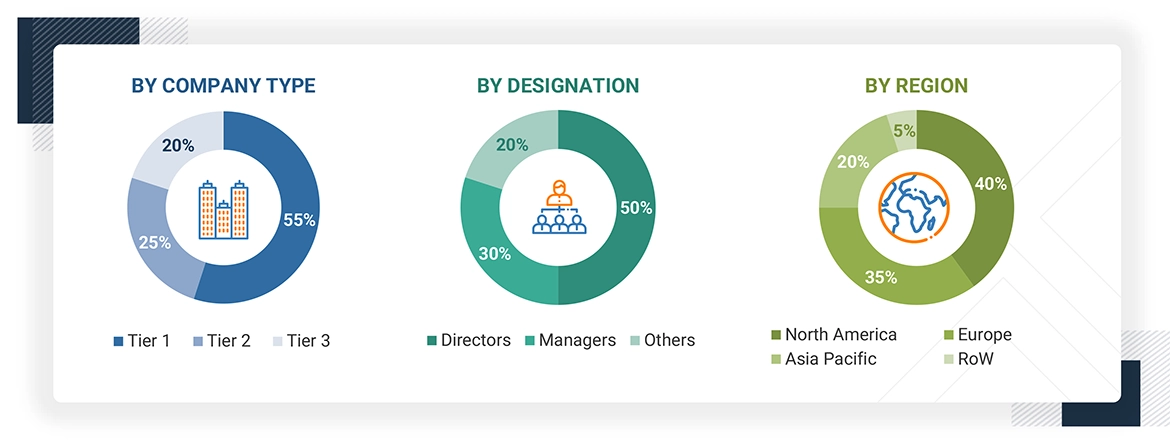
Note: Tier 1, Tier 2, and Tier 3 companies are classified based on their market revenue in 2023 available in the public domain, product portfolios, and geographical presence.
Other designations include consultants and sales, marketing, and procurement managers.
To know about the assumptions considered for the study, download the pdf brochure
| COMPANY NAME | DESIGNATION | |
|---|---|---|
| 3M | Director of Marketing | |
| Nitto Denko Corporation | Manager- Sales & Marketing | |
| Trelleborg AB | Sales Manager | |
| LINTEC Corporation | Production Manager | |
| Kitagawa Industries Co., Ltd. | Manager | |
Market Size Estimation
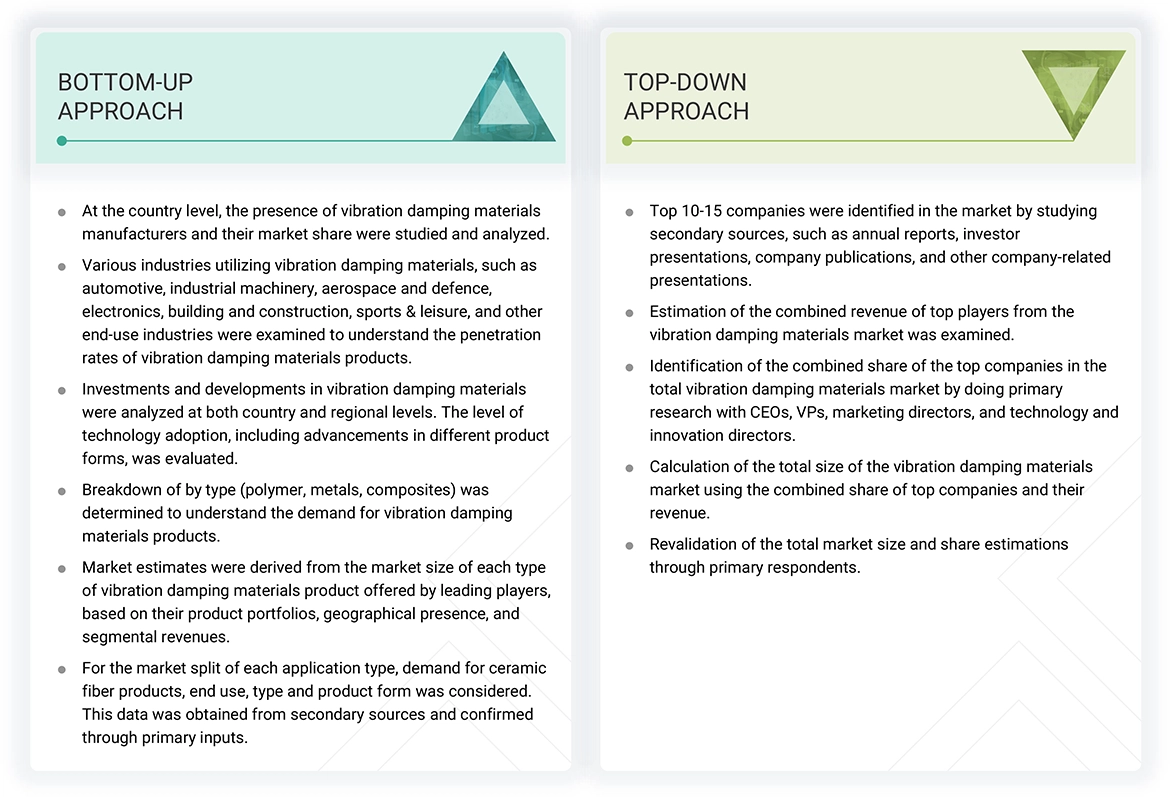
Both top-down and bottom-up approaches were used to estimate and validate the total size of the vibration damping materials market. These methods were also used extensively to estimate the size of various subsegments in the market. The research methodology used to estimate the market size includes the following:
- The key players in the industry have been identified through extensive secondary research.
- The supply chain of the industry has been determined through primary and secondary research.
- All percentage shares, splits, and breakdowns have been determined using secondary sources and verified through primary sources.
- All possible parameters that affect the markets covered in this research study have been accounted for, viewed in extensive detail, verified through primary research, and analyzed to obtain the final quantitative and qualitative data.
Vibration Damping Materials Market: Top-Down Approach
Data Triangulation
After arriving at the overall market size—using the market size estimation processes as explained above—the market was split into several segments and subsegments. To complete the overall market engineering process and arrive at the exact statistics of each market segment and subsegment, the data triangulation, and market breakdown procedures were employed, wherever applicable. The data was triangulated by studying various factors and trends from both the demand and supply sides in the vibration damping materials industry.
Market Definition
According to the International Institute of Noise Control Engineering (I-INCE), vibration damping materials are specialized materials designed to reduce noise, vibrations, and harshness (NVH) in various applications across industries. These materials help in absorbing and dissipating vibrational energy, preventing excessive wear and structural fatigue in machinery, vehicles, and infrastructure. Even under extreme operating conditions, they enhance stability, minimize resonance, and improve overall system efficiency. Vibration damping materials are specifically engineered for use in high-performance applications, including automotive, industrial machinery, electronics, and building & construction, where noise reduction, durability, and enhanced operational lifespan are critical. These materials play an essential role in optimizing system performance, extending component life, and improving user comfort and safety across diverse sectors.
Stakeholders
- Vibration Damping Materials Manufacturers
- Vibration Damping Materials Traders, Distributors, and Suppliers
- End-use Market Participants of Different Segments of Vibration Damping Materials
- Government and Research Organizations
- Associations and Industrial Bodies
- Research and Consulting Firms
- R&D Institutions
- Environment Support Agencies
- Investment Banks and Private Equity Firms
Report Objectives
- To define, describe, and forecast the vibration damping materials market in terms of value and volume
- To provide detailed information regarding the drivers, opportunities, restraints, and challenges influencing market growth
- To estimate and forecast the market size by type, by form, end-use industries, and region
- To forecast the size of the market for five main regions: Europe, North America, Asia Pacific, South America, and the Middle East & Africa, along with their key countries
- To strategically analyze micromarkets1 with respect to their growth trends, prospects, and contribution to the overall market
- To analyze opportunities in the market for stakeholders and provide a competitive landscape for market leaders
- To analyze competitive developments, such as deals and expansions, in the market
- To analyze the impact of the recession on the market
- To strategically profile key players and comprehensively analyze their growth strategies
Get the Full Vibration Damping Materials Market Report
Full forecast, segment splits, and company analysis for all Vibration Damping Materials Market.
- China Vibration Damping Materials Market
- India Vibration Damping Materials Market
- Japan Vibration Damping Materials Market
- South Korea Vibration Damping Materials Market
- Germany Vibration Damping Materials Market
- France Vibration Damping Materials Market
- Italy Vibration Damping Materials Market
- UK Vibration Damping Materials Market
- Mexico Vibration Damping Materials Market
- Canada Vibration Damping Materials Market
- US Vibration Damping Materials Market
- Iran Vibration Damping Materials Market
- South Africa Vibration Damping Materials Market
- Brazil Vibration Damping Materials Market
- Argentina Vibration Damping Materials Market
- Rest Of Europe Vibration Damping Materials Market
- Rest Of Asia Pacific Vibration Damping Materials Market
Need a Tailored Report?
Customize this report to your needs
Get 10% FREE Customization
Customize This Report
