
South Korea Video Processing Platform Market (2025-2030)

The South Korea Video Processing Platform Market was valued at $263.2 Million in 2025 and projected to reach to $484 Million by 2030, representing a compound annual growth rate of 13.0%. South Korea's video processing platform market is positioned for exceptional growth through 2030, driven by the nation's technological leadership and digital-first economy.


| Market Size in | USD 26.32 MN |
| Market Forecast in | |
| CAGR | |
| Forecast Period | |
| Units Considered | Value (USD MN) |
South Korea Video Processing Platform Market Trends and Insights
- This accelerated expansion in South Korea reflects the nation's advanced digital infrastructure, high internet penetration, and strong demand for video content across streaming, broadcasting, and enterprise sectors.
- South Korea's technology-forward economy and investment in AI-driven video analytics are positioning the country as a key regional hub for video processing innovation. The forecast period through 2030 demonstrates South Korea's commitment to digital transformation across media, entertainment, and telecommunications industries.
- South Korea's competitive advantage stems from its skilled workforce, robust semiconductor and software ecosystems, and early adoption of next-generation video technologies including 4K/8K processing and real-time transcoding solutions.
- South Korea continues to attract both domestic and international vendors seeking to establish regional operations, further accelerating market maturation and technological advancement..
Key Market Statistics
- CAGR (2025-2030) 13.0% CAGR
- Market Size, 2025 ~USD 263.2 Million
- Forecast, 2030 ~USD 484 Million
- Country South Korea
South Korea Video Processing Platform Market Overview
Market Valuation Growth :
South Korea's video processing platform market is valued at USD 263.2 million in 2025, with projections reaching USD 484.0 million by 2030, demonstrating strong regional momentum.
Superior Regional CAGR :
South Korea's 13.0% CAGR significantly outpaces the global average of 10.6%, reflecting the country's accelerated digital transformation and video content consumption trends.
Advanced Digital Infrastructure :
South Korea's world-leading internet penetration, 5G adoption, and tech-savvy population create an ideal ecosystem for video processing platform innovation and deployment.
Diverse Industry Demand :
Strong demand across streaming services, broadcasting, e-commerce, and enterprise sectors drives adoption of sophisticated video processing solutions throughout South Korea.
South Korea Video Processing Platform Market Dynamics
- The country's robust streaming industry, coupled with increasing demand from content creators and enterprises, fuels platform adoption.
- South Korea's investment in AI-powered video analytics, real-time processing capabilities, and cloud-based solutions reflects evolving market needs. The 13.0% CAGR trajectory indicates sustained expansion as businesses prioritize video content optimization, live streaming infrastructure, and automated content management.
- Government support for digital innovation, combined with competitive local and international vendors, ensures continued market dynamism.
- South Korea's position as a regional tech hub amplifies its influence on broader Asian video processing trends..
Market Ecosystem
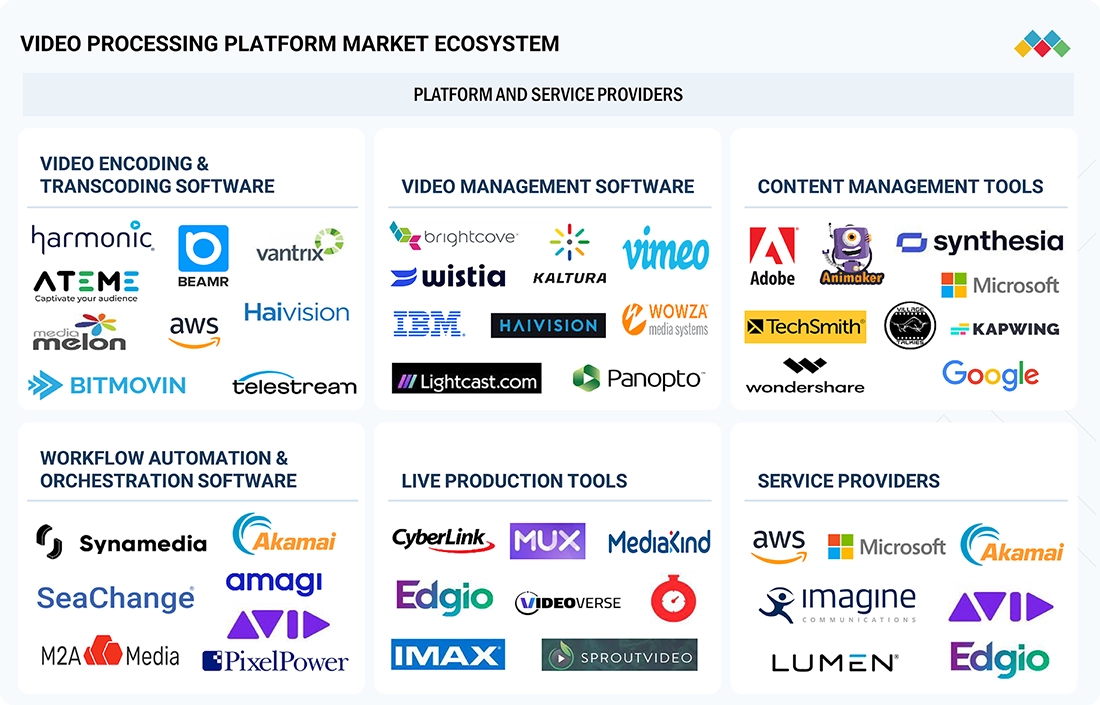
Video Processing Platform Market: COMMERCIAL USE CASES ACROSS INDUSTRIES
| COMPANY | USE CASE DESCRIPTION | BENEFITS |
|---|---|---|
 |
Taghos leveraged Akamai’s EdgeWorkers and global CDN to combat illegal streaming, secure broadcaster revenues, and deliver high-quality, reliable video content across Brazil, including rural regions. | Akamai enabled Taghos to block piracy and protect revenues while ensuring scalable, high-definition, buffer-free streaming experiences nationwide. |
 |
CFA Institute adopted Brightcove’s video marketing solution to expand global brand awareness and engagement, delivering live and on-demand video campaigns tailored for diverse audiences across 73 markets. | Brightcove tripled CFA Institute’s engagement scores and enhanced global visibility through localized, analytics-driven campaigns optimized for different audience segments. |
 |
Insight Global utilized Synthesia’s AI-powered video platform to rapidly create multilingual training videos for internationally educated nurses, improving onboarding speed, accessibility, and engagement across diverse healthcare environments. | Synthesia enabled 10× faster training content production and simplified updates, ensuring engaging, accessible, and up-to-date nurse training for improved learning outcomes. |
 |
The University of Dundee implemented Panopto’s comprehensive video management platform to improve lecture capture, accessibility, and system reliability, enhancing digital learning experiences for its global student community. | Panopto ensured stable, accessible, and integrated lecture delivery with accurate captioning and seamless LMS integration, improving efficiency and learning accessibility campus-wide. |
Logos and trademarks shown above are the property of their respective owners. Their use here is for informational and illustrative purposes only.
Related Ecosystem
Software And Services
- Natural Language Processing (NLP)
- Machine Learning
- Supply Chain Management
- Predictive Analytics
- Image Sensors
- International Business Machines Corporation
- MICROSOFT CORPORATION
- Oracle Corporation
- SAP SE
- Amazon.com, Inc.
Key Takeaways
- South Korea's video processing platform market is valued at USD 263.2 million in 2025 and is forecast to reach USD 484.0 million by 2030.
- South Korea demonstrates a 13.0% CAGR, outpacing the global average of 10.6%, driven by advanced digital infrastructure and high video consumption.
- South Korea's strength in semiconductor manufacturing and AI technology positions it as a regional innovation leader for video processing solutions.
- South Korea's streaming, broadcasting, and enterprise sectors are primary growth drivers, supported by government digital transformation initiatives.
Video Processing Platform Market Report Scope
| Report Metric | Details |
|---|---|
| Base Year | 2025 |
| Fastest Growing Segment | FILM & VIDEO PRODUCTION (Media & Entertainment 2020–2024) |
| Forecast Period | 2025–2030 |
| Growth Rate | CAGR of 10.6% from 2025 to 2030 |
| Largest Segment | PLATFORM (Offering) |
| Market Size Base Year (Billions) | ~USD 7.49 (2025) |
| Revenue Forecast (Billions) | ~USD 12.4 (2030) |
| Segments Covered | Offering, Platform, Services, Professional Services, Content Type, Deployment Mode, Application, End User, Enterprise User, Media & Entertainment 2020–2024, Media & Entertainment, Media & Entertainment Enterprise Users, Media & Entertainment User |
South Korea Video Processing Platform Market Report Segmentation
13 segment dimensions are covered across the global market.
By Offering
- Platform
- Services
By Platform
- Content Management Tools
- Other Platforms
- Video Encoding & Transcoding Software
- Video Management Software
By Services
- Managed Services
- Professional Services
By Professional Services
- Support & Maintenance
- Support And Maintenance
- System Integration & Implementation
- System Integration And Implementation
- Training & Consulting
- Training And Consulting
By Content Type
- Interactive & Immersive Video
- Interactive And Immersive Video
- Live Streaming Video
- Short Form Video & Social Media Content
- Video On Demand
- Video – On – Demand (Vod)
- Video-On-Demand (Vod)
By Deployment Mode
- Cloud
- On-Premises
By Application
- Content Creation & Post Production
- Content Creation & Post-Production
- Content Protection
- Other Applications
- Video Analytics & Qoe Monitoring
- Video Delivery & Distribution
- Video Editing & Enhancement
- Video Hosting & Publishing
- Video Ingest & Capture
- Video Personalization & Recommendation Engines
By End User
- Enterprise Users
- Individual Users
By Enterprise User
- Bfsi
- Education
- Healthcare & Life Sciences
- Manufacturing
- Marketing & Advertising Agencies
- Media & Entertainment
- Other Enterprise Users
- Retail & Ecommerce
- Travel & Hospitality
By Media & Entertainment 2020–2024
- Broadcasting & Streaming Service Providers
- Film & Video Production
- Gaming & Sports
- Other Media & Entertainment Enterprise Users
By Media & Entertainment
- Broadcasting & Streaming Service Providers
- Film & Video Production
- Gaming & Sports
- Other Media & Entertainment Enterprise Users
By Media & Entertainment Enterprise Users
- Broadcasting & Streaming Service Providers
- Film & Video Production
- Gaming & Sports
- Other Media & Entertainment Enterprise Users
By Media & Entertainment User
- Broadcasting & Streaming Service Providers
- Film & Video Production
- Gaming & Sports
Target Audience
- Video Platform Vendors : Software and SaaS providers need South Korea-specific market data to tailor product offerings, pricing strategies, and go-to-market approaches for this high-growth regional market.
- Enterprise Technology Buyers : South Korean corporations evaluating video processing solutions require localized market insights to benchmark vendors, assess ROI, and make informed procurement decisions.
- Investment & Private Equity Firms : Investors targeting South Korea's tech sector need detailed market forecasts and growth drivers to identify acquisition targets and fund allocation opportunities in video processing.
- Streaming & Media Companies : Content providers and broadcasters in South Korea require market intelligence to optimize video delivery infrastructure, understand competitive dynamics, and plan technology investments.
- Consulting & Strategy Firms : Management consultants advising South Korean clients need granular market data to develop digital transformation strategies and video technology roadmaps aligned with regional growth.
Key Companies in the South Korea Video Processing Platform Market
| Company | HQ | Ownership | Strongest segments |
|---|---|---|---|
| APRIORIT | United States | Private Company | Cybersecurity & Data Protection Engineering Services,System-Level & Kernel/Driver Development,Cloud, SaaS & Enterprise Product Engineering, |
| QUMU CORPORATION | United States | Public Company | GPU-accelerated cloud and colocation infrastructure,Managed AI infrastructure services and support,Consulting, integration, and other services, |
| AKAMAI TECHNOLOGIES | United States | Public Company | Security (Web, API, Bot & Abuse, Account Protection),Delivery (Web and Mobile Performance, Media Delivery, DNS),Cloud Computing (Compute, Storage, App Platform, Networking), |
| HARMONIC | United States | Public Company | cOS software-based broadband access platform,DAA and Remote PHY hardware (Oyster, Ripple, SeaStar, Reef, Wave, pebble),OLT modules and devices (fin, pearl, pier), |
| ADOBE | United States | Public Company | Digital Media (Creative Cloud & Document Cloud),Digital Experience,Publishing and Advertising & Other, |
| AVID TECHNOLOGY | United States | Private Company | Video editing and production software (Media Composer, MediaCentral),Shared storage and servers (Avid NEXIS, FastServe, AirSpeed),Audio software (Pro Tools, Sibelius), |
| MICROSOFT | United States | Public Company | Intelligent Cloud (Azure, Server, GitHub, Nuance),Productivity & Business Processes (Microsoft 365, LinkedIn, Dynamics),Personal Computing (Windows, Devices, Gaming, Search/Ads), |
| IBM | United States | Public Company | Software (Hybrid Cloud and AI Platforms),Consulting (Strategy, Technology Services, Intelligent Operations),Infrastructure (Servers, Storage, Lifecycle Services), |
| VIMEO | United States | Private Company | Core hosting, player, and video library,Live streaming and webinars,Video creation, editing, and Vimeo AI tools, |
| ATEME | France | Public Company | TITAN Live, File, Mux and Edge (compression and stream processing),Contribution encoders/decoders (TITAN Edge, KYRION, T-Rug),NEA OTT suite (CDN, DVR, Live, Ad Insertion, Anti-piracy), |
| CYBERLINK | Taiwan | Public Company | Consumer/prosumer video & photo editing software,Multimedia playback, burning, backup & media conversion,Livestreaming, desktop recording & webcam capture, |
| AMAGI | India | Public Company | Cloud playout & channel origination SaaS,Targeted advertising & CTV/FAST monetization,Content distribution & SaaS infrastructure services, |
| HAIVISION | Canada | Public Company | Makito encoders (X, X4, Rugged, FX, X1 Rugged),SRT-based infrastructure (StreamHub, SRT Gateway, SRT Open Source–driven services),ISR software and management (Haivision Play ISR, EMS, related tools), |
APRIORIT
APRIORIT is a private software development company founded in 2002 in the United States, specializing in custom software solutions and cybersecurity services.
QUMU CORPORATION
QUMU CORPORATION is a publicly traded U.S. company founded in 2019 with 29 employees, operating in the video and digital media technology sector.
AKAMAI TECHNOLOGIES
AKAMAI TECHNOLOGIES is a publicly traded U.S. company founded in 1998 with 11,000 employees, providing content delivery network and cloud security services.
HARMONIC
HARMONIC is a publicly traded U.S. company founded in 1988 with 521 employees, specializing in video delivery infrastructure and media processing solutions.
ADOBE
ADOBE is a publicly traded U.S. company founded in 1982 with 31,360 employees, providing creative software, digital marketing solutions, and cloud services.
AVID TECHNOLOGY
AVID TECHNOLOGY is a private U.S. company founded in 1987 with 1,485 employees, specializing in media and entertainment production software and solutions.
MICROSOFT
MICROSOFT is a publicly traded U.S. company founded in 1975 with 228,000 employees, providing software, cloud computing, and enterprise technology solutions globally.
IBM
IBM is a publicly traded U.S. company founded in 1911 with 264,300 employees, offering enterprise IT services, cloud solutions, and artificial intelligence technologies.
VIMEO
VIMEO is a private U.S. company founded in 2004 with 1,102 employees, providing video hosting, streaming, and creation tools for content creators and businesses.
ATEME
ATEME is a publicly traded French company founded in 1991 with 547 employees, specializing in video compression and streaming technology solutions.
CYBERLINK
CYBERLINK is a publicly traded Taiwanese company founded in 1990 with 430 employees, developing multimedia software for video editing, creation, and playback.
AMAGI
AMAGI is a publicly traded Indian company founded in 2008 with 986 employees, providing cloud-based media and broadcast technology solutions.
HAIVISION
HAIVISION is a publicly traded Canadian company founded in 2004 with 392 employees, specializing in video streaming and low-latency transmission technology.
Reasons to Buy this Report
- Localized Market Intelligence : Gain deep insights specific to South Korea's unique market dynamics, regulatory environment, and competitive landscape that differ significantly from global trends.
- Growth Opportunity Identification : Identify high-potential segments within South Korea's 13% CAGR market, enabling strategic investment and product development decisions for regional expansion.
- Competitive Positioning : Understand South Korea's vendor ecosystem, customer preferences, and technology adoption patterns to benchmark against competitors and refine market entry strategies.
- Forecast-Driven Planning : Leverage precise 2025-2030 projections for South Korea to align resource allocation, sales targets, and marketing initiatives with realistic market growth expectations.
- Regional Hub Advantage : Leverage South Korea's position as a regional technology leader to understand broader Asian market trends and establish a foothold for pan-Asian expansion.
Frequently asked questions
What is the current market size of the video processing platform market in South Korea?
South Korea's video processing platform market is valued at USD 263.2 million in 2025.
What is the projected market size for South Korea's video processing platform market by 2030?
South Korea's video processing platform market is forecast to reach USD 484.0 million by 2030.
What is the CAGR for South Korea's video processing platform market?
South Korea's video processing platform market is expected to grow at a compound annual growth rate of 13.0% from 2025 to 2030.
Which sectors are driving growth in South Korea's video processing platform market?
South Korea's streaming services, broadcasting networks, and enterprise video analytics sectors are primary growth drivers, supported by digital transformation initiatives.
Why is South Korea's video processing market growing faster than the global average?
South Korea's advanced digital infrastructure, high internet penetration, semiconductor expertise, and early AI adoption enable faster market expansion compared to global trends.
RESEARCH METHODOLOGY
This comprehensive market research study on the web content management market involved the use of extensive secondary sources, directories, as well as several journals and magazines, such as WCM Journal, Institute of Electrical and Electronics Engineers (IEEE) journals and magazines, and journals/forums for Machine Learning (ML), WCM India magazine, and other magazines. The primary sources were mainly industry experts from the core and related industries, preferred web content management product providers, third-party service providers, consulting service providers, end users, and other commercial enterprises. In-depth interviews were conducted with various primary respondents, including key industry participants and subject-matter experts, to obtain and verify critical qualitative and quantitative information, as well as assess the prospects.
Secondary Research
The market size of companies across the globe offering WCM products was arrived at based on the secondary data available through paid and unpaid sources. It was also arrived at by analyzing the product portfolios of major companies and rating companies based on their performance and quality.
In the secondary research process, various sources were referred to for identifying and collecting information for this study. The secondary sources included annual reports, press releases, and investor presentations of companies; white papers, journals, and certified publications; and articles from recognized authors, directories, and databases. The WCM spending of various countries was extracted from respective sources. Secondary research was mainly used to obtain key information about the industry’s value chain and supply chain to identify key players based on products; services; market classification and segmentation according to offerings of major players; industry trends related to product types, deployment mode, architecture, end user and regions; and key developments from both market- and technology-oriented perspectives.
Primary Research
In the primary research process, various primary sources from both supply and demand sides were interviewed to obtain qualitative and quantitative information on the market. The primary sources from the supply side included various industry experts, such as Chief Experience Officers (CXOs), Vice Presidents (VPs), directors from the business development department, marketing experts, product development/innovation n teams, and related key executives from web content management product vendors, SIs, professional service providers, industry associations, and key opinion leaders.
Primary interviews were conducted to gather insights, such as market statistics, data of revenue collected from the solutions, and services, market breakups, market size estimations, market forecasting, and data triangulation. Primary research also helped in understanding the various trends related to technology, application, deployment, and region. Stakeholders from the demand side, such as Chief Information Officers (CIOs), Chief Technology Officers (CTOs), and Chief Strategy Officers (CSOs), and installation teams of the governments/end users using web content management products were interviewed to understand the buyers’ perspective on the suppliers, products, and service providers; and their current usage of web content management products and how it would affect the overall web content management market.
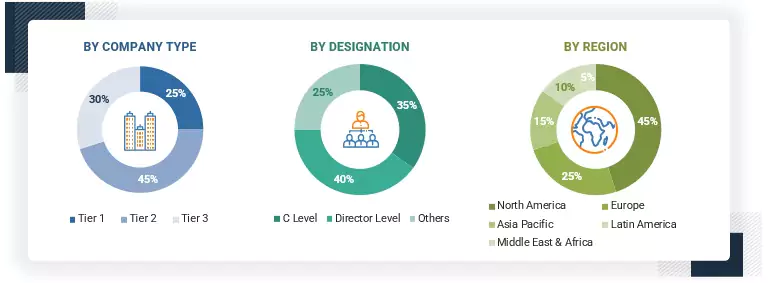
Note 1: Others include sales managers, marketing managers, and product managers.
Note 2: Tier 1 companies’ revenues are more than USD 10 billion; tier 2 companies’ revenues range between USD 1 and 10 billion; and tier 3 companies’ revenues range between USD 500 million and USD 1 billion.
Source: Industry Experts
To know about the assumptions considered for the study, download the pdf brochure
Market Size Estimation
Multiple approaches were adopted for estimating and forecasting the web content management market. The first approach involves estimating the market size by companies’ revenue generated through the sale of WCM products.
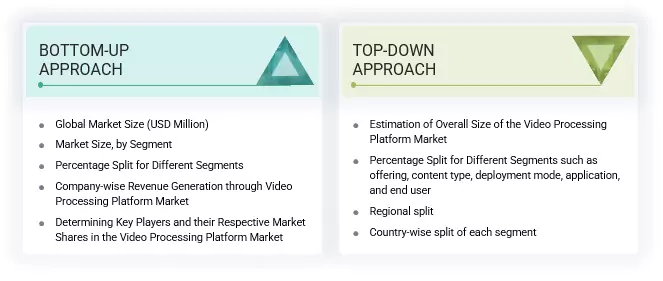
Market Size Estimation Methodology- Top-down approach
In the top-down approach, an exhaustive list of all the vendors offering products in the WCM market was prepared. The revenue contribution of the market vendors was estimated through annual reports, press releases, funding, investor presentations, paid databases, and primary interviews. Each vendor's offerings were evaluated based on the breadth of product type, deployment mode, architecture, and end user. The aggregate of all the companies’ revenue was extrapolated to reach the overall market size. Each subsegment was studied and analyzed for its global market size and regional penetration. The markets were triangulated through both primary and secondary research. The primary procedure included extensive interviews for key insights from industry leaders, such as CIOs, CEOs, VPs, directors, and marketing executives. The market numbers were further triangulated with the existing MarketsandMarkets’ repository for validation.
Market Size Estimation Methodology-Bottom-up approach
In the bottom-up approach, the adoption rate of web content management products among different verticals in key countries with respect to their regions contributing the most to the market share was identified. For cross-validation, the adoption of WCM products among enterprises, along with different use cases with respect to their regions, was identified and extrapolated. Weightage was given to use cases identified in different regions for the market size calculation.
Based on the market numbers, the regional split was determined by primary and secondary sources. The procedure included the analysis of the WCM market’s regional penetration. Based on secondary research, the regional spending on Information and Communications Technology (ICT), socio-economic analysis of each country, strategic vendor analysis of major web content management providers, and organic and inorganic business development activities of regional and global players were estimated. With the data triangulation procedure and data validation through primaries, the exact values of the overall web content management market size and segments’ size were determined and confirmed using the study.
Video Processing Platform Market : Top-Down and Bottom-Up Approach
Data Triangulation
After arriving at the overall market size using the market size estimation processes as explained above, the market was split into several segments and subsegments. To complete the overall market engineering process and arrive at the exact statistics of each market segment and subsegment, data triangulation and market breakup procedures were employed, wherever applicable. The overall market size was then used in the top-down procedure to estimate the size of other individual markets via percentage splits of the market segmentation.
Market Definition
According to OpenText, WCM is a software application that enables enterprises to easily manage and publish digital content. WCM systems include various capabilities, including site design, content authoring, editing, and personalization. A robust WCM would enable organizations to manage multiple websites, support more than one language, as well as deliver omnichannel customer experiences.
According to Sitecore, WCM is a software application that allows users to collaborate in the creation, editing, and production of digital content: web pages and blog posts to manage the overall digital experience. WCM helps users upload or write content, format it, add headlines and images, and perform a number of backstage tasks such as Search Engine Optimization (SEO).
Stakeholders
- WCM product and service providers
- Independent Software Vendors (ISVs)
- Investors and Venture Capitalists (VCs)
- Managed service providers
- Support and maintenance service providers
- System Integrators (SIs)/migration service providers
- Value-Added Resellers (VARs) and distributors
Report Objectives
- To define, describe, and predict the Video Processing Platform Market, by product type, deployment mode, architecture, end user and region.
- To describe and forecast the Video Processing Platform Market, in terms of value, by region—North America, Europe, Asia Pacific, Middle East & Africa and Latin America
- To provide detailed information regarding major factors influencing the market growth (drivers, restraints, opportunities, and challenges)
- To strategically analyze micromarkets1 with respect to individual growth trends, prospects, and contribution to the overall Video Processing Platform Market.
- To profile key players and comprehensively analyze their market positions in terms of ranking and core competencies2, along with detailing the competitive landscape for market leaders.
- To analyze competitive developments such as joint ventures, mergers and acquisitions, product developments, and ongoing research and development (R&D) in the Video Processing Platform Market.
- To provide the illustrative segmentation, analysis, and projection of the main regional markets.
Available Customizations
With the given market data, MarketsandMarkets offers customizations as per the company’s specific needs. The following customization options are available for the report:
Product Analysis
- The product matrix provides a detailed comparison of the product portfolio of each company.
Geographic Analysis as per Feasibility
- Further breakup of the North American Video Processing Platform Market
- Further breakup of the European Market
- Further breakup of the Asia Pacific Market
- Further breakup of the Middle East & Africa Market
- Further breakup of the Latin American Video Processing Platform Market
Company Information
- Detailed analysis and profiling of additional market players (up to five)
Get the Full Video Processing Platform Market Report
Full forecast, segment splits, and company analysis for all Video Processing Platform Market.
- Canada Video Processing Platform Market
- US Video Processing Platform Market
- UK Video Processing Platform Market
- Germany Video Processing Platform Market
- France Video Processing Platform Market
- Italy Video Processing Platform Market
- Spain Video Processing Platform Market
- China Video Processing Platform Market
- Japan Video Processing Platform Market
- India Video Processing Platform Market
- Saudi Arabia Video Processing Platform Market
- UAE Video Processing Platform Market
- Qatar Video Processing Platform Market
- Turkey Video Processing Platform Market
- Brazil Video Processing Platform Market
- Mexico Video Processing Platform Market
- Argentina Video Processing Platform Market
- Rest Of Europe Video Processing Platform Market
- Asean Video Processing Platform Market
- Rest Of Asia Pacific Video Processing Platform Market
- Indonesia Video Processing Platform Market
- Malaysia Video Processing Platform Market
- Rest Of Asean Video Processing Platform Market
- Singapore Video Processing Platform Market
- Rest Of Middle East Video Processing Platform Market
Need a Tailored Report?
Customize this report to your needs
Get 10% FREE Customization
Customize This Report
