
US Virtual Power Plant Market (2024-2029)

The US Virtual Power Plant Market was valued at $896.25 Million in 2024 and projected to reach to $1953.57 Million by 2029, representing a compound annual growth rate of 16.9%. The US Virtual Power Plant Market is poised for significant expansion through 2029, driven by accelerating grid modernization efforts and increasing penetration of distributed energy resources.


| Market Size in | USD 26.32 MN |
| Market Forecast in | |
| CAGR | |
| Forecast Period | |
| Units Considered | Value (USD MN) |
US Virtual Power Plant Market Trends and Insights
- The US market is driven by increasing grid modernization initiatives, rising adoption of distributed energy resources, and regulatory support for renewable energy integration.
- In the US, utilities and aggregators are leveraging advanced software platforms to optimize energy distribution and enhance grid stability across diverse geographic regions. The US Virtual Power Plant sector is benefiting from declining battery storage costs, growing consumer demand for energy independence, and federal incentives supporting clean energy deployment.
- By 2029, the US is expected to see significant penetration of VPP technologies across residential, commercial, and industrial segments.
- The US market's 16.9% CAGR reflects strong momentum in demand response programs, microgrid development, and the integration of electric vehicles into distributed energy networks..
Key Market Statistics
- CAGR (2024-2029) 16.9% CAGR
- Market Size, 2024 ~USD 896.25 Million
- Forecast, 2029 ~USD 1953.57 Million
- Country US
US Virtual Power Plant Market Overview
Market Valuation Growth :
The US Virtual Power Plant Market is valued at $896.25 million in 2024 and is projected to reach $1,953.57 million by 2029, representing a robust CAGR of 16.9% over the forecast period.
Grid Modernization Drivers :
US utilities are investing heavily in grid modernization initiatives to enhance reliability and efficiency. VPP technology enables real-time management of distributed energy resources across the nation's aging infrastructure.
Regulatory Support & Incentives :
Federal and state-level policies, including the Inflation Reduction Act and renewable portfolio standards, are accelerating VPP adoption across US markets, creating favorable conditions for market expansion.
Distributed Energy Resource Integration :
Rising adoption of rooftop solar, battery storage, and EV charging stations in the US is driving demand for VPP solutions that aggregate and optimize these decentralized resources for grid stability.
US Virtual Power Plant Market Dynamics
- Utilities and energy aggregators are deploying advanced software platforms to coordinate renewable generation, battery storage, and demand response programs, enhancing grid resilience while reducing operational costs.
- State-level renewable energy mandates and federal incentives are creating a favorable regulatory environment for VPP investments.
- The market will benefit from growing consumer adoption of rooftop solar and home battery systems, coupled with the electrification of transportation.
- As grid operators seek flexible, scalable solutions to manage peak demand and integrate variable renewable sources, VPP technology will become increasingly critical to US energy infrastructure modernization..
Market Ecosystem
Related Ecosystem
Decarbonization
- Battery Electric Vehicle (BEV)
- Energy Management Systems
- Fuel Cell
- Fuel Cell Electric Vehicle (FCEV)
- Geographical Information System (GIS)
- TotalEnergies SE
- Siemens ag
- Mitsui & Co., Ltd.
- General Electric Company
- Thyssenkrupp ag
Power Infrastructure
- Geographical Information System (GIS)
- Cogeneration
- Battery Electric Vehicle (BEV)
- Cellular Network
- Fuel Cell
- ABB India Limited
- Siemens ag
- SCHNEIDER ELECTRIC SE
- General Electric Company
- Eaton Corporation plc
Smart Energy And Digital Solutions
- Cellular Network
- Analytics Software
- Geographical Information System (GIS)
- Meter Data Management (MDM)
- Smart Meters
- Siemens ag
- SCHNEIDER ELECTRIC SE
- ABB India Limited
- General Electric Company
- Eaton Corporation plc
Key Takeaways
- The US Virtual Power Plant Market is valued at $896.25 million in 2024 and will reach $1,953.57 million by 2029, representing a 16.9% CAGR.
- The US market is driven by grid modernization, renewable energy integration, and declining battery storage costs.
- Federal incentives and demand response programs are accelerating VPP adoption across the US residential, commercial, and industrial sectors.
- The US is experiencing strong growth in microgrid development and electric vehicle integration into distributed energy networks.
Virtual Power Plant Market Report Scope
| Report Metric | Details |
|---|---|
| Base Year | 2024 |
| Fastest Growing Segment | MIXED ASSET (Technology) |
| Forecast Period | 2024-2029 |
| Growth Rate | CAGR of 23.4% from 2024 to 2029 |
| Largest Segment | RENEWABLE ENERGY (Source) |
| Market Size Base Year (Billions) | ~USD 1.92 (2024) |
| Revenue Forecast (Billions) | ~USD 5.5 (2029) |
| Segments Covered | Technology, Vertical, Component, Source, Offering, Vertical 2019-2022 |
US Virtual Power Plant Market Report Segmentation
6 segment dimensions are covered across the global market.
By Technology
- Demand Response
- Mixed Asset
- Supply Side
By Vertical
- Commercial
- Industrial
- Industries
- Residential
By Component
- Hardware
- Services
- Software
By Source
- Cogeneration
- Renewable Energy
- Storage
By Offering
- Hardware
- Services
- Software
By Vertical 2019-2022
- Commercial
- Industrial
- Residential
Target Audience
- Utility Companies & Grid Operators : US utilities need comprehensive market data to understand VPP adoption trends, competitive dynamics, and regulatory requirements for integrating distributed energy resources into their grid operations.
- Energy Technology Vendors : Software and hardware providers require detailed US market insights to identify growth opportunities, assess competitive positioning, and develop targeted solutions for utility and aggregator customers.
- Investment & Private Equity Firms : Investors evaluating opportunities in the US energy sector need accurate market sizing, growth forecasts, and regulatory analysis to assess VPP companies' valuation and return potential.
- Energy Aggregators & Service Providers : Aggregators and demand response providers need US-specific market data to understand customer acquisition opportunities, competitive landscape, and revenue models in the expanding VPP sector.
- Policy Makers & Regulatory Bodies : Government agencies and regulatory commissions require market intelligence on VPP adoption and grid modernization trends to inform energy policy, incentive programs, and infrastructure planning decisions.
Reasons to Buy this Report
- Strategic Market Sizing : Obtain precise valuation data for the US VPP market with detailed CAGR analysis, enabling accurate financial forecasting and investment decision-making for the 2024-2029 period.
- Regulatory Landscape Intelligence : Understand how federal policies like the Inflation Reduction Act and state-level renewable mandates are shaping VPP adoption across different US regions and utility markets.
- Competitive Positioning : Identify key growth drivers specific to the US market, including grid modernization priorities and distributed energy resource trends, to benchmark against competitors and identify market gaps.
- Investment Opportunity Assessment : Evaluate the US VPP market's growth trajectory and revenue potential to support capital allocation decisions, partnership strategies, and market entry planning for energy technology providers.
- Technology Adoption Insights : Gain actionable intelligence on how US utilities and aggregators are leveraging advanced software platforms to optimize distributed resources, informing product development and go-to-market strategies.
Frequently asked questions
What is the current size of the US Virtual Power Plant Market?
The US Virtual Power Plant Market was valued at $896.25 million in 2024 and is projected to grow to $1,953.57 million by 2029.
What is the growth rate of the US Virtual Power Plant Market?
The US Virtual Power Plant Market is expected to grow at a compound annual growth rate (CAGR) of 16.9% from 2024 to 2029.
What are the main drivers of growth in the US Virtual Power Plant Market?
Key drivers in the US include grid modernization initiatives, declining battery storage costs, federal clean energy incentives, demand response programs, and increasing adoption of distributed energy resources and electric vehicles.
Which segments are driving the US Virtual Power Plant Market expansion?
The US market is experiencing growth across residential, commercial, and industrial segments, with particular momentum in microgrid development and demand response programs.
How are regulatory policies impacting the US Virtual Power Plant Market?
Regulatory support for renewable energy integration, federal incentives for clean energy deployment, and state-level demand response mandates are accelerating VPP adoption throughout the US.
RESEARCH METHODOLOGY
The study involved major activities in estimating the current virtual power plant market size. Exhaustive secondary research was done to collect information on the peer and parent markets. The next step was to validate these findings, assumptions, and sizing with industry experts across the value chain through primary research. Both top-down and bottom-up approaches were employed to estimate the complete market size. Thereafter, market breakdown and data triangulation were used to estimate the market size of the segments and subsegments.
Secondary Research
This research study on the virtual power plant (VPP) market involved the use of extensive secondary sources, directories, and databases, such as Hoovers, Bloomberg, Businessweek, Factiva, International Energy Agency, and United States Energy Association, to identify and collect information useful for a technical, market-oriented, and commercial study of the global virtual power plant market. The other secondary sources included annual reports of the companies involved in the market, press releases & investor presentations of companies, white papers, certified publications, articles by recognized authors, manufacturer associations, trade directories, and databases.
Primary Research
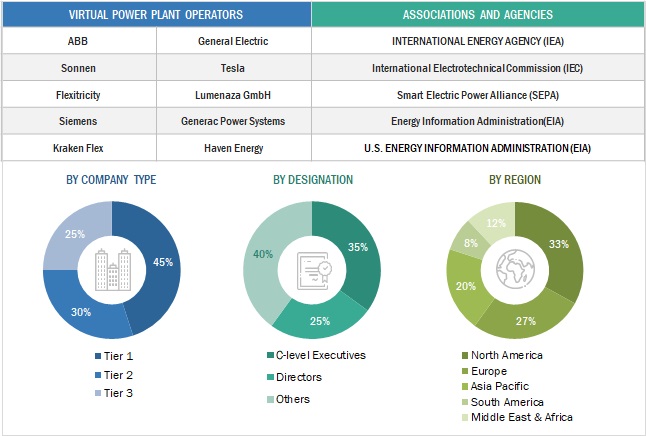
The virtual power plant (VPP) market comprises several stakeholders such as virtual power plant aggregators, manufacturers of subcomponents of virtual power plant, manufacturing technology providers, and technology support providers in the supply chain. The demand side of this market is characterized by the rising demand for energy efficiency. The supply side is characterized by rising demand for contracts from the automotive sector and mergers & acquisitions among big players. Various primary sources from both the supply and demand sides of the market were interviewed to obtain qualitative and quantitative information
Following is the breakdown of primary respondents:
To know about the assumptions considered for the study, download the pdf brochure
Virtual Power Plant Market Size Estimation
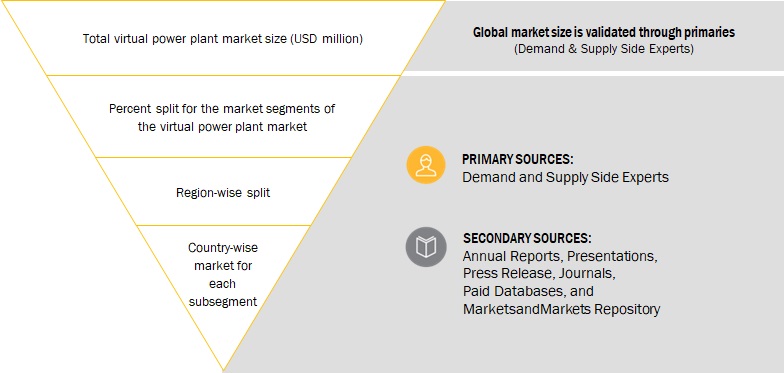
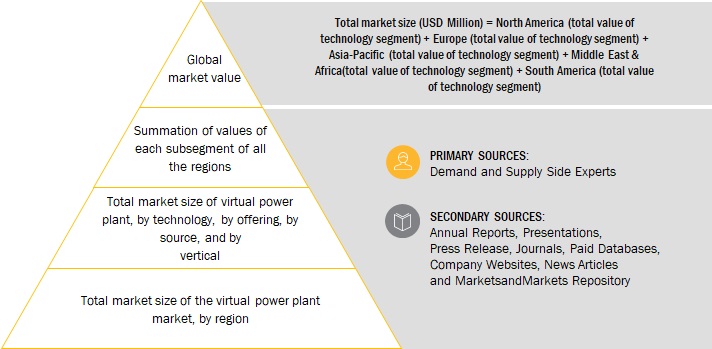
Both top-down and bottom-up approaches were used to estimate and validate the total size of the virtual power plant (VPP) market. These methods were also used extensively to estimate the size of various subsegments in the market. The research methodology used to estimate the market size includes the following:
- The key players in the industry and market have been identified through extensive secondary research, and their market share in the respective regions has been determined through both secondary and primary research.
- The industry’s value chain and market size, in terms of value, have been determined through primary and secondary research processes.
- All percentage shares, splits, and breakdowns have been determined using secondary sources and verified through primaries.
Global Virtual Power Plant Market Size: Top-down Approach
To know about the assumptions considered for the study, Request for Free Sample Report
Global Virtual Power Plant Market Size: Bottom-Up Approach
Data Triangulation
After arriving at the overall market size from the estimation process explained above, the total market has been split into several segments and subsegments. The complete market engineering process is done to arrive at the exact statistics for all the segments and subsegments, also data triangulation and market breakdown processes have been employed, wherever applicable. The data has been triangulated by examining various factors and trends from both the demand- and supply sides. Along with this, the market has been validated through both the top-down and bottom-up approaches.
Market Definition
A virtual power plant (VPP) is a cloud-based distributed power plant that aggregates heterogeneous distributed energy resources (DER) capacities for optimized power generation from existing sources, integration of various renewable energy sources, and, ultimately, trading or selling power in the electricity market. VPPs are networks of small energy-producing or storage devices, like solar panels and batteries, pooled together to serve the electricity grid. With their participants’ approval, their energy can be tapped by utilities during high demand or reserved for later. As a result, the desired power requirement can be met without large-scale power infrastructure upgrades. Virtual power plant solutions can be associated with concepts such as smart grid, microgrid, distributed generation, demand response, and advanced energy storage.
Key Stakeholders
- Public and Private Electric Utilities
- VPP Aggregators
- Distributed Energy Generation Solution Providers
- Virtual Power Plant Component Manufacturers
- Energy & Power Sector Consulting Companies
- Government & Research Organizations
- Independent Power Producers
- Investment Banks
- Electrical Equipment Associations
- Integrated Device Manufacturers (IDMs)
- Process Industries and Power and Energy Associations
- Energy Storage Device/Equipment Manufacturers and Integrators
- Distributed Energy Resource (DER) Owners
Objectives of the Study
- To define, describe, analyze, and forecast the size of the global virtual power plant (VPP) market by technology, vertical, source, offering and region, and in terms of value
- To forecast the market size for five key regions: North America, South America, Europe, Asia Pacific, and Middle East & Africa, along with their key countries
- To provide detailed information about the key drivers, restraints, opportunities, and challenges influencing the growth of the market
- To strategically analyze the subsegments with respect to individual growth trends, prospects, and contributions of each segment to the overall market size
- To analyze market opportunities for stakeholders and the competitive landscape of the market
- To strategically profile the key players and comprehensively analyze their market shares and core competencies
- To analyze competitive developments, such as sales contracts, agreements, investments, expansions, new product launches, mergers, partnerships, collaborations, and acquisitions, in the market
Available Customizations:
With the given market data, MarketsandMarkets offers customizations as per the client’s specific needs. The following customization options are available for this report:
Geographic Analysis
- Further breakdown of region or country-specific analysis
Company Information
- Detailed analyses and profiling of additional market players (up to 5)
Get the Full Virtual Power Plant Market Report
Full forecast, segment splits, and company analysis for all Virtual Power Plant Market.
- Canada Virtual Power Plant Market
- Australia Virtual Power Plant Market
- South Korea Virtual Power Plant Market
- Japan Virtual Power Plant Market
- UK Virtual Power Plant Market
- Germany Virtual Power Plant Market
- France Virtual Power Plant Market
- Denmark Virtual Power Plant Market
- South Africa Virtual Power Plant Market
- Turkey Virtual Power Plant Market
- Brazil Virtual Power Plant Market
- Rest Of Europe Virtual Power Plant Market
- Rest Of Asia Pacific Virtual Power Plant Market
- GCC Countries Virtual Power Plant Market
- Rest Of Middle East And Africa Virtual Power Plant Market
- Rest Of GCC Virtual Power Plant Market
- UAE Virtual Power Plant Market
- Rest Of South America Virtual Power Plant Market
Need a Tailored Report?
Customize this report to your needs
Get 10% FREE Customization
Customize This Report
