
US Warehouse Management System (WMS) Market (2025-2030)

The US Warehouse Management System (WMS) Market was valued at $1113.5 Million in 2025 and projected to reach to $2518 Million by 2030, representing a compound annual growth rate of 17.7%. The US Warehouse Management System market within the semiconductor and electronics sector is poised for sustained expansion through 2030.


| Market Size in | USD 26.32 MN |
| Market Forecast in | |
| CAGR | |
| Forecast Period | |
| Units Considered | Value (USD MN) |
US Warehouse Management System (WMS) Market Trends and Insights
- This 17.7% compound annual growth rate reflects the US market's accelerating adoption of advanced inventory and logistics automation technologies.
- The US semiconductor and electronics industry's increasing complexity, coupled with supply chain pressures and labor shortages, is driving demand for intelligent WMS solutions that optimize warehouse operations and reduce operational costs. Throughout the 2025–2030 forecast period, the US WMS market will benefit from heightened investment in Industry 4.0 technologies, real-time visibility requirements, and the need for rapid order fulfillment in the competitive electronics sector.
- The US market's maturity and technological sophistication position it as a leader in WMS adoption, with enterprises prioritizing cloud-based, AI-enabled platforms to enhance warehouse efficiency.
- As the US semiconductor supply chain continues to localize and expand, WMS solutions will remain critical infrastructure for maintaining competitive advantage and meeting evolving customer expectations..
Key Market Statistics
- CAGR (2025-2030) 17.7% CAGR
- Market Size, 2025 ~USD 1113.5 Million
- Forecast, 2030 ~USD 2518 Million
- Country US
US Warehouse Management System (WMS) Market Overview
Market Valuation Growth :
The US WMS market in semiconductor & electronics is valued at $1,113.5 million in 2025, with projections reaching $2,518.0 million by 2030, representing a 17.7% CAGR—outpacing the global growth rate of 17.1%.
Automation Adoption Surge :
US semiconductor and electronics manufacturers are rapidly deploying advanced WMS solutions to optimize inventory management, reduce operational costs, and enhance supply chain visibility amid increasing production complexity.
Regional Leadership Position :
The US market demonstrates stronger growth momentum than the global average, driven by high technology adoption rates, significant R&D investments, and the presence of major semiconductor and electronics hubs.
Supply Chain Resilience Focus :
Post-pandemic supply chain disruptions have accelerated US companies' investment in intelligent warehouse management systems to build resilience, improve demand forecasting, and maintain competitive advantage.
US Warehouse Management System (WMS) Market Dynamics
- Driven by increasing digitalization initiatives, labor shortages, and the need for real-time inventory optimization, US manufacturers are prioritizing WMS implementations to streamline operations and reduce costs.
- The 17.7% CAGR reflects strong demand from both established semiconductor giants and emerging electronics manufacturers seeking to modernize their logistics infrastructure. Key growth catalysts include the reshoring of semiconductor production, heightened focus on supply chain resilience, and integration of AI and IoT technologies within warehouse operations.
- US companies are increasingly recognizing WMS as critical infrastructure for maintaining competitiveness in global markets.
- Investment in automation and data-driven decision-making will continue to drive market expansion, with particular momentum in advanced analytics, real-time tracking, and predictive inventory management capabilities..
Market Ecosystem
Warehouse Management System (WMS) Market: COMMERCIAL USE CASES ACROSS INDUSTRIES
| COMPANY | USE CASE DESCRIPTION | BENEFITS |
|---|---|---|
 |
A natural foods distributor deployed AI-driven WMS for e-commerce fulfillment centers to handle high order volumes and real-time inventory updates | Faster order processing, reduced errors, improved customer satisfaction, and enhanced scalability for peak demand |
 |
Automation-led WMS integrated with robotics for automotive spare parts and assembly line supply management | Streamlined parts tracking, reduced downtime, improved production efficiency, and cost savings in automotive supply chains |
 |
WMS adoption for food & beverage distribution, ensuring product freshness, compliance, and cold storage management | Enhanced traceability, reduced food waste, regulatory compliance, and improved efficiency in temperature-sensitive logistics |
 |
Cloud-based WMS for healthcare logistics to track pharmaceutical inventories across global warehouses | Increased supply chain visibility, compliance with drug safety standards, reduced counterfeit risks, and improved patient safety |
 |
Implementation of advanced WMS integrated with IoT and automation for 3PL services across industries | Optimized logistics, reduced operational costs, real-time tracking, and flexible solutions for multi-client warehouse management |
Logos and trademarks shown above are the property of their respective owners. Their use here is for informational and illustrative purposes only.
Related Ecosystem
Logistics And Transportation
- Internal Combustion Engine (ICE)
- Crawler Excavator
- Fuel Cell
- Light Commercial Vehicles (LCVs)
- Sensors
- Siemens ag
- Alstom s.a.
- Hitachi, Ltd.
- Godrej Industries Limited
- ABB India Limited
Industrial Automation
- Sensors
- Image Sensors
- Manufacturing Execution System (MES)
- Actuators
- Flow Sensors
- Siemens ag
- ABB India Limited
- Emerson Electric Co.
- HONEYWELL INTERNATIONAL INC.
- SCHNEIDER ELECTRIC SE
Industrial Iot
- Sensors
- Pressure Sensors
- Flow Sensors
- Gas Sensors
- Image Sensors
- Siemens ag
- ABB India Limited
- HONEYWELL INTERNATIONAL INC.
- Emerson Electric Co.
- SCHNEIDER ELECTRIC SE
Key Takeaways
- The US WMS market will more than double from $1,113.5M (2025) to $2,518.0M (2030), driven by semiconductor and electronics sector digitalization.
- The US market's 17.7% CAGR outpaces the global average of 17.1%, reflecting stronger regional demand for automation and supply chain optimization.
- US enterprises are increasingly adopting cloud-based and AI-enabled WMS platforms to address labor shortages and enhance real-time inventory visibility.
- The US semiconductor supply chain localization trend will accelerate WMS investment as domestic manufacturing capacity expands through 2030.
Warehouse Management System (WMS) Market Report Scope
| Report Metric | Details |
|---|---|
| Base Year | 2025 |
| Fastest Growing Segment | CLOUD-BASED (Deployment Mode) |
| Forecast Period | 2025–2030 |
| Growth Rate | CAGR of 17.1% from 2025 to 2030 |
| Largest Segment | SOFTWARE (Offering) |
| Market Size Base Year (Billions) | ~USD 4.56 (2025) |
| Revenue Forecast (Billions) | ~USD 10.04 (2030) |
| Segments Covered | Offering, End Use, Deployment Mode, Tier, Application |
US Warehouse Management System (WMS) Market Report Segmentation
5 segment dimensions are covered across the global market.
By Offering
- Services
- Software
By End Use
- 3Pl
- Automotive
- Chemicals
- E-Commerce
- Electricals & Electronics
- Food & Beverages
- Healthcare
- Metals & Machinery
- Other End Uses
By Deployment Mode
- Cloud-Based
- On-Premises
By Tier
- Advanced (Tier 1)
- Basic (Tier 3)
- Intermediate (Tier 2)
By Application
- Asset & Inventory Tracking
- Order Fulfillment & Distribution
- Other Applications
- Supply Chain & Logistics Optimization
- Workforce/Labor Management
- Yard & Dock Management
Target Audience
- WMS Software Vendors : Vendors need US market data to refine product offerings, identify high-potential customer segments within semiconductor and electronics, and develop targeted sales strategies for the 17.7% growth opportunity.
- Semiconductor Manufacturers : US semiconductor producers require market insights to benchmark WMS investments, evaluate solution providers, and understand industry best practices for optimizing warehouse operations and supply chain efficiency.
- Electronics OEMs & Contract Manufacturers : Electronics manufacturers need detailed US market analysis to justify WMS capital expenditures, assess competitive positioning, and identify technology innovations that enhance operational performance.
- Supply Chain & Logistics Consultants : Consultants advising US semiconductor and electronics clients require market data to support recommendations, validate business cases, and demonstrate ROI potential for WMS implementations.
- Private Equity & Investment Firms : Investors evaluating opportunities in logistics technology and semiconductor supply chain solutions need US market forecasts and growth drivers to assess portfolio company potential and exit opportunities.
Key Companies in the US Warehouse Management System (WMS) Market
| Company | HQ | Ownership | Strongest segments |
|---|---|---|---|
| SWISSLOG HOLDING AG | Switzerland | Private Company | WMS Software – Advanced Tier (automation-centric, supply chain optimization),WMS Software – Intermediate Tier,WMS Software – Basic Tier, |
| EBAY INC. | United States | Public Company | Software-linked marketplace and data services,Logistics and fulfillment-adjacent services,Value-added seller services and advertising, |
| AMAZON | United States | Public Company | Software – Cloud WMS and orchestration,Software – On-premises and hybrid components,Services – Implementation and integration, |
| TIETO CORPORATION | Finland | Public Company | Software – WMS and adjacent Indtech modules,Services – Consulting, integration, managed operations, |
| JUNGHEINRICH AG | Germany | Public Company | WMS Software (core, advanced-tier, on-prem and cloud),Implementation & Integration Services,Managed Services & Support, |
| GODREJ GROUP | India | Private Company | WMS Software,WMS Implementation & Integration Services,Managed & Support Services, |
| TECHNICOLOR SA | France | Public Company | Software (WMS-adjacent connectivity, device and logistics orchestration),Services (professional, integration, logistics, post-sale), |
| DHC SOFTWARE CO., LTD. | United States | Public Company | Software (Industry 4.0, logistics, enterprise and public security platforms with WMS modules),Services (system integration, customization, managed operations around logistics and inventory), |
| PROXIMUS GROUP | Belgium | Public Company | Software (WMS and data platforms),Services (consulting, integration, managed), |
| ELECTROCOMPONENTS | United Kingdom | Public Company | Software (Digital procurement, inventory solutions, DesignSpark-linked tools),Services (Bundling, kitting, labelling, assembly, integrated supply chain),Automation and control hardware linked to WMS, |
| ENDRESS + HAUSER AG | Switzerland | Private Company | Software,Services,On-premises, |
| MANHATTAN ASSOCIATES | United States | Public Company | WMS Software (Manhattan Active WM, legacy WMS, Manhattan SCALE WMS components),Professional Services (implementation, consulting, change management),Maintenance & Support for On-premises WMS, |
| KöRBER AG | Germany | Private Company | Software – Advanced-tier WMS (on-premises and cloud),Software – Intermediate and Basic-tier WMS,Services – Implementation and Systems Integration, |
| ORACLE | United States | Public Company | Software – Cloud WMS (Fusion SCM, NetSuite),Software – On-premise WMS and licenses,Services – Implementation & Consulting, |
| SAP SE | Germany | Public Company | WMS Software (embedded in SAP S/4HANA and related suites),WMS Services (implementation, integration, optimization), |
| INFOR | United States | Private Company | WMS-related Software (data integration, MDM, analytics for WMS),WMS-related Services (professional & maintenance), |
SWISSLOG HOLDING AG
Swisslog Holding AG is a Swiss private company founded in 1900 with 2,372 employees. The company operates as an established industrial enterprise with over a century of operational history.
EBAY INC.
eBay Inc. is a publicly traded United States company founded in 1995 with 12,300 employees. The company operates as a major e-commerce and online marketplace platform.
AMAZON
Amazon is a publicly traded United States company founded in 1994 with 1,576,000 employees. The company is one of the world's largest e-commerce and cloud computing enterprises.
TIETO CORPORATION
Tieto Corporation is a publicly traded Finnish company founded in 1968 with 13,476 employees. The company operates as an established technology and IT services provider.
JUNGHEINRICH AG
Jungheinrich AG is a publicly traded German company founded in 1953 with 21,438 employees. The company is a major industrial enterprise with significant workforce operations.
GODREJ GROUP
Godrej Group is a private Indian company founded in 1897 with 13,316 employees. The company is an established conglomerate with over a century of business history.
TECHNICOLOR SA
Technicolor SA is a publicly traded French company founded in 1985 with 1,552 employees. The company operates in the media and entertainment technology sector.
DHC SOFTWARE CO., LTD.
DHC Software Co., Ltd. is a publicly traded United States company founded in 2001 with 10,757 employees. The company operates as a significant software and technology services provider.
PROXIMUS GROUP
Proximus Group is a publicly traded Belgian company founded in 1930 with 12,790 employees. The company operates as an established telecommunications and services provider.
ELECTROCOMPONENTS
Electrocomponents is a publicly traded United Kingdom company founded in 1937 with 8,500 employees. The company operates as a long-established industrial and electronics distributor.
ENDRESS + HAUSER AG
Endress + Hauser AG is a Swiss private company founded in 1953 with 17,046 employees. The company operates as a major industrial automation and instrumentation manufacturer.
MANHATTAN ASSOCIATES
Manhattan Associates is a publicly traded United States company founded in 1990 with 4,390 employees. The company operates as a software and supply chain solutions provider.
KöRBER AG
Körber AG is a German private company founded in 1946 with 10,665 employees. The company operates as a major industrial conglomerate with diverse business operations.
ORACLE
Oracle is a publicly traded United States company founded in 1977 with 141,000 employees. The company is a global leader in database software and enterprise technology solutions.
SAP SE
SAP SE is a publicly traded German company founded in 1972 with 111,038 employees. The company is a major provider of enterprise resource planning and business software solutions.
INFOR
Infor is a United States-based private company founded in 1993 with 5,200 employees. The company operates as a significant enterprise software and cloud solutions provider.
Reasons to Buy this Report
- Competitive Market Intelligence : Gain detailed insights into the US WMS market dynamics specific to semiconductor and electronics, enabling informed strategic decisions and competitive positioning in a high-growth sector.
- Growth Opportunity Identification : Identify emerging segments and customer needs within the US market growing at 17.7% CAGR, allowing businesses to capitalize on expansion opportunities before market saturation.
- Investment & Funding Decisions : Access comprehensive market sizing and forecasts ($1.1B to $2.5B by 2030) to support investment decisions, business case development, and resource allocation for US operations.
- Technology Adoption Roadmap : Understand US-specific adoption trends, implementation drivers, and technology preferences among semiconductor and electronics manufacturers to align product development and go-to-market strategies.
- Risk Mitigation & Planning : Leverage US market analysis to anticipate supply chain challenges, regulatory changes, and competitive threats specific to the American semiconductor and electronics landscape.
Frequently asked questions
What is the current size of the US WMS market in 2025?
The US Warehouse Management System market is valued at $1,113.5 million in 2025, representing significant investment in warehouse automation and logistics optimization within the semiconductor and electronics sector.
What is the projected US WMS market size by 2030?
The US WMS market is forecast to reach $2,518.0 million by 2030, representing more than a doubling of market value over the five-year forecast period.
What is the CAGR for the US WMS market?
The US WMS market is expected to grow at a compound annual growth rate of 17.7% from 2025 to 2030, outpacing the global CAGR of 17.1%.
What factors are driving growth in the US WMS market?
Key drivers include semiconductor supply chain localization, labor shortages, demand for real-time inventory visibility, Industry 4.0 adoption, and the need for rapid order fulfillment in competitive electronics markets.
Why is the US WMS market growing faster than the global average?
The US market benefits from advanced technological infrastructure, higher automation investment, domestic semiconductor manufacturing expansion, and greater enterprise focus on supply chain resilience and efficiency.
RESEARCH METHODOLOGY
The study involved four major activities in estimating the current size of the warehouse management system market. Exhaustive secondary research was conducted to gather information on the market, adjacent markets, and the overall warehouse management system landscape. These findings, along with assumptions and projections, were validated through primary research involving interviews with industry experts and key stakeholders across the value chain. Both top-down and bottom-up approaches were utilized to estimate the overall market size. Subsequently, market breakdown and data triangulation techniques were applied to determine the sizes of various segments and subsegments. Two key sources, secondary and primary, were leveraged to conduct a comprehensive technical and commercial assessment of the warehouse management system market.
Secondary Research
The secondary research process referred to various secondary sources to identify and collect necessary information for this study. The secondary sources included annual reports, press releases, and investor presentations of companies; white papers; journals and certified publications; and articles from recognized authors, websites, directories, and databases. Secondary research was conducted to obtain key information about the industry’s supply chain, the market’s value chain, the total pool of key players, market segmentation according to the industry trends (to the bottom-most level), regional markets, and key developments from market- and technology-oriented perspectives. The secondary data was collected and analyzed to determine the overall market size, which is further validated through primary research.
Primary Research
Extensive primary research was conducted after gaining knowledge about the current scenario of the warehouse management system market through secondary research. Several primary interviews were conducted with experts from the demand and supply sides across four major regions—North America, Europe, Asia Pacific, and RoW. This primary data was collected through questionnaires, emails, and telephonic interviews.
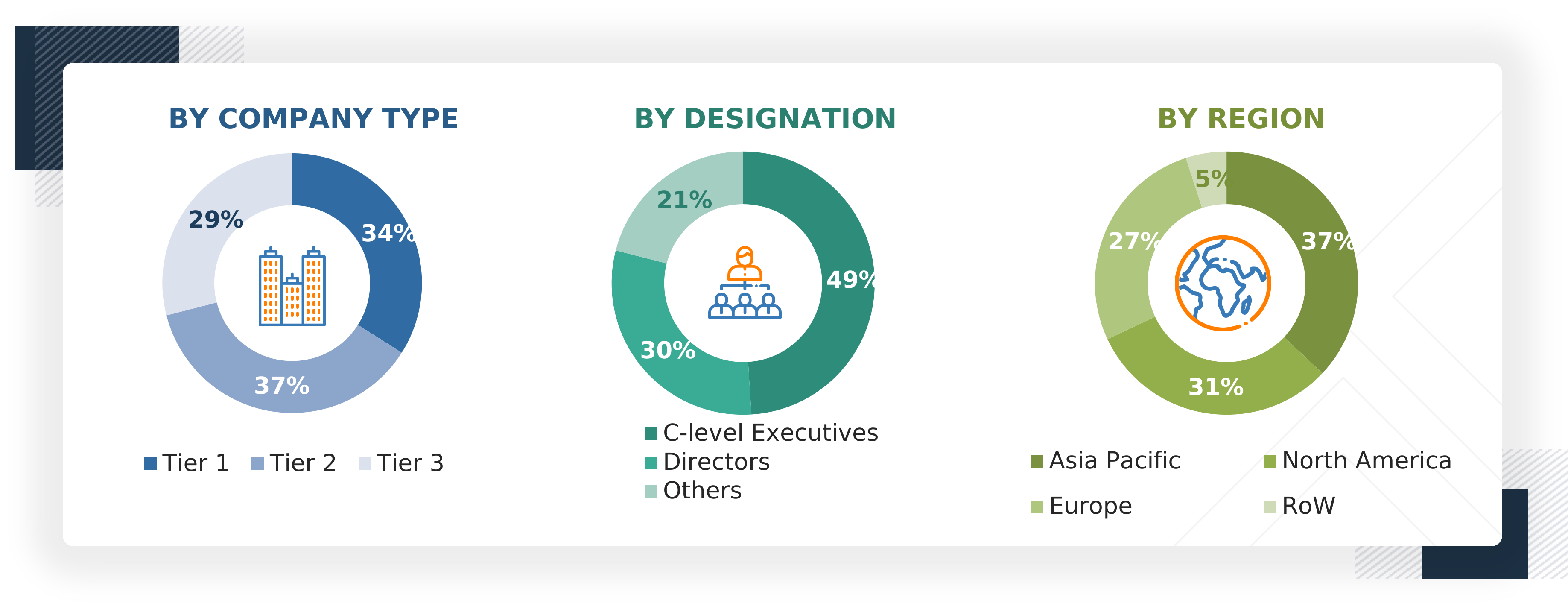
Notes: Three tiers of companies have been defined based on their total revenue as of 2024; Tier 1: >USD 1 billion, Tier 2: USD 250 million–USD 1 billion, and Tier 3: USD 250 million. Other designations include sales managers, marketing managers, and product managers.
To know about the assumptions considered for the study, download the pdf brochure
Market Size Estimation
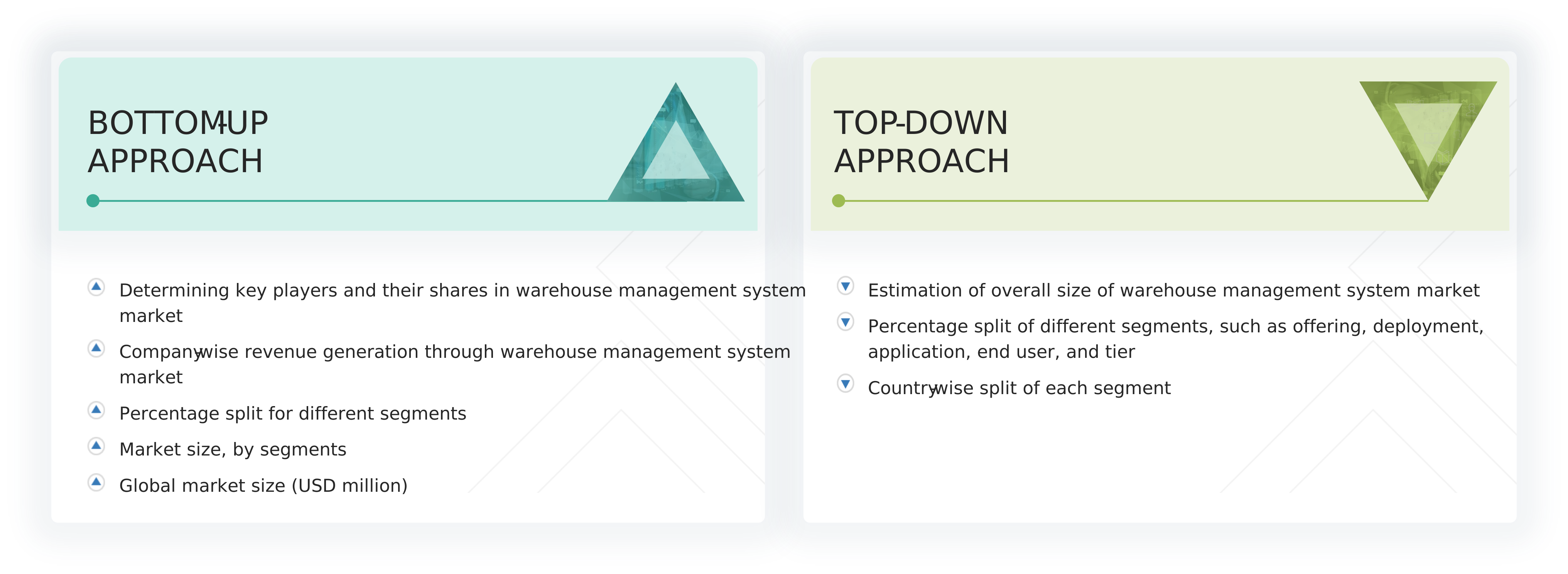
Both top-down and bottom-up approaches were used to estimate and validate the total size of the warehouse management system market. These methods have also been used extensively to estimate the size of various subsegments in the market. The following research methodology was used to estimate the market size:
- Major players in the markets were identified through extensive secondary research.
- The industry’s value chain and market size (in terms of value) were determined through primary and secondary research processes.
- All percentage shares, splits, and breakdowns were determined using secondary sources and verified through primary sources.
Warehouse Management System (WMS) Market: Top-Down and Bottom-Up Approach
Data Triangulation
After arriving at the overall size of the warehouse management system market using the market size estimation process explained above, the total market was split into several segments and subsegments. Data triangulation and market breakdown procedures were employed, wherever applicable, to complete the overall market engineering process and arrive at the exact statistics for all segments and subsegments of the market. The data was triangulated by studying various factors and trends from both the demand and supply sides. The market size was also validated using both the top-down and bottom-up approaches.
Market Definition
A warehouse management system (WMS) is a software application that helps manage warehouse operations most efficiently and productively. Functions of these systems include inventory control, labor management, yard management, and dock management, among others. A WMS can be deployed on-premises or can be accessed through cloud servers maintained by WMS vendors.
Key Stakeholders
- Associations, forums, and alliances related to warehouse management systems
- End users from industries such as 3PL, e-commerce, automotive, chemicals, food & beverages, metals & machinery, and electricals & electronics
- Manufacturers of material handling systems, such as robots, AGVs, ASRS, cranes, and conveyors & sortation systems
- Research organizations and consulting companies
- System integrators
- Venture capitalists and private equity firms
- Warehouse management system software designers and developers
- Warehouse management system service providers
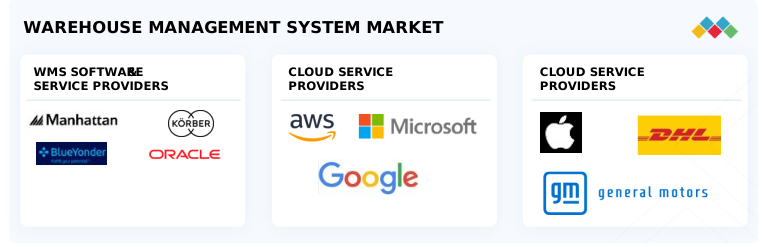
- Cloud service providers
- Market research and consulting firms
Report Objectives
- To define, describe, and forecast the warehouse management system market, in terms of offering, deployment, tier, application, end user, and region, in terms of value
- To describe and forecast the market, in terms of value, with regard to four main regions: North America, Europe, Asia Pacific, and Rest of the World (RoW), along with their respective countries
- To provide detailed information regarding major factors such as drivers, restraints, opportunities, and challenges influencing the market growth
- To provide a detailed overview of the warehouse management system value chain
- To strategically analyze micromarkets with respect to individual growth trends, prospects, and contributions to the warehouse management system market
- To analyze opportunities in the market for stakeholders by identifying high-growth segments of the warehouse management system market
- To strategically profile key players and comprehensively analyze their market position in terms of ranking and core competencies, along with detailing the competitive landscape for market leaders
- To analyze competitive strategies, such as product launches, expansions, and mergers & acquisitions, adopted by key players in the warehouse management system market
Available Customizations
With the given market data, MarketsandMarkets offers customizations according to the company’s specific needs. The following customization options are available for the report:
Company Information:
- Detailed analysis and profiling of additional market players (up to 5)
Get the Full Warehouse Management System (WMS) Market Report
Full forecast, segment splits, and company analysis for all Warehouse Management System (WMS) Market.
- Canada Warehouse Management System (WMS) Market
- Mexico Warehouse Management System (WMS) Market
- Germany Warehouse Management System (WMS) Market
- UK Warehouse Management System (WMS) Market
- France Warehouse Management System (WMS) Market
- Italy Warehouse Management System (WMS) Market
- Spain Warehouse Management System (WMS) Market
- China Warehouse Management System (WMS) Market
- Japan Warehouse Management System (WMS) Market
- India Warehouse Management System (WMS) Market
- South Korea Warehouse Management System (WMS) Market
- Australia Warehouse Management System (WMS) Market
- Nordics Warehouse Management System (WMS) Market
- Rest Of Europe Warehouse Management System (WMS) Market
- Rest Of Asia Pacific Warehouse Management System (WMS) Market
- Argentina Warehouse Management System (WMS) Market
- Brazil Warehouse Management System (WMS) Market
- Rest Of South America Warehouse Management System (WMS) Market
- Bahrain Warehouse Management System (WMS) Market
- Kuwait Warehouse Management System (WMS) Market
- Oman Warehouse Management System (WMS) Market
- Qatar Warehouse Management System (WMS) Market
- Rest Of Middle East Warehouse Management System (WMS) Market
- Saudi Arabia Warehouse Management System (WMS) Market
- UAE Warehouse Management System (WMS) Market
- Rest Of Africa Warehouse Management System (WMS) Market
- South Africa Warehouse Management System (WMS) Market
Need a Tailored Report?
Customize this report to your needs
Get 10% FREE Customization
Customize This Report
