
GCC Countries Water Treatment Chemicals Market (2025-2030)

The GCC Countries Water Treatment Chemicals Market was valued at $1743.2 Million in 2025 and projected to reach to $2264.9 Million by 2030, representing a compound annual growth rate of 5.4%. The GCC Countries water treatment chemicals market is positioned for sustained growth through 2030, driven by the region's critical water scarcity challenges and aggressive desalination infrastructure expansion.


| Market Size in | USD 26.32 MN |
| Market Forecast in | |
| CAGR | |
| Forecast Period | |
| Units Considered | Value (USD MN) |
GCC Countries Water Treatment Chemicals Market Trends and Insights
- GCC Countries' market is expanding at a compound annual growth rate (CAGR) of 5.4%, outpacing the global average of 4.5%, driven by rapid industrialization, population growth, and stringent water quality regulations across the region.
- The demand for advanced water treatment solutions in GCC Countries reflects the region's critical need to address water scarcity and support desalination infrastructure development. GCC Countries' water treatment chemicals sector is characterized by increasing investments in municipal water systems and industrial applications, particularly in oil and gas, petrochemicals, and power generation sectors.
- Between 2025 and 2030, GCC Countries will witness heightened adoption of specialty chemicals for membrane treatment, corrosion control, and disinfection processes.
- The market dynamics in GCC Countries are shaped by regional water stress, climate conditions, and the necessity for sustainable water management practices that align with Vision 2030 initiatives across member states..
Key Market Statistics
- CAGR (2025-2030) 5.4% CAGR
- Market Size, 2025 ~USD 1743.2 Million
- Forecast, 2030 ~USD 2264.9 Million
- Country GCC Countries
GCC Countries Water Treatment Chemicals Market Overview
Market Valuation Growth :
GCC Countries' water treatment chemicals market is valued at USD 1,743.2 million in 2025, with projections reaching USD 2,264.9 million by 2030, representing a robust expansion trajectory in the region.
Outpacing Global Growth :
The GCC market expands at 5.4% CAGR, significantly exceeding the global average of 4.5%, driven by region-specific factors including rapid industrialization and stringent regulatory frameworks.
Regulatory & Industrial Drivers :
Stringent water quality regulations across GCC Countries, combined with rapid industrialization and population growth, are creating sustained demand for advanced water treatment chemical solutions.
Regional Market Opportunity :
GCC Countries represent a high-growth market segment with unique characteristics including water scarcity challenges, desalination expansion, and increasing industrial water recycling requirements.
GCC Countries Water Treatment Chemicals Market Dynamics
- Rapid industrialization across key sectors including oil & gas, petrochemicals, and manufacturing is intensifying demand for specialized treatment chemicals.
- Stringent environmental regulations and water quality standards are compelling industries to adopt advanced treatment solutions, creating consistent market opportunities. Government initiatives promoting water sustainability and circular economy practices are further accelerating chemical adoption across municipal and industrial applications.
- The region's strategic focus on reducing freshwater dependency through desalination and wastewater recycling ensures long-term market resilience.
- Investment in smart water management technologies and treatment efficiency improvements will continue supporting market expansion beyond 2030..
Market Ecosystem
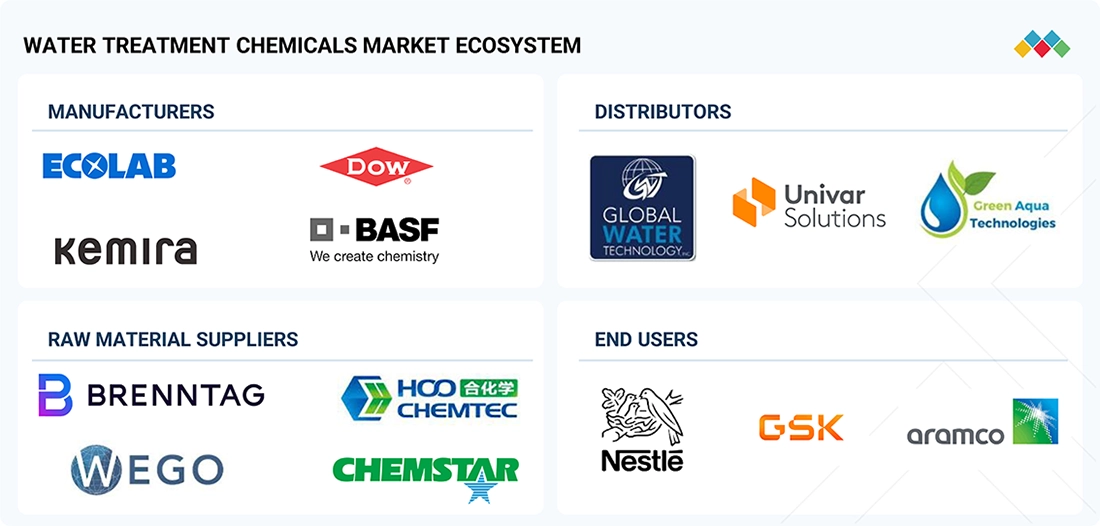
WATER TREATMENT CHEMICALS MARKET: COMMERCIAL USE CASES ACROSS INDUSTRIES
| COMPANY | USE CASE DESCRIPTION | BENEFITS |
|---|---|---|
 |
Uses coagulants, disinfectants, corrosion and scale inhibitors in on-site water and wastewater treatment for food processing plants and water reuse systems | Ensures consistent food-grade water quality, supports water reuse targets, protects processing equipment, reduces downtime, and enables compliance with strict food safety and environmental regulations |
 |
Applies high-purity water treatment chemicals for boiler feed water, cooling systems, and wastewater treatment in pharmaceutical manufacturing facilities | Maintains pharmacopeia-compliant water quality, prevents contamination risks, improves equipment reliability, and supports validated, regulated production processes |
 |
Utilizes cooling water treatment chemicals, corrosion inhibitors, biocides, and desalination pretreatment chemicals across refineries, upstream facilities, power plants, and seawater desalination units | Ensures operational reliability under high-salinity and high-temperature conditions, minimizes corrosion and fouling risks, supports large-scale water reuse and desalination, and ensures compliance with stringent environmental discharge standards |
Logos and trademarks shown above are the property of their respective owners. Their use here is for informational and illustrative purposes only.
Related Ecosystem
Speciality Chemicals
- Corrosion Inhibitors
- Polyetheretherketone (PEEK)
- Acrylonitrile Butadiene Styrene (ABS)
- Epoxy Resin
- Polycarbonate
- Basf se
- DOW CHEMICAL COMPANY
- Evonik industries ag
- Clariant ag.
- Solvay sa
Water Purification
- Corrosion Inhibitors
- Cartridge Filters
- Fiberglass
- Reverse Osmosis
- Acetone
- Veolia
- SOLENIS
- Kemira oyj
- CALGON CARBON CORPORATION
- Basf se
Key Takeaways
- GCC Countries' water treatment chemicals market will grow from USD 1,743.2M (2025) to USD 2,264.9M (2030) at a 5.4% CAGR, exceeding global growth rates.
- GCC Countries' market expansion is driven by water scarcity, desalination infrastructure investments, and industrial demand from oil, gas, and power sectors.
- GCC Countries demonstrates strong adoption of specialty chemicals for membrane treatment, corrosion inhibition, and advanced disinfection technologies.
- Regional regulatory frameworks and sustainability initiatives in GCC Countries are accelerating demand for innovative and eco-friendly water treatment solutions.
Water Treatment Chemicals Market Report Scope
| Report Metric | Details |
|---|---|
| Base Year | 2025 |
| Fastest Growing Segment | –MUNICIPAL (End User) |
| Forecast Period | 2025–2030 |
| Growth Rate | CAGR of 4.5% from 2025 to 2030 |
| Largest Segment | SYNTHETIC (Source) |
| Market Size Base Year (Billions) | ~USD 38.52 (2025) |
| Revenue Forecast (Billions) | ~USD 48 (2030) |
| Segments Covered | Source, Application, Type, End User |
GCC Countries Water Treatment Chemicals Market Report Segmentation
4 segment dimensions are covered across the global market.
By Source
- Bio-Based
- Synthetic
By Application
- Boiler Water Treatment
- Cooling Water Treatment
- Other Applications
- Raw Water Treatment
- Water Desalination
By Type
- Anti-Foaming Agents
- Biocides & Disinfectants
- Chelating Agents
- Coagulants & Flocculants
- Corrosion Inhibitors
- Other Types
- Ph Adjusters & Stabilizers
- Scale Inhibitors
By End User
- Commercial
- Industrial
- Residential
- –Chemical Fertilizers
- –Food & Beverage
- –Mining & Mineral Processing
- –Municipal
- –Oil & Gas
- –Other End Users
- –Others
- –Power
- –Pulp & Paper
Target Audience
- Chemical Manufacturers & Suppliers : Evaluate market entry opportunities, competitive positioning, and product-market fit within GCC Countries' water treatment sector to optimize regional expansion strategies.
- Industrial Water Treatment Operators : Understand emerging chemical solutions, regulatory compliance requirements, and supplier landscape in GCC to optimize procurement strategies and treatment efficiency.
- Desalination & Utility Companies : Identify specialized chemical requirements for desalination plants and municipal water systems across GCC Countries to enhance operational efficiency and meet regulatory standards.
- Investment & Private Equity Firms : Assess market growth potential, investment opportunities, and acquisition targets within GCC's water treatment chemicals sector for portfolio diversification and regional expansion.
- Government & Regulatory Bodies : Leverage market data to inform water sustainability policies, infrastructure planning, and regulatory frameworks that support GCC Countries' water security and environmental objectives.
Key Companies in the GCC Countries Water Treatment Chemicals Market
| Company | HQ | Ownership | Strongest segments |
|---|---|---|---|
| SCHLUMBERGER LIMITED | United States | Public Company | Digital & Integration,Reservoir Performance,Well Construction, |
| CALGON CARBON CORPORATION | United States | Private Company | Granular activated carbon (GAC),Powdered and pelletized activated carbon,Cloth activated carbon and specialty media, |
| NALCO COMPANY | United States | Private Company | Industrial water treatment programs,Process improvement chemicals and services,Air and energy optimization solutions, |
| ECOLAB | United States | Public Company | Global Institutional & Specialty,Global Water,Global Pest Elimination, |
| VEOLIA | France | Public Company | Municipal and industrial water & wastewater services,Waste collection, recycling, and waste-to-energy,Energy services and district heating/cooling networks, |
| BASF | Germany | Public Company | Chemicals (petrochemicals and intermediates),Materials (isocyanates, polyamides, inorganic basics, specialties),Industrial Solutions (dispersions, resins, additives, catalysts, electronic materials), |
| DOW INC. | United States | Public Company | Packaging & Specialty Plastics,Industrial Intermediates & Infrastructure,Performance Materials & Coatings, |
| KEMIRA | Finland | Public Company | Water Solutions,Packaging & Hygiene Solutions,Fiber Essentials, |
| SOLVAY | Belgium | Public Company | Soda ash and derivatives,Sodium bicarbonate,Hydrogen peroxide, |
| KURITA WATER INDUSTRIES LTD. | Japan | Public Company | Electronics Industry solutions (ultrapure water, precision cleaning, O&M),General Industry water treatment chemicals and systems,Engineering, remediation, and maintenance services, |
| SYENSQO | Belgium | Public Company | Specialty Polymers & Advanced Materials,Surfactants, Performance & Care Chemicals,Flavors, Fragrances & Aroma Chemicals, |
SCHLUMBERGER LIMITED
Schlumberger Limited is a global oilfield services company founded in 1926, providing technology and expertise to the energy industry. With approximately 109,000 employees, it operates as a publicly traded corporation serving clients worldwide.
CALGON CARBON CORPORATION
Calgon Carbon Corporation is a private company founded in 1942 with approximately 1,268 employees, operating in the activated carbon and water treatment sectors. The company provides solutions for environmental and industrial applications.
NALCO COMPANY
Nalco Company is a private chemical company founded in 1928, employing approximately 12,495 people. The company provides water treatment, process chemicals, and related services to industrial clients.
ECOLAB
Ecolab is a publicly traded company founded in 1923 with approximately 48,000 employees, providing cleaning, sanitizing, and water treatment solutions globally. The company serves diverse industries including food service, hospitality, and healthcare.
VEOLIA
Veolia is a French public company founded in 1853 with approximately 203,100 employees, specializing in environmental services including water, waste, and energy management. The company operates globally and is a leader in resource management solutions.
BASF
BASF is a German multinational public company founded in 1865 with approximately 106,428 employees, operating as one of the world's largest chemical producers. The company manufactures a diverse portfolio of chemicals, plastics, and performance products.
DOW INC.
Dow Inc. is a publicly traded American chemical company founded in 1897 with approximately 34,600 employees, producing materials science solutions including plastics, chemicals, and agricultural products. The company serves customers across multiple industries worldwide.
KEMIRA
Kemira is a Finnish public company founded in 1920 with approximately 4,867 employees, specializing in water treatment chemicals and pulp and paper chemicals. The company provides solutions for industrial water treatment and process optimization.
SOLVAY
Solvay is a Belgian public company founded in 1863 with approximately 8,400 employees, producing specialty chemicals and advanced materials for industrial applications. The company operates across multiple sectors including chemicals, plastics, and composites.
KURITA WATER INDUSTRIES LTD.
Kurita Water Industries Ltd. is a Japanese public company founded in 1949 with approximately 8,268 employees, providing water treatment chemicals and environmental solutions. The company serves industrial clients globally with specialized water management services.
SYENSQO
Syensqo is a Belgian public company founded in 1863 with approximately 13,000 employees, producing specialty chemicals and advanced materials for industrial and consumer applications. The company operates globally across multiple business segments.
Reasons to Buy this Report
- GCC-Specific Market Intelligence : Gain detailed insights into the GCC Countries market dynamics, including country-level breakdowns, regional regulatory frameworks, and market-specific growth drivers that differ from global trends.
- Competitive Positioning Data : Identify leading chemical suppliers, market share distribution, and competitive strategies specific to GCC Countries, enabling informed business development and partnership decisions in the region.
- Regulatory & Compliance Guidance : Understand stringent water quality regulations and environmental standards across GCC Countries, critical for product development, market entry, and compliance strategy formulation.
- Sector-Specific Opportunity Analysis : Analyze demand patterns across GCC's key industries—oil & gas, petrochemicals, desalination, and manufacturing—to identify high-potential application segments and customer segments.
- Strategic Growth Planning : Leverage 5-year forecast data and CAGR projections to develop targeted expansion strategies, investment decisions, and resource allocation plans for the GCC market through 2030.
Frequently asked questions
What is the market size of water treatment chemicals in GCC Countries in 2025?
The water treatment chemicals market in GCC Countries is valued at USD 1,743.2 million in 2025.
What is the projected market size for GCC Countries by 2030?
GCC Countries' water treatment chemicals market is forecast to reach USD 2,264.9 million by 2030.
What is the CAGR for water treatment chemicals in GCC Countries?
GCC Countries' market is growing at a compound annual growth rate (CAGR) of 5.4% from 2025 to 2030.
Which industries drive water treatment chemical demand in GCC Countries?
GCC Countries' demand is primarily driven by oil and gas, petrochemicals, power generation, municipal water systems, and desalination facilities.
Why is GCC Countries' market growing faster than the global average?
GCC Countries' 5.4% CAGR exceeds the global 4.5% due to acute water scarcity, rapid industrialization, large-scale desalination projects, and stringent regional water quality regulations.
RESEARCH METHODOLOGY
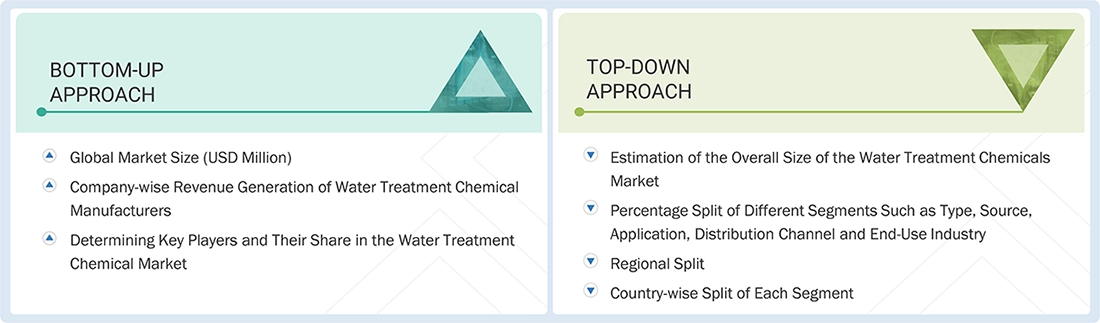
The study involves two major activities in estimating the current market size for the water treatment chemicals market. Exhaustive secondary research was done to collect information on the market, peer market, and parent market. The next step was to validate these findings, assumptions, and sizing with industry experts across the value chain through primary research. Both top-down and bottom-up approaches were employed to estimate the complete market size. After that, market breakdown and data triangulation were used to estimate the market size of segments and subsegments.
Secondary Research
Secondary sources referred to for this research study include financial statements of companies offering water treatment chemicals and information from various trade, business, and professional associations. Secondary research has been used to obtain critical information about the industry’s value chain, the total pool of key players, market classification, and segmentation according to industry trends to the bottom-most level and regional markets. The secondary data was collected and analyzed to arrive at the overall size of the water treatment chemical market, which was validated by primary respondents.
Primary Research
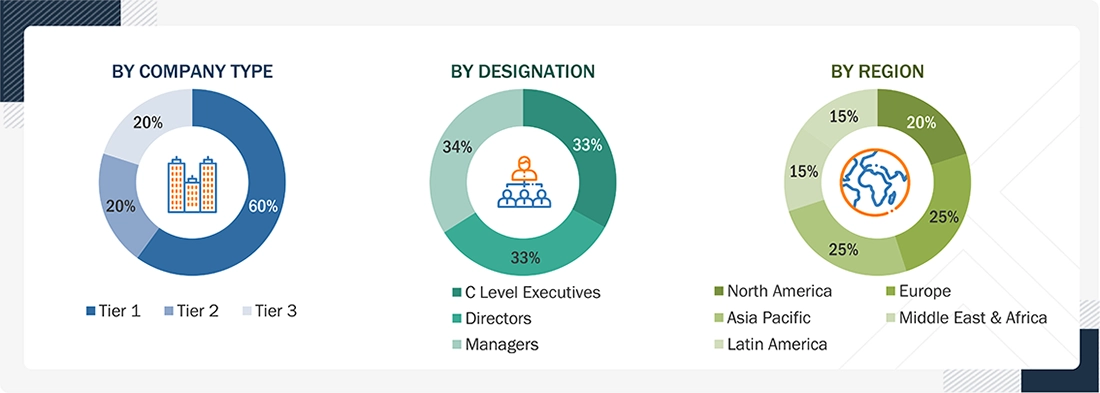
Extensive primary research was conducted after obtaining information regarding the water treatment chemicals market scenario through secondary research. Several primary interviews were conducted with market experts from both the demand and supply sides across major countries of North America, Europe, Asia Pacific, the Middle East & Africa, and South America. Primary data was collected through questionnaires, emails, and telephonic interviews. The primary sources from the supply side included various industry experts, such as Chief X Officers (CXOs), Vice Presidents (VPs), Directors from business development, marketing, product development/innovation teams, and related key executives from water treatment chemicals industry vendors, material providers, distributors, and key opinion leaders. Primary interviews were conducted to gather insights into market statistics, revenue from products and services, market breakdowns, market size estimates, market forecasting, and data triangulation. Primary research also helped in understanding the various trends related to type, source, application, end user, and region. Stakeholders from the demand side, such as CIOs, CTOs, CSOs, and installation teams of the customer/end users who are seeking water treatment chemical services, were interviewed to understand the buyer’s perspective on the suppliers, products, component providers, and their current usage of water treatment chemicals and future outlook of their business, which will affect the overall market.
The following is a breakdown of the primary respondents:
To know about the assumptions considered for the study, download the pdf brochure
Market Size Estimation
The research methodology used to estimate the size of the water treatment chemicals market includes the following details. The market sizing was undertaken from the demand side. The market was upsized based on the demand for water treatment chemicals in different end-use industries at a regional level. Such procurements provide information on the demand aspects of the water treatment chemical industry for each end-use industry. For each end-use, all possible segments of the water treatment chemicals market were integrated and mapped.
Data Triangulation
After arriving at the overall size from the market size estimation process explained above, the total market was split into several segments and subsegments. The data triangulation and market breakdown procedures explained below were implemented, wherever applicable, to complete the overall market engineering process and arrive at the exact statistics for various market segments and subsegments. The data was triangulated by studying various factors and trends from the demand and supply sides. Along with this, the market size was validated using both the top-down and bottom-up approaches.
Market Definition
The water treatment chemicals refers to the global industry that produces, distributes, and consumes chemical formulations that enhance water quality for municipal, industrial, and commercial uses. The chemicals are used throughout raw water treatment, process water treatment, wastewater treatment, and water reuse systems to eliminate pollutants, manage scaling and corrosion, and prevent microbial growth while meeting environmental and safety regulations. The market usually contains coagulants and flocculants, biocides & disinfectants, corrosion inhibitors and scale inhibitors, pH adjusters, and defoamers, providing products for municipal water utilities, power generation, oil & gas, chemicals, food & beverages, pharmaceuticals, mining, and data center end-use sectors.
Key Stakeholders
- Water Treatment Chemical Manufacturers
- Water Treatment Chemical Distributors and Suppliers
- End-use Industries
- Universities, Governments, and Research Organizations
- Associations and Industrial Bodies
- R&D Institutes
- Environmental Support Agencies
Report Objectives
- To define, describe, and forecast the water treatment chemicals market size in terms of volume and value.
- To provide detailed information regarding the key factors, such as drivers, restraints, opportunities, and challenges influencing market growth.
- To analyze and forecast the market type, source, application, end user, and region.
- To forecast the market size concerning five main regions (along with country-level data), namely, North America, Europe, Asia Pacific, Middle East & Africa, and South America, and analyze the significant region-specific trends
- To strategically analyze micromarkets with respect to individual growth trends, prospects, and contributions of the submarkets to the overall market
- To analyze the market opportunities and the competitive landscape for stakeholders and market leaders
- To assess recent market developments and competitive strategies, such as agreements, contracts, acquisitions, partnerships & collaborations, and new product developments/new product launches, to draw the competitive landscape.
- To strategically profile the key market players and comprehensively analyze their core competencies.
Available customizations:
MarketsandMarkets offers the following customizations for this market report:
- Additional country-level analysis of the water treatment chemicals market
Product Analysis
- Product matrix, which provides a detailed comparison of the product portfolio of each company's market
Get the Full Water Treatment Chemicals Market Report
Full forecast, segment splits, and company analysis for all Water Treatment Chemicals Market.
- US Water Treatment Chemicals Market
- Canada Water Treatment Chemicals Market
- Mexico Water Treatment Chemicals Market
- France Water Treatment Chemicals Market
- Germany Water Treatment Chemicals Market
- Italy Water Treatment Chemicals Market
- Spain Water Treatment Chemicals Market
- UK Water Treatment Chemicals Market
- Russia Water Treatment Chemicals Market
- China Water Treatment Chemicals Market
- India Water Treatment Chemicals Market
- Japan Water Treatment Chemicals Market
- South Korea Water Treatment Chemicals Market
- Indonesia Water Treatment Chemicals Market
- Saudi Arabia Water Treatment Chemicals Market
- UAE Water Treatment Chemicals Market
- South Africa Water Treatment Chemicals Market
- Egypt Water Treatment Chemicals Market
- Brazil Water Treatment Chemicals Market
- Argentina Water Treatment Chemicals Market
- Rest Of Europe Water Treatment Chemicals Market
- Rest Of Asia Pacific Water Treatment Chemicals Market
- –Other GCC Water Treatment Chemicals Market
Need a Tailored Report?
Customize this report to your needs
Get 10% FREE Customization
Customize This Report
