
Japan Wave Energy Converter Market (2026-2031)

The Japan Wave Energy Converter Market was valued at $0.06 Million in 2026 and projected to reach to $0.07 Million by 2031, representing a compound annual growth rate of CAGR 4.4%. Japan's wave energy converter market is poised for gradual expansion as the nation intensifies its renewable energy transition and seeks to diversify its power generation portfolio.


| Market Size in | USD 26.32 MN |
| Market Forecast in | |
| CAGR | |
| Forecast Period | |
| Units Considered | Value (USD MN) |
Japan Wave Energy Converter Market Trends and Insights
- Japan's strategic focus on renewable energy diversification and its extensive coastline position the nation as a potential hub for wave energy development in the Asia Pacific region.
- Despite modest current market size, Japan is investing in pilot projects and technological advancement to harness its significant wave energy potential. The wave energy sector in Japan faces both opportunities and constraints through 2031.
- Japan's commitment to carbon neutrality and marine resource utilization drives interest in wave energy converters, though commercialization remains in early stages.
- Japan's regulatory framework and government incentives are gradually supporting the transition toward ocean-based renewable energy infrastructure, with incremental growth expected as technology matures and deployment costs decline..
Key Market Statistics
- CAGR (2026-2031) CAGR 4.4%
- Market Size, 2026 ~USD 0.06 Million
- Forecast, 2031 ~USD 0.07 Million
- Country Japan
Japan Wave Energy Converter Market Overview
Modest but Growing Market :
Japan's wave energy converter market is valued at $0.06 million in 2026, with projections to reach $0.07 million by 2031, representing a steady 4.4% CAGR despite being significantly smaller than the global market expanding at 19%.
Strategic Renewable Energy Diversification :
Japan's commitment to renewable energy diversification, driven by post-Fukushima energy policy reforms, positions wave energy as a complementary technology to solar and wind, leveraging the nation's technological expertise and manufacturing capabilities.
Extensive Coastline Advantage :
With over 29,000 kilometers of coastline and significant wave resources, particularly along the Pacific coast, Japan possesses substantial geographic potential for wave energy development and commercialization opportunities.
Asia Pacific Hub Potential :
Japan's advanced marine technology sector, R&D infrastructure, and government support mechanisms position it as a potential regional leader for wave energy converter innovation and deployment across the Asia Pacific region.
Japan Wave Energy Converter Market Dynamics
- Government initiatives supporting marine renewable energy research and development, combined with Japan's world-class engineering capabilities, create a favorable environment for wave energy technology advancement.
- The 4.4% CAGR reflects cautious but consistent market growth as pilot projects mature and commercialization pathways become clearer. Looking ahead to 2031, Japan's wave energy sector will likely benefit from increased investment in offshore renewable infrastructure and technological breakthroughs in converter efficiency.
- Strategic partnerships between Japanese manufacturers and international wave energy developers, coupled with supportive regulatory frameworks, are expected to accelerate market penetration.
- However, growth will remain measured compared to global trends, as Japan balances wave energy development with established renewable technologies and addresses technical challenges specific to its marine environment..
Market Ecosystem
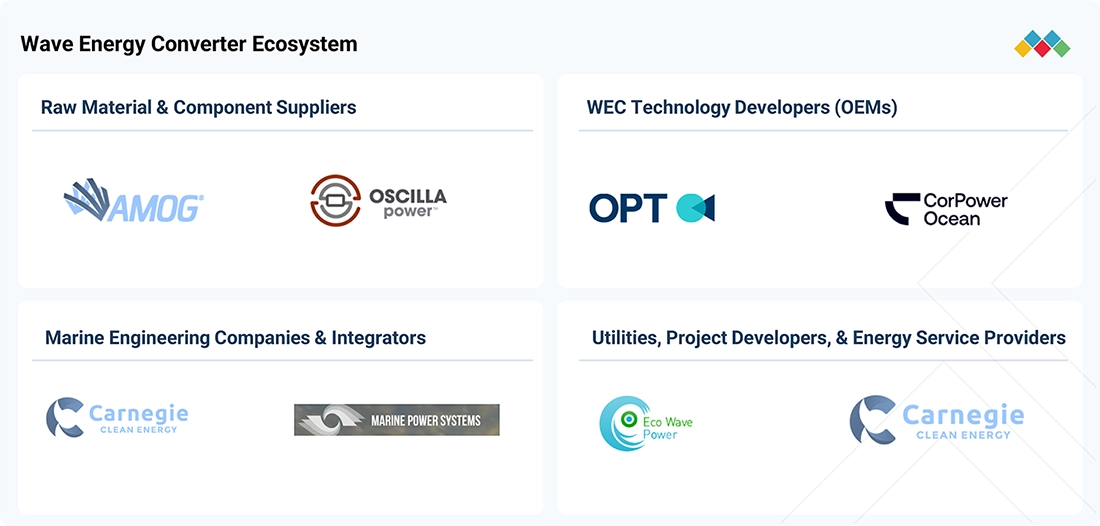
WAVE ENERGY CONVERTER MARKET: COMMERCIAL USE CASES ACROSS INDUSTRIES
| COMPANY | USE CASE DESCRIPTION | BENEFITS |
|---|---|---|
 |
Ocean Power Technologies deployed PowerBuoy® systems off the US coast to provide persistent offshore power, communications, and sensor integration for maritime surveillance. In 2026, the company expanded deployments supporting US Department of Homeland Security operations, including systems operating in deep water. | Demonstrates the use of wave-powered systems for persistent offshore infrastructure where conventional subsea cabling or frequent battery replacement can be difficult. The deployment supports maritime monitoring and communications while demonstrating WEC applicability to defense, security, and offshore infrastructure applications. |
 |
CorPower Ocean's HiWave-5 project at Aguçadoura, Portugal, uses its C4 Wave Energy Converter and is being expanded with next-generation C5 devices. The project is grid-connected and forms the basis for the company's planned larger VianaWave project, a 10-MW wave farm in Portugal. | Demonstrates the transition of wave energy from full-scale demonstration toward commercial-scale wave farms. Grid-connected operation provides real-world performance data and supports validation of device survivability, power generation, certification, and project development processes required for larger wave-energy deployments. |
 |
Eco Wave Power and EDF Renewables IL developed the EWP-EDF One wave energy station at Jaffa Port, Israel. The 100-kW project was connected to Israel's national electricity grid and began exporting electricity, using an onshore configuration integrated with existing port infrastructure. | Demonstrates the integration of wave energy with existing coastal and port infrastructure while supplying renewable electricity to the grid. The project provides operational experience for scaling onshore wave-energy systems and supports applications where offshore foundations and extensive subsea infrastructure can be minimized. |
Logos and trademarks shown above are the property of their respective owners. Their use here is for informational and illustrative purposes only.
Related Ecosystem
Decarbonization
- Battery Electric Vehicle (BEV)
- Hybrid Electric Vehicle (HEV)
- Energy Management Systems
- Fuel Cell
- Fuel Cell Electric Vehicle (FCEV)
- TotalEnergies SE
- Siemens ag
- Mitsui & Co., Ltd.
- General Electric Company
- Thyssenkrupp ag
Key Takeaways
- Japan's wave energy converter market is estimated at $0.06 million in 2026 with a projected value of $0.07 million by 2031.
- Japan's 4.4% CAGR reflects steady but modest growth driven by renewable energy commitments and coastal geography.
- Japan is developing pilot wave energy projects to establish technological expertise and supply chain capabilities.
- Japan's market growth is constrained by high capital costs and early-stage commercialization compared to mature renewable sectors.
Wave Energy Converter Market Report Scope
| Report Metric | Details |
|---|---|
| Base Year | 2026 |
| Fastest Growing Segment | OSCILLATING BODY CONVERTERS (Technology) |
| Forecast Period | 2026-2030 |
| Growth Rate | CAGR of 19% from 2026 to 2030 |
| Largest Segment | POWER GENERATION (Application) |
| Market Size Base Year (Billions) | ~USD 0.03 (2026) |
| Revenue Forecast (Billions) | ~USD 0.06 (2030) |
| Segments Covered | Technology, Type, Application |
Japan Wave Energy Converter Market Report Segmentation
3 segment dimensions are covered across the global market.
By Technology
- Oscillating Body Converters
- Oscillating Water Columns
- Other Technologies
- Overtopping Devices
By Type
- Attenuators
- Oscillating Wave Surge Converters
- Point Absorbers
- Submerged Pressure Differential Devices
By Application
- Desalination
- Other Applications
- Power Generation
Target Audience
- Energy & Utility Companies : Japanese and international utilities seeking to diversify renewable energy portfolios need Japan-specific market data to evaluate wave energy investment viability, project economics, and integration with existing power generation infrastructure.
- Wave Energy Technology Developers : Manufacturers and innovators in wave energy conversion require detailed Japan market analysis to assess commercialization potential, identify local partnerships, and tailor technology solutions to Japan's marine environment and regulatory requirements.
- Government & Policy Makers : Japanese government agencies and energy policy officials need market intelligence to inform renewable energy strategy, allocate R&D funding, and design incentive programs supporting wave energy sector growth and energy independence goals.
- Investment & Financial Institutions : Venture capital, private equity, and institutional investors evaluating renewable energy opportunities in Japan require market sizing and growth projections to assess risk-return profiles and identify promising wave energy ventures and funding opportunities.
- Research & Academic Institutions : Universities and research organizations conducting marine renewable energy studies need Japan-specific market data and forecasts to support grant proposals, validate research findings, and guide technology development initiatives aligned with market demand.
Reasons to Buy this Report
- Japan-Specific Market Sizing : Access precise valuation data for Japan's wave energy converter market ($0.06M in 2026, $0.07M in 2031) with country-specific CAGR analysis to inform investment and expansion decisions in this emerging segment.
- Competitive Landscape Intelligence : Understand Japan's unique position within the Asia Pacific wave energy ecosystem and identify opportunities to differentiate from global competitors while capitalizing on Japan's technological leadership and manufacturing expertise.
- Policy & Regulatory Insights : Gain clarity on Japan's renewable energy policies, government support mechanisms, and regulatory frameworks driving wave energy adoption, enabling strategic alignment with national energy transition goals and incentive programs.
- Geographic & Resource Assessment : Leverage detailed analysis of Japan's extensive coastline, wave resource potential, and regional marine conditions to identify optimal deployment zones and assess project feasibility for wave energy converter installations.
- Strategic Partnership Opportunities : Identify collaboration potential with Japanese manufacturers, research institutions, and energy companies to accelerate technology development, commercialization, and market entry in this high-potential regional market.
Frequently asked questions
What is the current size of Japan's wave energy converter market?
Japan's wave energy converter market is valued at $0.06 million in 2026, representing an emerging segment within Japan's broader renewable energy portfolio.
What is the projected market size for Japan by 2031?
Japan's wave energy converter market is forecast to reach $0.07 million by 2031, growing at a CAGR of 4.4% from 2026 to 2031.
Why is Japan's wave energy market growing slower than global averages?
Japan's 4.4% CAGR is lower than the global 19% CAGR due to technological maturity challenges, high deployment costs, and Japan's focus on other renewable sources like solar and offshore wind.
What factors are driving wave energy development in Japan?
Japan's extensive coastline, carbon neutrality goals, energy security concerns, and government support for marine renewable energy are key drivers of wave energy converter adoption in Japan.
What are the main barriers to wave energy growth in Japan?
Japan faces barriers including high capital investment requirements, limited commercial-scale projects, environmental impact assessments, and competition from more established renewable technologies.
RESEARCH METHODOLOGY
The research process for this technical, market-oriented, and commercial study of the wave energy converter market involved systematic collection, validation, and analysis of information related to wave-energy technologies, power conversion systems, deployment environments, marine-energy applications, project developments, and commercialization initiatives. Extensive secondary research was conducted using annual reports, investor presentations, technical papers, government publications, company websites, project documents, regulatory publications, industry databases, and financial reports to identify key market participants, technology trends, deployment activity, market developments, and competitive strategies. The findings were further validated through primary interviews with executives from wave energy technology developers, marine energy companies, project developers, engineering firms, utilities, government agencies, research institutions, and industry experts to assess market estimates, technology adoption, project pipelines, customer requirements, and competitive positioning.
Key market players and their market positions were established through a combination of secondary research and primary validation involving senior executives, business development managers, technology specialists, project managers, engineering experts, and commercial professionals across the wave energy ecosystem.
Secondary Research
In the secondary research process, various secondary sources were referred to for identifying and collecting information relevant to the study. Secondary sources included annual reports, investor presentations, press releases, company websites, technical papers, project reports, government publications, regulatory documents, industry journals, marine-energy databases, and recognized industry sources.
Publications and datasets from organizations such as the US Department of Energy (DOE), National Renewable Energy Laboratory (NREL), European Commission, European Marine Energy Centre (EMEC), Ocean Energy Europe, International Energy Agency (IEA), Pacific Marine Energy Center (PMEC), and national marine-energy and renewable-energy agencies were reviewed to understand wave-energy technology development, deployment activity, testing infrastructure, policy developments, marine-energy funding, and commercialization trends.
Secondary research was primarily conducted to obtain information on the wave energy converter value chain, key market participants, technology developments, product portfolios, project pipelines, wave-energy demonstrations, market drivers and restraints, regional deployment patterns, application trends, power-rating requirements, location-specific opportunities, and recent industry developments.
Primary Research
During the primary research phase, wave-energy technology developers, marine-energy companies, project developers, engineering and consulting firms, utilities, equipment suppliers, research institutions, government agencies, and industry experts were interviewed to obtain qualitative and quantitative insights on the Wave Energy Converter Market. Interviews were conducted to validate market estimates, technology adoption, project development trends, pricing and cost considerations, deployment requirements, regional demand, competitive positioning, and customer buying criteria.
A combination of top-down and bottom-up approaches, supported by data triangulation, was used to estimate and forecast the market across all segments and subsegments. Primary interviews also helped assess technology maturity, wave-resource requirements, installation and maintenance requirements, survivability, power-take-off systems, project financing, grid integration, marine permitting, and emerging applications. The findings were further validated against company disclosures, government statistics, project announcements, testing-facility information, and industry sources to refine market estimates, segment shares, regional forecasts, and competitive assessments.
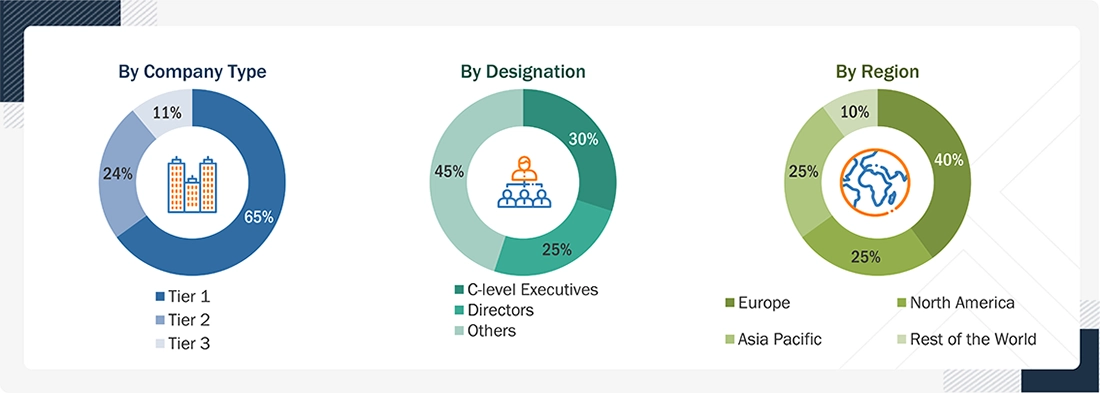
Note: Others include sales managers, engineers, project managers, technology specialists, business development managers, and regional managers.
Tier 1 Company-Revenue > USD 5 billion, Tier 2 Company-Revenue between USD 1 and USD 5 billion, and Tier 3 Company-Revenue < USD 1 billion.
To know about the assumptions considered for the study, download the pdf brochure
Market Size Estimation
Both top-down and bottom-up approaches have been used to estimate and validate the size of the wave energy converter market and its dependent submarkets. The key players in the market have been identified through secondary research, and their market positions across respective regions and technology segments have been assessed through both primary and secondary research. The research methodology includes the study of annual and financial reports of publicly listed market participants, company disclosures, project announcements, technology documentation, and interviews with industry experts, including chief executive officers, vice presidents, directors, project managers, business development managers, engineering managers, and technical specialists, to obtain key quantitative and qualitative insights related to the wave energy converter market.
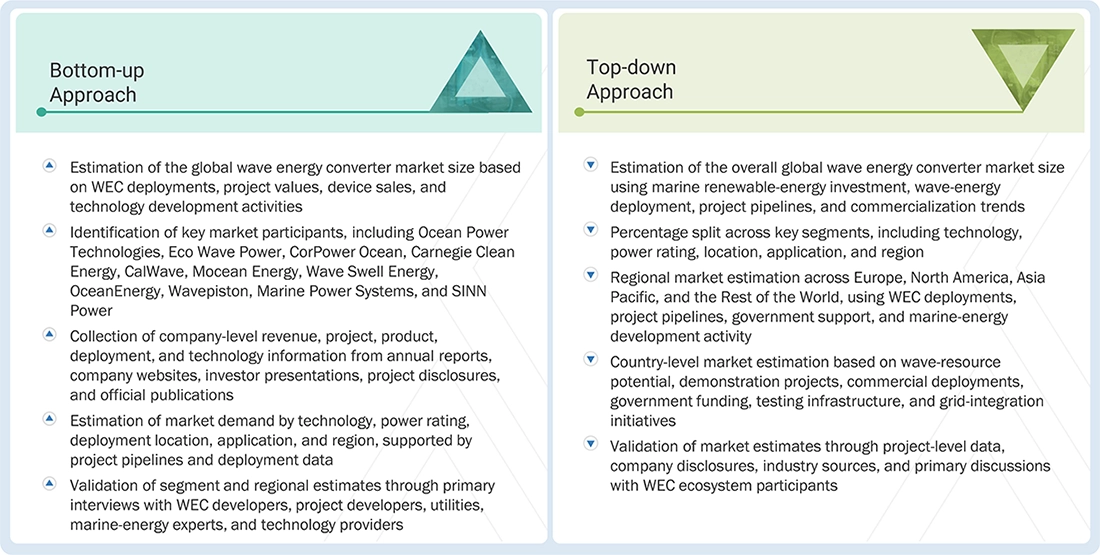
Bottom-up Approach
- Estimating the wave energy converter market size across technology, oscillating body converter sub-technology, power rating, location, application, and region by analyzing revenues and project values generated from WEC systems, equipment, deployments, and related commercial activities and consolidating segment-level estimates to derive the overall market size.
- Mapping leading market participants, including Ocean Power Technologies (US), Eco Wave Power Global (Israel), Carnegie Clean Energy (Australia), CorPower Ocean (Sweden), Mocean Energy (UK), Wave Swell Energy (Australia), CalWave (US), AWS Ocean Energy (UK), Oscilla Power (US), OceanEnergy (Ireland), Wavepiston (Denmark), Exowave (France), Checkmate SeaEnergy (UK), Wave Dragon (Denmark), Marine Power Systems (UK), Bombora Wave Power (Australia), INGINE (South Korea), AMOG Consulting (Australia), Atargis Energy Corporation (US), Hann-Ocean Energy (Singapore), Accumulated Ocean Energy (UK), Aquanet Power (Taiwan), Arrecife Energy Systems (Spain), and SINN Power (Germany).
- Collecting technology, product, project, deployment, and commercial information from annual reports, investor presentations, company websites, product documentation, technical papers, project announcements, press releases, government programs, regulatory filings, and other publicly available disclosures.
- Estimating demand across major applications, including power generation, desalination, and others, with further assessment of remote power, offshore power, coastal infrastructure, marine applications, and other emerging use cases based on WEC deployments, project pipelines, wave-resource availability, renewable-energy targets, and marine-energy development programs.
- Estimating market demand across major technologies, including oscillating water columns, oscillating body converters, overtopping devices, and others, using manufacturer technology portfolios, project deployment data, open-water testing, technology maturity, and regional development trends.
- Estimating the oscillating body converters market across point absorbers, attenuators, oscillating wave surge converters, and submerged pressure differential devices based on technology portfolios, project activity, deployment environment, and commercialization status.
- Incorporating qualitative factors, including government marine energy programs, renewable energy policies, wave resource availability, technology maturity, levelized cost of energy, survivability requirements, installation and maintenance costs, marine permitting, grid integration, project financing, supply chain availability, and technology advancements into the market forecasting model.
Top-down Approach
- Estimating the overall global wave energy converter market by analyzing global marine renewable-energy investment, wave-energy project development, renewable-energy deployment, coastal electricity demand, offshore infrastructure development, government marine-energy programs, and the transition toward low-carbon electricity generation.
- Allocating the market across technology (oscillating water column, oscillating body converters, overtopping devices, and others), oscillating body converter sub-technology, power rating, location, and application using regional deployment patterns, technology penetration, manufacturer portfolios, project pipelines, and industry data.
- Distributing market estimates across North America, Europe, Asia Pacific, and the Rest of the World based on regional wave-energy projects, installed and demonstrated capacity, government funding, marine-energy testing infrastructure, wave-resource availability, policy support, and technology adoption.
- Validating the final market estimates through primary discussions with technology developers, project developers, engineering companies, utilities, and channel participants to validate regional project activity, deployment trends, technology preferences, project economics, and commercialization prospects, followed by data triangulation to ensure consistency and accuracy.
Global Wave Energy Converter Market Size: Bottom-up Approach and Top-down Approach
Data Triangulation
The process of determining the overall market size involved the methodologies described earlier, followed by segmenting the market into multiple segments and subsegments. To finalize the comprehensive market analysis and obtain precise statistics for each market segment and subsegment, data triangulation and market breakdown procedures were applied, wherever appropriate.
Data triangulation was accomplished by examining factors and trends from both the demand and supply sides of the wave energy converter ecosystem, including WEC project deployments, technology demonstrations, manufacturer revenues and product portfolios, project pipelines, government funding, marine-energy policies, wave-resource availability, testing infrastructure, project economics, technology maturity, and regional market dynamics.
Market Definition
A wave energy converter (WEC) is a marine-energy device designed to capture the kinetic and potential energy contained in ocean waves and convert it into usable electrical energy or other forms of useful energy. WECs use different mechanical, hydraulic, pneumatic, or electrical power-take-off systems to convert wave-induced motion into energy. Depending on the technology, systems may be installed onshore, nearshore, or offshore and may use floating, submerged, seabed-mounted, or coastal-infrastructure-integrated configurations.
The wave energy converter market encompasses the revenue generated globally from the sale, deployment, and commercial implementation of different WEC technologies, including oscillating water columns, oscillating body converters, overtopping devices, and other wave-energy technologies. Oscillating body converters include point absorbers, attenuators, oscillating wave surge converters and submerged pressure differential devices. WEC systems are deployed across shoreline, nearshore, and offshore locations. The primary applications considered in the market are power generation and desalination.
Key Stakeholders
- Wave energy converter manufacturers and technology developers
- Marine-energy equipment and component manufacturers
- Power-take-off system and generator manufacturers
- Marine engineering, EPC, and system integration companies
- Wave energy project developers and renewable-energy companies
- Installation, operations, maintenance, and marine-service providers
- Government agencies and regulatory authorities
- Marine-energy testing centers and research institutions
- Utilities and electricity-generation companies
- Ports, coastal infrastructure operators, and offshore asset owners
- Research institutions, universities, and marine-energy associations
- Technology standards organizations, industry forums, alliances, and trade associations
- Institutional investors, infrastructure funds, and private equity firms
- Desalination companies and water infrastructure developers
Report Objectives
- To define, describe, segment, and forecast the wave energy converter market by technology, oscillating body converter sub-technology, location, and application, in terms of value
- To forecast the market sizes for four major regions, namely, North America, Europe, Asia Pacific, and the Rest of the World, along with their key countries, in terms of value
- To forecast the wave energy converter market by technology and region, in terms of volume where reliable deployment and capacity data are available
- To provide detailed information regarding key drivers, restraints, opportunities, and challenges influencing the growth of the wave energy converter market
- To provide the supply chain analysis, trends/disruptions impacting customer business, ecosystem analysis, regulatory landscape, patent analysis, case study analysis, technology analysis, key conferences & events, the impact of AI/Gen AI, macroeconomic outlook, pricing and cost analysis, Porter’s five forces analysis, and regulatory analysis influencing the wave energy converter market
- To analyze opportunities for stakeholders in the wave energy converter market and draw a competitive landscape of the market
- To benchmark market players using the company evaluation matrix, which analyzes market players based on broad categories of business and technology strategies adopted by them
- To compare key market players based on technology, product portfolio, deployment activity, project pipeline, applications, geographic presence, and commercialization stage
- To strategically profile key players and comprehensively analyze their market positioning, technology capabilities, project activity, and core competencies
- To analyze competitive developments, such as contracts, agreements, partnerships, collaborations, demonstrations, project deployments, product launches, technology developments, and expansions in the wave energy converter market.
Available customizations:
With the given market data, MarketsandMarkets offers customizations based on the company’s specific needs. The following customization options are available for the report:
PRODUCT ANALYSIS
- Product Matrix, which provides a detailed comparison of the product portfolio of each company
COMPANY INFORMATION
- Detailed analyses and profiling of additional market players (up to 5)
Get the Full Wave Energy Converter Market Report
Full forecast, segment splits, and company analysis for all Wave Energy Converter Market.
- Canada Wave Energy Converter Market
- US Wave Energy Converter Market
- Mexico Wave Energy Converter Market
- UK Wave Energy Converter Market
- France Wave Energy Converter Market
- Spain Wave Energy Converter Market
- Portugal Wave Energy Converter Market
- China Wave Energy Converter Market
- Brazil Wave Energy Converter Market
- Chile Wave Energy Converter Market
- Israel Wave Energy Converter Market
- Rest Of Europe Wave Energy Converter Market
- Rest Of Asia Pacific Wave Energy Converter Market
Need a Tailored Report?
Customize this report to your needs
Get 10% FREE Customization
Customize This Report
