
Italy Welding Materials Market (2025-2030)

The Italy Welding Materials Market was valued at $597.3 Million in 2025 and projected to reach to $663 Million by 2030, representing a compound annual growth rate of CAGR 2.11%. Italy's welding materials market is positioned for steady growth through 2030, supported by the country's established manufacturing infrastructure and continued demand from automotive and construction sectors.


| Market Size in | USD 26.32 MN |
| Market Forecast in | |
| CAGR | |
| Forecast Period | |
| Units Considered | Value (USD MN) |
Italy Welding Materials Market Trends and Insights
- Italy's welding materials sector is supported by the country's strong manufacturing base, particularly in automotive, construction, and metal fabrication industries.
- The moderate growth trajectory reflects Italy's mature industrial economy and steady demand for high-quality welding consumables and equipment. Driving Italy's welding materials market are investments in infrastructure modernization, automotive production recovery, and the adoption of advanced welding technologies in industrial applications.
- Italy's position as a European manufacturing hub ensures consistent demand for welding materials across multiple end-use sectors.
- Between 2025 and 2030, Italy is expected to maintain stable market conditions with incremental growth fueled by industrial automation and sustainability initiatives in manufacturing processes..
Key Market Statistics
- CAGR (2025-2030) CAGR 2.11%
- Market Size, 2025 ~USD 597.3 Million
- Forecast, 2030 ~USD 663 Million
- Country Italy
Italy Welding Materials Market Overview
Market Valuation :
Italy's welding materials market is valued at USD 597.3 million in 2025, with projected growth to USD 663.0 million by 2030, driven by robust demand from manufacturing sectors.
Growth Rate :
The Italian market exhibits a CAGR of 2.11% through 2030, reflecting steady but moderate expansion compared to the global CAGR of 3.62%, indicating Italy's mature but stable market position.
Industrial Foundation :
Italy's welding materials sector is anchored by strong manufacturing capabilities in automotive, construction, and metal fabrication industries, which are critical end-users driving material consumption.
Regional Significance :
As a key European manufacturing hub, Italy's welding materials market benefits from established supply chains, skilled workforce expertise, and proximity to major European industrial centers.
Italy Welding Materials Market Dynamics
- The moderate CAGR of 2.11% reflects Italy's mature industrial base and market saturation in certain segments, though opportunities exist in advanced welding technologies and sustainable material innovations.
- Investment in infrastructure projects and automotive modernization initiatives will provide incremental growth drivers.
- However, competition from Eastern European suppliers and the need for technological advancement may temper expansion rates compared to faster-growing global regions..
Market Ecosystem
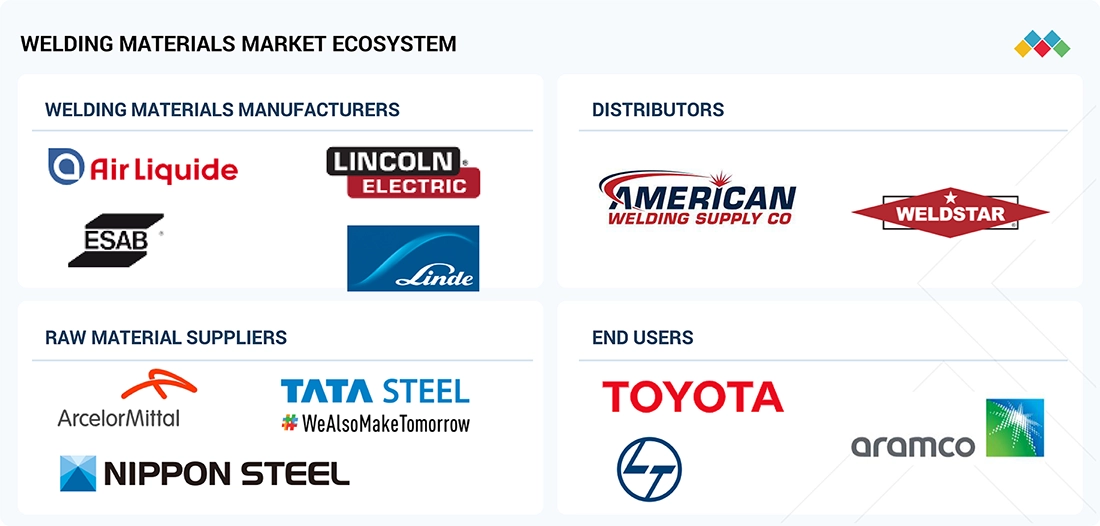
Welding Materials Market: COMMERCIAL USE CASES ACROSS INDUSTRIES
| COMPANY | USE CASE DESCRIPTION | BENEFITS |
|---|---|---|
 |
On-site rebuild of Hanson Cement's Purfleet VRM grinding table & rollers using Integra mill wire hardfacing kits. | Restored original profiles, improved mill productivity, minimized downtime, successful completion within 3 days, full COVID-19 compliance, innovative work zoning and automation for safety. |
 |
Used NSARC Copper-Glide 115 welding wire for producing material handling equipment and rack systems requiring smooth, consistent wire feedability and high-quality welds in robotic and semi-automatic MIG stations. | Achieved exceptional wire consistency, superior bead performance, enhanced production efficiency, cost effectiveness, and responsive support ensuring high-quality, reliable manufacturing of over 2 million pounds of welded steel weekly. |
 |
Received on-site hands-on technical support from NSARC for setting up new stainless-steel welding wire manufacturing line, optimizing welding parameters, and process improvements. | Improved welding line efficiency, operator confidence, reduced setup time, optimized welding processes, and competitive market readiness through tailored expert assistance and advanced technology introduction. |
Logos and trademarks shown above are the property of their respective owners. Their use here is for informational and illustrative purposes only.
Related Ecosystem
Equipment Machine And Tooling
- Wastewater Treatment
- Air Cooled Heat Exchangers
- Diaphragm Pumps
- Fiberglass
- HVAC System
- Alfa Laval Corporate AB
- Veolia
- Johnson Controls International plc
- Daikin Industries,Ltd.
- Parker-Hannifin Corporation
Key Takeaways
- Italy's welding materials market is valued at USD 597.3 million in 2025 with a projected value of USD 663.0 million by 2030.
- Italy experiences a moderate CAGR of 2.11% over the forecast period, reflecting a mature and stable industrial market.
- Italy's strong automotive and construction sectors drive consistent demand for welding consumables and advanced welding technologies.
- Italy's manufacturing base positions it as a key European market for welding materials with steady growth through 2030.
Welding Materials Market Report Scope
| Report Metric | Details |
|---|---|
| Base Year | 2025 |
| Fastest Growing Segment | FLUXES & WIRES (Type) |
| Forecast Period | 2025-2030 |
| Growth Rate | CAGR of 3.62% from 2025 to 2030 |
| Largest Segment | ARC WELDING (Technology) |
| Market Size Base Year (Billions) | ~USD 18.86 (2025) |
| Revenue Forecast (Billions) | ~USD 22.53 (2030) |
| Segments Covered | Technology, Type, End-Use Industry |
Italy Welding Materials Market Report Segmentation
3 segment dimensions are covered across the global market.
By Technology
- Arc Welding
- Other Technologies
- Oxy Fuel Welding
- Oxy-Fuel Welding
- Resistant Welding
By Type
- Electrodes & Filler Materials
- Fluxes & Wires
- Gases
By End-Use Industry
- Building & Construction
- Heavy Industries
- Other End-Use Industries
- Transportation
ITALY: WELDING MATERIALS MARKET, BY END-USE INDUSTRY, 2024–2030
| Segment | 2024 | 2025 | 2026 | 2027 | 2028 | 2029 | 2030 | CAGR (%) |
|---|---|---|---|---|---|---|---|---|
| BUILDING & CONSTRUCTION | 165.9 | 166.8 | 167.7 | 168.7 | 169.6 | 170.5 | 171.5 | 0.55 |
| HEAVY INDUSTRIES | 163.4 | 168.5 | 173.8 | 179.3 | 184.9 | 190.7 | 196.7 | 3.15 |
| OTHER END-USE INDUSTRIES | 76.9 | 79.5 | 82.2 | 85.1 | 88 | 91 | 94.1 | 3.43 |
| TRANSPORTATION | 179 | 182.5 | 186 | 189.5 | 193.2 | 196.9 | 200.7 | 1.92 |
| TOTAL | 585.2 | 597.3 | 609.8 | 622.5 | 635.7 | 649.2 | 663 | 2.11 |
Target Audience
- Welding Materials Manufacturers : Manufacturers need Italy-specific market data to develop localized product strategies, assess production capacity requirements, and identify growth opportunities in automotive and construction segments.
- Distributors & Suppliers : Distributors require detailed Italian market insights to optimize inventory management, forecast demand by sector, and establish strategic partnerships with local manufacturers and end-users.
- Investment & Private Equity Firms : Investors need comprehensive Italy market analysis to evaluate acquisition targets, assess market attractiveness, and determine ROI potential for welding materials companies operating in the region.
- Automotive & Construction Companies : End-user industries need market intelligence to benchmark material costs, identify supplier alternatives, and understand market trends affecting welding material availability and pricing in Italy.
- Market Research & Consulting Professionals : Analysts and consultants require Italy-focused data to support client advisory services, competitive analysis, and strategic planning for companies targeting the Italian welding materials market.
Reasons to Buy this Report
- Precise Market Sizing : Access Italy-specific valuation data (USD 597.3M in 2025) and 5-year forecasts to accurately assess market opportunity and investment potential in the Italian welding materials sector.
- Competitive Intelligence : Understand Italy's 2.11% CAGR relative to global 3.62% growth, enabling strategic positioning and identification of competitive advantages in this mature European market.
- Sector-Specific Insights : Gain detailed analysis of Italy's key end-user industries—automotive, construction, and metal fabrication—to tailor product offerings and marketing strategies for maximum market penetration.
- Investment Decision Support : Make informed decisions on market entry, expansion, or partnership opportunities in Italy with comprehensive data on market dynamics, growth drivers, and regional industrial capabilities.
- Supply Chain Optimization : Leverage Italy-focused market intelligence to optimize distribution networks, identify supplier opportunities, and understand local manufacturing demand patterns for welding materials.
Frequently asked questions
What is the current size of Italy's welding materials market?
Italy's welding materials market is estimated at USD 597.3 million in 2025.
What is the projected market size for Italy's welding materials by 2030?
Italy's welding materials market is forecasted to reach USD 663.0 million by 2030.
What is the CAGR for Italy's welding materials market?
Italy's welding materials market is expected to grow at a CAGR of 2.11% from 2025 to 2030.
Which industries drive demand for welding materials in Italy?
Italy's automotive, construction, metal fabrication, and industrial manufacturing sectors are primary drivers of welding materials demand.
What factors support growth in Italy's welding materials market?
Infrastructure modernization, automotive production recovery, industrial automation, and sustainability initiatives support growth in Italy's welding materials market.
RESEARCH METHODOLOGY
The study involved four main activities to estimate the current size of the global welding materials market. Comprehensive secondary research was conducted to gather information on the market, related product markets, and the broader product group markets. The next step was to validate these findings, assumptions, and estimates with industry experts across the entire welding materials value chain through primary research. Both top-down and bottom-up approaches were used to determine the overall market size. Subsequently, market segmentation and data triangulation were applied to identify the size of various segments and sub-segments within the market.
Secondary Research
The market size for companies offering welding materials is assessed using secondary data from paid and unpaid sources, analyzing the product portfolios of major companies in the industry, and rating these companies based on their performance and quality. Various secondary sources, such as Business Standard, Bloomberg, the World Bank, and Factiva, were consulted to gather information for this study on the welding materials market. Multiple sources were examined during the secondary research process to collect relevant data. These sources included annual reports, press releases, investor presentations from welding material manufacturers, forums, reputable publications, and whitepapers. The secondary research provided important insights into the industry’s value chain, the key players, as well as market classification and segmentation from both market and technology perspectives.
Primary Research
During the primary research process, various primary sources from both the supply and demand sides were interviewed to collect qualitative and quantitative information for this report. The supply-side sources included industry experts such as Chief Executive Officers (CEOs), Vice Presidents (VPs), marketing directors, technology and innovation directors, and other key executives from several leading companies and organizations within the Welding materials market. After completing the market engineering—covering calculations for market statistics, market breakdown, market size estimates, market forecasting, and data triangulation—extensive primary research was carried out to gather, verify, and validate the critical numbers used in the report. Primary research was also conducted to identify the segmentation types, industry trends, competitive landscape of welding materials offered by various market players, and key market dynamics such as drivers, restraints, opportunities, challenges, industry trends, and key player strategies. In the complete market engineering process, the top-down and bottom-up approaches and several data triangulation methods were extensively used to estimate and forecast the overall market segments and subsegments listed in this report. Extensive qualitative and quantitative analysis was performed throughout the market engineering process to highlight key information and insights in the report.
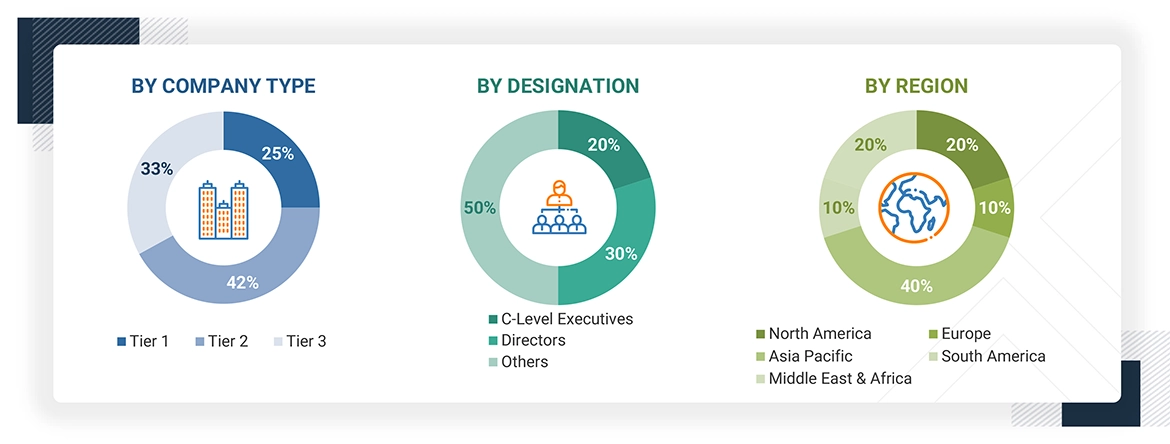
Notes: Other designations include sales, marketing, and product managers.
Tier 1: >USD 1 Billion; Tier 2: USD 500 million–1 Billion; and Tier 3: < USD 500 million
To know about the assumptions considered for the study, download the pdf brochure
Market Size Estimation
The top-down and bottom-up approaches were employed to estimate and validate the size of the global welding materials market. These methods were also widely used to determine the size of various related market segments. The research methodology used to estimate the market size included the following:
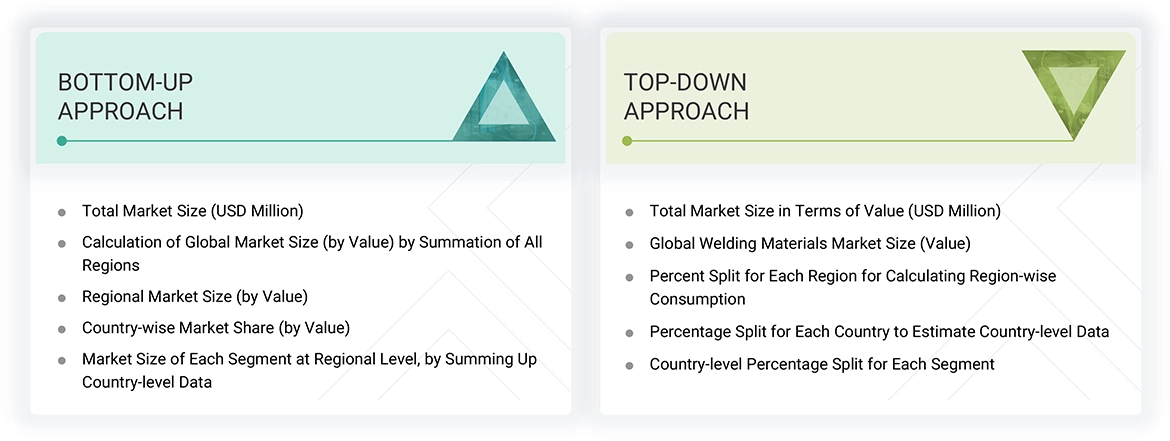
Data Triangulation
After estimating the overall market size using the appropriate methods, the market was divided into several segments and subsegments. Data triangulation and market breakdown procedures were applied, where applicable, to complete the overall market analysis and determine precise statistics for each segment and subsegment. The data was triangulated by examining various factors and trends from both demand and supply perspectives.
Market Definition
Welding is the process in which two metal parts are joined together by melting materials at their surfaces. It is a vital process in metal fabrication industries. The welding process is commonly used in many fields, such as transportation, shipbuilding, construction, and manufacturing. It is also utilized in the repair and maintenance industry to fasten different metal surfaces. Any material used in welding is known as welding material. Welding materials mainly consist of electrodes, fluxes, wires, and shielding gases.
Stakeholders
- Welding material manufacturers
- Raw material suppliers
- Traders and distributors
- Industry associations
- Research organizations, trade associations, and government agencies
- R&D institutes
- Regulatory bodies
- End-use industries
Report Objectives
- To define, describe, and forecast the size of the global welding materials market based on type, technology, end-use industry, and region in terms of value
- To provide detailed information on the significant drivers, restraints, opportunities, and challenges influencing the market
- To strategically analyze micromarkets concerning individual growth trends, prospects, and their contribution to the market
- To assess the growth opportunities in the market for stakeholders and provide details on the competitive landscape for market leaders
- To forecast the market size of segments and subsegments for North America, Europe, Asia Pacific, South America, and the Middle East & Africa
- To strategically profile key players and comprehensively analyze their market shares and core competencies
- To analyze competitive developments such as product launches, acquisitions, expansions, partnerships, and agreements in the welding materials market
- To provide the impact of AI/Gen AI on the market
Get the Full Welding Materials Market Report
Full forecast, segment splits, and company analysis for all Welding Materials Market.
- Canada Welding Materials Market
- Mexico Welding Materials Market
- Germany Welding Materials Market
- UK Welding Materials Market
- France Welding Materials Market
- Russia Welding Materials Market
- Netherlands Welding Materials Market
- South Africa Welding Materials Market
- Brazil Welding Materials Market
- Argentina Welding Materials Market
- Rest Of Asia Pacific Welding Materials Market
- China Welding Materials Market
- Japan Welding Materials Market
- India Welding Materials Market
- Indonesia Welding Materials Market
- US Welding Materials Market
Need a Tailored Report?
Customize this report to your needs
Get 10% FREE Customization
Customize This Report
