
Rest Of Asia Pacific Wireless Charging Market (2024-2029)

The Rest Of Asia Pacific Wireless Charging Market was valued at $325.8 Million in 2024 and projected to reach to $755 Million by 2029, representing a compound annual growth rate of 18.3%. Rest Of Asia Pacific represents a critical growth corridor for the wireless charging market, driven by accelerating smartphone penetration and rising consumer demand for convenient charging solutions.


| Market Size in | USD 26.32 MN |
| Market Forecast in | |
| CAGR | |
| Forecast Period | |
| Units Considered | Value (USD MN) |
Rest Of Asia Pacific Wireless Charging Market Trends and Insights
- Rest Of Asia Pacific represents a critical growth corridor driven by rising smartphone penetration, increasing adoption of wireless-enabled consumer electronics, and growing infrastructure investments across emerging economies.
- The region's 18.3% compound annual growth rate reflects strong demand for convenient charging solutions and the proliferation of compatible devices. Rest Of Asia Pacific's wireless charging ecosystem is characterized by rapid technology adoption and competitive pricing dynamics.
- Throughout the 2024-2029 forecast period, Rest Of Asia Pacific will benefit from expanding manufacturing capabilities, rising disposable incomes, and accelerating digital transformation initiatives.
- Key market participants are establishing regional partnerships and localized production facilities to capitalize on Rest Of Asia Pacific's growth potential, positioning the region as a significant contributor to global wireless charging expansion..
Key Market Statistics
- CAGR (2024-2029) 18.3% CAGR
- Market Size, 2024 ~USD 325.8 Million
- Forecast, 2029 ~USD 755 Million
- Country Rest Of Asia Pacific
Rest Of Asia Pacific Wireless Charging Market Overview
Rapid Market Expansion :
Rest Of Asia Pacific wireless charging market is projected to grow from USD 325.8 million in 2024 to USD 755.0 million by 2029, representing an 18.3% CAGR and demonstrating strong regional momentum.
Smartphone Penetration Driver :
Rising smartphone adoption across emerging economies in Rest Of Asia Pacific is accelerating wireless charging integration, with consumers increasingly demanding convenient charging solutions for mobile devices.
Consumer Electronics Expansion :
Growing adoption of wireless-enabled devices including wearables, tablets, and IoT products across Rest Of Asia Pacific is diversifying the wireless charging ecosystem beyond smartphones.
Infrastructure Investment Growth :
Emerging economies in Rest Of Asia Pacific are investing heavily in digital infrastructure and retail modernization, creating opportunities for wireless charging deployment in public spaces and commercial establishments.
Rest Of Asia Pacific Wireless Charging Market Dynamics
- The region's emerging economies are witnessing rapid digital transformation, with increasing adoption of wireless-enabled consumer electronics across multiple device categories.
- Infrastructure investments and retail modernization initiatives are creating favorable conditions for wireless charging ecosystem expansion. The 18.3% CAGR through 2029 reflects strong regional momentum, supported by competitive pricing, growing OEM partnerships, and increasing consumer awareness.
- As middle-class populations expand and disposable incomes rise across Rest Of Asia Pacific, demand for premium wireless charging solutions is expected to accelerate, positioning the region as a key growth engine for global wireless charging manufacturers and technology providers..
Market Ecosystem
Related Ecosystem
Battery And Wireless Charging
- Nickel-Cadmium Battery
- Battery Electric Vehicle (BEV)
- Energy Harvesting
- Hybrid Electric Vehicle (HEV)
- Smart Cards
- Panasonic Holdings Corporation
- MOMENTIVE PERFORMANCE MATERIALS INC.
- Lg corp
- FDK Corporation
- Samsung
Automotive Electronics And Electrical Equipment
- Battery Electric Vehicle (BEV)
- Light Commercial Vehicles (LCVs)
- Fuel Cell Electric Vehicle (FCEV)
- Sensors
- Hybrid Electric Vehicle (HEV)
- BOSCH LIMITED
- DENSO Corporation
- Continental ag
- Panasonic Holdings Corporation
- Texas Instruments Incorporated
Key Takeaways
- Rest Of Asia Pacific wireless charging market valued at USD 325.8M in 2024, expanding to USD 755.0M by 2029 at 18.3% CAGR
- Rest Of Asia Pacific's growth driven by smartphone proliferation, rising consumer electronics adoption, and emerging market infrastructure development
- Rest Of Asia Pacific benefits from competitive pricing, localized manufacturing, and strategic regional partnerships among key vendors
- Rest Of Asia Pacific positioned as high-growth region with expanding digital transformation and increasing disposable income supporting market acceleration
Wireless Charging Market Report Scope
| Report Metric | Details |
|---|---|
| Base Year | 2024 |
| Fastest Growing Segment | AUTOMOTIVE (Application) |
| Forecast Period | 2024-2029 |
| Growth Rate | CAGR of 20.3% from 2024 to 2029 |
| Largest Segment | CONSUMER ELECTRONICS (Application) |
| Market Size Base Year (Billions) | ~USD 6.35 (2024) |
| Revenue Forecast (Billions) | ~USD 16 (2029) |
| Segments Covered | Implementation, Technology, Application, Type, Capacity, Voltage |
Rest Of Asia Pacific Wireless Charging Market Report Segmentation
6 segment dimensions are covered across the global market.
By Implementation
- Receivers
- Transmitters
By Technology
- Inductive
- Magnetic Resonance
- Radio Frequency
By Application
- Aerospace
- Automotive
- Consumer Electronics
- Healthcare
- Industrial
- Marine
- Medical
- Power
- Telecommunications
By Type
- Lco
- Lfp
- Lmo
- Lto
- Nca
- Nmc
By Capacity
- 10,001-60,000 Mah
- 3,001-10,000 Mah
- Above 60,000 Mah
- Below 3,000 Mah
By Voltage
- High
- Low
- Medium
Target Audience
- Electronics Manufacturers : OEMs and device manufacturers need Rest Of Asia Pacific market data to inform product development roadmaps, determine wireless charging integration priorities, and identify regional partnership opportunities.
- Wireless Charging Solution Providers : Technology companies and charging solution vendors require detailed regional insights to assess market entry strategies, competitive positioning, and revenue potential across Rest Of Asia Pacific's emerging economies.
- Investment and Private Equity Firms : Investors evaluating wireless charging sector opportunities need validated market forecasts and regional growth drivers for Rest Of Asia Pacific to support due diligence and portfolio allocation decisions.
- Retail and Distribution Partners : Retailers and distributors need Rest Of Asia Pacific market intelligence to optimize inventory planning, identify high-growth product categories, and develop targeted sales strategies for wireless charging solutions.
- Strategic Business Planners : Corporate strategists and business development teams require comprehensive Rest Of Asia Pacific market analysis to support long-term planning, competitive strategy development, and regional expansion initiatives.
Reasons to Buy this Report
- Regional Growth Quantification : Obtain precise market sizing data for Rest Of Asia Pacific with validated 2024 baseline (USD 325.8M) and 2029 forecast (USD 755.0M), enabling accurate regional revenue projections and investment decisions.
- Emerging Market Opportunity Assessment : Identify high-potential emerging economies within Rest Of Asia Pacific with detailed insights into smartphone penetration rates, consumer electronics adoption, and infrastructure development trajectories.
- Competitive Positioning Strategy : Benchmark your wireless charging solutions against regional market dynamics and understand localized demand drivers to optimize product positioning and go-to-market strategies in Rest Of Asia Pacific.
- Investment and Expansion Planning : Leverage comprehensive market intelligence to support capital allocation decisions, partnership strategies, and expansion timelines specific to Rest Of Asia Pacific's 18.3% CAGR growth trajectory.
- Technology Adoption Insights : Understand regional adoption patterns for wireless-enabled devices, consumer preferences, and infrastructure readiness to align product development and marketing initiatives with Rest Of Asia Pacific market needs.
Frequently asked questions
What is the market size of wireless charging in Rest Of Asia Pacific?
Rest Of Asia Pacific's wireless charging market was valued at USD 325.8 million in 2024 and is forecast to reach USD 755.0 million by 2029.
What is the CAGR for wireless charging in Rest Of Asia Pacific?
Rest Of Asia Pacific's wireless charging market is projected to grow at a compound annual growth rate of 18.3% from 2024 to 2029.
What factors are driving wireless charging adoption in Rest Of Asia Pacific?
Rest Of Asia Pacific's wireless charging growth is driven by increasing smartphone penetration, rising adoption of wireless-enabled consumer electronics, expanding manufacturing capabilities, and growing digital transformation initiatives across emerging economies.
How is Rest Of Asia Pacific positioned compared to other Asia Pacific regions?
Rest Of Asia Pacific represents a critical growth corridor within Asia Pacific, characterized by rapid technology adoption, competitive pricing, and significant infrastructure investments that position it as a major contributor to regional wireless charging expansion.
What market opportunities exist in Rest Of Asia Pacific for wireless charging vendors?
Rest Of Asia Pacific offers vendors opportunities through localized production facilities, regional partnerships, rising disposable incomes, and the expanding base of wireless-compatible devices across emerging markets in the region.
RESEARCH METHODOLOGY
The study involves four major activities that estimate the size of the wireless charging market. Exhaustive secondary research was conducted to collect information related to the market. Following this was validating these findings, assumptions, and sizing with the industry experts across the value chain through primary research. Both top-down and bottom-up approaches were employed to estimate the overall size of the wireless charging market. Subsequently, market breakdown and data triangulation procedures were used to determine the extent of different segments and subsegments of the market.
Secondary Research
Secondary sources in this research study include corporate filings (such as annual reports, investor presentations, and financial statements); trade, business, and professional associations; white papers, certified publications, articles from recognized authors; directories; and databases. The secondary data were collected and analyzed to estimate the overall market size, further validated by primary research. The relevant data is collected from various secondary sources, it is analyzed to extract insights and information relevant to the market research objectives. This analysis has involved summarizing the data, identifying trends, and drawing conclusions based on the available information.
Primary Research
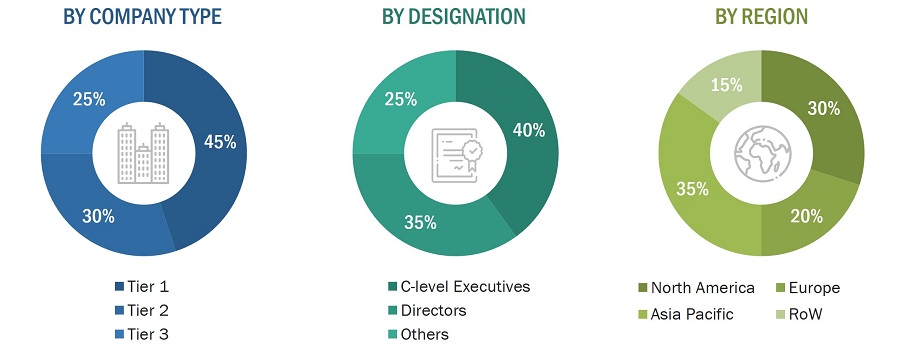
In the primary research process, numerous sources from both the supply and demand sides were interviewed to obtain qualitative and quantitative information about this report. The primary sources from the supply side included various industry experts such as Chief X Officers (CXOs), Vice Presidents (VPs), and Directors from business development, marketing, product development/innovation teams, and related key executives from wireless charging providers, (such as Energizer, SAMSUNG, Plugless Power Inc., Ossia Inc., and Qualcomm Technologies, Inc.) research organizations, distributors, professional and managed service providers, industry associations, and key opinion leaders. Approximately 25% of the primary interviews were conducted with the demand side and 75% with the supply side. These data were collected mainly through questionnaires, emails, and telephonic interviews, accounting for 80% of the primary interviews.
To know about the assumptions considered for the study, download the pdf brochure
Market Size Estimation
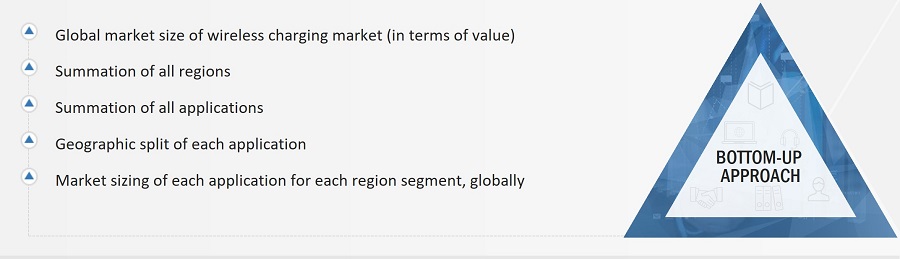
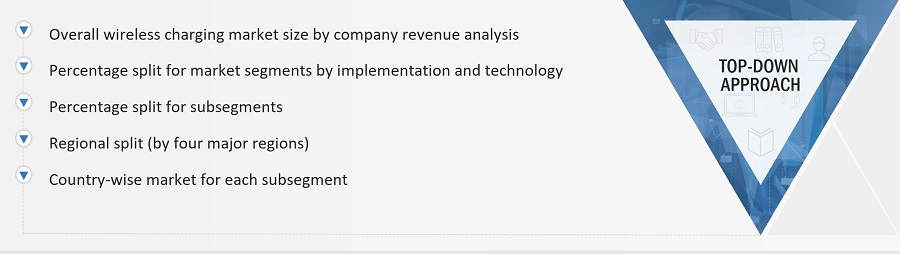
In the market engineering process, both top-down and bottom-up approaches were implemented, along with several data triangulation methods, to estimate and validate the size of the wireless charging market and other dependent submarkets listed in this report.
- The key players in the industry and markets were identified through extensive secondary research.
- Both the supply chain of the industry and the market size, in terms of value, were determined through primary and secondary research.
- All percentage shares, splits, and breakdowns were determined using secondary sources and verified through primary sources.
Market Size Estimation Methodology-Bottom-up Approach
Market Size Estimation Methodology-Top-Down Approach
Data Triangulation
After estimating the overall market size, the total market was split into several segments. The market breakdown and data triangulation procedures were employed wherever applicable to complete the overall market engineering process and gauge exact statistics for all segments. The data were triangulated by studying various factors and trends from both the demand and supply sides. The market was also validated using both top-down and bottom-up approaches.
Market Definition
Wireless charging, or cordless charging, is a method of charging electronic devices without a physical connection. Wireless charging of electronic devices covers a variety of technologies and transmission ranges used in consumer electronics, healthcare, automotive, industrial, and other applications.
Players in the wireless charging market offer different types of technology, such as magnetic resonance, inductive, and RF technology. A wireless charging device comprises a transmitter and receiver. The transmitter acts as a standalone charger, whereas the receiver is an integrated chipset in electronic devices such as smartphones, smart watches, electric vehicles, and others.
Stakeholders
- Raw material and manufacturing equipment suppliers
- Electronic design automation (EDA) and design tool vendors
- Component manufacturers
- Original equipment manufacturers (OEMs)
- Integrated device manufacturers (IDMs)
- Original design manufacturers (ODMs)
- Wireless technology service, and solution providers
- Suppliers and distributors
- System integrators
- Government and other regulatory bodies
- Technology investors
- Research institutes and organizations
- Market research and consulting firms
The main objectives of this study are as follows:
- To describe and forecast the overall wireless charging market based on Implementation, technology, application, in terms of value
- To describe and forecast the market for four key regions: North America, Europe, Asia Pacific, and Rest of the World (RoW), along with their respective countries, in terms of value
- To analyze competitive developments such as product launches and developments, acquisitions, collaborations, agreements, and partnerships in the wireless charging market
- To provide an analysis of the recession impact on the growth of the market and its segments
- To define and describe the overall wireless charging market on the basis of implementation, technology, application, and geography
- To strategically profile key players and comprehensively analyze their market position in terms of ranking and core competencies2
- To forecast the overall wireless charging market till 2029
- To strategically analyze the micromarkets1 with respect to individual growth trends, prospects, and contribution to the overall wireless charging market
- To provide detailed information regarding the major factors (drivers, restraints, opportunities, and industry-specific challenges) influencing the growth of the wireless charging market
- To analyze the opportunities in the wireless charging market and provide details of the competitive landscape for market leaders
- To strategically profile the key players in the wireless charging market and comprehensively analyze their market presence and core competencies2
- To analyze competitive developments, such as joint ventures, mergers & acquisitions, and new product launches, along with research and development (R&D) in the wireless charging market
Available Customizations:
With the given market data, MarketsandMarkets offers customizations according to the specific requirements of companies. The following customization options are available for the report:
Country-wise Information:
- Analysis for additional countries (up to five)
Company Information:
- Detailed analysis and profiling of different market players (up to five)
Get the Full Wireless Charging Market Report
Full forecast, segment splits, and company analysis for all Wireless Charging Market.
- Canada Wireless Charging Market
- Mexico Wireless Charging Market
- US Wireless Charging Market
- France Wireless Charging Market
- Germany Wireless Charging Market
- UK Wireless Charging Market
- Rest Of Europe Wireless Charging Market
- China Wireless Charging Market
- India Wireless Charging Market
- Japan Wireless Charging Market
Need a Tailored Report?
Customize this report to your needs
Get 10% FREE Customization
Customize This Report
