
US Workforce Management Market (2025-2030)

The US Workforce Management Market was valued at $3066.8 Million in 2025 and projected to reach to $4700.6 Million by 2030, representing a compound annual growth rate of 8.9%. The US Workforce Management Market is poised for sustained expansion through 2030, driven by enterprises' commitment to digital transformation and labor cost optimization.


| Market Size in | USD 26.32 MN |
| Market Forecast in | |
| CAGR | |
| Forecast Period | |
| Units Considered | Value (USD MN) |
US Workforce Management Market Trends and Insights
- This expansion reflects the US economy's increasing reliance on digital labor optimization solutions as enterprises prioritize operational efficiency and employee productivity.
- The US market benefits from high technology adoption rates, mature IT infrastructure, and significant investment in workforce automation across sectors including retail, healthcare, manufacturing, and financial services. Driving this 8.9% compound annual growth rate, the US market is shaped by regulatory compliance requirements, labor cost pressures, and the shift toward hybrid and remote work models.
- US organizations are increasingly deploying advanced scheduling, time-and-attendance, and performance management tools to navigate complex workforce dynamics.
- The competitive intensity in the US market has spurred innovation in AI-driven analytics, mobile-first platforms, and cloud-based solutions tailored to American enterprise needs. By 2030, the US Workforce Management Market will represent a critical component of enterprise software spending, with adoption accelerating across mid-market and small business segments seeking cost-effective workforce optimization..
Key Market Statistics
- CAGR (2025-2030) 8.9% CAGR
- Market Size, 2025 ~USD 3066.8 Million
- Forecast, 2030 ~USD 4700.6 Million
- Country US
US Workforce Management Market Overview
Market Valuation :
The US Workforce Management Market is valued at $3,066.8 million in 2025, demonstrating strong market maturity and significant enterprise investment in labor optimization technologies across the nation.
Projected Growth :
Expected to reach $4,700.6 million by 2030 with a CAGR of 8.9%, reflecting sustained demand for workforce management solutions among US enterprises seeking competitive operational advantages.
Technology Adoption :
The US market benefits from exceptionally high technology adoption rates and a mature IT infrastructure, enabling rapid deployment of advanced workforce management platforms across diverse industry verticals.
Operational Efficiency Focus :
US enterprises increasingly prioritize digital labor optimization to enhance employee productivity and operational efficiency, driving widespread adoption of integrated workforce management systems.
US Workforce Management Market Dynamics
- Organizations across sectors are investing heavily in cloud-based workforce management solutions to streamline scheduling, improve compliance, and enhance employee engagement.
- The mature US IT landscape and high digital literacy among businesses accelerate adoption rates, positioning the market for consistent 8.9% annual growth.
- Emerging technologies like AI-driven analytics and predictive workforce planning are reshaping competitive dynamics, with leading vendors capturing significant market share through innovation and integration capabilities..
Market Ecosystem
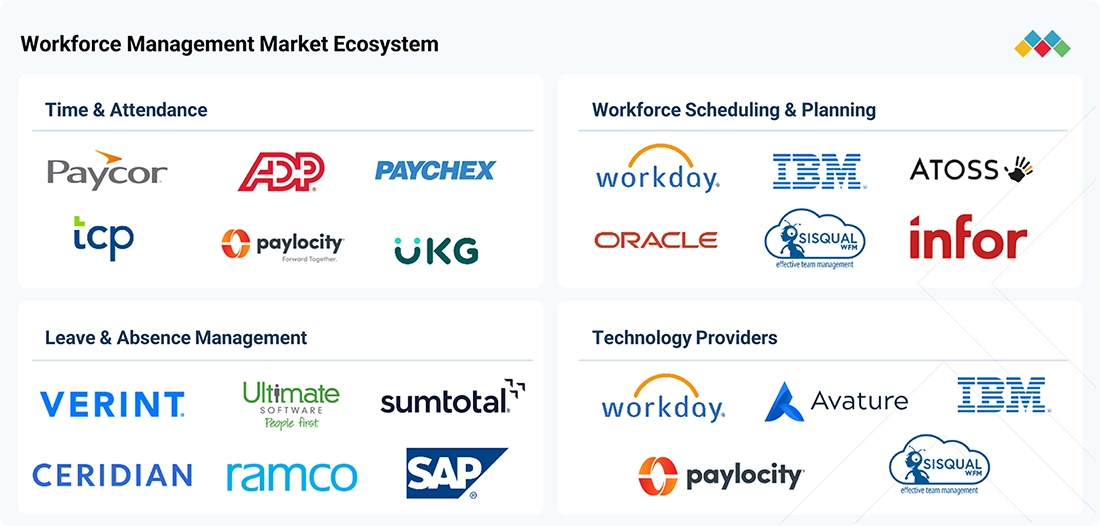
WORKFORCE MANAGEMENT MARKET: COMMERCIAL USE CASES ACROSS INDUSTRIES
| COMPANY | USE CASE DESCRIPTION | BENEFITS |
|---|---|---|
 |
MileOne Autogroup modernized its outdated workforce management practices by adopting Workday’s unified scheduling, time tracking, and absence management solutions. The new system gave frontline employees greater control over their schedules while enabling managers to plan labor needs more accurately using real-time data. This shift improved operational efficiency, reduced guesswork, and strengthened employee engagement across all dealerships. | MileOne consolidated five payroll systems into one, eliminated 100% of paper-based scheduling, and reduced manual HR administration time by 75%. Off-cycle payroll checks dropped by 70%, employee retention improved, and the company saved around $100K annually by digitizing records and reducing storage costs. The unified system boosted productivity, streamlined operations, and elevated overall workforce satisfaction. |
 |
Omega Healthcare Management Services (Omega Healthcare), which had grown rapidly through acquisitions, was struggling with fragmented, legacy IT systems across HR, finance, procurement, and operations. To standardize processes, improve scalability, and data visibility, the company implemented Oracle Fusion Cloud Applications (ERP, EPM, and HCM), consolidating all acquired entities onto a unified platform. | As a result, Omega Healthcare slashed its quarterly financial close from 25 days to 2 days and significantly improved capacity planning, project management, and expense management. It also centralized HR/payroll and workforce management, enhanced data governance and compliance, and enabled faster, insight-driven decision-making across its global operations. |
 |
SunOpta, a US and Canada-based manufacturer of beverages, broths, and snacks, transitioned from multiple disconnected HR and time-keeping systems to a unified Dayforce platform in 2019. By consolidating payroll, HR, time and attendance, recruiting, onboarding, and analytics into a single system of record, the company streamlined its workforce operations and reduced process complexity across all locations. | The shift to Dayforce enabled SunOpta to reduce HR headcount by more than 50% and cut payroll recalculation time by roughly 90%. Automated time and payroll processes improved compliance, increased accuracy, reduced manual effort, and, through Dayforce Wallet, enabled faster wage access—strengthening the overall employee experience and retention. |
 |
Plains Commerce Bank, with over 400 employees across more than 25 states, was struggling with manual, paper-heavy HR and onboarding processes, disparate systems, and limited employee self-service. By implementing Paycor as a unified HR platform, the bank automated onboarding, payroll, benefits, time tracking, and employee lifecycle management. Paycor+1 | Plains Commerce Bank saved over 330 administrative hours annually by automating onboarding and eliminated thousands of hours of manual work through automated workflows and notifications. They also realized cost savings; for example, handling 600+ background checks via integrated tools saved about USD 20,000 while boosting employee engagement, self-service, and overall HR efficiency. |
 |
Pilot Flying J, a large fuel and retail-service network operating more than 950 travel-center locations across North America, replaced its fragmented legacy HR/time and attendance systems with Infor Workforce Management (WFM). The organization moved from multiple disparate systems and manual processes to a unified, mobile-enabled solution that works across all sites. | With Infor WFM in place, Pilot Flying J replaced disparate workforce systems with a single integrated platform, digitizing time tracking, scheduling, PTO requests, and payroll data collection. This reduced weekly payroll data collection and verification time by about five hours, improved scheduling accuracy and attendance tracking, and let staff and managers spend less time on admin and more on customer service, ultimately improving operational efficiency and the guest experience. |
Logos and trademarks shown above are the property of their respective owners. Their use here is for informational and illustrative purposes only.
Related Ecosystem
Software And Services
- Natural Language Processing (NLP)
- Machine Learning
- Supply Chain Management
- Predictive Analytics
- Image Sensors
- International Business Machines Corporation
- MICROSOFT CORPORATION
- Oracle Corporation
- SAP SE
- Amazon.com, Inc.
Key Takeaways
- The US Workforce Management Market will grow from $3,066.8M (2025) to $4,700.6M (2030) at an 8.9% CAGR, driven by digital transformation and labor optimization priorities.
- US enterprises are increasingly adopting cloud-based and AI-powered workforce management solutions to address hybrid work complexity and regulatory compliance demands.
- The US market is characterized by high technology maturity and competitive intensity, with vendors innovating in mobile platforms, analytics, and real-time workforce visibility.
- Mid-market and small business segments in the US represent significant growth opportunities as cost-effective workforce management solutions become more accessible and feature-rich.
Workforce Management Market Report Scope
| Report Metric | Details |
|---|---|
| Base Year | 2025 |
| Fastest Growing Segment | MANAGED SERVICES (Service Type) |
| Forecast Period | 2025–2030 |
| Growth Rate | CAGR of 10.38% from 2025 to 2030 |
| Largest Segment | LARGE ENTERPRISES (Organization Size) |
| Market Size Base Year (Billions) | ~USD 9.57 (2025) |
| Revenue Forecast (Billions) | ~USD 15.67 (2030) |
| Segments Covered | Offering, Service Type, Solution Type, Delivery Mode, Organization Size, Business Function, Vertical |
US Workforce Management Market Report Segmentation
7 segment dimensions are covered across the global market.
By Offering
- Services
- Solutions
By Service Type
- Managed Services
- Professional Services
By Solution Type
- Core Wfm
- Workforce Intelligence & Strategy
- Workforce Optimization (Wfo) & Analytics
By Delivery Mode
- Cloud
- On-Premises
By Organization Size
- Large Enterprises
- Smes
By Business Function
- Finance & Payroll
- Hr/People Function
- It/Security
- Operations/Frontline Leaders
By Vertical
- Bfsi
- Government & Defense
- Government& Defense
- Healthcare & Life Science
- Healthcare & Life Sciences
- It & Ites
- Manufacturing
- Media & Entertainment
- Other Verticals
- Retail & E-Commerce
- Telecommunication
- Telecommunications
- Transportation & Logistics
Target Audience
- Enterprise IT Decision Makers : CIOs and IT directors need detailed US market insights to evaluate workforce management solutions, benchmark vendor capabilities, and justify technology investments to stakeholders.
- Workforce Management Vendors : Solution providers require granular US market data to identify growth opportunities, assess competitive positioning, and develop targeted sales and marketing strategies.
- HR & Operations Leaders : HR directors and operations executives seek market intelligence to select optimal workforce management platforms, understand industry best practices, and optimize labor costs.
- Management Consultants : Consulting firms advising US enterprises on digital transformation need credible market data and forecasts to support client recommendations and strategic planning engagements.
- Investment & Private Equity Firms : Investors evaluating opportunities in the US workforce management sector require comprehensive market analysis, growth projections, and competitive dynamics to inform investment decisions.
Key Companies in the US Workforce Management Market
| Company | HQ | Ownership | Strongest segments |
|---|---|---|---|
| BOOZ ALLEN HAMILTON | United States | Public Company | AI and advanced analytics solutions,Cyber solutions and mission cyber operations,Cloud-enabled infrastructure and data platforms, |
| DIMENSION DATA | United Kingdom | Private Company | Managed Services (network, data center, UC, endpoint),System Integration & Professional Services,Cloud & ITaaS (including onecloud, Microsoft cloud, contact center), |
| CERNER CORPORATION | United States | Private Company | Core EHR and departmental solutions (Cerner Millennium),Tech-enabled services (hosting, application management, revenue cycle, support),Data platforms and analytics (HealtheIntent, real-world evidence, data services), |
| ZENSAR TECHNOLOGIES LTD | India | Public Company | Digital and Application Services,Cloud Infrastructure and Security Services,Brand, Marketing, and Consulting Services, |
| SOPRA STERIA | France | Public Company | Consulting & Digital Transformation (incl. AI, emerging tech),Systems Integration & Application Services,Infrastructure Management & Digital Workplace, |
| WORKDAY | United States | Public Company | Human Capital Management Suite,Financial Management & Spend/Expense,Planning Applications, |
| UKG | United States | Private Company | UKG Pro (HCM suite: HR, payroll, talent, HRSD, analytics),UKG Dimensions (workforce management: time, scheduling, compliance, analytics),Other services and add-ons (implementation, support, ancillary modules), |
| ORACLE | United States | Public Company | Cloud applications (Fusion ERP/EPM/SCM/HCM, NetSuite, Oracle Health, CX),Cloud infrastructure and autonomous database,On-premise licenses and license support, |
| SAP | Germany | Public Company | SAP S/4HANA and core ERP,SAP SuccessFactors and HR solutions,SAP Business Technology Platform (BTP), |
| ATOSS SOFTWARE | Germany | Public Company | Enterprise Workforce Management Suites (Staff Efficiency Suite, Startup Edition),SMB Solutions (Crewmeister, Time Control for SMB),Consulting, Implementation, and Training Services, |
| DAYFORCE | United States | Private Company | Dayforce HCM platform (HR, payroll, tax, workforce management, benefits, talent intelligence, wallet),Powerpay (SMB cloud HR and payroll),Payroll and payroll-related services, |
| INFOR | United States | Private Company | Data Integration & Engineering,API & Application Integration,Data Quality & Observability, |
| ADP | United States | Public Company | Employer Services – Payroll & Core HR Platforms (RUN, Workforce Now, Lyric HCM core),PEO Services – ADP TotalSource,Adjacencies – Workforce Management, Talent, Analytics, and Other Services, |
| VERINT | United States | Public Company | Workforce Engagement Management (WEM),Customer Analytics & Experience (CX) Analytics,Recording, Compliance & Security, |
| IBM | United States | Public Company | Software (Hybrid Cloud & AI Platforms, Data & Automation),Consulting (Strategy, Technology Services, Intelligent Operations),Infrastructure (Servers, Storage, Hybrid Cloud Infrastructure Services), |
| RAMCO SYSTEMS | India | Public Company | Aviation, Aerospace & Defense (MRO and asset management),ERP (EAM, production, finance, supply chain, projects, facilities),Payroll and HR (including managed services and AI assistant), |
| ACTIVEOPS PLC | United Kingdom | Public Company | ControliQ,WorkiQ,CaseworkiQ, |
BOOZ ALLEN HAMILTON
Booz Allen Hamilton is a leading management and technology consulting firm founded in 1914, headquartered in the United States with 31,500 employees. Operating as a public company, it provides consulting, analytics, and digital solutions primarily to government and commercial clients.
DIMENSION DATA
Dimension Data is a United Kingdom-based private company founded in 1983 with 11,032 employees, specializing in IT services, infrastructure solutions, and digital transformation.
CERNER CORPORATION
Cerner Corporation is a private healthcare information technology company founded in 1979 in the United States with 25,150 employees, providing electronic health records and clinical solutions.
ZENSAR TECHNOLOGIES LTD
Zensar Technologies Ltd is an India-based public company founded in 1963 with 10,066 employees, offering IT services, digital transformation, and enterprise solutions.
SOPRA STERIA
Sopra Steria is a French public company founded in 1968 with 51,275 employees, providing digital services, consulting, and software solutions to enterprises across multiple sectors.
WORKDAY
Workday is a United States-based public company founded in 2005 with 20,834 employees, specializing in cloud-based enterprise resource planning and human capital management software.
UKG
UKG is a United States-based private company founded in 1990 with 5,113 employees, providing workforce management and human capital management solutions.
ORACLE
Oracle is a multinational technology company founded in 1977 in the United States with 141,000 employees, offering database software, cloud computing services, and enterprise solutions as a public company.
SAP
SAP is a German public company founded in 1972 with 111,038 employees, providing enterprise resource planning software and cloud-based business solutions globally.
ATOSS SOFTWARE
ATOSS Software is a German public company founded in 1987 with 796 employees, specializing in workforce management and human resources software solutions.
DAYFORCE
Dayforce is a United States-based private company founded in 1992 with 9,600 employees, providing cloud-based human capital management and payroll solutions.
INFOR
Infor is a United States-based private company founded in 1993 with 5,200 employees, offering enterprise resource planning and business management software solutions.
ADP
ADP is a United States-based public company founded in 1949 with 67,000 employees, providing payroll processing, human resources, and business outsourcing services.
VERINT
Verint is a United States-based public company founded in 1994, providing customer engagement and workforce optimization software solutions.
IBM
IBM is a multinational technology company founded in 1911 in the United States with 264,300 employees, offering cloud computing, artificial intelligence, and enterprise IT solutions as a public company.
RAMCO SYSTEMS
Ramco Systems is an India-based public company founded in 1997 with 1,442 employees, providing enterprise resource planning and human capital management software.
ACTIVEOPS PLC
ActiveOps PLC is a United Kingdom-based public company founded in 1995 with 290 employees, specializing in workforce management and operational analytics solutions.
Reasons to Buy this Report
- Market Size & Growth Data : Access precise US market valuations ($3,066.8M in 2025) and 2030 forecasts ($4,700.6M) with detailed CAGR analysis to inform strategic investment and expansion decisions.
- Competitive Landscape Intelligence : Understand market dynamics specific to the US, including vendor positioning, technology adoption patterns, and competitive strategies among leading workforce management providers.
- Segment & Vertical Analysis : Identify high-growth segments and industry verticals within the US market, enabling targeted go-to-market strategies and resource allocation for maximum ROI.
- Technology Trend Insights : Discover emerging technologies and innovation drivers reshaping the US workforce management landscape, including AI, cloud solutions, and predictive analytics adoption.
- Strategic Planning Support : Leverage comprehensive US market data to develop informed business strategies, product roadmaps, and partnership opportunities aligned with market growth trajectories.
Frequently asked questions
What is the current size of the US Workforce Management Market in 2025?
The US Workforce Management Market is valued at $3,066.8 million in 2025, reflecting strong enterprise investment in labor optimization and scheduling solutions.
What is the projected size of the US Workforce Management Market by 2030?
The US Workforce Management Market is forecast to reach $4,700.6 million by 2030, representing a compound annual growth rate of 8.9% over the five-year period.
What are the primary drivers of growth in the US Workforce Management Market?
Key growth drivers in the US market include hybrid work adoption, regulatory compliance requirements, labor cost pressures, and increasing demand for AI-driven workforce analytics and real-time visibility.
Which industries in the US are leading adoption of Workforce Management solutions?
The US retail, healthcare, manufacturing, and financial services sectors are leading adoption of workforce management solutions due to complex scheduling needs and regulatory requirements.
How is the US Workforce Management Market evolving technologically?
The US market is experiencing rapid innovation in cloud-based platforms, mobile-first applications, AI-powered predictive analytics, and integrated employee experience solutions that address modern workforce challenges.
RESEARCH METHODOLOGY
This research study on the workforce management market involved extensive secondary sources, directories, IEEE Communication-Efficient: Algorithms and Systems, International Journal of Innovation and Technology Management, and paid databases. Primary sources included industry experts from core and related industries, third-party service providers, consulting service providers, end users, and other commercial enterprises. In-depth interviews with primary respondents, including key industry participants and subject matter experts, were conducted to obtain and verify critical qualitative and quantitative information and assess the market’s prospects.
Secondary Research
In the secondary research process, various sources were referred to identify and collect information for this study. Secondary sources included annual reports, press releases, and investor presentations of companies; white papers, journals, and certified publications; and articles from recognized authors, directories, and databases. The data was also collected from other secondary sources, such as journals, government websites, blogs, and vendors’ websites.
Primary Research
During the primary research process, various sources from both the supply and demand sides were interviewed to gather qualitative and quantitative information on the market. Primary sources on the supply side included industry experts such as chief experience officers (CXOs), vice presidents (VPs), and directors specializing in business development, marketing, and workforce management providers. It also included key executives from system integrators (SIs), professional service providers, industry associations, and other key opinion leaders.
Breakup of Primary Profiles
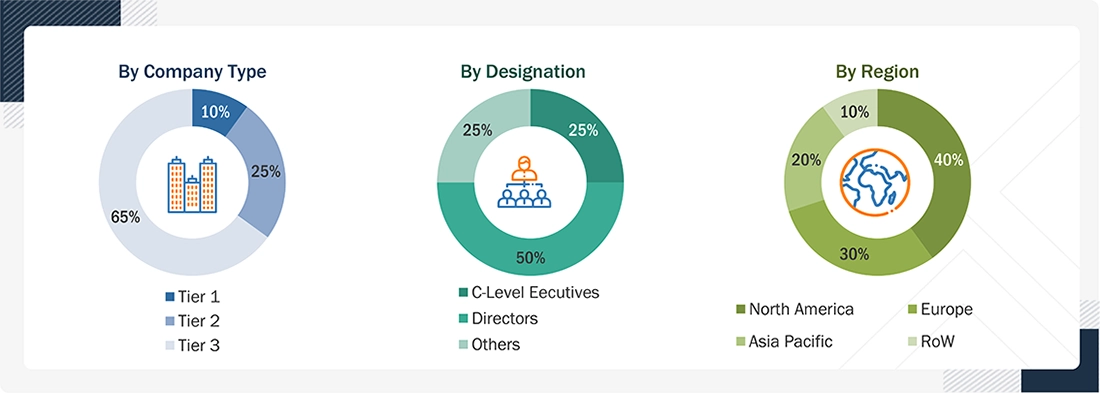
Note: Tier 1 companies’ revenues are more than USD 10 billion; tier 2 companies’ revenues range between USD 1 and 10 billion; and tier 3 companies’ revenues range between USD 500 million and USD 1 billion. Other designations include sales managers, marketing managers, and product managers.
Source: Industry Experts
To know about the assumptions considered for the study, download the pdf brochure
Market Size Estimation
Multiple approaches were adopted to estimate and forecast the workforce management market. The first approach involved estimating the market size by the companies’ revenue generated through the sales of the workforce management market.
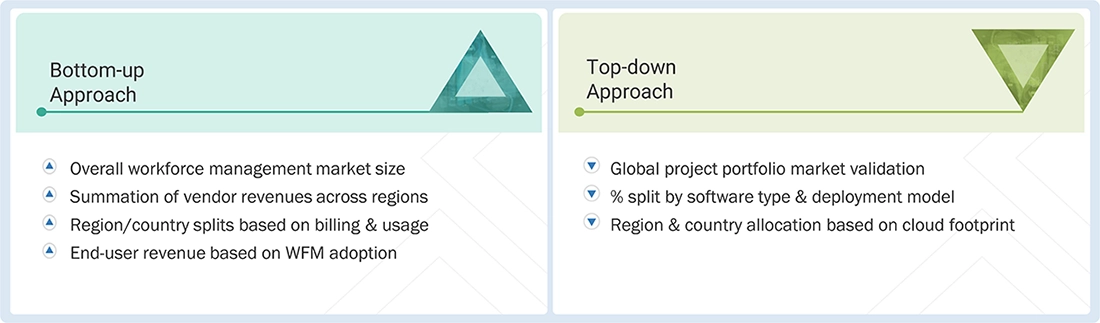
Market Size Estimation Methodology: Top-down Approach
The top-down approach estimates the overall workforce management market size by starting with a macro-level view, such as total IT spending or digital transformation expenditures. High-level industry or market values are divided and allocated into segments based on identified proportions by solution type, deployment model, organization size, or geography using researched splits. This approach uses broad market trends, industry reports, and expert insights to proportionately distribute the total value among various sub-markets, regions, and countries. It ensures the overall estimate aligns with recognized industry benchmarks, enabling accurate segmentation and a holistic market perspective.
Market Size Estimation Methodology: Bottom-up Approach
The bottom-up approach for estimating the workforce management market size involves aggregating data at the most granular level, such as company revenues, to build up to the global figure. This process begins by collecting company-wise revenue data directly related to workforce management solutions and services. By analyzing the market share and revenue of key players and integrating percentage splits for different segments, such as by service line or industry, the total market size is calculated. Additional segmentation is performed by region or vertical to ensure comprehensive coverage. The method then validates market estimates by comparing and consolidating segment results, providing a robust, detailed market size assessment based on concrete, ground-level business activity.
Workforce Management Market : Top-Down and Bottom-Up Approach
Data Triangulation
After determining the overall market size using the market size estimation processes as explained above, the market was split into several segments and subsegments. Data triangulation and market breakup procedures were used, where applicable, to complete the overall market engineering process and determine the exact statistics for each market segment and subsegment. The overall market size was then used in the top-down approach to estimate the size of other individual markets by applying percentage splits to the market segmentation.
Market Definition
Based on the views of various associations and sources, MarketsandMarkets defines workforce management (WFM) as the integrated set of processes and tools organizations use to optimize employee productivity, scheduling, and utilization. It includes time and attendance tracking, labor forecasting, shift planning, leave and absence management, and compliance with labor regulations. By aligning staffing with operational demand, WFM helps organizations reduce costs, improve efficiency, and enhance employee experience.
Key Stakeholders
- HR leaders
- HR operations teams
- Line managers
- Supervisors
- Employees
- Payroll teams
- Finance teams
- IT teams
- System administrators
- Compliance teams
Report Objectives
- To define, describe, and forecast the workforce management market based on offering, solution type, delivery mode, organization size, business function, and vertical
- To forecast the market size of five major regional segments: North America, Europe, Asia Pacific, the Middle East & Africa, and Latin America
- To strategically analyze the market subsegments concerning individual growth trends, prospects, and contributions to the total market
- To provide detailed information related to the major factors influencing the growth of the market (drivers, restraints, opportunities, and challenges)
- To strategically analyze macro and micro markets with respect to growth trends, prospects, and their contributions to the overall market
- To analyze industry trends, patents and innovations, and pricing data related to the market
- To analyze the opportunities in the market for stakeholders and provide details of the competitive landscape for major players
- To analyze the impact of AI/generative AI on the market
- To profile key players in the market and comprehensively analyze their market share/ranking and core competencies
- To track and analyze competitive developments such as mergers & acquisitions, product launches, and partnerships & collaborations in the market
Available customizations:
With the given market data, MarketsandMarkets offers customizations as per the company’s specific needs. The following customization options are available for the report:
Product Analysis
- The product matrix provides a detailed comparison of the product portfolio of each company.
Geographic Analysis Based on Feasibility
- Further breakup of the North American workforce management market
- Further breakup of the European workforce management market
- Further breakup of the Asia Pacific workforce management market
- Further breakup of the Middle East & Africa workforce management market
- Further breakup of the Latin American workforce management market
Company Information
-
Detailed analysis and profiling of additional market players (up to five)
Get the Full Workforce Management Market Report
Full forecast, segment splits, and company analysis for all Workforce Management Market.
- Canada Workforce Management Market
- UK Workforce Management Market
- Germany Workforce Management Market
- France Workforce Management Market
- Italy Workforce Management Market
- China Workforce Management Market
- India Workforce Management Market
- Japan Workforce Management Market
- Saudi Arabia Workforce Management Market
- UAE Workforce Management Market
- South Africa Workforce Management Market
- Brazil Workforce Management Market
- Mexico Workforce Management Market
- Rest Of Europe Workforce Management Market
Need a Tailored Report?
Customize this report to your needs
Get 10% FREE Customization
Customize This Report
