
South America Yellow Phosphorus & Derivatives Market (2025-2030)

The South America Yellow Phosphorus & Derivatives Market was valued at $55.3 Million in 2025 and projected to reach to $67.3 Million by 2030, representing a compound annual growth rate of 4.0%. South America's yellow phosphorus and derivatives market demonstrates consistent growth momentum, driven by expanding construction and mining sectors across major economies.


| Market Size in | USD 26.32 MN |
| Market Forecast in | |
| CAGR | |
| Forecast Period | |
| Units Considered | Value (USD MN) |
South America Yellow Phosphorus & Derivatives Market Trends and Insights
- This steady growth in South America reflects increasing demand across packaging, construction, mining, and industrial gas applications.
- South America's market expansion is driven by infrastructure development, rising industrial activity, and growing adoption of phosphorus-based chemicals in regional manufacturing sectors. The yellow phosphorus derivatives market in South America benefits from the region's robust mining operations and expanding construction projects.
- South America's strategic position as a resource-rich continent supports sustained demand for phosphorus compounds used in flame retardants, fertilizers, and specialty chemicals.
- Between 2025 and 2030, South America is expected to maintain consistent growth momentum, supported by regional industrialization and increased investment in sustainable chemical production. South America's market dynamics are shaped by both domestic consumption and export opportunities to neighboring regions.
- The region's competitive landscape includes established chemical manufacturers and emerging suppliers capitalizing on South America's favorable raw material availability and growing end-user industries..
Key Market Statistics
- CAGR (2025-2030) 4.0% CAGR
- Market Size, 2025 ~USD 55.3 Million
- Forecast, 2030 ~USD 67.3 Million
- Country South America
South America Yellow Phosphorus & Derivatives Market Overview
Market Size & Growth Trajectory :
South America's yellow phosphorus and derivatives market is valued at USD 55.3 million in 2025, with projections reaching USD 67.3 million by 2030, representing a steady 4.0% CAGR aligned with global expansion trends.
Key Application Sectors :
Demand is primarily driven by packaging, construction, mining, and industrial gas applications across South America, with infrastructure development and industrial modernization fueling consumption in these sectors.
Regional Infrastructure Investment :
South America's market expansion is supported by increasing infrastructure projects, construction activities, and mining operations, particularly in Brazil, Chile, and Peru, which are major contributors to regional demand.
Competitive Positioning :
South America represents a moderate-growth market within the global landscape, offering opportunities for regional suppliers and international players seeking to establish or expand presence in Latin American industrial sectors.
South America Yellow Phosphorus & Derivatives Market Dynamics
- Infrastructure development initiatives and industrial gas applications are creating sustained demand for phosphorus-based products.
- The region's 4.0% CAGR reflects steady economic recovery and increased industrial activity post-pandemic. Looking ahead to 2030, South America's market will benefit from continued urbanization, mining expansion, and packaging industry modernization.
- Strategic investments in infrastructure and manufacturing capabilities will support market penetration.
- Regional players and international suppliers are positioning themselves to capitalize on emerging opportunities in this growing market segment..
Market Ecosystem
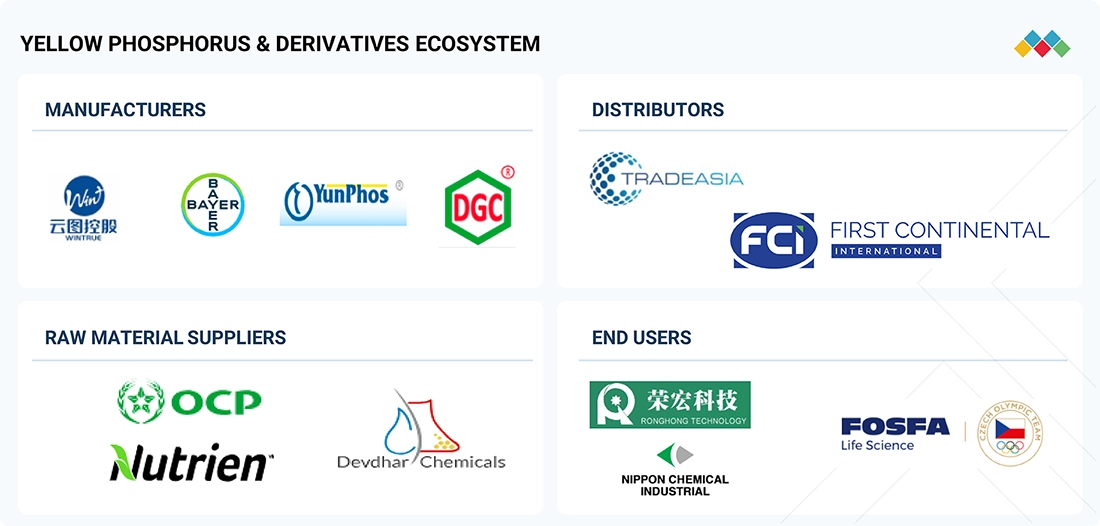
YELLOW PHOSPHORUS & DERIVATIVES MARKET: COMMERCIAL USE CASES ACROSS INDUSTRIES
| COMPANY | USE CASE DESCRIPTION | BENEFITS |
|---|---|---|
 |
Production of yellow phosphorus and derivatives for fertilizers, food additives, and electronics. | Integrated supply chain | High export quality | Support for agriculture and electronic sectors |
 |
Large-scale yellow phosphorus supply for industrial chemicals, flame retardants, and batteries. | Secures reliable feedstock for multiple critical industries | Energy-efficient operations |
 |
Manufacture of agrochemical and industrial phosphorus intermediates using yellow phosphorus. | Global reach | Support for crop yield and protection | Reliable input for industrial chemicals. |
 |
Yellow phosphorus is used in agrochemicals, detergents, and flame-retardant additives. | Focus on green manufacturing | Broad customer base | Industry certifications. |
 |
Production of yellow phosphorus and derivatives for fertilizers, flame retardants, food additives, and industrial chemicals. | Stable supply from integrated mining and production | Cost-competitive due to low energy/raw material sourcing | Diverse high-quality product portfolio supporting multiple sectors |
Logos and trademarks shown above are the property of their respective owners. Their use here is for informational and illustrative purposes only.
Related Ecosystem
Mining Minerals And Metals
- Wastewater Treatment
- Fiberglass
- Light Commercial Vehicles (LCVs)
- Nitrogen
- Acetic Acid
- LHOIST S.A
- SEVERSTAL JSC
- ArcelorMittal S.A.
- TW METALS, INC.
- Linde plc
Key Takeaways
- South America's yellow phosphorus market is valued at USD 55.3 million in 2025 with projected growth to USD 67.3 million by 2030.
- South America maintains a steady 4.0% CAGR, driven by construction, mining, and industrial gas sector expansion.
- South America's abundant natural resources and mining operations create strong demand for phosphorus derivatives.
- South America's market is supported by infrastructure development and increasing adoption of flame retardants and specialty chemicals.
Yellow Phosphorus & Derivatives Market Report Scope
| Report Metric | Details |
|---|---|
| Base Year | 2025 |
| Fastest Growing Segment | LITHIUM-ION BATTERIES (End Use) |
| Forecast Period | 2025-2030 |
| Growth Rate | CAGR of 4.1% from 2025 to 2030 |
| Largest Segment | SEDIMENTARY MARINE DEPOSITS (Type Of Resource) |
| Market Size Base Year (Billions) | ~USD 5.65 (2025) |
| Revenue Forecast (Billions) | ~USD 6.91 (2030) |
| Segments Covered | Derivative, End Use, Type Of Resource |
South America Yellow Phosphorus & Derivatives Market Report Segmentation
3 segment dimensions are covered across the global market.
By Derivative
- Other Derivatives
- Phosphorus Pentoxide
- Phosphorus Sulfides
- Phosphorus Trichloride
- Red Phosphorus
- Thermal Phosphoric Acid
By End Use
- Agriculture
- Chemicals
- Food & Beverages
- Lithium-Ion Batteries
- Other End Uses
- Pharmaceuticals
By Type Of Resource
- Biogenic
- Igneous And Weathered
- Other Types Of Resources
- Sedimentary Marine Deposits
Target Audience
- Chemical Manufacturers & Suppliers : Yellow phosphorus producers and derivatives manufacturers need South America-specific demand forecasts and application insights to optimize production capacity, supply chain planning, and regional sales strategies.
- Construction & Mining Companies : Construction firms and mining operators require market intelligence on phosphorus-based product availability, pricing trends, and supplier landscape in South America to secure reliable sourcing and manage procurement costs.
- Packaging Industry Stakeholders : Packaging manufacturers and converters need regional market data to understand phosphorus derivatives usage in their sector, identify innovation opportunities, and benchmark against South American competitors.
- Investment & Private Equity Firms : Investors evaluating opportunities in South America's chemical and industrial sectors require detailed market sizing, growth projections, and competitive analysis to assess investment viability and returns.
- Trade Associations & Government Bodies : Industry associations and regulatory agencies in South America need comprehensive market data for policy development, industry advocacy, and strategic planning to support regional industrial growth.
Reasons to Buy this Report
- Regional Market Sizing & Forecasts : Obtain precise market valuations specific to South America with detailed 2025-2030 projections, enabling accurate budget allocation and investment planning for regional operations and expansion strategies.
- Sector-Specific Demand Analysis : Understand consumption patterns across packaging, construction, mining, and industrial gas applications in South America, identifying high-growth segments and emerging opportunities within your target markets.
- Competitive Landscape Intelligence : Gain insights into regional competitive dynamics, market positioning, and key players operating in South America's yellow phosphorus sector to inform strategic partnerships and market entry decisions.
- Infrastructure & Economic Drivers : Access analysis of South America's infrastructure investments, mining activities, and industrial development trends that directly influence phosphorus derivatives demand and market growth potential.
- Strategic Market Entry Planning : Leverage country-specific data to develop targeted go-to-market strategies, identify distribution channels, and assess regulatory requirements for successful market penetration in South America.
Frequently asked questions
What is the current market size of yellow phosphorus in South America?
South America's yellow phosphorus and derivatives market is estimated at USD 55.3 million in 2025.
What is the projected market size for South America by 2030?
South America's market is forecasted to reach USD 67.3 million by 2030, representing a 4.0% CAGR.
Which industries drive demand for yellow phosphorus in South America?
South America's primary demand drivers include packaging, construction, mining, and industrial gas sectors.
What growth rate is South America experiencing in this market?
South America is experiencing a compound annual growth rate (CAGR) of 4.0% from 2025 to 2030.
Why is South America's yellow phosphorus market growing?
South America's growth is driven by infrastructure development, mining expansion, industrial activity, and increased adoption of phosphorus-based chemicals in manufacturing.
RESEARCH METHODOLOGY
The research encompassed four primary actions in assessing the present market size of yellow phosphorus & derivatives. Comprehensive secondary research was conducted to gather information on the market, the peer market, and the parent market. The subsequent stage involved corroborating these findings, assumptions, and dimensions with industry specialists throughout the yellow phosphorus & derivatives value chain via primary research. The total market size is ascertained with both top-down and bottom-up methodologies. Subsequently, market segmentation analysis and data triangulation were employed to ascertain the dimensions of the market segments and sub-segments.
Secondary Research
The research approach employed to assess and project the access control market initiates with the collection of revenue data from prominent suppliers using secondary research. In the course of the secondary research, many secondary sources, such as Hoovers, Bloomberg BusinessWeek, Factiva, the World Bank, and industry magazines, were utilized to identify and compile information for this study. The secondary sources comprised annual reports, press releases, and investor presentations from corporations; white papers; accredited periodicals; writings by esteemed authors; announcements from regulatory agencies; trade directories; and databases. Vendor offerings have been considered to ascertain market segmentation.
Primary Research
The yellow phosphorus & derivatives market comprises several stakeholders, such as manufacturers, suppliers, traders, associations, and regulatory organizations, in the supply chain. The demand side of this market is characterized by the development of fertilizers, chemical manufacturing industry, fertilizers, flame retardants, animal feed additives, and other applications. Advancements in technology characterize the supply side. Various primary sources from both the supply and demand sides of the market were interviewed to obtain qualitative and quantitative information. Following is the breakdown of interviews with experts:
The following is a breakdown of the primary respondents:
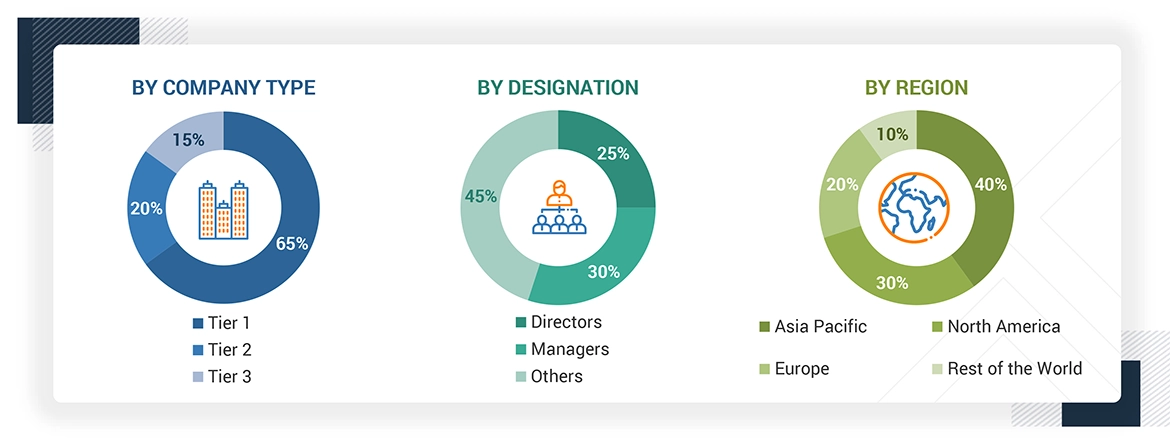
To know about the assumptions considered for the study, download the pdf brochure
Market Size Estimation
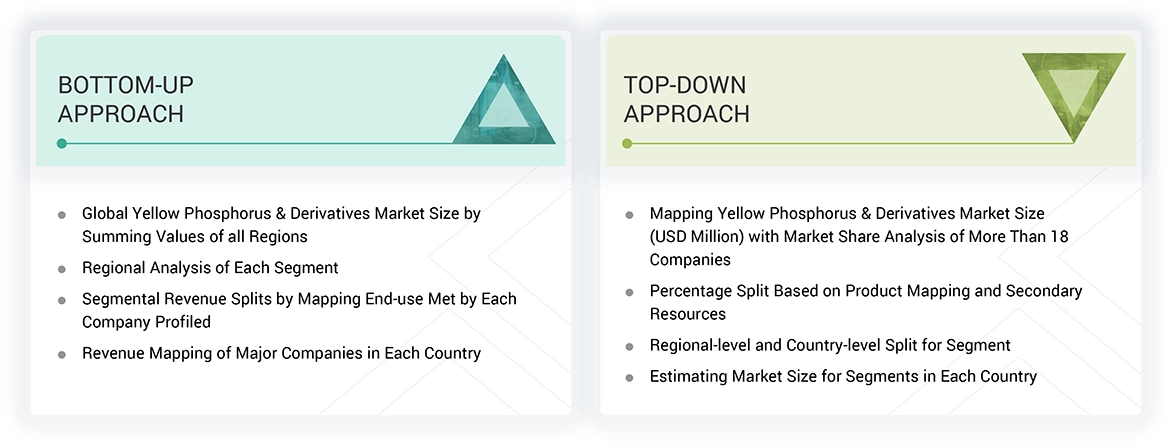
Both the top-down and bottom-up approaches were used to estimate and validate the total size of the yellow phosphorus & derivatives market. These methods were also used extensively to determine the size of various sub-segments in the market. The research methodology used to estimate the market size included the following:
- The key players were identified through extensive primary and secondary research.
- The value chain and market size of the yellow phosphorus & derivatives market, in terms of value, were determined through primary and secondary research.
- All percentage shares, splits, and breakdowns were determined using secondary sources and verified through primary sources.
- All possible parameters that affect the market covered in this research study were accounted for, viewed in extensive detail, verified through primary research, and analyzed to obtain the final quantitative and qualitative data.
- The research included the study of reports, reviews, and newsletters of top market players, along with extensive interviews for opinions from key leaders, such as CEOs, directors, and marketing executives.
Global Yellow Phosphorus & Derivatives Market Size: Bottom Up and Top Down Approach
Data Triangulation
After arriving at the overall market size using the market size estimation processes as explained above, the market was split into several segments and subsegments. To complete the overall market engineering process and arrive at the exact statistics of each market segment and subsegment, data triangulation and market breakdown procedures were employed, wherever applicable. The market size was calculated globally by summing up the country-level and regional-level data.
Market Definition
Yellow phosphorus is a highly reactive allotrope of elemental phosphorus, primarily produced through the thermal reduction of phosphate rock in electric arc furnaces. It serves as a fundamental raw material for a broad range of derivatives. These include thermal phosphoric acid, which is essential in fertilizers, food processing, and industrial chemicals; phosphorus trichloride, which is widely applied in pesticides, flame retardants, and plastic additives; phosphorus pentoxide, which functions as a strong dehydrating agent and is used in the production of polyphosphoric acids; phosphorus sulfides, which find use in matches, pyrotechnics, and lubricant additives; and red phosphorus, which is valued in flame retardants, safety matches, and electronic components. Yellow phosphorus is supplied in different forms such as solid, liquid, and slurry, allowing it to be adapted to various handling and processing needs. Its applications extend across fertilizers, pesticides, flame retardants, animal feed additives, and other specialized uses. The demand for yellow phosphorus is supported by a wide set of end-use industries, including agriculture, chemicals, food and beverage, pharmaceuticals, lithium-ion batteries, and other industrial sectors. This makes yellow phosphorus a cornerstone intermediate that underpins diverse downstream chemical processes and industrial value chains.
Stakeholders
- Yellow Phosphorus & Derivatives Manufacturers
- Yellow Phosphorus & Derivatives Suppliers
- Yellow Phosphorus & Derivatives Traders, Distributors, and Suppliers
- Investment Banks and Private Equity Firms
- Raw Material Suppliers
- Government and Research Organizations
- Consulting Companies/Consultants in the Chemicals and Materials Sectors
- Industry Associations
- Contract Manufacturing Organizations (CMOs)
- NGOs, Governments, Investment Banks, Venture Capitalists, and Private Equity Firms
Report Objectives
- To define, describe, and forecast the size of the global yellow phosphorus & derivatives market in terms of volume and value
- To provide detailed information regarding the key factors, such as drivers, restraints, opportunities, and industry-specific challenges, influencing the growth of the global yellow phosphorus & derivatives market
- To analyze and forecast the size of various segments (derivative and end-use) of the yellow phosphorus & derivatives market based on five major regions—North America, Asia Pacific, Europe, CIS Countries, and Rest of World—along with key countries in each of these regions
- To analyze recent developments and competitive strategies, such as agreements, partnerships, product launches, and joint ventures, to draw the competitive landscape of the market
- To strategically profile the key players in the market and comprehensively analyze their core competencies
Get the Full Yellow Phosphorus & Derivatives Market Report
Full forecast, segment splits, and company analysis for all Yellow Phosphorus & Derivatives Market.
- China Yellow Phosphorus & Derivatives Market
- Japan Yellow Phosphorus & Derivatives Market
- India Yellow Phosphorus & Derivatives Market
- South Korea Yellow Phosphorus & Derivatives Market
- Vietnam Yellow Phosphorus & Derivatives Market
- Malaysia Yellow Phosphorus & Derivatives Market
- Canada Yellow Phosphorus & Derivatives Market
- US Yellow Phosphorus & Derivatives Market
- Germany Yellow Phosphorus & Derivatives Market
- Italy Yellow Phosphorus & Derivatives Market
- Poland Yellow Phosphorus & Derivatives Market
- France Yellow Phosphorus & Derivatives Market
- Denmark Yellow Phosphorus & Derivatives Market
- Czech Republic Yellow Phosphorus & Derivatives Market
- Rest Of Europe Yellow Phosphorus & Derivatives Market
- Rest Of Asia Pacific Yellow Phosphorus & Derivatives Market
- Former Ussr Yellow Phosphorus & Derivatives Market
- Kazakhstan Yellow Phosphorus & Derivatives Market
Need a Tailored Report?
Customize this report to your needs
Get 10% FREE Customization
Customize This Report
