
Traffic Management Market Size, Share, Growth & Latest Trends

Traffic Management Market by Solution (Traffic Monitoring & Analytics, Adaptive Traffic Control System, Traffic Enforcement Management, Incident Detection & Management, Electronic Toll Management), Areas of Application, End User - Global Forecast to 2032




OVERVIEW
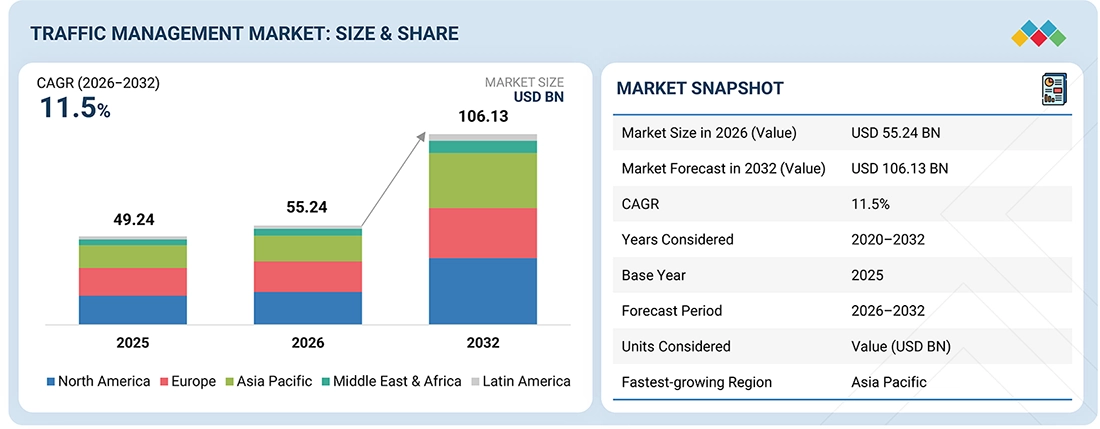
Source: Secondary Research, Interviews with Experts, MarketsandMarkets Analysis
The global traffic management market is expected to grow from USD 55.24 billion in 2026 to USD 106.13 billion by 2032, at a CAGR of 11.5% during the forecast period. Growth is driven by increasing urban congestion, rising vehicle density, and the need for efficient road network utilization across smart cities and metropolitan regions. Governments and transport authorities are deploying intelligent traffic systems to improve mobility, reduce travel delays, and enhance road safety. The integration of sensors, AI-based analytics, and connected infrastructure is further supporting the adoption of traffic management solutions across highways, urban roads, and transit corridors.
Market Size and Forecast:
- 2025 Market Size: USD 49.24 Billion
- 2026 Projected Market Size: USD 55.24 Billion
- 2032 Forecast Size: USD 106.13 Billion
- Growth Rate (2026-2031): CAGR of 11.5%
- Services segment is register the highest CAGR of 12.8%
- Forecast period: 2026–2033
Key Market Trends and Insights
- Fastest Growing Region: Asia Pacific
- Growth Drivers: rising urban congestion, AI adaptive control, and road safety demand.
- Latest Trends:shifting toward AI adaptive systems and unified smart city platforms.
- Emerging Opportunities: smart city ecosystem expansions and freight logistics integration.
- Leading companies: Cisco (US), Mundys SpA (Italy), SWARCO (Austria), Siemens (Germany), IBM (US)
- AI impact on traffic management market: enabling real-time traffic optimization, predictive congestion management, adaptive signal control, automated incident detection
KEY TAKEAWAYS
-
By OfferingThe services segment is expected to register the highest CAGR of 12.8%.
-
By End-UserThe government segment accounted for a 79.1% share in 2026.
-
By RegionThe Asia Pacific region is projected to grow at the fastest rate from 2026 to 2032
-
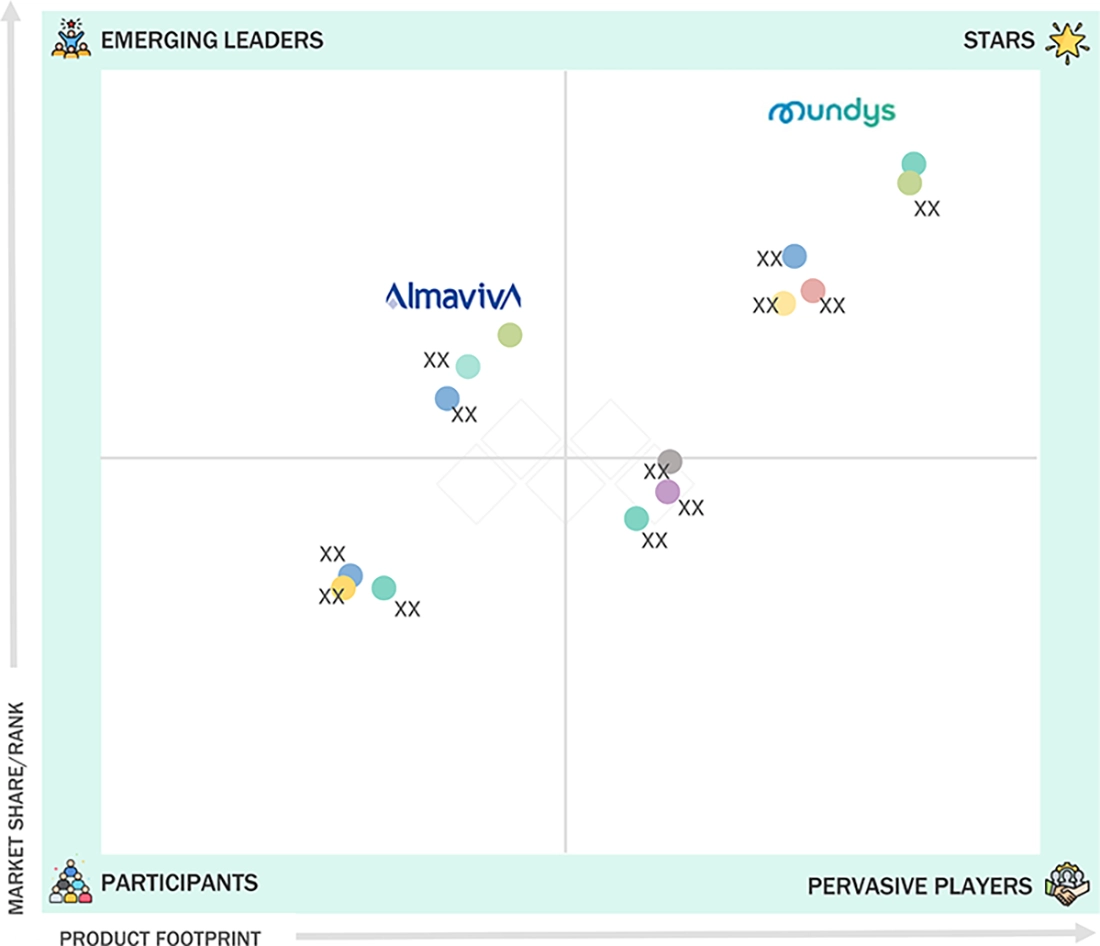
Competitive Landscape - Key PlayersCompanies such as SWARCO, Kapsch TrafficCom, Mundys, Almaviva, Siemens Mobility, and Q-Free, were identified as some of the star players in the traffic management market, given their strong market share and product footprint.
-
Competitive Landscape - Startup/SMECompanies such as Miovision, NoTraffic, and Rekor were identified as some of the startups and SMEs in the traffic management market.
The rising focus on real-time traffic optimization and road safety enforcement is accelerating the deployment of traffic management systems. Authorities are increasingly using these platforms to monitor congestion, manage signal timing, detect incidents, and improve emergency response coordination. Integration with IoT-enabled sensors, connected cameras, and cloud-based analytics is enabling more data-driven decision-making. As urban populations expand and vehicle usage increases, traffic management systems are becoming an essential part of smart mobility infrastructure.
TRENDS & DISRUPTIONS IMPACTING CUSTOMERS' CUSTOMERS
The traffic management market is shifting from traditional traffic control systems to integrated, data-driven mobility platforms. Fixed signal-based systems are being replaced with real-time traffic optimization enabled through sensors, connected infrastructure, and analytics. The ecosystem is expanding with new use cases such as predictive congestion management, dynamic routing, and incident response systems. Adoption is also driven by new technologies, platform-based deployment models, and increased collaboration between public authorities and technology providers.
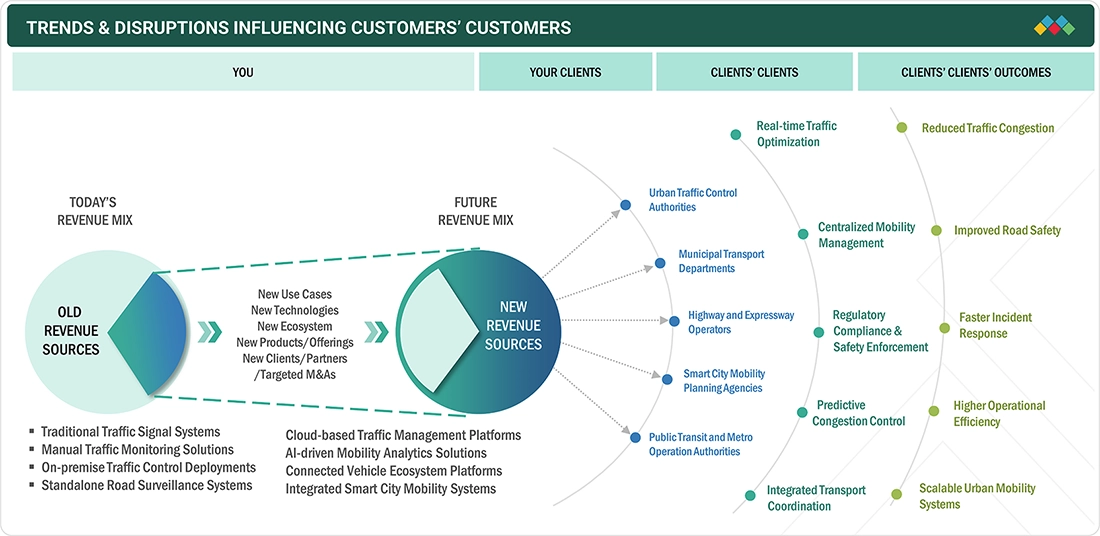
Source: Secondary Research, Interviews with Experts, MarketsandMarkets Analysis
MARKET DYNAMICS

Level
-
Increasing adoption of AI-enabled adaptive traffic control and connected mobility systems

-
Increasing focus on road safety enforcement and automated violation monitoring systems


Level
-
High deployment cost and complexity of integrating legacy traffic infrastructure

-
Limited availability of skilled traffic operations personnel and field-level execution capacity


Level
-
Expansion of smart city programs and connected transportation ecosystems

-
Integration of traffic management systems with logistics and freight optimization networks


Level
-
Data fragmentation and lack of standardization across transport networks

-
Data latency and inconsistencies in real-time traffic information exchange

Source: Secondary Research, Interviews with Experts, MarketsandMarkets Analysis
Driver: Increasing adoption of AI-enabled adaptive traffic control and connected mobility systems
The traffic management market is witnessing strong growth driven by the increasing deployment of AI-enabled adaptive signal control systems and connected mobility infrastructure. These systems integrate data from roadside sensors, surveillance cameras, GPS-enabled devices, and vehicle-to-infrastructure (V2I) communication networks to enable continuous real-time traffic optimization. This allows traffic authorities to dynamically adjust signal timing, manage congestion more efficiently, and improve response times during incidents or disruptions. As urban traffic conditions become more complex due to rising vehicle density, governments are increasingly shifting toward intelligent traffic platforms that support data-driven decision-making. The growing focus on smart city development is further accelerating the adoption of these systems across both urban and interurban transport networks.
Restraint: High deployment cost and complexity of integrating legacy traffic infrastructure
Despite strong demand, the adoption of advanced traffic management systems is constrained by the high cost of deployment and the complexity involved in integrating modern platforms with existing legacy infrastructure. Many cities continue to rely on traditional traffic signal systems and outdated roadside equipment that are not fully compatible with digital traffic management solutions. Upgrading these systems requires significant investment in hardware, communication networks, and centralized control platforms, often resulting in long implementation cycles. In addition, interoperability challenges between multiple vendors and technologies create further delays in achieving seamless system integration. These factors collectively slow down large-scale modernization, particularly in regions with limited funding and fragmented transport infrastructure.
Opportunity: Expansion of smart city programs and connected transportation ecosystems
The expansion of smart city initiatives is creating significant opportunities for the traffic management market as governments invest in integrated mobility ecosystems. These systems bring together traffic monitoring, public transportation coordination, and road safety management into a unified operational framework. The growing adoption of connected vehicle technologies and real-time mobility applications is increasing the need for centralized traffic control platforms that can manage multiple transport modes efficiently. This integration is enabling improved traffic forecasting, optimized route planning, and better utilization of urban road infrastructure. As cities continue to digitize transportation networks, traffic management systems are becoming a key enabler of efficient and coordinated urban mobility.
Challenge: Data fragmentation and lack of standardization across transport networks
A major challenge in the traffic management market is the fragmentation of traffic data and the lack of standardized communication protocols across transport networks. Traffic information is generated from multiple sources, including sensors, cameras, toll systems, and third-party mobility platforms, often leading to inconsistencies in data formats and integration issues. This makes it difficult for authorities to develop a unified view of traffic conditions across regions. Additionally, variations in regulatory frameworks and differing levels of technology adoption further complicate interoperability between systems. As a result, ensuring real-time, accurate, and standardized data exchange across multiple agencies remains a persistent operational challenge.
TRAFFIC MANAGEMENT MARKET SIZE, SHARE, GROWTH & LATEST TRENDS: COMMERCIAL USE CASES ACROSS INDUSTRIES
| COMPANY | USE CASE DESCRIPTION | BENEFITS |
|---|---|---|
 |
Kapsch TrafficCom has deployed its EcoTrafiX urban traffic management platform across city and highway environments such as Madrid and Panama City projects, supporting integrated traffic control, tolling, and mobility data management. The system connects traffic signals, incident management tools, and highway monitoring systems to enable centralized control of urban and interurban traffic movement. | Improved highway and urban traffic coordination | Better toll and corridor management | Centralized traffic visibility | Reduced operational fragmentation |
 |
Yunex Traffic has supported deployments in European city traffic networks including urban intersection management systems where its solutions integrate adaptive signal control, variable message signs, and traffic monitoring infrastructure. These deployments are used by municipal authorities to manage congestion and improve flow efficiency in dense urban road networks. | Improved urban traffic regulation | Better real-time congestion control | Enhanced signal synchronization | Improved safety at intersections |
 |
Cubic has implemented integrated mobility and traffic management solutions in transit-heavy cities where systems connect public transport operations, road traffic data, and payment/mobility platforms. These deployments are used to improve coordination between road traffic and public transportation networks, particularly in multimodal urban environments. | Better multimodal transport coordination | Improved mobility data integration | Higher operational efficiency | Improved passenger flow management |
Logos and trademarks shown above are the property of their respective owners. Their use here is for informational and illustrative purposes only.
MARKET ECOSYSTEM
The traffic management ecosystem comprises platform providers, software developers, analytics vendors, communication providers, surveillance technology suppliers, and system integrators that collectively support intelligent transportation operations. Platform and software providers deliver traffic control, monitoring, and mobility management solutions, while analytics vendors enable real-time traffic intelligence and operational insights. Communication providers facilitate data exchange across transportation networks, and surveillance vendors supply cameras and roadway monitoring systems. System integrators play a critical role in combining these technologies into unified traffic management platforms that improve traffic flow, enhance road safety, and support efficient transportation network operations.
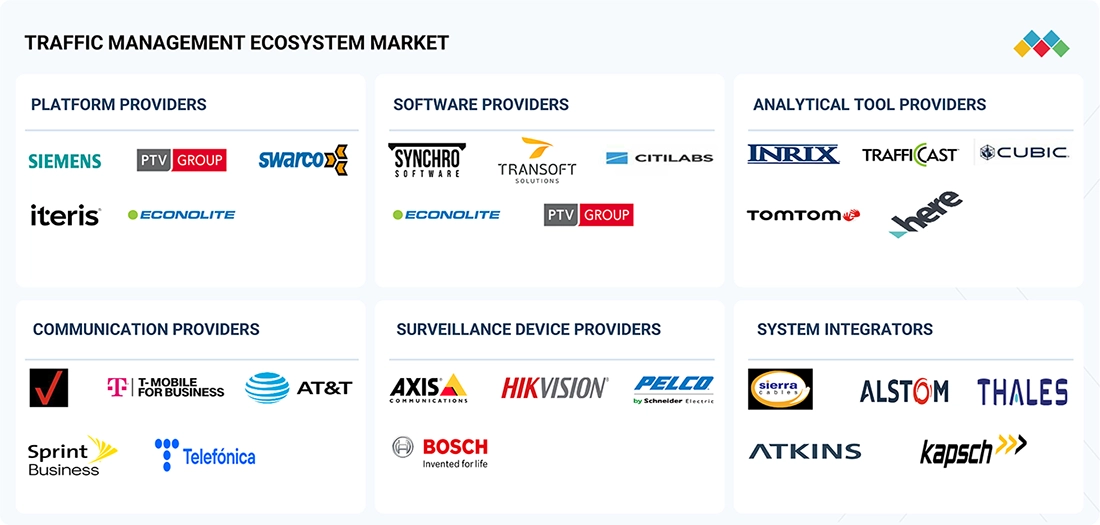
Logos and trademarks shown above are the property of their respective owners. Their use here is for informational and illustrative purposes only.
MARKET SEGMENTS
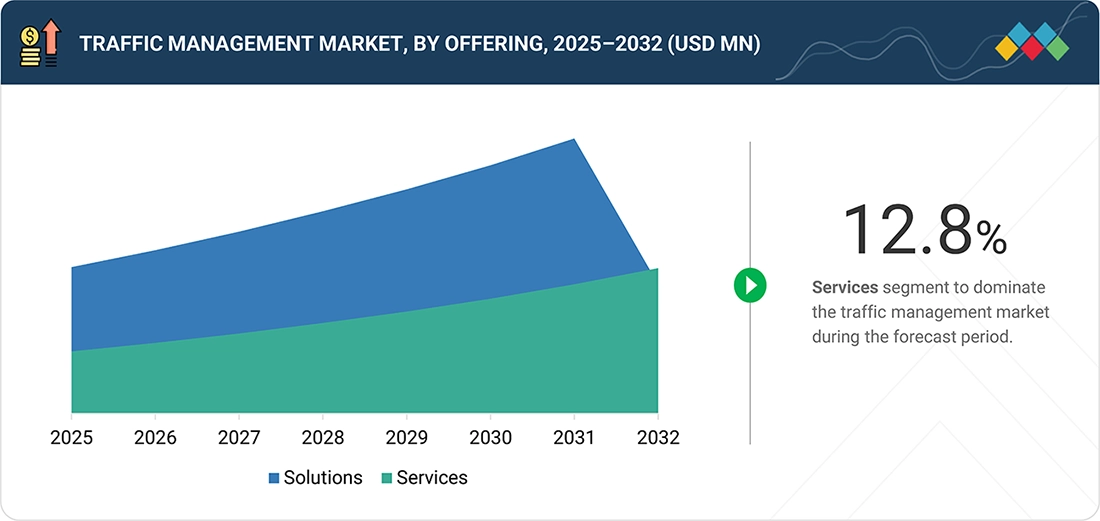
Source: Secondary Research, Interviews with Experts, MarketsandMarkets Analysis
Traffic Management Market, by Solution
Modern traffic management systems rely heavily on traffic monitoring and analytics solutions to capture real-time road conditions and improve mobility efficiency. These systems integrate data from sensors, cameras, GPS-enabled devices, and connected infrastructure to analyze congestion levels, detect incidents, and support traffic flow optimization. The use of AI and data analytics enables adaptive signal control, improved route guidance, and faster response to disruptions. These capabilities support urban planners in improving road utilization, reducing congestion in high-density areas, and enhancing overall traffic safety. The growing focus on smart city development and data-driven transportation planning is further strengthening adoption of traffic monitoring and analytics solutions.
Traffic Management Market, by Area of Application
Inter-urban traffic management systems are gaining traction across highway corridors and long-distance transport networks due to increasing vehicle movement between cities. These systems support toll management, corridor traffic monitoring, and integration with weather and road condition reporting tools to improve driver awareness and safety. Technologies such as vehicle-to-infrastructure (V2I) communication and real-time analytics help manage congestion, detect incidents, and improve travel efficiency across intercity routes. Adaptive traffic signals, variable message signs, and connected highway systems further support uninterrupted traffic flow and faster incident response. The rising demand for efficient regional connectivity and safer highway operations is driving growth in the inter-urban segment.
REGION
Asia Pacific to be fastest-growing region in global traffic management market during forecast period
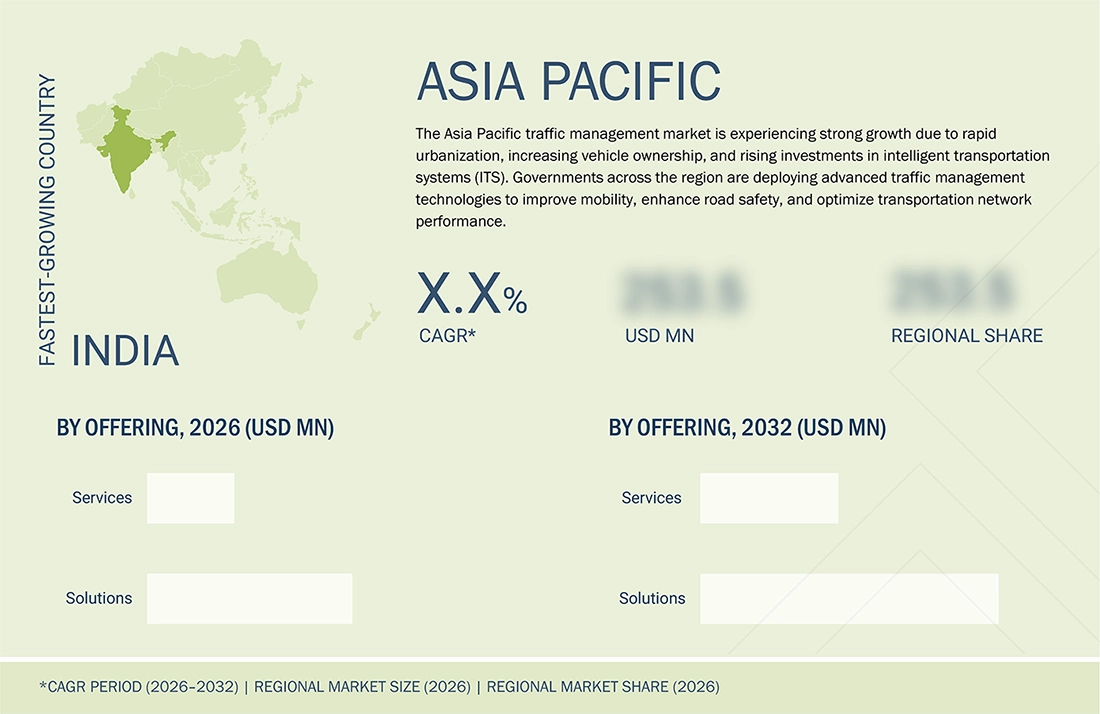
Asia Pacific is expected to record the fastest growth rate in the traffic management market during the forecast period. Rapid urbanization, increasing vehicle ownership, and large-scale infrastructure development are key factors driving adoption across the region. Countries such as China, India, Japan, South Korea, and Australia are investing heavily in smart transportation systems and intelligent traffic control infrastructure. Governments in the region are focusing on reducing urban congestion, improving road safety, and enhancing public transportation efficiency. The expansion of smart city initiatives and integration of AI-based traffic monitoring systems is further supporting market growth. Rising investments in highway modernization and urban mobility projects are also contributing to increased deployment of traffic management solutions.
TRAFFIC MANAGEMENT MARKET SIZE, SHARE, GROWTH & LATEST TRENDS: COMPANY EVALUATION MATRIX
In the traffic management market matrix, Mundys (Star) holds a leading position, supported by its strong mobility infrastructure portfolio, intelligent transport systems capabilities, and integrated traffic management solutions deployed across highways, urban road networks, and smart mobility corridors. Its strength lies in real-time traffic monitoring, congestion control, and scalable deployment across connected transport environments. Almaviva is positioned as an Emerging Leader, supported by its expanding presence in digital mobility platforms and traffic data management solutions. Its capabilities in system integration, transport analytics, and smart infrastructure support position it for growth as demand increases for connected traffic management and intelligent urban mobility systems.
Source: Secondary Research, Interviews with Experts, MarketsandMarkets Analysis
KEY MARKET PLAYERS
- Huawei (China)
- Mundys SpA (Italy)
- Kapsch TrafficCom (Austria)
- SWARCO (Austria)
- Umovity (Germany)
- ST Engineering (Singapore)
- Indra (Spain)
- Q-Free (Norway)
- Almaviva SpA (Italy)
- Jenoptik (Germany)
- Cubic Corporation (US)
- Teledyne FLIR (US)
- Cisco Systems (US)
- IBM (US)
- TomTom (Netherlands)
- INRIX (US)
MARKET SCOPE
| REPORT METRIC | DETAILS |
|---|---|
| Market Size in 2025 (Value) | USD 49.24 Billion |
| Market Size in 2026 (Value) | USD 55.24 Billion |
| Market Forecast in 2032 (Value) | USD 106.13 Billion |
| Growth Rate | CAGR of 11.5% from 2026–2032 |
| Years Considered | 2020–2032 |
| Base Year | 2025 |
| Forecast Period | 2026–2032 |
| Units Considered | Value (USD Billion) |
| Report Coverage | Revenue Forecast, Company Ranking, Competitive Landscape, Growth Factors, and Trends |
| Segments Covered |
|
| Regions Covered | North America, Europe, Asia Pacific, Middle East & Africa, Latin America |
WHAT IS IN IT FOR YOU: TRAFFIC MANAGEMENT MARKET SIZE, SHARE, GROWTH & LATEST TRENDS REPORT CONTENT GUIDE
DELIVERED CUSTOMIZATIONS
We have successfully delivered the following deep-dive customizations:
| CLIENT REQUEST | CUSTOMIZATION DELIVERED | VALUE ADDS |
|---|---|---|
| Leading Service Provider (US) | Regional Analysis: • Further breakdown of the North American traffic management market • Further breakdown of the European traffic management market • Further breakdown of the Asia Pacific traffic management market • Further breakdown of the Middle Eastern & African traffic management market • Further breakdown of the Latin American traffic management market | • Identifies high-growth regional opportunities, enabling tailored market entry strategies • Optimizes resource allocation and investment based on region-specific demand and trends |
| Company Information | Detailed analysis and profiling of additional market players (up to 5) | • Broadens competitive insights, helping clients make informed strategic and investment decisions. • Reveals market gaps and opportunities, supporting differentiation and targeted growth initiatives. |
RECENT DEVELOPMENTS
- February 2026 : SWARCO UK & Ireland launched the PTC3 Controller series, an AI-ready traffic controller designed to support adaptive traffic management strategies, including SWARCO ImFlow and Smart AI. The platform enables transportation authorities to optimize traffic flows, respond to incidents, and support future intelligent mobility deployments through enhanced analytics and processing capabilities.
- May 2026 : Iteris launched VantageNode, an AI-powered quad-camera traffic detection solution designed for small and underserved intersections. The platform supports vehicle, pedestrian, and bicycle detection and integrates with the ClearGuide traffic analytics platform for traffic monitoring, performance analysis, and transportation planning.
- May 2026 : Kapsch TrafficCom and Valeo partnered to develop a next-generation V2X-powered tolling solution. The collaboration combines connected vehicle technologies and electronic toll collection capabilities to support future intelligent transportation ecosystems.
- September 2025 : Huawei introduced the Urban Traffic Large-scale Model to support city-wide traffic optimization through AI-driven traffic prediction, congestion analysis, signal optimization, and incident response. The platform enables transportation authorities to improve operational efficiency and enhance decision-making through advanced analytics and large-scale traffic intelligence capabilities.
Table of Contents
 Exclusive indicates content/data unique to MarketsandMarkets and not available with any competitors.
Methodology
The research study involved four major activities in estimating the traffic management market size. Exhaustive secondary research has been done to collect important information about the market and peer markets. The next step has been to validate these findings and assumptions and size them with the help of primary research with industry experts across the value chain. Both top-down and bottom-up approaches have been used to estimate the market size. Post which, the market breakdown and data triangulation have been adopted to estimate the market sizes of segments and subsegments.
Secondary Research
The market size of the companies offering traffic management solutions to various end users was arrived at based on the secondary data available through paid and unpaid sources and by analyzing the product portfolios of major companies in the ecosystem and rating the companies based on their performance and quality. In the secondary research process, various sources were referred to identify and collect information for the study. The secondary sources include annual reports, press releases, investor presentations of companies, white papers, certified publications, and articles from recognized associations and government publishing sources. Several journals and various associations, such as the International Road Federation (IRF), International Traffic Safety Data and Analysis Group (IRTAD), The World Road Association (PIARC), the American Traffic Safety Services Association (ATSSA), and the Traffic Management Association of Australia (TMAA), were also referred to.
Secondary research was mainly used to obtain critical information about industry insights, the market’s monetary chain, the overall pool of key players, market classification and segmentation according to industry trends to the bottom-most level, regional markets, and key developments from both market-oriented and technology-oriented perspectives.
Primary Research
In the primary research process, various sources from the supply and demand sides were interviewed to obtain qualitative and quantitative information for the report, such as chief experience officers (CXOs), vice presidents (VPs), directors from business development, marketing, and product development/innovation teams, and related key executives from traffic management solution vendors, system integrators, professional and managed service providers, industry associations, independent consultants, and key opinion leaders.
Primary interviews were conducted to gather insights, such as market statistics, data on revenue collected from platforms and services, market breakups, market size estimations, market forecasts, and data triangulation. Stakeholders from the demand side, such as chief information officers (CIOs), chief finance officers (CFOs), chief strategy officers (CSOs), and the installation team of end users who use traffic management solutions, were interviewed to understand buyers’ perspectives on suppliers, products, service providers, and their current usage of traffic management solutions which is expected to affect the overall traffic management market growth.
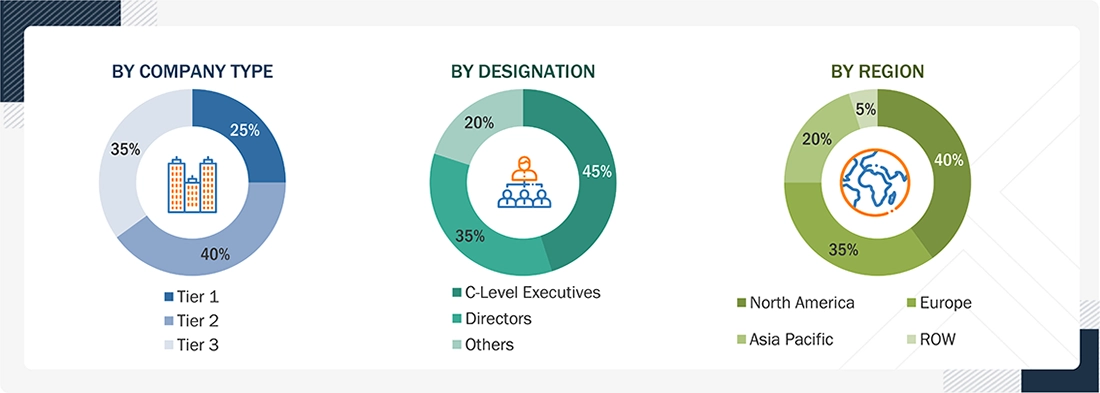
Note 1: Tier 1 companies have revenues over USD 1 billion; Tier 2 companies’ revenues range between USD 500 million and 1 billion; and Tier 3 companies have revenues of less than USD 500 million.
Other designations include sales managers, marketing managers, and product managers.
To know about the assumptions considered for the study, download the pdf brochure
Market Size Estimation
Multiple approaches were adopted to estimate and forecast the size of the traffic management market. The first approach involves estimating market size by summing up the revenue generated by companies through the sale of solutions.
Top-down and bottom-up approaches were used to estimate and validate the total size of the traffic management market. These methods were extensively used to estimate the size of various segments in the market. The research methodology used to evaluate the market size is listed below.
- Key players in the market have been identified through extensive secondary research.
- In terms of value, the industry’s supply chain and market size have been determined through primary and secondary research processes.
- All percentage shares, splits, and breakups have been determined using secondary sources and verified through primary sources.
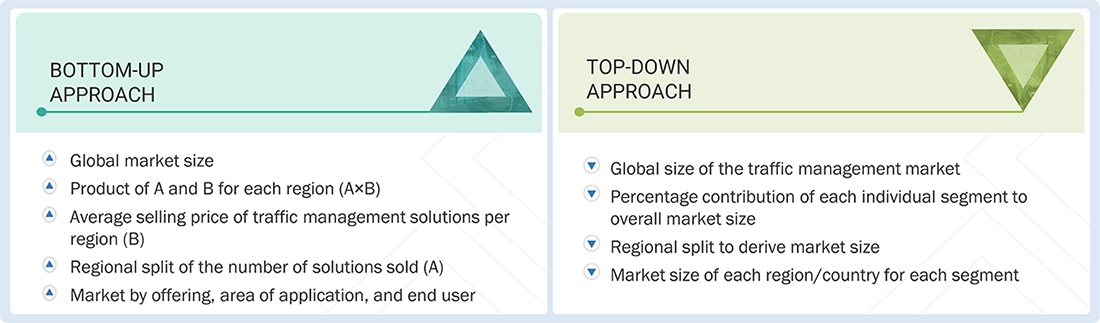
Data Triangulation
After arriving at the overall market size from the above estimation process, the traffic management market has been split into several segments and subsegments. To complete the overall market engineering process and arrive at the exact statistics for all segments and subsegments, data triangulation and market breakdown procedures have been used, wherever applicable. The data has been triangulated by studying various factors and trends from both the demand and supply sides. The traffic management market size has been validated using top-down and bottom-up approaches.
Market Definition
Traffic management refers to the planning, monitoring, control, and optimization of traffic flow across road transportation networks to improve mobility, enhance road safety, reduce congestion, and maximize the efficiency of existing transportation infrastructure. It involves the use of technologies such as traffic signal control systems, traffic surveillance cameras, sensors, traffic monitoring platforms, incident detection systems, and intelligent transportation systems (ITS) to collect, analyze, and manage real-time traffic information. Traffic management solutions enable transportation authorities and road operators to monitor roadway conditions, respond to incidents, optimize traffic operations, and support efficient movement of vehicles, pedestrians, and public transportation across urban and interurban networks.
Key Stakeholders
- Original Equipment Manufacturers (OEMs)
- Internet of Things (IoT) Technology Vendors
- Technology Vendors
- Managed Service Providers (MSPs)
- Networking and Communications Service Providers (CSPs)
- Consulting and Advisory Firms
- Regional Department of Public Transport Authorities
- Governments and Urban Planning Agencies
- Regional Associations
- Investors and Venture Capitalists
- Independent Software Vendors
- Value-added Resellers (VARs) and Distributors
Report Objectives
- To determine, segment, and forecast the traffic management market based on offering, area of application, end user, and region
- To forecast the size of the market segments with respect to five main regions: North America, Europe, Asia Pacific, the Middle East & Africa, and Latin America
- To provide detailed information about the major factors (drivers, restraints, opportunities, and challenges) influencing the growth of the market
- To study the complete supply chain and related industry segments, and perform a supply chain analysis of the market landscape
- To strategically analyze the macro- and micro-markets with respect to individual growth trends, prospects, and contributions to the total market
- To analyze the industry trends, pricing data, patents, and innovations related to the market
- To analyze the opportunities for stakeholders by identifying the high-growth segments of the market
- To profile the key players in the market and comprehensively analyze their market share/ranking and core competencies
- To track and analyze competitive developments, such as mergers & acquisitions, product launches & developments, partnerships, and collaborations, in the market
Available customizations:
With the given market data, MarketsandMarkets offers customizations per the company’s specific needs. The following customization options are available for the report:
Geographic Analysis
- Further breakup of the Asia Pacific market into countries contributing 75% to the regional market size
- Further breakup of the North American market into countries contributing 75% to the regional market size
- Further breakup of the Latin American market into countries contributing 75% to the regional market size
- Further breakup of the Middle East & African market into countries contributing 75% to the regional market size
- Further breakup of the European market into countries contributing 75% to the regional market size
Company Information
- Detailed analysis and profiling of additional market players (up to 5)
Key Questions Addressed by the Report
Need a Tailored Report?
Customize this report to your needs
Get 10% FREE Customization
Customize This ReportPersonalize This Research
- Triangulate with your Own Data
- Get Data as per your Format and Definition
- Gain a Deeper Dive on a Specific Application, Geography, Customer or Competitor
- Any level of Personalization
Let Us Help You
- What are the Known and Unknown Adjacencies Impacting the Traffic Management Market
- What will your New Revenue Sources be?
- Who will be your Top Customer; what will make them switch?
- Defend your Market Share or Win Competitors
- Get a Scorecard for Target Partners

Custom Market Research Services
We Will Customise The Research For You, In Case The Report Listed Above Does Not Meet With Your Requirements
Get 10% Free CustomisationTESTIMONIALS
Growth opportunities and latent adjacency in Traffic Management Market






Vilde
Jun, 2019
Interested in LiDAR (Lighting Detection And Ranging) in the traffic.
Tommaso
Jun, 2018
Understanding the market segments of Traffic Management Market.
Alp
Jun, 2019
Intersted in Traffic management market.
James
Sep, 2013
Interseted in Traffic management market.
sandrine
Jun, 2017
Interested in sensor technology in traffic management market.
Ayanda
Feb, 2015
Interested in traffic management market in south africa .
Constantinos
Oct, 2018
Understanding the market size and growth in traffic management system and itelligent transport systems..
Thierry
Jul, 2016
Interseted in Traffic management market.
G
May, 2019
Interested in Trafiic control market.
Bogdan
Mar, 2019
Interested in Traffic management market in south africa .
Dimitry
Jun, 2019
Understanding the market segments of Traffic Management Market.
Fedor
Jun, 2019
Interested in Traffic Management Market.
Akshay
Dec, 2018
Understanding the close-loop traffic light control system market.
Dimitry
Jun, 2019
Understanding the market segments of Traffic Management Market.
Elif
Apr, 2019
Market prediction and future scope of traffic management system.
Richard
Feb, 2015
Segments and players in the solution segments.
Lukas
Oct, 2017
Interested in Traffic management market in south africa .
Bogdan
Aug, 2019
Interested in Traffic management market in south africa .
Claire
Jul, 2016
Interested in data on toll management solutions.
Govardhan
Jul, 2014
Interseted in Traffic management market.
DEVARAJU
Feb, 2019
Interested in Traffic Survey Market.
Tobias
Jan, 2019
Interested in market size and forecast of traffic management market.